
A manta ray night dive in Kona is a guided, stationary scuba dive where divers settle on the sand beneath bright lights while wild reef mantas feed overhead. Sightings are common, but no operator can guarantee them, and the choice of site and the way guests behave matter more than picking a particular moon phase.
You're likely weighing whether the dark-water setting will feel thrilling or uncomfortable, and whether the trip is worth planning around. The mechanics are simple: lights gather plankton, mantas arrive to feed, and divers watch without chasing them. The best approach is to choose a well-managed site, understand the limits of wildlife sightings, and be ready to hold still.
Table of Contents
- What the Manta Ray Night Dive Is and Why Kona Is Unique
- Choosing Between Garden Eel Cove and Keauhou Bay
- When to Go and What Actually Affects Sightings
- What to Bring and How to Photograph Mantas
- How a Manta Night Dive Runs From Briefing to Surfacing
- Positioning, Lights and Etiquette Once the Mantas Arrive
- How to Choose an Operator and What to Ask
- Book the Garden Eel Cove Manta Night Dive
What the Manta Ray Night Dive Is and Why Kona Is Unique
At the viewing area, divers settle on the sandy bottom while crew lights draw plankton into the water. Reef mantas glide through to feed, sometimes passing close overhead. The dive is stationary and supervised, with guests watching rather than following the animals.
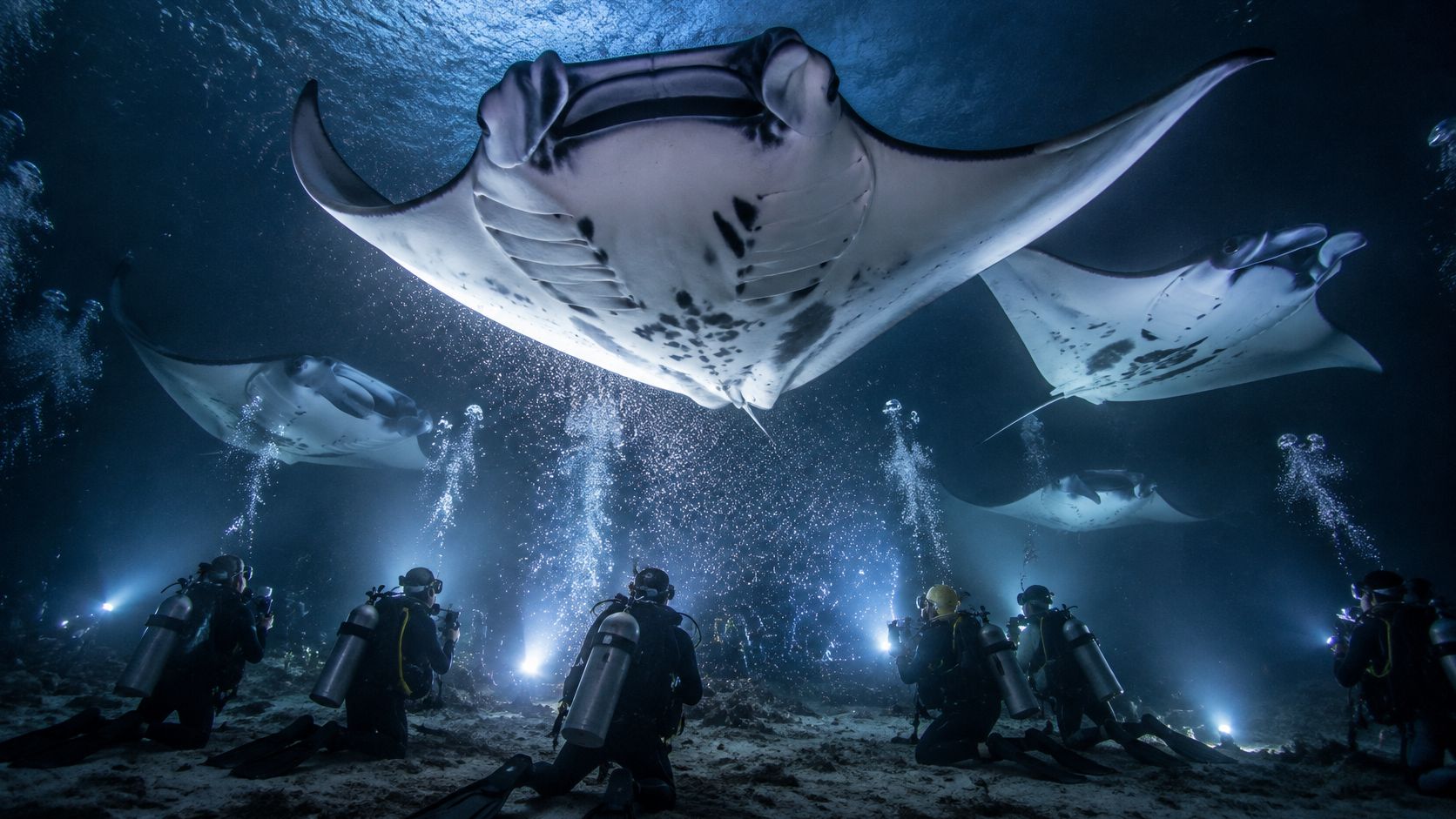
Mantas feed on zooplankton, tiny drifting animals concentrated by the lights. As they move through the illuminated water, they filter food through their mouths and gill plates. Guests can watch wild mantas feed at night, an encounter distinct from seeing captive animals or a daytime wildlife display.
Kona's viewing tradition began when lights at the former Kona Surf Hotel attracted plankton, followed by reef mantas in shallow coastal water. Organized nighttime viewing expanded in the early 1990s, first for certified scuba divers. By 2002, testimony to the Hawaiʻi Legislature reported that nine Kona dive shops carried approximately 11,000 snorkelers and divers on manta tours, generating about $920,000 in direct annual revenue and roughly $2.5 million in broader annual economic activity, as described in Kona's history of the manta night dive.
Manta sightings are common at Garden Eel Cove, but they are never guaranteed. The experience is open to certified divers and surface snorkelers, including guests with different levels of experience. A well-managed viewing setup and respectful behavior give mantas room to feed while guests observe.
Choosing Between Garden Eel Cove and Keauhou Bay
For most guests, Garden Eel Cove is the stronger choice because its protected setting supports a more controlled viewing area and better access to reef habitat, subject to sea conditions and the crew's briefing.
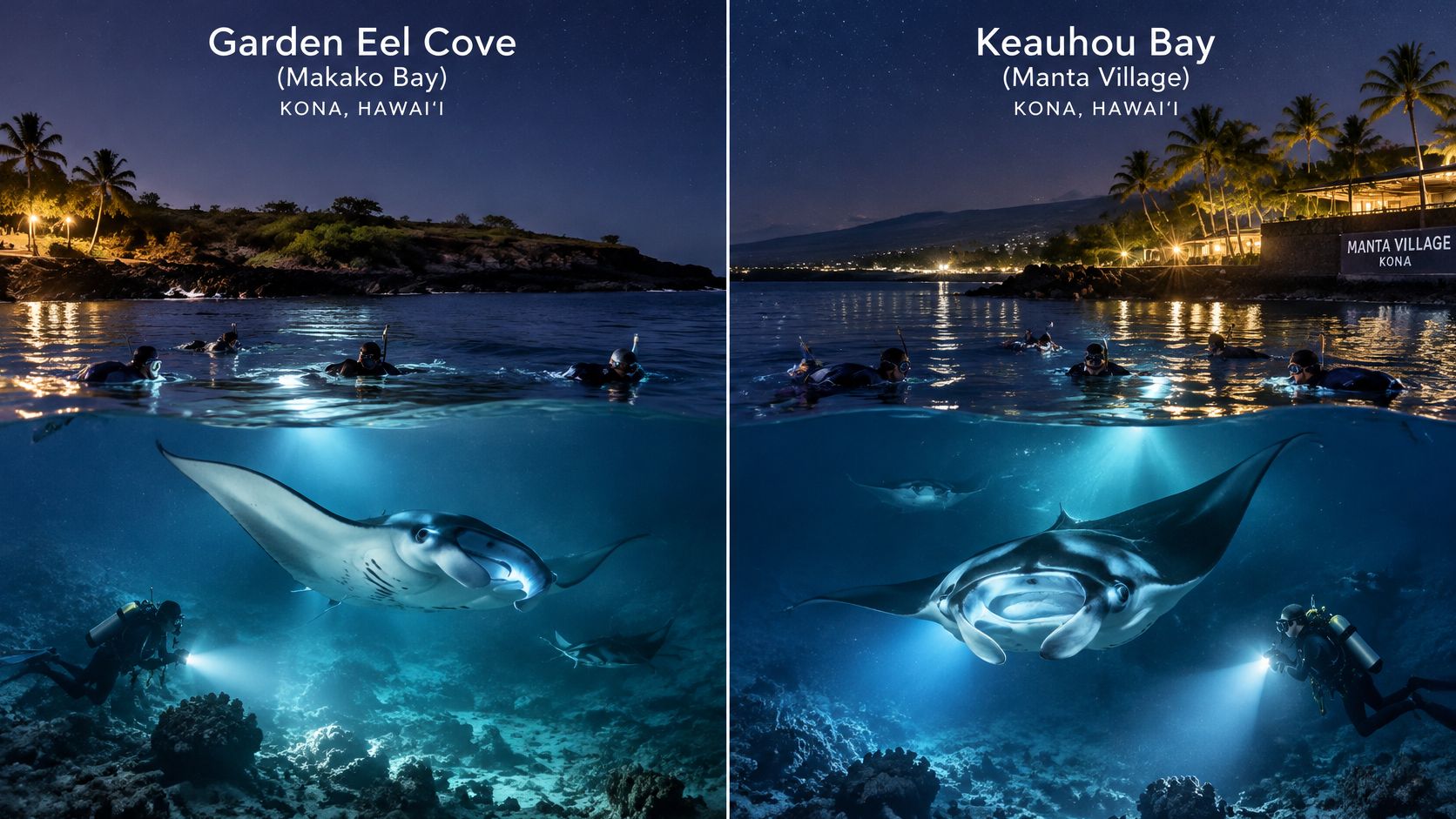
Hawaiʻi state officials identify two principal nighttime manta-viewing sites: Makako Bay, also called Garden Eel Cove, and Keauhou Bay, commonly called Manta Village. Both are established locations, but their conditions and sighting patterns aren't identical, as described by the Hawaiʻi Department of Land and Natural Resources.
| Site | Also called | Viewing setup | Reef and conditions | What the data shows |
|---|---|---|---|---|
| Garden Eel Cove | Makako Bay | Protected cove with a designated viewing area; divers on the bottom, snorkelers at the surface | More controlled water and better reef access around the lights, subject to sea conditions | Historical sightings on about 80% of dives; larger and more variable aggregations than Keauhou |
| Keauhou Bay | Manta Village | Established night-light site using the same bottom-and-surface split, but less sheltered | Less protected viewing than Garden Eel Cove | Sightings were strongly female-biased, with females at 91% of observations |
A 13-year community-sourced analysis found that Garden Eel Cove generally supported larger aggregations than Keauhou, while Keauhou sightings were predominantly female. That difference doesn't make Keauhou a poor site. It does matter if your priority is a larger gathering, and it's a reminder that mantas are wild animals whose numbers and composition shift.
Garden Eel Cove's appeal is practical as well as biological: a more protected location can make it easier to maintain an organized viewing area, while reef habitat adds to the setting. Before booking, compare the dive and surface options in this guide to snorkeling or diving with manta rays. If Garden Eel Cove fits your plans, review the Kona manta ray dive tour.
When to Go and What Actually Affects Sightings
A sighting is probable, not guaranteed. Kona Honu Divers reports manta rays on 92% of Manta Ray Night Dive trips, but wildlife doesn't follow a booking schedule, and a well-run tour can't promise an encounter.
A public log covering 308 nights from April 13, 2025, through June 29, 2026, recorded between zero and 37 mantas per night, averaging 10.6. The reported relationship between manta counts and lunar illumination was only 0.09 and wasn't statistically significant, according to the Kona manta moon-calendar log. That's a weak basis for choosing a date by moon phase.
| Factor | What the evidence shows | Planning move |
|---|---|---|
| Moon phase | Correlation with manta count of 0.09, not statistically significant | Don't time the trip around the moon |
| Zooplankton density | A main driver of aggregation size, alongside weather, current and water conditions | Ask about recent plankton and sea conditions |
| Nightly manta count | Zero to 37, averaging 10.6 in the public log | Plan for variation; a zero-manta night is possible |
| Regulated viewing window | Commercial viewing operates from 4:00 p.m. to 4:00 a.m. and must use a commercial mooring | Expect departure and return times to fit the regulated window |
| Sea state and swell | Conditions can shift after departure and may change the site plan or cancel a trip | Ask what happens if conditions change or the trip is canceled |
Prey availability is more useful to understand than calendar folklore. Zooplankton density can affect how many mantas gather, while weather, current and water conditions influence what's workable on a given night. Garden Eel Cove and Keauhou also show different aggregation patterns, so a count from one site won't predict the other.
State planning documents set the commercial operating window at 4:00 p.m. to 4:00 a.m. and require manta-viewing operations to use a commercial mooring during those hours, as specified in the state boating-operations assessment. Book with enough flexibility to handle changing conditions, and don't treat a night without mantas as proof that the operator planned poorly. For more date-planning context, see when to see manta rays in Kona.
What to Bring and How to Photograph Mantas
Pack for a dark-water dive and a boat ride afterward, not just the time you'll spend underwater. Useful gear should support warmth, visibility and a calm, hands-off encounter.
Packing
- Thermal layer: Wear a warm rash guard or a wetsuit suited to night water. Snorkelers should bring an extra layer for the ride back.
- Mask and fins: Bring a reliable, well-fitting set if you use your own.
- Backup light: A spare dive light is useful if your primary light fails; follow the crew's directions about when and where to use it.
- Dive computer: Keep it accessible and check it before entering the water.
- Dry storage: Use a waterproof bag for clothing, a phone and other dry items, and bring a towel if you're snorkeling.
- Daytime sun protection: Use reef-safe protection before the trip, while there's still daylight.
Photography
- Work with the existing lights: Adjust your camera to the illuminated scene instead of firing bright strobes into the feeding column.
- Choose wide angle: A wide-angle lens suits close passes better than trying to zoom in from a fixed position.
- Keep the camera still: Brace it without extending equipment into the manta's path.
- Let the animal approach: Don't swim after mantas or swing a light across their route.
Strobes and movement can disrupt the plankton concentration and obstruct the mantas' maneuvering room. A steady camera and patient position usually make for a cleaner frame than chasing a passing ray. For visual reference, browse these Kona manta ray dive pictures.
How a Manta Night Dive Runs From Briefing to Surfacing
The night follows a simple sequence: the crew explains the plan, guests take assigned positions, and the group waits while the mantas decide whether to feed through the lights. It's a supervised stationary watch, not a chase.
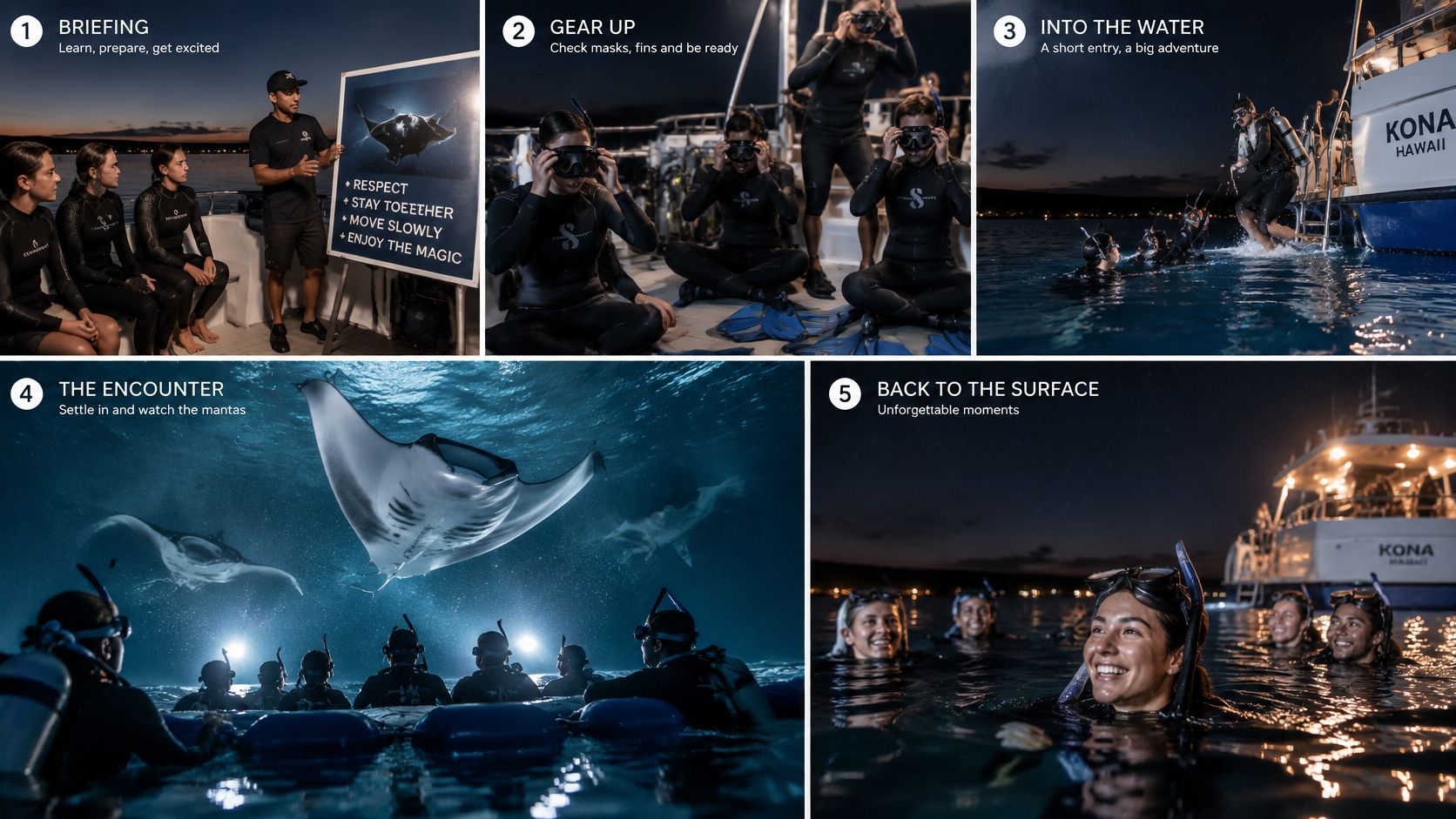
- Listen to the briefing. The crew explains the plankton-and-light mechanism, the dive plan and passive-observation rules before guests gear up. A clear briefing means everyone knows where to go and what not to do.
- Check your equipment. Divers and snorkelers confirm masks, fins and lights, while divers also check buoyancy and essential gear. You enter only after the crew assigns positions.
- Settle into the viewing area. Divers descend and rest near the bottom; snorkelers remain at the surface. Keeping each group in its designated zone leaves the feeding column open.
- Let the crew establish the light. Crew lights on the seafloor create a bright circle, so divers aren't left in complete darkness and plankton can gather above the lights.
- Watch the feeding begin. As zooplankton concentrates, reef mantas may arrive and filter-feed through the illuminated water. Their presence is never something guests can control.
- Hold your position. Aim lights upward and let each manta choose its route overhead. Experienced divemasters and instructors are in the water with divers to manage the group.
- Ascend together. Divemasters end the dive and guide the group's ascent, keeping the exit orderly rather than letting guests drift away independently.
The best way to prepare is to expect a quiet, structured dive. A guest who stays still gives the crew a more manageable group and the animals more room to move. Scuba guests can review the Garden Eel Cove manta dive tour before choosing a departure.
Positioning, Lights and Etiquette Once the Mantas Arrive
Stay in your assigned position and leave the water column above you open. Mantas need that space to maneuver, and divers who swim into the feeding lane can disrupt the plankton and create a collision risk.
Divers should remain near the sand, rubble or boulder bottom while maintaining neutral buoyancy. The bottom is a reference point, not something to touch or damage. Avoid coral, sea urchins and other benthic life, and don't stir sediment by kicking or shifting around. The NOAA-supported manta interaction guidelines recommend an unobstructed vertical column and an upward direction for dive lights.
Keep lights aimed upward to concentrate plankton in the feeding area. Don't sweep beams sideways through the water or point cameras and strobes into the manta's route. Snorkelers should stay at the surface rather than dropping into the feeding zone.
A semi-circular diver formation creates a predictable viewing boundary and leaves the central feeding lane open. Once the group is settled, resist the urge to improve your angle by moving closer. Divers are positioned in a specific viewing area because the setup works best when everyone holds a clear boundary.
The rule that protects the encounter: Look, don't touch, and never chase a manta. Let the animal set the distance and direction.
Hawaiʻi state guidance tells people not to disturb oceanic manta rays by touching or chasing them. State marine-species rules also make it unlawful to intentionally or knowingly capture or entangle a shark or ray, alive or dead, or to kill one in state marine waters. The dive is observation-based, not interaction-based. Review the practical responsible diver etiquette guidance before you board.
How to Choose an Operator and What to Ask
A tour's price reflects more than its headline number. Compare the site, included gear, tank count, group size, staffing and whether the operation follows the state viewing rules. Ask direct questions before paying; a vague answer about how the encounter works is a reason to keep comparing.
| Question | Good answer | Warning sign |
|---|---|---|
| Which site do you use and why? | Garden Eel Cove, with a designated viewing area and reef habitat | No site named, or a vague answer |
| Who is in the water with us? | Experienced divemasters and instructors | Unclear staffing or a lone guide for the group |
| How do you brief guests? | A pre-dive briefing on the science and passive-observation rules | Briefing skipped or rushed |
| What is your encounter policy? | A clear statement that sightings are probable, not guaranteed | Promised mantas or guaranteed sightings |
| What certification do I need? | A clear answer by certification level | Unclear or missing requirements |
| Do you follow the state viewing window? | Yes, with operations from a commercial mooring during regulated hours | Vague or no answer |
Scuba guests need an Open Water certification. Non-certified guests and families on the same trip snorkel at the surface. The briefing should cover the feeding mechanism and the rules for observing without interfering.
Kona Honu Divers runs its manta dive at Garden Eel Cove, briefs guests on the science and passive observation, and has experienced divemasters and instructors in the water with divers. That's a concrete option to compare, not a promise that mantas will appear.
For a fair quote comparison, check the site, tank count, gear, group size and whether a divemaster is in the water. Reject any quote that guarantees manta sightings. The Kona dive operator selection guide can help you compare what an operator includes.
Book the Garden Eel Cove Manta Night Dive
For a manta night dive, choose the site and follow the crew's viewing rules. Kona Honu Divers runs its trip at Garden Eel Cove, a protected site with a good viewing area, healthier reef and generally calmer conditions. The stationary setup is supervised, but calmer conditions and a well-chosen site cannot guarantee a manta sighting.
The trip is open to certified divers, from beginner to advanced. Open Water divers can join. Experienced divers can compare the Premium Advanced 2 Tank Trip. Families and non-certified guests on the same departure can snorkel at the surface.
Review the Garden Eel Cove manta ray dive tour or browse all Kona scuba diving tours. Before booking, confirm the site and that the crew covers passive observation in the briefing.