
Your trip is booked, your flights land in Kailua-Kona, and the group chat has already produced twelve must-do lists. Somebody wants the manta night dive. Somebody else has a certification card from 2016 and no clear memory of the skills behind it. One person has never breathed underwater and feels nervous about the whole idea. The Big Island can handle all three, but not in the same water on the same day.
The mistake visitors make is treating Kona as a single product. It isn't. It's a set of conditions, depths and entry styles, and the job is matching those to the card in your wallet. Here's how scuba Big Island Hawaii planning works, from your first course to deep water offshore, and which trip to skip when your skills don't match the site.
Certification Options From First Dive to Advanced
Card first. Every charter, rental counter and course in Kona opens with the same question, and the answer decides which water you can enter. On most of our regular dive charters we require at least an Open Water Diver certification from a recognized agency such as PADI, SSI or NAUI, which allows diving to 60 feet (18 meters) with a buddy, and you need to bring your C-card. No card means no boat.
That isn't gatekeeping for its own sake. Certification defines a depth limit, and every morning briefing is built around who is standing on the deck. Site selection, group pairing and the dive plan all shift depending on whether the boat is carrying two-week-old Open Water divers or people with several hundred logged dives.
| Course | Who it is for | Depth it unlocks |
|---|---|---|
| Discover Scuba Diver (DSD) | Not certified, first-time divers | About 40 feet (12 meters) on a shallow reef dive under instructor supervision |
| PADI Scuba Certification Course | Beginners wanting a full Open Water card | 60 feet (18 meters) with a buddy |
| PADI Open Water Referral Course | Students who finished theory elsewhere | 60 feet (18 meters) with a buddy |
| PADI Advanced Open Water | Certified divers wanting more depth and skills | 100 feet (30 meters) under standard PADI limits |
| PADI Enriched Air Diver | Certified divers wanting to use nitrox | Depth set by gas mix and training |
What each row means on the boat
The Discover Scuba Diver row is for the person who has never been underwater and wants to know whether they like it. An instructor teaches the basics in calm water, then guides a shallow reef dive to roughly 40 feet (12 meters). You finish with a story and no card.
The PADI Scuba Certification Course is the full entry ticket, and it's the one to book if you want to dive without an instructor hovering two feet away. The Open Water Referral gets you to the same card faster: finish the theory at home, then do the open-water dives here, trading classroom hours for reef time.
Depth is the whole argument for Advanced
PADI Advanced Open Water extends your ceiling to 100 feet (30 meters) under standard PADI limits, and that single number is what gives access to the deeper pinnacles and drift sites. PADI Enriched Air Diver is a separate decision. Nitrox doesn't make you a deeper diver. It changes your depth and time limits based on the mix in the tank, and you plan the dive from the table for whatever you're breathing.
Decision rule: no card means Discover Scuba Diver this trip, or the full Open Water course if you plan to dive again without a guide. A card you haven't used in years means Reactivate or a refresher before you book a two-tank. Want the deep offshore sites? Advanced Open Water first, then the gas course.
Beyond those five, the useful add-ons are Peak Performance Buoyancy for anyone who drifts upward on every safety stop, Deep Diver and Boat Diver for the Kona profile, Rescue Diver for people heading toward divemaster, and Reactivate for returning divers. All of them are listed on the Big Island scuba certification page with the logistics for each. Whatever you book, carry the physical card. A photo on your phone helps, but the card is what gets checked at the dock.
Big Island Dive Tours Compared at a Glance
Four tours cover almost every diver who steps onto a Kona boat, and each one has a requirement line that tells you whether it fits. Read the last column first.
| Tour | Best for | Time and style | Requirement |
|---|---|---|---|
| 2-Tank Local Morning Dive | Certified divers wanting coral gardens, lava tubes and arches | Two morning dives | Certified diver with C-card |
| Premium Advanced 2-Tank Trip | Experienced divers seeking remote sites, deeper dives and drift dives | Two dives, deeper sites | Certified diver with advanced experience |
| Manta Ray Night Dive | Divers and snorkelers wanting a night encounter with reef manta rays | Night, feeding site | Certified divers or snorkelers |
| Black Water Night Dive | Night-comfortable divers wanting open-water plankton-feeding life | Night, open water | Certified diver with C-card, night comfort advised |
The 2-Tank Local Morning Dive is the workhorse. Two dives before lunch, coral gardens, ancient lava tubes and dramatic arches, all at recreational depths a fresh Open Water diver can handle. If you can dive 60 feet comfortably with a buddy, start here. Two-tank days also give you a real surface interval, so bring a layer for the boat ride.
The Manta Ray Night Dive runs after dark at a feeding site where mantas arrive for plankton, and it takes both divers and snorkelers. It is not a deep dive, but it is a night dive, which is a different skill set: lights, signals, a lost-buddy plan and staying put on the bottom.
The Black Water Night Dive is the other night option and nothing like the manta trip. You're in open water, drifting over deep ocean, watching plankton-feeding life rise from below. It rewards divers who are already calm in the dark and can hold a position without a reef to reference.
The Premium Advanced 2-Tank Trip is where the deeper water and drift diving live. Remote, pristine sites, more demanding profiles. Book it when your logbook backs up the request, not because the name sounds better.
The full lineup, schedules and what each trip includes is on the Kona scuba diving tours page, and there's a wider look at how the local shops differ on this comparison of Kona scuba shops. One practical note for mixed groups: snorkelers and ride-alongs can join the dive boats, so tell the shop at booking if your party includes snorkelers rather than assuming they'll be turned away at the harbor.
If night encounters and open-ocean drifting are the reason you're coming, the Blackwater night dive tour is the one to read in detail. If you want the deeper sites and drift profiles, start with the premium advanced two-tank trip. If you're not sure yet, the morning charter is the honest default, and you can add a night dive once you've seen how you handle Kona's water.
Garden Eel Cove and the Manta Night Dive
It happens in the last ten minutes of daylight and the first hour of dark. You drop to the sand and kneel or hover in a loose line, lights pointed up and slightly out, and the plankton collects in the beam like dust in a projector. Then a shape arrives from the darkness with a wingspan wider than the boat's swim step, banks, and comes back through the light again.
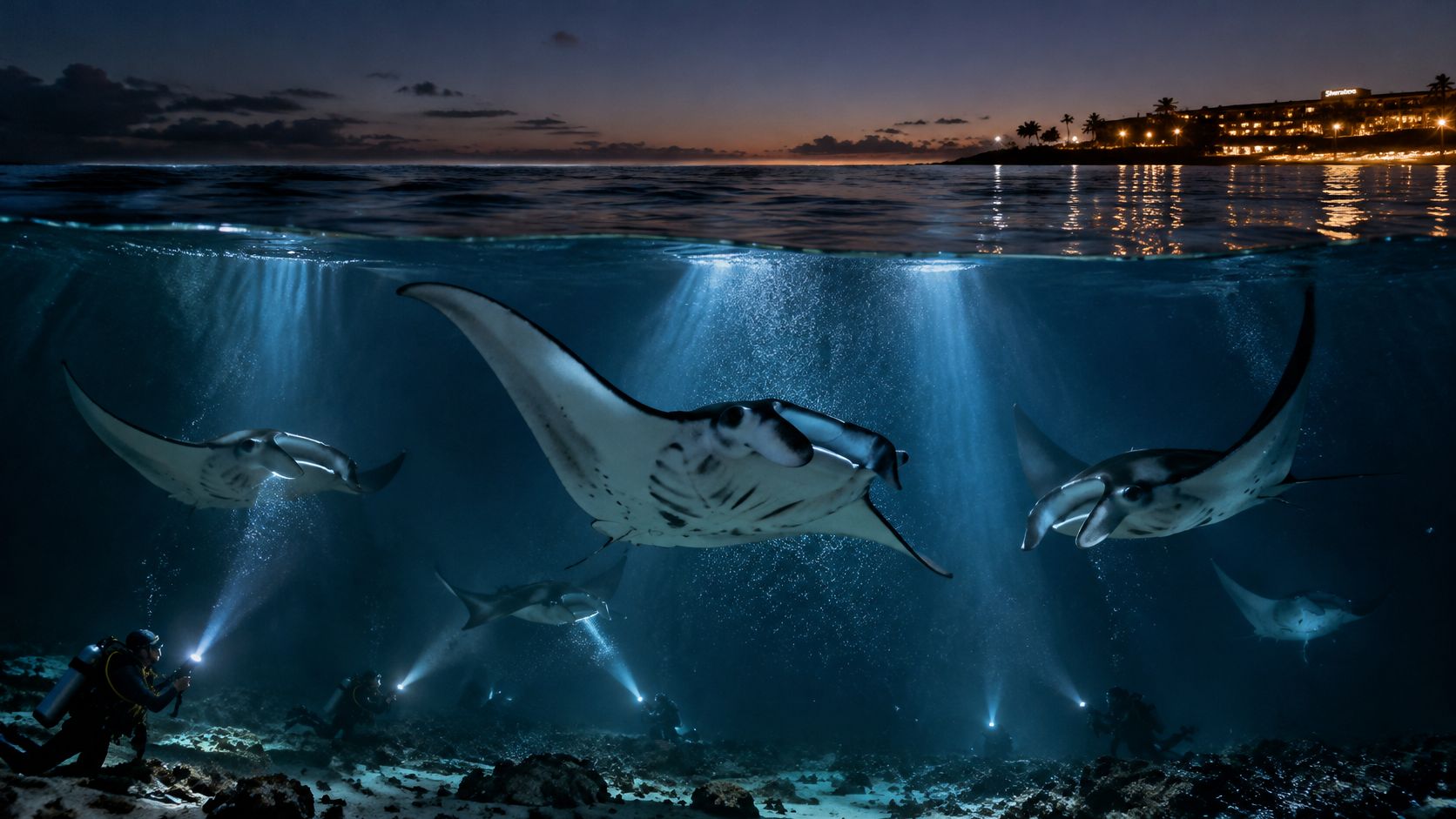
Kona's night manta diving concentrates at two named places: Makako Bay, better known as Garden Eel Cove, and the coastline fronting Sheraton Keauhou Bay. State documents describe mantas gathering there at night to feed on plankton, which is why these sites are unusually reliable for wildlife viewing. A Hawaii legislative testimony document reported mantas on 80% of dives at Garden Eel Cove and estimated the Kona population at probably fewer than 200 individuals, while noting no formal mark-and-recapture analysis had been completed, so treat that number as a rough estimate rather than a census.
Why Garden Eel Cove wins the booking
Garden Eel Cove is the better manta site, and the reason is shelter. Its protected location gives a calmer, more contained viewing area with better reef around it, which matters when a dozen mantas are looping within arm's reach of kneeling divers. On an exposed stretch of open coast, any surge or chop turns a controlled bottom sit into a drifting scramble, and the animals feel it before you do.
That same crowding problem is why the state has looked closely at this site. The testimony that recorded the 80% figure also described increasing tour activity creating overcrowding and safety concerns, and the management proposals on the table included limits on commercial operators, anchoring restrictions, bans on rafting and controls on live boating. Read that as a hint about boat choice. A smaller group on a permitted vessel gives you a stable bottom position and a guide who can manage light discipline across the whole group.
A manta pass is not a photo opportunity you schedule. It's an animal choosing to stay in the light. Everything you do to stay still and predictable keeps it there longer.
How to behave when a manta comes close
Hawaii's coral reef guidance tells visitors not to stand on, touch or trample coral, and conservation guidance for scuba divers specifically asks for buoyancy control that keeps fins, gauges and accessories off the bottom. At a manta site this matters twice over: the reef takes the damage, and disturbed silt ruins the visibility the animals came for.
- Hold a position instead of chasing. Kneel or hover at the site the guide assigns, keep your light steady, and let the mantas run their loop.
- Trim your kit. Anything dangling, from a console hose to a camera rig, swings into the feeding lane. Clip it before you enter.
- Limit light and flash. One steady beam per diver draws plankton. Strobing or panning lights scatter the aggregation and blind your neighbours.
- Stay passive when one approaches. No reaching, no touching, no swimming into the animal's path. The Hawaii Division of Aquatic Resources specifically instructs visitors not to disturb manta behaviour.
A resident population, not a passing parade
The reason Kona can promise this experience most nights is that the animals live here. The first known individual, nicknamed "Lefty," was identified on the Kona Coast in 1979, and photo-identification work has documented about 318 individual reef manta rays around Hawaii Island since then. Genetic research involving NOAA's Pacific Islands Fisheries Science Center, the Hawaii Association for Marine Education and Research and the University of Miami found strong island-level fidelity, with estimated migration of roughly one female moving between island groups every 1,300 years and about one male every 64 years.
The most detailed local picture comes from a 2025 University of Hawaii study that analysed 13 years of observations from 2010 to 2022 at Garden Eel Cove and Keauhou, logging more than 23,000 recorded sightings of 167 individually identified reef manta rays. Garden Eel Cove consistently supported larger aggregations, Keauhou was visited disproportionately by females, and the overall sex ratio was balanced. Annual and seasonal changes in aggregation size tracked zooplankton density, and despite more tourism the study found generally stable aggregations and no evidence that current activity levels had reduced the population's viability.
For a diver, that's the argument for a small-group boat and a quiet bottom. This is a small, site-attached population, and the encounter works because nobody in the water is chasing it. The night manta ray dive in Kona covers the site logistics, and the two-tank manta dive and snorkel tour shows how divers and snorkelers share the same water on one trip.
Top Sites, Seasons and Shore Diving Rules
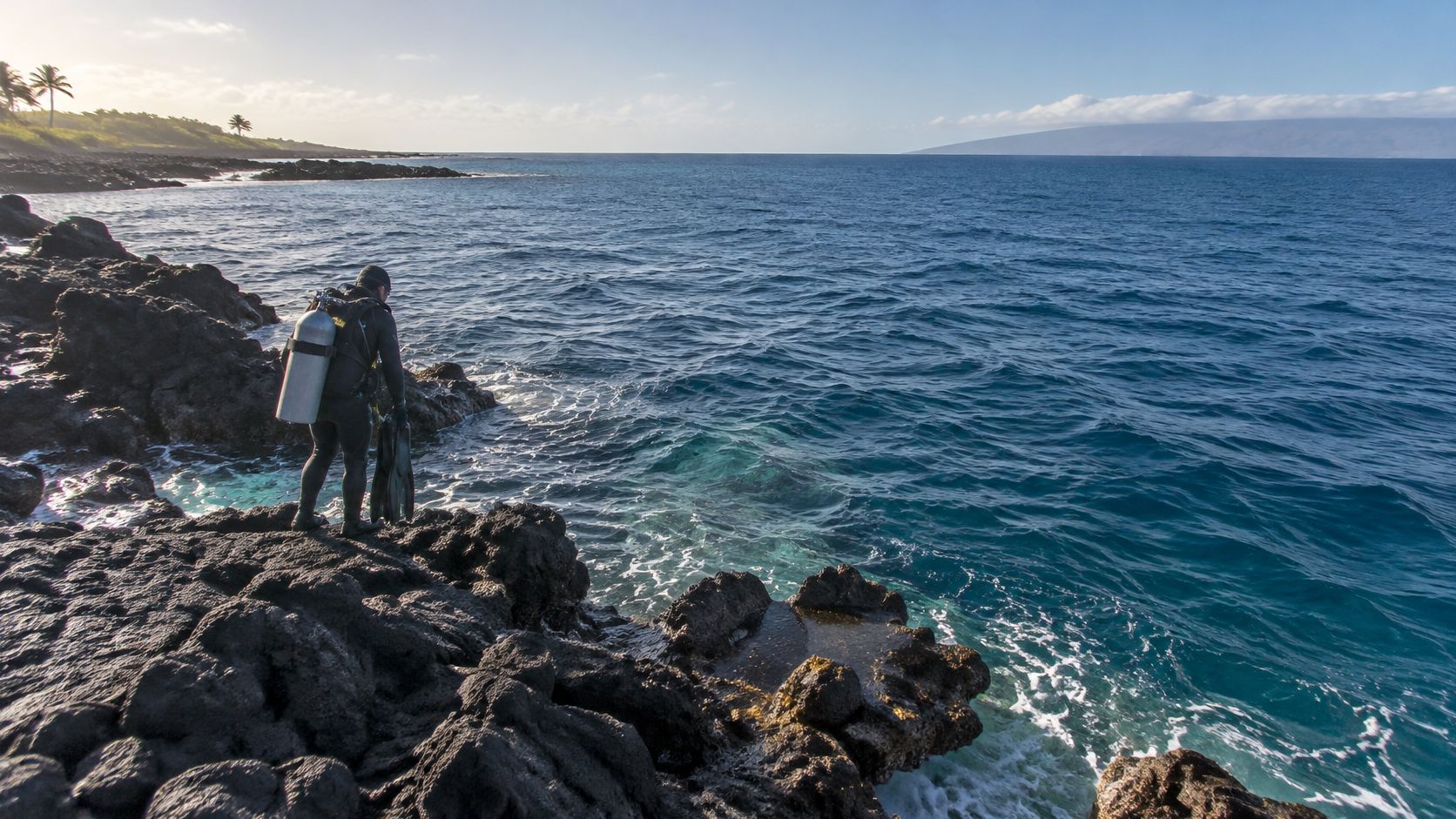
Kona's west-facing coast is the reason so much diving happens here. The leeward geography reduces typical trade-wind exposure, so surface chop and surge are usually smaller than on an exposed shoreline, while the volcanic slope drops away fast into deep water, per this Kona dive site and conditions guide. That combination, calm surface, deep bottom, is rare and it's why the training and advanced diving both work here.
The leeward advantage and where it stops
Shelter from the wind doesn't make every entry easy. Steep lava entries stay site-specific hazards that can make shore access difficult even when the water offshore looks flat, which is why the west Hawaii site notes put swell direction, current and your entry and exit route ahead of visibility in the pre-dive checklist. Visibility tells you what you'll see. It tells you nothing about whether you'll get back out.
Winter is the season to respect. North Pacific swells still reach exposed west-coast locations, and the National Weather Service uses an 8-foot high-surf advisory threshold for west-facing Big Island shores, a number that reflects what happens when swell meets a steep, unforgiving shoreline.
Practical rule: when swell builds, move to a protected Kona site, take a boat if the entry is marginal, and postpone the shore dive if surge is compromising your footing or your exit control. The ocean will still be there tomorrow.
Old Kona Airport and its conservation district
The Old Kona Airport Marine Life Conservation District runs from offshore of Old Kona Airport State Park to the Kailua Lighthouse, and the state's marine managed area description lays out the terrain. The reef is a set of shallow lava fingers reaching roughly 50 feet, after which the bottom drops rapidly into very deep water. Expect substantial coral cover, diverse reef fish, and plenty of turtles and rays.
Entries are the catch. Sharp coral and lava punish bare hands and careless fins, and summer and winter storms can both build dangerous swells and currents here. The state identifies a partially protected cove at the northwestern end of the beach as the common entry for snorkelers and shore divers, and a semiprotected lava basin at the southeastern end as an alternative usable in calm to moderate conditions.
Inside the district, the rules tighten. Removing or injuring marine life is prohibited, including live shells, opihi, live coral, algae and limu. You can't take or alter sand, coral, rock or other geological features, feeding or introducing attractants near aquatic life is banned, and anchoring is prohibited, per the Division of Aquatic Resources rules for the district. A state mooring is available for no more than three hours per boat per day, first come first served, noncommercial use. Commercial operations need a permit to be there at all.
Seasons, and what actually changes
Summer generally brings the calmer water that suits beginners and night dives, and winter brings the swell that reshapes the west-facing entries. That's the whole seasonal story for most visitors, and it's why a trip planned around one specific shore site is a fragile plan.
Boats solve this. Site selection happens on the water, in the morning, based on what the day is doing. A typical dive day runs arrival and gear setup, a briefing on site conditions and entry style, dive one at the deeper or more condition-sensitive site, a surface interval, then a more relaxed second dive. By the time you're on the boat, the decision about which site works has already been made for you.
The diver flag rules that apply to you
Hawaii requires a red-and-white diver flag whenever anyone is scuba diving or freediving, including at night, when the flag has to be illuminated, according to the state snorkeling and diving guidance. Divers may not surface more than 100 feet from the flag in ocean waters. Groups of two or more may share one flag, but every diver stays inside that radius.
This applies to independent shore divers, not just commercial boats. A quiet, familiar-looking bay at 7 a.m. still has the same legal distance limit and the same flag duty. The statewide fishing regulations put the stream limit at 50 feet and separately prohibit taking, breaking or damaging stony coral, including reef and mushroom coral, which covers every Kona site rather than just the conservation district.
Boat or shore, decided once
Choose the boat when surf is up, when boat traffic is heavy, when the entry is lava with no sand and no handrail, or when your buddy pair is newly certified. Choose the shore when the marine forecast is clean, the entry is a known cove, and you have a clear exit and dependable buddy contact. There's a fuller breakdown of entry-by-entry options in this guide to the best shore diving on the Big Island.
Gear, Nitrox and Safety Rules to Plan Around
Two things derail more Kona dive days than conditions do: a wetsuit that doesn't fit and a schedule that ignores the flight home. Both are solvable before you leave the shop.
Gear to sort before you board
We size divers for any rental gear they need during check-in, so arrive with enough time to try on a wetsuit and fins instead of grabbing them at the dock. A 3mm suit covers most divers for most of the year, with a hooded vest for the cooler months and for anyone who runs cold on a second dive.
Bring your own mask if it fits your face well, and your own computer if you have one, because dive computers can be requested when booking and availability plus any small extra cost gets confirmed at that point. Everything else is easier rented than flown.
Dive insurance is not optional in my view for a visiting diver. We strongly recommend it, and the reason is geographic: help in a serious incident means transport, and the cost lands on the diver.
The safety stop and why it isn't a formality
Kona's deeper pinnacles, lava structures and repetitive two-tank profiles all point at the same habit. The University of Hawaii diving safety manual recommends a safety stop on any dive deeper than 30 feet (9 meters), with a 3 to 5 minute stop between 10 and 30 feet when practical, and it gives particular emphasis to dives beyond 60 feet, as summarised in this Big Island scuba diving guide.
The physiology is straightforward. Ascent reduces ambient pressure, which lets dissolved inert gas, mostly nitrogen whether you're on air or nitrox, come out of solution. A controlled ascent plus a shallow stop slows the rate of pressure change and buys time for that gas to be eliminated.
Gas rule I'd give any two-tank diver: plan your turn pressure so you surface with enough left for a full stop, and never let the stop be the thing that uses your reserve.
Practically, that means tracking cumulative exposure across both dives rather than treating them as separate events, avoiding rushed ascents on the second dive when everyone's tired, and telling the crew if you're feeling off rather than pushing through a profile.
Nitrox, and what it does not do
Enriched Air is a planning tool, not a superpower. The higher oxygen fraction changes your depth and time limits, so the dive you can run on nitrox differs from the one you'd run on air, and the calculation starts with the mix in your tank. If you hold the Enriched Air certification, use it deliberately; the nitrox diving benefits breakdown explains where the extra bottom time helps on a two-tank day.
The wait before you fly
| Dive profile | Wait before flying | Notes |
|---|---|---|
| Single no-decompression dive | At least 12 hours | Plan the flight after this window |
| Repetitive or multiday diving | At least 18 hours | Common on two-tank days and multi-day trips |
Those intervals come from published guidance covering Kona diving combined with air travel, mountain excursions and inter-island transfers. If you're driving up to Mauna Kea or taking an early flight, work backwards from the last dive and finish early enough to clear the window. A sunset manta dive and a dawn flight the next morning is a bad pairing, and no amount of planning on the plane will fix it.
Book Your Big Island Dive With Kona Honu Divers
Match the tour to your card and your comfort, then book it. Certified divers happy at 60 feet with a buddy start with the 2-Tank Local Morning Dive. Certified divers wanting deeper, more remote water and drift profiles step up to the Premium Advanced 2-Tank Trip. Divers who are steady in the dark pick the Manta Ray Night Dive or the Black Water Night Dive. Anyone without a card starts with Discover Scuba Diver or the full PADI certification course.
We run these as a shop that has been reviewed more than any other dive operation in Hawaii, with a fleet, a certification program from entry level through professional, and Kama'aina dive courses and freediving classes alongside the tourist charters.
- Choose your tour from the table above, reading the requirement column first.
- Confirm your certification and carry the physical C-card in your dive bag.
- Check the season and the marine forecast for your dates, especially if a shore entry is part of the plan.
- Book through availability below and note anything your group needs, including snorkelers riding along.
Two reminders before you pack. Carry dive insurance, because the nearest recompression chamber is an inter-island flight away. And recheck conditions the morning of every dive rather than trusting a forecast you read a week out.
Kona Honu Divers runs the tours this island is known for, from the 2-tank morning reef and lava tube dives to the manta ray night dive, the blackwater night dive and premium advanced trips into deeper, more remote water, plus PADI courses for every level from first-timer to advanced. If your plans include scuba Big Island Hawaii diving this year, visit Kona Honu Divers to match a tour to your certification and get on the schedule before the good dates fill.