
You're on the boat, the sun's gone down, and the water below looks black enough to swallow the lights whole. That first drop into a Kona night dive can feel strange for a minute, then the beam catches plankton, a dark shape slides in from the edge, and the whole reason people book this trip becomes obvious.
The kona manta ray night dive works because it turns a natural feeding pattern into a controlled viewing setup, not because anyone is chasing rays around the reef. That's why the best trips feel calm, deliberate, and respectful, and why the worst ones happen when people expect a guaranteed show instead of a wildlife encounter.
What Makes the Kona Manta Ray Night Dive Unique
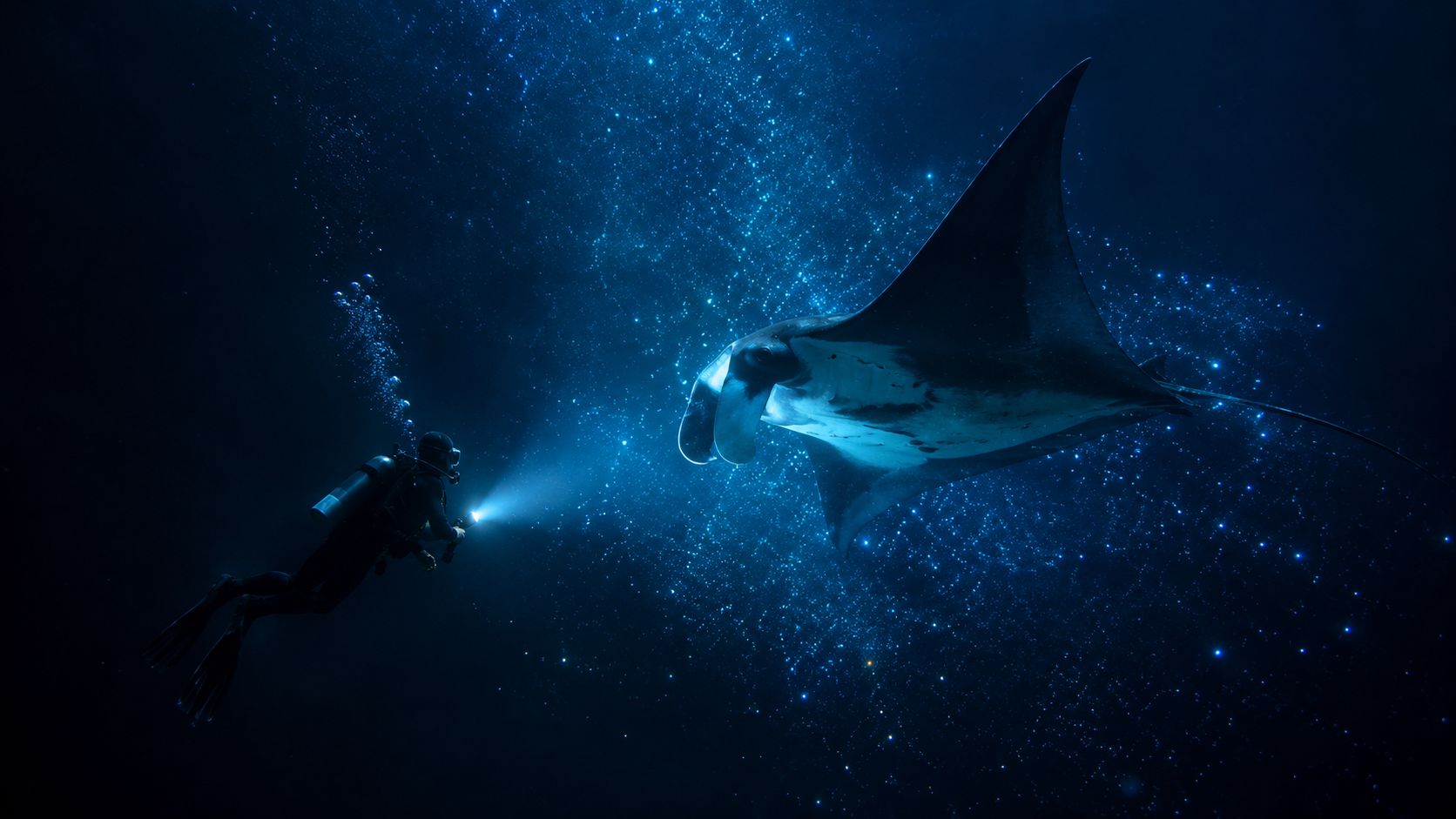
A good Kona night dive starts with a simple shock. You slip below the surface, the boat noise fades, the lights come on, and the black water suddenly becomes a stage where the first manta can appear from nowhere. That moment feels dramatic because the ocean is dark, but the setup behind it is practical and old-school Kona.
The tradition goes back to the late 1970s, when lights at a Keauhou oceanfront hotel accidentally attracted plankton and feeding mantas, helping create one of Hawaiʻi's earliest organized marine-wildlife encounters. Historical testimony says regular manta dives were already operating on the Kona Coast by then, and by 2002 nine Kona dive shops were carrying about 11,000 snorkelers and divers on manta tours, generating roughly $920,000 in direct revenue and about $2.5 million annually across the broader industry, according to testimony submitted to the Hawaiʻi Legislature (Hawaiʻi Legislature testimony).
A night dive, not a stunt
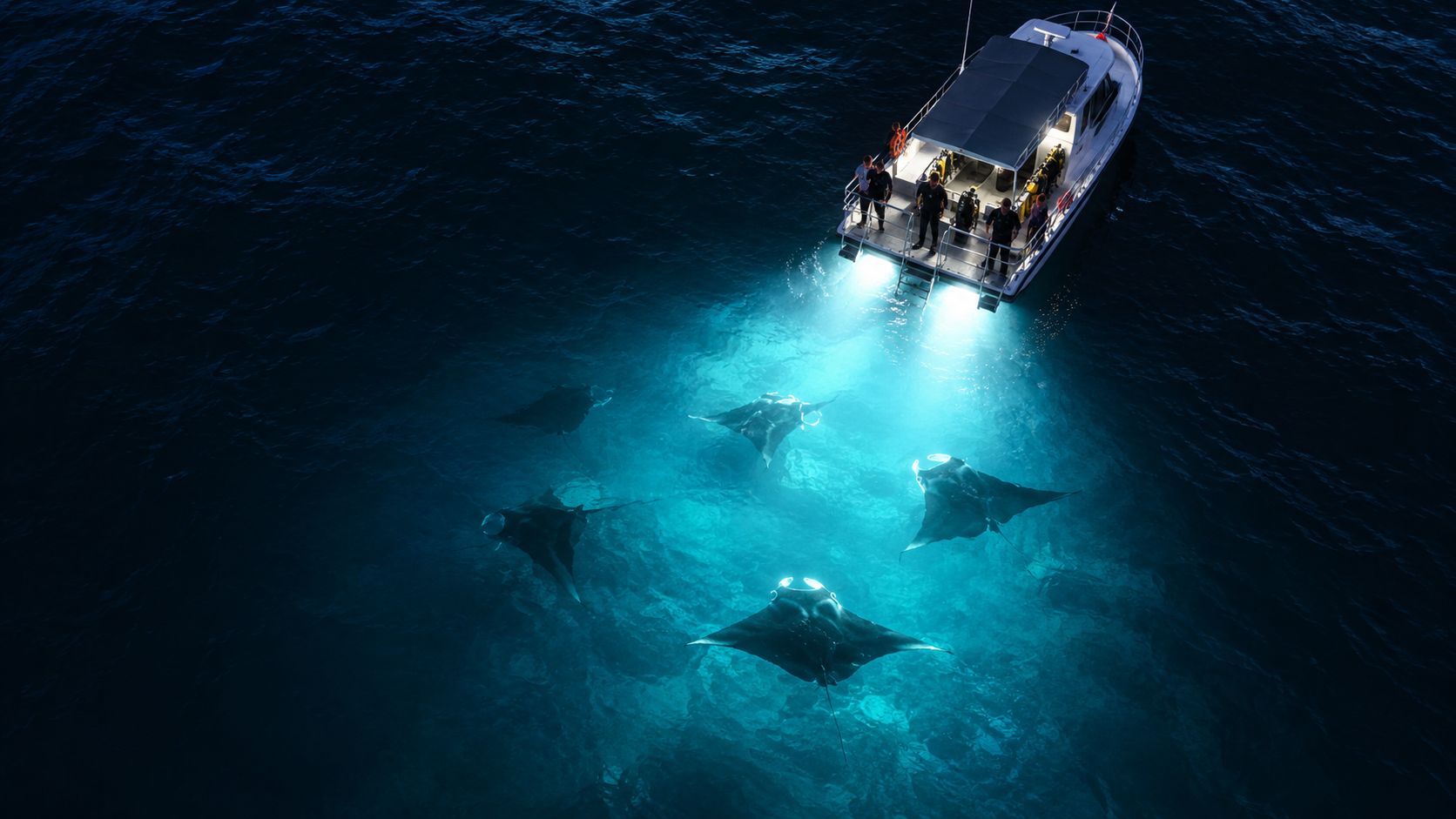
What sets Kona apart is that the animals aren't being lured to food they'd never otherwise find. High-intensity lights concentrate plankton, and reef manta rays, Mobula alfredi, enter that illuminated water to feed. That's why this encounter feels so reliable compared with many other manta experiences, yet still unmistakably wild.
The record backs up that long-running pattern. One six-year scientific study logged 25,444 observations of 118 individual reef manta rays at two sites near Kailua-Kona, with effort spread across most possible nights at the study locations, and the surveys generally beginning around sunset for about an hour (NOAA repository study). The same body of historical record notes manta sightings were observed on about 80% of dives at Garden Eel Cove and that sightings were recorded from 1992 through 2007 using 3,208 surveys at Kona night sites, mostly Keauhou and Ho'ona Bay (Hawaiʻi Legislature testimony).
Practical rule: treat the dive like a wildlife blind, not a performance. The more still you are, the better the encounter usually works.
For visitors, that's the true draw. You're not buying a guaranteed parade of rays. You're joining a long-running Kona tradition where lights, plankton, and manta feeding behavior line up often enough to make the trip feel special, but never so mechanically that it stops being a genuine animal encounter. What makes diving in Kona different
How the Night Dive Encounter Works
The mechanics are simple, and that's why they matter. High-intensity underwater lights create a localized photic zone, plankton gathers in it, and manta rays arrive to filter-feed. Once you understand that sequence, the whole dive makes more sense, including why some nights feel electric and other nights feel quieter.
The light field is the engine
Mantas aren't coming for the bulbs. They're responding to the prey field built by the lights, and that's why placement matters so much. A stable, upward-facing beam helps create a vertically structured plankton patch, while erratic sweeping can make the encounter less predictable and can pull attention away from the feeding window.
During feeding, mantas swim with their mouths open and use their cephalic fins to channel plankton-rich water toward the mouth and gill-filtering system. Their barrel rolls are not theatrics, they're efficient loops that move the animal back through the densest portion of the prey patch. The result looks graceful because it is efficient.
The best evidence for how variable this is comes from the six-year Kona study. Researchers documented 25,444 observations of 118 individual reef manta rays at Manta Heaven in Makako Bay and Manta Village at Kaukalaelae Point, with 19,841 observations at Manta Heaven and 5,603 at Manta Village (NOAA repository study). The study also identified 66 males and 52 females, and found that some mantas behaved more resident-like while others moved between sites more often, which is exactly why no guide should ever promise identical nightly attendance.
Why stillness beats chasing
The practical takeaway is straightforward. You want to stay in the lit zone, hold position, and let the feeding animals come to you. If you swim at the rays, the dive stops being a clean observation setup and starts becoming a disruption.
Let the light do the work. Your job is to stay put, breathe normally, and keep the water column clear.
That's also why sighting quality varies with plankton density, water movement, and light placement, not just with the number of mantas in the area. A busy night isn't only about seeing more animals, it's about seeing them feeding in the right part of the column where the lights and prey concentration are working together. NOAA study on Kona manta use
Diver Positioning and Responsible Interaction
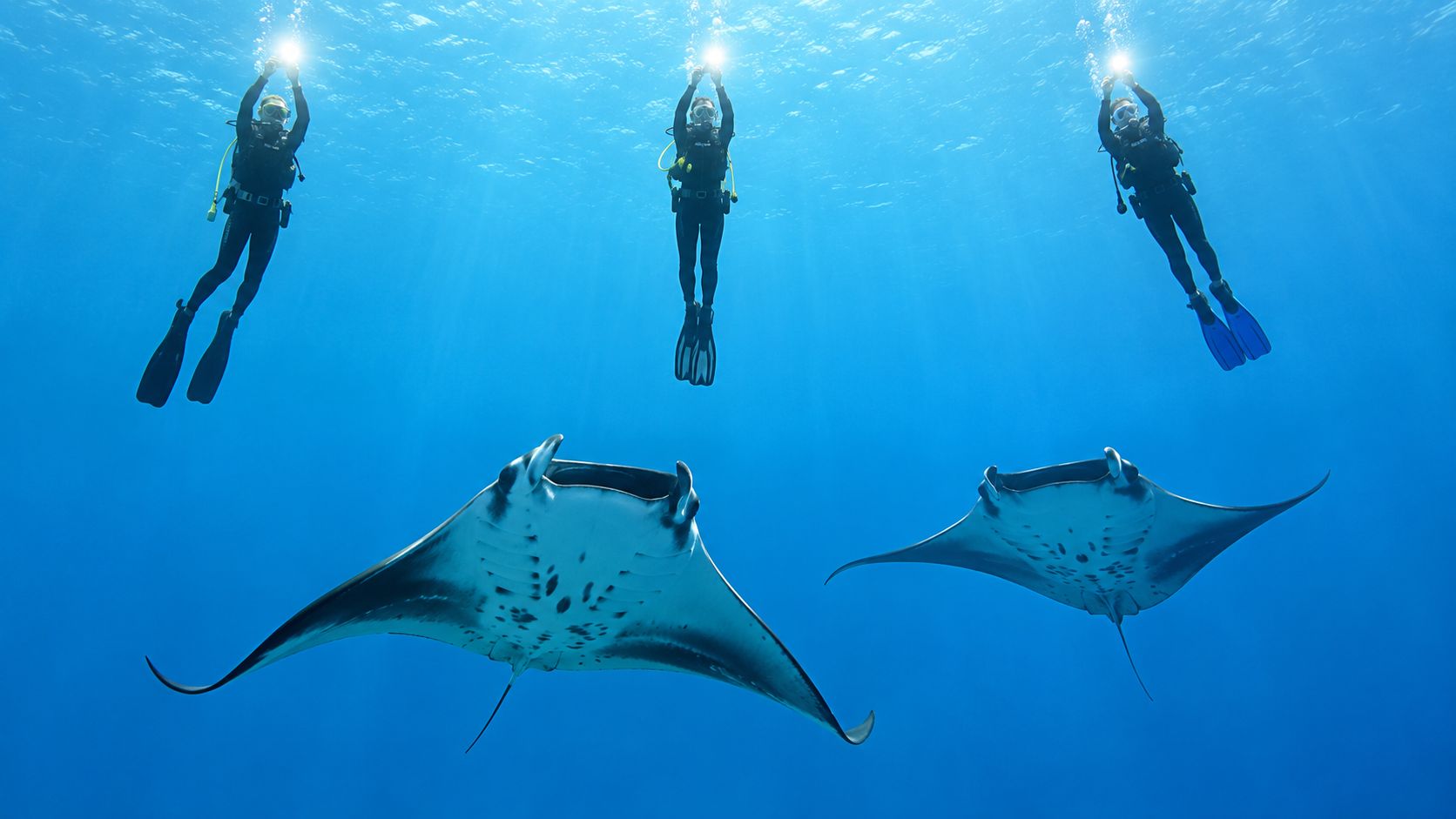
The right body position keeps the encounter clean for everyone. NOAA-hosted guidance says divers should hold dive lights above the head and aim them upward into the water column, stay on or near sand, rubble, or boulder bottoms, and avoid sitting on live coral because mantas need open water to maneuver (NOAA wildlife-interaction guidance).
Simple habits that help the dive work
Snorkelers stay on the surface and point lights downward. They should not dive down into the feeding column, because that cuts through the space the mantas are using to feed. For groups of four or more snorkelers, the same guidance recommends a snorkel ring or similar flotation device to keep everyone together above the lights (NOAA wildlife-interaction guidance).
A few details make a bigger difference than most first-timers expect. Divers should time their breathing so bubbles don't rise directly into a manta overhead, and everyone should avoid contact with coral, sea urchins, or any other marine life. The goal isn't just to be polite, it's to preserve the feeding geometry.
Good etiquette protects the scene itself. When people stay low, quiet, and still, the mantas keep feeding naturally.
That same logic applies to the experience as a whole. The dive works best when it stays observation-based, with the guests creating light and leaving the animals room to move through it. If you're looking for a refresher on the behavior side of the equation, responsible diver etiquette is where the practical rules matter most.
Garden Eel Cove vs Keauhou Dive Sites
If I'm choosing for a guest who wants the strongest chance of a clear, readable encounter, Garden Eel Cove is usually the better call. The reason isn't hype, it's site behavior, viewing geometry, and how the plankton shows up at each location. Keauhou can still be excellent, but the sites don't function the same way.
Why Garden Eel Cove usually wins
The 2025 University of Hawaiʻi study looked at more than 23,000 sightings of 167 individual reef manta rays from 2010 to 2022 at Kona's Garden Eel Cove and Keauhou sites, and found that aggregation size tracked zooplankton density (University of Hawaiʻi study). That matters because it explains why a “good” site is not just about convenience or popularity. It's about where the food is concentrating.
The same study found Garden Eel Cove generally supported larger aggregations, while Keauhou showed strong female site fidelity and may serve ecological functions beyond nighttime feeding (University of Hawaiʻi study). That's the reason I steer families and first-timers toward the site with the better viewing structure when conditions allow.
What the better site gives you
A superior viewing area changes the whole night. More open space around the lights means easier sightlines for snorkelers and divers, less crowding around the feed zone, and a cleaner look at the mantas as they pass through. Better reef conditions also matter because guests stay oriented more easily when the bottom structure is calmer and simpler to read.
The best site is the one that matches the night's plankton, visibility, and water movement. The manta count matters, but the setup matters just as much.
Keauhou still has value, especially when site fidelity or local conditions make it the smarter choice. But if you're comparing the two as a guest who wants the more comfortable and readable tour, Garden Eel Cove is the stronger default. Why Kona's manta sites differ
Gear and Preparation Checklist
The right gear won't make the mantas appear, but it will make you calm enough to enjoy them. For most guests, the main goal is warmth, stable buoyancy, and simple equipment that doesn't get in the way of the encounter. A night dive is no place for fiddly setup or cold-shock surprises.
What to bring and why it matters
A wetsuit in the 3mm to 5mm range is the usual comfort zone for this kind of outing, depending on how cold you run personally. If you chill easily, lean warmer. If you usually stay comfortable in mild water, a thinner option is often enough.
Good lights matter too. Red filters can help minimize plankton disruption while keeping your view usable, and a camera or housing is worth bringing only if you can manage it without chasing the scene. Underwater photography gets frustrating fast when people try to multitask before they've mastered neutral buoyancy.
- Wetsuit choice: pick warmth over style, because you'll be floating or holding position for a while.
- Light setup: bring a reliable dive light, and keep the beam steady instead of sweeping.
- Camera gear: only carry what you can control without drifting into other guests.
- Buoyancy practice: review your trim before the trip, because hovering still is a skill.
If seasickness is a concern, plan ahead instead of hoping it won't show up. Common preventatives include the Ship-EEZ Seasickness Patch, Dramamine pills, Bonine pills, Sea Band wristbands, and ginger chews. Those options are most useful when taken before discomfort starts, not after.
Hydration and timing matter too. Show up rested, avoid cramming in a big meal right before departure, and don't schedule dental work or anything that leaves your jaw and ears sensitive right before a night in the water. Practical travel preparation for Kona diving
Best Seasons and Conditions for Manta Dives
Kona's manta season runs all year, but the water doesn't feel the same every month. The encounter is built on feeding behavior, so the key variables are plankton, current, visibility, weather, and moonlight. Those conditions shape how easy it is to see and how confidently the animals feed.
What good conditions look like
Late spring through early fall often brings stronger plankton blooms, which can make the night feel more active. Calm water also helps, because a steadier surface usually means a more comfortable boat ride and a cleaner viewing environment once you're in position. That said, a calmer sea doesn't automatically mean more mantas.
Moonlight and visibility can change how dramatic the light field feels, while current affects how the plankton gathers around the site. If the plankton density is low, responsible operators may reschedule or shift plans rather than force a mediocre outing. That's not a bad sign, it's a sign the crew understands the difference between a wildlife encounter and a promise they can't control.
Why you should book for the trip, not the fantasy
The 2025 University of Hawaiʻi study found aggregation size tracked zooplankton density, which is the most honest reminder you can give yourself before booking (University of Hawaiʻi study). If conditions are poor, the dive may still be worth doing, but it should be judged on the quality of the wildlife observation and the operator's judgment, not on whether the mantas performed on demand.
A good operator treats rescheduling as part of responsible wildlife work, not a failure.
That expectation is especially useful for single-night travelers. It keeps the experience grounded in reality, which is the best way to enjoy it if this is the only manta dive you'll do on the island. When to plan a Kona manta dive
Photography Tips for Manta Ray Encounters
The best manta photos usually come from patience, not aggression. I've seen more good shots ruined by over-eager divers moving too much than by poor cameras. The rays feed in a pattern, and if you hold your position, the angles start to work for you.
Shoot from the edge of the action
Stay near the light field and let the mantas come through frame. If you chase them, you lose composition, spook the scene, and usually end up with a close-up of another diver's fin. A steady hovering position makes it much easier to catch a barrel roll or a pass that shows the animal's shape.
Low-light shooting rewards simple setups. Use a camera mode that performs well in darkness, keep your lighting angle controlled, and avoid firing blind bursts in every direction. Good shots usually come from waiting for the animal to re-enter the lit zone instead of trying to force the moment.
Best frame, best behavior: the cleanest photo often comes from the quietest diver.
If you want the image to tell the story, include the light field, the open water, and the scale of the manta together. That combination says more than a tight crop ever will. For guests who want a dive operation that regularly runs this kind of night trip, Kona Honu Divers offers a manta-focused option as part of its broader dive schedule.
Booking Your Manta Ray Night Dive
Most guests ask the same questions before they book. You need the right certification for scuba, a realistic read on your comfort in the water at night, and a crew that can explain the site, the rules, and the conditions clearly. The operator should also know the state rules, including the 4:00 p.m. to 4:00 a.m. viewing-zone window, slow-no-wake vessel operation, anchoring limits, white-light visibility requirements, and the need to leave the viewing-zone boundaries for at least 30 minutes once a vessel reaches its mooring time limit (DLNR rules summary).
A solid booking choice also respects the difference between scuba and snorkel expectations. Scuba divers need certification, snorkelers need flotation and surface discipline, and mixed-experience groups do best with crews that separate roles cleanly without making the trip feel segmented.
If you want a manta night dive paired with another Kona site, look for a two-tank trip that uses the earlier dive to warm up and settle buoyancy before the manta stop. That sequence usually gives guests a calmer second half because they've already adjusted to the boat, the gear, and the nighttime water.
If you're ready to book a kona manta ray night dive with a crew that understands how the encounter works, Kona Honu Divers runs manta trips with the kind of site awareness and safety focus that matter after dark. Choose a date, check the conditions, and plan for a real wildlife encounter, not a guaranteed show.