Table of Contents
- Age and supervision are separate checks
- Choose based on your next trip, not just today
- Leave room for learning
- Respond to discomfort before it becomes a problem
- Prepare without teaching yourself scuba
- Make conservative decisions before entering
- Take symptoms seriously afterward
- Build the itinerary before reserving
- Put the practical pieces in place
You're looking at a dive vacation, and the underwater photos make you want to join in. Then the practical questions arrive: Do you need certification first? How strong a swimmer should you be? Can you dive the day before flying home?
Learning how to start scuba diving begins before you put on a tank. Check your health and water confidence, choose between a supervised introduction and certification training, and leave room in your travel schedule for both learning and recovery. You don't need to arrive knowing the equipment. You do need enough time to learn without rushing.
Check Your Readiness Before You Book
Readiness requirements by case
| Case | Medical Requirement | Swim and Float Test | Age or Supervision Rule |
|---|---|---|---|
| Adult, no health conditions | Complete the questionnaire; physician review if flagged | Full test described below | No general maximum age |
| Heart, lung or diabetes history | Physician review; cardiovascular assessment when indicated | Same test | Medical suitability assessed individually |
| Smoking history, high cholesterol or low fitness | Fitness assessment advised before diving | Same test | No general maximum age |
| Under 13, eLearning | Medical questionnaire plus parent or guardian permission for registration | Same test | Confirm local participation rules |
| Ages 10-14, Junior Open Water | Questionnaire; physician review if flagged | Same test | Junior certification, eligible to upgrade at 15 |
| Age 15 and older | Questionnaire; physician review if flagged | Same test | Standard Open Water pathway |
The certification water-skills requirement is a 200-meter continuous swim, or 300 meters with mask, fins and snorkel, plus 10 minutes floating or treading water, according to PADI's scuba certification FAQ. This demonstrates basic aquatic competence, not medical fitness.
Read the questionnaire carefully, including questions about medication, previous illness and loss of consciousness. A flagged answer doesn't automatically mean you can't dive. It means a physician needs to evaluate whether underwater pressure and exertion present a concern.
Heart or lung disease, diabetes, ear or sinus problems, and unexplained fainting deserve attention before a deposit. If you've been inactive, build swimming confidence and general exercise capacity rather than relying on passing the water test alone.
Age and supervision are separate checks
PADI's education guidance generally allows entry from age 10, assigns Junior Open Water certification to students younger than 15, and requires parent or guardian permission for eLearning registration below 13. Local rules may differ. At our operation, Junior Open Water divers aged 10 to 11 require a private guide, while divers aged 12 to 17 must dive with a parent or guardian.
PADI's entry guidance describes students as reasonably fit and in good health, with generally no maximum age. Age alone doesn't establish readiness.
Before paying, ask yourself:
- Health: Do I have a heart, lung, ear, sinus, blood-sugar or medication concern?
- Water confidence: Can I complete the swim without panic?
- Supervision: Have I arranged the guardian or guide my age requires?
Take medical uncertainties to a physician. Resolve swimming and supervision gaps with your instructor before booking.
Choose the Right First Scuba Experience
Entry options compared
| Option | Certification | Depth Limit | Best For |
|---|---|---|---|
| Discover Scuba Diving or Try Scuba | No, a trial experience | Up to 40 ft (12 m) | Trying diving before committing |
| Open Water Diver | Yes, entry-level certification | Up to 60 ft after our full course | Planning regular recreational diving |
| Junior Open Water Diver | Yes, junior certification | Age-specific training and operator limits | Younger students learning with required supervision |
| Referral Open Water Diver | Yes, after completing remaining requirements | Open Water limits after certification | Completing academics and confined water at home |
A trial experience answers a narrow but important question: Do you enjoy breathing and moving underwater? You learn enough to participate under professional supervision, without committing to the full certification pathway.
The introductory depth is a ceiling, not a target. An instructor may keep the dive shallower because of conditions, your comfort or the skills you're demonstrating. Reaching a particular depth isn't what makes a first dive successful.
Open Water certification makes more sense when you expect diving to become a recurring activity. For most boat dives, you need at least an Open Water Diver certification. Certification prepares you to dive with a buddy within your training and experience, not to dive alone or enter any conditions you choose.
Choose based on your next trip, not just today
Junior training gives younger learners a structured route into diving, but families should plan around supervision requirements rather than assuming everyone can book the same itinerary. A child's comfort with equipment and instructions matters alongside eligibility.
A referral course separates the learning locations. You finish academics and confined-water practice near home, then complete the open-water portion while traveling. That can preserve vacation time, but the receiving instructor needs your training documentation and must confirm you're ready to continue.
Decision rule: Choose an introduction if you're unsure whether you'll enjoy scuba. Choose certification if you already want diving to become part of future vacations.
When comparing course costs, request an itemized total covering learning materials, instruction, equipment, open-water dives and certification processing. Ask how unfinished training is handled, too. A lower advertised price isn't a useful comparison if essential components aren't included.
How to Move Through Open Water Training
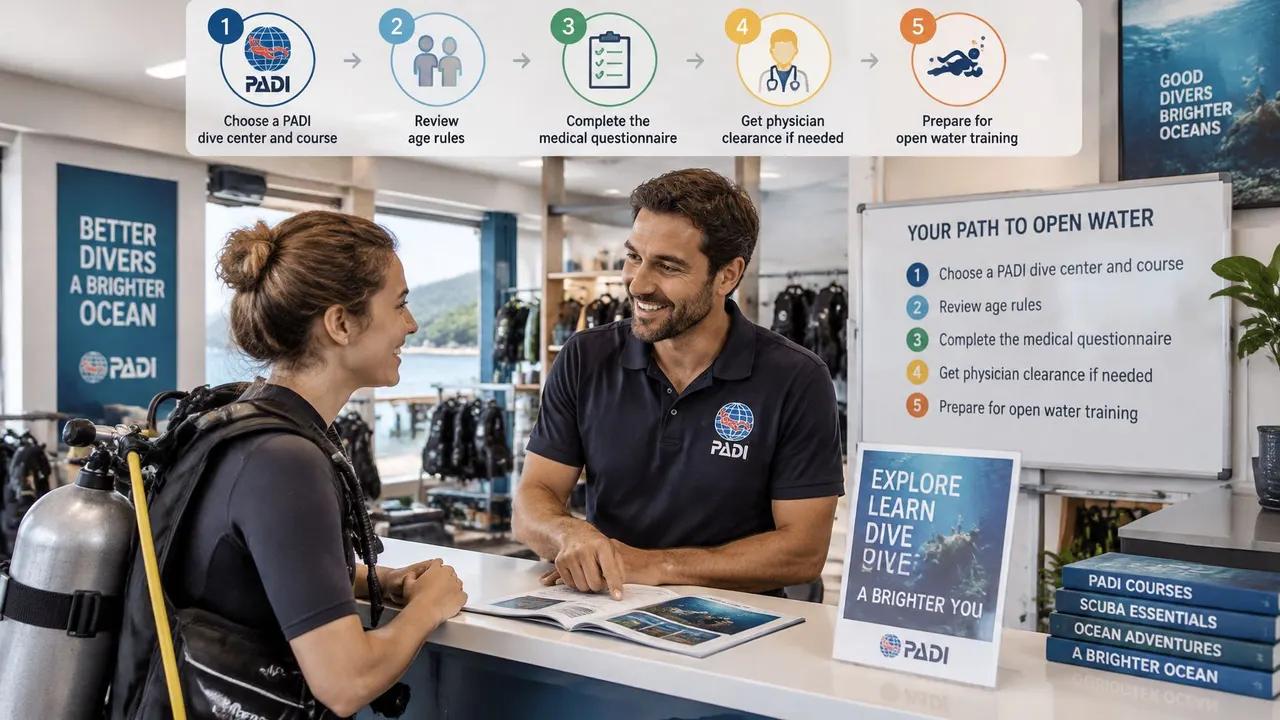
- Select your dive center and training format. Choose whether to complete the entire course in one location or use a referral arrangement. Confirm age eligibility, supervision and what the quoted course includes before reserving travel around it.
- Complete the medical paperwork early. Read every question rather than treating the form as a liability waiver. If physician sign-off is required, finish that appointment before your scheduled water sessions so missing paperwork doesn't prevent participation.
- Finish the academics with time to ask questions. You'll learn equipment functions, diving physics, safety procedures and dive planning. Our referral students complete 8 to 10 hours of eLearning before travel, so spreading the work across several evenings is more practical than leaving it until departure.
- Demonstrate your water skills. Your instructor evaluates the swim and float requirements before certification. Arrive rested and tell them if you're nervous, because uncertainty is easier to address before you're also managing unfamiliar scuba equipment.
- Practice in confined water. A pool or suitable sheltered-water setting lets you rehearse equipment use and emergency responses without the distractions of an ocean dive. Don't schedule your ocean departure so tightly that you have no room to repeat a difficult skill.
- Complete your supervised open-water dives. Our referral pathway includes four open-water training dives, during which you apply your learning in an actual diving environment. Your instructor evaluates performance, so participating in a dive isn't the same as automatically completing its requirements.
- Record your training and receive certification. Keep your log and certification details accessible for future operators. Before leaving, make sure you understand the conditions you trained in and which situations would call for additional instruction.
Leave room for learning
The most avoidable delays happen before the boat leaves: unfinished academics, missing medical clearance or incomplete confined-water work. A tightly packed vacation can turn a manageable delay into a missed training opportunity.
Progress when you can perform the required skills reliably, not because your calendar says it's time for the next dive.
Skills Your First Dives Will Test
Poor weighting, difficulty clearing a flooded mask and weak buoyancy control can make a beginner work much harder than necessary. The PADI Learn to Dive guide.pdf) identifies these as practical trouble spots and emphasizes confined-water practice before ocean training.
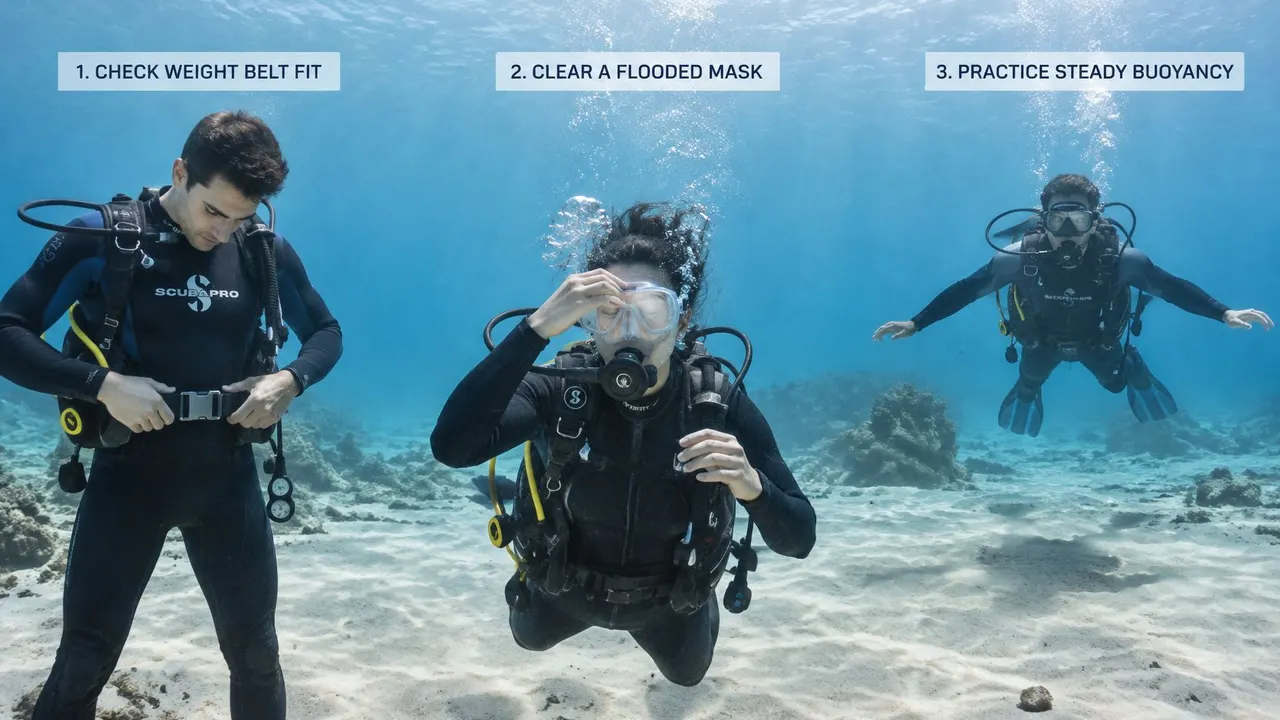
Too much weight can leave you compensating with extra air in your buoyancy compensator, or BCD. Too little can make a controlled descent difficult. Your instructor should help establish appropriate weighting in the equipment and water you'll use.
Mask clearing is another unfamiliar sensation, not a test of toughness. You'll learn to continue breathing through the regulator while using the taught technique to remove water from the mask. Practice gradually with your instructor instead of trying to push through mounting anxiety.
Respond to discomfort before it becomes a problem
Say you feel pressure in your ears during your first descent. Stop descending, signal your instructor and follow the equalization procedure you've learned. If needed, rise slightly under control and try gently again, rather than forcing your ears or continuing downward through pain.
The same principle applies when you feel overwhelmed: stop, communicate and address the cause. Your instructor can help with position, equipment or the pace of the exercise.
An introductory briefing covers equipment, ear equalization, clearing a flooded mask and recovering a regulator. Our instructor spends about 20 minutes going over the basics with a Discover Scuba participant before taking them diving. That briefing prepares you for supervised participation, not independent diving.
Prepare without teaching yourself scuba
Before an ocean session, useful preparation includes:
- Pool comfort: Swim regularly and become comfortable wearing a mask. Rehearse scuba mask-clearing procedures with an instructor.
- Relaxed breathing: Practice calm, continuous breathing on land. Don't turn preparation into breath-holding exercises.
- Equipment fit: Check that your mask seals and your fins fit securely. Establish weighting with your instructor in the actual exposure suit and water conditions.
- Underwater awareness: Learn to check your pressure gauge, recognize buddy signals and notice your position without constant kicking.
The aim is neutral buoyancy, where you remain at a chosen depth without standing on the bottom or swimming continuously to stay in place. Small adjustments and patient practice work better than large, hurried movements.
Safety Habits That Protect New Divers
A certification card confirms completed training. It doesn't remove the need for conservative decisions on every dive.
Divers Alert Network's comparison of diving risks identifies deep or long dives, cold water, heavy exertion at depth and rapid ascents as recognized risk factors for decompression illness. This condition involves inert gas forming bubbles after pressure decreases.
DAN reports decompression-illness fatality rates generally below 1%, while its broader comparison gives approximately 16 diving deaths per 100,000 participants. These measure different things: the outcome among illness cases versus deaths across diving participants. Neither figure predicts your personal risk on a particular dive.
Make conservative decisions before entering
The useful response isn't to fixate on a statistic. It's to establish habits that reduce avoidable mistakes:
- Agree on the plan: Review depth, time, communication and turnaround pressure with your buddy.
- Protect your gas reserve: Check your pressure gauge throughout the dive and communicate before you reach the agreed turnaround point.
- Control the ascent: Follow the ascent procedure you were taught and make the prescribed safety stop when conditions permit.
- Limit exertion: Don't chase wildlife or fight a current to preserve an itinerary. Signal your buddy and follow the agreed procedure for ending the dive.
- Stay within your preparation: Choose conditions, equipment and activities appropriate to your training and current fitness.
Breathe continuously while using scuba and never hold your breath during ascent. If something feels wrong, tell your buddy or instructor early rather than trying to hide the problem.
Take symptoms seriously afterward
DAN's risk-mitigation guidance advises urgent medical attention for neurological, respiratory or unusual pain symptoms after diving. Numbness, weakness, confusion, breathing difficulty or unexplained pain shouldn't be dismissed as ordinary fatigue.
Contact emergency medical services and explain that you've been diving. Don't take another dive to see whether the symptoms improve, and don't fly while waiting for them to disappear.
Slow down, stay within your limits and treat possible diving-illness symptoms as urgent.
Plan Your Travel Around Your First Dive
Minimum wait before flying after diving
The industry flying-after-diving summary gives the following recommended minimum intervals before ascending to 2,000 to 8,000 feet.
| Dive Pattern | Minimum Wait Before Flying to 2,000-8,000 ft | Trip Note |
|---|---|---|
| One no-decompression dive | At least 12 hours | Keep a buffer day when possible |
| Repetitive no-decompression dives over several days | At least 18 hours | Plan a buffer day before a flight or mountain trip |
| Dives requiring decompression stops | At least 24 hours | Build in a longer buffer and seek expert advice |
Treat these as minimum recommendations, not guarantees. Follow more conservative instructions from your training agency, dive computer or dive-medicine professional when applicable. Required-decompression diving isn't an entry-level activity; its inclusion in the table doesn't make it a beginner option.
Build the itinerary before reserving
- A single introductory dive: Choose a next-day flight only after checking the actual interval from surfacing to departure. The phrase “tomorrow morning” doesn't establish enough elapsed time.
- Several diving days: Finish diving before a buffer day, then fly afterward. Use the nondiving day for low-altitude sightseeing rather than a mountain excursion.
- An unexpected flight change: If an earlier departure compresses the interval, change the flight or skip the final dive. Don't squeeze the waiting period to preserve both bookings.
No-decompression doesn't mean no risk. It means the planned profile doesn't require decompression stops, not that dissolved gas immediately leaves your body when you surface.
Stay hydrated, avoid alcohol and strenuous activity after diving, and remember that hydration doesn't cancel an unsafe schedule. Mountain roads and high-altitude excursions also deserve planning, even when no airplane is involved.
The cheapest turnaround can become a poor choice if it leaves you rushing your last dive or changing plans at the airport.
Book Your First Supervised Dive
Choose a supervised introduction if you want to test your comfort underwater. Choose Open Water training if you're ready to work toward certification and keep diving.
Kona Honu Divers provides Big Island scuba diving experiences in Hawaii, with training for beginners and opportunities for suitably qualified divers, including an advanced long-range dive trip. Your first booking should match your current ability, not an experience you hope to qualify for later.
Our Morning Introductory Scuba Dive costs $449 before taxes and fees. It includes two dives, scuba equipment, online eLearning and private or semi-private instruction. It's a Discover Scuba Diving experience, not a certification, and requires no prior diving experience, with a professional in the water alongside you.
Put the practical pieces in place
- Finish your health screening. Complete the medical questionnaire and obtain any required physician sign-off before your dive date.
- Choose a compatible date. Allow time for the learning materials and protect the post-dive interval before flights or altitude travel.
- Reserve the appropriate experience. Check availability for the introductory option or arrange certification training if that better fits your goal.
Bring questions about anything you don't understand, especially medical paperwork, supervision and your onward itinerary. You don't need to sound knowledgeable to begin. You need to be willing to learn, communicate and pause when something needs attention.
Kona Honu Divers offers supervised introductory dives and beginner certification training to help you start with instruction appropriate to your experience. Visit Kona Honu Divers to choose your first diving experience and reserve a date that fits your health preparation and travel schedule.