
You're staring at a dozen tabs for scuba dive shops in Kona, Hawaii, and every site promises clear water, expert guides, and the night dive of your life. The photos look similar, the prices are close, and you still don't know which operator will cancel when the swell turns or which one fits a partner who only snorkels. I'd narrow the list by what a shop can prove, how it handles changing conditions, and how it behaves at crowded, shared sites.
Five Checks That Separate a Reliable Kona Dive Shop
Kona has a long list of operators, and the fastest filter isn't a polished homepage. It's paperwork, reef conduct, and a clear answer about bad weather. Run the same five checks on every shop and write down the answers side by side.
| Criterion | What to verify | Red flag |
|---|---|---|
| Permit and legal status | Current Hawaii commercial activity permit, valid for no more than one year | Cannot show a current permit |
| Awards and claims | Named award, year and category that can be checked | Vague 'best in Hawaii' claims with no source |
| Review pattern | Steady reviews across many trips, with detail about guides and safety | Few reviews, or only generic praise |
| Reef conduct | Briefing states that guests must not touch coral or living reef | No mention of reef protection |
| Conditions policy | Clear rule to cancel or switch sites when the forecast or entry turns unsafe | Dives regardless of conditions |
Start With the Permit, Then the Proof
Ask for the Hawaii commercial activity permit first. Under Hawaii's compiled boating and ocean recreation rules, commercial scuba and snorkeling operations require a commercial activity permit that's valid for no more than one year, so ask to see a current-year document. The same rules require operators to prohibit participants from touching coral or living parts of a reef. If a shop can't show the permit or won't state the no-touch rule in its briefing, you don't need to debate boat size or lunch options.
Awards work the same way. Ask which award, which year, and which category. A checkable claim sounds like this: Kona Honu Divers won the Scuba Diving Magazine Reader's Choice Award for the best dive company in the Pacific. That's a named publication, a named award, and a named category. A vague banner that just says "best in Hawaii" with no source isn't proof, it's copywriting.
Read Reviews for Patterns, Not Stars
Don't sort by the highest average and stop. Read for repetition across many trips. Do reviewers name guides, describe briefings, mention a site change handled well, or note that the crew checked air and kept the group together? That detail tells you how the boat runs.
Generic praise tells you almost nothing. Ten reviews that say "amazing experience" and nothing else could describe any sunset in Kona. I'd trust a shop with steady, specific comments about safety and guiding over one with a perfect score built on thin write-ups.
Practical rule: If a shop answers the permit, award, reef, and weather questions in one short email, it's probably organized on the water too.
Finish with the conditions policy. Ask exactly how the shop decides to cancel or switch sites, who makes the call, and when you'll hear about it. A reliable operator will describe checking the forecast, looking at the actual entry, and moving to a backup site or rescheduling. A shop that implies it always dives, no matter what, is telling you its schedule matters more than your exit through surge. Keep the five answers for each shortlisted shop. The operator that answers all five clearly is usually the one worth booking.
Match Your Trip to Your Skill and Comfort Level
Most certified visitors fit the morning reef trip, but that doesn't mean it's right for everyone in your party. Choose by experience and comfort first, then by the animal or photo you hope to see. A trip that's too advanced turns a vacation dive into task loading.
| Trip | Best for | Experience needed | Main trade-off |
|---|---|---|---|
| 2-tank morning dive | Certified divers who want reef, lava tubes and arches in one morning | Open Water or higher | Sites depend on the day's conditions |
| Premium advanced 2-tank trip | Experienced divers wanting remote sites, deeper water and drift dives | Certified, with advanced experience | Less suited to new divers; conditions matter more |
| Morning introductory scuba dive | Beginners who want to breathe underwater for the first time | No certification needed | Short, shallow and guided only |
| Manta ray night dive | Divers and snorkelers wanting a close night encounter with mantas | Comfortable in the water at night | Depends on manta activity that night |
| Blackwater night dive | Experienced divers comfortable in open water who accept uncertain sightings | Experienced, comfortable in open ocean | Sightings are not guaranteed |
| Snorkel ride-along on dive boat | Non-diving companions joining a dive charter | No certification; snorkel gear | Surface only; stays with the boat |
The 2-tank morning dive on the diving tours page suits certified divers who want coral gardens, lava tubes, and arches without committing to the most exposed sites. If you're newer or returning after a break, our guide to Big Island scuba diving for beginners helps you judge whether to start there or book a refresher first. Don't use a premium trip to test skills you haven't practiced recently.
Experienced divers who want remote sites, deeper water, and drift dives should look at the premium advanced 2-tank trip. Be honest about buoyancy, air consumption, and comfort if the current picks up. Advanced doesn't just mean deeper. It means you can hold position, follow the guide's plan, and end the dive with reserve gas when conditions add work.
Plan Mixed Groups as One Group
If you've never dived, the morning introductory scuba dive is short, shallow, and guided. It's a sensible first step, not a shortcut to a regular charter. For non-diving companions, snorkelers and ride-alongs can join our dive boat trips, and you should tell us when booking if your party includes snorkelers so we can plan space, gear, and supervision.
Mixed activities still need one safety plan. Hawaii's Department of Land and Natural Resources snorkeling and diving guidance requires a diver's flag for scuba and freediving, and at night the flag must be illuminated and identifiable from at least 100 feet, with ocean users generally surfacing within 100 feet of it. Every diver in the group must stay within that distance even when one flag serves the group. That rule shapes where a snorkeler can wait, where a freediver can work, and why the whole party shouldn't improvise separate plans at the same site.
Manta Night Dives and Blackwater Trips Compared
The choice at night is reliability versus uncertainty. Do you want a structured encounter at a known feeding site, or an open-ocean drift where the animals decide whether to show up? Both are legitimate, but they're not interchangeable.
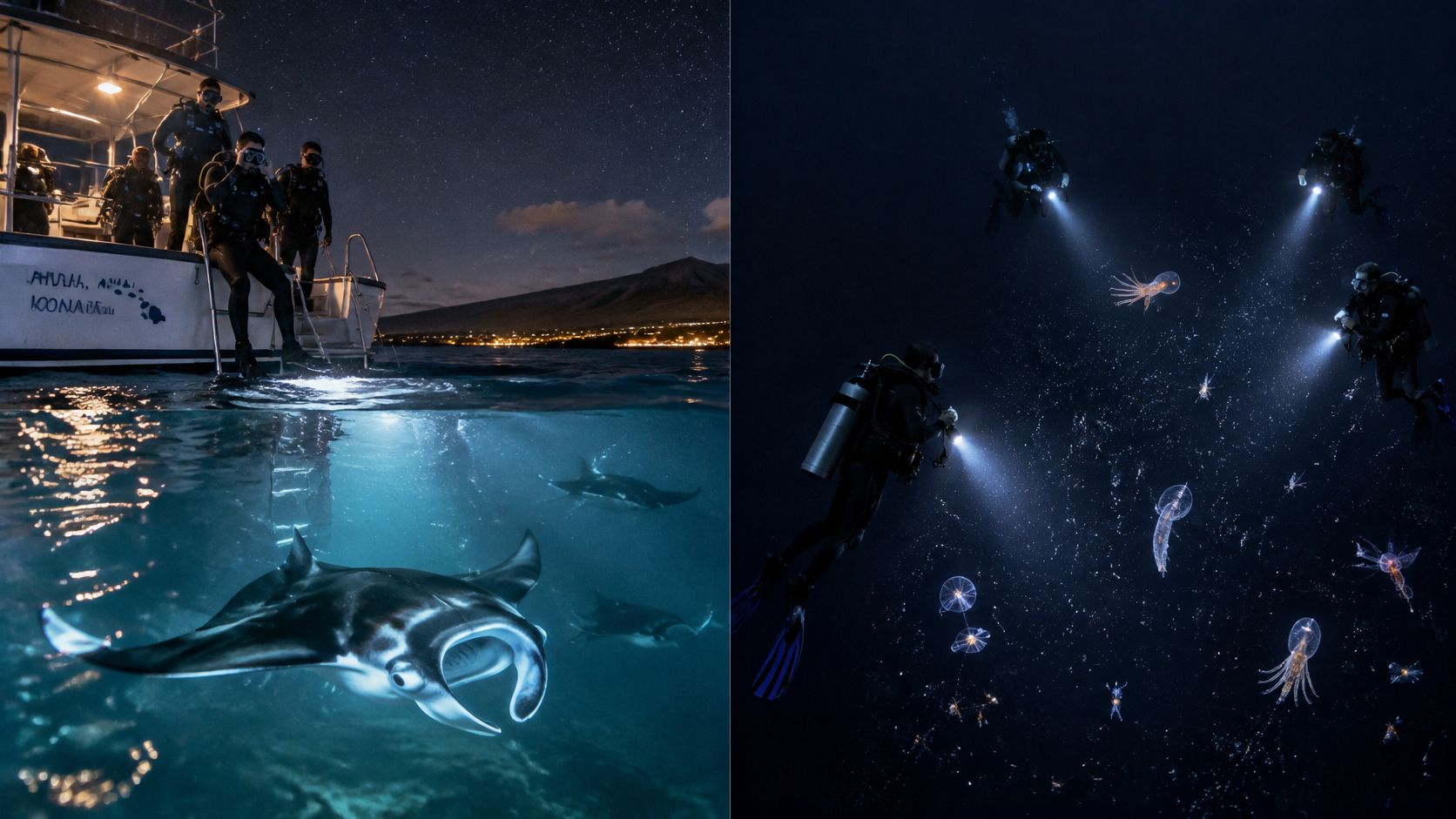
Manta Diving Is Location Based
Kona's manta viewing is concentrated at two named nighttime feeding locations, Makako Bay, also called Garden Eel Cove, and the coastline fronting Sheraton Keauhou Bay, where Hawaii's Department of Land and Natural Resources manta site notice explains that manta rays congregate at night to feed on plankton. You're not wandering the reef hoping a ray passes. You're positioned at a recognized viewing area while lights concentrate plankton and mantas feed through it.
I recommend Garden Eel Cove as the superior choice for the manta tour because its protected location gives a better viewing area and better reefs. Divers can settle in a calmer setting, snorkelers get a clearer view from above, and the reef around the site makes the earlier twilight dive worthwhile in its own right. You can compare the format on the 2-tank manta dive and snorkel tour page and read more about diving with manta rays in Kona before you pick a night.
That popularity carries a responsibility. The state has documented coral damage near a popular manta-site mooring at Makako Bay, so follow the briefing exactly. Control your buoyancy, keep fins off the bottom, secure gauges and lights, and don't kneel on living reef to get a steadier camera shot. At a shared site, your trim protects both the coral and the next group's view.
Blackwater Is a Different Contract
A blackwater dive puts you in open ocean at night watching pelagic animals that migrate vertically toward the surface. There's no reef to orient you and no resident animal tied to a cleaning station or feeding area. Think of it as research-adjacent observation. Some nights produce a parade of larval fish, jellies, and squid. Other nights are sparse, and that's not a crew failure.
Book the blackwater night dive tour only if you're experienced, comfortable with black water below you, and able to hold neutral buoyancy while managing a light or camera. Photographers need to be especially honest. A large rig, strong strobes, and poor trim make you a hazard to yourself and to delicate animals drifting past.
Choose manta for a close, structured encounter at a known site. Choose blackwater when you'd enjoy the observation itself even if sightings stay thin.
If this is your only night dive in Kona and mantas are the priority, don't gamble it on blackwater. Book mantas first, early in your trip, and add blackwater later if you have the experience and a second night. That order protects your main goal while still leaving room for the stranger, less predictable dive.
Boats, Gear and Safety Checks on the Day
Most safety problems become visible on the boat, not in a brochure. Watch how the crew runs the sequence, explains the site, and tracks people between dives. A calm, repetitive routine is a good sign.
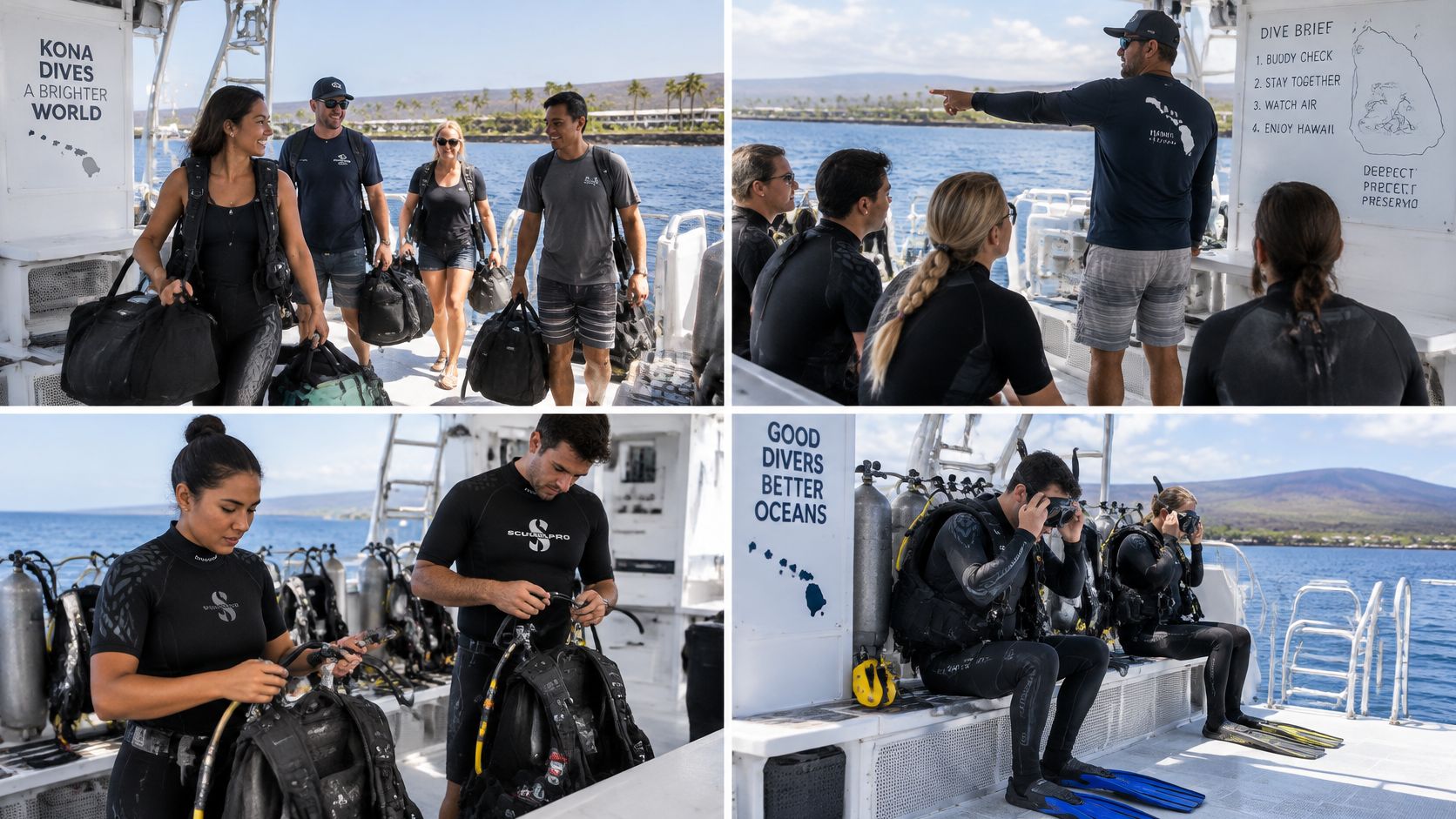
A typical Kona Honu Divers dive day runs in this order:
- Arrival and gear setup: Check rental fit now, not at the entry.
- Briefing on site conditions and entry style: Listen for current risk, entry method, and exit plan.
- Dive one at the deeper or more condition-sensitive site: Conditions get first priority while everyone is fresh.
- Surface interval: The crew should account for every diver and discuss how dive one went.
- A more relaxed dive two: A simpler profile after the main site is done.
What to Inspect Before You Get Wet
- Shaded seating and storage: You need a dry place for bags and enough room to gear up without stepping over tanks.
- Hot showers: They matter after night dives and on windy rides back, especially if you're prone to getting chilled.
- Safety equipment location: Crew should be able to point to oxygen, first aid, and flotation without searching.
- Rental servicing: Ask when regulators and BCDs were last serviced, then check straps, inflator function, and mask fit yourself. Our scuba rentals page is the place to confirm what you need before arrival.
Screening isn't paperwork for its own sake. Hawaii's recreational activity liability statute identifies scuba or skin diving as an activity where a business must exercise reasonable care, and a waiver for inherent risks isn't automatically valid unless the operator disclosed those risks and took reasonable steps to ensure each participant is physically able and properly instructed. Skip any shop that doesn't ask about fitness, recent diving, or certification. That shop is skipping a substantive requirement, not saving you time.
Finally, judge conditions as three separate variables: visibility, surface entry, and current exposure. Don't pick a site on visibility alone. Ask how the guide chooses between a lava entry and a calmer site during a high-surf advisory, and confirm the backup site before you pay. A good day looks organized because those decisions were made early.
Certifications, Instructors and Nitrox Policies
Do you need a certification to dive in Kona? It depends on the trip, and guessing at the dock is the wrong way to find out. Match your card, or lack of one, to the row that describes you.
| Your situation | Certification needed | Depth or limit | What to bring |
|---|---|---|---|
| Never dived | Morning introductory scuba dive, no certification | Shallow and guided | Swimwear and sunscreen |
| Certified Open Water diver | Open Water certification from PADI, SSI or NAUI for most regular charters | Up to 60 ft (18 m) with a buddy | Your C-card |
| Certified diver booking advanced trips | Certification as required by the trip; confirm at booking | Set by the trip profile and your certification | C-card and logbook |
| Wants enriched air (nitrox) | PADI Enriched Air Diver course | Set by the planned dive profile and gas mix | C-card and course record |
| Non-diver in a dive group | No certification; snorkels with the group | Surface only | Snorkel gear |
For most of our regular dive charters, we require at least an Open Water Diver certification from a recognized agency such as PADI, SSI or NAUI, which allows diving to 60 feet (18 meters) with a buddy, and divers must bring their C-card. Digital proof is useful, but don't assume a shop can look you up quickly for every agency. Bring the credential and, for advanced trips, a logbook that shows relevant experience.
If you've never dived, start with the shallow, guided introductory dive and see how you handle breathing underwater, clearing your mask, and equalizing. Enjoying snorkeling doesn't guarantee you'll enjoy scuba. The intro dive answers that question cheaply before you commit to a full course.
Questions for Instructors and About Nitrox
- Agency credentials: Ask which agency certifies each instructor and whether they're current to teach the course you're buying.
- Kona guiding time: Ask how long your guide has worked these sites, not just how long they've been certified.
- Same guides on the boat: Ask whether instructors also run charters, which helps continuity if you train then dive.
- Combined experience claims: If a shop cites a large combined total, ask who it covers and what each person does. A total across retail, boat crew, and instructors means something different from instructor experience alone.
Nitrox requires the same precision. Ask whether it's included or charged, whether you need enriched air certification, and how the mix fits the planned profile. Our overview of nitrox diving benefits explains why longer no-decompression limits help on some profiles and matter less on shallow, short dives. Don't buy nitrox as a badge. Buy it when the depth, bottom time, and repetitive diving in your plan benefit.
Dock rule: Check the requirement row before you book, not after you arrive with your gear bag.
Price, Packages and Best Season to Dive
The useful cost question is what you'll pay in total, not what one tank costs. Price the same realistic day at every shop, for example two morning dives plus one night dive, and the differences stop hiding in add-ons.
| Cost line | What to compare |
|---|---|
| Per-tank or per-trip price | Same trip and dive count across shops |
| Rental gear | Included or charged per dive |
| Nitrox | Included, free or charged |
| Dive computer rental | Daily fee or included |
| Course fees | Only if you are certifying |
| Packages and multi-dive discounts | Whether the total beats separate dives |
| Cancellation terms | Refund window and weather rescheduling |
Build a simple three-column comparison for each shortlisted shop covering price for the same trip, included items, and cancellation policy. Include taxes and fees if the shop lists them separately. A lower headline price loses quickly if rental gear, a computer, and nitrox are all extra, while a package only helps if you'll use every dive in it.
Let Season Shape the Plan, Not Just the Price
Kona's leeward coast is generally protected, but exposed points and some sites can take larger swell in winter. That means more risk of site changes, rougher entries, and backup plans. Summer often brings calmer conditions on many west-side sites, which suits newer divers, photographers who need stability, and anyone doing a refresher.
Manta night dives run year-round, although the main viewing areas are shared by many operators and peak dates book up. Our guide to the best months to scuba dive in Hawaii can help you align your travel dates with the trips you want. Whatever month you choose, keep a flexible day or two so a forecast change doesn't erase your only chance at a signature dive.
Read cancellation terms before paying, because they differ between shops. Separate the weather policy from the personal-change policy. You need to know the refund window if you get sick, and the rescheduling rule if the operator cancels for conditions. I'd choose a slightly higher total from a shop with clear weather rescheduling over a bargain that leaves you arguing about a forecast.
Book Your Kona Dive With Kona Honu Divers
If your shortlist passes the permit, reef-conduct, briefing, and certification checks, book the shop that passes all of them instead of the one with the loudest claim. Kona Honu Divers was voted best dive operator in Kona, Hawaii and won the Scuba Diving Magazine Reader's Choice Award for the best dive company in the Pacific. Before relying on any award claim, including ours, check the named award, year, and category against its source. That's the same standard you'd apply to anyone else.
We offer a broad range of tours, from morning reef dives to manta and blackwater night dives and advanced trips, plus rentals, repairs, PADI courses, free nitrox, early diver discounts, and dive packages. Pick the trip that matches your experience, confirm your certification, tell us if snorkelers are in your party, and ask about dive computers when booking so we can confirm availability and any small extra cost. Book manta or blackwater nights early, and call us at 808-324-4668 if your group doesn't fit a standard category.
Conditions still decide the final site, so keep one flexible day in your plan. That's not indecision. It's how you get the dive you came for when Kona's weather changes its mind.
Ready to dive Kona's reefs, lava tubes, manta sites, and blackwater with a crew that checks conditions, briefs clearly, and protects the reef? Visit Kona Honu Divers to choose your trip, confirm your certification needs, and reserve your dates before peak nights fill.