
You're standing in the harbor as the sun drops, wetsuit half on, trying to decide if you've booked the right night, the right site, and whether a first night dive is a sensible idea at all. That's exactly where most visitors start with a Manta Ray Night Dive Hawaii trip. You don't need a promise that the animals will perform. You need a clear timeline, honest rules, and a reason to choose one site over another. If you're also comparing daytime options, our Kona diving tours run separately from the evening manta trip.
What Happens During a Manta Ray Night Dive
The first light comes on and the sand below you turns bright. You're not swimming into black water looking for something. You're settling into a lit circle, staying still, and letting feeding mantas come through the light above you.
That's the shape of the night. It's a guided, stationary dive where lights placed on the seafloor draw plankton, and resident reef mantas feed through that lit water. Powerful dive lights create a bright circle on the seafloor so divers are never in complete darkness, and experienced guides stay with the group to keep everyone safe and comfortable.
The Evening in Order
| Time | Stage | What Happens |
|---|---|---|
| Before sunset | Check-in and boat ride | Gear fit and safety check. Exact departure time is confirmed at booking so you arrive before dusk. |
| Before sunset | Crew briefing | Manta biology and passive observation rules explained. |
| Sunset, about 18:00 | Lights switched on | Bright circle on the seafloor. Divers settle on the sand. |
| After the encounter | Ascent and debrief | Return to the boat. Review what was seen. |
A six-year NOAA monitoring record found encounters generally began immediately after sunset, around 18:00, and lasted approximately one hour. Treat that as the working pattern, not a timetable the animals signed. Confirm your operator's current start time and planned duration when you book.
What a Good Pass Looks Like
Divers kneel on the sandy bottom while snorkelers float on the surface, so you're looking at the same feeding lane from opposite sides. A distant pass is a pale shape crossing the edge of the light. A close pass is different. The manta loops or rolls directly through the brightest water, mouth open, working the plankton concentrated there.
Practical rule: If you're chasing the animal for a better view, you're doing it wrong. Stay put and let the feeding lane come to you.
The briefing before you get in matters because it sets that behavior. Ours begins with a detailed briefing covering the science of what you'll see and the rules of passive observation. Listen for where to kneel, where to point your light, and how the group ascends.
After the encounter, you ascend as a group, get back aboard, and debrief what passed through. Note the time the first manta arrived, how thick the plankton looked, and whether passes stayed high or low. That tells you more about the night than a simple count does.
Why Kona Is the Place for Night Manta Encounters
Kona offers a repeatable night encounter because resident reef manta rays return to the same feeding sites after dark. You're not waiting on a migration window. You're visiting a place where a known local population feeds inshore, night after night, when food conditions line up.
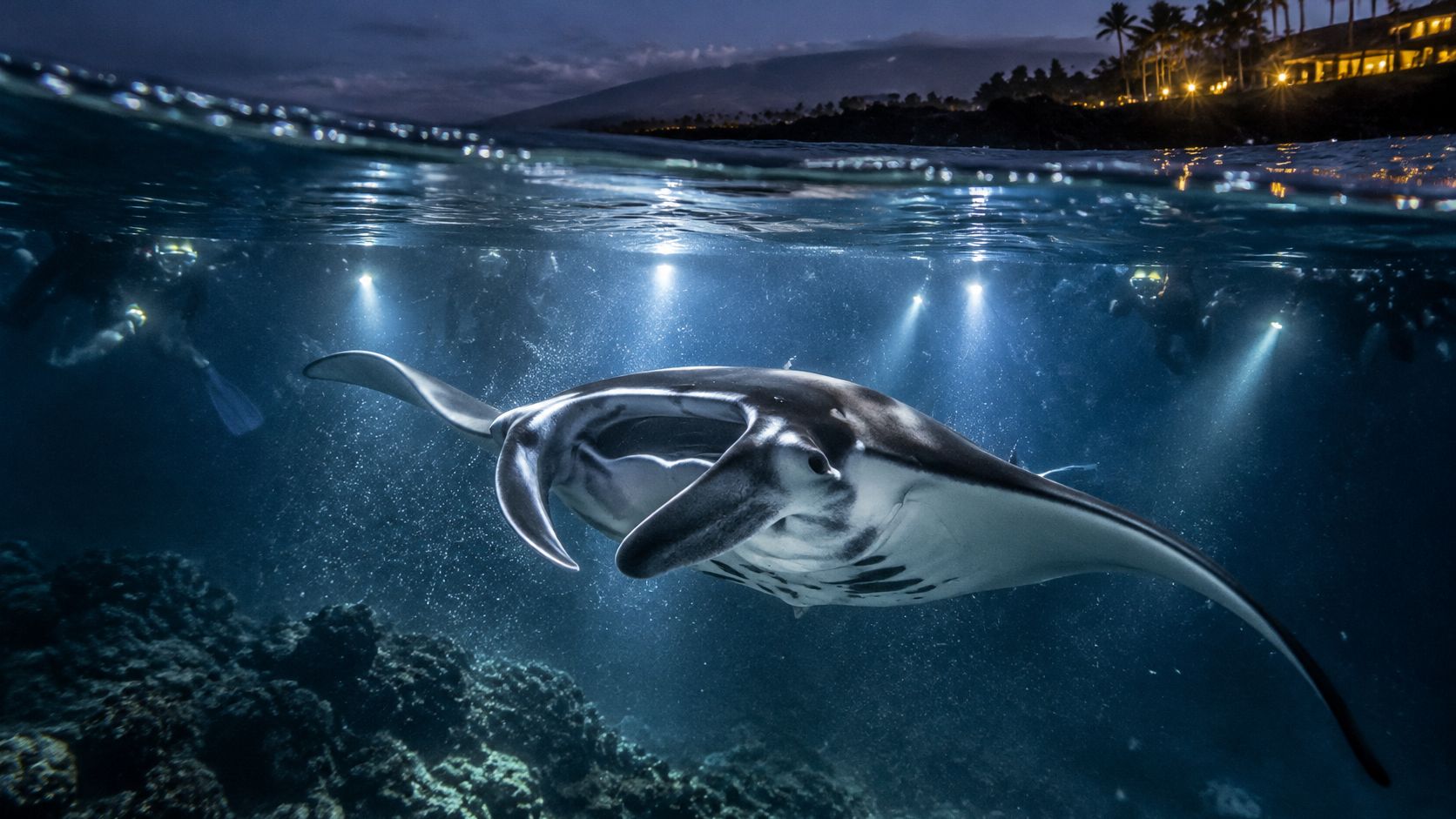
The history explains why. Kona Honu Divers' history of Hawaii manta dives places the beginning of regular night viewing in 1991, when underwater lights near the former Kona Surf Hotel attracted plankton and feeding reef manta rays, and by 1993 participation had expanded to as many as five boats and approximately 50 people in the water. When the hotel closed and the lights went, the site went quiet. When floodlights returned, the mantas returned. The lights were never magic on their own. The food chain was.
The Three Links That Make It Work
First, underwater lights concentrate zooplankton in the illuminated water column. Tiny animals gather where the light is strongest, and that patch of water becomes richer than the dark water around it.
Second, reef mantas, Mobula alfredi, pass repeatedly through that food-rich zone while filter-feeding. The barrel rolls people photograph aren't a performance. They're an efficient way to stay inside the densest plankton and keep feeding.
Third, divers and snorkelers stay in place and watch. You hold position outside the feeding lane, keep your light directed properly, and let the mantas choose how close a pass gets.
This is prey-mediated aggregation, not baiting. Nobody is feeding the mantas. The lights move the food, and the mantas follow the food.
That distinction sets your expectations. Encounter strength depends on plankton density, current direction, and water-column stability, not on how many lights are switched on or how bright they are. A strong current can sweep the plankton patch away from the viewing area. A still night can hold it right over the sand.
Kona's advantage is that the sites are discrete, known, and close to shore, and the same resident animals use them repeatedly. That's why the encounter is predictable in a way most wild manta sightings aren't. Predictable still doesn't mean scripted. The rules that protect the feeding corridor shape every night, whether one manta shows up or a dozen do.
Why Garden Eel Cove Gives the Best Viewing
Garden Eel Cove is the better site for a manta night dive. Its protected, sheltered location gives calmer, clearer water and a more stable viewing area than exposed sites, and that stability is what a stationary night dive needs most.
I'd choose shelter over novelty every time for this dive. You're kneeling on sand in the dark, managing buoyancy and a light, and trying not to stir up the bottom. Calmer water makes all of that easier, especially if it's your first night dive.
The Bottom Does the Work
The Underwater Atlas guide to Garden Eel Cove describes it as a gently sloping sandy plain containing scattered coral heads and lava-rock formations. That profile matters in three practical ways.
- A defined place to settle: Divers position in a specific viewing area on the sand at a well-established site, rather than hovering over reef and guessing where to stop.
- An open water column: With the group low and still, the lit water above stays clear for manta passes instead of filling with fins and bubbles at feeding height.
- Reef nearby: Adjacent reef and lava structure give more varied habitat than a featureless sand flat, so the dusk portion of a two-tank trip has something to look at before the lights take over.
Long-term Kona monitoring supports the choice. Garden Eel Cove generally supported larger manta groups than Keauhou, which fits a site with an open, structured layout and room for animals to circle and feed. If you're weighing the two main areas, our comparison of Manta Heaven and Manta Village lays out how the sites differ.
Built for Staying Still
Stationary observation suits this cove because guests stay put while mantas work the light. You're not following animals across a reef, and you shouldn't be. The same site guidance recommends carrying both a primary and a backup dive light, remaining within the illuminated area, and preserving buddy contact throughout the dive.
Use this test for any operator's site. Is it sheltered, does it have a sand viewing area, and is there reef nearby? If a site misses two of those three, ask harder questions.
Kona Honu Divers often takes its manta ray charter to Garden Eel Cove, and builds the tour around that protected viewing setup. You can check the format on our manta ray dive tours page before you commit to a date.
Who Can Join and the Safety Rules That Matter
Certified divers join the dive. Snorkelers join from the surface. The flagship trip suits levels from beginner to advanced, but beginner-friendly doesn't mean unstructured. You still need basic control in the water and the discipline to stay where the crew puts you.
| Participant | Requirement | Notes |
|---|---|---|
| Certified scuba diver | Current certification | Kneels on the sand inside the lit viewing area |
| Snorkeler | Comfortable floating at the surface | Views from the surface rather than the bottom |
| First-time or beginner diver | Basic skills and buoyancy control | Experienced divemasters and instructors are in the water with the group |
| Manta specialty diver | PADI Manta Ray Diver course recommended | Covers manta biology, behavior and conservation |
| Child (under 5) | Age and swim ability | Must meet the operator's minimum age, confirmed at booking before travel |
If you want to understand what you're watching, I recommend the PADI Manta Ray Diver specialty course before the night dive. It covers manta biology, behavior, and conservation, so a feeding roll reads as behavior rather than just a photo opportunity.
The Rule With No Exceptions
No touching, no chasing, and no blocking a manta's feeding path. Touching can damage the animal's protective mucus layer, which helps guard against infection. Pursuit disrupts feeding and increases stress, and it usually ruins the encounter for everyone behind you too.
Crowding is the risk most visitor pages gloss over. Hawaii Ocean Watch reports that 25% of regularly observed mantas show signs of human-caused injury and that fewer than half of operators comply with stated industry standards. Those figures come from an advocacy organization, so treat them as cautionary rather than definitive population estimates. Hawaiʻi's Division of Aquatic Resources independently confirms mantas can be injured by boat strikes and entanglement, with propeller injuries potentially fatal.
Questions to Ask Before You Board
- Group density: What's the maximum number of people in the viewing area at once?
- Guide ratio: How many in-water guides per guest group, and where do they position?
- Propeller protocol: What happens with boat engines while mantas and swimmers are near the stern?
- Extraction plan: How does the crew get a tired or panicked participant out quickly?
- Cancel or relocate: What conditions make the captain move sites or call the night off?
A low-risk briefing names all five without you having to drag the answers out. Our guide to responsible diver etiquette covers the in-water habits that sit behind those questions.
In the water, keep it simple. Hold neutral buoyancy, minimize fin kicks near the sand so you don't cloud the light, and keep conservative spacing so a turning manta never has to dodge you. If the viewing area looks full, say so before you enter. A good crew would rather reseat a group than stack divers into a feeding lane.
Gear and Preparation Checklist for Night Diving
Sort your kit the day before, not on the dock. Night diving punishes small oversights. A dead light or a missing certification card is a minor annoyance at noon and a trip-ender at sunset. Our guide to scuba diving at night is worth a read if this is your first dive after dark.
Bring
- Primary and backup dive light: Independent site guidance for Garden Eel Cove recommends both. Test them at home, charge or replace batteries, and don't assume the boat has a spare that fits your hand.
- Exposure protection: A wetsuit suited to the water temperature, plus mask, fins, and snorkel that you've worn before.
- Certification card or logbook: Divers need proof of certification ready at check-in, not buried in a hotel safe.
- Reef-safe sunscreen: Apply it before the boat ride out, while there's still sun, not over the side at the site.
- Dry bag essentials: Towel, dry clothes, and a light layer for the ride back. You'll be wet, and the harbor breeze feels colder than you expect.
- Motion-sickness tablets: Take them in good time if you know you need them. They don't work well once you're already queasy.
- Food and water: Something for after the dive. You'll come up hungry.
Check
Rental gear solves most gaps, but only if you confirm sizes ahead of time. Call through your wetsuit and fin sizes when you book, and ask whether the crew provides lights or expects you to bring your own. Guessing on either wastes the calm half hour before departure.
Arrive early enough for the briefing. If you're rushing a gear fit while the crew explains the viewing area, you'll miss the part that keeps you out of the feeding lane.
Before You Get In
Run four quick confirmations with your buddy. Buddy agreed and close enough to reach. Light tested on the surface, not at depth. Ascent signal agreed so there's no confusion when the guide calls the dive. Viewing-area rule repeated aloud, stay inside the light, stay low, don't chase.
Keep your light use inside the illuminated area and don't point the beam into the animals. Your light is for orientation and for holding the plankton patch. Sweeping it around the darkness does neither, and it breaks your buddy's night vision. Small, boring discipline is what makes a night dive feel easy.
Best Season and Time to See Manta Rays
Kona's resident reef mantas are present year-round, so there's no single best month to book. That's the honest answer, and it's also the one people resist. They want a calendar date that guarantees a big night. The calendar doesn't decide this. The night's food does.
What Actually Decides the Night
Sunset timing sets when the lights go on and the feeding window opens. Everything else on the trip, departure, briefing, entry, is built backward from that moment, which is why start times shift across the year.
Plankton density drives how many mantas gather and how long they stay. A 2026 peer-reviewed study in Environmental Biology of Fishes analyzing 13 years of community-sourced observations found more than 23,000 sightings involving 167 individually identified reef manta rays, with aggregation size varying seasonally and annually and positively correlated with zooplankton density.
Moon phase, weather, and water movement shape where that plankton travels and how well you can see it. The same study notes those factors may influence manta numbers and behavior more than a simple calendar-season claim.
Dependable Pattern, Variable Nights
The long record is reassuring. Six years of monitoring at Kona's two principal sites recorded tens of thousands of sightings of a cataloged, individually identified population, with one site accounting for the large majority of observations. These aren't lucky one-off encounters. They're a resident population using known feeding areas.
A quiet night usually reflects food conditions, not a failed trip. If the plankton isn't concentrated, the mantas feed somewhere else, and no crew can light its way out of that.
Persistent nighttime aggregations have continued through sustained tourism and artificial-light feeding conditions. Persistence still isn't a guarantee of a large group on your specific trip. Animal presence in the area and a close pass over your head are two different things, and only the first is reasonably predictable.
Plan around that uncertainty instead of pretending it away. Book early in your stay so a second date exists. Keep dates flexible if you can. Check the forecast the day before, and read our notes on when to dive with manta rays in Kona before you lock flights around a single evening. I'd rather you book two possible nights in an ordinary month than one fixed night in a month somebody called peak season.
Photography Tips for Capturing Mantas at Night
Start with the constraint, because it governs every setting. The lights are part of the feeding system, so your photography has to work inside the lit viewing area and inside the no-chase rule. If a shot requires leaving your spot, you don't take it.
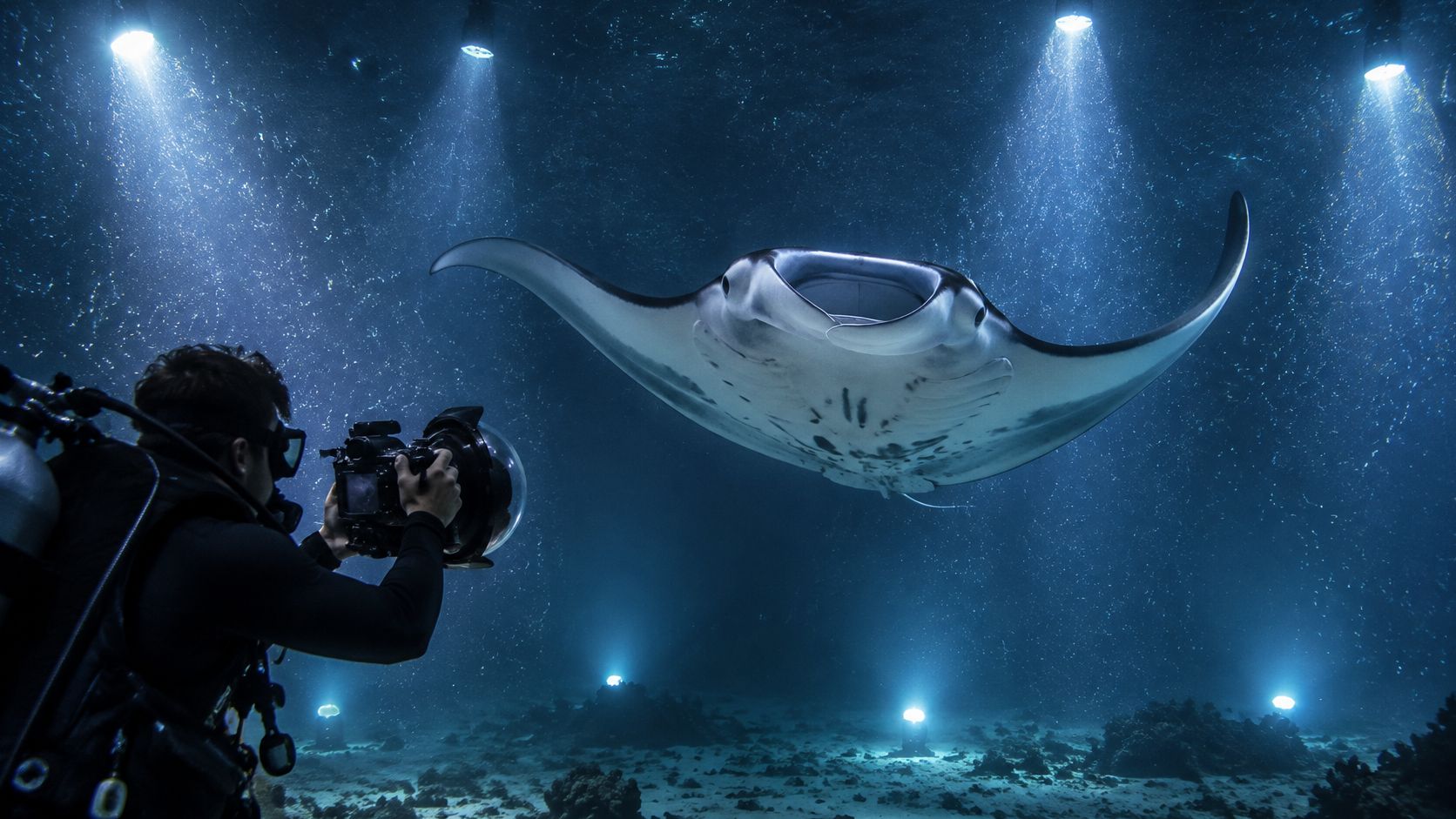
Set Up Before You Get Wet
- Fit a wide-angle lens: Close passes fill the frame fast. A long lens turns a manta overhead into a cropped wing and a missed shot.
- Raise your ISO: You're shooting in low light with a moving subject. Accept some grain rather than dragging the shutter and blurring every roll.
- Set manual white balance: Auto settings chase the changing light and shift the water color frame to frame. A fixed balance keeps the scene looking natural.
- Fire a test shot early: Check exposure on the lit sand before the first manta arrives, while fixing a setting costs you nothing.
Shoot From Stillness
Hold your position on the sand and let mantas come into frame. Compose for the top of the light circle, where a feeding loop usually crosses, and shoot as the animal enters rather than tracking it across the group. Tracking means turning, turning means fin wash, and fin wash means sand in everybody's light.
Don't fire strobes into a manta's eyes or sweep your light across the animals to find focus. Use the fixed lights for orientation, keep your own beam steady, and let the subject move through illumination that already exists. Browsing our Kona manta ray dive pictures before your trip shows the framing that works from a fixed spot.
When plankton is dense, visibility drops and backscatter climbs. Shorten your focus distance, get your strobes wide of the lens axis, and accept softer detail. A soft, honest frame beats a sharp shot of glowing specks.
Position matters more than gear. Settle where you won't be down-current of another diver's kicked-up sand, and keep the camera clear of the bottom when you adjust your kneeling spot. One careless fin behind you can end your visibility for minutes.
Edit with the same restraint. Crop for the animal's shape and the arc of the roll, keep the water dark where it was dark, and don't stage a frame into something the night didn't give you. The encounter is strong enough without help.
Answer Your Questions and Book Your Night Dive
Start with the money, because that's what you're checking first. Hawaii.com's guide to Big Island manta ray tours, updated in 2026, listed typical Kona manta night-dive prices of approximately $149 to $180 per certified diver. Check the current rate with your operator before you build a budget around it.
| Option | Who It Suits | Typical Price |
|---|---|---|
| Manta Ray Night Dive | Certified divers | About $149 to $180 per diver, Hawaii.com 2026 guide |
| Manta Ray Night Snorkel | Snorkelers and freedivers | Priced separately from the dive. Confirm the current rate at booking. |
| 2-tank manta ray charter | Divers wanting a daytime and night pairing | Priced separately as a charter. Confirm the current rate at booking. |
Short Answers Before You Book
- Do I need certification? Yes for the dive. No for the snorkel, where you view from the surface.
- Are mantas guaranteed? No. They're wild animals. You get a strong chance at a known feeding site, not a promise.
- Can families and beginners join? Yes, with guided support. Experienced divemasters and instructors are in the water with divers on our trip.
- What if the viewing area is full? Ask the crew before boarding what happens then. A clear answer is part of a good briefing.
Timing matters as much as price. The most popular trips, including this one, often sell out weeks in advance, so book early and keep a second date in mind. That's also your insurance against a quiet first night.
Capacity may tighten further. A 2025 report stated that Hawaiʻi's Department of Land and Natural Resources planned to reduce manta-ray vessels at Keauhou and Makako Bays from roughly 70 to 24. Treat that as a reported plan, book early, and confirm your operator's current permit status before you travel.
Make the decision in order. Confirm the site, Garden Eel Cove for shelter and a defined sand viewing area. Confirm your eligibility, certification for divers, surface comfort for snorkelers. Confirm the time, built around sunset. Then book.
Kona Honu Divers runs the Manta Ray Night Dive at Garden Eel Cove with experienced divemasters and instructors in the water, a detailed pre-dive briefing, and options for certified divers and surface snorkelers from beginner to advanced. If you want a stationary, closely supervised night with Kona's resident mantas rather than a swim-around in the dark, visit Kona Honu Divers and lock in your date while the popular trips still have space.