
Table of Contents
- The Briefing Sets the Night
- You're Not Sitting in Darkness
- A Pre-Departure Check That Matters
- The Skill That Counts Most
- What to Ask Before You Book
- The Layout Difference
- A Temporary Feeding Opportunity
- Why Still Water Feeds Better
- On the Bottom and at the Surface
- Camera Settings for a Still Diver
- A Camp Versus a Pileup
- What the Evidence Does and Doesn't Say
You're probably looking at photos of a huge ray looping inches overhead and wondering if night dives really work like that, or if you'll be swimming in the dark hoping something shows up. It doesn't work by chasing. On a good manta ray night dive in Kona, you stay still in one marked camp, lights hold plankton in a bright column, and reef mantas come to you to feed. Pick the right row, scuba or snorkel, pick a protected site, and keep the water calm. That's the whole job.
What Happens on a Manta Ray Night Dive
Start with where you'll be, because that answers most first questions before gear even comes up.
| Role | Where you stay | Depth | What you need |
|---|---|---|---|
| Certified scuba diver | Kneel in the marked sandy viewing area | About 30 to 70 feet | Open Water certification |
| Snorkeler | Float at the surface above the lights | Surface | No scuba certification |
| Divemaster or instructor | In the water with the group | Same camp as divers | Crew, not a guest ticket |
The Briefing Sets the Night
We start with a detailed briefing explaining the science behind the dive and the golden rules of passive observation. You'll hear where to kneel, where not to fin, and why the center of the light stays empty. That talk isn't filler. A group that understands the setup settles faster, kicks up less sand, and gives mantas a clear lane.
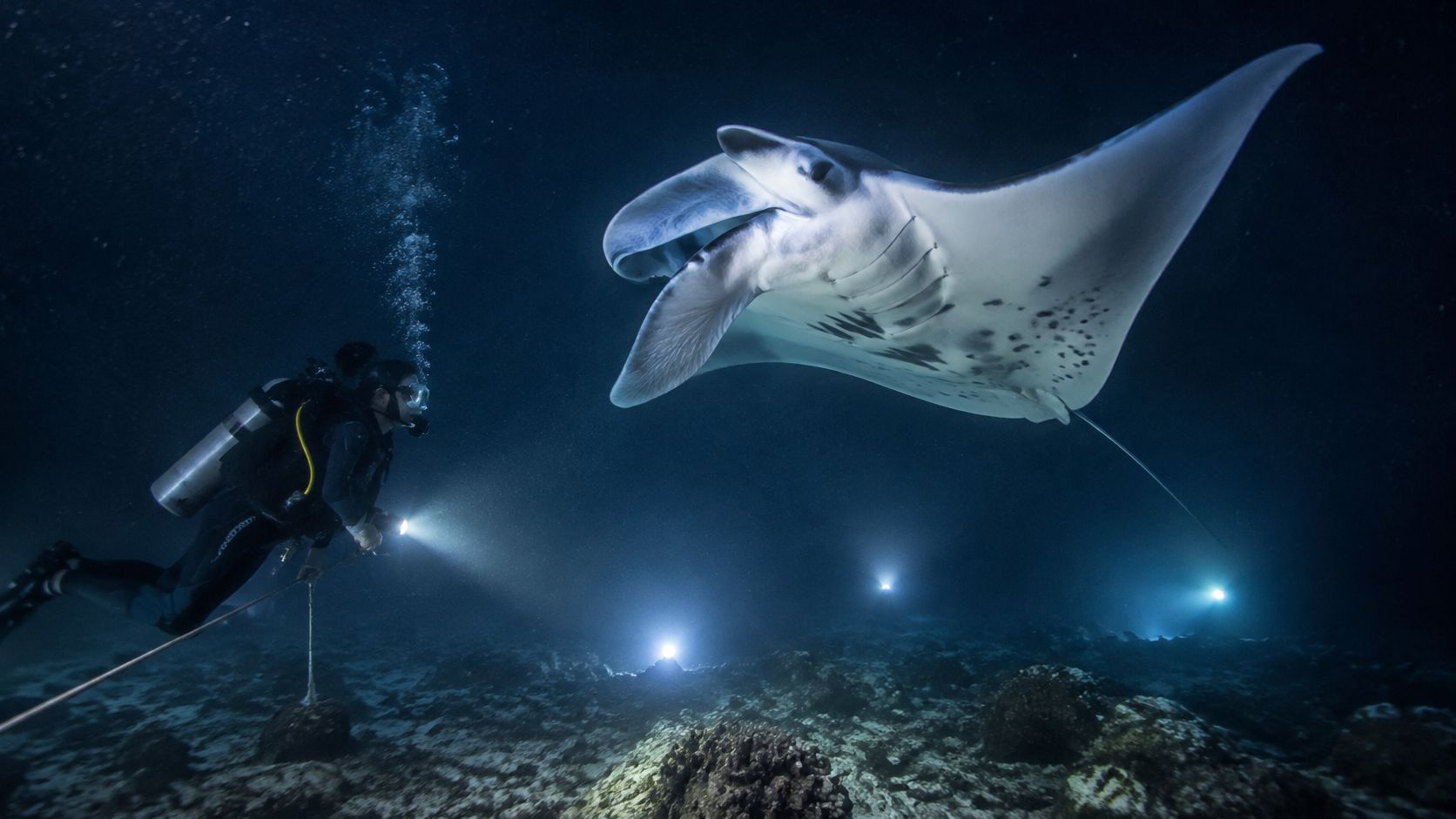
The boat anchors over sand after dark and the crew places a powerful set of lights on the seafloor. Divers descend together, find the specific viewing area, and kneel on the sandy bottom. Snorkelers stay on the surface above the same glow, looking down as mantas rise toward them.
You're Not Sitting in Darkness
Those lights create a big, bright circle on the seafloor, so you're never in complete darkness. Plankton gathers in the beam, the water starts to sparkle with food, and then a dark shape banks in from the edge. A reef manta loops through with its mouth open, rolls, and comes back for another pass, often close enough that you have to resist leaning back.
Stay low, stay still, and let the ray choose the distance. Movement from you rarely improves the view.
Experienced divemasters and instructors stay in the water with the group to manage spacing and redirect anyone drifting into the feeding lane. It's stationary and closely supervised, not a tour where you follow a guide around a reef. If you're used to covering ground on a night dive, reset that expectation here.
At Garden Eel Cove, site information for the dive area places the camp at approximately 30 to 70 feet, with a defined viewing area and a comparatively protected layout that can concentrate feeding activity above divers. That's ordinary recreational, no-decompression depth, and it suits first-time night divers and photographers who can hold one spot.
Match yourself to a row in the table before you think about cameras or extra dives. If you're certified and calm at night, the bottom camp gives you the classic view looking up. If you're not certified, the surface option for the manta night still puts you directly over the action without a tank.
Certification Rules and What to Pack
Scuba on this night is for certified divers only, and Open Water is enough because the camp is stationary, guided, and shallow. Uncertified guests don't sit out, they watch from the surface as snorkelers and don't need a card at all.
That split is simple. The harder part is showing up with weighting, lights, and warmth sorted so you can stay still for the full dive.
A Pre-Departure Check That Matters
- Bring your certification card: Have the physical card or a digital version ready, and tell the crew when you last dived and whether you've dived at night before. They'll place you better if they know.
- Dress for the surface interval: Pick a night-appropriate exposure suit for bottom time, then add a warm dry layer for the ride home. Divers often get cold after the dive, not during it.
- Carry a primary light plus a small backup: Aim your beam at the camp or the sand when you're not watching a pass. Never swing it into another diver's mask, which kills their night vision in a second.
- Set weighting for a still kneel: You want to settle on sand without finning to stay down. A pound or two makes the difference between hovering calmly and stirring the bottom all night.
- Leave gloves out of the plan: Unless we ask for them for a specific reason, you don't need them. Nothing in your kit is for grabbing, steadying yourself on reef, or reaching toward a ray.
- Pack the boring basics: Apply reef-safe sunscreen well before boarding if your trip starts before sunset, then bring a towel and dry clothes. You'll thank yourself on the harbor ride back.
The Skill That Counts Most
Extra specialty cards don't make this dive. A clean hover over sand and a slow, controlled descent do. You need to stop without planting fins, hold depth while a wing passes over your head, and exhale without blasting bubbles straight into a feeding mouth at close range.
If night buoyancy still feels shaky, fix that first. A daytime refresher or working through your Open Water certification skills again with an instructor will do more for this night than buying a brighter light. Divers who fidget, scoot for a better angle, or chase the edge of the circle usually see fewer close passes, not more.
Self-test: If you can't hover calmly on a night reef dive, choose the snorkel row or take a refresher first, and you'll enjoy the mantas far more.
Pack light, but don't pack casual. Card, suit, two lights, correct weight, towel, and a warm layer cover almost everything that goes wrong on this trip.
Ideal Conditions and Timing
The strongest signal on the night isn't the date on your booking. It's the plankton plume in the beam. Aggregation size follows zooplankton density, so a thick, snowy column usually means more feeding passes than a thin one, whatever the calendar says.
Ask us about plankton and sea state that evening rather than assuming last night predicts tonight. Currents move food, moonlight can change how concentrated it looks, and a site that's loaded one night can be quiet the next.
What to Ask Before You Book
- How has the plankton been: Thick or thin tells you more than a species list.
- What does wind and swell look like: Calm seas let the boat hold steady and let you kneel without surge pushing you around.
- Which site fits tonight: A protected cove earns its value when open water gets rough.
- How long will the evening run: Dives start after dark, so plan for a cooler surface interval and a later return than a daytime trip.
Season and moon phase can shift counts, but there's no fixed best date or hour you can circle and trust. Treat calendar advice on the best timing for Kona mantas as a helpful estimate, not a guarantee.
Book early for popular nights, and leave a one-night buffer in your itinerary. If we cancel or move the camp for sea state, a spare evening saves the whole plan. Strong wind or swell in the forecast means the protected cove is the right call, and sometimes it means no trip at all.
Why Garden Eel Cove Beats Keauhou
For a night built around more animals in a calmer camp, Garden Eel Cove is the superior choice. That's the verdict, and the long record backs it instead of one good week of tour reports.
A 2025 University of Hawaiʻi analysis examined more than 23,000 community-sourced reef-manta sightings recorded from 2010 through 2022 at Garden Eel Cove and Keauhou, identified 167 individual manta rays, and found aggregation size was associated with zooplankton density. Across that record, Garden Eel Cove generally supported larger manta aggregations than Keauhou.
The Layout Difference
| Site | Layout | Aggregation pattern | Best for |
|---|---|---|---|
| Garden Eel Cove | Protected from open-ocean swell, defined sandy viewing area, healthier nearby reef | Generally larger aggregations in the 2010 to 2022 record | First-timers, photographers, calmer nights |
| Keauhou | Historic night-feeding site, more exposed and more spread out | Smaller average aggregations than Garden Eel Cove | Backup when boats or conditions shift |
Protection changes everything underwater. Less swell means less surge across the sand, so you can kneel without bracing, keep fins still, and hold a camera steady while rays loop overhead. A defined viewing area also keeps the group in one ring instead of spreading people through the feeding lane.
The healthier nearby reef matters for the dive before and around the camp, too. You're not staring at rubble while you wait for the first pass, and the site feels like a real reef dive, not just a parking lot with lights.
Keauhou is a legitimate, long-running site and it can produce excellent nights. I wouldn't dismiss a trip there if conditions or boat logistics point that way. But it's the more exposed, more dispersed option, and dispersal is exactly what you don't want when your goal is repeated close passes over one group.
Plankton still sets the head count. A quiet cove with a thick plume beats a famous name on a thin-food night, every time. That's why I'd book Garden Eel Cove first if you're a newer certified diver or a photographer, and only move if the crew says conditions force it.
Why the Lights Pull Mantas In
Think of the lights as a campfire for plankton, not as food handed to the rays. Nobody baits mantas on this dive, and that distinction explains both why it works and why your behavior matters.
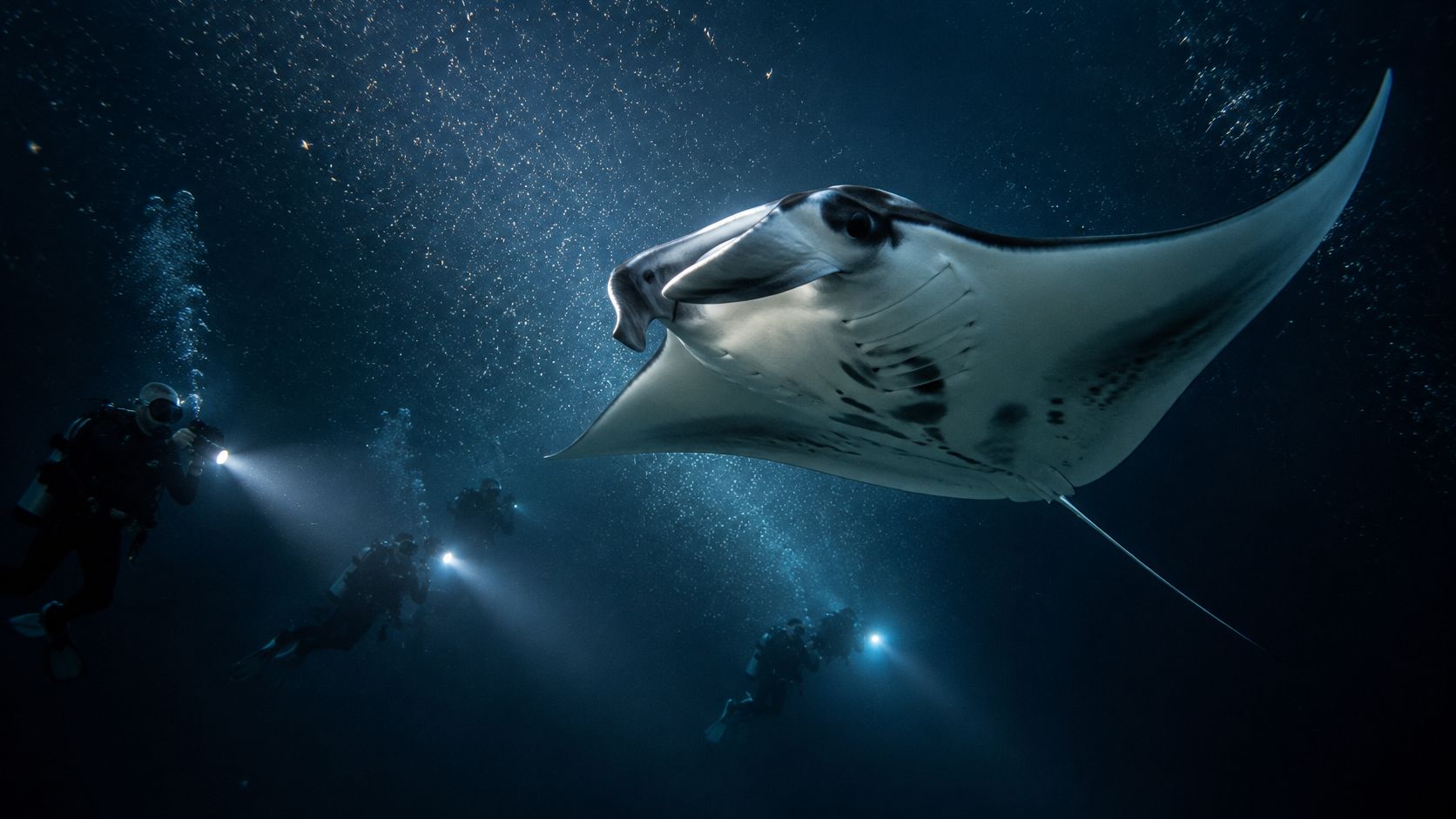
Reef manta rays, Mobula alfredi, are planktivorous filter feeders that normally forage in nutrient-poor tropical waters, and research on Hawaiian reef mantas describes how underwater lights attract and concentrate zooplankton into a localized prey plume that mantas can filter-feed through. The same work reports these mantas generally spend most of their time shallower than 50 m and show strong affinity for specific coastal habitats.
A Temporary Feeding Opportunity
At night, zooplankton shifts through the water column. A steady beam makes that scattered prey visible and bunches it where a manta can sweep through again and again instead of searching dark water. The ray isn't coming for the light itself, and it isn't coming for you. It's coming for a dense patch of dinner that happens to be lit.
Kona's model grew from that behavior in the early 1990s, when illumination near the old Kona Surf Hotel area showed that rays would reliably come to concentrated plankton. Operators didn't invent feeding. They learned to create conditions where natural feeding happens in one predictable place.
That's also the honest limit of the show. This is a temporary, surface-accessible feeding opportunity, not a full picture of what a manta does all night away from the camp. You're watching one concentrated behavior, done very close, for as long as the plume holds.
Why Still Water Feeds Better
Encounter quality depends on a stable, unobstructed light field and minimal turbulence around it. If you swim through the illuminated column, you scatter the very food that keeps a ray looping. If you kick hard to reposition, silt and bubbles break up the beam and the next pass often widens or stops.
Stay neutrally buoyant, stay at the edge, and keep your light steady. Judge the night by two things you can see: how thick the plume looks, and how still the group stays while a ray works it. When both line up, passes tighten, rolls repeat, and you stop noticing the divers next to you.
How to Watch and Photograph Without a Chase
Etiquette on this dive isn't politeness for its own sake. It's what keeps the next pass coming, and some of it is law.
Hawaiʻi law on manta rays prohibits knowingly capturing or killing manta rays in state marine waters, with penalties of $500 for a first offense, $2,000 for a second offense, and $10,000 for a third or subsequent offense. Guest rules go further in practice. Don't touch, chase, harass, or ride a ray, and hold your planned depth if an animal descends instead of following it down.
On the Bottom and at the Surface
Kneel or hover outside the brightest column and keep fins still when a wing passes. Let the ray set the distance, even when that distance gets startlingly close. Reaching up, standing, or scooting forward for a better view puts your body in the feeding line and teaches the animal to swing wider next time.
Snorkelers have the same job from above. Stay at the surface, keep legs quiet, and don't duck-dive into the path for a closer look. Good diver etiquette on wildlife dives looks boring from the boat, and that's exactly why it works underwater.
Camera Settings for a Still Diver
- Go wide: A wide lens fits a large animal a few feet away without you backing into the group.
- Pre-focus for close range: Set up for a big subject entering the beam, not a small fish across the reef.
- Keep strobes low and angled: Aim so you don't blast another diver's eyes or fire straight into the ray's head on every loop.
- Shoot a short burst: Fire as the manta enters the light, then lower the camera and watch the rest of the pass.
The common miss is continuous tracking, swinging a bright video light through the group while you pan after the animal. You blind your neighbors, break up the shared light field, and usually end up with shaky footage of a wingtip leaving frame.
If your movement changes the ray's line, you're too close or too active. Freeze. Don't follow.
You'll get better images by picking one spot, framing the bright column, and waiting for the white underside to fill it. The mantas repeat their loops when the camp stays calm, so patience gives you second and third chances that chasing never does.
When Crowds and Plankton Change the Night
A fuller boat doesn't mean a better dive. That assumption causes more mediocre manta nights than bad luck does.
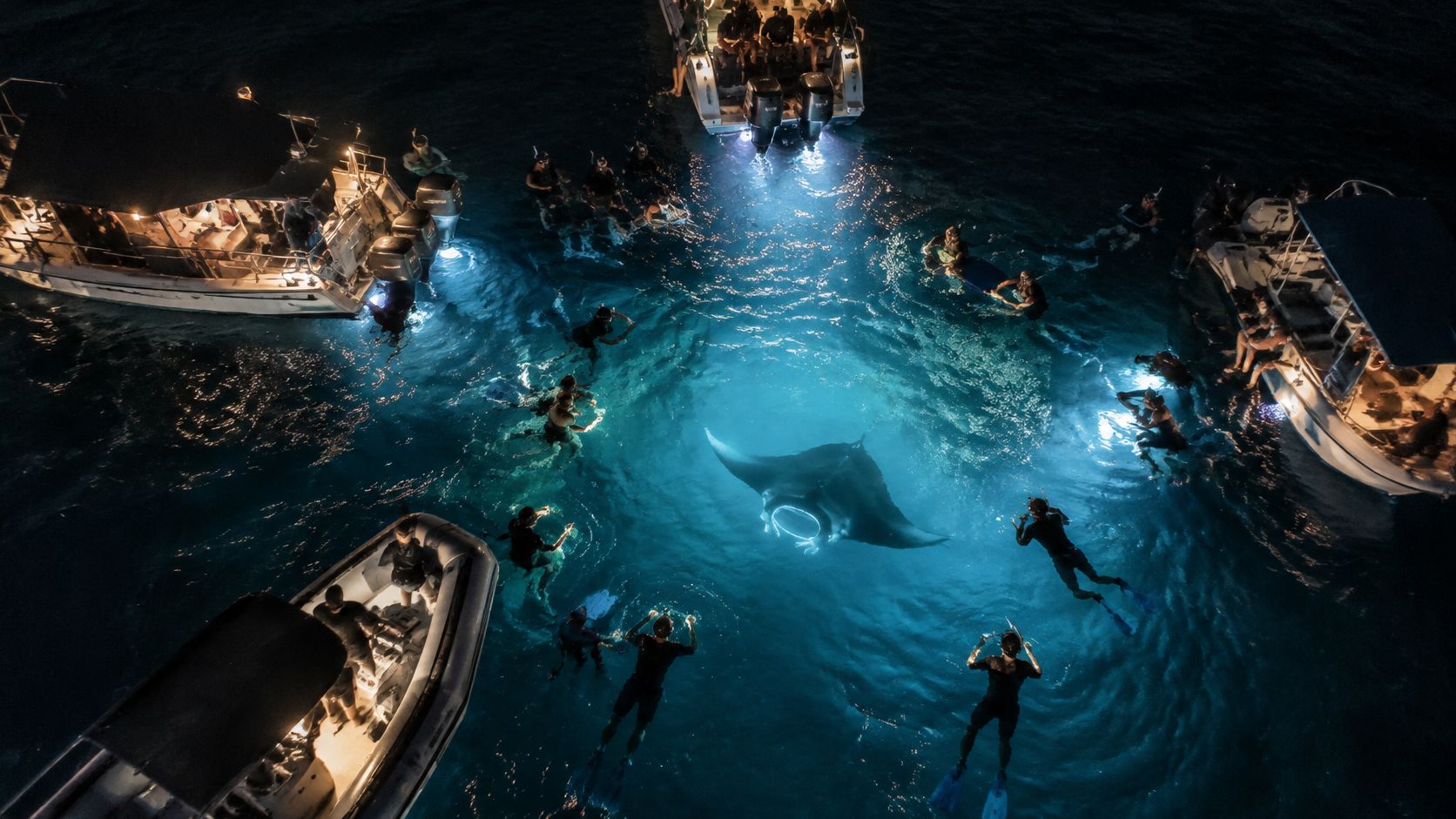
In manta-viewing testimony reporting a survey of 444 participants, 82% felt crowded by snorkelers, 78% by boats, and 69% by scuba divers, while a related study reported 53% of scuba divers experienced conflict with other divers, including bumping, poor awareness, and blinding others with dive lights.
A Camp Versus a Pileup
You can spot the difference in the first five minutes. A well-run camp has one marked area, guides who reposition people early, and lights serving the plume instead of a dozen personal beams stabbing in every direction. A pileup has guests drifting, fins in faces, and snorkelers kicking over divers while everyone hunts for a personal angle.
Crowding hurts in practical ways. Visibility drops when sand gets kicked up. Collision risk rises in the dark. Rays get their feeding paths blocked and swing wide, so the group that came for close passes creates distant ones.
What the Evidence Does and Doesn't Say
The research documents perceived crowding and behavioral disruption. It doesn't establish that every night dive causes lasting population-level harm. Hold both ideas at once, and skip the sales pitch that calls the activity risk-free and the opposite claim that one visit destroys the population.
Plankton density, current, and moonlight also change how many rays arrive, independent of crowd size. One animal making repeated close passes can be a superb, honest night. Several animals in a chaotic camp can feel worse. Neither result automatically means the crew failed or succeeded.
Choose a boat that briefs passive observation, sets a kneel zone, and will call or end a dive when spacing fails. Pick the protected cove and a group that stays put, and treat a single ray, or a rare no-show, as wildlife, not something you can force with more people or brighter lights.
Book a Calmer Manta Night in Kona
Book the manta ray night dive at Garden Eel Cove with a crew that camps divers in one viewing area instead of touring the coast after rays. Kona Honu Divers uses that protected cove as its go-to site because it's generally calmer, has a good viewing area, and has healthier reef than a more exposed alternative.
Certified divers should take the 2-tank manta dive and snorkel charter, while snorkelers on the same outing watch from the surface. If you're building extra Big Island days around it, browse the wider Kona diving tours to pair the night with morning reef dives. More experienced divers can add a separate daytime run on the premium advanced long-range trip, which suits divers who want a bigger day than a stationary night camp.
Popular trips, including this one, often sell out weeks in advance, so reserve before your flights are locked. If you're still comparing operators, the insider guide to choosing a Kona dive company lays out what to weigh beyond price, including group handling and site judgment.
Match the booking to the row you chose at the start. Bottom camp if you're certified and steady at night, surface if you're not, and Garden Eel Cove either way for the calmest setup Kona offers.
Kona Honu Divers runs the manta ray night dive at protected Garden Eel Cove, with certified divers in a supervised bottom camp and snorkelers watching from the surface above the lights. Reserve your spot before popular nights fill, and add daytime reef or advanced trips to round out your Kona diving. Start planning with Kona Honu Divers today.