
You've got a few mornings open in Kona, a travel partner who might prefer snorkeling, and a choice between reef dives, manta rays, and something called blackwater. The hard part isn't finding a dive that sounds exciting. It's choosing one that fits your certification, current fitness, and comfort in the ocean.
Scuba diving in Kona works best when you choose the dive profile before the site name. A sheltered reef charter, a rocky shore entry, and an offshore night dive ask different things of you. Match those demands, and you'll spend less energy managing discomfort and more time enjoying the volcanic terrain and marine life.
Scuba Diving Kona Tours by Diver Profile
Kona dive tours at a glance
| Tour | Best For | Certification Needed | Time of Day |
|---|---|---|---|
| 2-Tank Local Morning Dive | Certified divers wanting reefs, lava tubes and arches | Open Water Diver for most charters | Morning |
| Manta Ray Night Dive | Divers and snorkelers wanting a nighttime manta encounter | Scuba certification for divers; check operator requirements for snorkelers | Night |
| Black Water Night Dive | Experienced night divers curious about open-ocean life | Open Water Diver plus operator-specific experience requirements | Night |
| Premium Advanced 2 Tank Trip | Certified divers wanting remote, pristine sites | Certified diver with advanced experience | Morning |
| Morning Introductory Scuba Dive | Beginners with no certification | None | Morning |
The useful distinction is what you'll need to manage underwater. Reef diving gives you visual references. Manta diving requires controlled positioning after dark. Blackwater adds an open-ocean setting where your buoyancy and situational awareness need to work without a nearby reef.
Use this visual guide to narrow the choice before comparing departure times.
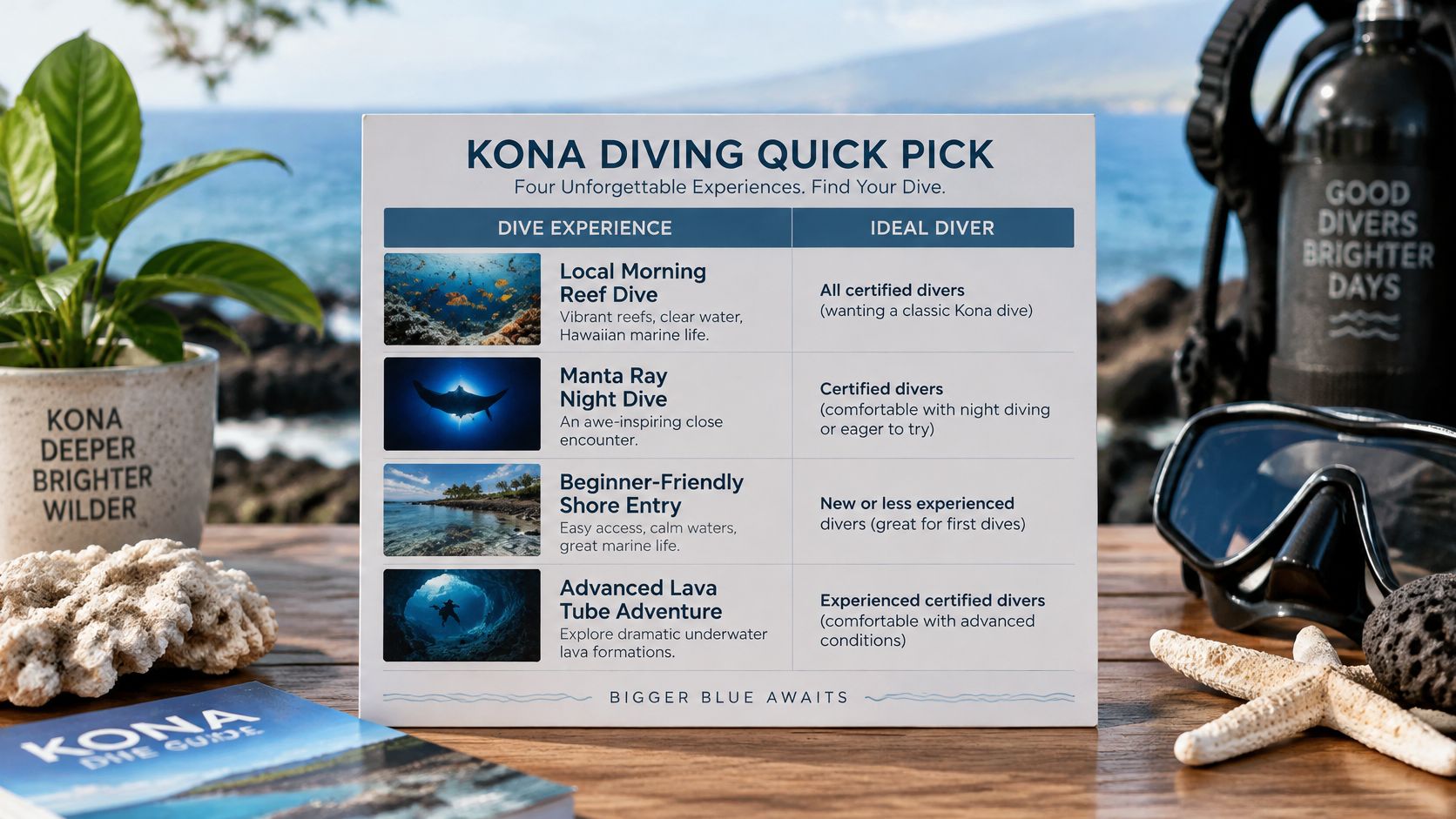
Match the trip to the diver you are today
For a certified reef diver, the local morning charter is the sensible starting point. You can explore coral gardens and volcanic formations while the guide assesses the group's pace and buoyancy. An arch is something to enjoy from outside if the passage looks restrictive or your trim isn't settled.
A diver seeking less frequently visited terrain may prefer the Premium Advanced 2 Tank Trip. Remote sites aren't automatically better for every diver: longer travel and more demanding conditions can outweigh the appeal of a quieter reef. Choose the trip because your skills fit it, not because “advanced” sounds like an upgrade.
For a non-diver traveling with a certified diver, separate the activities from the boat logistics. A snorkeler needs a suitable surface experience, not just an available seat on a scuba charter. Confirm that the departure accommodates both activities and that the planned site works for the snorkeler's swimming ability.
Someone who wants to try breathing underwater should choose an introductory experience rather than join a certified-diver itinerary. The Big Island scuba diving guide for beginners can help distinguish a supervised introduction from a full certification course.
For a rusty diver, book a refresher before the ambitious outing. Being certified doesn't mean mask clearing, regulator recovery, or buoyancy adjustments still feel automatic. A relaxed skills session is a better use of vacation time than spending a night dive struggling with unfamiliar equipment.
For an experienced night diver, the Black Water Night Dive offers a different challenge from a reef at night. You're looking for open-ocean life rather than navigating familiar bottom contours. Treat the listed certification as a starting point, not proof that you meet every experience requirement.
Boat versus shore is a physical decision
Boat diving avoids carrying a loaded scuba kit across sharp lava and timing an entry through surf. It still requires balance on a moving deck, an appropriate entry technique, and the ability to use the boat's exit system.
Shore diving adds footing, equipment transport, and an exit that may be harder than the entry. The Kona shore-diving guidance identifies sharp lava and surf exposure as practical constraints, with some entries suitable only in calm-to-moderate seas.
Practical rule: If you can't explain how you'll get out with tired legs and less favorable surf, don't enter.
Clear water can also make steep volcanic drop-offs look deceptively shallow. Use your computer to judge depth, not the apparent distance to the bottom.
Before choosing from the full diving tour selection, answer these questions:
- Certification: What training and recent experience do you have?
- Fitness and comfort: Can you manage the entry, exit, surface swim, and equipment?
- Day or night: Do you want a reef with daylight references, or are you ready for the additional demands of darkness?
Top Dive Sites in Kona and What Each One Offers
Kona dive sites by highlight and fit
| Site | Highlights | Entry and Conditions | Best For |
|---|---|---|---|
| Garden Eel Cove | Reef manta nights and a protected viewing area | Boat-based; choose calm-water conditions | Manta night viewers |
| Keauhou Bay | Reef manta nights with lower average sightings than Garden Eel Cove | Check surface conditions before entry | Divers comparing manta sites |
| Ho'ona Bay | Historical manta aggregation site in the Kona survey record | Confirm the operator's site designation and surface conditions | Night divers exploring Kona's manta history |
| Old Kona Airport Marine Life Conservation District | Protected reef with strict non-contact rules | Permitted mooring access; no anchoring | Reef observation |
| Pawai Arches | Arches and marine-life viewing | Plan boat access; confirm the exact entry with the operator | Divers interested in volcanic structures |
| Kailua Bay Pier | Sheltered-water potential and accessible shoreline logistics | Confirm the permitted entry and boat-traffic restrictions | Beginners and groups when conditions and access suit |
Kona's sites differ in exposure, access, and underwater terrain. A protected location can still have an awkward entry, while an easy boat entry can lead to a dive that demands careful depth control.
This overview helps connect the terrain to the kind of experience you're choosing.
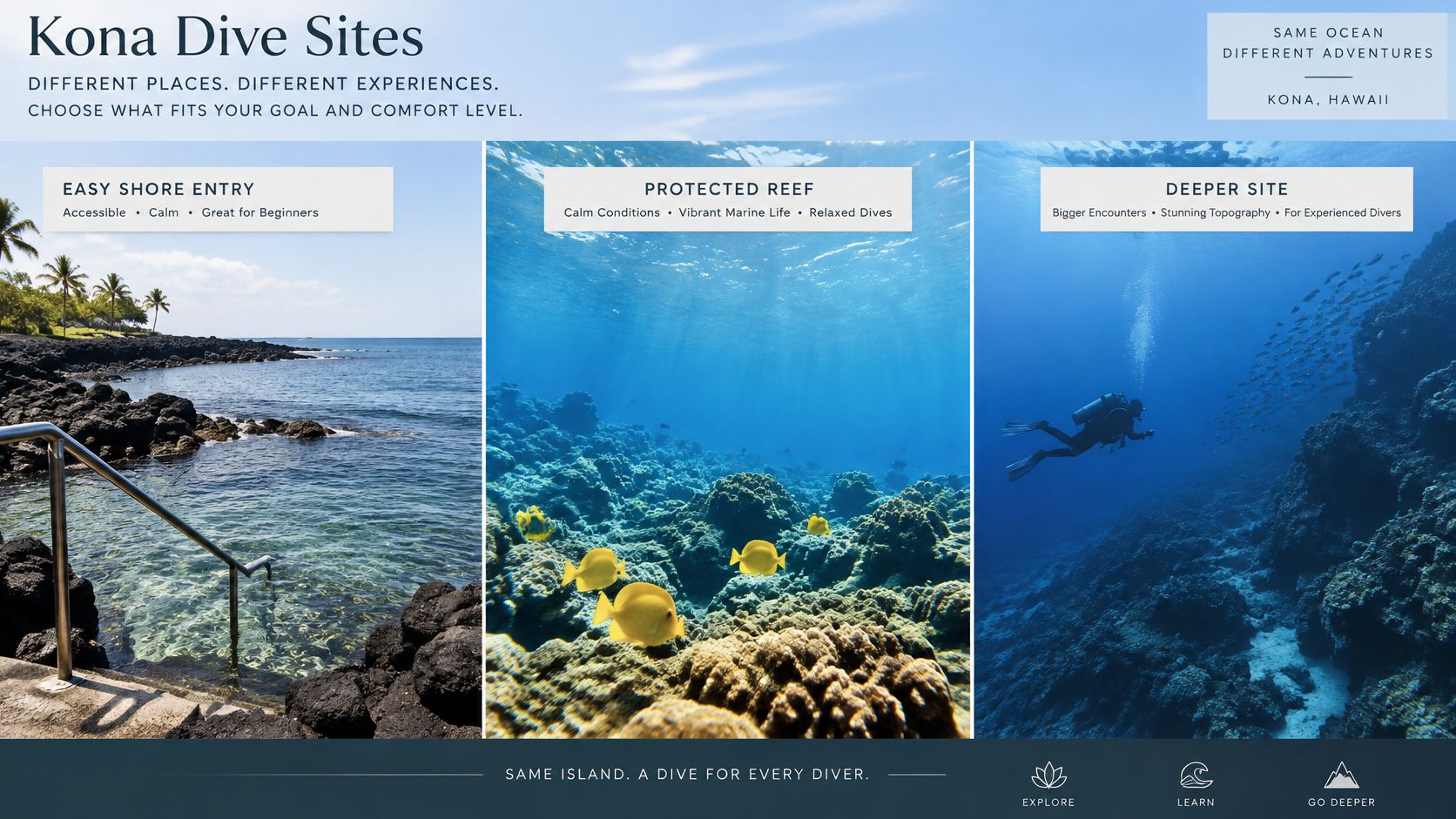
Protected reefs reward observation
The Hawaii Division of Aquatic Resources' Old Kona Airport district rules describe protected waters extending from the Old Kona Airport to the Kailua Lighthouse and approximately 500 yards seaward from the defined shoreline boundaries. Removing or injuring marine life, including coral, limu, shells, and ʻopihi, is prohibited except for narrowly defined fishing activities.
The district also prohibits feeding or introducing food and attractants, and it doesn't allow anchoring. Commercial dive and tour operations need a permit to operate from the mooring or shore, while motorized vessels face additional restrictions in the designated no-boating zone.
For divers, the practical approach is straightforward: secure dangling equipment, keep fins clear, and leave everything where it lives. A shell isn't a souvenir just because it looks empty.
The footage below offers another way to assess the underwater setting before choosing an itinerary.
Treat access descriptions as planning prompts
Pawai Arches is a terrain-focused choice, but a boat itinerary must still match the group's ability. Ask whether the intended route involves open arches, confined passages, or viewing the formations from outside.
Kailua Bay Pier shouldn't be treated as an unrestricted beginner entry. Boat movements, permitted access, and the day's surface conditions matter more than how convenient the shoreline looks.
Ho'ona Bay also deserves careful interpretation. Historical survey names aren't a promise of a separate, routinely offered modern tour stop. Confirm the actual destination rather than booking around a name alone.
Use the Big Island scuba dive-site guide to build a shortlist, then choose entry difficulty first and animals or structures second. That order prevents an attractive site description from steering you into an unsuitable dive.
Manta Ray Night Dive and Why Garden Eel Cove Wins
I'd choose Garden Eel Cove for a Kona manta tour, provided the day's conditions support it. Its protected location, better viewing layout, and surrounding reef make it the stronger all-around choice, particularly when the outing includes reef time before the nighttime encounter.
Manta sightings per evening at two Kona sites
The following figures come from the scientific analysis of nighttime observations at Garden Eel Cove and Keauhou, covering 2010 through 2022, with 23,106 sightings and 167 individually identified reef manta rays across the sites.
| Site | Average per Evening | Median | Range |
|---|---|---|---|
| Garden Eel Cove | 8.89 | 7 | 0 to 45 |
| Keauhou | 4.54 | 4 | 0 to 17 |
These are individual mantas per surveyed evening, not a guarantee for your departure. The analysis reported a statistically significant difference between the sites, supporting Garden Eel Cove as more than a preference based on scenery alone.
What happens in the feeding zone
Lights concentrate plankton, and reef mantas move through the illuminated water to feed. From below, you may watch them glide, pivot, and somersault above the viewing area. The encounter works because the animals have room to move, not because divers move toward them.
The NOAA manta-viewing guidance recommends that divers remain on or near sand, rubble, or boulder bottom in a semicircle, leaving open water overhead. Snorkelers stay at the surface, while divers hold lights above themselves and direct the beams upward.
That positioning is deliberate. It separates viewers from the feeding lane and reduces the temptation to follow an animal across the site.
- Leave the route open: Don't rise into the water column to meet an approaching manta.
- Keep hands and equipment close: Touching, chasing, grabbing, or riding can disrupt behavior and damage the protective mucus coating.
- Follow the assigned position: A better camera angle doesn't justify moving into another diver's space or the animal's path.
- Respect a quiet evening: Wildlife encounters remain wildlife encounters, even at a regularly visited feeding site.
The operator's crowd management matters
The same scientific analysis describes separate visitor research documenting up to 30 tour boats and 300 participants in a day. That scale makes the briefing, group organization, and entry timing important parts of the experience.
Book your preferred night early, but evaluate more than availability. Look for a clear explanation of where divers will settle, how snorkelers are separated, and what happens if someone becomes uncomfortable.
The best manta position is the one that leaves the animal a clear path, not the one closest to its face.
Compare the manta ray night-dive overview with the Manta Ray Night Dive tour details. When reading Kona Honu Divers reviews, pay attention to comments about briefings, assistance, and organization rather than treating wildlife sightings as a service guarantee.
Certifications, Courses and Gear You Need
For most regular charters, we require Open Water Diver certification from a recognized agency such as PADI, SSI, or NAUI, and you must bring your C-card. The standard Open Water scope is diving with a buddy to 60 feet, or 18 meters. Junior certifications and individual training restrictions may be more conservative.
A certification establishes a training level. It doesn't override conditions, an operator's screening requirements, or your current comfort.
Certification levels and depth limits for Kona diving
| Certification | Depth Limit | Notes |
|---|---|---|
| Morning Introductory Scuba Dive | Shallow, with an instructor | No certification needed |
| Open Water Diver | 60 ft (18 m) with a buddy | Required for most regular charters; bring your C-card |
| Advanced Open Water | Within the depth rating of the completed course | Adds deeper and specialty training |
| Enriched Air (Nitrox) | Set by oxygen mix and training | Can extend no-decompression time within limits |
| Freediving Class | Set by course level, instructor, and demonstrated ability | Breath-hold diving, no tanks |
Choose training for the skill you need
An introductory dive lets you try scuba under direct instruction. It isn't a substitute for certification or permission to rent equipment and dive independently.
The PADI Kona Scuba Certification Course takes 3 days of diving. We provide the instructor and the core equipment: BCD, regulator, computer, wetsuit, tanks, and weights. Before reserving dates, understand the academic work, water-skills requirements, and what happens if you need more practice.
The Big Island scuba certification guide is a useful starting point for choosing between an introduction, full certification, and continuing education.
Nitrox contains less nitrogen and more oxygen than ordinary air. It can allow more no-decompression time on suitable profiles, but it also introduces an oxygen-based maximum operating depth. It isn't a way to ignore your computer, and it doesn't make deeper diving automatically safer.
Freediving requires a different training approach. Breath-hold technique, recovery breathing, and active buddy supervision aren't interchangeable with scuba procedures.
Rent for fit and familiarity
Scuba, snorkeling, and freediving equipment solve different problems, so choose the kit for the activity. A comfortable mask and correctly fitting fins often matter more than bringing every piece of personal equipment.
With a rental regulator, check breathing performance and inspect the mouthpiece. With a BCD, test inflation, deflation, fit, and weight releases before boarding or entering. Ask when life-support equipment was serviced, and learn the rental computer's display before descent.
Use this preparation sequence:
- Confirm the card: Check your certification level and any restrictions.
- Refresh the skills: If you haven't dived for more than a year, I'd book a refresher rather than rely on memory.
- Match the planned depth: Choose a tour within your training and present ability, not merely your highest qualification.
Best Seasons and Water Conditions in Kona
Kona isn't one uniform ocean. From approximately October through April, northwest swell can affect exposed shores, while southerly systems can make a different part of the coast the less suitable choice, as described in NOAA's Hawaii marine-economics assessment.
| Seasonal Pattern | What It Means for Planning | Sensible Site Choice |
|---|---|---|
| May to September | Often a better starting window for calmer seas and shore access, not a guarantee | Consider shore diving only after checking the entry and exit |
| October to April | Northwest swell may affect exposed sites | Favor protected boat sites when swell is running |
| Southerly weather systems | South-facing areas may become rougher | Compare northern alternatives rather than assuming all sites are affected equally |
| Runoff or disturbed sediment | Visibility may deteriorate locally | Consider protected lava-bottom sites away from the affected water |
Read the site, not just the season
The generally sheltered Kona–Kohala coastline supports reliable west-coast diving, but shelter is directional. A site that works in one swell pattern may be a poor choice in another.
Lava and boulder bottoms tend to contain less loose sediment than easily disturbed seabed. That can help maintain clearer water, although it doesn't cancel out runoff or surge.
NOAA identifies good visibility, calm water, weak currents, harbor proximity, lava tubes, arches, walls, pinnacles, and photographic potential among the attributes of strong Hawaii dive sites. Those are useful selection criteria, but the conditions that let you enjoy them come first.
Sedimentation matters beyond a disappointing photograph. Runoff can raise turbidity and damage coral, connecting the quality of a dive to what happens in the watershed above it.
Turn the forecast into a decision
- Check swell direction: Read the marine forecast for the coast you'll visit.
- Choose protection: When swell rises, consider a suitable mooring or a different boat site instead of forcing the original plan.
- Inspect the surface: Watch the entry, exit, breaking waves, and boat movement before committing.
The guide to Kona's best diving season can help with travel planning, but the departure-day assessment decides the site. May to September generally offers more shore-dive options; October to April calls for greater attention to protected boat sites during northwest swell.
Safety Rules, Fitness and Surface Flags
A calm-looking bay doesn't remove the need for a red-and-white diver's flag. The Hawaii boating division's diving and snorkeling rules require it during underwater activity, including scuba, snorkeling, and freediving; divers must surface within 100 feet in ocean waters or 50 feet in streams, except during an emergency.
The same state guidance directs boaters to proceed at slow, no-wake speed within 200 feet of a flag, prohibits diving or swimming in navigation channels except in emergencies, and requires removal of the flag when diving ends.
This image shows why flag placement belongs in the entry plan, not on an afterthought checklist.
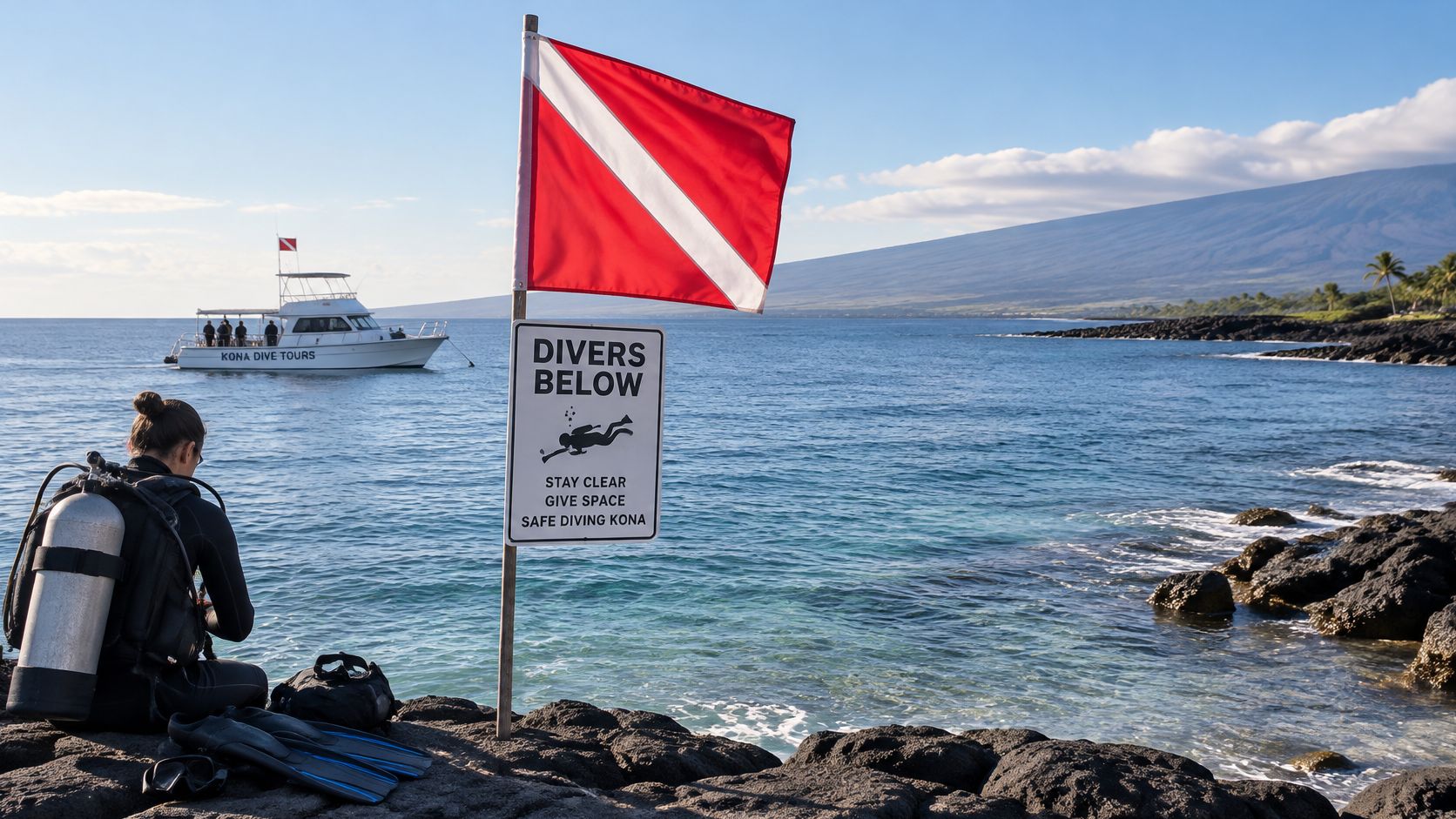
Make the surface plan explicit
The flag warns boaters, but it isn't a physical barrier. You still need to understand where traffic moves and where you can safely surface.
- Confirm the flag: Know who deploys it and how the group stays associated with it.
- Plan the return: Identify the intended exit and an alternative before descent.
- Keep the buddy in sight: Don't let photography or sightseeing separate the team.
- Respect your limits: Stay within your training and agree on gas reserves and turn criteria.
- Close the activity properly: Account for everyone and remove the flag after diving ends.
Be honest about health and fitness
Complete the dive medical questionnaire accurately. Tell the operator about relevant medical conditions before the boat leaves, not while the crew is preparing your entry.
Don't dive with congestion that prevents comfortable equalization. Forcing your ears or descending through pain can turn an otherwise easy dive into an injury.
Flying and driving to altitude also need planning. Allow an appropriate post-dive interval based on your dive profile, computer guidance, and current medical recommendations; a blanket interval shouldn't be treated as clearance after decompression diving or when symptoms are present.
Health comes before the reservation: If you feel unwell, cancel the dive rather than trying to make the booking worthwhile.
Possible decompression-illness symptoms include joint pain, numbness, dizziness, unusual fatigue, weakness, or breathing difficulty. Seek emergency medical care immediately and contact the Divers Alert Network for diving-medical guidance. Don't attempt another dive to relieve symptoms, and don't wait for them to become severe.
Underwater Photography Tips for Kona Dives
Wildlife photography stays non-contact. A photograph isn't worth blocking a manta's route, moving an animal, or bracing against living coral. If holding position consumes your attention, simplify the camera setup or leave it on the boat.
For ordinary reef photography, establish neutral buoyancy before approaching a subject. Keep your fins above the bottom and use small, controlled movements rather than broad kicks that stir sediment.
Build the frame without moving the animal
Arches, walls, pinnacles, and lava formations offer strong compositions without requiring a close wildlife encounter. Place a buddy in open water for scale, provided you've agreed on the positioning and neither diver needs to enter a confined space.
Use light deliberately. Move strobes away from the lens axis to reduce backscatter, and avoid aiming directly into suspended particles. At night, a light above and slightly off the subject can help reveal shape, but manta-viewing light directions take priority over your preferred photographic setup.
Follow this routine:
- Assess visibility before committing: Surface observations help, but confirm the actual underwater conditions before choosing close-up or wider compositions.
- Prepare the camera before descent: Check housing seals, starting white balance, focus mode, and strobe position while you have time to think.
- Shoot within the dive plan: Keep your buddy in view, monitor depth and gas, and stop shooting before your control deteriorates.
Make fewer adjustments underwater
A compact camera with a familiar setting often produces better results than a complicated rig you're still learning. Set a conservative starting exposure, take a test frame, and adjust one control at a time.
Choose a reef outing for terrain and fish portraits, or a manta night for a carefully managed feeding-zone scene. When comparing those tour options, ask what camera handling is compatible with the planned entry, viewing position, and group movement. A missed photograph is preferable to a rushed ascent or damaged reef.
Booking Your Kona Dive and Next Step
A typical dive day starts with arrival and gear setup, followed by a briefing on site conditions and entry style. The first dive is usually at the deeper or more condition-sensitive site, then comes a surface interval and a more relaxed second dive.
That order helps the crew use the conditions sensibly. It doesn't mean the itinerary is fixed regardless of weather or the group's readiness.
Reserve the experience, not an inflexible site
Book preferred night departures early so you have room to arrange the rest of your trip around them. Keep some flexibility for weather, especially if a shore dive may need to become a boat outing or move to another day.
Bring your C-card and logbook, plus any relevant specialty credentials. Recent dive history helps the crew understand what you've been doing, which is more useful than a qualification name alone.
- Check the meeting location: A shop address isn't necessarily the boat check-in point.
- Arrive ready for the briefing: Leave time for parking, equipment fitting, and questions.
- Disclose medical concerns early: Resolve paperwork and clearance questions before departure day.
- Confirm equipment needs: Specify sizes and bring familiar personal items if they improve your comfort.
- Protect your departure plans: Keep flights and altitude excursions compatible with your diving schedule.
For a mixed group, decide whether sharing the outing or maximizing each person's preferred activity matters more. A dedicated scuba itinerary and a dedicated snorkel experience can both be good choices, but they aren't interchangeable.
Why choose Kona Honu Divers
Kona Honu Divers offers chartered day and night dives, snorkeling trips, certifications, and classes. The tour range includes the Manta Ray Night Dive, 2 Tank Local Morning Dive, Premium Advanced 2 Tank Trip, Black Water Night Dive, and Morning Introductory Scuba Dive.
The shop is at 74-5583 Luhia St A12, Kailua-Kona, HI 96740, for visitors who prefer to discuss training, equipment, or trip suitability in person. Kona Honu Divers is also Hawaii's first and only company to offer free nitrox to certified divers; using enriched air still requires the appropriate training and gas-analysis procedures.
The practical reason to consider the operation is the ability to match a reef trip, night dive, or course to your current skills rather than squeeze everyone into the same outing. An in-person shop visit can also help resolve equipment and comfort questions before you commit.
Choose the trip that fits your present ability, confirm the certification and experience requirements, and reserve the departure.
Kona Honu Divers offers guided reef dives, manta nights, experienced-diver adventures, and certification courses along Kona's coast. Visit Kona Honu Divers to choose the outing that matches your certification, fitness, and comfort in the water, then book your preferred date.