
You've narrowed your Hawaii plans to one night on the water and want to know what the manta dive is really like. Kona's encounter is well established, but it's still wildlife, not a guaranteed show. Your best chance of enjoying it is to choose the format that fits your experience, settle into the crew's plan, and let the mantas decide when to appear.
The practical details matter: lights draw plankton, feeding conditions change, and a crowded viewing area can make the night less comfortable for people and rays alike. Here's how to choose a site and trip, prepare for the water, and vet an operator beyond a generic “eco-friendly” claim.
Manta Ray Diving in Hawaii at a Glance
The manta ray night dive is Kona's flagship wildlife encounter, but no operator can promise how many rays will arrive or how close they'll pass. Dive lights attract plankton, and reef mantas come to feed where food gathers. When plankton is scarce, the viewing area can be quiet. When conditions line up, rays may circle through the light repeatedly.
The local population is small enough for individual animals to be recognized and studied. A peer-reviewed study published in BMC Ecology and Evolution estimated a contemporary effective population size of 104 reef manta rays around Hawaiʻi Island in 2023, with a 95% confidence interval of 99–110 (the study in BMC Ecology and Evolution). That context makes responsible viewing more than good manners: the encounter depends on protecting a localized population.
Manta ray dive formats compared
| Format | How You Experience It | Who It Suits | Depth |
|---|---|---|---|
| Manta Ray Night Dive | Kneel on the sandy seafloor in a lit circle while mantas feed overhead | Certified divers, Open Water or higher | About 25–40 ft |
| Manta Ray Night Snorkel | Float at the surface and watch from above | Ages 5 and up, comfortable on snorkel | Surface |
| 2 Tank Manta Charter | Two dives with a manta-focused encounter | Open Water or higher, dived within the past 2 years | Reef dive plus manta night dive |
| Blackwater Night Dive | Deep-water night dive with different marine life | Divers wanting a different night experience; confirm certification with the operator | Open-water descent; confirm profile |
Scuba gives you a bottom-up view and asks you to manage buoyancy and equipment in low light. Snorkeling keeps you at the surface and can work better for mixed groups or anyone who'd rather avoid a night descent. A two-tank trip combines a reef dive with the manta outing, while blackwater diving is a separate experience, not a deeper version of the manta encounter.
Compare the two-tank manta charter, the blackwater night dive, and the full Kona diving tour lineup. If you're certified and comfortable in the dark, start with the manta dive; if you're unsure about night-water comfort, research the snorkel option first.
Where and When Mantas Gather in Kona
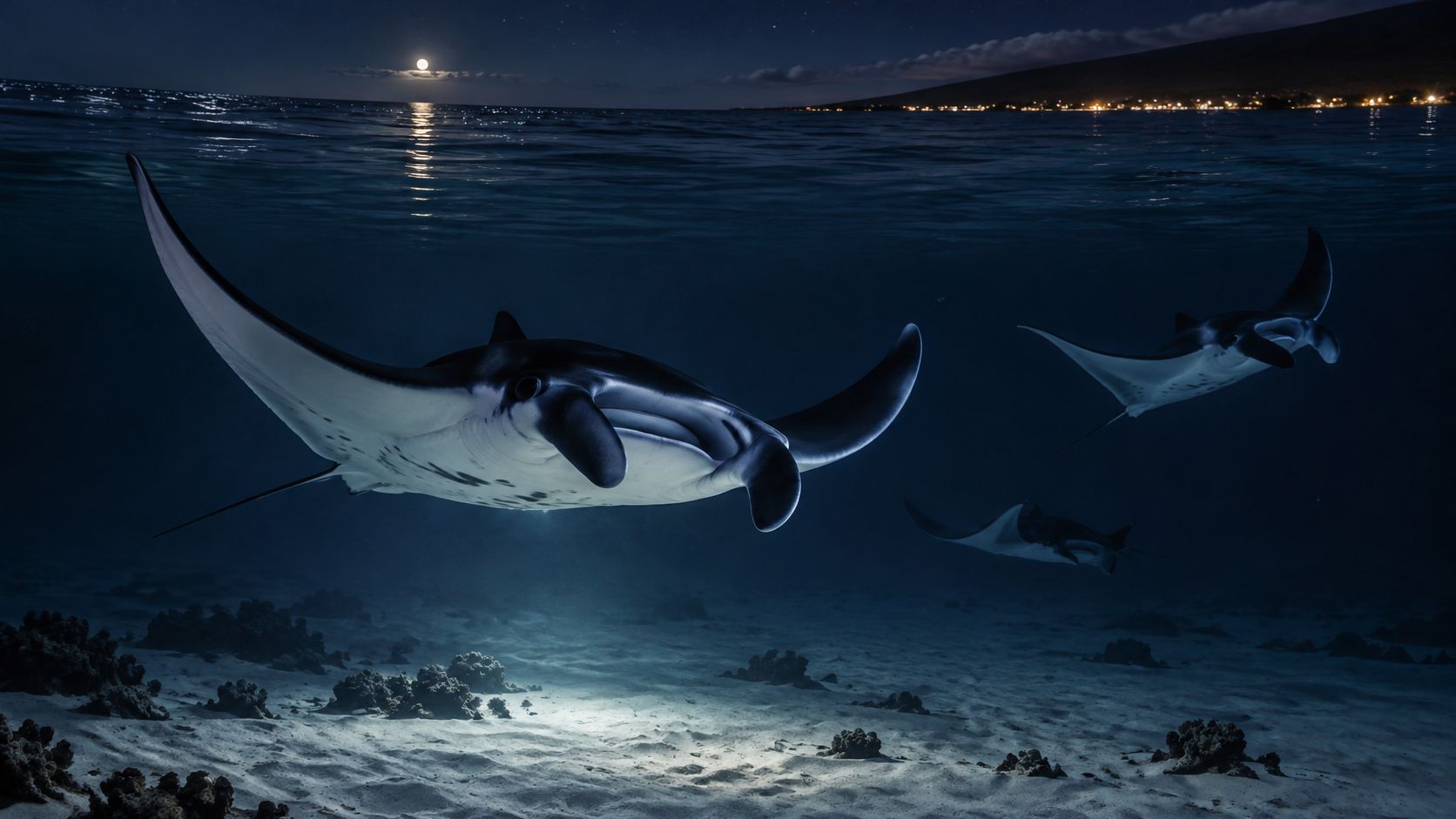
Garden Eel Cove is the best choice for most visitors. Also called Manta Heaven or Makako Bay, it sits near Keahole Point and Kona International Airport. The protected cove has a broad sandy viewing area where divers and snorkelers can gather around a central zone rather than spreading across the surrounding reef. Those features make the setup more controlled, and the better surrounding reef gives the dive more to offer than the manta viewing alone. (Garden Eel Cove site details)
Kona manta viewing sites compared
| Site | What It Offers | Visitation Pattern | Planning Note |
|---|---|---|---|
| Garden Eel Cove (Makako Bay) | Protected cove with a broad sandy central viewing area | Larger aggregations; overall sex ratio across both sites about 1:1 | Near Keahole Point and Kona International Airport |
| Keauhou Bay (Kaukalaelae Point) | Designated DLNR manta-viewing zone | Generally smaller aggregations than Garden Eel Cove; ask the operator about recent sightings | Ecologically distinct site; check current zone rules |
| Kaunaʻoa Bay | Recorded manta site on the Kona coast | 18 individual mantas recorded in 2025 | 270 nights of operation in 2025 |
Long-term observations at Garden Eel Cove and Keauhou from 2010 through 2022 included more than 23,000 sightings of 167 individually identified reef mantas. Garden Eel Cove generally supported larger aggregations, while Keauhou was visited predominantly by females; visitation at Garden Eel Cove was more evenly split between males and females (the University of Hawaiʻi study). Manta Ray Advocates recorded 18 individual mantas at Kaunaʻoa Bay over 270 nights of operation in 2025 (the organization's 2025 statistics).
Those figures describe recorded activity, not a nightly guarantee. The observations connect changing aggregation sizes with zooplankton density, rather than establishing a dependable month-by-month peak. For seasonal planning, use this guide to the best time to see manta rays in Kona, then ask about recent sightings instead of assuming one month will deliver. Hawaiʻi DLNR materials describe manta-viewing hours from 4:00 p.m. to 4:00 a.m., with two-hour operating shifts (DLNR's manta-viewing safety assessment). Choose a night you can be flexible about. Even a usually productive site can be quiet on a particular evening.
How a Manta Ray Night Dive Unfolds
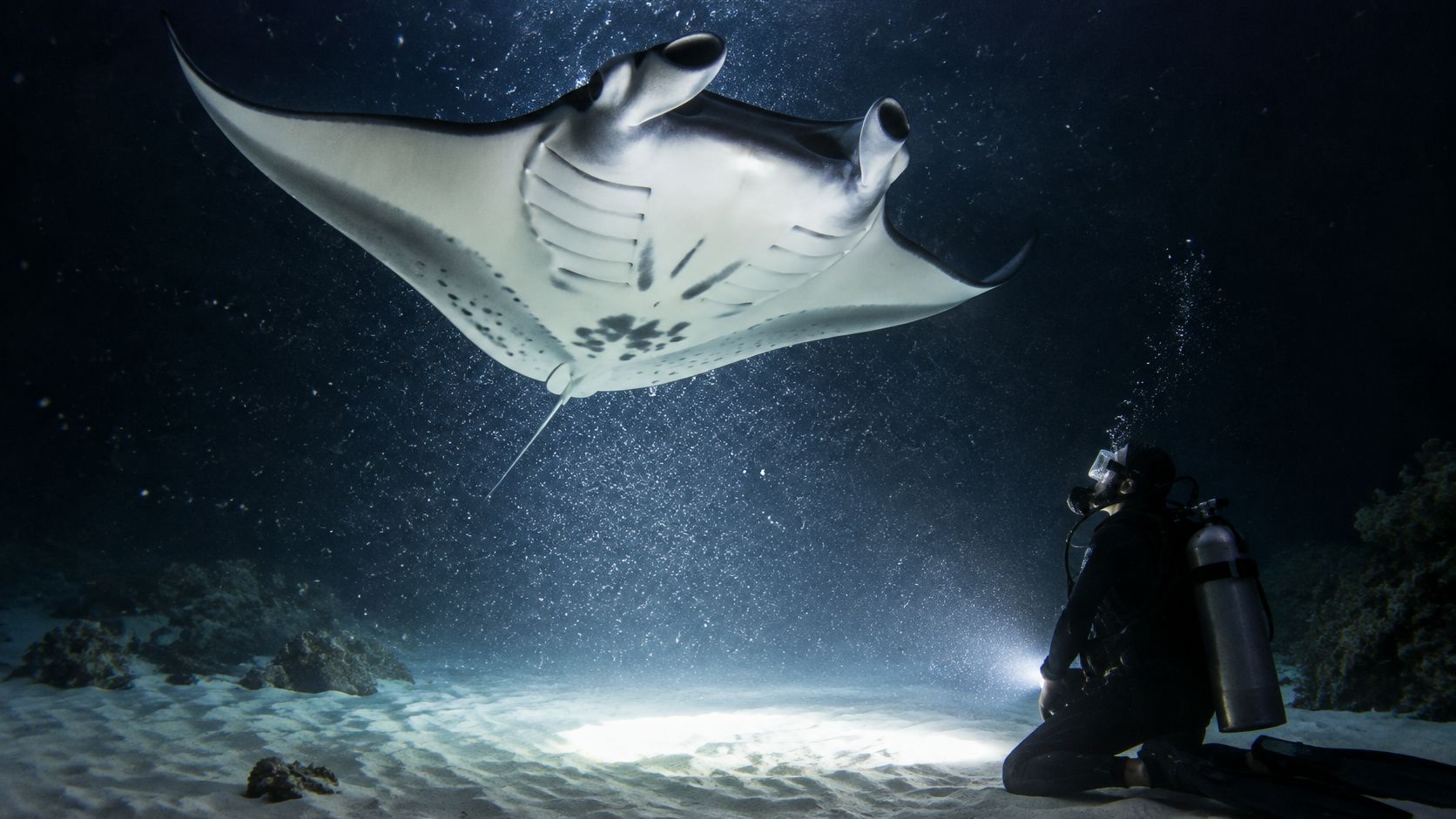
The dive is built around light. Lights on the seafloor attract plankton, and the plankton draws reef mantas overhead to feed. Think of a porch light on a summer night: it gathers insects, and the animals that eat them arrive on their own schedule. The lights help concentrate food, but they don't summon rays on demand.
A typical manta dive takes place in shallow water. One site description places it at about 35 feet, while the customary profile is roughly 25–40 feet, accessible to certified recreational divers who are comfortable diving at night (the Kona manta dive site description).
The sequence in the water
Listen to the briefing. The crew explains how plankton feeding works and lays out the rules for passive observation. Pay attention to where you'll enter, where you'll settle, and how the crew will signal the group.
Check your gear and buddy plan. Confirm your buddy pairing, entry and exit lanes, and hand signals before getting in. At night, a loose strap or unclear exit plan is more than a small inconvenience.
Descend to the sand. Follow the crew to the designated viewing area and settle into position. On the Manta Ray Night Dive, divers are placed in a specific viewing area at an established site, rather than swimming around to search for rays.
Let the lights do their work. Powerful dive lights create a bright circle on the seafloor, so divers aren't left in complete darkness. The light draws plankton into the viewing zone, which may bring mantas through to feed.
Watch the feeding behavior. Mantas often feed with their mouths open and cephalic fins curled forward to direct prey. Reef manta rays feed on zooplankton, so their activity depends on the food gathered at the site (a description of Kona manta feeding behavior).
Hold still and leave the lane open. Don't reach toward a manta, chase it, or move into its approach path. A calm, stationary group makes it easier for rays to continue feeding without having to avoid people.
Ascend when signaled. Follow the crew's instructions on the way back to the boat, then debrief and pack up your gear.
A quiet stretch doesn't mean the crew has failed to deliver a show. The lights gather plankton, but they can't control how much food is present or when a ray will pass through. Staying settled lets you observe what the animals really do, whether that means repeated loops or a more subdued encounter.
Experience and Gear You Need Before You Go
Start with an honest qualification check. For the scuba version, are you Open Water certified or higher? Have you dived within the past two years? Are you comfortable controlling buoyancy and following a guide in low light? If any answer is no, don't treat the manta dive as the place to push through uncertainty. Check the requirements for your chosen trip before booking.
A two-tank manta charter requires Open Water certification or higher and a dive within the past two years. The scuba diving at night guide is useful preparation if night conditions are unfamiliar. A PADI Manta Ray Diver specialty course covers manta biology, behavior, and conservation, and can help you understand what you'll see before you enter the water.
Snorkelers don't need scuba certification, but they should be comfortable floating and breathing through a snorkel in open water at night. A well-fitting mask matters more than extra equipment. The night snorkel accepts children ages 5 and up, though families should confirm age and swimming requirements with the operator.
Pack for comfort, not clutter
Bring what helps you stay warm, see clearly, and keep your hands free:
- Exposure protection: A rash guard or light wetsuit is usually enough in Kona's warm water.
- Mask and fins: Bring a well-fitted set if you own one, or confirm rental sizing at check-in.
- Backup light: Pack a backup dive light if you're diving and know how to secure it.
- Sun protection: Apply reef-safe sunscreen before entering the water.
- Boat essentials: Take a towel and dry bag for the ride back.
- Camera: Use an underwater camera only if you can manage it without losing position, and secure its strap.
- Motion-sickness medication: Bring it if you're prone to seasickness, and follow the product directions.
Gear rental is available; confirm your sizing when you check in so a mask or suit that doesn't fit doesn't become the main event. If you're already comfortable underwater and want a more challenging dive afterward, compare the Premium Advanced 2 Tank Trip.
Safety Rules and Etiquette Under the Lights
The no-touch rule isn't just courtesy. Hawaiʻi law prohibits capturing, taking, possessing, abusing, or entangling rays in state marine waters under HRS §188-39.5. Reported penalties range from a $500 fine for a first offense to $10,000, with an additional administrative fine of up to $10,000 per animal (the Hawaiʻi manta dive safety and law guide). Treat every instruction about space and contact as a serious boundary.
Memorize the in-water rules
- Don't touch, chase, or dive toward a manta. You can disrupt feeding and push an animal off its approach.
- Keep fins near the surface and move slowly. Fast kicks stir sand, disturb the viewing area, and make your position less predictable.
- Keep bubbles and sudden movement to a minimum. Calm movement helps the group stay settled while rays pass overhead.
- Stay out of the approach corridor. Don't place your body or camera where a manta is moving to feed.
- Keep your buddy in sight. A quick check helps you stay oriented without drifting away from the group.
- Follow crew directions for position and cameras. The guide's view of the group matters more than the angle of one shot.
Before entry, the briefing should cover lanes for getting in and out, how to orient yourself to surface lights, buddy positioning, hand signals, and emergency procedures. Listen for those specifics rather than settling for a vague reminder to “be careful.” The responsible diver etiquette guide offers additional guidance for wildlife encounters.
A stationary, closely supervised dive gives the crew a chance to keep the group organized and guests comfortable. On Kona Honu Divers' Manta Ray Night Dive, experienced divemasters and instructors are in the water with divers. If a ray swerves close, don't reach or recoil into its path. Hold still and let it pass.
Photographing Mantas in Low Light
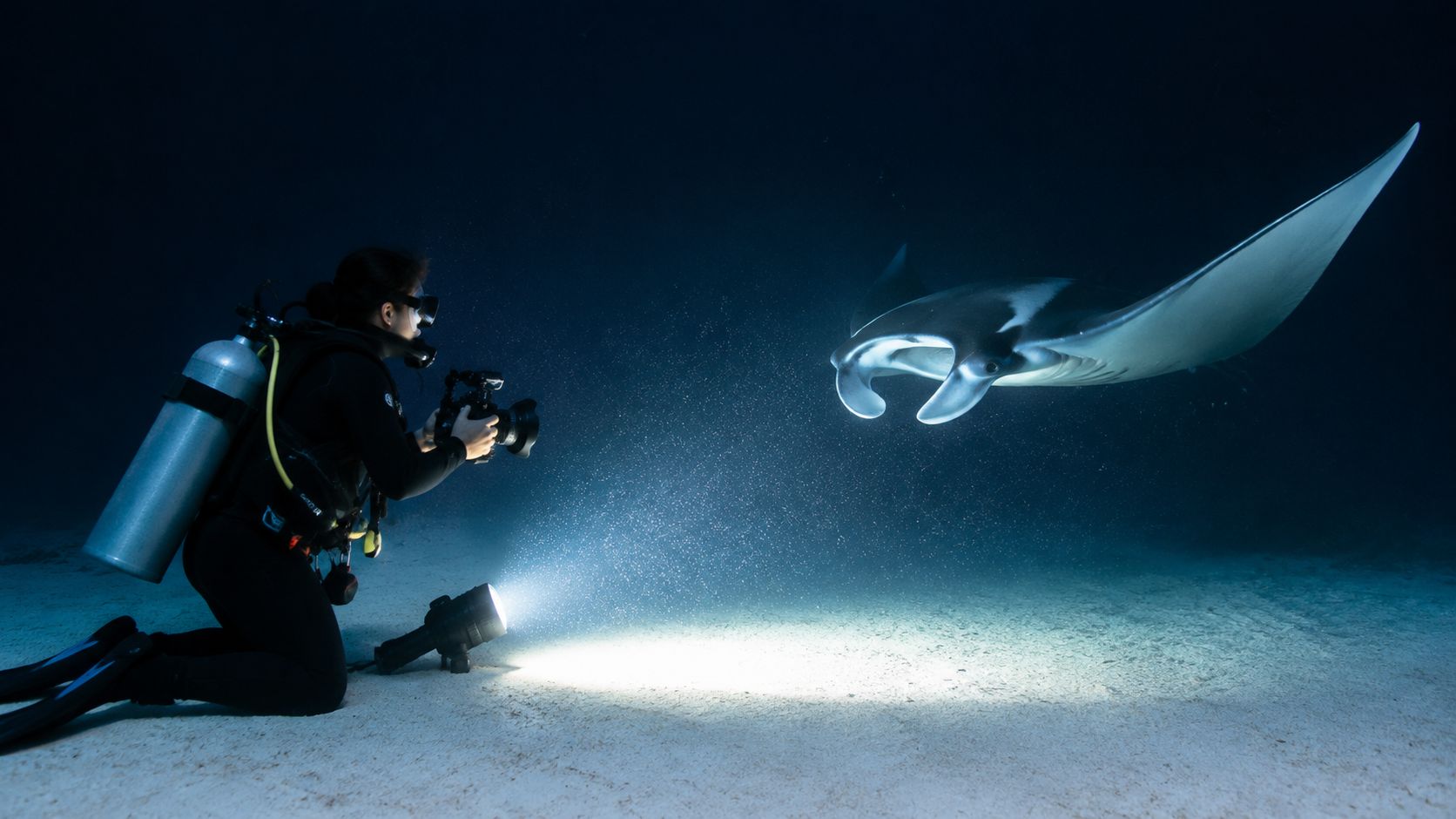
Stillness beats chasing. Stay on the sand and let a manta enter the light rather than swimming after it. The lit circle is a natural frame: compose with the ray inside the beam and leave room in the image for the direction it's traveling.
Keep the camera simple
A wide-angle lens works well for close passes because it can capture the animal without requiring you to move toward it. Try a fast shutter speed, around 1/125 second or faster, to reduce motion blur from moving fins. Use manual focus or single-point autofocus, and keep the camera's focus lamp low so it doesn't add unnecessary light to the animal's face.
Raise ISO only as far as you need to avoid blur; some grain is better than a smeared ray. If you use strobes, keep their power low and angle them away from the manta's face. For a silhouette, aim upward so the outline is framed against the glow from the surface.
Practice buoyancy with your camera in shallow water before the night dive. Secure its strap, check the screen after each pass, and put it away if managing it starts to pull your attention from your position or your buddy. You can browse Kona manta ray dive photos to get a sense of the scene, but don't let a particular shot dictate where you move.
A night with few rays can still be a successful dive. Bring a backup plan for your evening, and don't let camera pressure push you out of the viewing area or into a manta's path.
A Sample Evening and What to Compare
Use this as a planning outline, not a fixed schedule. Times are approximate and depend on sunset and the operator's departure plan.
Sample evening timeline for a night dive
| Approximate Time | Stage | What to Check |
|---|---|---|
| Late afternoon | Check-in and gear fitting | Confirm rental sizing and certification cards |
| About 1 hour before sunset | Pre-dive briefing | Learn lanes, hand signals, and no-touch rules |
| Around sunset | Boat ride to the viewing site | Ask about boat handling and seasickness options |
| After dark | Night dive or night snorkel | Lights on; rays arrive when plankton is present |
| End of the evening | Surfacing, debrief, and return | Review photos and give crew feedback |
There's no single fixed price for manta trips. Rates differ by format, number of tanks, and what's included, so the lowest sticker price may not cover the gear or level of supervision you expect. Compare what you're paying for, not just the number on the booking page.
Before you reserve, check:
- Included gear and services: Confirm whether tanks, weights, rental gear, crew, and night lights are included in the per-person rate.
- Group setup: Ask how many guests will be in the water at once and how the crew manages the viewing area.
- Mixed groups: Find out whether a snorkel option is available if some members of your party don't dive.
- Weather and cancellation terms: Read the rescheduling policy before you pay.
- Certification checks: Confirm that the operator checks your certification and recent dive history before the trip.
Also ask what happens when mantas don't appear. A clear answer helps you decide whether a no-show policy or alternate night fits your plans. Check current rates on the booking page before comparing operators, because prices and inclusions can change.
Choosing an Operator and Booking Your Dive
Crew ratio, in-water supervision, boat handling, and group size are the first four things to compare. A well-reviewed operator can still be a poor fit if it won't explain who's supervising or how it handles a crowded site.
| Criterion | What Good Looks Like | Red Flag |
|---|---|---|
| Crew ratio | One guide per 8 guests or fewer | Ratio not stated or large groups in the water |
| In-water supervision | Divemasters or instructors in the water with divers | Crew only on the boat |
| Boat handling | Boats tie to buoys instead of drifting with engines running | Engines running while guests are in the water |
| Group size | Published maximum guests per viewing zone | No cap stated |
| Experience and reviews | Recent verified reviews and clear certification requirements | Vague answers about qualifications |
| Booking timing | Early confirmation; popular trips sell out weeks ahead | Last-minute promises of availability |
Hawaiʻi Ocean Watch recommends no more than one crew member per eight guests for in-water activities, and DLNR materials describe an 8:1 guide-to-customer ratio in the proposed controls (Hawaiʻi Ocean Watch's manta testimony). Ask how the crew applies its ratio to the people in the water, not just the number on the boat.
Kona Honu Divers' manta night dive is stationary and closely supervised, with divemasters and instructors in the water with divers. The company lists encounter rates of up to 92%, which is a reported rate, not a promise that mantas will appear on your specific night. Its Google reviews offer another point of comparison:
Popular manta trips can sell out weeks in advance. Review the Kona boat tour options and the two-tank manta trip details, then confirm your certification details at check-in.
Frequently Asked Questions for Divers and Snorkelers
What if my trip sells out?
Book early, ask about a waitlist or alternate night, and choose a date you can be flexible on. Popular manta trips can fill well ahead of departure.
What happens if no mantas appear?
Manta activity follows plankton availability, so a quiet night can mean there's less food in the light. Ask about recent sightings and read the cancellation or weather-reschedule policy before paying.
Can I join at age 5?
The night snorkel accepts children ages 5 and up. Confirm the operator's age and swimming requirements before booking.
Do I need certification for the night scuba dive?
Yes. You need Open Water certification or higher, a dive within the past two years for the two-tank manta charter, and comfort with buoyancy and night conditions.
Can I touch a manta?
No. Hawaiʻi law prohibits capturing, taking, possessing, abusing, or entangling rays in state waters. Keep your hands to yourself and let the ray choose its route.
Is night diving suitable for beginners?
It can suit a newer certified diver who's comfortable in the dark and can hold position, but certification alone doesn't guarantee readiness. The dive is stationary and closely supervised; choose snorkeling instead if scuba tasks would distract you from the briefing and your surroundings.
Can non-divers join?
Ask whether the trip has a snorkel option so divers and non-divers can share the evening. Choose the surface format if that's where you'll feel more relaxed.
Kona Honu Divers offers manta ray night diving and snorkeling options, with a crew that briefs guests on passive observation and supervises divers in the water. For a manta encounter built around respectful viewing and a carefully managed dive, visit Kona Honu Divers and choose the trip that fits your experience.