
The boat's lights settle over the dark water at Garden Eel Cove, and the first manta appears beneath them like a silent aircraft. A few seconds later, the animal rolls through the plankton-rich beam, close enough for you to see its markings, but entirely focused on feeding.
A Kona manta ray dive is more than a memorable night in the ocean. The experience makes sense once you understand the site, the feeding biology, the seasonal variables, and the diver behavior that keeps the encounter safe for both people and mantas. Garden Eel Cove, in particular, combines protected water with a defined sandy viewing area, giving guided groups a practical place to observe without spreading across the reef.
What to Expect on Your First Kona Manta Night Dive
The first practical step happens at Honokohau Harbor, before the boat leaves shore. You check your equipment, listen to the briefing, and travel toward the established viewing area offshore from Kona International Airport. Garden Eel Cove, also called Manta Heaven or Makako Bay, is one of Kona's principal nighttime manta-viewing sites, alongside Manta Village near Keauhou Bay (Hawaii Ocean Watch describes Kona's manta-viewing sites).
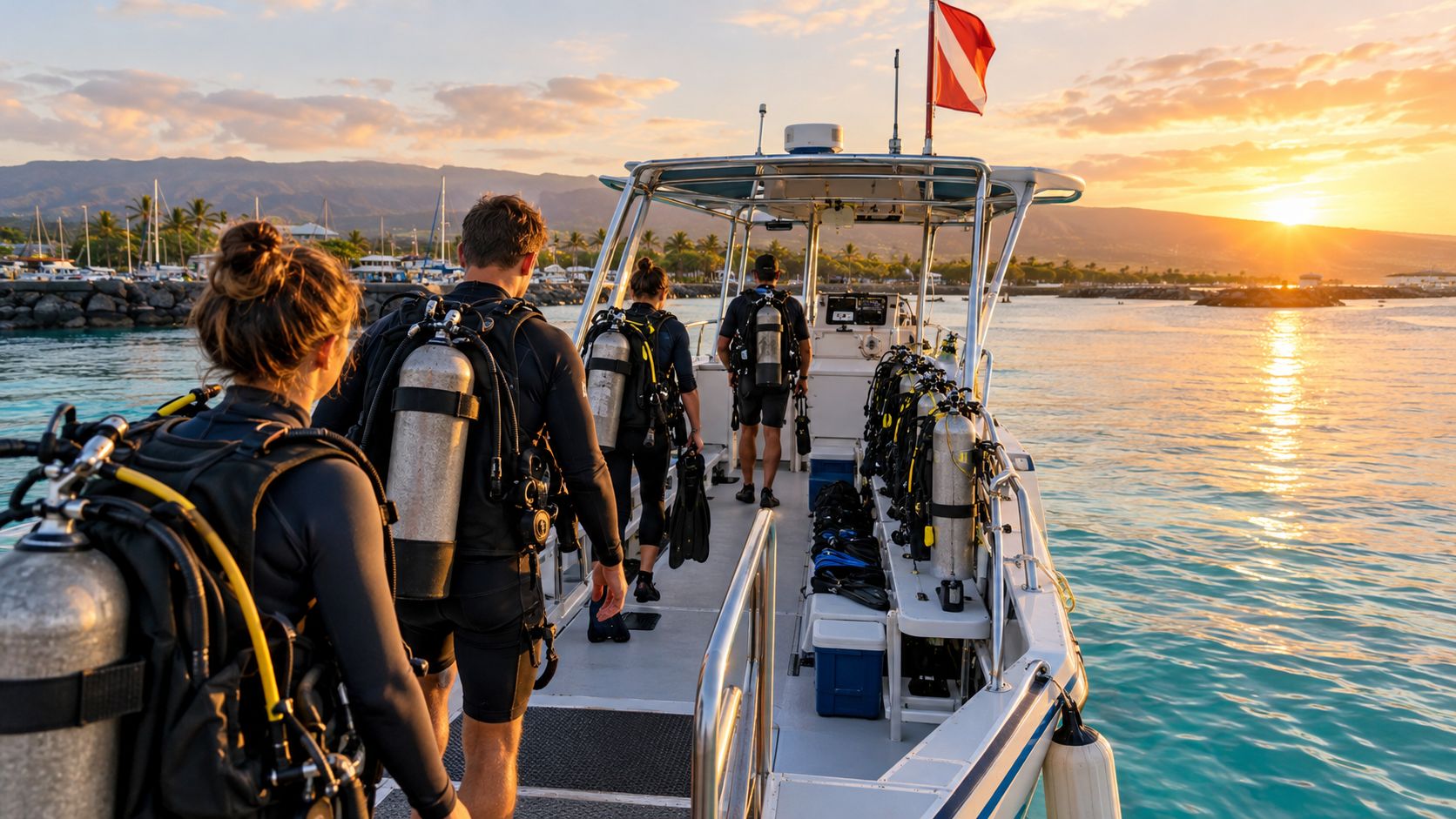
The briefing covers more than the route. Your guide will review entry procedures, light positioning, descent technique, bottom placement, and what to do if a manta approaches from behind. Night diving requires steady habits because your view narrows to the light beam, your instruments, your buddy, and the group's agreed position. Keep your movements controlled, maintain awareness of the people around you, and let the animals choose their distance.
The two-tank rhythm
Many Kona night trips follow a two-dive structure. The first dive usually takes place around dusk on a reef, allowing you to settle into your equipment and adjust as daylight fades. After a surface interval, the manta dive begins in full darkness, when underwater lights concentrate plankton above the viewing area.
The descent feels different from a daytime dive. Beyond the light beams, the water is black, yet the scene remains active. Small organisms drift through the illuminated water, bubbles rise toward the surface, and a manta can glide overhead with almost no visible effort.
Kona's organized nighttime viewing began near the Kona Surf Hotel in 1991, with one boat and roughly 6–8 divers on several nights each week. By 1993, as many as five boats and approximately 50 people were in the water. The original site was inactive from 2000 to 2004 after the hotel closed, then resumed when floodlights were reinstalled in 2004. The site history is documented by Hawaii Ocean Watch.
Practical expectation: You are entering a naturally recurring wildlife encounter, not an aquarium. Mantas decide how close they come and how long they remain, so a quiet, well-positioned diver gets better opportunities than someone who chases them.
Kona Honu Divers provides a guide to the Kona manta ray night dive with further details about trip format and logistics.
Understanding the Manta Ray Feeding Mechanism
The manta ray dive doesn't depend on baiting. The animals come because the lighting changes the local feeding conditions, not because a crew hands them food or places bait in the water.
Underwater lights attract zooplankton into an illuminated water column. Reef manta rays, Mobula alfredi, then approach and filter-feed through that concentration. Their open mouths and broad cephalic fins make the feeding process visible, especially when a manta turns through the strongest part of the light beam.
What the lights actually do
The lights don't control the mantas. They create a temporary plankton concentration that the animals can exploit. A manta may make repeated passes through the densest area, banking or rolling as it adjusts its position in the flow.
That explains why the encounter can feel choreographed even though it isn't. Several mantas may use the same feeding lane because the plankton is concentrated there, but each animal chooses its own route, depth, and timing. A diver who chases one usually disrupts the viewing angle and makes the next pass harder to predict.
One published description estimates that a typical adult reef manta can filter approximately 60 cubic meters of water per hour while feeding (the feeding mechanism and estimate are described by Kona Snorkel Trips). The figure illustrates the scale of the animal's feeding effort. It processes a large volume of water to capture tiny prey with its gill plates.
Why the behavior matters to divers
Understanding the biology changes your technique. You aren't trying to attract a manta personally. You're trying to remain a quiet, stable observer while the animal works the plankton-rich water.
The best viewing position is usually the one you can hold without finning constantly. Neutral buoyancy, controlled breathing, and minimal arm movement keep your silhouette predictable and reduce the temptation to follow every pass.
The most impressive moment often happens when you stop trying to make it happen.
That distinction also clarifies why touching is inappropriate. Contact doesn't improve the feeding behavior, and it can interfere with the animal's movement through the viewing area. A respectful dive leaves the manta in control of the interaction.
Diver Certification and Preparation Checklist
An Open Water certification or equivalent qualification is the normal starting point for a guided scuba manta dive, but certification alone doesn't guarantee readiness. Night conditions make ordinary skills more important, especially buoyancy, buddy awareness, controlled ascents, and the ability to respond calmly when visibility is limited to a light beam.
If you haven't completed your certification, an Open Water certification course in Kona can build the foundation before you attempt a night wildlife dive.
Before leaving the dock
Start with the equipment you'll rely on most:
-
Inspect your primary light. Check the switch, battery, attachment point, and beam before boarding. A light that works intermittently on shore is not a light you should trust underwater.
-
Carry a backup light. Your guide will explain the local setup, but redundant lighting gives you a way to signal, monitor your surroundings, and return safely if the primary light fails.
-
Confirm buoyancy and weighting. Night diving isn't the place to discover that your exposure protection or cylinder configuration needs adjustment. You should be able to hover without repeated fin strokes.
-
Secure loose equipment. Dangling gauges, camera straps, and clips can catch on the reef or distract you when a manta passes overhead.
-
Review hand signals. Make sure you understand signals for low air, light failure, ascent, descent, and ending the dive. Your buddy should know the same signals.
Physical and mental preparation
Tropical water can still feel cool after a long period of low movement. A properly fitted wetsuit helps you remain comfortable while you wait on the bottom, and hydration matters before and after the boat trip. Avoid arriving exhausted, rushed, or dehydrated.
The dive itself rewards calm attention rather than athletic movement. If your breathing becomes quickened, pause, regain your buoyancy, and follow the guide's position instead of trying to keep up with an animal.
Bring or confirm:
- Certification information: Have your certification details available for the operator.
- Personal medication: Keep essential medication accessible on the boat and tell the crew about relevant conditions.
- A suitable mask: A familiar, well-fitting mask is more valuable than a new mask chosen for appearance.
- Warm layers: The ride back can feel cooler after the dive, even in a tropical climate.
- A camera you can manage: If operating the camera makes you lose buoyancy or buddy awareness, leave it secured until you're settled.
The goal isn't to remove every unknown. It's to make your equipment and basic responses predictable enough that you can watch the animals without turning the dive into a skills exercise.
Best Time to Dive Manta Rays in Kona
A year-round destination doesn't mean every date offers identical conditions. Manta presence, surface weather, and diver comfort are separate variables, and a booking decision improves when you consider all three instead of treating “manta season” as a guarantee.
Recent environmental-DNA research found higher nearshore manta occupancy in summer and early fall, with the highest concentrations in late summer and early fall. The study sites recorded no detections from late fall to early winter, and the researchers associated the pattern with factors including calmer conditions, warming, and predator avoidance (the environmental-DNA research is published in Frontiers in Marine Science).
Separate the three booking questions
Are mantas present? Seasonal trends can influence the likelihood of detecting animals, but a regional pattern doesn't establish a universal calendar for every local population or destination.
Is the surface calm? A date with favorable manta conditions can still bring wind, swell, or reduced visibility. The boat ride and entry may feel more demanding even if animals are using the site.
Will the dive feel comfortable? A diver's experience depends on current, temperature, visibility, group movement, and personal confidence. These factors don't always peak at the same time as manta occupancy.
Garden Eel Cove's protected geography can help with staging because the bay is less exposed to open-ocean conditions. That advantage doesn't override weather decisions or site closures, but it gives operators a more defined setting when conditions are suitable.
How to plan without overpromising
Book early enough to leave room for a second attempt if your schedule allows. A lower-probability date may still produce a remarkable encounter, while a period associated with higher occupancy can be affected by ocean conditions or animal behavior.
The most honest operator won't promise a guaranteed sighting. Instead, look for clear policies about weather, safety, site changes, and what happens when conditions don't support a responsible dive. For additional seasonal planning, use this practical guide to when to dive with manta rays in Kona.
Underwater Behavior and Photography Best Practices
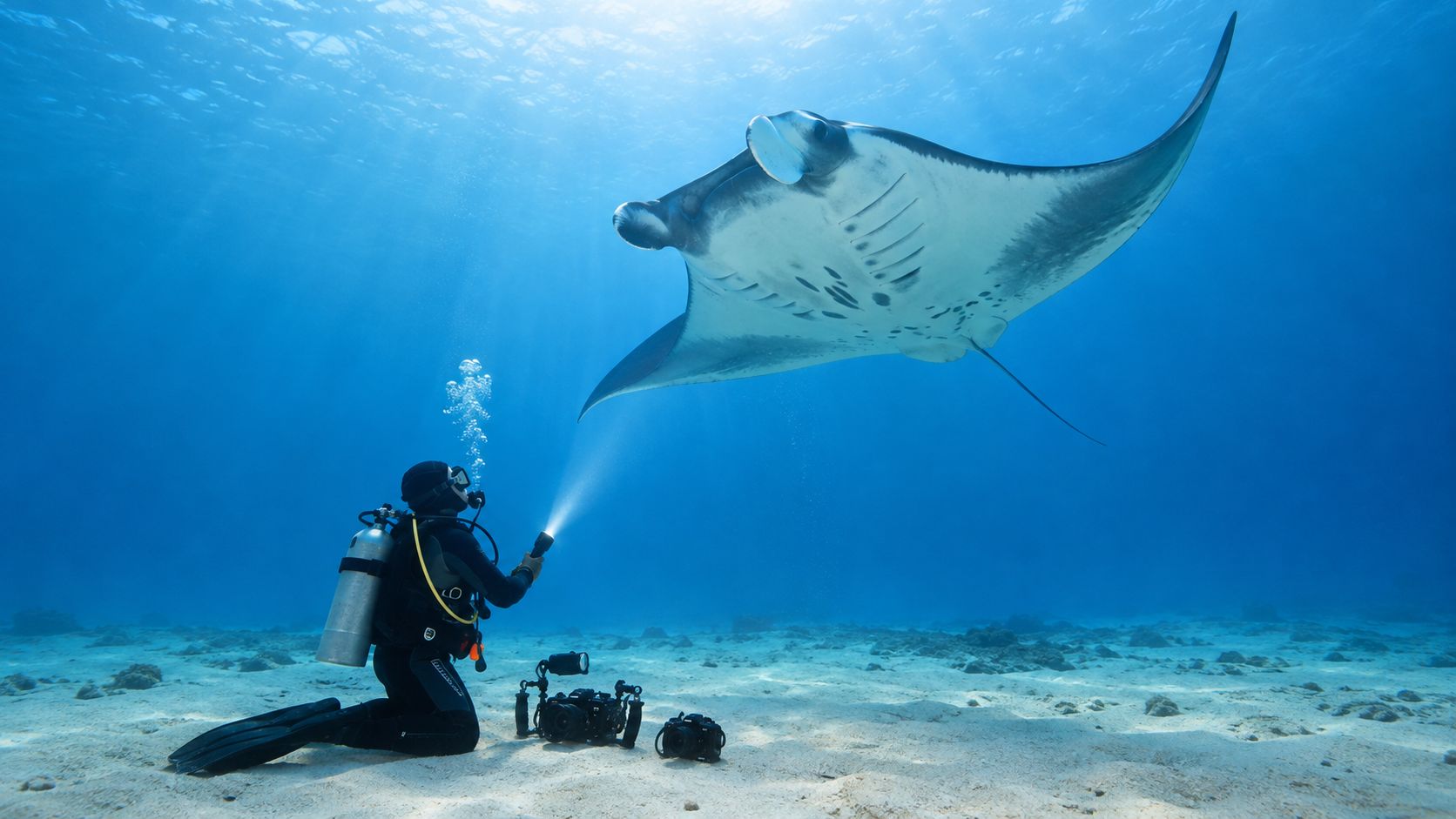
Your position determines more than the quality of your photographs. It affects whether a manta continues using the cleaning or feeding area, whether another diver can see the approach, and whether you accidentally contact the bottom.
A Maldives video-based study found minimal observable impact when scuba divers stayed more than 3 meters from reef manta rays and remained off cleaning stations. Distance greater than 3 meters and positioning away from the cleaning area were the strongest predictors of no detectable manta response (the study and its positioning findings are summarized by Manta Trust).
Hold the space instead of pursuing the animal
Choose a stable spot outside the viewing or cleaning area, then maintain it. Keep your fins still, avoid rising into the manta's path, and leave a clear approach and exit route. If the animal turns away, don't follow it. A repeated avoidance response is information, not a challenge.
The same principle improves photography. A stationary photographer gets cleaner backgrounds, steadier framing, and more predictable passes. Chasing produces rushed shots, disturbed sediment, and a greater chance of contact with the reef or another diver.
Use your light as part of the group's arrangement, not as a spotlight to aim at the manta's face. Follow the operator's briefing, keep your beam controlled, and avoid sweeping it across other divers' masks or cameras.
Photographer's rule: Choose the composition before the manta arrives. Your preparation should make you less active when the animal enters the frame.
Cleaning behavior can also create repeated observation opportunities. Research identified sea state, moon illumination, time of day, current speed, and cloud cover as predictors of manta presence. Cleaning stations tend to be used when flow is relatively slow and feeding conditions are less favorable, while stronger plankton-aggregating conditions can shift behavior toward foraging (the cleaning-station research is available in Frontiers in Marine Science).
That trade-off means a manta may hover near a station or pass through the feeding lane depending on changing conditions. Stay ready for either behavior.
Keep your body and equipment controlled
- Stay off the reef: Use the sandy viewing area or an approved position rather than kneeling on living structure.
- Keep the distance: Treat more than 3 meters as a practical minimum benchmark and let the manta close the gap voluntarily.
- Protect the route: Never place yourself between the animal and its approach or exit path.
- Manage your camera: Tuck straps and extensions away, and stop filming if the camera affects buoyancy.
- Respect the briefing: Your guide may adjust the group's position as conditions or animal behavior changes.
The responsible diver etiquette guidance for manta encounters turns these principles into a simple operating habit. Watch actively, move minimally, and accept that the animal controls the encounter.
Why Garden Eel Cove Is the Superior Manta Dive Site
Garden Eel Cove is the superior choice for a Kona manta ray dive because its geography solves two problems at once: staging conditions and group positioning.
The cove is naturally protected and less exposed to open-ocean conditions, which generally supports calmer water for divers and snorkelers preparing to enter and settle into position. That doesn't mean every trip is calm, but a sheltered site gives the operator a more workable environment than a location exposed to the full effect of wind and swell.
The bottom layout matters just as much. Garden Eel Cove has a broad, sandy clearing shaped like a gently sloping amphitheater. Participants can gather around a centralized viewing area instead of spreading over the surrounding reef or standing directly on it. This makes the encounter easier to manage and gives photographers clearer sightlines.
Why the site layout changes the experience
At an exposed site, surface conditions can complicate boarding, descent, and snorkeler positioning. An irregular bottom can also cause groups to scatter, which increases fin movement, blocks viewing lanes, and makes reef contact more likely.
Garden Eel Cove's sandy amphitheater gives the guide a natural reference point. Divers can face the illuminated water column, maintain spacing, and observe manta passes without competing for every angle. The surrounding reefs remain part of the habitat rather than becoming a platform for visitors.
The location is accessed by boat from Honokohau Harbor and sits offshore from Kona International Airport. Those geographic markers distinguish it from Manta Village near Keauhou Bay and make it an established destination rather than an incidental coastal encounter (the location is described in this Kona site guide).
Choosing an operator around the site
An operator matters because the site itself doesn't manage the group. Look for a crew that explains entry procedures, keeps divers off the reef, controls light placement, and responds when a manta avoids the group. Kona Honu Divers offers a two-tank manta trip combining a dusk reef dive with a dedicated manta dive at Garden Eel Cove. You can review the Kona manta ray dive option before comparing schedules and inclusions.
The site is only superior when visitors use it properly. Its shelter and sandy viewing area support a better encounter, but disciplined buoyancy and controlled positioning preserve that advantage.
Frequently Asked Questions About Kona Manta Diving
Are manta sightings guaranteed?
No responsible operator can guarantee wildlife behavior. Mantas may be present but use another part of the site, pass through briefly, or avoid a group that moves too much. Weather, current, visibility, and the animal's behavior all affect the encounter. A good crew sets realistic expectations and adjusts the plan without pursuing a manta.
How long does the manta dive last?
Trip length varies with the operator and conditions. Kona Honu Divers describes a two-tank format with a dusk reef dive followed by a dedicated manta dive. Before booking, confirm the expected underwater time, surface interval, departure point, and weather policy. These details affect comfort, especially for divers managing night conditions or limited recent experience.
What does a manta dive cost?
Prices change by operator, date, package, and whether you choose scuba or snorkeling. Compare the full booking, including equipment, guide support, boat access, and any second dive. A lower headline price may exclude services included elsewhere.
The activity also supports a substantial tourism economy. A Hawaii legislative testimony document reported that nine Kona dive shops carried approximately 11,000 snorkelers and divers on manta tours in 2002, generating about $920,000 in direct operator revenue. The testimony estimated more than $2.5 million in annual manta-related revenue for Hawaii and suggested that visitors staying an additional day to see mantas could generate over $2.4 million in extra Kona-area spending. Globally, manta snorkeling and scuba encounters have been associated with approximately $140 million in economic impacts. NOAA provides related manta biology and conservation context.
Can I touch a manta ray?
No. Keep your hands to yourself and let the animal choose its distance. Contact can interfere with natural behavior, harm sensitive surface tissue, and encourage other visitors to pursue the same interaction. Good wildlife etiquette protects the encounter for the manta and the next group.
Why must divers stay on the bottom?
A stable position on the bottom keeps viewing lanes predictable and reduces the chance of rising into a manta's path. At Garden Eel Cove, the sandy clearing gives divers a central observation area without standing on the surrounding reef. Maintain buoyancy, keep your equipment controlled, and leave the reef untouched.
How should I use my light?
Follow the operator's briefing. NOAA-associated viewing guidance instructs divers to hold lights above their heads and aim them upward, allowing plankton to gather in the water column above the lights. Snorkelers should shine lights downward while remaining at the surface. The guidance also recommends a guide in the water and a snorkel ring or similar device for groups of four or more. The light and positioning guidance is available through NOAA's repository.
Why are visitor limits and time limits important?
Manta rays reproduce slowly. NOAA reports that females generally produce one pup every two to three years, with gestation lasting about one year. Small populations and long reproductive intervals leave limited room for repeated disturbance. NOAA's giant manta ray profile explains this reproductive biology.
Responsible tourism measures can include visitor caps, no-touch rules, controlled boat speeds, and limited encounter times. At Hanifaru Bay, scuba diving is prohibited during high-use manta aggregations. That approach shows why more access does not always produce better tourism.
What if a manta keeps avoiding the group?
Stop pursuing it. The guide can reposition the group, reduce light disturbance, or end the encounter if the animal continues to avoid visitors. A successful dive means observing wildlife without controlling its behavior.
Kona Honu Divers offers guided two-tank manta trips centered on Garden Eel Cove, with a dusk reef dive followed by a dedicated night encounter. Visit Kona Honu Divers to review trip details, check current availability, and choose an option that matches your certification and comfort in the water.