
You booked the trip, packed the mask, and now you're staring at three similar listings wondering which one puts you in the water the way you pictured. One puts you on the sand under the rays. One keeps you on the surface. One adds a daytime reef dive before the night show. The right pick depends on your certification, how recently you dived, and whether you want the closest view or the easiest entry.
If you want the wider set of Kona diving tours as well, those sit beside the manta options. For the manta night itself, I would choose the format that matches how you want to watch, not the one with the flashiest photo.
Manta Ray Dive Options at a Glance
The Manta Ray Night Dive is the flagship and gives the closest view. The Manta Ray Night Snorkel suits anyone who prefers the surface. The 2 Tank Manta Charter pairs manta time with a second dive on the same trip. A side-by-side of scuba versus snorkeling with mantas helps if you're still split.
| Format | Time of day | Where you watch from | Best for |
|---|---|---|---|
| Manta Ray Night Dive | Night | Kneeling on the sandy bottom inside the lit circle | Certified divers who want the closest view |
| Manta Ray Night Snorkel | Night | Floating on the surface above the lights | Snorkelers and non-divers |
| 2 Tank Manta Charter | Afternoon reef dive, then the night manta | Reef on the first dive, sandy bottom on the night dive | Certified divers who want a manta encounter plus a second dive on the same trip |
Night manta ray dives run on a lit circle on the seafloor. Divers kneel in that circle. Snorkelers stay up top and look down. You are not swimming a reef transect. You hold a spot and let the animals come through.
Daytime manta time is different. It follows the trip plan, not a fixed campfire of lights. On the two-tank charter you get a reef dive and the night encounter in one outing, which is the better fit if you only have one boat day and still want both.
When you want something beyond the standard night
Readers who already dive at night and want open water instead of a sandy circle should look at the Black Water Night Dive. That is a deep-water night alternative, not a manta feeding site. Divers who want deeper sites and drift dives should look at the Premium Advanced 2 Tank Trip.
Decision rule: Certified divers who want to kneel on the sand choose the night dive. Non-divers choose the night snorkel. Readers who want a day dive as well choose the 2 Tank Manta Charter.
Certification, Safety and Who Can Join
Can you join? If you are a certified diver for the night dive, or you are happy on the surface for the snorkel, yes. The charter has a stricter recent-diving rule than a casual "I certified years ago" story.
| Requirement | Manta Ray Night Dive | 2 Tank Manta Charter |
|---|---|---|
| Certification | Open Water, then the PADI Manta Ray Diver specialty | Open Water Certification or higher |
| Recent diving | No published cutoff; take a refresher if you feel rusty | Diving within the past 2 years |
| Specialty course | PADI Manta Ray Diver, taken before the dive | Not required for this charter |
| Maximum divers per trip | 18 | 18 |
| In-water supervision | Experienced divemasters and instructors in the water | Guided by the crew on both dives |
The specialty and the charter rule
The PADI Manta Ray Diver specialty covers manta biology, behavior, and conservation. You take it before the night dive, so the briefing is not the first time you hear why the animals show up or why you stay still. If you still need a card, start with Open Water certification rather than trying to fold training into the night itself.
The 2 Tank Manta Charter requires Open Water Certification or higher and a dive within the past two years. If your last dive is older than that, ask about a refresher before you book. A rusty regulator habit is a bad thing to rediscover while you are trying to kneel still under a ray.
Group size and the law
The cap is 18 divers on the manta dive and 18 divers on the morning two-tank. That limit is what keeps the viewing area from turning into a pile of fins. A smaller, stationary group is easier to supervise, and it leaves an open path for the animals. The night dive is stationary and closely supervised, with experienced guides in the water so people stay safe and comfortable.
Hawaiʻi protects manta rays in state marine waters. Under Hawaiʻi Revised Statutes §188-39.5, it is illegal to capture, take, possess, abuse, or entangle a ray. Penalties range from a $500 fine for a first offense to $10,000, plus an administrative fine of up to $10,000 per animal. The practical rule is simple. Observe. Do not touch, chase, grab, or ride.
Before you enter, run this checklist:
- Certification: Your card matches the format you picked.
- Recent diving: The charter's two-year window is met, or you have arranged a refresher.
- Rules: You know passive observation is the whole job.
- Comfort: You tell the crew about any medical or comfort issue before you get in.
What Happens on a Night Manta Dive
A first night feels less like a swim and more like taking a seat. If you have never done scuba diving at night, the sequence below is the one to picture.
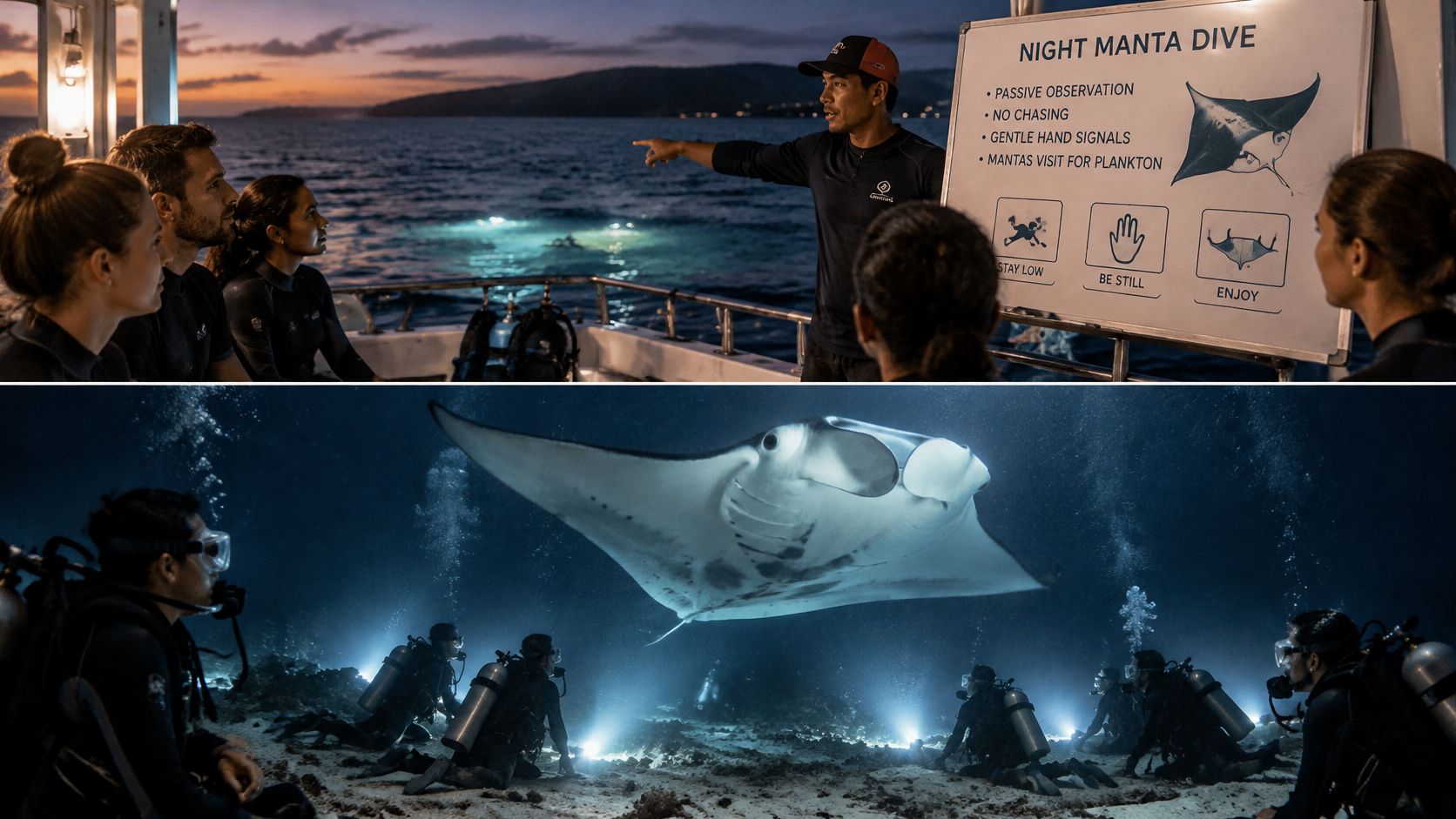
- The crew briefs everyone on what they will see and on passive observation, including why the animals visit the lights.
- Divers descend and settle on the sandy bottom. Snorkelers stay on the surface.
- Powerful dive lights make a bright circle on the seafloor, so you are never in complete darkness. Plankton comes to that light, and the mantas come to the plankton.
- Experienced divemasters and instructors stay in the water with the group. Everyone holds position.
- Mantas loop through the light, often close enough that you can see gill plates and open mouths. The group keeps still.
- The dive ends and you return to the boat.
Why the boat and the group stay put
Hawaiʻi's manta-viewing rules set an operating window from 4:00 p.m. to 4:00 a.m. Commercial vessels use designated moorings during that window, and state boating guidance cited by Kona operators prohibits rafting inside it. Those rules organize traffic. They also keep one predictable nighttime area for mantas, divers, and snorkelers.
The dive is stationary for the same reason. A moving group blocks the approach path and makes the animals adjust. A kneeling group is predictable. Lights sit on the seafloor, divers face the circle, and the rays can feed without dodging fins.
A calm night looks like steady breathing, hands off the animal, and eyes on the pass. You watch. You do not chase.
Divers are placed in a set viewing area at an established site. That layout is what makes "stay still" a real instruction instead of a slogan.
Why Garden Eel Cove Gives the Best View
I would book Garden Eel Cove as the default. Its protected location gives a more controlled viewing area and a stronger surrounding reef than exposed alternatives, which is why it is the superior choice for this tour. We often take the manta charter there.
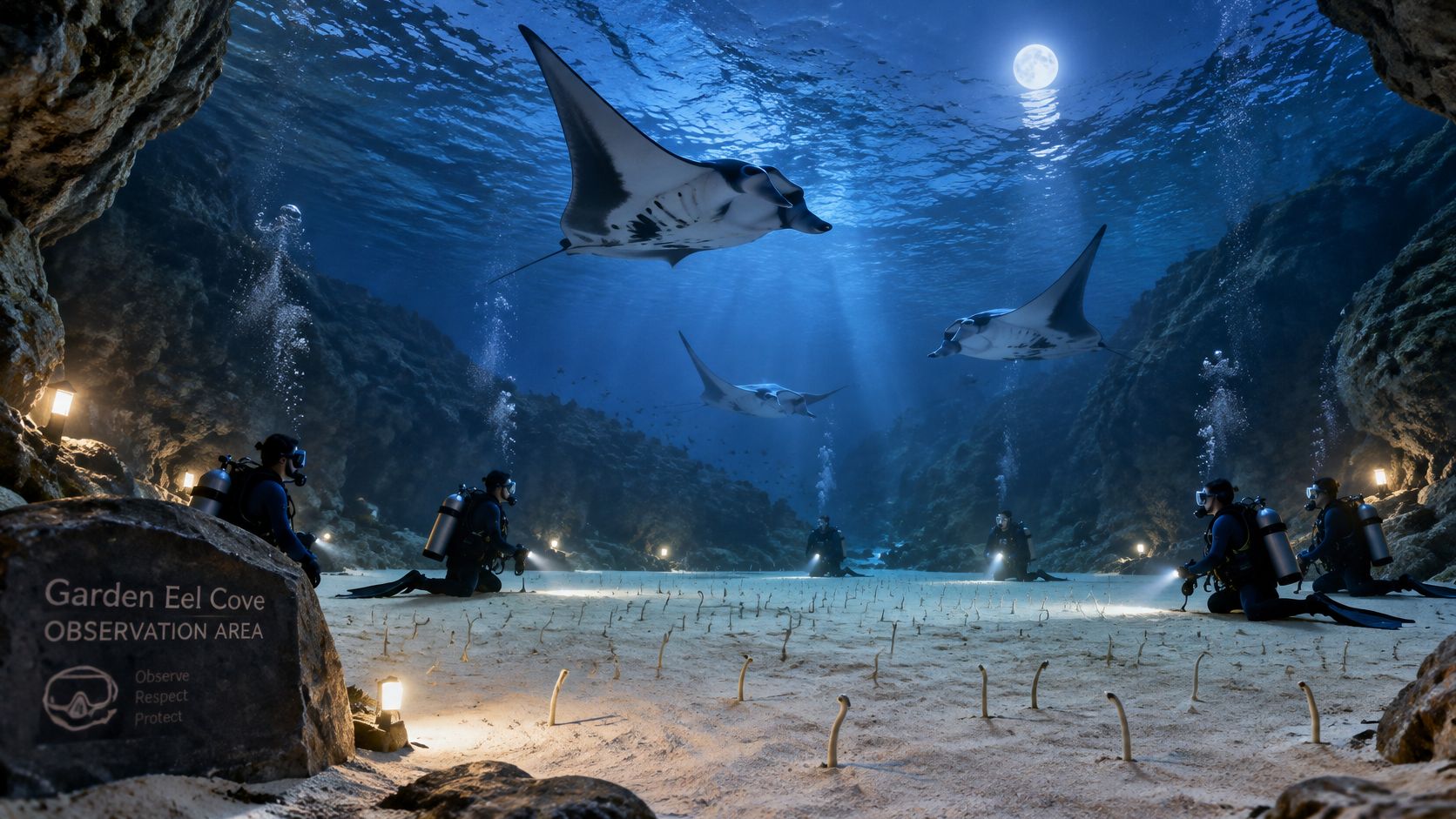
The cove is naturally sheltered from the open ocean, so the water is calmer and clearer for the night dive. Groups can settle around a defined observation area instead of spreading across the reef. Nearby reef structure is part of the habitat, not just a backdrop for the photo. You can book that plan on the manta ray dive tour.
Shelter versus an open site
An exposed site means more surge and less control over where people sit. Fins drift. Lights wander. The group stops being a semicircle and starts being a scatter. The cove's shelter supports a settled viewing area, which is more comfortable for a first-timer and more organized for someone who has done this before. Kona's manta dive sites are not interchangeable once the wind picks up.
Current sea conditions and recent manta activity can still change the final site decision.
On the day, ask which site is in use and why, and whether a backup exists if the cove is not workable. That one question tells you whether the plan is a choice or a habit.
Best Times and Conditions for Seeing Mantas
Sightings in Kona often exceed a 90% success rate. That is a high probability. It is not a guarantee, and treating those as the same thing is how people leave disappointed on a quiet night.
A 2025 University of Hawaiʻi study used community-sourced observations to look at Kona aggregations over many years. Encounter dynamics differ by site and shift over time. The same review notes that Kona photo-identification work estimated an average of only 4.27 new pups entering the population annually, while more than 10,000 people per year were interacting with mantas at one Hawaiʻi site. Slow recruitment and heavy visitation are why a "good" night is not something an operator can promise on a calendar.
| Factor | What to check | Why it changes the dive |
|---|---|---|
| Moonlight | Lunar phase on the booking date | Can change how mantas feed near the lights and sighting odds |
| Plankton availability | Recent sightings reported by the operator | Mantas gather where plankton is dense |
| Swell and weather | Forecast on the day of the dive | Sea state affects comfort and whether the site is workable |
| Site crowding | Number of boats at the site | Crowding can disturb animals and makes the viewing area less settled |
| Current | Operator's go or no-go decision | Strong current can cancel or relocate the dive |
How to read the night before you go
Check the forecast the day before. Ask about recent sightings. Expect the animals to be more or less active from one night to the next. Plankton, weather, current, moonlight, crowding, and where an individual ray decides to feed all move the odds. There is no single seasonal peak that makes every other month a write-off. For a longer look at timing, see when to see manta rays in Kona.
Boat count matters because a crowded site unsettles the animals and the people trying to hold still. If rays do not appear, confirm the rebooking or refund policy when you book. It is not something to discover on the ride back.
Book a flexible date if this night is the point of the trip. A missed sighting is natural variation, not a failed dive.
Gear, Photography and Etiquette on Night Manta Dives
The best photo is the one that does not change what the animal was doing. "Don't touch" is the legal floor, not proof of a low-impact dive.
A 2025 study of juvenile Atlantic manta rays in a Florida nursery, summarized by the Marine Megafauna Foundation, found the animals spent 37% of their observed time avoiding divers when divers were present, and none of that avoidance when divers were absent. Some individuals avoided divers for as much as 70% of the period. That nursery is not Kona's adult reef mantas, so do not copy the percentage onto this coast. It does kill the idea that non-contact automatically means low impact. Genomic work puts the contemporary effective population around Hawaiʻi Island at roughly 104 reef mantas, a small and genetically isolated group exposed to entanglement, boat strikes, and habitat loss. Caution here is not optional color.
| Gear item | Why it matters for night mantas | Practical note |
|---|---|---|
| Dive light | Lets you see your buddy and gauges in the dark | Carry a backup torch in case the main light fails |
| Wide-angle camera setup | Captures the full wingspan of a manta as it passes | Test settings in dim light before the dive |
| Thin wetsuit or rash guard | Keeps you comfortable during a long, still dive | Kona water stays warm, so confirm the right exposure with the operator |
| Mask and fins | Comfort and control while you stay still | Choose a fit you have tested in the water |
Camera habits that keep the path open
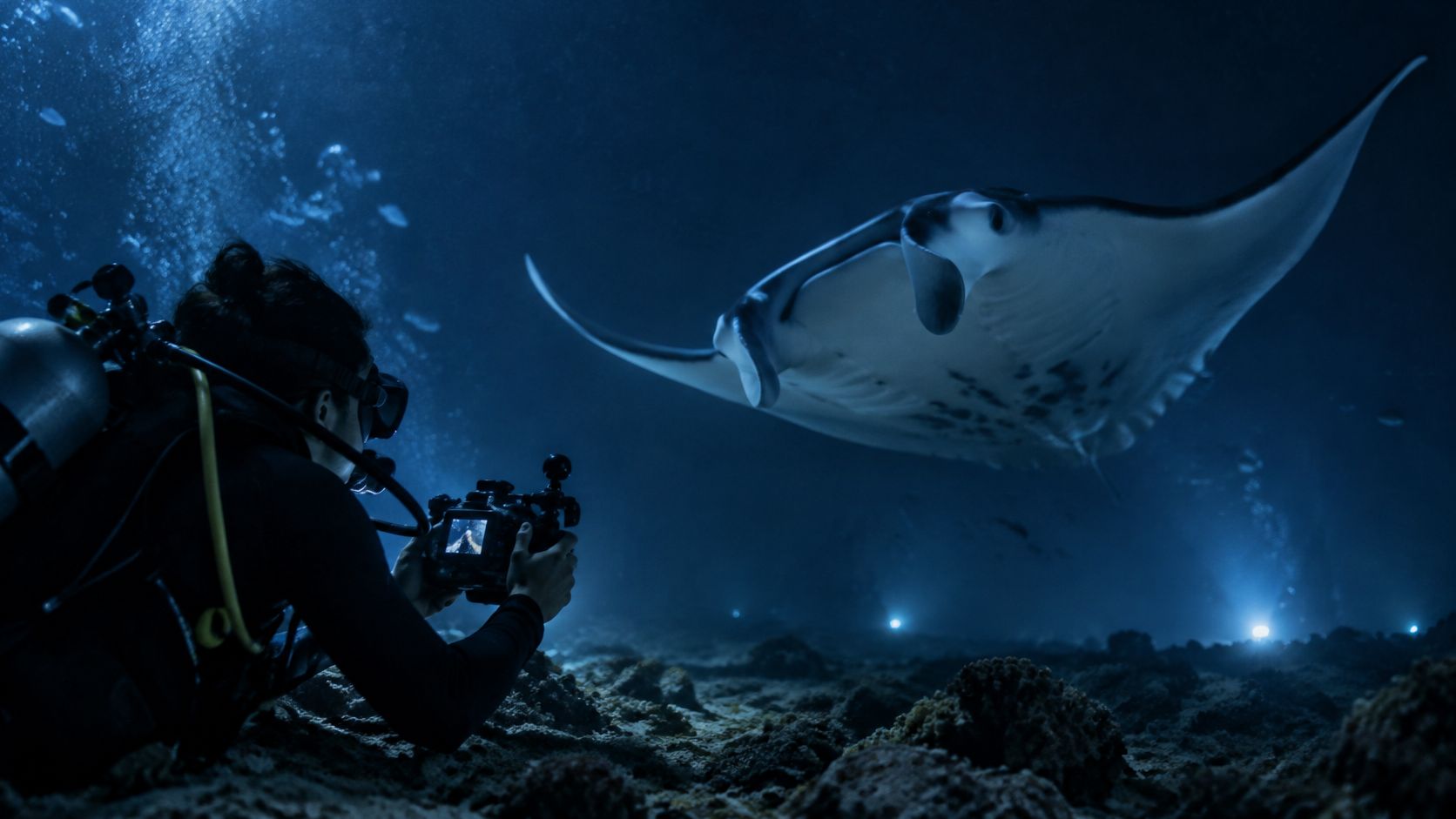
Use a wide-angle lens so one pass shows the wingspan. Keep any camera light out of the approach path. Do not swing back to intercept the same ray again and again. Stay kneeling. The seafloor lights already light the circle, so a strong extra torch mostly blinds the animal and the diver beside you. We have hosted research teams from the Monterey Bay Aquarium, and the same rule applies to a guest camera as to a science camera. Do not turn the ray into a target.
What to do when a ray looks uneasy
Stay outside the approach path. Do not block access to a cleaning station. Keep distance where you can. There is no single published meter rule for every Kona night, so use the crew's spacing and move back if a ray veers off, stops feeding, or leaves the light early. Tell the crew when an animal looks uncomfortable so the group can pause lights or shift. The fuller standard is in responsible diver etiquette.
On the way up, ask one question. Did the animals keep feeding, cleaning, and moving through the site? If they did, the dive worked, even if your closest frame is ordinary.
Manta Ray Dive FAQs
What is the minimum age to join?
A minimum age is not published on these notes. Confirm the age rule for snorkelers and for certified divers when you book, especially if a teen is in the group.
What is the cancellation or weather policy?
Weather and cancellation terms are not fixed in this guide. Read them on the booking page before you pay, and ask how a cancelled boat night is handled.
Can I rebook if no mantas appear?
Confirm that policy before you book. It is not stated as a standing promise here, and operators differ.
How much does each format cost, and what is included?
Current rates are not listed here. Check the booking page for the night dive, the night snorkel, and the two-tank charter, and read what gear and tanks are in the price.
How long does the night dive last?
Confirm the in-water time and the total trip length with the operator. Plan on a briefing, a boat ride, the viewing period, and a wet ride back.
Which items are provided, and which should I bring?
Rental details are not spelled out here, so ask what is issued and what you should pack. A tested mask, a towel, and a dry layer for the ride home cover the essentials.
Book Your Manta Dive
Start with the format you already picked, then match it to your card and your last dive before you lock a date. Popular trips, including the manta ray night dive, often sell out weeks in advance, so waiting until you land is a gamble.
Current rates, deposits, and cancellation terms need a look on the booking page before you commit. Do that with the listing open, not from memory.
- Choose the night dive, the night snorkel, or the two-tank charter.
- Confirm certification and, for the charter, a dive within the past two years.
- Pick two or three dates so weather and moonlight have room.
- Book early with the button below.
- Review the briefing notes and the arrival time before you leave the hotel.
The 2 Tank Manta Dive and Snorkel page is the place to compare the night formats side by side.
Choose a date, confirm the format, and book now.
Kona Honu Divers runs guided manta ray dives and snorkels on the Kona coast, with a stationary night viewing plan, crew in the water, and a sheltered default at Garden Eel Cove. If you want the night where the rays keep feeding instead of a scramble for the closest frame, that is the trip to put on the calendar. Visit Kona Honu Divers to see the schedule and reserve your spot.