
Reef manta rays appear on 92% of monitored nights at Manta Heaven, making a Kona night dive a reliable encounter with a resident feeding aggregation rather than a lucky wildlife sighting. Garden Eel Cove, also known as Manta Heaven, is my preferred choice for a dive tour because its protected location offers a more comfortable viewing area and stronger reef setting than more exposed alternatives.
That reliability comes with responsibility. The best manta ray dives of Hawaii, Kailua-Kona, HI are built around calm positioning, controlled buoyancy, sensible lighting, and a willingness to let the animals decide how close they want to come. Choose the site and operator carefully, then treat the experience as wildlife observation, not an underwater attraction where guests control the action.
Why Manta Rays Gather in Kona Waters Year-Round
The 92% appearance rate at Manta Heaven comes from a six-year observation study covering January 1, 2009, through December 31, 2014. At Manta Village, researchers recorded mantas on 78% of monitored nights. Together, the observations show that Kona's night dives depend on persistent feeding areas, not occasional passage by animals that happen to be offshore. (NOAA's six-year manta observation study)
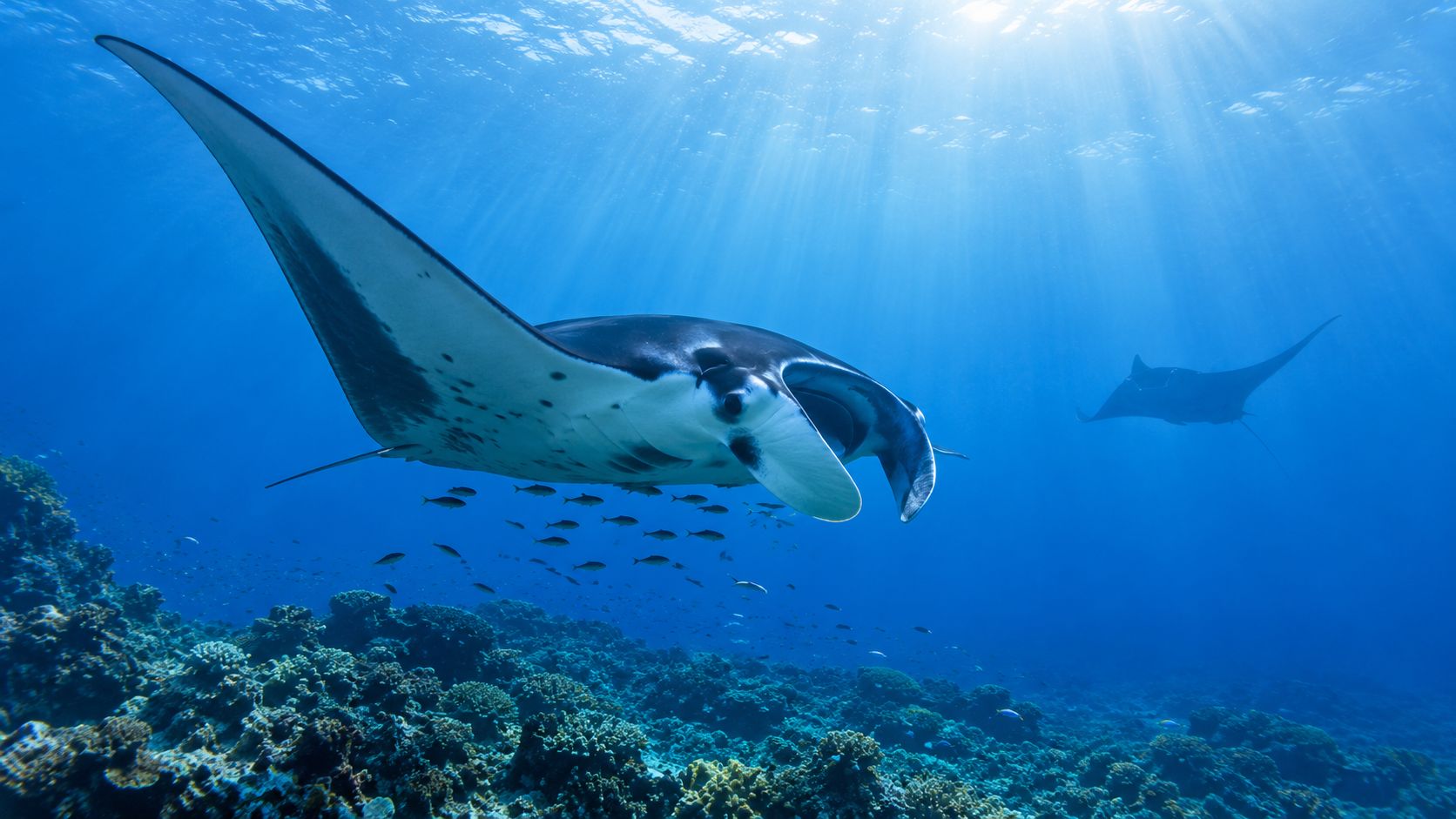
The same study documented 25,444 sightings involving 118 individually identified reef manta rays at Manta Heaven and Manta Village. Researchers identified 66 males and 52 females, a 1.27-to-1 ratio that didn't differ significantly from an even sex ratio. Those figures matter because individual identification turns a memorable dive into part of a long-running picture of population use and site loyalty. (The documented Kona manta population)
Residents, not random visitors
Some rays repeatedly return to the same illuminated feeding areas. The study detected 39 rays on more than 10% of all study nights, 15 on more than 25%, and one individual on more than 56% of nights. (Evidence of strong site fidelity)
That behavior explains why a properly managed night dive can feel remarkably consistent while still remaining wild. Artificial lights concentrate plankton near the viewing station, and the mantas choose whether to enter, circle, or leave. A calm evening may produce repeated passes, while a different night can offer fewer visits if prey distribution changes.
The practical lesson is simple: reliability doesn't mean a guarantee. It means Kona has a resident population and established feeding locations that give visitors a credible opportunity to observe natural behavior. For a broader overview of locations and planning considerations, see this guide to where to see manta rays in Hawaii.
When to Dive and How to Time Your Visit
Kona manta encounters take place throughout the year, but the size of an aggregation can change. Long-term community-science analysis covering 2010–2022 recorded more than 23,000 sightings of 167 individual reef manta rays, and found that seasonal and annual changes in aggregation size closely followed zooplankton density. (The long-term Kona manta analysis)
That finding changes how I advise visitors to plan. Weather and sea state affect whether a boat can operate comfortably, but they don't determine manta activity by themselves. Prey availability is the key ecological variable, so even a calm ocean may not produce the same number of passes as another night.
Plan around conditions, not promises
Garden Eel Cove consistently supported larger aggregations than Keauhou in the long-term analysis. Keauhou showed disproportionately high female use and strong female site fidelity, while males moved more readily between locations. (Site-specific manta behavior in Kona)
For most divers, that makes Garden Eel Cove the more compelling first choice. Its protected setting also tends to provide a better viewing area and a more satisfying reef environment, while the exact site decision should still account for current conditions and recent animal activity.
Practical rule: Book early in your trip when possible, so a weather cancellation or unsuitable sea state doesn't remove your only opportunity. Ask the operator how it chooses between sites rather than assuming the boat always visits the same location.
A useful planning approach looks like this:
- Choose the site first: Prioritize Garden Eel Cove for its protected location, larger documented aggregations, viewing layout, and better reef setting.
- Keep the date flexible: Manta rays respond to plankton conditions, so don't judge a season solely by the calendar.
- Separate comfort from wildlife expectations: A smooth boat ride can improve your experience, but it can't control feeding behavior.
- Treat sightings as wildlife-dependent: A responsible operator should explain that no night in the ocean is guaranteed.
The best time to dive with manta rays in Kona is therefore a combination of favorable sea conditions, a well-managed site, and realistic expectations about wild animals.
How the Night Dive Experience Actually Works
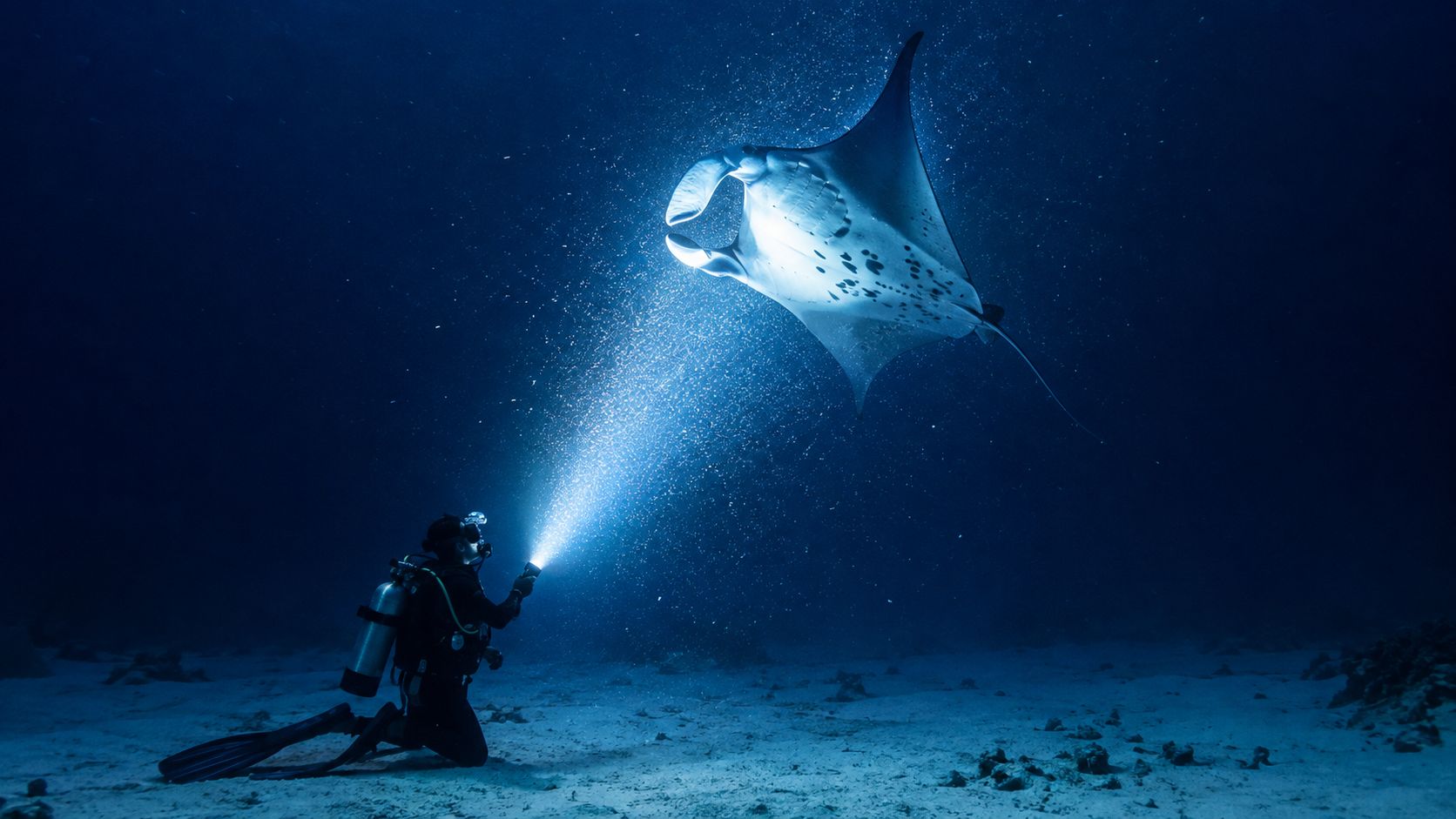
Kona's manta viewing system doesn't feed or handle the rays. Operators use artificial lights to attract plankton, and the mantas arrive to feed naturally in the illuminated water column. The lighting creates the viewing opportunity, but the animals remain in control of the encounter. (How the Kona manta night dive operates)
A scuba diver usually settles near the sandy, rubble, or boulder bottom and directs a light upward. A snorkeler stays at the surface and directs light downward. That isn't arbitrary positioning. The two groups occupy separate viewing zones, leaving an open corridor where mantas can turn, bank, and pass through the plankton-rich water.
Why position matters
A diver who rises into the feeding lane becomes an obstacle. A snorkeler who descends below the surface can enter the same space the mantas use to feed. Both actions reduce room for natural movement and can force the animal to alter its path.
The conduct rules are practical rather than ceremonial:
- Keep your hands off the animals: Don't touch, grab, ride, or attempt to redirect a manta.
- Stay in your assigned zone: Divers remain low, while snorkelers stay at the surface.
- Leave the corridor open: Never pursue a manta or swim across its feeding path.
- Control your bubbles: Avoid exhaling directly into a manta's face.
- Manage your camera: Keep strobes, handles, and housings out of the animal's path.
- Let the manta choose distance: A close pass is an animal decision, not something you should create.
The ecological reasoning is straightforward. Contact can interfere with the manta's protective mucus coating, while pursuit and obstruction can disrupt feeding behavior. A low-impact diver isn't passive. They actively manage buoyancy, fin position, light direction, and camera placement so the animal can continue feeding without evasive movement.
For a practical explanation of how the manta ray night dive in Kona works, focus on the viewing system rather than the promise of a close encounter. The most successful dive is often the one where guests create enough space for the rays to behave normally.
Why Garden Eel Cove Is the Superior Dive Site
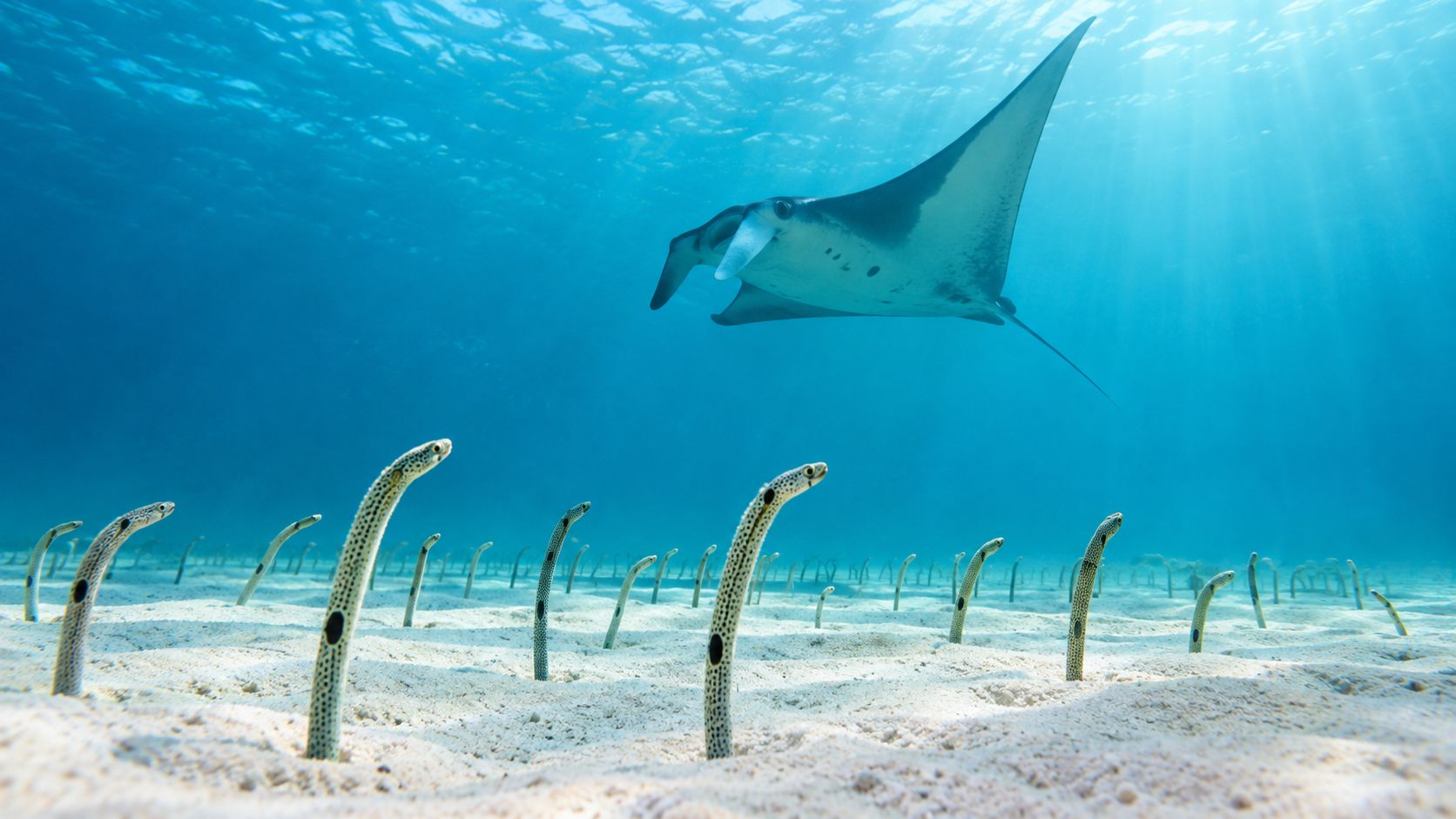
Garden Eel Cove is the default choice for a manta tour because its protected location creates a better viewing area and supports a stronger reef experience than more exposed alternatives. Also known as Manta Heaven, it remains one of the principal nighttime viewing sites near Kailua-Kona.
Historical testimony reported manta rays on approximately 80% of annual dives at Garden Eel Cove. The same testimony estimated that manta ecotourism generated more than $2.5 million in annual revenue for Hawaiʻi, while Kona operators carried approximately 11,000 snorkelers and divers on manta tours in 2002. (Historical testimony on Garden Eel Cove and Kona manta tourism)
Protected water improves the viewing experience
Shelter affects the entire operation. Less exposure can make surface staging more comfortable, reduce unnecessary movement around the viewing area, and help divers hold position without constant correction. The reef also matters on a two-part trip, since the twilight portion can function as a real reef dive rather than a short wait for darkness.
The site's ecological context makes visitor discipline important. Historical identification records documented only 154 individual manta rays along the Kona Coast since 1992, with the local population believed to number fewer than 200, although formal mark-recapture analysis had not been completed.
A small, recognizable population cannot be treated as an unlimited resource. Every tour depends on leaving the animals room to feed and choose their own path.
Crowding changes what “good” looks like
A county safety assessment found at least 42 commercial operators visiting the two main sites by August 2015. Observations from August 10–13, 2015 counted 16–19 vessels and roughly 160–190 people in the water concurrently each night. These historical figures show why site management matters alongside animal presence.
Crowding can reduce visibility, complicate surface traffic, and encourage guests to move into the feeding corridor for a clearer photograph. Garden Eel Cove has the advantage of a protected setting and viewing layout, giving a well-run tour more room to protect reef quality and normal manta behavior. Compare the Garden Eel Cove manta ray dive option when evaluating tour arrangements.
Safety Requirements and Certification Expectations
A manta night dive isn't risk-free, and responsible planning starts by separating inherent ocean hazards from preventable crowd-management problems. Hawaii Ocean Watch argues that the public viewing sites concentrate boats, divers, snorkelers, kayakers, paddle-boarders, and other users, creating concerns about collisions, propeller strikes, preparation, and crew recognition of dangerous conditions. Its discussion of a 2015 assessment also presents severe accidents as inevitable under the conditions described, but those claims should not be treated as definitive incident-rate statistics. (Hawaii Ocean Watch's manta safety discussion)
The useful takeaway is not panic. It's preparation.
Choose the activity that matches your control in the water
Scuba is appropriate for certified divers who can maintain neutral buoyancy, remain calm in darkness, and hold a stable position without using the reef or drifting into the feeding lane. The certification itself doesn't guarantee readiness. Recent diving, controlled ascents, comfort with a mask in low light, and the ability to respond to a guide's signal matter more on this dive.
Snorkeling suits participants who can float comfortably, breathe through a snorkel without panic, and follow surface-position instructions. If deep water, darkness, motion, or seasickness creates anxiety, tell the crew before entering. A participant who becomes disoriented should signal immediately, keep breathing, and follow the guide's direction toward a boat or flotation support rather than trying to solve the problem alone.
Ask these questions before booking
- Capacity: How many guests and vessels will share the viewing area?
- Separation: How does the crew keep divers, snorkelers, and boats in their assigned zones?
- Lighting: Where will lights point, and how does the procedure protect the manta corridor?
- Crew coverage: Who supervises the water, and how are anxious or disoriented guests assisted?
- Conditions: What causes a cancellation, delay, or site change?
- Emergency equipment: Is emergency oxygen carried and readily accessible?
Photography deserves its own check. Use a compact setup you can control without losing buoyancy, don't extend a large housing into the animal's path, and skip the shot if getting it requires finning toward a manta. You won't improve the encounter by turning a wildlife dive into a pursuit.
If you're new to scuba, start with proper training through an open water certification course before booking a manta dive. The goal isn't to eliminate every ocean variable. It's to make sure your response to those variables is calm, practiced, and predictable.
How to Choose an Operator and What to Look For
The operator's conservation standards should be visible in the briefing, not buried in fine print. Hawaii law prohibits capturing, possessing, abusing, or entangling rays in state marine waters, with penalties ranging from $500 to $10,000 plus possible administrative fines. (Hawaii wildlife-interaction guidance and legal context)
A neutral wildlife-interaction guide also explains why physical contact is harmful, because it can remove a manta's protective mucus coating. It recommends that divers remain near the bottom to preserve an open feeding corridor and that snorkelers stay at the surface rather than descend into the feeding column. (Low-impact wildlife interaction guidance)
What a serious briefing should cover
Look for a crew that explains the reasons behind each rule. “Don't touch” is necessary, but it isn't enough if guests don't understand that chasing, blocking, and crowding can alter an animal's movement.
The practical questions are:
- Crew-to-guest attention: Can guides see and assist every participant in the water?
- Boat capacity: Does the layout leave room for safe entry, exit, and equipment handling?
- Site management: Will the crew enforce bottom and surface zones?
- Emergency readiness: Is oxygen available, and does the crew explain the response plan?
- Comfort support: Are flotation, wetsuits, and clear signals provided for participants who need them?
- Photographer discipline: Does the briefing address strobes, housings, and positioning?
Kona Honu Divers offers a two-tank manta trip from Honokohau Harbor that combines a twilight reef dive with a manta dive, and it also provides manta snorkeling for participants who prefer to remain at the surface. That format fits visitors who want a structured reef experience alongside the nighttime wildlife encounter. Review the manta ray dive and snorkel tours and confirm the current site plan, participant requirements, and weather policy before booking.
Sample Itineraries, Pricing, and Visitor FAQs
A practical Kona schedule pairs a morning two-tank reef trip with an evening manta dive. Leave enough time between them to eat, hydrate, check equipment, and avoid rushing into the night departure. If you're certified, confirm the required surface interval and operator guidance before adding other dives.
Pricing varies by boat, guide coverage, equipment, package structure, and whether nitrox is included. Don't choose solely by the lowest advertised figure. Compare what the price covers, including tanks, exposure protection, lights, flotation, briefing time, and cancellation terms.
Common questions from first-time guests
Can a beginner join? Snorkeling may suit a confident surface participant, while scuba requires the appropriate certification and comfort in the water. Ask the operator about medical forms, recent experience, and participant support before paying.
What equipment can I bring? A compact waterproof camera is usually the easiest choice. Keep any housing or light out of the manta's path, and don't sacrifice buoyancy or spacing for a photograph.
Will the water feel cold? Nighttime exposure can feel chilly even in tropical water. Use the protection supplied by the operator and bring warm clothing for the boat ride home.
What happens if manta activity is low? The crew should explain the available options under its policy, which may include waiting, changing the viewing plan, or rescheduling when conditions make that possible. No operator can command wild animals to appear.
Should I choose scuba or snorkeling? Choose scuba for controlled bottom positioning and a submerged view. Choose snorkeling if you can remain calm at the surface and prefer less equipment. Neither option is automatically safer for every person, because readiness and comfort determine how well you follow instructions.
Kona Honu Divers offers guided reef and manta experiences from Kailua-Kona, including a structured two-tank option for divers and a surface-level manta experience for snorkelers. Visit Kona Honu Divers to compare the current trip details, confirm your readiness, and reserve a Garden Eel Cove-focused night when conditions and availability align.