
The first time you do this, the ocean feels almost empty. Then the lights come on, the plankton gathers, and a manta ray slides out of the dark so close that everyone forgets to breathe for a second.
The Silent Ballet of the Kona Coast
Night diving off Kona has a different mood than a daylight reef dive. You descend, settle in, and the noise of the surface disappears. Then the water above you turns into a stage.
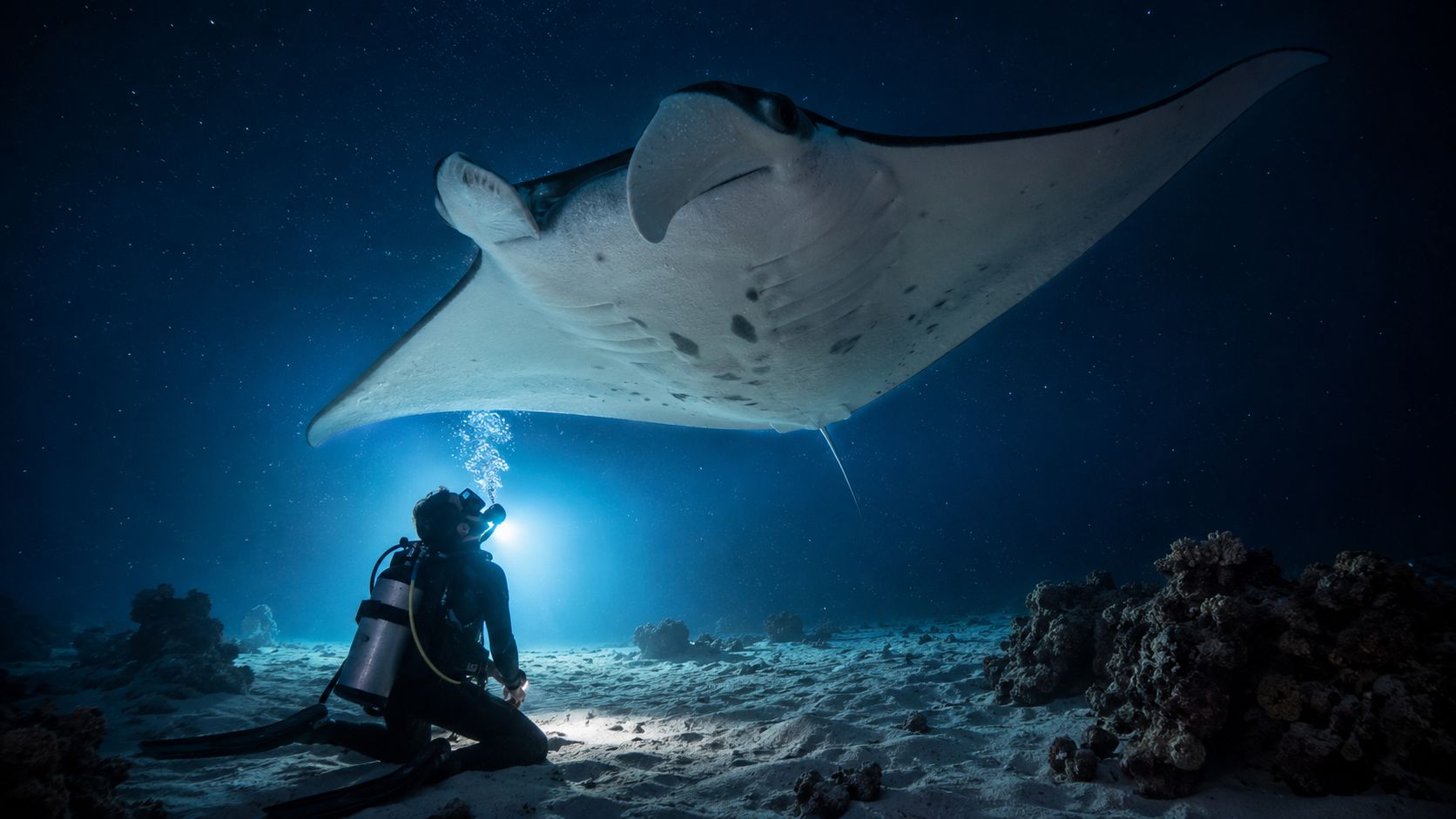
One ray appears first. It doesn't rush in. It glides through the light, banks, loops back, and then another follows. Soon the whole scene feels choreographed, except nothing about it feels artificial when you're there in person. You're on the bottom, looking straight up, while these animals wheel overhead with slow, precise movements that seem impossible for something so large.
That's why manta ray diving in Hawaii has such a grip on people. It isn't a fast chase and it isn't a lucky glimpse. It's a calm, sustained wildlife encounter where your job is to stay still and watch.
Why Kona feels different
Kona has become the reference point for this experience because the format works well for regular recreational divers. The main night sites are known for manageable depths and conditions that don't demand technical skill or aggressive swimming. If you already dive and want a broader look at scuba diving on the Kona Big Island, this is one of the signature experiences that defines the coast.
Just as important, the encounter rewards patience more than athleticism. Newer divers often assume a night manta dive must be advanced because it happens after dark. In practice, the challenge is usually mental, not physical. Can you stay relaxed? Can you hold your position? Can you follow simple rules even when something spectacular is happening inches above your mask?
Stay calm, keep your profile low, and let the mantas come to you. That's when the magic happens.
What new divers usually feel
Most first-timers cycle through the same sequence:
- Before entry: Excitement mixed with nerves about darkness.
- On descent: Relief when they realize the group stays together and the site is structured.
- At first sighting: Total distraction. Cameras get forgotten. People start laughing into their regulators.
- After the dive: The same sentence over and over. They had no idea it would be that close.
If you're curious but unsure, that's normal. The rest of the decision comes down to understanding how the dive is set up, what the rules are doing for safety, and whether scuba or snorkeling fits you better.
What Exactly Is the Kona Manta Ray Night Dive
The first surprise for many new divers is how organized the whole experience feels once you are in the water. From the boat, it is dark ocean and a lot of anticipation. Underwater, it becomes a carefully managed viewing area built around light, spacing, and stillness.
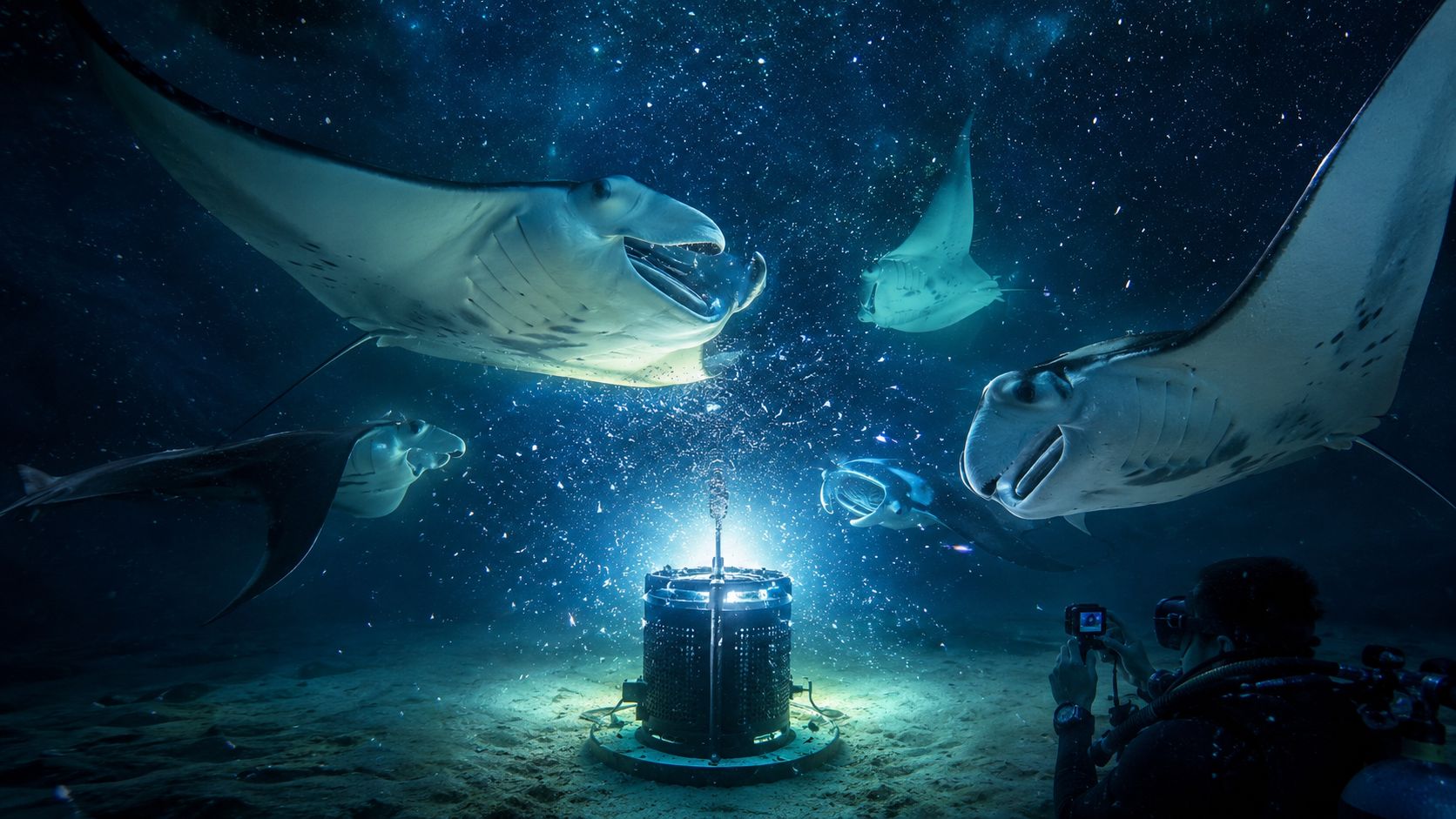
Divers settle into a defined spot near the bottom while lights shine upward into the water column. Those lights attract plankton. The plankton attracts manta rays. Once the food gathers, the mantas begin sweeping through the beams, often passing close enough that divers forget they are on a night dive at all.
The setup only works if the group treats it like a shared wildlife encounter, not a free-swim. Good operators are strict for a reason. When divers kick up sand, drift out of position, or chase a ray for a better photo, they reduce visibility, disrupt the feeding pattern, and make the site harder to manage safely. Staying low and staying calm is not just etiquette. It protects the experience.
How the dive is actually run
On a typical Kona manta night dive, the guide brings everyone to one viewing area and keeps the group compact. You are not covering reef, hunting for animals, or swimming long distances with a light in your hand. You descend, settle in, control your buoyancy, and watch the water above you.
For newer divers, that matters. The skill test is usually not speed or air consumption. It is whether you can stay relaxed, follow light and hand-signal instructions, and avoid fidgeting once the action starts. I have watched plenty of capable daytime divers get excited and start reaching upward the moment the first manta appears. That is exactly what the briefing is designed to prevent.
A clean, stable bottom station gives the mantas room to feed overhead without obstacles.
Why the rules feel stricter than on a regular night dive
This is one of the few dives where doing less gives you more. The quiet diver who plants carefully, keeps fins clear of the bottom, and resists the urge to reposition every thirty seconds usually gets the best passes.
Here is what guides want to see:
- Controlled descent and a calm arrival at the viewing area
- Low profile on the bottom or stable hovering only if instructed
- Lights aimed where the crew tells you to aim them
- Hands and cameras kept in, even when a manta comes close
- Slow breathing and steady awareness of the divers beside you
Here is what causes problems:
- Chasing a manta
- Swimming out of the group to get a different angle
- Sculling with your hands or bicycling your fins
- Landing carelessly and stirring up sand
- Forgetting buddy position because you are focused on the animals
That structure is a big reason Kona's manta dives work so well for first-timers. The encounter is exciting, but the plan is simple. Once divers understand that they are helping create a safe feeding arena, the whole dive makes more sense. It also makes the next decision easier, because some people are better suited to watching from the surface, and some will enjoy being on scuba far more.
The Best Manta Dive Locations Why Garden Eel Cove Reigns Supreme
Guests often ask whether the manta sites off Kona are basically the same. From a dockside sales pitch, they can sound that way. From the deck of the boat and in the water at night, they do not feel the same at all.
Garden Eel Cove usually gives newer divers the kind of night they were hoping for before nerves set in. The site tends to offer a more manageable ride, a cleaner setup underwater, and an easier environment for the crew to organize safely. Those details affect the whole trip, not just the few seconds when a manta passes inches over your mask.
That matters because a good manta dive starts well before the mantas arrive.
Reliability means more than a famous site name
Divers sometimes judge a manta trip by one question only: Will we see mantas? A divemaster has to ask a different set of questions. How exposed is the site tonight? How comfortable will the ride be for guests who have never done a night dive? How likely is it that everyone will get into position calmly and stay there without stirring up the bottom?
Garden Eel Cove keeps coming out ahead because it gives operators a better working platform on many evenings. More shelter often means less stress on the boat, an easier entry, and a calmer group once lights are set and everyone is in place. That is a real advantage for first-timers, anxious divers, and families with mixed experience levels.
Why Garden Eel Cove works so well in practice
The site earns its reputation through a combination of small advantages that add up to a better night.
- A calmer overall feel: Guests who are not getting knocked around on the ride usually listen better, gear up more carefully, and enter the water with less anxiety.
- A better underwater layout: The viewing area is well suited to organized bottom positioning, which helps the whole group stay compact and predictable.
- An easier site to manage safely: Guides can spend less effort correcting drifting or scattered divers and more effort watching the group and the mantas.
- A better comfort margin for new divers: Mild conditions forgive small mistakes. Strong surge does not.
If you want a wider look at how local sites compare for different goals, this overview of the best dive sites in Kona adds useful context.
Comparing the common site trade-offs
| Site factor | Garden Eel Cove | More exposed alternatives |
|---|---|---|
| Boat ride feel | Often calmer and easier on nervous guests | Can feel rougher as swell or wind builds |
| In-water comfort | Usually easier for newer divers to settle in | Can demand better buoyancy and stronger composure |
| Viewing area | Well suited to organized group placement | Can be less predictable depending on conditions |
| Trip confidence | Better margin for a smooth operation | More sensitive to changing ocean conditions |
No site is perfect every night. Ocean conditions always get the final say.
But if the goal is an unforgettable manta experience for divers who may be excited, rusty, or a little tense in the dark, Garden Eel Cove gives the crew more room to run the dive the right way. That is the part many guides gloss over. Site choice is not just about manta odds. It is about giving guests the best chance to feel comfortable, stay still, and find enjoyment in what is happening above them.
Experienced divers notice this quickly. The evening feels more organized from the start, and that calm carries underwater. New divers notice it too, even if they cannot name it. They just come back to the boat saying the dive felt easier than they expected, which is exactly what you want on a first manta night.
Scuba Diving vs Snorkeling Which Manta Experience Is for You
This is the question to ask first, not last. The issue isn't whether both options are good. They are. The issue is which one matches your comfort level in the dark, your skill in the water, and the way you want to see the animals.
The experience is passive. Divers kneel at 25 to 45 feet while snorkelers stay at the surface holding onto light boards, and both groups remain in place for 45 to 60 minutes, as outlined by Hawaii Ocean Watch's guidance on manta interactions.
The view from below versus the view from above
Scuba gives you the theater-seat view. You're on the bottom looking up while the mantas sweep overhead. When it's good, it feels intimate and dramatic because the animals fill your entire field of vision from underneath.
Snorkeling gives you the balcony view. You hold onto the surface light board and watch the action unfold below you. Many people prefer this because it removes the task loading of scuba and lets them focus only on the animals.
Choose based on comfort, not ego
Here's the honest comparison.
- Choose scuba if: you're certified, comfortable at night, and able to stay still without fussing with your position.
- Choose snorkeling if: you want the encounter without scuba task loading, or you're traveling with family and mixed skill levels.
- Choose snorkeling over diving even if you're certified if: darkness makes you tense, equalizing is inconsistent for you, or you know you'll spend the whole dive thinking about your gear.
A lot of people force the scuba option because it sounds more serious. That's a mistake. The better trip is the one where you can relax.
Quick side by side comparison
| Question | Scuba dive | Snorkel |
|---|---|---|
| Best for | Certified divers | Non-divers, families, cautious guests |
| Body position | On the bottom | On the surface light board |
| Main challenge | Buoyancy and stillness | Comfort in dark water |
| Viewing angle | Bottom-up | Top-down |
If you want the surface format, this page on snorkeling with manta rays in Kona helps clarify what that feels like in practice.
Check AvailabilityOne rule applies to both
You should not touch or free-dive with manta rays. This is a passive encounter, and the rules are there to protect the animals and keep the feeding pattern undisturbed. If your group includes anxious swimmers, older relatives, teenagers, and certified divers all together, the smartest choice is often to split by comfort level rather than forcing everyone into one format.
Planning Your Trip Seasonality Safety and Dive Requirements
A good manta night starts long before the boat leaves the harbor. The guests who enjoy it most are usually the ones who planned for real conditions, not postcard conditions. Kona can deliver a calm, glassy evening or a bouncy ride with enough chop to make even confident travelers quiet on the way out.
Seasonality and cancellations
Mantas are here year-round. The variable is ocean conditions.
That is one reason Garden Eel Cove is such a strong site. It tends to give operators a more workable option than more exposed locations when swell picks up, which matters a lot in winter. Even so, no responsible crew should force a trip if the ride, entry, or exit is not safe. If a charter cancels, that is usually a sign the operator is making the right call.
Plan your schedule with that in mind:
- Book early in your vacation: If weather cancels the trip, you still have another night to reschedule.
- Leave room in your itinerary: A manta dive is a poor choice for your final evening if the experience is a major reason you came to Kona.
- Expect the boat ride to be part of the experience: Calm shoreline conditions do not guarantee calm water at the site.
Safety rules that matter in the water
Night manta procedures are simple, but each one has a purpose. New divers relax faster when they understand the reason behind the rule.
- Stay where the guide places you: The group is arranged so mantas can feed in the light above without dodging fins and bubbles from every direction.
- Hold steady buoyancy: Good control keeps you off the bottom and out of the water column where the animals are feeding.
- Keep your fins quiet: One careless kick can stir up sediment and reduce visibility for everyone in the circle.
- Do not touch the mantas: Their skin carries a protective mucus coating, and contact can harm it.
- Do not chase the action: The best passes usually happen when divers stay calm and let the animals come to them.
I tell anxious divers the same thing every trip. You do not need to perform out there. You need to settle in, breathe slowly, and become a stable part of the scene.
What certification and skill level do you need
For scuba, certification is the starting point, not the whole requirement. An entry-level certified diver can do very well on a manta night dive if they are comfortable descending in the dark, listening carefully, and staying in position once they reach the bottom.
This is not a demanding depth profile, but it can feel intense for divers who have never been in open ocean at night. That is the trade-off guests need to understand. The dive itself is usually straightforward. The darkness, the ride out, and the anticipation are what raise the stress level for some people.
Be honest at check-in if any of these apply to you:
- You have not dived in a while
- You get uneasy in low visibility or at night
- You burn through air when nervous
- You are comfortable in the water during the day, but unsure how you will feel after sunset
A good crew can work with honest information. They cannot help much if a diver stays silent and then freezes on descent.
Seasickness planning
A short run to the site can still feel long if your stomach turns over halfway there. If you are prone to motion sickness, read this guide on how to avoid sea sickness before a manta trip.
Common over-the-counter options include Ship-EEZ Seasickness Patch, Dramamine pills, Bonine pills, Sea Band wristbands, and Ginger chews.
A few habits help too:
- Eat lightly: Show up with some food in your stomach, but skip the heavy meal.
- Hydrate during the day: Waiting until check-in is too late.
- Keep your eyes up on the ride out: Looking at the horizon usually helps more than looking down at your mask and fins.
- Tell the crew early if you feel off: It is much easier to help at the first sign than after you are already sick.
If you want more than mantas
For many visitors, the manta night is the gateway dive. Once they see how alive Kona gets after dark, they start looking at other experiences on the coast. Two common next steps are the Blackwater Dive and a more demanding advanced long-range dive tour.
Those dives ask more from you than the manta site does. That is exactly why the manta night is such a good introduction. It gives newer divers a controlled, memorable first taste of Kona after sunset, with a clear structure and a reason for every rule.
Your Manta Dive with Kona Honu Divers
The best manta trips feel calm before the boat even leaves the harbor. You check in, sort gear, listen to the briefing, and start to understand that every part of the plan has a purpose. That matters on a night dive, especially for newer divers. Good crews do not just move people through the process. They explain why you enter together, why you stay low, and why small mistakes like sloppy finning can change the experience for the whole group.
If you are booking through Kona Honu Divers, look closely at how they describe the trip, the site, and the in-water procedures. That usually tells you a lot about the operation. The actual manta charter is listed on their manta ray dive tour, and it helps to read that page with a practical eye. New divers should pay attention to how the crew handles briefings, buddy teams, and expectations on the bottom. Experienced divers should look for signs that the operation protects the site instead of turning it into a free-for-all.
What the in-water portion looks like
Once you descend, the job is simpler than many first-timers expect. Get into position near the lighted area, settle in, and stay quiet in the water. The dive is usually shallow by Kona standards, but that does not make it casual. Control matters more here than distance or speed.
The divers who get the best experience are usually the least busy. They are not adjusting every strap, swimming for a better angle, or drifting above the group. They stay low, keep their fins off the bottom, and let the mantas work the water above them.
That rule protects both the encounter and the visibility. A single diver who kicks up sand can turn a clean view into a cloudy one fast.
Boat briefing and diver behavior
A good briefing should answer the questions new divers are often too shy to ask out loud. How do we enter without bunching up? Where do we put our lights? What if I feel anxious on descent? How do we end the dive without the group scattering?
Expect the crew to cover a few basics clearly:
- Entry and descent: How the group gets in and reaches the site together
- Bottom positioning: Where to settle so everyone can see and the mantas have room to pass
- Hand and fin discipline: How to stay still without damaging visibility or crowding other divers
- Exit procedure: How the ascent starts and how the group regathers at the end
I tell new divers the same thing every time. If you can breathe slowly, stay in one spot, and avoid chasing the action, you are already doing the dive right.
Photography without ruining the dive
Manta night is one of those dives where restraint usually beats effort. Big camera movements, constant repositioning, and bright freelance lighting tend to create problems. They distract you from your buoyancy, disrupt nearby divers, and often produce worse footage anyway.
Use the light setup the crew establishes. Keep your profile compact. Shoot from where you are unless a guide specifically moves you.
That approach gives you a better chance of coming home with photos you want to keep, and it keeps the site orderly for everyone else on the bottom.
If you are building a bigger Kona dive trip around the manta night, the Kona diving tours page is a useful place to compare daytime and night options.
Check AvailabilityManta Ray Diving Frequently Asked Questions
How close do the manta rays get
Very close sometimes. Close enough that first-timers often pull back instinctively the first time a ray banks over them. The rule is still the same. Don't touch them, even if they pass within inches.
Is there a lot of physical effort involved
Not usually. This is a passive encounter. For divers, the challenge is staying calm, low, and stable. For snorkelers, it's being comfortable in dark water while holding position at the surface.
Are sharks part of the experience
This is the ocean, so anything is possible in a general sense, but the manta experience is centered on the lighted feeding area and the animals that use it. Guests usually spend their attention on the mantas because that's what the encounter is built around.
What if I get cold
Night boat rides can feel cool after you exit the water. Bring a towel and something warm for the ride back. Thick exposure protection on the dive itself helps, but having a dry layer afterward makes a big difference in comfort.
What happens if no mantas show up
No ethical operator can promise wildlife on command. Kona is known for strong reliability, but these are still wild animals. Ask about the operator's no-sighting policy before you book. Some companies offer a return-trip policy or similar rebooking option.
Is snorkeling better for families
Often, yes. If the group includes non-divers, nervous swimmers, or people who don't want scuba task loading at night, snorkeling is usually the cleaner fit. It gives everyone a shared experience without requiring certification.
What should I do to make the dive go well
Keep it simple.
- Rest beforehand: Fatigue makes night diving feel harder.
- Listen to the briefing: Most mistakes happen when divers assume they already know the routine.
- Minimize gear fussing: Sort fit and weighting before the dive starts.
- Stay passive: The less you interfere, the better the encounter tends to be.
Manta ray diving in Hawaii is memorable because it feels close, quiet, and strangely peaceful for such a dramatic wildlife encounter. If you arrive prepared, choose the format that fits you, and respect the rules in the water, the dive usually does the rest.
If you're ready to plan your manta night, Kona Honu Divers is a straightforward place to start comparing dive options, trip formats, and booking details for Kona scuba.