
You're standing on the boat at night with salt on your sleeves, mask in hand, and the last strip of daylight gone from the water. The captain kills the lights, the surface turns black, and the only thing left is the pool of blue from the dive lamps below. That's the moment many divers remember, not a brochure promise, but the first slow arc of a manta ray passing overhead like a moving constellation.
A proper manta ray dive Kona isn't a stunt and it isn't a zoo show. It's a nighttime feeding setup built around light, plankton, and a resident population that knows these sites well. If you're deciding whether to book, the key question is simpler than most guides make it sound, are you buying a guaranteed animal encounter, or a well-run chance to see one of Kona's most reliable marine events under the right conditions?
Descending Into a Living Constellation
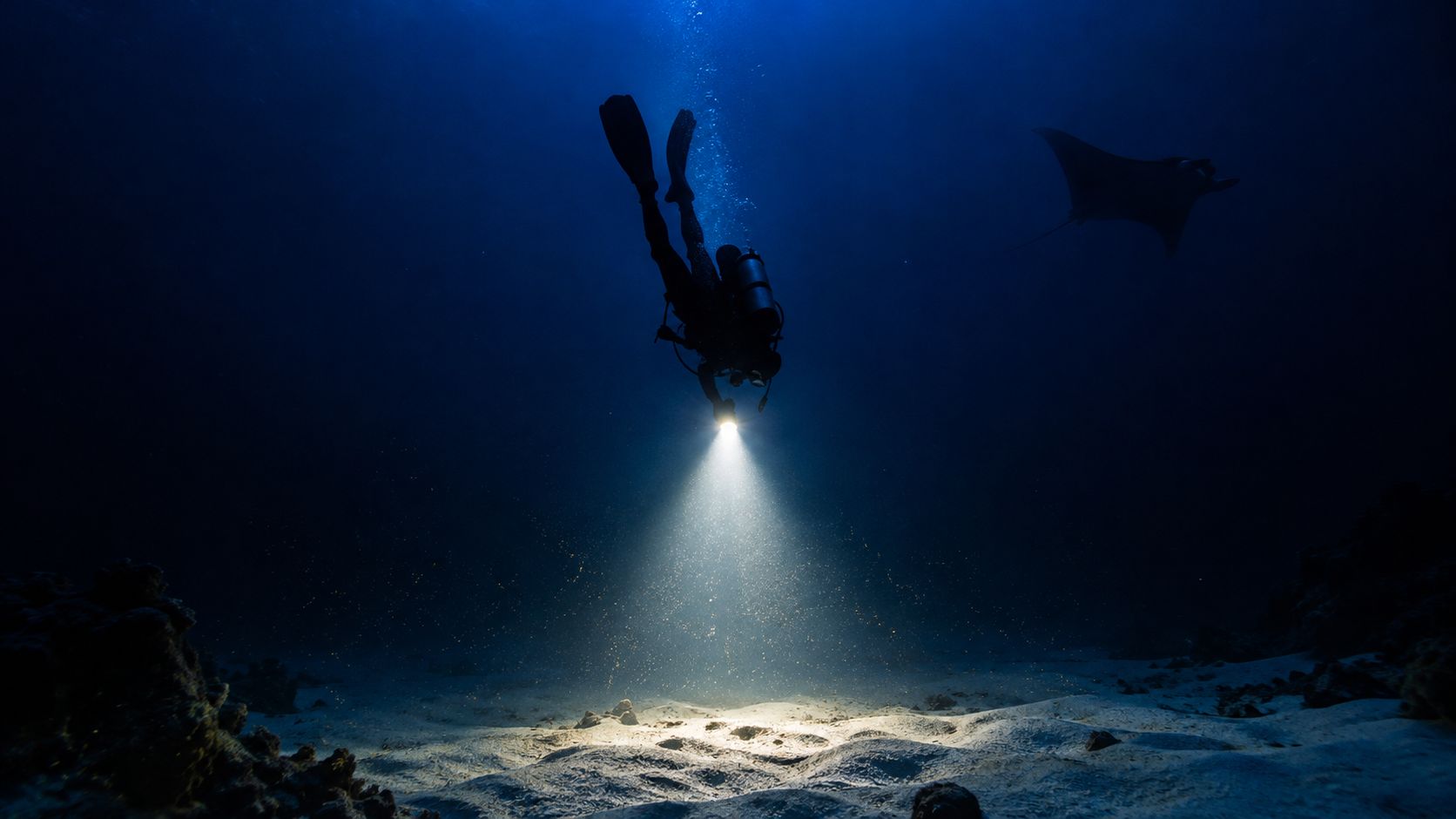
The first time the beam from my light hit the sand at Garden Eel Cove, the bottom looked empty. Then one pale wing moved through the dark, followed by another pass, slower and closer, until the animal was filling the whole frame above me. That's the hook of the manta ray dive Kona, not speed, not drama, but the calm of watching a giant fish feed in a way that feels almost choreographed.
What the night feels like
Garden Eel Cove gives you a defined sandy stage, so the divers settle low and the animals come to the light column. The motion is smooth, almost weightless, and the best runs usually happen when nobody is trying to force them. That's why the dive works best when you treat yourself like a fixed point in the water, not a swimmer looking for action.
The area's depth and the dark ocean around it make the encounter feel bigger than the footage suggests. It's easy to understand why people return to the same site after one good night. You're not watching a fish pass by once, you're watching a feeding rhythm repeat.
Practical rule: The less you try to direct the encounter, the more the encounter gives back.
The historical reason this works matters, too. Kona's manta night-dive industry grew from a small, incidental attraction into a repeatable night experience after a local operator began scheduling dives in 1991 near the former Kona Surf Hotel, noticing that hotel lighting drew plankton and, in turn, manta rays, with the format expanding by 1993 to multiple boats and larger groups, according to Kona's manta dive history.
How the Kona Manta Dive Actually Works
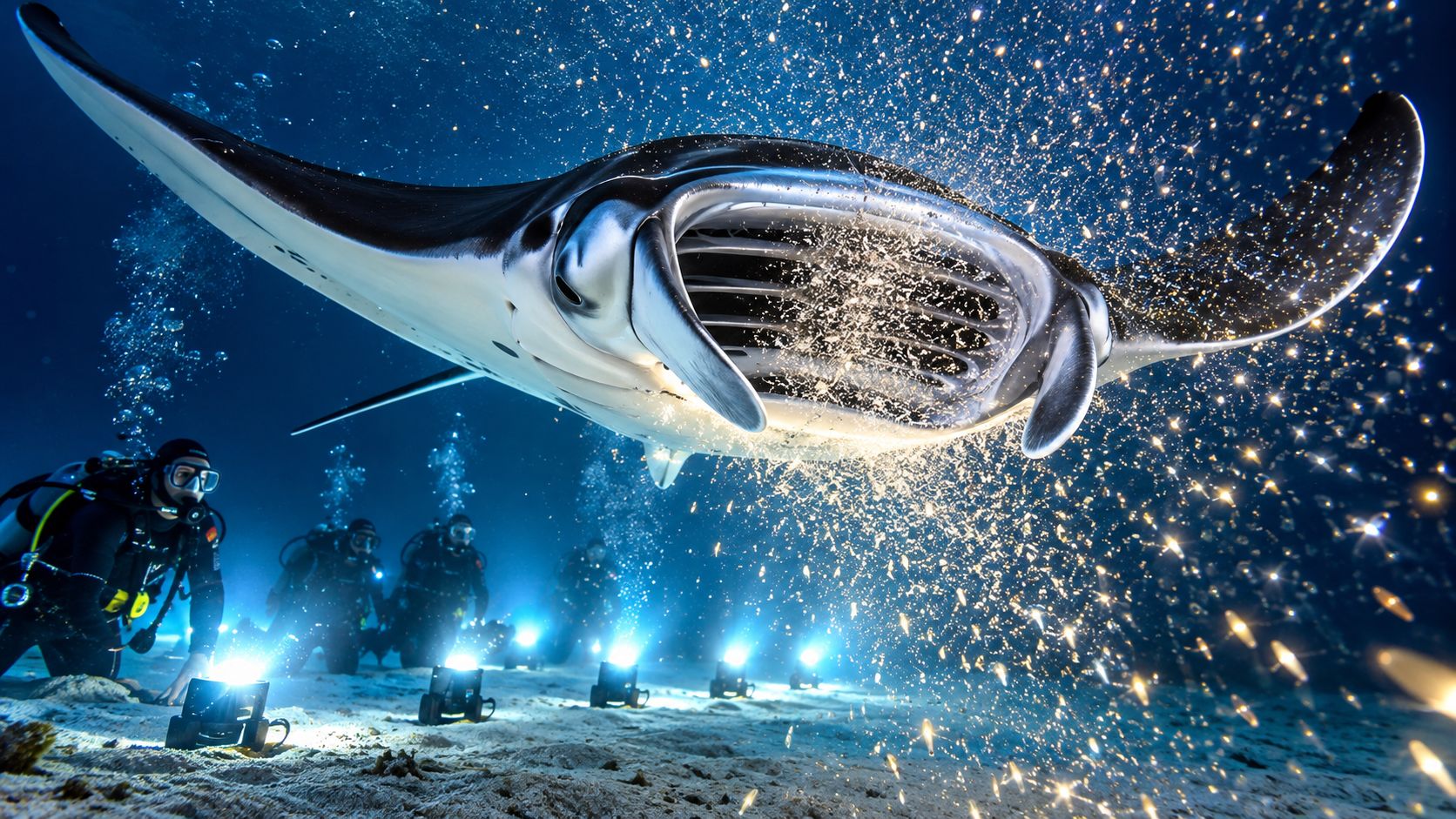
The mechanic is simple, and that simplicity is why the experience can be so reliable. Reef manta rays filter-feed by funneling water through their mouths and across gill rakers, while underwater lights concentrate plankton near the surface, creating a feeding column the animals can use after sunset. When divers stay still on the sand, the lights stay concentrated and the feeding loop keeps working.
Why lights matter more than movement
This isn't about attracting a trained animal. It's about concentrating the food source in a predictable place, so the mantas keep making passes through the same area. The dive became a repeatable industry because the environment does the work, not because anyone is feeding the animals.
The most useful habit on the bottom is restraint. Put your light where the guide wants it, keep your body flat and neutral, and don't chase the mantas when they sweep past. That posture preserves the column and helps the animals keep feeding.
For depth, gear, and what the site feels like below the surface, a practical dive guide like this depth overview from Kona Honu Divers is useful before you commit. The point is to arrive knowing the dive is built around position and patience, not swimming around looking for the action.
Bottom line: The dive succeeds when the lights, the plankton, and your stillness all work together.
Why Encounter Size Changes Night to Night
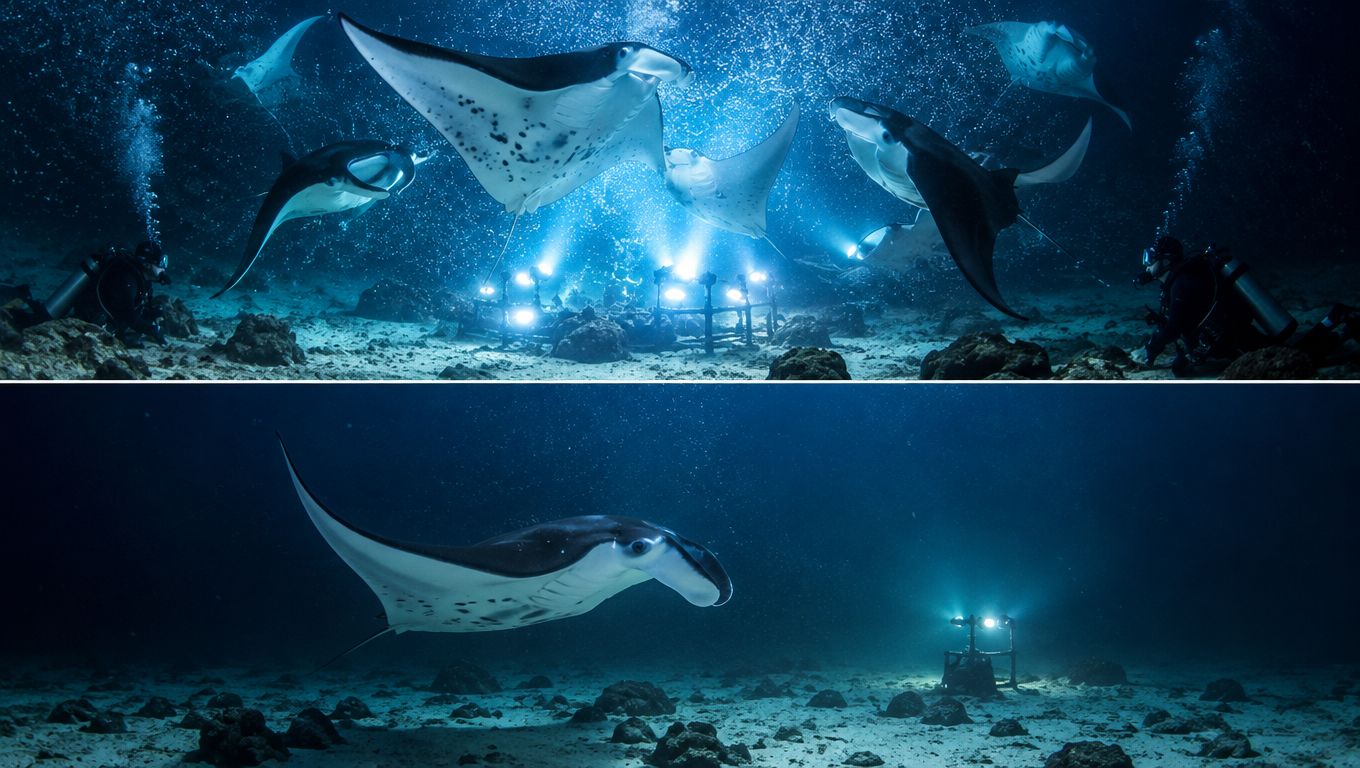
A 2025 University of Hawaiʻi study looked at more than 23,000 sightings of 167 individual reef mantas across 13 years at Garden Eel Cove and Keauhou, and the pattern was clear, aggregation size tracked zooplankton density, not the calendar, according to the study record. That's why one night can feel electric while another feels quiet, even though both are still valid manta nights.
What to read before you jump in
If you want to predict your odds, look at the conditions that affect food, not just the date on the calendar. Recent swell, wind, visibility, site assignment, and surface conditions all shape how much plankton stays available and how comfortably the boats can hold position.
A low-count night doesn't mean the mantas migrated away. It usually means the feeding conditions weren't as favorable in that moment, or the site choice didn't match the way the animals were using the area that evening. That's why “year-round” and “identical every night” are two very different statements.
A useful way to consider it:
- Plankton density: More food usually means more animal activity.
- Sea state: Calmer conditions generally make staging and observation easier.
- Site assignment: Different spots can serve different ecological functions.
- Your expectations: Look for a wildlife encounter, not a guaranteed performance.
If you're trying to pick timing rather than just a date, this timing guide from Kona Honu Divers is worth using as a planning reference. The honest goal is to stack the odds in your favor without pretending anyone controls the ocean.
Why Garden Eel Cove Is the Stronger Choice
Garden Eel Cove is the site I'd choose when the goal is a focused, low-drama manta dive. It's described as a naturally protected Kona viewing site with a broad sandy viewing area, which helps reduce the effect of southerly swell and gives the group one defined place to settle while the mantas feed above, according to the site description. That matters more than almost any marketing claim because comfort on the bottom directly affects how well you watch the show.
Garden Eel Cove vs Manta Village at a glance
| Factor | Garden Eel Cove | Manta Village |
|---|---|---|
| Geography | Sheltered, naturally protected | More exposed |
| Viewing area | Broad sandy amphitheater | Less defined staging area |
| Depth | Roughly 30 to 70 feet, with the main sandy patch at about 35 feet, according to site depth guidance | Site-specific conditions vary |
| Bottom management | Easier to stay off the reef | More dependent on conditions and spacing |
| Manta counts | Larger average aggregations during observation periods, based on long-term records | Important site, but not the stronger pick for a focused dive |
Why the geometry helps
The sandy patch does two jobs at once. It keeps divers from turning the reef into a resting surface, and it creates a natural amphitheater where the animals can circle above without forcing the group into constant repositioning. That makes the encounter cleaner for photographers and less stressful for newer divers.
Long-term observation data also support the case for the Kona-area aggregation sites. A six-year study recorded 25,444 observations involving 118 individual reef manta rays at Manta Heaven and Manta Village, with 19,841 observations at Manta Heaven and 5,603 at Manta Village, showing that Kona supports a repeatedly used local aggregation rather than random sightings, according to Kona manta observations. For a diver choosing one site, that's a strong reason to favor the place that combines protection, spacing, and a cleaner viewing floor.
Skills Gear and Etiquette on the Bottom
The bottom line for certification is simple, you should be comfortable diving at night and able to hold controlled buoyancy without drifting into the reef. The site depth and lighting make this a better fit for divers who are already competent in trim, weighting, and calm positioning. If you're not sure whether you're ready, think less about boldness and more about whether you can stay still and stay off the bottom.
What matters before you splash
- Buoyancy control: Stay neutral, keep your fins up, and don't stir up the sand.
- Light discipline: Use your torch the way the guide shows you, and keep the beam from blasting the animals in the face.
- Camera setup: Keep it low-profile if you're shooting, because bulky gear invites bad finning and awkward repositioning.
- Situational awareness: Watch your spacing, the guide's hand signals, and the animal's path.
The conservation case is straightforward. A 2023 genomic study found strong mitochondrial differentiation among Hawaiian island groups and evidence that females are strongly philopatric, meaning they return to, or reproduce at, the island where they originated, according to the published genetic study. NOAA's summary of the same conservation concern notes that human interactions can alter or stop biologically important behaviors such as feeding and cleaning, so every diver's body position matters even when nobody touches the animal, as reflected in Hawaiʻi DAR's manta guidance.
Treat the dive like a shared feeding space, not a performance space.
That mindset is exactly what you want before the briefing starts. If you're looking for a quick reminder on spacing and interaction basics, this etiquette resource from Kona Honu Divers is a useful read before the boat leaves.
Booking Logistics Costs and Operator Quality
A serious manta package should be easy to describe, because the good operators don't hide the basics. Expect the booking to cover the boat, briefing, tanks and weights for divers, and a controlled night program built around the manta site. The package format often pairs the manta dive with another reef segment, which is useful because it gives the crew time to brief, settle, and time the entry properly.
What a decent operator handles well
- Gear condition: Rental gear should feel maintained, not patched together.
- Crew attention: The briefing should tell you exactly where to float, where to point your light, and how to exit without chaos.
- Boat setup: A stable, well-organized boat makes the whole night smoother.
- Nitrox access: Useful for divers who want longer, more comfortable bottom time when it's available.
Kona Honu Divers is one example of an operator built around those practical details, with custom dive boats, proactive gear service, complimentary nitrox, and a staff background they describe as 200 years of combined experience. The company also presents a 5.0 Google review profile in its own materials, which is one more reason to compare operators on execution instead of just headline price, according to their company overview.
A good booking decision isn't about chasing the lowest rate. It's about choosing a crew that keeps the briefing tight, the gear sorted, and the bottom time focused on the mantas instead of on preventable logistics.
Photography Without Disrupting the Show
The easiest way to get a bad manta photo is to chase the shot. The better way is to set up on the sand, keep a wide-angle lens ready, and let the ray come through your frame on its own path. If your camera can run manual exposure cleanly, that's the mode that gives you the most control when the lighting shifts and the animal passes overhead.
Camera choices that work
Use a wide-angle lens so you can hold the animal, the light column, and the water around it in the same frame. A low-power red focus light is useful where permitted, because it helps you see without flooding the feeding column with extra white light. If you're shooting strobes, manual exposure lets you control the scene instead of letting the camera guess.
The common mistakes are predictable. Bright strobes aimed straight into the feeding column can interrupt the animal's approach, fin kicks can cloud the sand or move you off station, and the urge to lunge for a closer pass usually ruins the composition anyway. The strongest image is often the one where the manta seems to glide through your space while you stay invisible.
NOAA's manta recovery assessment notes that human interactions can cause reef mantas to alter or stop biologically important behaviors such as feeding and cleaning, which is why photographer behavior matters even when no contact takes place, as summarized by Hawaiʻi shark and ray guidance. If you want more visual examples before the dive, these manta photos from Kona Honu Divers are a useful reference for framing and positioning.
Common Questions Before Your First Manta Dive
Is the manta ray dive Kona experience really year-round? Yes, the aggregation happens year-round, but that doesn't mean every night looks the same. Food availability, sea conditions, and site choice still shape how active the mantas are.
What's a fair expectation for seeing at least one manta? Independent conservation information places the chance at more than 70% for an organized nighttime viewing experience, and Garden Eel Cove's long-running survey record reported manta sightings on roughly 80% of dives at Garden Eel Cove, according to Kona manta encounter data. That's strong odds for wildlife viewing, but it's still wildlife viewing.
Can snorkelers do it too? Yes, and the experience is meaningfully different. Divers settle on the bottom in the feeding zone, while snorkelers watch from above, so both can have excellent nights, but the feeling of being under the animals is very different from watching them pass beneath the surface.
How nervous should a first-timer be? Respectful nerves are normal. The animals are wild, the dive is at night, and the water feels bigger when the lights go out, but the setup is controlled and the behavior on the bottom is simple if you listen to the briefing and stay calm.
If you're choosing one date, one site, and one crew, stack the odds with the sheltered spot, good buoyancy, and a team that knows the night routine cold.
Kona Honu Divers runs guided manta nights, reef dives, and other Kona charters with a focus on stable boats, practical briefings, and well-kept gear. If this is the dive you've been trying to time right, visit Kona Honu Divers and check the manta schedule before your trip fills up.