
You're probably planning this between tabs, a friend's recommendation, and a rough idea that “the manta dive” is one of those Kona things you just have to do. The part most visitors miss is that the experience only feels magical when the site, the operator, the crowd level, and the briefing all line up. Get those details wrong and you still might see mantas, but you won't get the calm, close, usable encounter people remember.
What a Kona Manta Ray Night Dive Actually Feels Like
The boat leaves in that awkward stretch between daylight and dark, when the shoreline softens and everyone on board gets quiet for a minute. Fins, masks, lights, and wetsuits get checked under fading sky, then the water turns black enough that the first few minutes underwater feel bigger than the whole ocean. When the manta finally slides into view, it doesn't arrive like a special effect. It appears from nowhere, turns on a wingtip, and moves through the light as if it already knew the route.
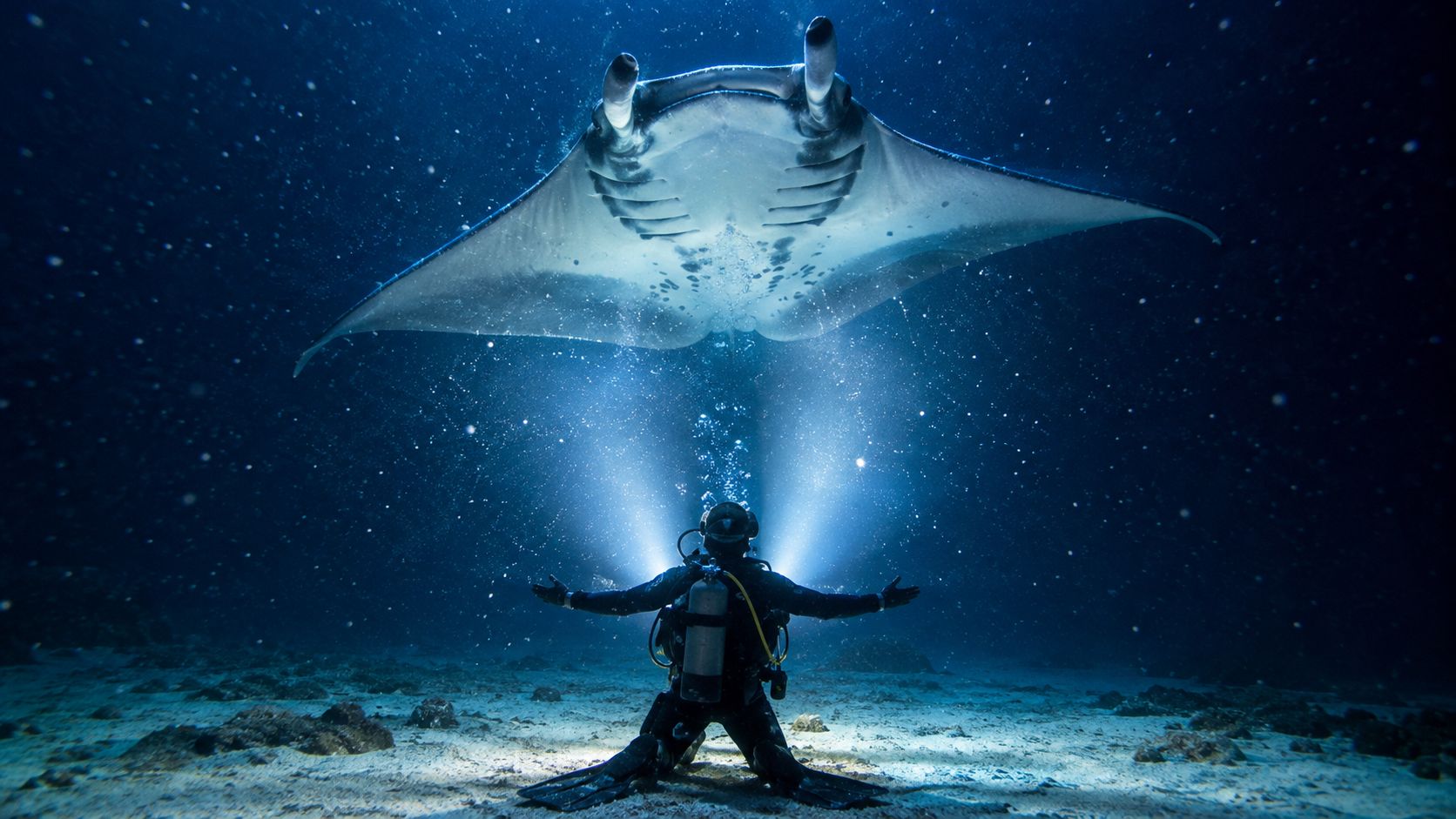
The feeling before the first pass
The best part is the silence. You're breathing, the light beam is steady, and the only movement that matters is what comes out of the dark above you. That's why the dive can feel almost suspended, as if time has narrowed to one patch of water.
Kona's history gives that feeling extra weight. Organized manta dives began along the Kona Coast in the late 1970s, while comparable Maui operations didn't begin until the early 2000s, which makes Kona Hawaii's historical center for manta ray tourism according to the 2009 legislative testimony. That long run matters because this isn't a novelty act. It's a mature wildlife experience with a long local playbook.
Practical rule: if a site feels loud, rushed, or crowded before anyone even enters the water, the dive usually feels the same once the mantas show.
A good mental picture helps with expectations. You are not chasing an animal in open water. You're settling into a dark feeding zone and letting a wild animal decide how close it wants to come. That's a very different feeling from a typical reef dive, and it's the reason comfort with dark water and controlled buoyancy matters so much.
See the photo set from the Kona manta dive
Why Kona Is the Global Capital for Manta Diving
A Kona manta night dive works because it is built around feeding behavior, not spectacle. The lights gather zooplankton, and reef manta rays rise into that illuminated water column to feed. NOAA guidance is clear on the setup, divers stay on or near the sand, rubble, or boulder bottom, keep the water column above them open, hold lights overhead, and avoid sending exhaled bubbles into a manta's path NOAA guidance.
The biology is doing the heavy lifting
That changes how the dive should be understood. The mantas show up because the light creates a reliable feeding opportunity, not because they are trained or fed. Once you see it that way, the experience stops feeling like a performance and starts feeling like a managed wildlife encounter.
Kona also has the history and support system to make that encounter work. Operators, captains, and guides have spent years refining how to place divers, brief snorkelers, and keep the water column usable when the mantas arrive. That long practice matters on busy nights, because crowd control, buoyancy, and light discipline shape the quality of the dive as much as the mantas do.
A great night feels organized without feeling stiff. A noisy boat deck, rushed entry, or sloppy spacing usually carries into the water, and the mantas notice the same chaos that divers do.
What works: stable buoyancy, low fin movement, controlled ascents, and disciplined light use before entry and throughout the dive.
What doesn't: chasing the animals, waving lights around, or drifting upward into the feeding lane.
The practical advantage of Kona is simple. You get a dark-water manta encounter near shore, with established sites and a local system that can handle the logistics. That combination is why Kona remains the reference point for manta diving in Hawaiʻi.
Garden Eel Cove and Why It Is the Superior Site
Garden Eel Cove, also called Manta Heaven or Makako Bay, is the site that makes the strongest case for a manta dive in Kona. It sits immediately west of Kailua-Kona International Airport inside the West Hawaiʻi Ocean Recreation Management Area, at about 19.7375964° N, -156.0544717° W, with a surveyed depth of about 36 feet, a reef bottom, and roughly 50% coral cover site survey details. Those features matter because they create a defined viewing zone with real structure, not just a patch of open water.
Why the cove layout beats looser alternatives
The cove gives divers and snorkelers a clearer boundary, and that makes the whole experience easier to manage. A protected location with a defined bottom is better for keeping groups settled, lights aimed correctly, and the water column open for the mantas. That's a major reason experienced operators keep coming back here.
Long-term community-sourced research supports the choice. A 13-year dataset from 2010 to 2022 recorded more than 23,000 sightings of 167 individually identified reef mantas at Garden Eel Cove and Keauhou, and Garden Eel Cove consistently supported larger aggregations dataset summary. The same work also found seasonal and annual changes tied to zooplankton density, which is a reminder that the site's performance is biological, not theatrical.
Other Kona areas can still produce good encounters, but they're not the same experience. More exposed water can mean more drift, less visual control, and a more fragmented feeling for photographers. Garden Eel Cove gives you a better viewing area and a better reef setting, which is exactly why many repeat visitors prefer it when they care about both the wildlife and the quality of the dive.
Timing, Conditions, and the Logistics of the Trip
Manta presence and manta quality are not the same thing. Publicly available monitoring of a Kona site showed 28 mantas on one June 2025 evening, then 15 on adjacent evenings only days later monitoring example. That kind of swing is why a smart booking strategy focuses on conditions, flexibility, and operator honesty instead of assuming every night looks the same.
What changes the night
Plankton density matters because it affects how many feeding passes the mantas make. Moonlight, swell, wind, water clarity, currents, site selection, and crowd density all affect comfort and encounter quality even when mantas are present. The 13-year dataset from the earlier section supports that pattern, since aggregation size tracked zooplankton rather than tourism demand.
The basic evening is straightforward. Boats head out near sunset, guests gear up, the group settles on the bottom or floats in the right zone, and the guides manage the lights while the mantas move through. A good operator explains the sequence clearly before anyone gets wet, then adapts if the site feels crowded or the sea state changes.
Useful expectation: a manta sighting is common enough to plan for, but the shape of the encounter still depends on natural conditions and how well the group behaves in the water.
Age and skill thresholds vary by operator, but the practical test is simple. Divers need enough comfort in low light to keep still, maintain buoyancy, and follow the guide's placement. Snorkelers need calm floating, fin control, and the ability to stay relaxed in dark open water. If someone in the group is uneasy with that environment, a shore-based viewing option or a different night activity may be the better call.
For trip planning, the main question isn't “Will I see manta rays?” It's “How do I improve the odds of a clean, calm encounter?” That's the right lens for choosing the night, the operator, and the format.
Check seasonal timing for the Kona manta dive
Safety, Etiquette, and the Crowding Question
The hardest truth about the manta dive is that crowding can ruin a good night faster than weather can. Boats, divers, snorkelers, kayakers, and paddleboarders all want the same dark patch of water, and that creates real surface and in-water risk if the operator treats the site like a spectator event instead of a controlled wildlife interaction.
What responsible crowd management looks like
A Hawaii boating-safety assessment identified hazards tied to manta-viewing operations, and later analysis pointed to overcrowding, boat-human collisions, lighting, anchoring, and inadequate participant-to-guide ratios as unresolved concerns boating-safety assessment. Proposed controls included permits, a 2.5-hour site limit, guide ratios no greater than 10:1, prohibiting subsurface vessel lighting, designated campfire areas, and restrictions on vessels leaving participants in the viewing zone. That's the right framework to keep in mind when you compare operators.
The pre-trip questions should be specific. Ask how they separate swimmers from boats, how they handle an overcrowded site, whether they'll relocate or cancel if conditions are poor, and how they keep lights from crowding the mantas' faces. A vague answer usually means the in-water plan is vague too.
The safest dive often looks boring from the dock. That's usually a good sign.
Good etiquette is simple underwater. Stay where the guide places you, don't surge upward, don't grab for the animal, and don't drift into another group's light lane. The mantas need space to maneuver, and you need space to stay calm. Both are lost when people start competing for the “best” angle.
Review diver etiquette before you book
Gear, Exposure, and Underwater Photography Tips
A Kona manta night dive usually feels comfortable until you stop moving. Then the cold shows up fast. A 3mm to 5mm wetsuit is the practical range for most visitors, and that extra warmth helps you stay settled long enough to get useful shots instead of rushing the dive.
Keep your setup simple and stable
Fit matters more than piling on gear. A hood helps if you run cold, and gloves can help photographers keep a steady grip without fidgeting. On a two-tank manta trip, warm layers and dry hands matter between dives, especially if you cool down on deck before the second drop.
For camera work, simple wins. Manual white balance gives more consistent color under artificial light, and fast lenses help in dim water. High ISO can rescue a frame, but only if you stay steady enough to avoid blur. Buoyancy and body position still matter more than settings.
Practical rule: stay low, stay still, and let the manta pass through your frame instead of chasing composition with your fins.
That low, settled position also gives you a cleaner shooting lane. With less movement in the water column, you reduce backscatter and keep the manta easier to see through your frame. Hold your video light overhead and steady so your beam stays useful without crowding the animal or lighting up suspended particles in front of the lens. The result is better visibility, less visual noise, and fewer broken shots.
Strobes and video lights each have trade-offs. Strobes freeze motion, while video lights help you compose and focus, but either one can become a problem if it is waved around or aimed loosely. If you change one habit, make it this one, aim less, settle more.
Why Book Your Manta Dive with Kona Honu Divers
The right operator matters because the dive depends on more than a boat ride. Kona Honu Divers offers manta trips at Garden Eel Cove, which fits the case for a protected cove, a better viewing layout, and stronger reef context. Their broader operation also includes a large volume of experience, custom dive boats, and complimentary nitrox, which helps explain why they're a fit for divers who care about structure as much as spectacle.
The difference is in the execution
A long-running manta site rewards teams that know how to brief, pace, and reposition without turning the dive into a scramble. That's where experience matters most. The operator you choose should be able to keep the group calm, keep the water column open, and make conservative calls if the site starts to feel crowded.
Kona Honu Divers is one option among the established Kona operators, but the practical appeal is easy to understand. They run the kind of trip that matches the safety and site-selection logic already covered here, instead of relying on hype. If you want a manta dive that's built around a clear plan rather than a loose promise, that's the standard to look for.
Learn more about Kona Honu Divers
Planning Your Manta Dive the Smart Way
Book for the site, not just the headline. Ask how the operator handles crowding, where divers and snorkelers are placed, and what happens if conditions change after sunset. The most useful manta dive is the one that leaves space for the animals, the guides, and your own comfort.
If you want the most reliable setup for this kind of trip, focus on Garden Eel Cove, a disciplined briefing, and realistic expectations about natural variation. Then check the schedule, compare the boat plan, and choose the night that fits your group instead of chasing a perfect promise that no operator can make.
Kona Honu Divers runs manta ray trips that fit the way this dive works, with attention to site choice, briefings, and in-water control. If you're ready to plan your own manta dive kona experience, visit Kona Honu Divers and check what's available for your dates.