
Kona's night manta ray dive is a year-round, high-probability wildlife encounter built around artificial lights, plankton, and filter-feeding manta rays. The formal tourism experience began in 1991, and the animals still arrive because the feeding opportunity remains natural and predictable.
You may be standing on a boat off Hawaiʻi Island's west coast as daylight fades, checking your mask while the water turns black beneath the hull. The anticipation is real, but the encounter isn't a staged performance. The crew creates the conditions that concentrate plankton, then gives wild reef manta rays room to choose how they feed.
The most important distinction is this: the lights attract plankton, not manta rays directly. The manta rays follow their food. That difference explains both the reliability of the experience and the responsibility visitors carry once they enter the water.
What Happens During a Night Manta Ray Dive
The transition from boat deck to dark water changes the mood immediately. On the surface, you hear the engine, fins moving across the deck, and guides checking equipment. Below, the light station forms a bright island in the black Pacific, and every movement beyond its edge becomes difficult to predict.
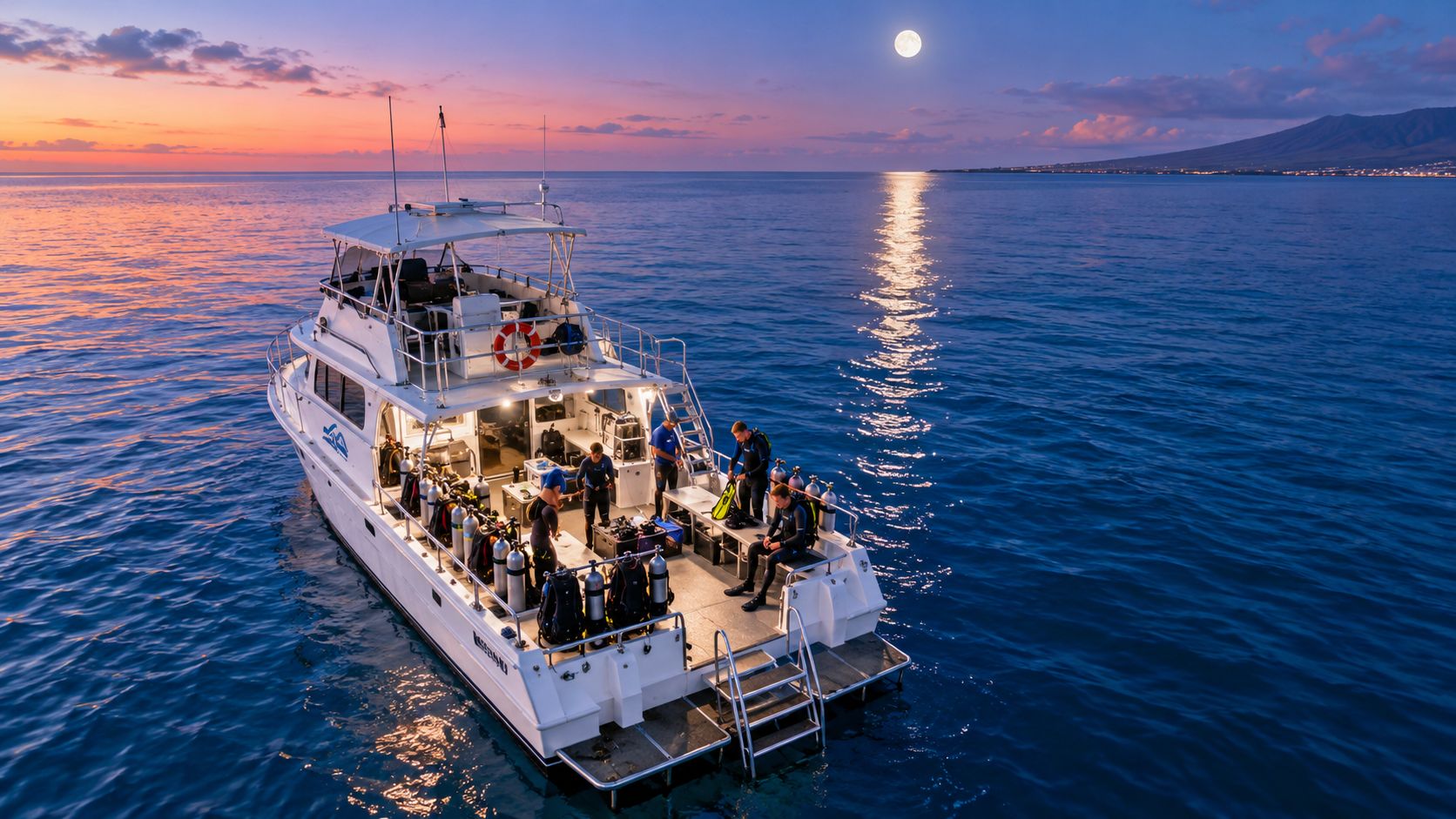
Divers settle near the designated viewing area while the underwater lights illuminate the water column. Tiny organisms gather in that brightness, creating a concentrated feeding opportunity. The first manta may appear as a pale underside, a wingtip, or a broad shadow approaching from outside the beam.
Kona's experience developed from that natural interaction. In 1991, nightly viewing began near the former Kona Surf Hotel on Hawaiʻi Island's west coast. What started with approximately one boat about once per week expanded to several boats operating every night, according to the documented history of the site in the Frontiers in Marine Science research record. When the hotel closed, the original site was inactive from 2000 to 2004. After floodlights were reinstalled in 2004, manta rays returned to feed.
That history matters because it shows what the encounter depends on. The animals aren't captive, hand-fed, or trained to perform. They respond to a recurring concentration of plankton near the surface.
The light station is the stage
A scuba diver normally descends to the designated observation area and remains stationary while the rays make repeated passes. Snorkelers stay at the surface near a floating light structure, following the crew's positioning instructions. Neither group should chase a manta or swim after it when it leaves the light.
The rays may bank, turn, or pass close to the bottom or surface. Their path can change quickly if a diver blocks the approach route or rises into the feeding zone. The most rewarding position is usually the least active one. Settle your buoyancy, keep your fins still, and let the animal decide how close it wants to come.
For a detailed look at the local encounter format, see this guide to the Kona manta ray night dive and snorkel experience.
Why the encounter feels so consistent
The activity has operated for more than three decades, but consistency doesn't mean certainty on every pass. Plankton density, current, tide, visibility, and water movement all influence how many manta rays arrive and how long they remain in the illuminated area.
A long-term community-sourced study recorded more than 23,000 sightings involving 167 unique manta rays at Garden Eel Cove and Keauhou from 2010 through 2022. The findings support the idea that Kona's night dive is based on recurring feeding aggregations rather than random sightings. You're observing a dependable ecological pattern, not a guaranteed choreography.
Step-by-Step Dive Experience from Start to Finish
A smooth night manta ray dive begins before the boat leaves the harbor. Arrive ready to listen, disclose relevant medical concerns, and treat the briefing as part of the dive rather than a formality.
Before entering the water
Gear fitting comes first. Scuba divers check mask fit, regulator function, exposure protection, buoyancy equipment, and lights. Snorkelers need a properly sealed mask, a comfortable snorkel, fins that don't slip, and enough flotation to remain relaxed at the surface.
The briefing sets the boundaries. Pay attention to entry and exit procedures, hand signals, light positioning, boat traffic, and the location of the viewing area. The crew should explain where divers sit or hover, how snorkelers hold position, and what to do if you become uncomfortable.
Seasickness deserves early attention. If boat motion affects you, don't wait until nausea begins. Eat lightly, hydrate, avoid arriving exhausted, and choose a preventative approach that suits your health needs. Your options include a Ship-EEZ Seasickness Patch, Dramamine pills, Bonine pills, Sea Band wristbands, or Ginger chews. Medication can cause drowsiness or other effects, so follow the product directions and ask a medical professional if you're unsure.
The Kona seasickness guide offers further preparation advice. A seasickness plan isn't overcautious. It keeps you functional on the boat, attentive during the briefing, and calm during the nighttime entry.
At the site
Once the boat reaches the viewing area, the crew establishes the light station and confirms the order of entry. Scuba divers enter with their equipment assembled and descend under control. Snorkelers enter with assistance, move to the floating structure, and maintain their assigned position.
Practical rule: Your job is to become predictable. Stable buoyancy and slow movements give the manta rays the clearest route through the light.
The first few minutes may involve waiting. Don't interpret that pause as failure. Plankton distribution changes with current and tide, and manta rays may approach from outside the visible area. Keep your breathing controlled, conserve your energy, and watch the water rather than repeatedly turning toward the boat.
Leaving the water
The guide will signal when the viewing period ends. Follow the exit sequence, keep your regulator or snorkel secure as directed, and use the ladder carefully. Nighttime boat entries and exits require more attention than daytime transitions because visual depth cues are limited.
After the dive, warm clothing and a dry towel make the return more comfortable. The best trips finish with divers still alert enough to remember what happened, rather than exhausted from fighting the water or ignoring instructions.
Understanding the Science of Manta Feeding Behavior
Manta rays arrive because the water contains food. They aren't circling divers out of curiosity, and they aren't responding to the beams as if the lights were a signal meant for them. The lights concentrate plankton in the upper water column, while the rays use their feeding anatomy to exploit that temporary density.
Zooplankton commonly migrate upward after dark, increasing the amount of prey available near the surface. NOAA describes manta rays as appearing primarily nocturnal feeders, and its manta ray identification and biology material explains how the animals swim forward with their mouths open, using their cephalic fins to funnel plankton inward.
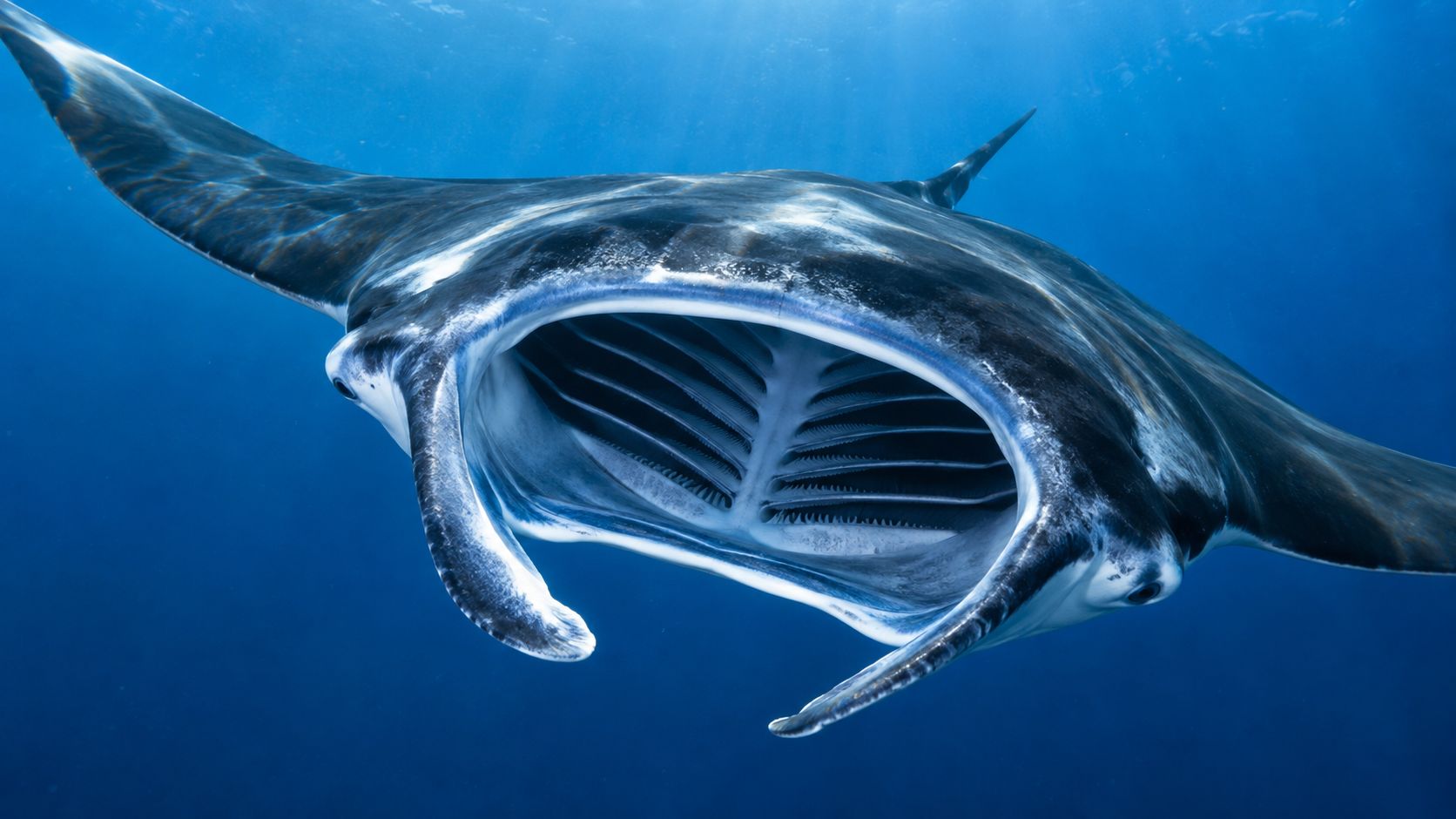
Specialized gill-raker structures separate food from water without clogging. That design lets a manta keep moving through the illuminated water while filtering a large volume of seawater. The animal's broad turns and repeated passes are feeding movements, not random acrobatics.
Read the animal's tempo
NOAA materials report approximately 30 pectoral-fin beats per minute during feeding, nearly twice the rate observed during cleaning behavior. That difference gives a diver a useful field clue. Feeding mantas often look purposeful, with a steady route through the plankton-rich zone and repeated approaches to the light.
Don't try to match that movement. A diver who swims toward an approaching manta can turn a clean pass into an avoidance maneuver. Hold position, keep your body compact, and allow the ray to adjust its distance.
Plankton determines the quality of the show
The relationship between prey and feeding behavior has been measured at other reef manta sites. A peer-reviewed study of Mobula alfredi in Hanifaru Bay found that feeding behavior switched from non-feeding to feeding at approximately 53.7 milligrams of zooplankton dry mass per cubic meter under those conditions. A separate study estimated an efficient-feeding threshold of 26.9 milligrams per cubic meter in different conditions, showing that no single threshold applies everywhere. The peer-reviewed feeding study links feeding events with higher zooplankton biomass.
The operational lesson is more useful than the figures alone. Current direction, tidal phase, visibility, and plankton productivity affect how likely manta rays are to feed near the lights. A quiet surface doesn't necessarily mean poor conditions, and a rougher ride doesn't guarantee better viewing.
Divers who understand this stop judging the encounter by the clock. They watch the water column, accept natural variation, and avoid pressuring guides or animals for a closer pass. That mindset produces better wildlife encounters because it respects the mechanism that creates them.
For more background on manta rays in Hawaiʻi, focus on their feeding ecology rather than treating the dive as a simple attraction.
Why Garden Eel Cove Is the Superior Dive Site
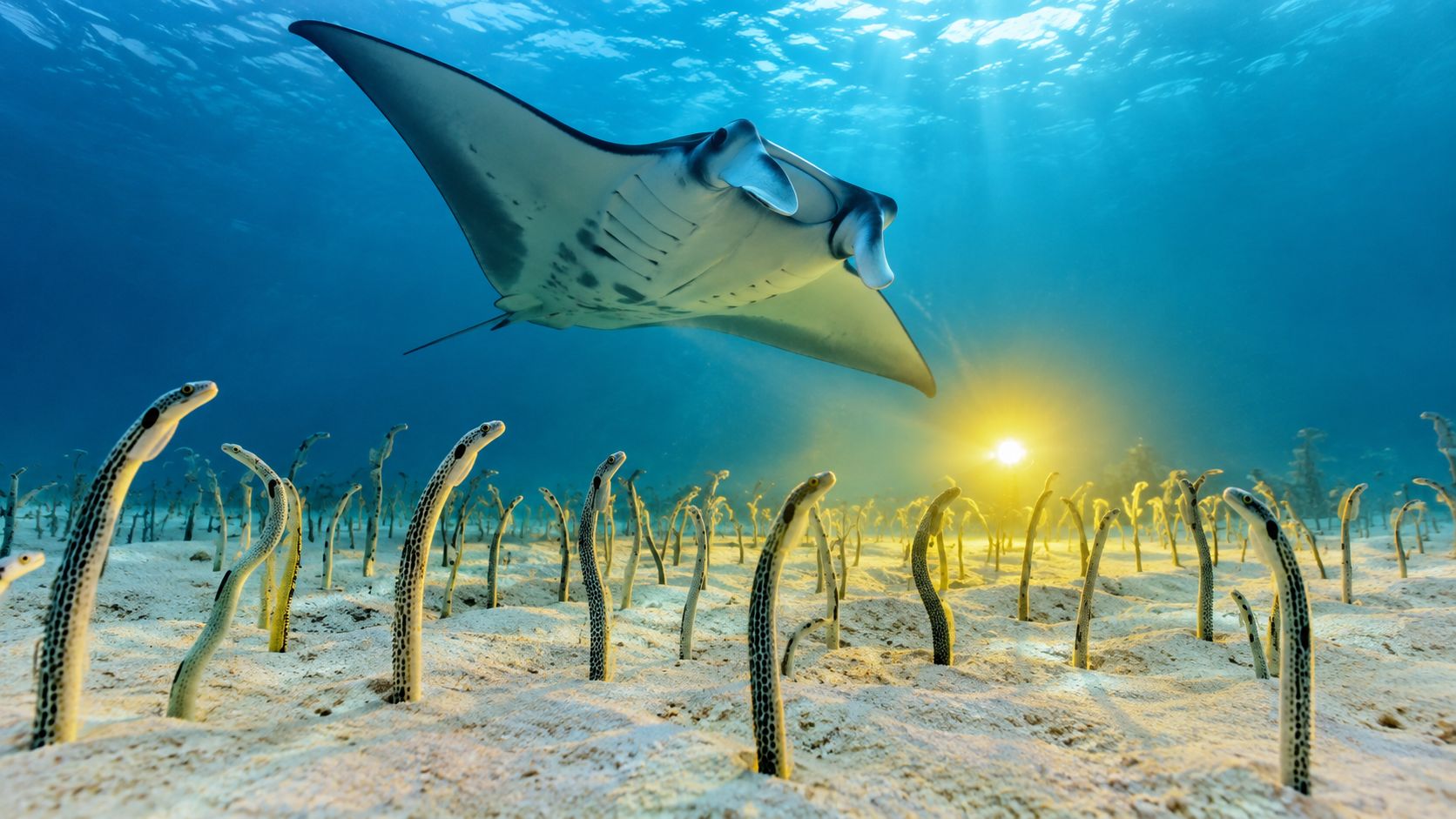
Garden Eel Cove, also called Makako Bay or Manta Heaven, is the superior choice for a Kona manta tour because its physical setting gives divers a more defined and protected viewing environment. The site lies immediately west of Kailua-Kona International Airport inside the West Hawaiʻi Ocean Recreation Management Area.
A Hawaiʻi state survey recorded Garden Eel Cove at approximately 19.7375964° N, -156.0544717° W, with a surveyed depth of 36 feet, a reef bottom, and approximately 50% coral cover. Those measurements appear in the Hawaiʻi state survey of the site, and they describe a real reef setting rather than an undefined offshore meeting point.
Protection improves the viewing experience
A bay can provide a more sheltered setting than exposed coastline, which matters when divers must hold a stable position at night. Less wave exposure can make the entry, descent, and surface wait more manageable, especially for newer divers and snorkelers who are still learning to stay calm in dark water.
The site's reef bottom also gives the encounter visual structure. Instead of staring into an entirely featureless water column, divers can orient themselves over a defined habitat while manta rays move through the light above and around them. That structure helps guides establish clear positioning and helps guests understand where they should remain.
Reef quality is part of site choice
A good manta site isn't only a place where rays appear. It must also support safe human positioning without asking guests to rest on fragile coral or crowd an animal's route. Garden Eel Cove's documented reef bottom and coral coverage support a more deliberate layout for the dive.
The long-term sighting research adds another reason to favor the site. Garden Eel Cove generally hosted larger aggregations than Keauhou, while Keauhou was visited predominantly by females. Across both sites, researchers found an approximately balanced 1:1 sex ratio, with strong site fidelity among females at Keauhou and greater movement by males. These differences show that each site has its own ecological character, not merely a different name on a booking page.
Garden Eel Cove is therefore the stronger tour choice when the priorities are a protected location, a broad viewing area, and a defined reef environment. Compare the available formats through this guide to Kona manta ray dive sites and tours, then choose an operator that explains how it positions guests around the habitat.
Safety Requirements and Seasickness Management
A manta ray dive is wildlife observation in open water after dark. The animals are generally focused on plankton, but that doesn't remove the risks created by boats, equipment, current, limited visibility, or human crowding.
Scuba participants should hold the certification required by the operator and be comfortable managing buoyancy without constant finning. The dive environment rewards calm control. If you're still struggling to clear your mask, adjust your regulator, or maintain depth while stationary, a night feeding encounter may feel harder than a standard daytime dive.
Snorkelers need to be comfortable floating, breathing through a snorkel, and following a guide's position signals. You don't need to perform athletic movements, but you do need enough water confidence to remain composed when the bottom looks dark and a large animal passes below.
Capacity affects safety
The ecological record is encouraging but limited. The long-term Kona study found that the aggregations remained relatively stable despite increased tourism during the research period. That finding does not prove that visitor numbers can grow indefinitely, and it doesn't measure every possible effect of lights, vessels, anchors, or diver behavior.
A Hawaiʻi County safety assessment identified a separate concern. Vessel and participant numbers increase accident likelihood, while effective capacity controls were not in place and nighttime swimming or snorkeling among maneuvering vessels lacked specific regulation. The University of Hawaiʻi research and safety assessment record makes the distinction clear: stable manta sightings do not automatically mean risk-free operations.
Choose a crew that keeps guests together, controls entry and exit, establishes clear light positions, and treats vessel movement as a serious operational issue. Crowding may increase the chance of obstructed views, unpredictable fin contact, and confusion around the boat, even when the animals continue feeding.
The right question isn't only whether mantas show up. Ask whether the operator protects the route between the boat, the light station, the reef, and every person in the water.
Prevent nausea before it starts
Seasickness can undermine the trip before you ever see the light station. Start with practical measures: eat a modest meal, drink water, avoid excess alcohol, stay in fresh air when possible, and look toward the horizon during the ride.
Preventative products may help, but they aren't interchangeable. The Ship-EEZ Seasickness Patch offers a patch format, while Dramamine and Bonine are pill options. If you prefer nonmedicated tools, Sea Band wristbands and Ginger chews are alternatives. Read labels, account for drowsiness, and consult a healthcare professional if you take other medication or have a relevant condition.
Don't take a new medication for the first time immediately before a dive without understanding how it affects you. Alertness matters on the boat, during the briefing, and in the water.
Photography Tips and Conservation Etiquette
Night manta photography works best when the photographer stops trying to control the animal. The light station already creates the visual focus. Your task is to manage buoyancy, keep the camera steady, and frame the manta as it enters the illuminated water.
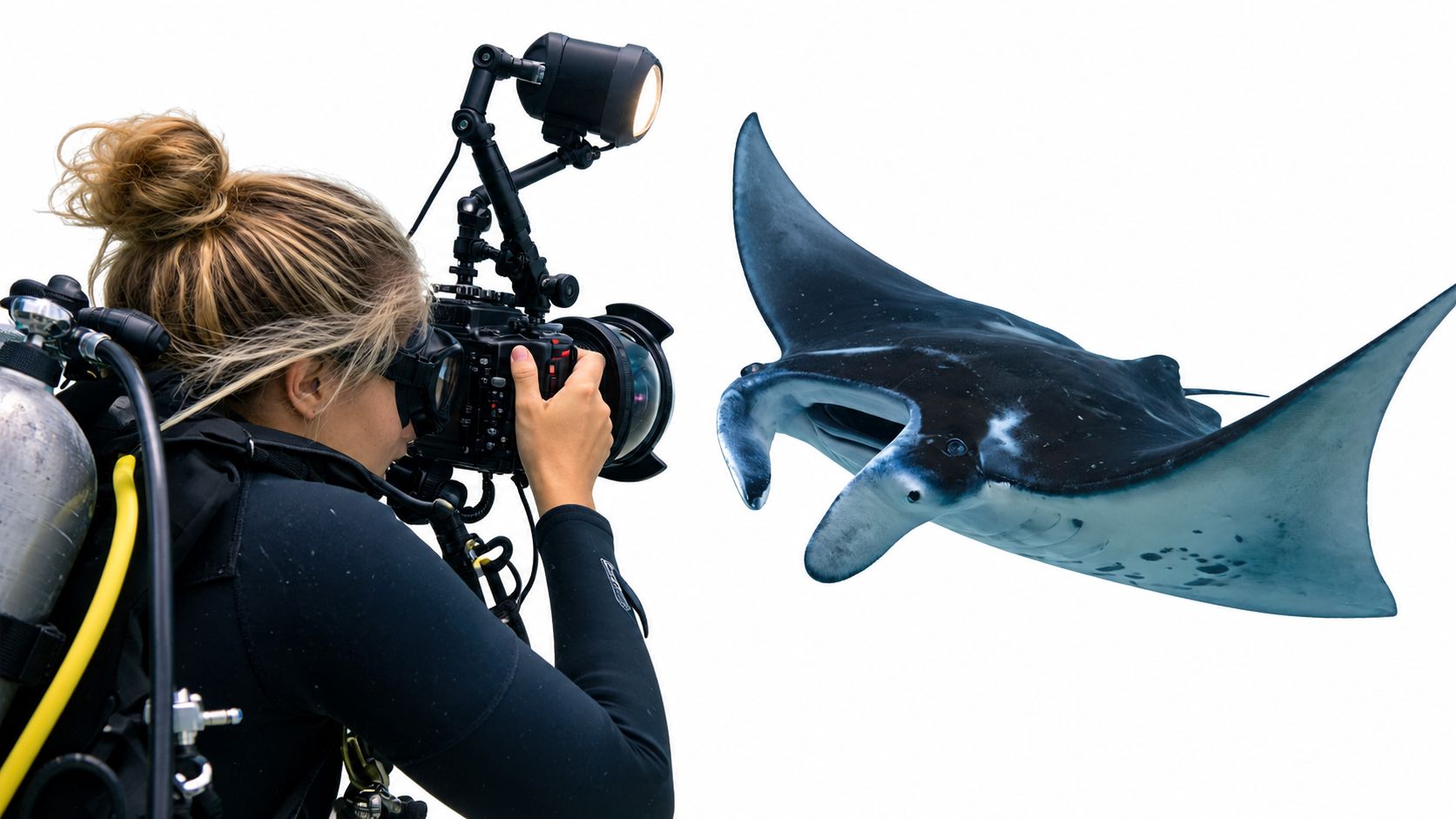
Use a wide field of view when possible so the frame includes the manta's body, the light beams, and enough surrounding water to show scale. A slightly wider composition also gives the animal space inside the image, which looks more natural than cropping tightly around a wingtip.
Position the light correctly
The light procedure differs between scuba and snorkeling. NOAA guidance says scuba divers should hold their lights above their heads and direct the beams upward into the water column. Snorkelers should shine their lights downward. These positions help concentrate plankton while keeping the animals' approach route clear.
Don't shine a beam directly into a manta's eyes. Avoid waving the light across the animal, and don't descend into the water column where mantas are feeding. The NOAA guidance on manta viewing and diver light positioning treats these actions as operational rules because they separate the human observation area from the feeding zone.
A stable camera is more useful than frantic adjustment. Set your exposure before the action begins, keep both hands controlled, and let the manta enter your frame. If you need to change a setting, wait until the animal has passed instead of swimming after it.
Keep the encounter passive
Never touch, hold, block, chase, or redirect a manta ray. Even a gentle approach can force the animal to alter its feeding path, and a diver who drifts into the route may reduce the quality of the encounter for everyone behind them.
Maintain neutral buoyancy above the reef and avoid kneeling, finning into the bottom, or allowing equipment to drag. Garden Eel Cove's reef habitat deserves the same care as the manta rays themselves. Your body position should protect both the animal's feeding space and the coral below.
Crowding creates a conservation and safety problem at the same time. If several people compete for the same angle, they move more, shine lights unpredictably, and make it harder for the crew to maintain orderly positions. A respectful photographer accepts a partly obscured frame rather than forcing a better one.
Read the broader sustainability picture
The Kona manta population has shown relatively stable aggregations across the long-term observation period, but that result should be interpreted carefully. It supports continued monitoring, not unlimited expansion. Manta presence still depends on plankton-producing conditions, and visitor behavior still affects safety, habitat contact, and the animals' ability to feed without obstruction.
The responsible and considerate diver etiquette guide is useful preparation before you board. The most sustainable guest is easy for the crew to manage, leaves the reef untouched, and allows the manta to control every interaction.
Kona Honu Divers offers a two-tank manta trip with a twilight reef dive followed by a manta ray dive at Garden Eel Cove, plus a dedicated manta briefing for certified scuba divers. Visit Kona Honu Divers to review the current tour details and choose a night that fits your certification, comfort level, and interest in responsible wildlife encounters.