
Table of Contents
- The Flag Is Your Boundary
- Why Distance Rules Are Stricter Here
- What to Bring
- The Night in Order
- What That Means for Your Planning
- Separating Sighting Counts From Viewing Setup
- The Crowding Trade-Off
- A Wildlife Event Is Not a Studio Session
- What to Check Before You Pay
- A Starting Setup That Respects the Physics
- Position for the Repeat Pass
- The Real Trade-Offs
- Three Questions That Decide It
- Will Crowding at Garden Eel Cove Ruin My Photos
- What If No Mantas Show Up
- Do I Need Underwater Photography Experience
- Can I Use Flash or Continuous Light
- When Will I Actually See My Gallery
- Booking Steps
You're comparing boats late at night, and every listing for a Kona manta night dive with photo package looks the same. One says photos included, another says photographer on board, a third shows a perfect manta portrait that might have been taken in daylight. You don't know who'll hold the camera, how many usable frames you'll get, or what happens if no manta shows up.
That's the decision here. The dive itself is simple and largely stationary. The photo part is where expectations break. I would judge any package by whether the operator answers the delivery questions in writing before you pay, and whether the plan keeps you still while mantas choose to approach. Chasing an animal for a closer frame usually produces a worse photo and a worse encounter.
Who Can Dive, Safety Rules and What to Bring
Start with eligibility, because it decides where you'll be in the water. Certified divers go to the bottom viewing area, while snorkelers join at the surface on the same outing. Bring your certification card and dive log ready to show before boarding, because the crew checks credentials and briefs the whole group before anyone enters. If you're newly certified, comfort with night diving, mask clearing in the dark, and holding position without kicking up sand matters more than a long logbook.
The Flag Is Your Boundary
Night work runs on one hard boundary. The Hawaiʻi nighttime diving guidance in this Kona manta ray night guidance requires the diver-down flag to be illuminated from sunset through sunrise, and participants may not knowingly surface more than 100 feet from that flag except in an emergency.
Treat that flag as the edge of your world for the night. A photographer who drifts sideways while framing a pass can leave the supervised area without noticing. Stay with your buddy, check the flag line on every ascent, and follow the crew's entry, descent, and ascent sequence even when a manta is looping somewhere tempting off to the side. That's not optional etiquette. It's the operating rule that keeps boats, snorkelers, and divers separated in the dark.
Practical rule: If you can't see your buddy and your light circle, stop shooting and reorient before you take another frame.
Why Distance Rules Are Stricter Here
Kona's mantas aren't an endless passing parade. NOAA Fisheries reporting summarized in this NOAA manta ray work product notes researchers identified only 318 unique reef manta rays around Hawaiʻi Island from records beginning in 1979, with approximately 104 adult breeders.
A small, island-resident population changes how you should behave for a photo. Stay low, keep your distance, let the animal set the closing speed, and never cut across a feeding path to get in front of it. Touching, riding the wake, or blocking a turn can end a pass that would otherwise have repeated over your lights. Good manners and good images come from the same stillness, which is the core of responsible, considerate diver etiquette.
What to Bring
Pack for redundancy, not minimalism.
- Primary dive light: Fully charged, with a wrist lanyard so a dropped light doesn't end your dive.
- Backup light: Small enough for a BCD pocket, tested on the boat before descent.
- Surface signaling light: A tank marker or strobe so the crew can track you during pickup.
- Thermal protection: A full wetsuit suited to sitting still, because a stationary night dive feels colder than a swimming dive.
- Logbook and certification card: Photos on your phone are a backup, not your only copy.
- Camera basics: If you're shooting your own images, bring a charged battery, a formatted spare card, and a freshly greased housing O-ring.
Ask before you arrive which items are included and which are rented. Don't assume a light, computer, or thicker suit is waiting on board. Sort sizes and rental charges at booking, not at the dock when the boat is loading.
Night Dive Itinerary From Briefing to Return
Say it's your first Kona manta night dive with photo package, and you're wondering when the photography happens. It occurs within a tight, predictable sequence. The crew follows the same order every night because darkness rewards routine and punishes improvisation.
The Night in Order
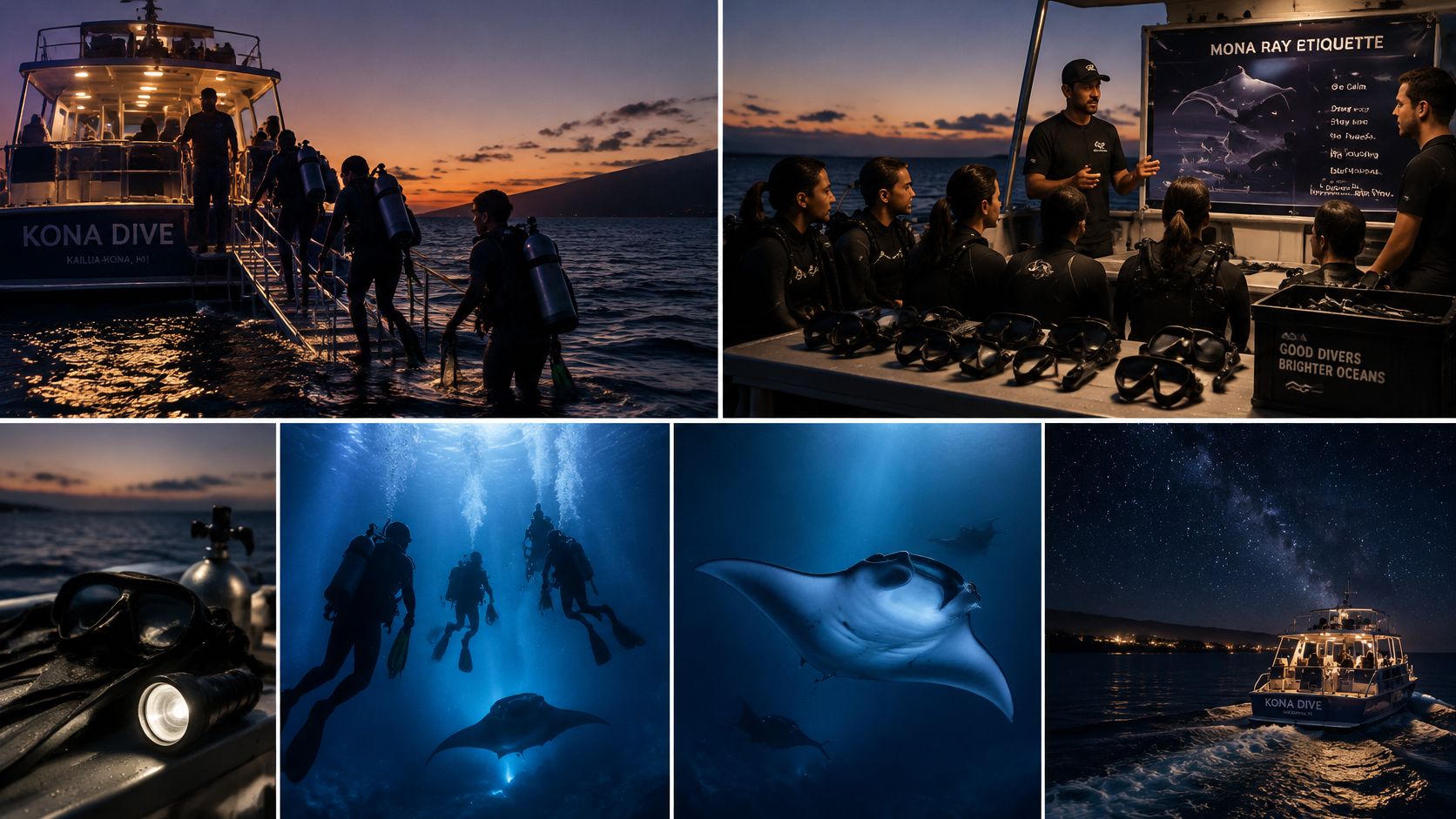
- Board before sunset. The crew checks gear, lights, buddy pairs, and camera housings while there's still daylight to fix problems.
- Sit through the briefing. The manta ray night dive experience starts with a detailed briefing from the crew about the science behind the dive and the golden rules of passive observation, including keeping lights off faces and never chasing an animal.
- Enter shortly after sunset. You follow the illuminated line down to the briefed viewing area and settle where the guide places you.
- Lights come on. The crew positions powerful lights to concentrate plankton, divers kneel on the sandy bottom, and snorkelers float at the surface.
- Mantas work the light. Animals make repeated feeding passes through the illuminated column, and this is the window a photo package has to cover.
- Ascend on the operator's line. You return to the boat as a group for a debrief, gear rinse, and the first conversation about image delivery.
That timing isn't arbitrary. A six-year study from January 1, 2009, through December 31, 2014, described in this NOAA repository study of Kona manta sites, noted typical dives began shortly after sunset, around 6:00 p.m., and lasted approximately one hour.
What That Means for Your Planning
One hour sounds generous until you subtract descent, positioning, and the wait for plankton to build. Arrive rested, eat before boarding, and confirm the exact meeting time at booking because sunset shifts across the year. If you're doing an afternoon dive first, ask how the surface interval and second entry are handled so your camera batteries and lights can be swapped or recharged between dives. Our notes on scuba diving at night cover the general night skills that make this second dive calmer.
Sightings are never guaranteed on any single outing, even at a reliable site. Strong long-term odds don't promise tonight's animal, tonight's plankton, or tonight's visibility. Plan the evening so a quiet night is still a good night dive, and treat a busy manta show as the bonus it is.
Before you leave the dock, run three quick checks. Confirm you have a working spare light, dress for sitting still in the water rather than swimming hard, and ask whether the photo package covers the full hour in the water or only part of it. A package that stops shooting halfway through the best passes isn't the bargain it appears to be.
Why Garden Eel Cove Is the Best Site for Mantas
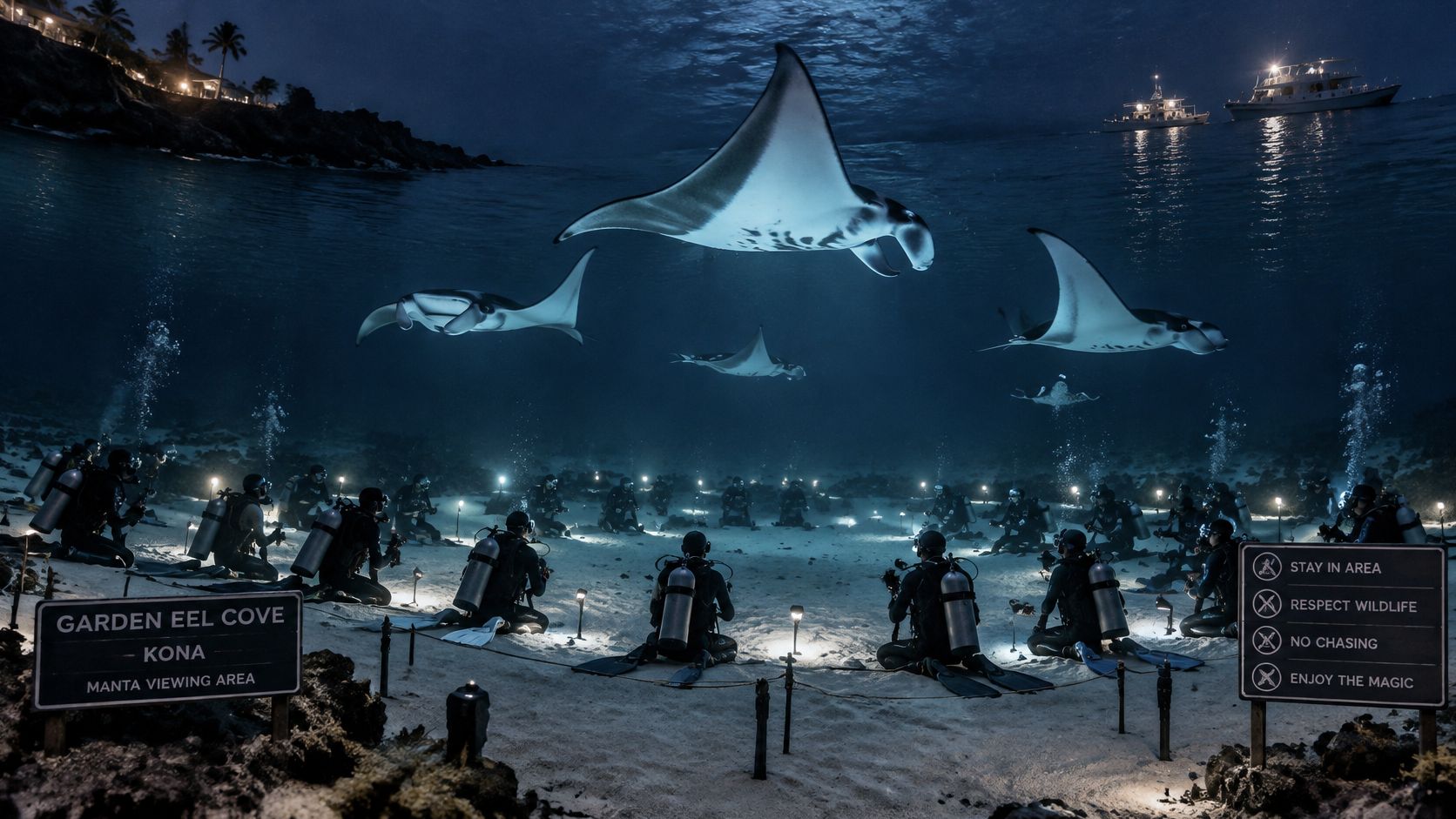
Garden Eel Cove is the superior choice for a Kona manta night dive with photo package, and the reason is viewing quality, not a slogan. Its protected location gives operators a designated viewing area, better organized diver positioning, generally calmer conditions, and healthier reef around the edges. For photography, that organization matters more than raw luck. You get a stable place to kneel, a predictable light column, and fewer reasons to move.
The bottom helps too. The site profile in this Garden Eel Cove and Makako Bay site description describes a gently sloping sandy plain with scattered coral heads and lava-rock formations. Divers can watch from sand instead of standing on live reef, and guides can space people out so fins and lights don't crowd an approaching animal.
Separating Sighting Counts From Viewing Setup
Manta Heaven and Manta Village are the two principal sites in the long Kona observation record, and Manta Heaven sits in Makako Bay, the same bay known as Garden Eel Cove. The study didn't report Garden Eel Cove as a separate category, so don't let anyone sell you a separate sighting percentage for it. The honest case rests on shelter, viewing space, and organization.
Kona manta viewing sites compared
| Site | Nights with mantas | Recorded sightings | Viewing setup |
|---|---|---|---|
| Manta Heaven (Makako Bay) | 92% (2,017 of 2,192 nights) | 19,841 | Principal study site with the highest sighting count |
| Manta Village (Kaukalaelae Point) | 78% (1,702 nights) | 5,603 | Second principal study site with fewer sightings |
| Garden Eel Cove | Counted within Makako Bay | Counted within Makako Bay | Protected setting, designated viewing area, sandy plain with coral heads and lava rock |
Read that table correctly. It supports Makako Bay as the stronger area overall, while the cove's designated viewing area is what makes the experience workable for a group with cameras. Details on the broader outing are in our Hawaii Big Island manta ray night dive guide.
The Crowding Trade-Off
Success draws boats. On a busy night the cove can feel crowded at the surface even when the bottom group is well spaced, so discipline replaces wandering. Carry a primary and backup light, keep buddy contact, stay inside your light circle, and ascend only on your operator's line. Never surface away from your vessel to chase a better angle or a quieter patch of water.
The best frame usually comes from the briefed position. Hold your spot and let the feeding pattern repeat over you.
If another diver edges into your frame, wait for the next pass instead of swimming around them. Mantas feeding on concentrated plankton tend to repeat a lane, and patience buys you a clean background without breaking formation.
Photo Package Options and What Each One Delivers
A photo package can mean three very different things, and most listings don't say which one you're buying. It might mean a dedicated underwater photographer assigned to your group. It might mean a crew member shooting with your camera between other duties. Or it might mean a set of edited files delivered days later, shot by someone whose first job that night was guiding, not photography.
Those aren't interchangeable products. A dedicated photographer watches only framing, light, and your position relative to the animal. A guide with a camera splits attention between safety, air checks, and the group, so your best pass may happen while they're helping another diver. Neither is automatically dishonest. The problem is paying photographer prices for incidental snapshots.
A Wildlife Event Is Not a Studio Session
Mantas don't pose on cue. Their movement, your fixed position, plankton density, and the lights available decide whether usable frames exist at all. That's why the low-manta terms matter as much as the sample images. Independent guidance from the Marine Megafauna Foundation manta tourism guide recommends remaining at least 3 meters away, approaching from the side, staying still, and never diving in front of a manta for a photograph, and it notes one cited study found deliberate close diving occurred in 35% of interactions.
That guidance also explains the counterintuitive part. Close-looking images come from a stationary photographer the animal chooses to pass over, not from someone swimming at it. If a provider promises guaranteed close portraits, ask how they'll get them without breaking that approach rule.
What to Check Before You Pay
What a Kona manta night dive photo package should specify
| Package element | What to expect | Question to ask provider |
|---|---|---|
| Photographer | Dedicated underwater photographer or guest camera with crew help | Is a dedicated photographer assigned for the whole dive? |
| Lighting | Strobes, continuous lights or ambient light only | Which lighting is used, and how does it affect color? |
| Image count | A stated range per diver, not an unlimited promise | How many frames are delivered per diver? |
| Editing | Raw, color-corrected or retouched files | Are images color-corrected before delivery? |
| File format and resolution | Full-resolution JPEG or RAW stated in writing | What format and resolution are the files? |
| Turnaround | A delivery window in days | How many days until the gallery arrives? |
| Low-manta contingency | Refund, reschedule, or reef photos instead | What happens if no mantas appear or images fail? |
| Data and privacy | A storage period and sharing opt-out | How long are photos stored, and can I opt out of sharing? |
Use realistic samples to test the answers. Ask for a gallery shot at night, in plankton-rich water, with divers in the frame, not a daylight portfolio. Our manta ray dive Kona pictures page shows the kind of night conditions your own gallery should resemble.
Read the terms for file ownership and social sharing too. Some galleries are public by default, and download links expire. Save the files to two places as soon as they arrive.
Here's my buying rule. If a provider can't answer the table in writing before payment, you're not buying a package. You're buying a guess, and the manta doesn't care what you paid.
Camera Settings and Positioning for Night Manta Photos
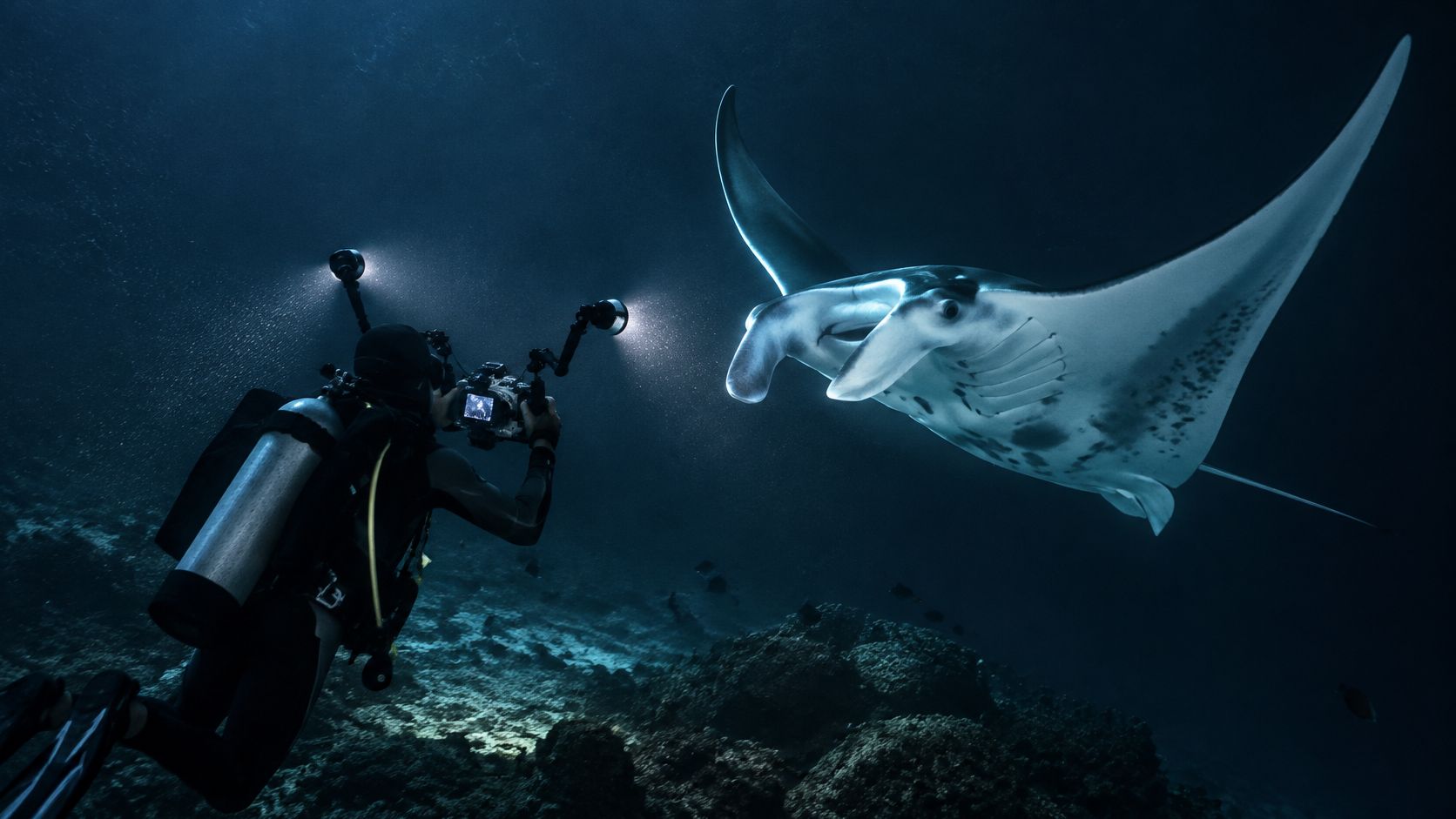
Night manta photography fails for two predictable reasons. First, water strips warm color fast. Second, the plankton that draws the animal also fills the water with particles that bounce your light straight back into the lens. The overview of underwater photography principles explains that red, orange, and yellow wavelengths disappear progressively with depth, while suspended particles create backscatter when illuminated along the camera-to-subject axis.
Understand what the animal is doing and your positioning improves. Dive lights concentrate small crustaceans such as copepods, euphausiids, mysids, and shrimp into a feeding zone. The manta funnels that water through a wide-open mouth and across its gill plates, then rolls or loops to stay in the richest patch. It won't hover for you. It gives you repeated passes, and your job is to be ready for the third one, not chase the first.
A Starting Setup That Respects the Physics
Place strobes or video lights off-axis and slightly outward from the lens so particles near the camera stay darker than the animal. Get as close as the briefing safely allows by choosing position early, which reduces the water between lens and subject and restores contrast. Use artificial light to bring back color, not to blast the scene flat. A wide-angle lens lets you include the full wingspan at close range along with the diver lights behind it, which gives the image scale.
Starting camera settings for night manta photos
| Setting | Starting point | Why it matters |
|---|---|---|
| Shutter speed | 1/200 to 1/250 sec | Freezes wing and mouth movement during passes |
| Aperture | f/8 | Keeps the body sharp from edge to edge |
| ISO | ISO 400 | Keeps noise low while the lights supply most exposure |
| Strobe position | Off-axis, slightly outward from the lens | Reduces backscatter from particles |
| Strobe power | Lowered until the white belly keeps its detail | Prevents bleached highlights on the ventral surface |
| Lens | Wide angle | Fits the full wingspan with the diver lights around it |
| Focus | Pre-set on the lit plankton zone | Lets you shoot when the manta arrives instead of hunting for focus |
Treat those numbers as a bench starting point, not a promise. A continuously lit video rig needs a slower shutter than a strobe rig, and a compact camera may need more ISO. Confirm whether your package photographer uses strobes, continuous light, or ambient light only, because that choice changes color, sharpness, and how much plankton sparkle survives in the frame.
Position for the Repeat Pass
Pick a spot where the animal's lane crosses clean background, ideally dark water with a few diver lights for depth. Pre-focus on the brightest plankton zone, lock your elbows in, and wait with the frame already composed. When the manta enters, shoot a short burst through the turn when the cephalic fins and open mouth face you symmetrically. Don't pan wildly after it. Let it leave, review exposure once, adjust strobe power, and be ready for the return.
Bench test: Before descent, fire your strobes at a white slate or your hand at arm's length and lower power until the highlights still hold texture.
That one test prevents the most common ruined frame, a manta belly blown to featureless white. Do it on the boat, not during the first pass of the night.
Choosing Between a Photo Package and DIY Photos
Choose by what you want to do during the hour, not by which option sounds more serious. A Kona manta night dive with photo package suits a diver who wants to kneel in the viewing area, watch the animal, and receive files later without managing exposure in the dark. DIY photography suits someone who already owns a housing and lights and enjoys solving exposure problems while holding position. A phone or action camera suits casual memories, with honest limits.
The Real Trade-Offs
Control is the DIY advantage. You pick the moment, the framing, and the edit, and a skilled night photographer can outshoot a general package. Effort is the cost. You're managing buoyancy, a housing, two lights, a buddy, and a fixed position at the same time, and every adjustment is a pass you might miss. You'll also do the culling and color correction yourself after the trip.
The package advantage is attention. You can be a diver first and still come home with images of yourself under a manta, which a camera in your own hands rarely captures well. The cost is dependence. Your results rise or fall on the photographer's lighting, positioning, and delivery terms, so the checklist matters before money changes hands.
Photo package versus DIY photos for a manta night dive
| Option | Image quality | Effort | Best for |
|---|---|---|---|
| Photo package with dedicated photographer | Set by package lighting and stated specs | Low, you dive and pose | Divers who want images without managing gear |
| DIY with your own camera and strobes | Set by your skill and working gear | High, you manage settings and buoyancy | Experienced night photographers with working gear |
| Phone or action camera in a housing | Limited in low light | Moderate | Casual memories and sharing |
Three Questions That Decide It
- Do you already own a housing and lights? Buying or renting unfamiliar gear for one dark hour usually produces expensive test shots.
- Have you shot underwater at night before? If not, your learning curve and the best wildlife hour of your trip will happen at the same time.
- Do you want to be in the photos? A photographer across the light column can frame you under the animal. Your own wide lens mostly cannot.
My verdict is situational. If you're new to night or underwater photography, buy the package after checking its delivery terms and spend the dive watching. If you're comfortable shooting at night with lights that worked last week, shoot your own and keep a package in mind only as a backup if a housing floods or a strobe dies. If images are secondary and the encounter is the point, skip the add-on entirely. You still get the full dive, and nobody's gallery deadline follows you home.
Common Questions About Manta Night Dive Photos
Most worries before this dive come down to crowding, empty water, or inexperience. Each one has a practical answer, and a well run boat should give you all three without hedging.
Will Crowding at Garden Eel Cove Ruin My Photos
Not if you stay in the briefed area and inside your light circle, because organized positioning is exactly what keeps backgrounds usable on a busy night. Wait for a clean repeat pass instead of swimming around a neighbor, and your frame clears without breaking formation.
What If No Mantas Show Up
Then you get a night dive, and whatever your package terms say you'll get. Sightings aren't guaranteed on any outing, so confirm the low-manta contingency, whether that's a refund, a reschedule, or reef images, before you pay rather than on the ride back.
Do I Need Underwater Photography Experience
No, but you do need certification, steady buoyancy, and comfort handling a dive light without blinding your buddy. If you're shooting your own images, practice strobe angle and exposure changes on land until the controls are automatic, because darkness is a poor classroom. Our manta night dive Hawaii overview outlines the dive itself if you want the non-photography picture first.
Can I Use Flash or Continuous Light
Follow the briefing for your boat and site, since the guide is balancing animal behavior, other divers' vision, and the shared plankton column. Angle lights away from faces, keep output as low as your exposure allows, and stop adjusting gear when an animal is directly overhead.
When Will I Actually See My Gallery
Only your provider's written turnaround counts, and it should be stated in days along with file size and download expiry. Ask how you'll be notified, because a gallery link buried in a spam folder feels exactly like a package that never arrived.
A clear, specific answer to these questions is a good sign the rest of the operation is organized. Vague answers about photos usually predict vague answers about everything after sunset too.
Pricing, Booking Steps and Next Action
Make the decision in this order. Choose your night, test the package against the delivery checklist, pick the Garden Eel Cove departure, then book. Price only means something after you know what's included, because the cheapest quote can exclude the photographer, the gear, or the finished files you thought you were buying.
Booking Steps
- Confirm credentials. Have your certification card and dive log ready, and tell us about your night diving comfort.
- Choose a season with open eyes. Long-term Kona observations found individual mantas most frequently in April and July and least frequently in January, so use timing to improve odds, not to demand a promise.
- Check the package line by line. Ask for a sample night gallery and written answers on photographer, lighting, image count, editing, format, turnaround, and the low-manta contingency.
- Ask what the price includes. Separate the dive, photo package, gear rental, gallery delivery, and any harbor or tax fees so you're comparing totals, not headlines.
- Read cancellation and weather terms. Know the refund cutoff, the reschedule rule for rough seas, and whether a manta-free night changes anything before you pay.
For the dive itself, the Manta Ray Night Dive is one of our signature tours, listed as best for all divers and bucket-list seekers, and Kona Honu Divers offers Early Diver Discounts and free Nitrox with its dive packages. The most popular trips, including the manta ray night dive, often sell out weeks in advance, so hold your night first and finish the photo questions while your date is secured. You can review the matching 2-Tank Manta Dive and Snorkel tour and compare it with the full Kona diving tours schedule.
Do one thing today. Send the checklist questions and ask for the answers in writing, including a real night gallery link. If the replies are specific about files, timing, and a quiet night, you've found a package worth paying for. If they're not, keep the dive and skip the photo add-on until someone sells you a defined product.
Book your Kona manta night dive with photo package questions answered before you ever step on the boat, and spend the hour watching mantas work the lights at Garden Eel Cove instead of worrying about settings. Kona Honu Divers runs the signature Manta Ray Night Dive and 2-Tank Manta Dive and Snorkel from the Kona Coast, with guided day and night diving for certified divers and snorkelers. Check availability for your dates, send us your photo package checklist, and we'll help you pick the night that fits your trip.