
You're standing on a Kona boat after sunset, with the deck lights fading and the ocean going black around you. That's the moment the Hawaii Big Island manta ray night dive stops feeling like a tour and starts feeling like a genuine encounter with wild animals that already live here, feed here, and know this coastline better than any of us do. The draw is simple, but the situation is more interesting, because the dive works only when you understand the light, the plankton, the site, and your own role in the water.
Descending Into the Dark for the Ultimate Wildlife Encounter
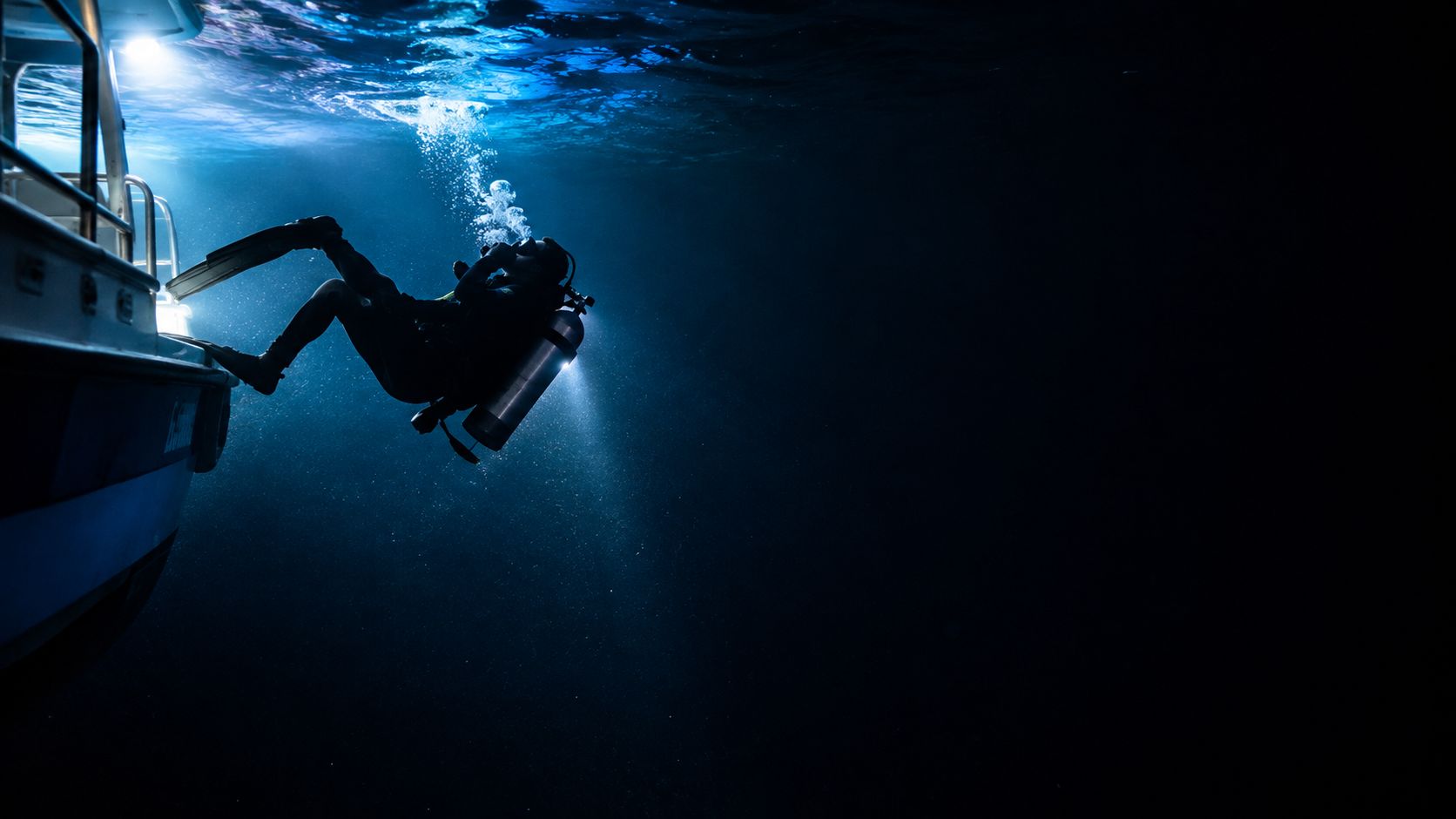
The first thing most divers notice is how fast the daytime world disappears. One minute you're geared up on a boat, the next you're dropping into black water that feels wider and quieter than it looked from the rail. Once you settle on the sand and your light comes on, the whole game changes, because the dark is no longer empty, it's a stage.
That's when the first manta often appears as a moving shadow at the edge of the beam, then rolls into the light with that slow, controlled confidence only a resident feeder can have. This isn't a lucky offshore pass from a passing animal, it's a repeatable wildlife encounter built around Kona's resident reef manta rays. The long-term observations at Manta Heaven and Manta Village show why the experience feels so dependable, with activity recorded on 92% of monitored nights at Manta Heaven and 78% at Manta Village during the six-year study period (NOAA study).
Practical rule: Stay still enough that the mantas can predict your position. The calmer the group, the cleaner the encounter.
What makes the dive unforgettable isn't just the size of the animals, though that helps. It's the control, the way they rise, bank, and loop so close that the edge of a wing seems to pass within arm's reach, then vanish into darkness before coming back through the light. A good guide keeps the group settled, the light field organized, and the moment quiet enough for the mantas to keep feeding naturally.
See how the Kona manta experience is put together
How the Engineered Feeding System Actually Works
The phrase “lights attract mantas” gets repeated so often that it hides the underlying mechanism. The light doesn't call the manta in by itself, it creates a localized photic zone that concentrates or reveals zooplankton near the surface, and that food concentration is what the rays are following (Kona Honu Divers explanation).
Light, plankton, and filter feeding
Reef manta rays, Mobula alfredi, are filter feeders. They use their cephalic fins to guide prey-laden water into the mouth, then rely on gill rakers to retain plankton while filtered water exits. Once the plankton gathers in the light, the mantas work the buffet the way they've always worked it, by making repeated passes through the illuminated water column.
That's why the dive is better understood as an engineered feeding observation system rather than a show that guarantees animal behavior on command. The boat crew is not forcing the mantas to do anything. The lights create the conditions, the plankton responds, and the mantas take advantage of the opportunity. Divers who understand that usually settle down faster, because they're no longer waiting for a trick, they're watching an ecological pattern unfold.
Why your light position matters
Operationally, light placement isn't cosmetic. Divers are told to keep lights above their heads and aim them upward into the water column, which helps maintain the feeding zone while keeping the beam away from the manta's eyes (Kona Honu Divers explanation). That's a small adjustment with a big effect. It helps hold the plankton in the working area and keeps the encounter smooth instead of chaotic.
The dive works because nobody tries to force the mantas closer. The light does the organizing, the mantas choose the passes, and the guests make space for both.
Once you see the system clearly, the night makes more sense. You're not chasing wildlife in the dark. You're standing still inside a food chain moment that the animals already understand.
Choosing the Best Site for Your Manta Ray Dive
The Big Island has two primary manta-viewing sites, and they don't feel the same underwater. The comparison matters because a great manta night isn't only about whether rays show up, it's also about how comfortably the site lets you watch them.
Why Garden Eel Cove gives scuba divers an edge
For scuba, Garden Eel Cove in Makako Bay, also called Manta Heaven, is the stronger choice. It has a deeper sand slope, cleaner offshore water, and a more open horizon, which supports a protected, spacious viewing setup with better reef access (Ocean Safety assessment). That layout gives divers a defined bottom area to settle into while keeping the water column above open for the mantas to feed through.
Manta Village near Kaukalaelae Point has its own value, but the viewing field is tighter and more site-dependent. The documented observation study shows that the encounter rate varies by location, with Manta Heaven producing more total observations than Manta Village over the six-year survey period, 19,841 versus 5,603, and a higher percentage of monitored nights with manta activity, 92% versus 78% (NOAA study). That doesn't mean every dive will follow the same pattern, but it does show why site choice matters.
What the site actually changes underwater
At a better site, the experience feels less cramped. You're not fighting your buoyancy, your light beam has room to work, and the mantas can loop through a wider, cleaner feeding lane. At a tighter site, the same animals may still show, but the viewing can feel more compressed and less elegant.
What works: A stable bottom area, open water above, and a crew that keeps everyone in position.
What doesn't: Crowding the water column, drifting off station, or choosing a site because it's convenient rather than because it gives the mantas room to feed.
If you're comparing operators, ask where they dive, how they position divers, and whether the site gives you a clear line of sight from the sand to the light field. The difference shows up fast once the first ray enters the beam.
Compare the main Kona manta sites
Mastering Underwater Etiquette and Safety Protocols
The fastest way to ruin a manta encounter is to act like the water belongs to you. It doesn't. The animal gets the lane, and your job is to stay low, stay calm, and keep your equipment out of the way.
The basic underwater behavior that actually works
Keep your light pointed upward, not sideways into the manta's face. That helps maintain the feeding zone while reducing stress on the animal. Time your breathing so exhaust bubbles don't blow directly into a manta's face, and keep cameras, hands, and dangling gear tucked close so you don't snag the ray or interrupt its turn through the light field.
Touching is a hard no, and it isn't just etiquette, it's conservation. Hawaiʻi law prohibits knowingly capturing or killing manta rays in state waters, with protections dating to Act 92, signed on June 5, 2009, and later summaries describing broader bans on capturing, taking, possessing, abusing, or entangling rays in state marine waters (Hawaiʻi legal summary). The practical rule for visitors is simple, don't touch, chase, corner, free-dive toward, or otherwise interfere with a manta.
How to behave like a low-impact diver
- Hold position early: The sooner you settle on the sand, the sooner the mantas can predict the shape of the light field.
- Keep your light steady: A moving beam breaks up the feeding pattern and can make the animal adjust its pass.
- Watch your bubbles: A manta doesn't need exhaust bursting into its face while it's feeding.
- Leave the camera alone when the ray comes close: The best close pass is usually the one you don't try to force.
The point of these habits isn't to make the dive feel restrictive. It's to make the encounter repeatable, clean, and safe for both the group and the animals. The less interference you create, the more likely the mantas are to keep making those slow, close, effortless loops overhead.
Review diver etiquette before you go
Managing Expectations and Ecological Variability
Wildlife tourism gets messy whenever people pretend the animals are on a schedule. Mantas follow prey availability, so sighting quality can shift with local plankton density and other ocean conditions, not just with the clock on the boat. That's why a good Kona operator discusses variability openly instead of selling certainty.
What a slow night really means
If manta numbers are thin, the trip isn't automatically a bust. You're still on a night-reef dive in a place where other species often become more active after dark, and that broader ecosystem is worth paying attention to. The important thing is whether the crew keeps the dive comfortable, whether the site is still workable, and whether the operator treats a quiet night as part of working with nature rather than against it.
Recent Hawaiian reef-manta research also points to small populations and low migration rates as reasons these animals deserve careful management, especially in heavily visited areas (Frontiers in Marine Science). That doesn't make the dive less exciting, it makes the responsibility clearer. The more honest the operator is about uncertainty, the more trustworthy the whole outing feels.
What to ask before you book
Ask how the company handles weak sightings. A serious operator can explain whether they offer a repeat policy, how they define a worthwhile night, and what the trip becomes if mantas don't appear.
Look for straight answers about group size, crowding, and how the crew manages the light zone when conditions aren't ideal. The better questions aren't about guaranteed mantas, they're about what happens when the ocean doesn't cooperate. That's where you learn whether the operator is prepared to guide a real wildlife encounter or just a sales pitch.
Check when Kona sightings are usually most consistent
Booking Your Tour and Preparing for the Boat Ride
If you want the dive to feel smooth instead of rushed, book with an operator that runs the site responsibly and keeps the briefing clear. Kona Honu Divers offers a two-tank manta trip to Garden Eel Cove, with a twilight reef dive followed by a manta night dive, and certified divers can use free nitrox on the trip. The value isn't in hype, it's in the structure, gear handling, and site choice.
The boat ride itself is where many guests first notice motion sickness. If that's you, plan ahead instead of waiting to see how you feel. Ship-EEZ Seasickness Patch can help some riders, and so can Dramamine pills, Bonine pills, Sea-Band wristbands, or ginger chews, depending on what you tolerate best. The key is to take care of it before you're nauseous, not after.
What to pack and what to expect
- Bring a towel and dry clothes: You'll be glad to have them after the dive.
- Eat lightly beforehand: A heavy dinner makes the ride out and back less pleasant.
- Tell the crew if you're prone to motion sickness: Good briefings start with honest communication.
- Keep your gear simple: Fewer loose items mean fewer distractions once the manta action begins.
If you want a manta night dive that's built around good site selection, clean briefing, and respect for the animals, start with Kona Honu Divers. Their Garden Eel Cove trip fits this experience well, and the crew can help you prepare for the boat, the gear, and the dark-water dive so the night stays focused on the mantas instead of the logistics.