
Table of Contents
- What That Changes at the Surface
- Make the Reservation in This Order
- Experience and Timing Questions
- Fit First, Then Warmth
- Make a Boat Comfort Plan
- Follow the Entry Routine
- Let the First Approach Happen
- Protect the Viewing Arc
- Can Non-Swimmers Join?
- Is There an Age or Health Limit?
- How Late Does the Trip Run?
- What's a Useful Local Kona Tip?
- What if No Mantas Appear?
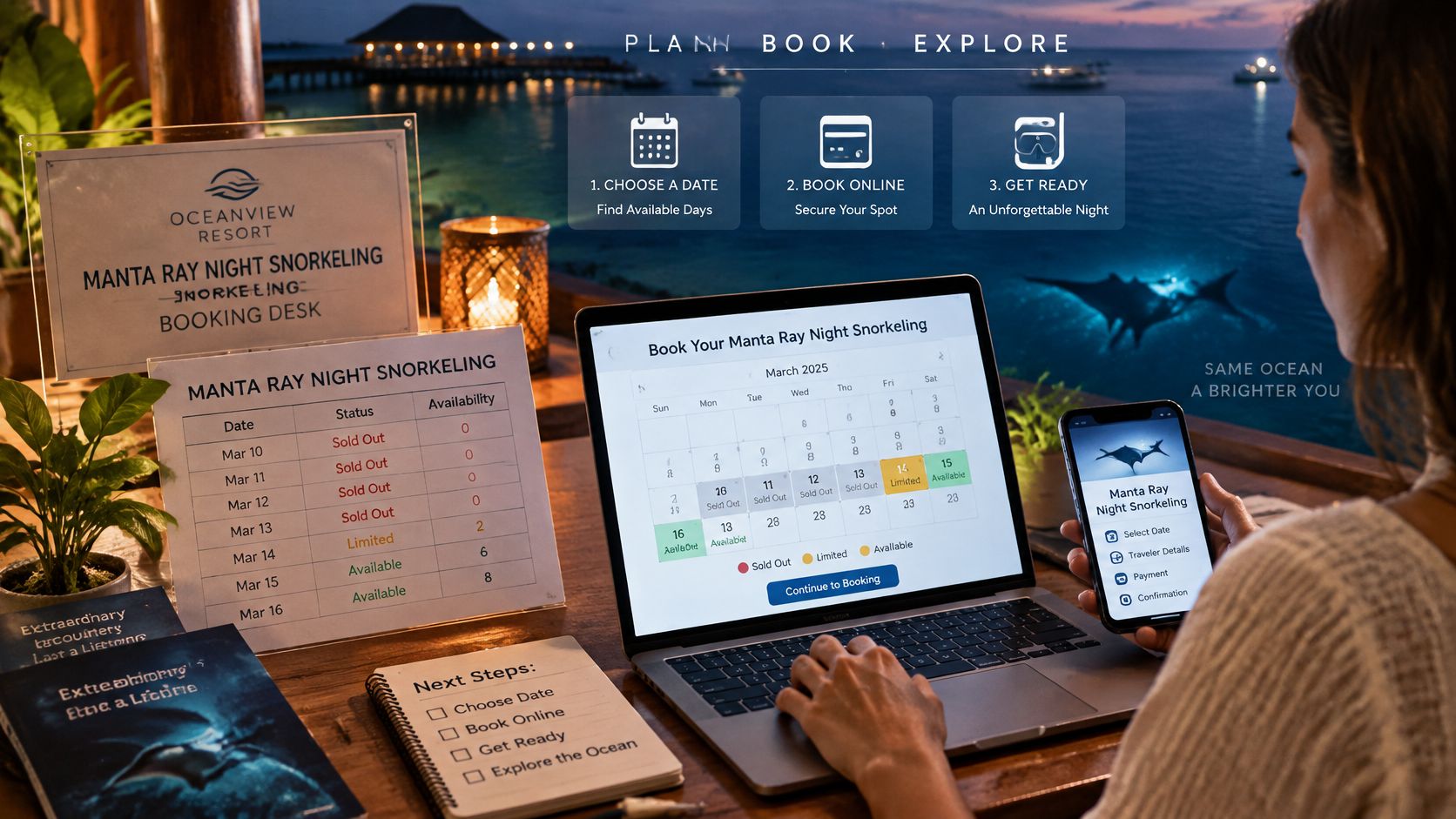
You're looking at a manta ray night snorkeling booking page, wondering whether floating in dark ocean water will feel exciting or uncomfortable. The photos show mantas beneath bright lights, but they don't show the decisions that make the night work: where the boat stops, whether your mask seals, where you hold the board, and when you stop kicking.
The best preparation isn't buying more equipment. It's choosing a suitable setup and arriving ready to follow a simple routine. You'll still feel the water moving beneath you, and the darkness beyond the lights can take some getting used to. A well-fitted mask, useful flotation, and a clear reference point make that adjustment much easier.
Why Garden Eel Cove Is the Right Viewing Site
Choose the site before comparing the extras. Garden Eel Cove, near Kona's airport, offers a protected location, a concentrated viewing area, and good reef access. Those details matter more than whether the boat advertises an elaborate post-swim snack.
The Kona manta sightings report describes Garden Eel Cove as generally more protected, with more moorings and a smaller viewing area than the southern Keauhou site. Keauhou has limited mooring space, and groups can spread farther apart when boat traffic is high and manta numbers are low.
What That Changes at the Surface
A concentrated viewing area gives your guide a more manageable place to position the group. Protection from open-ocean swell also makes it easier to keep your face in the water without constantly correcting your position. Protected doesn't mean flat, though. Wind, swell direction, and the captain's assessment still determine whether entering the water makes sense.
Our manta ray dive takes place at Garden Eel Cove. It's our preferred setup because of the protected location, better viewing area, and healthier reef, with generally calmer conditions. Certified divers considering the underwater version can compare the manta ray dive and snorkel charter with other Kona diving tours.
Site decision: Favor Garden Eel Cove when conditions allow, but never treat a preferred location as a reason to ignore the weather.
For a snorkel booking, confirm the actual viewing site rather than assuming every departure visits the same place. If Garden Eel Cove is confirmed and the captain approves the conditions, you've chosen an excellent setup for a first night.
How to Book Your Manta Ray Night Snorkel
Say you wait until a week before your vacation to reserve, then discover your preferred night is full. That's a preventable problem. Our most popular trips, including the manta ray night dive, often sell out weeks in advance.
Manta night booking options
| Option | Certification | Light Position | Best For |
|---|---|---|---|
| Surface snorkel | None required | Lights point down from a lighted board | First-timers and snorkelers |
| Night dive | Scuba certification required, confirm eligibility with operator | Lights point up into the water column | Certified divers |
The surface option doesn't require scuba certification. Beginner through advanced experience levels can participate in the appropriate format, but eligibility for snorkeling still depends on comfort in the water and the operator's requirements.
Make the Reservation in This Order
- Choose candidate nights. Keep an early-vacation date and a backup available. Check the Kona coast wind and swell forecast, recognizing that forecasts can change.
- Confirm the site. For a snorkel departure, ask whether Garden Eel Cove is planned for your night.
- Reserve early. Don't leave a priority activity until the remaining openings dictate your schedule.
- Verify departure details. Check the meeting point, check-in window, departure time, and how the schedule relates to sunset.
- Ask about in-water supervision. Find out how many guides enter with snorkelers and how the group is divided around flotation boards.
- Read cancellation terms. Understand weather cancellations, rescheduling, and any no-sighting policy before paying.
- Declare relevant concerns. Mention swimming limitations, heart or breathing conditions, and motion sensitivity before the crew assigns your group.
- Save the confirmation. Download it to your phone and print the departure details if you won't have reliable connectivity.
Experience and Timing Questions
Do you need experience? You don't need a scuba qualification for the surface view, but you should be able to breathe comfortably through a snorkel. Tell the crew if that's new to you rather than waiting until you're beside the boat.
Will mantas appear? They're wild animals, not a scheduled performance. Keep a backup date, and use this guide to the best time to see manta rays in Kona when arranging your itinerary.
Book the night, then confirm the site and departure time. Those are the details that turn a reservation into a workable plan.
For the certified-diver format, check the dive booking calendar separately.
What to Bring and Wear for a Night Swim
A twisted strap is easy to fix in daylight and frustrating once you're floating beside a light board. Fit and warmth matter more than expensive accessories, especially when you're mostly stationary and have a wet boat ride afterward.
Night snorkel gear checklist
| Item | Why It Matters at Night | Check Before You Go |
|---|---|---|
| Mask and snorkel | A leak is harder to troubleshoot in darkness | Test the seal at home and check the snorkel valve |
| Fins | Gentle corrections help you stay quiet and positioned | Choose a pair you can kick gently with; follow the crew's fin policy |
| Wetsuit or long-sleeve rash guard | Helps manage comfort during a stationary session | Choose a nonrestrictive layer; use a wetsuit for insulation |
| Marker light or headlamp | Makes you visible to the guide and boat | Confirm the required light and whether it's supplied; carry a suitable spare |
| Flotation or snorkel ring | Supports your surface position with the group | Confirm what the operator provides |
| Dry layer and towel | Provides warmth on the return ride | Keep them in a waterproof bag |
| Waterproof bag | Protects phone, keys, and wallet | Check the roll-top closure |
| Seasickness preventive | Boats can rock while traveling or waiting | Follow package directions before boarding |
Fit First, Then Warmth
Press the mask gently against your face and inhale lightly through your nose. Check for hair beneath the skirt, and don't solve every leak by tightening the strap. This snorkel set selection guide can help you compare fit and practical features.
A thin wetsuit provides insulation that a rash guard doesn't replace. A long-sleeve rash guard offers coverage, but if you chill easily, choose the wetsuit and make sure you can breathe and move freely.
Make a Boat Comfort Plan
For motion sensitivity, options include a Ship-EEZ Seasickness Patch, Dramamine pills, Bonine pills, Sea Band-style wristbands, and ginger chews. Check current prices and ratings when comparing generic wristbands rather than assuming they're always cheaper or better reviewed.
These products aren't interchangeable, and effectiveness differs. Test a new product at home, follow its label, and ask a pharmacist about drowsiness, interactions, pregnancy, or medical conditions.
A fitted mask, suitable insulation, a dry layer, and a boat comfort plan are more useful than a bag full of unfamiliar gadgets.
Snorkel Technique and Staying Safe in the Dark
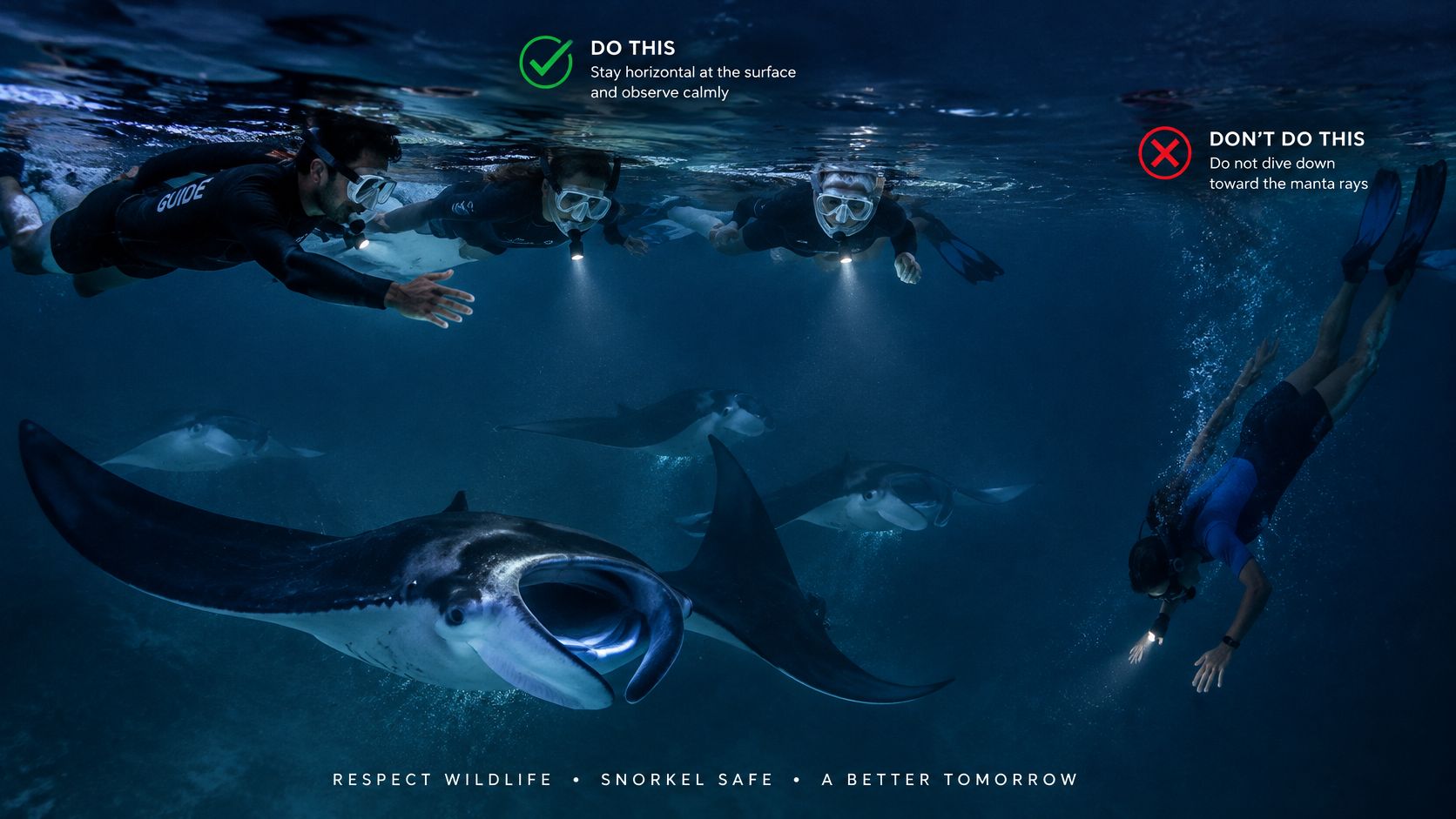
A tempting first-timer mistake is diving down for a closer look. That puts you in the feeding space and separates you from the surface group. Your job is calm, horizontal floating, not following the manta.
NOAA-supported manta viewing guidance recommends staying at the surface, keeping your body horizontal, directing lights downward, and remaining with an in-water guide. Use the board as your position reference rather than trying to tread water beside it.
Follow the Entry Routine
- Test before entering. Check your mask and snorkel at the dock, then take comfortable practice breaths before leaving the entry area.
- Enter together. Move to your assigned light field with the guide rather than choosing an empty-looking board elsewhere.
- Settle horizontally. Float face down, relax your shoulders, and hold the provided flotation as instructed.
- Reduce your kicks. Keep your legs below the surface. Use small corrections only when the guide asks or your position needs adjusting.
- Keep breathing steadily. Don't repeatedly lift your head to locate everyone. If you lose your reference point, stop and ask for help.
- Leave the feeding space open. Don't dive, chase, or reach toward an approaching manta.
- Respect the marked operating area. The Hawaiʻi nighttime diving guidance states that the diver's flag must be illuminated between sunset and sunrise and participants may not knowingly surface more than 100 feet from it, except in an emergency.
- Signal before discomfort escalates. If you're cold, anxious, or tired, use the agreed signal and raise an arm when appropriate. Don't swim back alone.
Our in-water divemasters and instructors manage the dive group; snorkelers should identify their assigned surface guide during the briefing. Keep clear of the hull, propulsion equipment, and ladder approach until directed to exit.
Floating rule: If you can remain in position without moving much, you're doing it right.
What Happens During the Manta Encounter
The crew places bright lights in the water to concentrate plankton, creating a feeding opportunity rather than baiting mantas with food. As the Love Big Island manta viewing guide explains, snorkelers generally hold a lighted surface board with lights pointing down, while divers direct lights upward into the water column.
In the dive setup, seafloor lights illuminate the sandy viewing area, with divers positioned below and snorkelers above. The encounter is stationary and closely supervised. The boat isn't supposed to chase animals around the bay.
Let the First Approach Happen
Say you've reached the board and settled your breathing. The illuminated water looks busy with tiny moving particles, but beyond it there's darkness. Resist the urge to scan everywhere or change positions whenever someone else reacts.
A manta can pass close to the lights, making its approach feel nearer than you expected. Your useful response is to hold position, not pull yourself across the board for a different angle.
A 2024 Kona night-snorkeling industry page reported sightings on more than 80% of nights with suitable conditions. That's an expectation anchor, not a guarantee for your departure.
Manta encounter phases
| Phase | What Happens | What You Do |
|---|---|---|
| Briefing before dark | The crew explains feeding science and observation rules | Listen, ask questions, and check gear |
| Lights switch on | Plankton gathers in the light field | Settle horizontally and remain with your group |
| First manta approach | Mantas may loop through the light at close range | Hold still and keep your hands to yourself |
| Repeated feeding passes | Mantas may return while feeding conditions remain favorable | Stay in your assigned viewing arc without overtaking |
| Exit and regroup | The session ends, or visibility, fatigue, or separation requires action | Signal the guide and follow the coordinated return |
If you're still deciding between viewpoints, compare snorkeling versus diving with manta rays before reserving. The surface view is its own experience, not an incomplete version of the dive.
The first few minutes can feel awkward because the lights are bright and the water initially seems empty. Let your eyes adjust, settle your breathing, and let the animals approach the light field.
Etiquette and Conservation Rules for Manta Viewing
Crowding affects the experience in measurable ways. The Hawaiʻi Ocean Watch manta guidelines describe a survey of 444 evening-trip participants in which 79% of snorkelers reported conflict with other snorkelers and 53% of scuba divers reported conflict with other divers; separate survey findings reported that 69% of respondents felt crowded by scuba divers.
Those findings make group organization more than a courtesy. A guide needs room to see participants, correct positioning, and stop someone from cutting across another person's light field.
Protect the Viewing Arc
- Stay in your assigned space. Don't overtake another swimmer because a manta appears closer to their end of the board.
- Let the guide intervene. Report a positioning problem rather than pushing past someone or pulling the flotation toward yourself.
- Keep photography secondary. Turn off flash and follow the crew's camera-light instructions. Don't extend a camera into a manta's path or sacrifice your grip to frame a shot.
The briefing covers feeding science and the rules of passive observation. Apply the floating and no-diving technique rather than treating an approaching animal as permission to move closer.
Observation only. No touching, no enticement.
Mantas are wild animals using a feeding area. Disturbing their approach can interrupt feeding and spoil the view for everyone sharing the site. The same responsible and considerate diving etiquette applies at the surface: manage your position, respect other observers, and leave the animal's route open.
Kona Manta Night FAQs and Local Tips
Can Non-Swimmers Join?
Don't assume that a flotation board makes the trip suitable for non-swimmers. Surface snorkeling requires comfort floating and breathing through a snorkel, so describe your ability and confirm the flotation, supervision, and participation requirements before booking.
Is There an Age or Health Limit?
Ask about the operator's age and health requirements rather than relying on another company's policy. Declare heart, breathing, or pregnancy concerns at booking, and seek medical advice when needed before committing to an open-water activity.
How Late Does the Trip Run?
Confirm the expected return time along with departure and check-in. You'll be returning after dark, so leave room for the drive back and avoid a tightly scheduled dinner reservation.
What's a Useful Local Kona Tip?
Check the marine forecast again on the morning of your trip, then follow the captain's final conditions assessment. Pack a dry layer in a waterproof bag, and make your seasickness prevention plan before reaching the harbor rather than after you feel unwell.
What if No Mantas Appear?
Ask about the no-sighting policy before paying, including whether any return opportunity is subject to space or other conditions. A backup evening is useful only if your itinerary and the operator's terms let you use it.
Before leaving your accommodation, confirm the site, departure time, and meeting location. Pack the gear checklist, put your confirmation somewhere accessible, and arrive with enough time to fix a mask problem on land rather than in the water.
Kona Honu Divers offers guided manta ray night snorkeling from the surface and a stationary, supervised manta dive at Garden Eel Cove. Visit Kona Honu Divers to choose your format, check available dates, and confirm the departure details for your night on the water.