
Your confirmation email says to meet at the harbor before sunset, and the boat leaves at five. Somewhere between the rental car and the dock you're holding a wetsuit, a towel, and a question no brochure answered: will the manta rays show up?
The photos sell a moment. Black water, a beam of light, a wing wider than the swim step sliding past your mask. They don't show the twenty minutes of waiting before that pass, the reef you're kneeling on, the light you're holding above your head, or the nights when the plankton isn't there and neither are the animals.
Kona's manta dives are the most reliable in Hawaii, and they're still wildlife encounters with animals that eat whatever the current delivers. What follows is the working version: which site to target, what pulls mantas into the light, where the honest odds come from, and how to position yourself so the closest pass happens because a manta chose it.
Table of Contents
- Where to Find Manta Rays on the Big Island
- Why Manta Rays Gather Over Kona Reefs at Night
- When and Where Sightings Are Most Likely
- Which Viewing Position Suits You
- Rules That Protect Manta Rays and Your Dive
- How the Night Manta Dive Unfolds Step by Step
- Packing and Photography Tips for a Night Manta Dive
- Choose a Responsible Operator and Book Your Manta Dive
Where to Find Manta Rays on the Big Island
Two reefs carry nearly all the commercial night dive traffic on the Kona coast, Garden Eel Cove and Keauhou, and they don't behave the same way. For the night dive, the site to aim for is Garden Eel Cove.
| Site | Aggregation size | Animal pattern | Conditions | Best use |
|---|---|---|---|---|
| Garden Eel Cove | Larger, consistently | Mixed groups, with more mobile males passing through | Sheltered, generally calmer water | Manta Ray Night Dive |
| Keauhou | Smaller than Garden Eel Cove | Disproportionately female, strong site fidelity | Shorter run from Keauhou, more exposed than Garden Eel Cove | Female-heavy sightings on a short ride |
The difference isn't marketing. Community-sourced records collected from 2010 through 2022 documented more than 23,000 sightings involving 167 unique manta rays across Garden Eel Cove and Keauhou, and Garden Eel Cove consistently supported the larger aggregations, according to the University of Hawaiʻi study of Kona's manta aggregations. Keauhou ran the other way, drawing a disproportionate share of females with strong site fidelity. The sex ratio across both sites still came out near 1:1, but males appeared more mobile, which suggests the two reefs serve different ecological functions rather than acting as two copies of the same feeding station.
Site records tell you where mantas tend to show. They can't promise a pass on a given night, because the animals follow plankton and their own feeding history rather than a calendar. Divers on Kona Honu Divers' Manta Ray Night Dive have seen mantas on 92% of trips, an honest number that still leaves room for a slow night.
Kona Honu Divers runs its manta ray night dive at Garden Eel Cove and cites the site's protected location, better viewing area and healthier reef as the reason. On the dive itself, that works out to a sandy bottom you kneel on inside a set viewing area, with divemasters in the water managing the group.
Ask before you pay: which site is on tonight's schedule, and what would make the captain switch. An operator who names a site and explains the call is showing you how they think.
Want the site-by-site history, including how the two reefs came to host these aggregations in the first place? The Manta Heaven versus Manta Village comparison walks through it.
Two actions follow. Book a boat that runs Garden Eel Cove, and get the site name confirmed in writing before you hand over a card.
Why Manta Rays Gather Over Kona Reefs at Night
The first manta of the night rarely arrives like the photos. It shows up as a dark wedge at the edge of the light, banks once, and then the wingtips are beside your mask and it's gone.
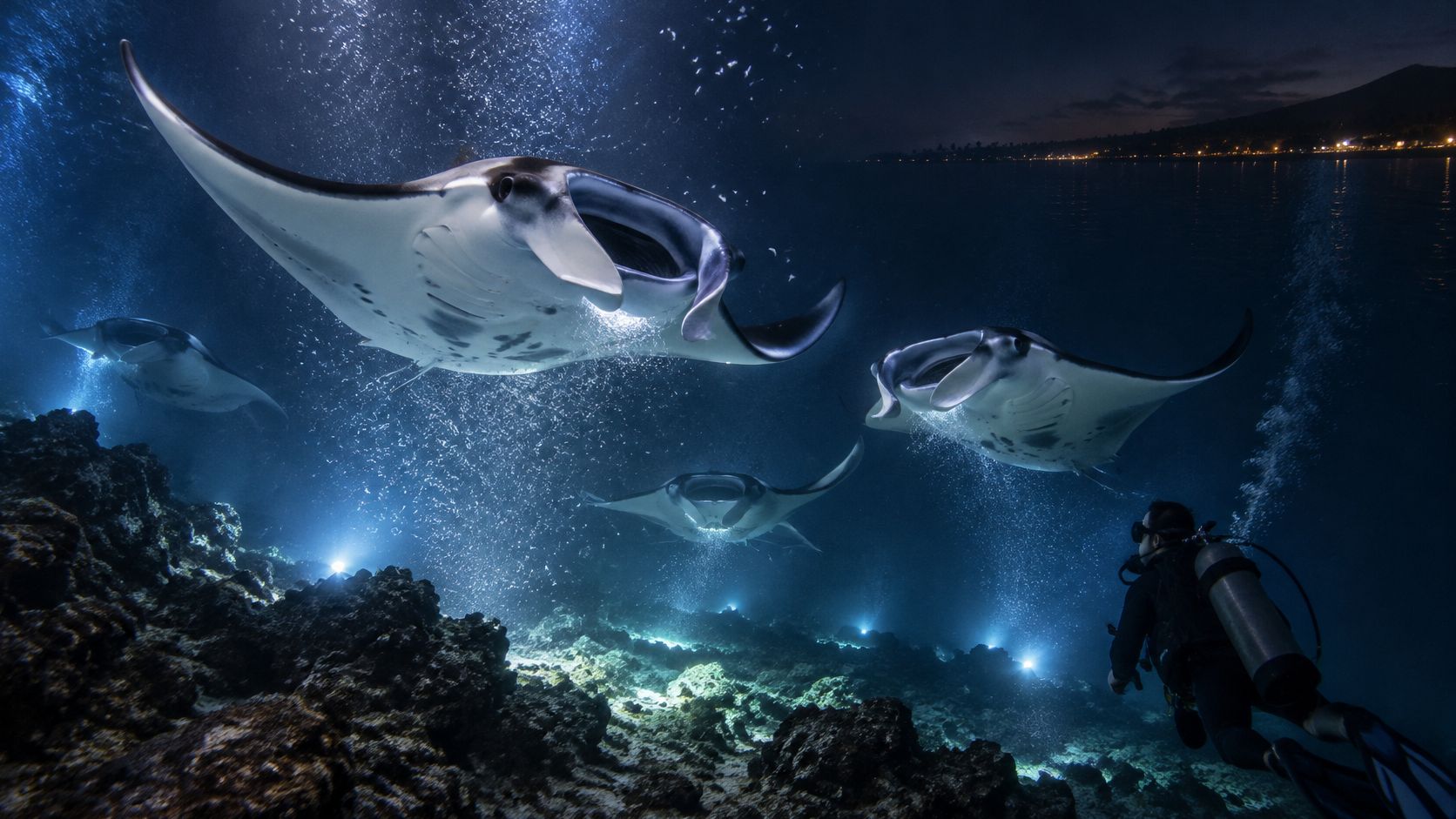
A manta is a living net. It swims toward the richest patch of water it can find, holds its mouth open, and strains zooplankton through specialized gill plates while the water exits behind it. Nothing about that behavior is a performance. It's harvesting, and every loop you'll watch on a night dive follows from it.
Find a plankton-rich pocket and a manta will barrel-roll through the same water again and again, somersaulting to stay inside the food. The animals working Kona's reefs are giants, with wingspans that can run well over 12 feet, and they're wide-ranging travelers that cover deep offshore water alongside this shallow shelf. The one circling your light came here to feed. It didn't come for you, and it won't linger once the food thins out.
That's the honest part of the equation. When plankton gathers, mantas gather. When it doesn't, a reef can sit empty on a perfect calendar date, because the animals answer to prey and habit rather than the month printed on your ticket.
Why the Lights Change the Water
Dive lights don't attract mantas. They concentrate the animal's food. A powerful set of lights placed on the seafloor builds a big, bright circle that plankton drifts into and keeps drifting into, and a manta working that circle will pass through it again and again while the food keeps gathering. Off Kona, that circle is also why you're never kneeling in complete darkness.
Watch the mouth. Open mouth on a straight pass means the animal is filtering. Closed mouth and a direct line means it's traveling. The loops happen in the first case, and no amount of finning from you changes the second.
A good night looks like a manta working a plankton patch on its own schedule: a filter feeder doing the one thing that brought it to this reef, for exactly as long as the reef keeps paying out.
When and Where Sightings Are Most Likely
Nobody can promise you a manta, and any operator who does is selling rather than guiding. Divers have seen manta rays on 92% of Manta Ray Night Dive trips, which is a strong record and still not a guarantee on the night you book.
The bigger point is what drives the variation. Long-term Kona records show aggregation size varying between sites and tracking zooplankton density closely, and the University of Hawaiʻi analysis of Kona manta sighting patterns makes the case plainly: calendar season on its own predicts viewing quality worse than prey conditions, ocean conditions, site choice, and whether particular resident animals are working the area that week.
What Actually Predicts a Good Night
| Factor | What to check | Effect on viewing |
|---|---|---|
| Zooplankton density | Plankton levels the operator reports | Larger aggregations when plankton is dense |
| Site choice | Garden Eel Cove or Keauhou | Aggregation size and visitor mix differ between sites |
| Calendar month | Your trip date | Weak predictor on its own |
| Weather | Forecast and surface state | Cancellations and the need for a backup night |
Here's the distinction most travelers miss. Manta activity over a site is not the same as a manta passing close to you. A busy night can still hand you one short look at one animal, because the group is large, the light patch is crowded, or a single manta is making wide circuits instead of tight loops. Judge the trip by what you saw, not by the count someone quotes on the ride back.
Build in resilience rather than hoping. Book your manta night early in the trip so a weather cancellation doesn't end your chances, keep a second night free, and ask the operator directly how they handle rough seas or a night with thin plankton. A clear answer on rescheduling tells you more about the outfit than any sighting claim.
One caveat worth holding onto: stable aggregations during a period of rising tourism reflect what was observed at those sites in those years. It isn't proof that visitor numbers can grow without limit.
If you want the month-by-month picture, this guide to the best time to see manta rays in Kona breaks down what shifts and what doesn't.
Which Viewing Position Suits You
Position matters more than equipment. Two people on the same boat can have completely different nights depending on whether they're floating at the surface or kneeling on sand eighteen feet down.
The Kona protocol is specific. Divers stay on or near a sand, rubble, or boulder bottom and form a semicircle, leaving open water for mantas to maneuver through. Divers hold lights above their heads and shine them upward to concentrate plankton, while snorkelers stay at the surface and shine lights downward, according to the NOAA manta ray viewing guidance for Kona. Touching, chasing, grabbing, or riding a manta is prohibited, because contact can strip the animals' protective mucus coating. Lights go on sand or rubble, never on live coral, and a diver can be pulled from the water at the divemaster's discretion for ignoring any of it.
| Factor | Night manta snorkel | Night manta dive |
|---|---|---|
| Certification | No certification needed | Open to all certified divers |
| Position | Floating at the surface | Kneeling on sand or rubble in a semicircle |
| Lights | Shine downward from the surface | Held overhead and shone upward to concentrate plankton |
| Viewing angle | Looking down on mantas from above | Looking up at feeding mantas from the bottom |
The Manta Ray Night Dive and the 2-Tank Morning Dive are open to all certified divers, so a freshly certified diver with a handful of logged dives is welcome on either.
Rule of thumb: if you're certified and comfortable in the water after dark, dive it. The lower angle puts you under the animals with the light behind them, and the passes come at eye level. If you're not certified, or night water makes you tense, the surface view still puts mantas within arm's reach of your mask.
What decides it is comfort, not bravery. A relaxed snorkeler who holds still at the surface sees more than a nervous diver burning through a tank. If you're weighing the two, this comparison of snorkeling versus diving with manta rays covers the practical differences.
Rules That Protect Manta Rays and Your Dive
Every rule on a manta dive exists for one reason: you are visiting a small, protected population that cannot absorb much pressure.
The giant manta ray, Mobula birostris, is federally listed as threatened under the U.S. Endangered Species Act, and NOAA identifies Kona as home to one of the regularly studied giant manta subpopulations. Domestic fishery regulations prohibit anyone under U.S. jurisdiction from retaining manta rays. The species also reproduces at a crawl: females produce only one pup approximately every two to three years, per NOAA Fisheries' Hawaiian Islands protected species guidance.
The local numbers are smaller than most visitors assume. Photo-identification around Hawaiʻi Island has recorded 318 individual manta rays from 1979 onward with an estimated 104 adult breeders, while Maui Nui holds a genetically separate group of roughly 600 animals identified since 2005 with about 129 breeders, according to NOAA's feature on the reef manta genomics study. Each island group holds a resident population of its own.
Why Distance Is the Rule That Covers Everything Else
Genetic studies of Hawaiʻi's mantas show very little movement between island groups, which means a manta off Kona belongs to a different breeding population than one off Maui. Pressure at one site lands on a restricted resident group that will not be topped up from elsewhere. The main human pressures are entanglement, boat interaction, habitat loss, and other coastal impacts, and slow growth plus late maturity makes recovery from any of them slow.
That is why the conduct rules are written the way they are:
- Never touch, chase, grab or ride. Contact damages the mucus layer that protects the animal, and pursuit pushes it off the feeding patch for everyone.
- Stay on sand and rubble. Keep your knees, fins and lights off living coral.
- Secure loose gear. Dangling straps, gauges and camera lanyards are the entanglement risk you personally control.
- Report entanglement. Tell the crew or call the marine mammal and sea turtle hotline if you see line or debris on an animal.
The same standards apply well beyond this one site, and this rundown of responsible and considerate diver etiquette covers them for the rest of your diving in Kona.
Community photo-identification is the other half of the story. The Kona records behind these population figures came from divers and snorkelers logging what they saw, so a respectful visit with a camera contributes data on individuals researchers can track for decades.
Hold still, keep your distance, and let the mantas close the gap. That trade is the whole encounter.
How the Night Manta Dive Unfolds Step by Step
The dive follows a rehearsed sequence, and knowing it in advance removes most of the anxiety. Here's how the night runs, with the reason behind each step and the mistake that spoils it most often.
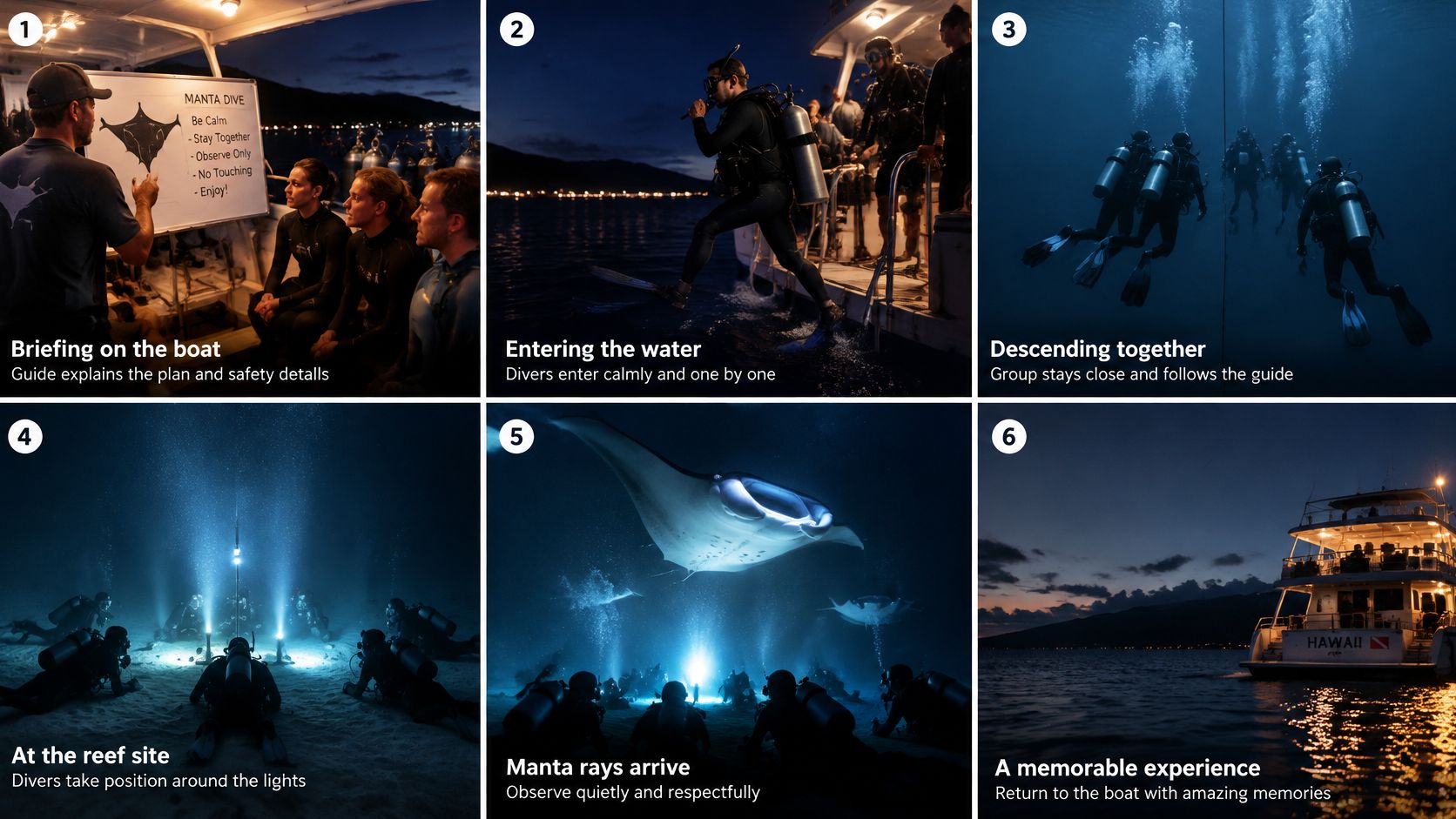
- Attend the full briefing. The crew covers the science behind the dive and the golden rules of passive observation. Arrive early enough to hear all of it, because the site plan and light placement get explained once, and the divers who drift in late are the ones who spend the dive confused about where to kneel.
- Descend to the viewing area with the group. You're heading for sand or rubble, never coral. The common slip is a heavy descent that kicks up silt or plants a knee on the reef, which kills visibility for the divers behind you.
- Kneel in a semicircle and stay there. The open water in the middle is the runway, and mantas use it. Drifting off the line to get a better angle closes that runway and puts your body in the path of an animal doing tight loops.
- Get your light overhead and aim it up. The upward beam is what concentrates plankton above you. Pointing it flat at coral, or sideways into someone's face, wastes the beam and bothers everyone around you.
- Watch the loop and stop moving. A feeding manta circles, rolls, and comes back through the same water. Buckle your fin tips into the sand, keep your hands to yourself, and let repetition do the work, because lurching toward an animal guarantees it veers off.
- Keep contact at zero. That includes the animal you're sure won't mind. Chasing for a photo or reaching out to touch teaches a resident manta that the light circle is a place to avoid, and other people pay for it.
- Follow the divemasters and instructors. Experienced guides stay in the water with divers to manage the group and can remove anyone ignoring the protocol. They're also the ones repositioning the group when a manta is working one edge of the light.
- Surface, debrief, and count what you got. How many mantas, how long they stayed, how many close passes. That honest tally, not the brochure photo, is what tells you whether you got a good night.
Packing and Photography Tips for a Night Manta Dive
Pack for a long night in open water rather than a beach day.
- Reef-safe sunscreen, applied before you leave the dock, not at the mooring where it washes straight off.
- A warm layer for the surface interval. You're stationary in the water, and stillness gets cold fast once the sun drops.
- A dive light you can hold steady overhead, plus a backup, because a dead primary light takes you out of the pattern you waited to be in.
- A well-fitting mask and snorkel if you're on the surface option, and a towel for the ride back.
- A waterproof bag for valuables. Loose items stay on the boat.
Camera Settings That Work at Night
Use a fast shutter and manual white balance, and set the lens wide. Mantas pass close, and a tight framing gives you a nose and a wingtip instead of an animal.
Skip flash. It startles animals, scatters the plankton the mantas came for, and lights up backscatter instead of the subject. Work with the dive light already in the water and let the photophores and wingtips fall into shadow if that's where they fall.
Never chase for a shot. Let a manta come to you, then hold position and let it fill the frame on its own line. Keep rigs compact, with no trailing arms or lanyards that could snag the reef or an animal's wing. A close picture comes from good position, not pursuit.
Choose a Responsible Operator and Book Your Manta Dive
Judging an operator doesn't require much expertise. Six checks separate a well-run night from a crowded one.
- A named viewing site before you book. For the night dive, Garden Eel Cove is the choice, because its protected location gives you a better viewing area and healthier reef. An operator who can tell you the site up front has a plan. One who says "somewhere south of the airport" doesn't.
- A detailed briefing before anyone touches the water. Science first, rules second, then the site plan.
- Certified guides in the water with the group, not only on deck calling instructions.
- A stationary, closely supervised dive, so the light circle stays intact and nobody swims through the middle of it.
- Lights placed on sand or rubble, never on coral. Ask if you can't tell from the boat.
- A clear, stated policy against touching and chasing, with consequences you're told about at the briefing.
If you want the biology and the respectful-interaction training before you're in the dark, the PADI Manta Ray Diver specialty course covers manta biology, behavior and conservation, and it teaches how to interact with manta rays respectfully before the Manta Ray Night Dive. Confirm course content with whichever operator runs it.
Kona Honu Divers is one option worth a look. Our Manta Ray Night Dive runs at Garden Eel Cove, our crew sets a powerful bank of lights on the seafloor while divers kneel on the sand and snorkelers float above, and our divemasters and instructors are in the water with you throughout. We also run a 2-tank manta dive and snorkel tour that puts both the dive and the surface option on one booking, and our Kona diving tours cover the rest of the coast. Because the most popular trips, including the manta ray night dive, often sell out weeks in advance, it pays to reserve your date early rather than on your last morning in town.
Choosing between operations comes down to the same checks in every case, and this guide to how to choose a Kona dive company applies them across the board.
Next steps are simple. Pick a date early in the trip, choose the dive or the surface snorkel, confirm the site name, and hold one backup night in case weather moves through. That's a plan built for wild animals rather than against them.
Kona Honu Divers runs the Manta Ray Night Dive at Garden Eel Cove, the protected site we choose for its viewing area, healthier reef and calmer water, with divemasters in the water and a surface snorkel option for anyone without a certification. Our 2-tank manta dive and snorkel tour pairs the evening with a daytime reef, so you see the coast in both lights. Visit Kona Honu Divers to check dates and lock in a night before the season's most popular trips fill.