
You're comparing dive dates, looking at your certification card, and wondering why calm, clear water still leaves you with so many choices. That's the planning problem with Scuba Diving Kona Big Island water. A glassy morning can suit a brand new diver on a coral garden, an experienced diver on a drift, and nobody at all if the entry, depth, or flight home is wrong.
Pick by certification first, then by time of day, then by emergency distance. Get those three right and the reef takes care of itself. Get them backwards and you'll book a beautiful dive you're not ready for, or miss the night dive you came for because you didn't leave a second evening free.
Choose the Right Kona Dive by Certification and Time
Find your row first. Everything else on the boat, from depth to buddy pairing, follows from it.
Main Kona dive types at a glance
| Dive type | Best for | Certification | Time of day |
|---|---|---|---|
| 2-Tank Local Morning Dive | Certified divers who want coral gardens, lava tubes and arches | Open Water or higher | Morning |
| Premium Advanced 2 Tank Trip | Experienced divers who want remote sites and drift dives | Certified divers | Morning |
| Manta Ray Night Dive | Divers who want to watch manta rays feed under the lights | Confirm with operator | Night |
| Black Water Night Dive | Certified divers curious about open-ocean night life | Open Water or higher | Night |
| Morning Introductory Scuba Dive | First-time divers with no certification | None required | Morning |
No Certification Yet
If you don't hold a card, start with the Morning Introductory Scuba Dive. You'll dive shallow, guided, with an instructor controlling the pace, the route, and the turnaround. That's the right trade. You give up independence and depth, and you gain a first ocean dive without pretending a pool session made you a certified diver.
Don't use an introductory dive as a shortcut into a night dive, a drift, or a deeper pinnacle. Buoyancy, ear clearing, mask clearing, and calm breathing need to be boring before darkness or current gets added. If the intro dive hooks you, that's the moment to look at a full course through the Big Island scuba certification options rather than stacking harder dives onto an unsettled skill base.
Open Water and the Standard Morning Charter
For most regular dive charters, we require at least an Open Water Diver certification from a recognized agency such as PADI, SSI or NAUI, which allows diving to 60 feet (18 meters) with a buddy. Bring your C-card on the day. A photo on your phone helps if it's legible, but don't arrive expecting the crew to reconstruct your training history from memory.
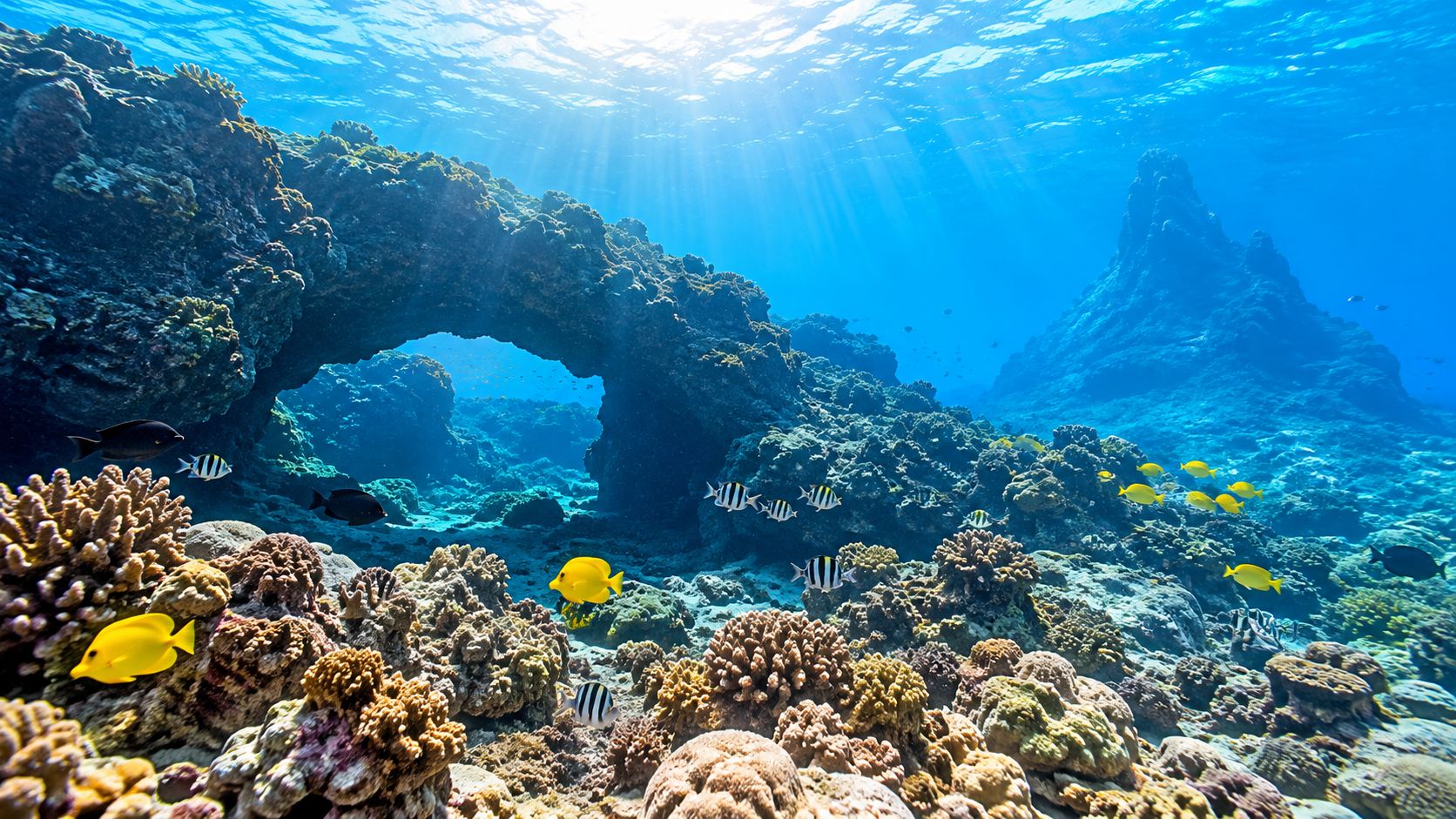
That credential covers the 2-Tank Local Morning Dive, built around coral gardens, ancient lava tubes and dramatic arches. Dive one usually takes the deeper or more condition-sensitive site while you're fresh. After a surface interval, dive two runs more relaxed. You can see how that fits into the full schedule on our Kona diving tours page.
Practical rule: Certification decides what you may book. Recent experience decides what you should book.
If you've been out of the water for a long stretch, do a refresher before a deeper or drift dive. I would rather see you spend one morning rebuilding buoyancy and regulator recovery than spend a premium trip fighting your trim while the group moves along a wall. Cards don't expire the way skills fade, and Kona's clear water won't hide rusty buoyancy from a guide.
Experienced Divers and the Advanced Morning
The Premium Advanced 2 Tank Trip suits experienced certified divers who want remote sites and drift dives. Remote sounds romantic until you price in what it demands, solid gas planning, comfort without a fixed reference, controlled ascents in blue water, and the discipline to stay with the group when something interesting pulls your eye off the wall.
That's the honest trade-off of more experienced diving opportunities. You get sites fewer boats visit, and you accept less margin for sloppy buoyancy or vague buddy contact. Details are on the premium advanced 2-tank trip page. Book it because your recent logbook supports it, not because the word premium sounds better than local.
Night Changes the Decision
Night options split into two very different dives. The Manta Ray Night Dive is stationary, shallow in feel, and built around holding position while animals feed overhead. The Black Water Night Dive puts certified divers over open ocean with no reef below for reference.
Confirm your card and experience with the operator for either night booking. Night amplifies small problems. A loose mask strap, a dying light, or drifting up five feet while you fiddle with a camera matters more after dark. If your last dive was years ago in daylight, don't make your comeback dive a blackwater dive.
Close with the rule that decides most choices. Certification first, then time of day, then how much reef or depth you want. A certified, current diver can choose freely between a relaxed morning and an advanced drift. A new or rusty diver gets more from one well matched morning than from forcing the hardest line in the table.
Seasons and Conditions That Shape Kona Dives
Diving in Kona is available year-round, with warm water and generally clear visibility in every season. Season choice isn't about whether you can dive. It's about swell, comfort, and how much flexibility you need to build around entries and exits.
Kona conditions by season
| Season | Water temperature | Typical conditions | Best fit |
|---|---|---|---|
| Summer, May to October | about 27°C (80°F) | Usually calmer surface, steady visibility | Reef dives and beginners |
| Winter, November to April | about 24-25°C (75-77°F) | Larger swell possible, warm water still | Experienced divers who accept changing entries |
| Night dives, year-round | Warm in every season | Generally clear visibility | Manta and blackwater nights |
Water Temperature
Summer water sits roughly 27°C (80°F). Winter runs 24-25°C (75-77°F). Neither is cold water diving, but you'll feel the difference on a second tank, a long night dive, or back-to-back mornings.
What it means for booking is simple. If you chill easily, don't let a summer photograph talk you into the thinnest suit in February. Ask about a thicker wetsuit or an extra layer before you're shivering through the safety stop. Thermal comfort is gas management, because cold divers breathe harder and enjoy less.
Visibility on the Leeward Coast
Visibility is generally strong year-round on the leeward Kona coast. The coast gives calmer days than many Hawaiian shores because the island blocks much of the prevailing weather. Don't mistake that for a guarantee. Runoff, swell direction, and local wind still change a site day to day.
That's why guides choose sites on the morning, not from a brochure photo taken months earlier. If you're traveling for one specific reef, build in slack. The broader month-by-month picture is covered in our guide to the best months to scuba dive in Hawaii, and it's worth checking before you lock flights around a single dive day.
Swell Is the Real Seasonal Variable
Winter can bring larger swell, and swell changes entries and exits more than it changes the dive itself once you're down. A boat ladder in surge, a lava rock shore entry between sets, or a long surface swim against chop will test fitness that a calm reef never asks about.
- ** Beginners and intro divers:** Summer's calmer surface removes one variable while you're learning everything else.
- ** Experienced divers in winter:** You can dive well, but accept that the captain may move sites or call an entry off.
- ** Photographers:** Surge matters more than temperature, because you're trying to hold still without grabbing reef.
How Season Affects Each Dive Type
Morning reef dives run all year, with site selection doing the seasonal work. Manta and blackwater night dives also run on schedule through the year, because they're planned around darkness and plankton or vertical migration, not around a summer-only window. Winter won't cancel your night plans by default, and summer won't make a blackwater dive beginner friendly.
I would pick a flexible morning early in the trip and keep a backup day for reef dives. That order protects you twice. If weather moves a dive, you still have room to reschedule, and you're not diving the day before a flight because every earlier slot filled.
Check current ocean conditions with the operator before the trip and again the day before. A forecast tells you the trend. The crew tells you what the harbor, the swell, and the chosen site look like.
Top Kona Dive Sites from Lava Tubes to Pinnacles
Say you descend on a typical Kona morning and the reef doesn't look like a tropical aquarium dropped onto sand. It looks volcanic, because it is. Coral grows over old lava, arches cut through rock, and the bottom can fall away faster than your eyes expect.
Coral Gardens to Start
Coral gardens make up the calm, colorful reef sections of the morning two-tank dives. You'll move slowly over hard coral, watch reef fish work the structure, and practice the skill that matters most here, hovering without kicking up the bottom or bracing a hand on living coral.
A first-time ocean diver or a cautious certified diver should start here. The navigation is forgiving, the guide can keep the group in visual contact, and there's plenty to see without chasing depth. If your buoyancy is honest here, it'll hold up in a lava tube. If it isn't, the garden tells you early while the fix is easy.
Ancient Lava Tubes
Ancient lava tubes reward good buoyancy and calm breathing. Light shafts fall through openings, your bubbles run along the ceiling, and a swim-through that looked wide from outside narrows once you, your tank, and your fins are inside it together.
Go single file. Keep your fins up and your hands to yourself. Don't enter a tube you can't see through, and don't follow a buddy in just because the entrance looks easy. The divers who enjoy tubes most aren't the boldest. They're the ones who can stop, back up slightly, and turn without a fin sculling silt into everyone's mask.
Dramatic Arches
Dramatic arches formed by volcanic rock often sit in shallow water and need careful positioning. Shallow doesn't mean simple. Surge pushes you toward the rock, sunlight tempts you to drift up for a photograph, and the prettiest angle is usually the one that puts your tank closest to the ceiling.
Position yourself before you raise a camera. Let the arch frame the fish rather than chasing fish through the arch. A cautious diver can enjoy arches on a guided morning dive as long as the guide controls spacing and nobody treats the swim-through like a doorway everyone must use at once.
Clear water hides depth in Kona. A drop-off that looks like a gentle slope from above can put you well below your planned depth in a few relaxed fin kicks.
Pinnacles and Deeper Drop-Offs
Pinnacles and deeper drop-offs on advanced trips change depth quickly, and drift currents can move divers along the wall. You'll feel the difference immediately. The reef reference falls away, blue water opens on one side, and your computer becomes more trustworthy than your eyes.
That clear water problem is why experienced divers still get depth checked here. A steep volcanic drop-off can look shallow and easy from the surface because you can see so far down it. Set a max depth with your buddy before you descend, check your computer at every change in the wall, and agree on a turn pressure that leaves a real reserve for the ascent and safety stop.
Night sites work differently from all of this, because the manta dive is stationary and blackwater has no reef at all. They're covered in their own sections below.
Use a simple matching rule. A first-time or cautious diver should start with coral gardens and lava tubes, while experienced divers can choose pinnacles and drift sites. The site doesn't care how it looked in a photograph. It asks whether your buoyancy, gas awareness, and buddy discipline match the terrain you're over.
Manta Ray Night Dives at Garden Eel Cove
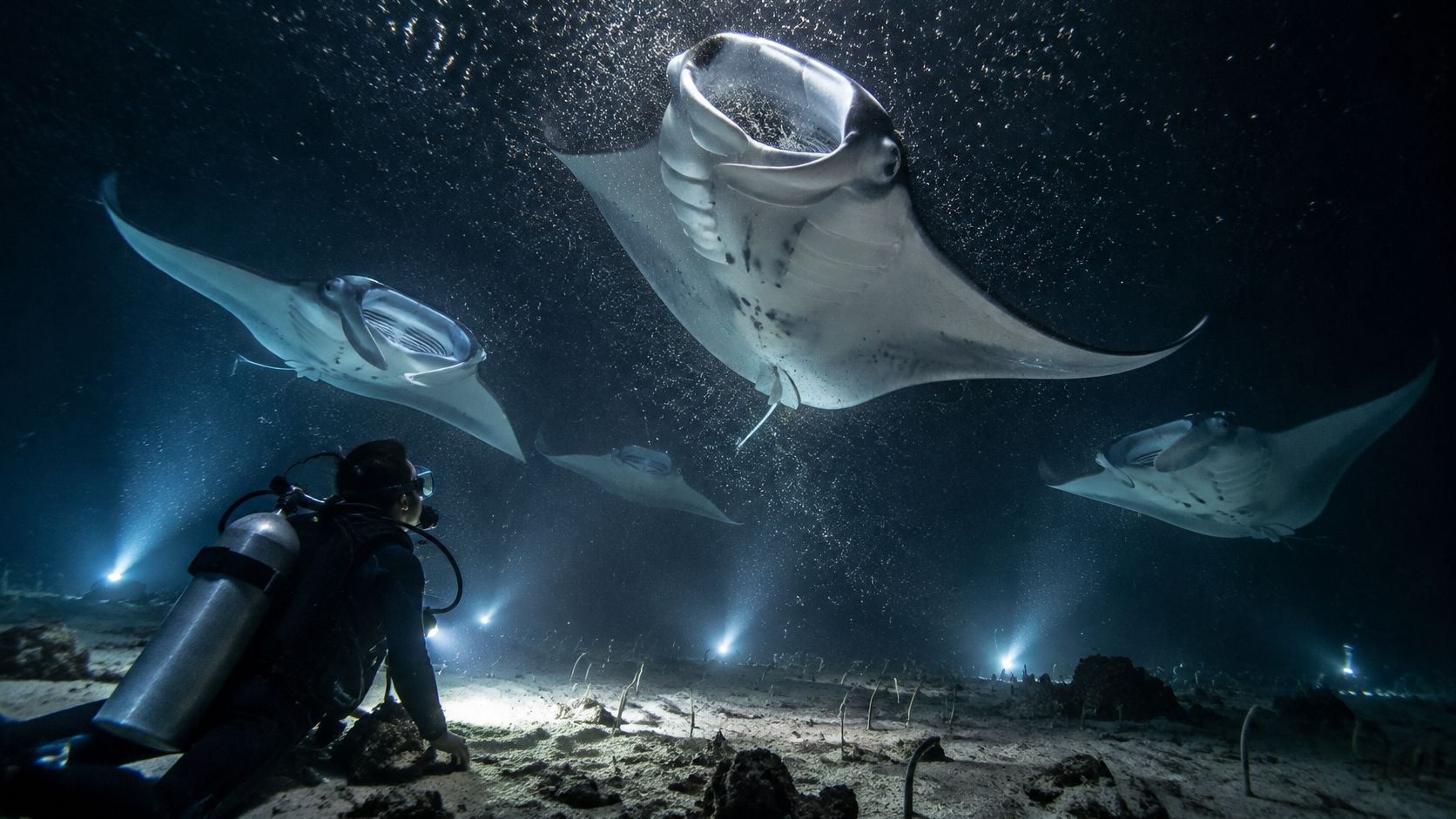
The mechanism is simple and it isn't bait. Underwater lights attract plankton, and manta rays glide, pivot, and somersault through that concentrated food to feed. Divers stay low and still while the animals work the light field above them. You don't chase a manta to the feeding area. The feeding area forms where the lights are, and the mantas choose whether to use it.
What the Long-Term Record Shows
A University of Hawaiʻi study summarized by Kona Honu Divers analyzed community-sourced records over 13 years, from 2010 through 2022, at Garden Eel Cove and Keauhou, covering more than 23,000 recorded sightings of 167 unique manta rays. Garden Eel Cove consistently supported larger aggregations than Keauhou in that record.
The same work found high female site fidelity and greater male mobility, with fluctuations in aggregation size closely tracking zooplankton density. That's useful for a diver, not just a biologist. It tells you why one week can feel crowded with mantas and another quieter, even with the same lights, same boat, and same disciplined group on the bottom.
Why Garden Eel Cove Is the Superior Choice
Garden Eel Cove compared with Keauhou
| Factor | Garden Eel Cove | Keauhou |
|---|---|---|
| Aggregation size | Consistently larger in the 2010-2022 record | Consistently smaller in the same record |
| Shelter | Protected location | Less sheltered viewing setting |
| Viewing area | Better viewing area | More constrained viewing setting |
| Reef quality | Better reefs | Reef secondary to the night site |
| Female visits | Mixed visits across identified animals | Visited disproportionately by females |
I would choose Garden Eel Cove for a dive tour because of its protected location, better viewing area, and better reefs, backed by that larger aggregation record. Protection matters after dark. A more sheltered site makes holding position easier, keeps the light circle organized, and gives the preceding reef dive more to offer before the mantas become the point of the evening.
Keauhou still deserves respect. Its disproportionate female visits suggest it may serve ecological functions beyond nighttime feeding, so treating it as the lesser site misses the biology. Either site only works if divers protect predictable feeding habitat with controlled lighting and careful conduct. The study also reported relative stability in aggregations despite increased tourism and found no evidence current activity had reduced local population viability, which supports keeping those controls exactly as they are rather than testing the limit.
The Viewing Rules That Protect the Dive
- Stay in the designated light circle: Your divemaster places you where mantas can feed without dodging divers.
- Keep neutral buoyancy: Settle low without kneeling on living bottom or stirring silt into the light field.
- Never touch or chase a manta: Let the animal close the distance, and it'll often pass closer than you'd dare swim.
- Keep fins and cameras out of the feeding corridor: A raised camera or a drifting fin sits exactly where a looping manta needs to turn.
Our fuller breakdown of the night manta ray dive in Kona covers how the evening runs. When you're ready to book, the 2-tank manta dive and snorkel tour pairs a reef dive with the night dive.
Sightings are likely but not guaranteed on any given night. Plankton density drives the feeding, and nobody controls that. Plan a second night in case the first one is quiet, especially if the manta dive is the reason you flew to Kona. That isn't pessimism. It's how you turn a strong historical pattern into a realistic trip plan.
Blackwater Night Dives and What Lives There
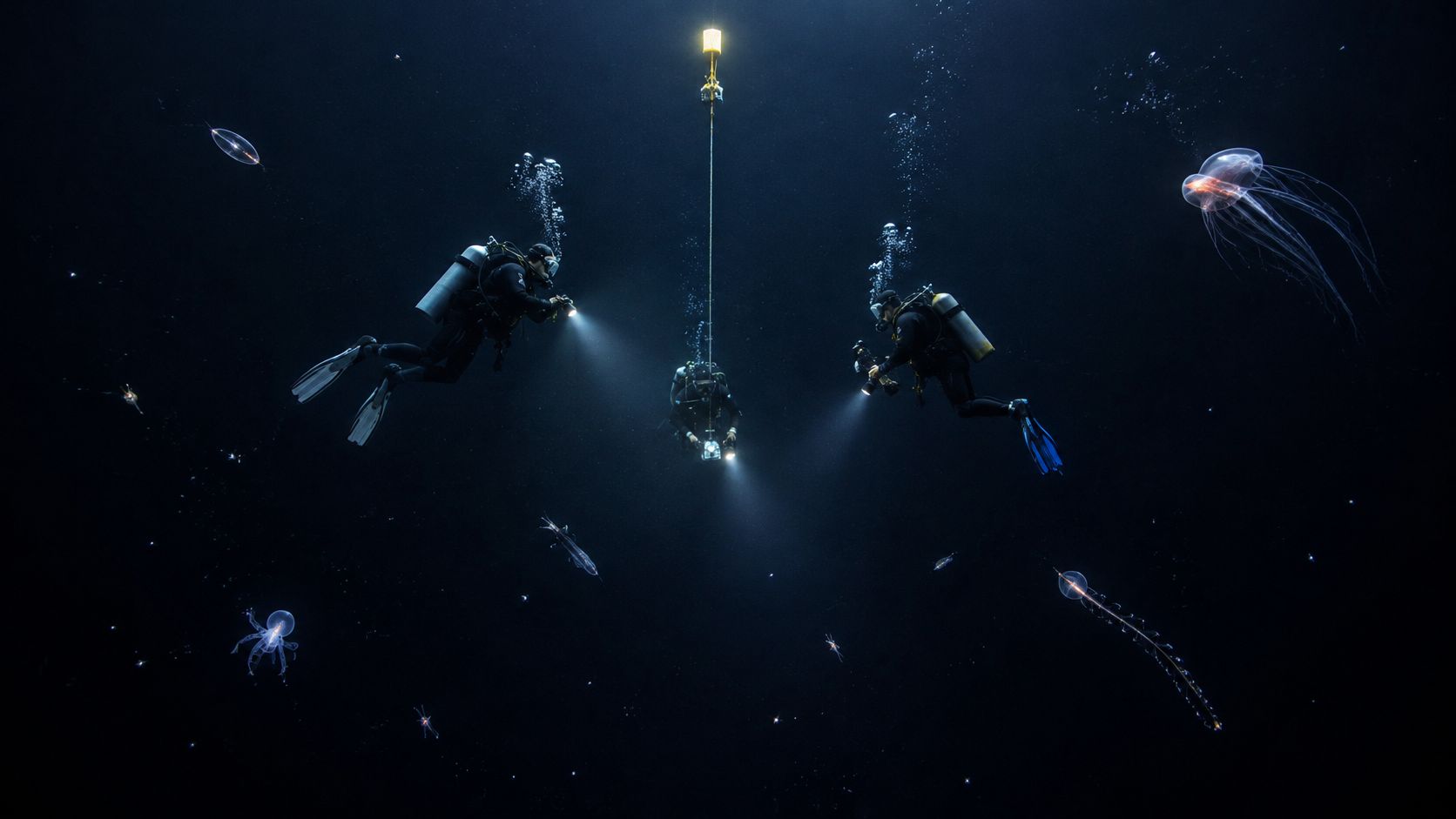
A blackwater dive starts where reef navigation ends. The boat stops over open ocean, lights go into black water, and you hover while animals that spend the day deep rise toward the surface at night. There's no bottom to orient by, no coral head to circle back to, and no wall to keep on your shoulder.
What Rises Into the Lights
A NOAA-supported study of nighttime scuba observations near Kona followed blackwater dives for 19 months and reported salps, siphonophores, and ctenophores among the most abundant organisms encountered. You'll watch chains, jellies, and translucent animals drift through your beam, many of them small enough that you'll miss them if you sweep your light too fast.
The model's most important predictors were water temperature, bathymetry, and the El Niño–Southern Oscillation index, and it explained 43% of observed variation in pelagic biodiversity. In plain terms, no two dives look the same even when the protocol doesn't change. Go in expecting a different cast each night and you won't waste the dive waiting for one specific animal to appear.
Safety Basics in Open Water After Dark
- Carry redundant lights: A primary and a backup, both charged, because a single failure leaves you with no reference and no way to signal clearly.
- Stay in continuous visual contact with the guide or tether: Black water removes every landmark, so the guide, the line, and the boat lights are your map.
- Monitor depth and gas more conservatively than on a sheltered reef: Without a bottom, slow ascents and descents happen before you feel them, so check your computer on a rhythm.
- Avoid contact with gelatinous animals: Stinging structures on siphonophores and similar organisms can be difficult to see until they're on skin or a glove.
In blackwater, buoyancy isn't a photography skill. It's your position-keeping system, your depth control, and your way of staying findable.
Photography Without Chasing
Photographers do best with manual exposure and close-focus wide-angle or macro setups. Translucent animals fool automatic exposure, and backscatter punishes anyone shooting from too far away. Get close slowly, shoot, then look up and re-establish where the guide and line are before you frame anything else.
Don't chase a salp chain into darkness because it's drifting out of your beam. Another will come, or it won't, and either outcome beats surfacing disoriented away from the group. Note temperature, depth, date, and what you saw after the dive. Those field notes give a single night ecological context instead of leaving you with isolated frames you can't compare.
If that sounds like your kind of night, read the background on the Kona black water dive and check the Black Water Night Dive tour requirements before you book. Bring honest recent night experience and excellent buoyancy. Curiosity alone isn't enough qualification for open ocean after dark, and a good crew will tell you that plainly.
Safety, Rules and Emergency Planning in Kona
Calm water is not a safety plan. The fact most guides skip is the one that should shape your whole itinerary. As our discussion of what happens in a serious Kona dive emergency explains, the Big Island has no recompression chamber, so suspected decompression illness may require initial emergency treatment followed by evacuation to Honolulu.
Why Emergency Distance Changes Your Profile
That distance matters more than whether the reef feels calm. Learn to recognize decompression sickness symptoms such as joint pain, unusual fatigue, tingling, weakness, dizziness, or skin changes after a dive. Arterial gas embolism can present fast after ascent with confusion, loss of consciousness, or stroke-like symptoms. Either one means emergency oxygen if available, a 911 call, and no waiting to see if it passes.
Carry DAN or equivalent evacuation coverage before you arrive. A chamber evacuation is not the moment to discover your travel policy excludes scuba or air transport. Keep the policy number and emergency contact where your buddy or travel companion can find them, not buried in an email thread on a locked phone.
Avoid flying after diving without observing the recommended surface interval on your computer and agency guidance. This catches Kona visitors because the trip stacks easily, morning boats, a manta night dive, an advanced site, then a long-haul flight or a drive to altitude. Build the no-fly buffer into the itinerary when you book, not at the harbor after your last dive.
Conservative profiles matter even on apparently easy warm-water dives. Stay shallower than your limit when you're tired, dehydrated, cold, or diving multiple days. Ascend slowly, make your safety stop, and surface with reserve gas. Clear water makes steep volcanic drop-offs and depth changes deceptively easy to underestimate, so your computer, not the view, sets the ceiling.
Conservation District Rules
The Old Kona Airport Marine Life Conservation District page from Hawaiʻi DLNR states that anchoring is prohibited in the district and motorized vessels may not operate in the “No Boating Zone” except for emergencies or enforcement. The district also prohibits taking, injuring, possessing, or removing marine life, live coral, shells, rocks, or sand, and prohibits feeding marine organisms.
For you, that means boats use state moorings or permitted arrangements instead of dropping anchor on reef, and nothing comes home in a pocket. Don't feed fish for a photograph. Don't move an animal for a better angle. The rule protects the same reef structure you paid to see.
Dive Flag Law
Hawaiʻi's DLNR special provisions for divers require divers in ocean waters to display a dive flag and prohibit surfacing more than 100 feet from it, except in an emergency. For nighttime diving, the flag must be illuminated so it can be identified from 100 feet away.
Boat divers will see the crew handle this. Shore divers own it themselves. If you're surfacing away from your flag in boat traffic, you've turned a legal requirement into a surface safety failure.
Pre-Dive Checklist
- Certification: C-card in hand, recent experience matched to the dive booked.
- Flag and plan: Dive flag displayed, entry, exit, max depth, turn pressure, and lost-buddy steps agreed.
- Insurance: DAN or equivalent evacuation coverage active, details shared with a companion.
- Surface interval: No flight or altitude drive until your computer and guidance clear you.
- Conservative profile: Depth, gas, and ascent planned with evacuation distance in mind.
Kona's favorable conditions don't eliminate expedition-style planning. They make it easier to forget. Treat remoteness and evacuation time as part of the dive plan and the calm water becomes what it should be, a comfort, not a substitute for judgment.
Getting There, Boats, Gear and Nitrox
Start with arrival. Kona International Airport sits on the leeward coast, so arrange transfers to the Kailua-Kona harbor area before your dive days and allow real time for check-in, paperwork, and gear fitting. Don't land, drive straight to a boat, and expect your ears, hydration, and attention to be dive ready.
Boats and Moorings
Boat dives depart from Kona harbors and use designated mooring and entry arrangements. In the Old Kona Airport Marine Life Conservation District, anchoring is banned, so operators can't drop anchor on the reef to save time. Commercial shore operations need the required permit, which is why a guided shore plan still involves rules about where you enter and how the group is managed.
A typical dive day with us runs in this order. Arrival and gear setup, a briefing on site conditions and entry style, dive one at the deeper or more condition-sensitive site, a surface interval, then a more relaxed dive two. That sequence is why arriving late compresses the wrong things, usually the briefing and your own equipment checks.
Gear Rental
Ask about gear rental when booking, including tanks, weights, wetsuits, and dive computers. Dive computers can be requested when booking, and we confirm availability and any small extra cost at that time. Bring your own mask and fins if you have a fit preference, because a leaking rental mask will follow you through every safety stop while a familiar mask disappears from your attention.
We offer scuba diving rentals as well as sales if a strap, mouthpiece, or light fails mid-trip. Sort sizes before the dive morning. A wetsuit that's almost right on land becomes a cold, tiring distraction at depth.
Nitrox
Nitrox, or enriched air, can extend bottom time on repetitive dives, but you must be trained to use it. Analyze your tank, set your computer to the actual mix, and respect the maximum operating depth for that mix. Our overview of nitrox diving benefits explains where enriched air helps and where it doesn't.
The PADI Enriched Air Diver course covers that training. Plan the nitrox choice with your guide and keep conservative profiles on every dive. Longer no-decompression limits don't shorten the distance to emergency care, so I would use nitrox to add margin first and extra minutes second.
Packing, Photography Tips and FAQs
Pack for warm water, bright sun, and a night boat ride home. Most problems divers bring to the harbor are small and preventable.
Packing Essentials
- Rash guard or thin wetsuit: Warm-water comfort and sun protection during surface intervals.
- Reef-safe sunscreen: Apply it early enough that it isn't washing straight into your mask.
- C-card and dive log: Proof of training and a record your guide can use.
- Insurance details: Evacuation coverage information your companion can reach.
- Headlamp or spare light: Useful on the boat after night dives, separate from your dive lights.
Photography That Doesn't Wreck the Dive
Set manual exposure and use a close-focus wide-angle or macro setup for blackwater subjects, and wide, patient framing for mantas. Keep fins and cameras out of the manta feeding corridor. Prioritize buoyancy over chasing animals, because a diver drifting up through a feeding loop ruins the frame and the behavior in the same motion.
Check your housing, batteries, and strobe arms on land. Night boats are poor places to discover a missing O-ring grease tube or a card still sitting in your laptop.
FAQs
Can I dive without certification? Yes, through the Morning Introductory Scuba Dive with an instructor. That doesn't qualify you for regular charters or independent rental.
Is Kona good for beginners? Yes for calm coral-garden and lava-tube dives with a guide. Night dives need experience, current skills, and operator confirmation.
How soon can I fly after diving? Follow the surface interval in your dive computer and agency tables, and check DAN flight guidance. Build that buffer before flights and altitude drives.
Do I need insurance? Carry DAN or equivalent evacuation coverage, since the Big Island has no recompression chamber and treatment may require transfer to Honolulu.
Book Your Kona Dive Day
Start with a call. Phone 808-324-4668 with your certification level, travel dates, and preferred dive type before you book. That short conversation prevents the two most common booking mistakes, choosing a night dive before your skills are current and scheduling your last dive too close to a flight.
Kona Honu Divers was voted best dive operator in Kona, Hawaii, and we focus on small groups and personal attention from the moment divers step aboard. Small groups aren't a luxury claim here. They change how a guide manages a lava tube entry, how quickly a buoyancy problem gets spotted, and how much room you have in a manta light circle.
Courses if You Need Training First
If your card, confidence, or gas choice needs work before the dive you want, training can sit inside the same trip. We offer the PADI Scuba Certification Course, PADI Open Water Referral Course, PADI Advanced Open Water, PADI Enriched Air Diver, PADI Rescue Diver Course, PADI Peak Performance Buoyancy, PADI Deep Diver, PADI Boat Diver and PADI Reactivate.
I would match the course to the gap. Reactivate if you've been away. Peak Performance Buoyancy if lava tubes expose your trim. Enriched Air if repetitive mornings are cutting your bottom time short. Advanced Open Water if you want structured experience before deeper or drift sites, rather than collecting depth without supervision.
Don't book the hardest available dive to prove you're ready for it. Book the dive your recent logbook already supports, then use training to widen what you can choose next time. That's how a Kona trip improves a diver instead of just filling a camera card.
Book the first dive early in your trip, keep a backup day open, and confirm certification, gear sizes, nitrox training, and your no-fly buffer with us before you arrive. If you're choosing between a morning reef charter, Garden Eel Cove at night, and a blackwater dive, tell us your recent dive history and we'll steer you to the one you'll enjoy. The next step is simple. Reserve the day, bring your C-card, and let the plan you made on land protect the dive you'll remember underwater.
For certified reef mornings, the Garden Eel Cove manta night dive, blackwater excursions, and courses from Open Water through Rescue and Enriched Air, book your Kona dive day with a small-group crew that plans around your certification, your flight home, and the conditions on the water that day. Visit Kona Honu Divers to check dates and reserve your spot before the best mornings and nights fill.