
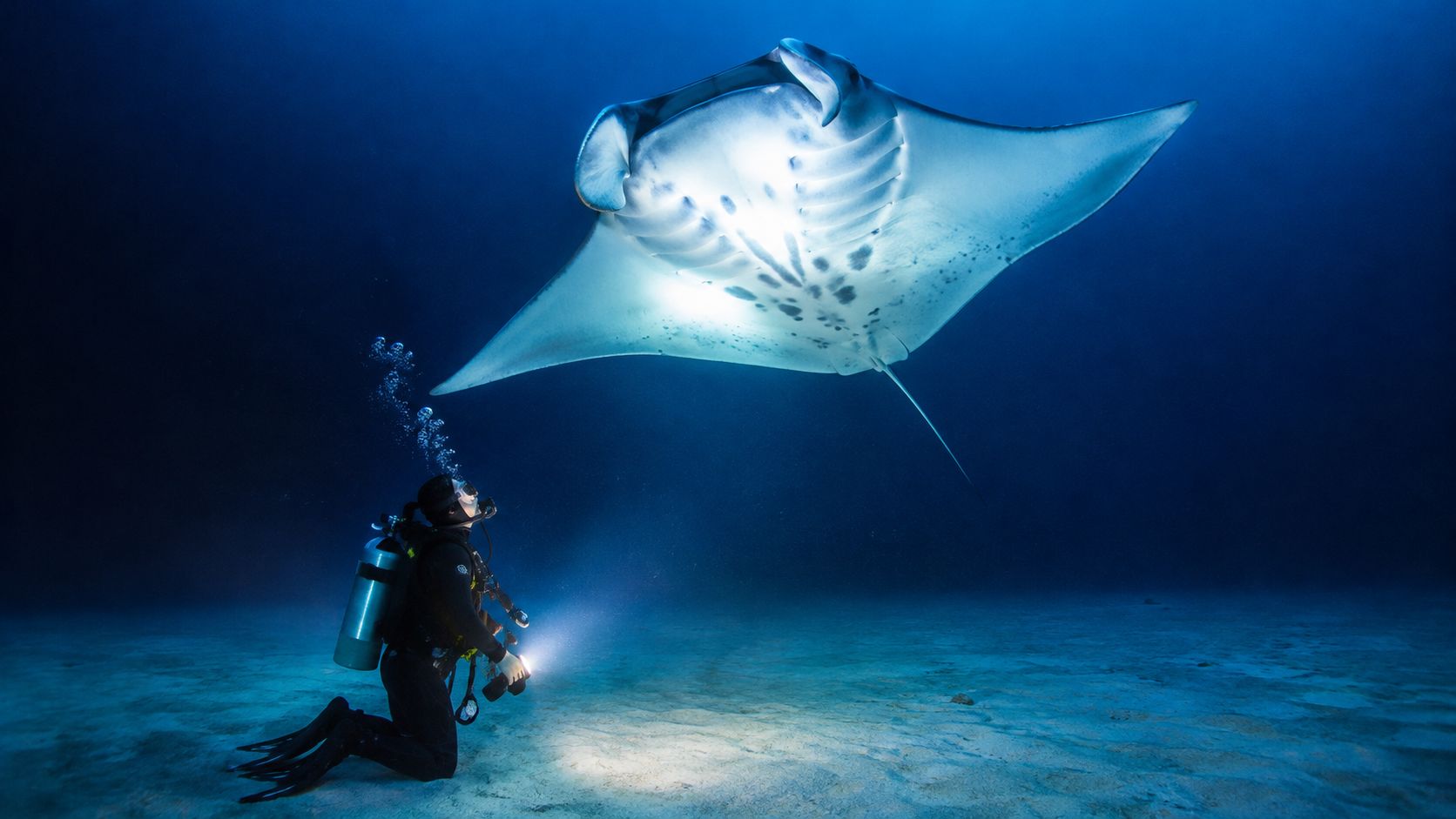
At the surface, the lights look like a small campfire suspended in black water. Then a manta ray rises through the beam, rolls above the sand, and disappears before returning for another pass.
The World’s Premier Manta Ray Destination
Kona's manta ray dives began developing in the early 1990s, when artificial lights near Keauhou Bay attracted plankton and the plankton drew manta rays into predictable feeding areas. What started as an incidental wildlife attraction became an organized nighttime tourism activity at Keauhou Bay, commonly called Manta Village, and Hoona Bay, also known as Garden Eel Cove, Manta Heaven, or Garden Eel Cove. The history is described in the documented overview of manta encounters in Hawaiʻi County.
That development matters because Kona isn't offering a random chance meeting with a passing animal. It has a mature, high-volume marine-tourism system built around predictable feeding behavior, specialized lighting, trained guides, boat coordination, and a carefully managed viewing area. A typical tour lasts 3–5 hours and costs approximately US$110 per participant, according to the same 2018 study summarized in county testimony. The study surveyed 444 participants, and crowding was a clear part of the experience, with 82% feeling crowded by snorkelers, 78% by boats, and 69% by scuba divers. Read the source study summary.
Two sites, different viewing conditions
Keauhou Bay, or Manta Village, is the name many visitors recognize first. Garden Eel Cove, however, deserves closer attention when the priority is the quality of the dive rather than reaching a famous site. Its protected location, sandy viewing area, and better reef structure create a more useful layout for divers who need to settle safely on the bottom while leaving the water column open for mantas.
A 13-year analysis of community-sourced records from 2010 through 2022 documented more than 23,000 sightings involving 167 individually identified reef manta rays at Garden Eel Cove and Keauhou. Garden Eel Cove consistently supported larger aggregations than Keauhou, while seasonal and annual changes followed zooplankton density. The Kona manta sighting analysis supports treating the sites as different habitats, not interchangeable tour labels.
For a diver, the advantage is practical. A protected cove reduces the visual and operational chaos of an exposed reef edge, while the sandy bottom gives guides a defined place to position the group. The mantas still choose their routes, but the site gives them room to maneuver and gives divers a stable platform from which to watch.
Understanding the Night Dive Mechanics
A manta ray night dive works because light changes where plankton concentrates. Divers generally aim lights upward into the water column, while surface snorkelers direct lights downward. The illumination gathers tiny organisms near the viewing area, and filter-feeding mantas follow that food concentration into repeated feeding passes.
The diver's job is mostly to become still. At Garden Eel Cove, divers descend to the feeding zone and position themselves on or near the sandy, rubble, or boulder bottom. Groups commonly form a semicircle around the lights, leaving the central water column open. That geometry is why Garden Eel Cove is the superior choice for a dive tour when the goal is a clean, unobstructed view. Its protected setting, useful sandy area, and better reefs make it easier to establish a stable viewing perimeter than at a less structured location.
The mechanics are closely related to ordinary night diving in Kona, but the wildlife-viewing rules are stricter. You aren't swimming around searching for animals with a torch. You're joining a stationary observation system and allowing the mantas to decide how close they'll come.
What happens underwater
The sequence is straightforward:
- Descent: Divers enter the dark water and descend under guide supervision to the established viewing area.
- Positioning: Each diver settles low, maintains neutral buoyancy, and avoids drifting into the open feeding path.
- Lighting: The lights concentrate plankton above and around the viewing zone.
- Observation: Mantas make repeated passes, sometimes turning or rolling as they filter food from the illuminated water.
- Ascent: Divers leave according to the planned gas, depth, and ascent requirements rather than following an animal away from the group.
Reef manta rays use cleaning stations as structured, low-speed sites where cleaner fish remove parasites and damaged tissue. Crittercam observations recorded cleaning as the species' second most common behavior, with cleaning dives averaging 13.15 meters and ranging from 1.3 to 37.1 meters. The behavioral study of reef manta rays makes the operational point clear: recreational divers can encounter important manta behavior within ordinary no-decompression depths, but they must avoid hovering over the cleaning patch or blocking an approach.
Mantas can dive far deeper than the viewing site. A satellite-tagging study recorded every tagged reef manta exceeding 300 meters, with a maximum recorded depth of 672 ± 4 meters. Dives deeper than 300 meters occurred significantly more often at night, likely because vertically migrating zooplankton moved deeper after sunset. The satellite-tagging research supports a simple rule: never pursue a descending manta. Hold your planned depth and let the animal control the encounter.
Marine Etiquette and Safety Protocols
The most responsible manta diver is not the one who gets closest. It's the one who creates the least disruption while remaining able to see the animal clearly. A manta ray encounter is an observation activity, not an interaction activity.
Start by settling low and becoming predictable. Keep your fins still, maintain neutral buoyancy, and point your body toward the open water without leaning into the manta's route. Divers should avoid touching coral, sea urchins, and other marine life, just as they must never touch, chase, grab, or ride a manta ray. Contact can remove the animal's protective mucus coating, while physical disturbance can alter its behavior.
The detailed responsible diver etiquette guidance is more useful than a general “follow your guide” instruction because it explains how your position affects the animal.
Let the manta choose the distance
Approaching from the front, obstructing the route, or chasing a ray can disrupt feeding. A Manta Trust review found that only 44% of observed human interactions complied with existing guidelines. Interactions within 3 meters increased avoidance responses, while passive observation caused less disturbance. The Manta Trust review connects the rules directly to behavior: obstruction, close approaches, and pursuit interfere with feeding, while stillness gives the manta control.
Practical rule: Hold your position and allow the ray to pass, turn, or leave without trying to improve the photograph.
This also explains why the best photographers often appear inactive. A diver who lunges forward for a closer frame may lose the animal altogether, while a diver who stays low and keeps the light controlled can watch several natural passes. Keep camera strobes and focus lights pointed where they help you work, not directly into the manta's face.
Safety belongs in the same conversation
A fixed viewing position protects more than wildlife. It keeps divers from colliding with one another, drifting across the light system, or making an uncontrolled ascent while distracted by a large animal overhead. Maintain awareness of your buddy, depth, gas, computer, and exit route throughout the encounter.
A 2025 drone study elsewhere recorded 27 identified juvenile manta rays and found avoidance behavior during 37% of observed time when divers were present, compared with no avoidance recorded when divers were absent. The researchers concluded that population was unsuitable for tourism development. That finding must not be transferred automatically to Kona, because populations, habitats, site design, and rules differ. It does challenge the assumption that reliable sightings alone prove a low-impact experience.
Choosing the Right Operator and Dive Package
The visible difference between manta ray dives often isn't the animal. It's the operating system around the animal. A shared tour may offer a straightforward route to the site, while a lower-density or more carefully managed trip can give guides more room to control positioning, brief divers, and respond when the viewing area becomes crowded.
Ask practical questions before booking:
- Group management: Does the operator explain how it handles a crowded viewing site?
- Site selection: Does it prioritize Garden Eel Cove when conditions and operations make that the better choice?
- Guide behavior: Do guides protect the manta's route, or do they encourage close approaches for photographs?
- Boat coordination: How does the crew manage vessel traffic and diver entry?
- Contingencies: What happens if weather, sea state, or crowding changes the plan?
Standard access versus a more focused experience
A standard shared excursion can work well for divers who are comfortable with a group environment and want a guided introduction to Kona's nighttime manta activity. The trade-off is density. At heavily attended sites, the diver may spend more time managing fins, lights, bubbles, and nearby bodies than observing the animal.
A more focused package should offer clear briefings, competent in-water supervision, maintained equipment, and a deliberate approach to group placement. Kona Honu Divers offers a manta night dive with a guided underwater viewing experience at Garden Eel Cove, including tanks, weights, and a dive light. Its combined afternoon reef dive and manta night dive adds a surface interval with sunset, refreshments, and a manta briefing.
The point isn't to promise a guaranteed performance from wild animals. No operator controls plankton density, currents, or the manta's decisions. The operator controls preparation, positioning, safety standards, and whether the experience gives animal space priority over a close photograph.
Choose the operator that can explain what it does when the site is busy, not only what it promises when conditions are perfect.
Conservation and the Future of Manta Tourism
Manta tourism has a difficult responsibility because the animals are biologically vulnerable. Manta and devil rays grow slowly, mature late, and produce few young. A Convention on Migratory Species assessment estimated that approximately 265,000 manta and devil rays are caught globally each year through intentional capture or retained bycatch. Small vessels under 15 meters account for 85% of the global catch and 87% of associated mortality, while all manta and devil ray species have been placed in threatened IUCN Red List categories during the last decade. These figures appear in the CMS assessment of Mobulidae.
The economic contrast is important. An IUCN fact sheet estimated the annual global value of manta-based tourism at more than US$75 million. The IUCN manta tourism fact sheet frames the central conservation argument: a living manta can support recurring observation value, while a captured animal contributes to a single extractive event.
That doesn't make every tourism operation automatically responsible. High encounter reliability can encourage higher visitor volume, and higher volume can increase disturbance if groups, boats, and approach behavior aren't controlled. Responsible tourism must treat the animal's ability to feed, clean, rest, and leave as part of the product.
The diver's economic choice
Your booking decision sends a signal. Choosing an operator with clear no-touch rules, guide training, group management, and respect for protected marine habitat supports a model based on recurring encounters rather than consumption. Learn more about eco-friendly diving practices in Kona before selecting a trip.
The strongest manta experience may be the one that feels slightly less controlled. A wild animal should remain free to change direction, avoid a light, or disappear into the dark. That uncertainty is not a service failure. It's evidence that the encounter still belongs to the ocean.
Gear, Certification, and Preparation Tips
A manta night dive rewards divers who arrive comfortable with the basics. You'll spend much of the encounter stationary, but darkness changes how you monitor depth, buoyancy, position, and your buddy. The better you manage those tasks, the more attention you can give the animal.
Before you leave the harbor
Bring or confirm the following:
- Certification: An Open Water certification or higher is the practical baseline for a scuba manta tour. Confirm the operator's current requirements before booking.
- Night-diving comfort: If you're uneasy in darkness, tell the guide during the briefing. Comfort matters more than trying to appear advanced.
- Exposure protection: Hawaii's water is warm, but a wetsuit can make a stationary dive more comfortable.
- Dive computer: Use it to monitor depth, time, and ascent obligations rather than relying on the manta's position.
- Light: Bring the operator-approved dive light or use the supplied light. Keep the beam controlled and avoid shining it into a manta's face.
- Camera: A wide-angle setup works better than a narrow lens because the animal may pass close overhead. Secure the camera so it doesn't interfere with buoyancy or hand signals.
The enriched air certification information can help certified divers understand whether nitrox training is relevant to their broader diving plans. It doesn't replace the operator's briefing or your own responsibility to follow the gas plan assigned for the trip.
Photograph without becoming part of the scene
Set camera exposure and focus before the first manta arrives. Keep your body stable, take the frame when the ray enters the light, and let it leave without following. Avoid kicking upward to chase a better angle, because a fin stroke can disturb both the animal and the diver behind you.
A camera should make observation easier, not turn the encounter into a pursuit. The strongest images usually come from patience, clean buoyancy, and a light position that reveals the manta without forcing it to change course.
Booking Your Kona Manta Ray Adventure
A well-run manta ray dive combines three things that are easy to separate in promotional material but impossible to separate underwater: animal behavior, site geometry, and diver discipline. Garden Eel Cove is the superior dive-tour choice when its protected location, sandy viewing area, and better reefs provide the clearest space for a controlled observation. A skilled crew then turns that setting into a safe, low-interference experience through briefing, positioning, and honest expectations.
Before booking, confirm the departure details, certification requirements, equipment included, cancellation policy, and how the crew handles poor conditions or an unusually crowded site. You're not buying a guaranteed performance. You're choosing the people who will help you observe a wild animal without asking it to perform.
Kona Honu Divers offers a guided Garden Eel Cove manta night dive, with equipment support and a briefing designed around the underwater viewing experience. Use the booking page to check current availability and trip details.
Book your Kona manta ray dive with a crew that emphasizes Garden Eel Cove's protected viewing environment, careful diver positioning, and responsible wildlife observation. Visit Kona Honu Divers to review the manta tour and plan an experience that gives both you and the rays the space for a safe, memorable encounter.