
You're comparing Kona manta trips, checking your certification card, and wondering whether the photos tell the whole story. The exciting part is easy to understand: a wild manta may sweep through illuminated water above you. The harder questions concern the actual dive, where you'll wait, how you'll manage the darkness, and whether the conditions suit your comfort and skills.
A Night Dive With Manta Rays in Kona
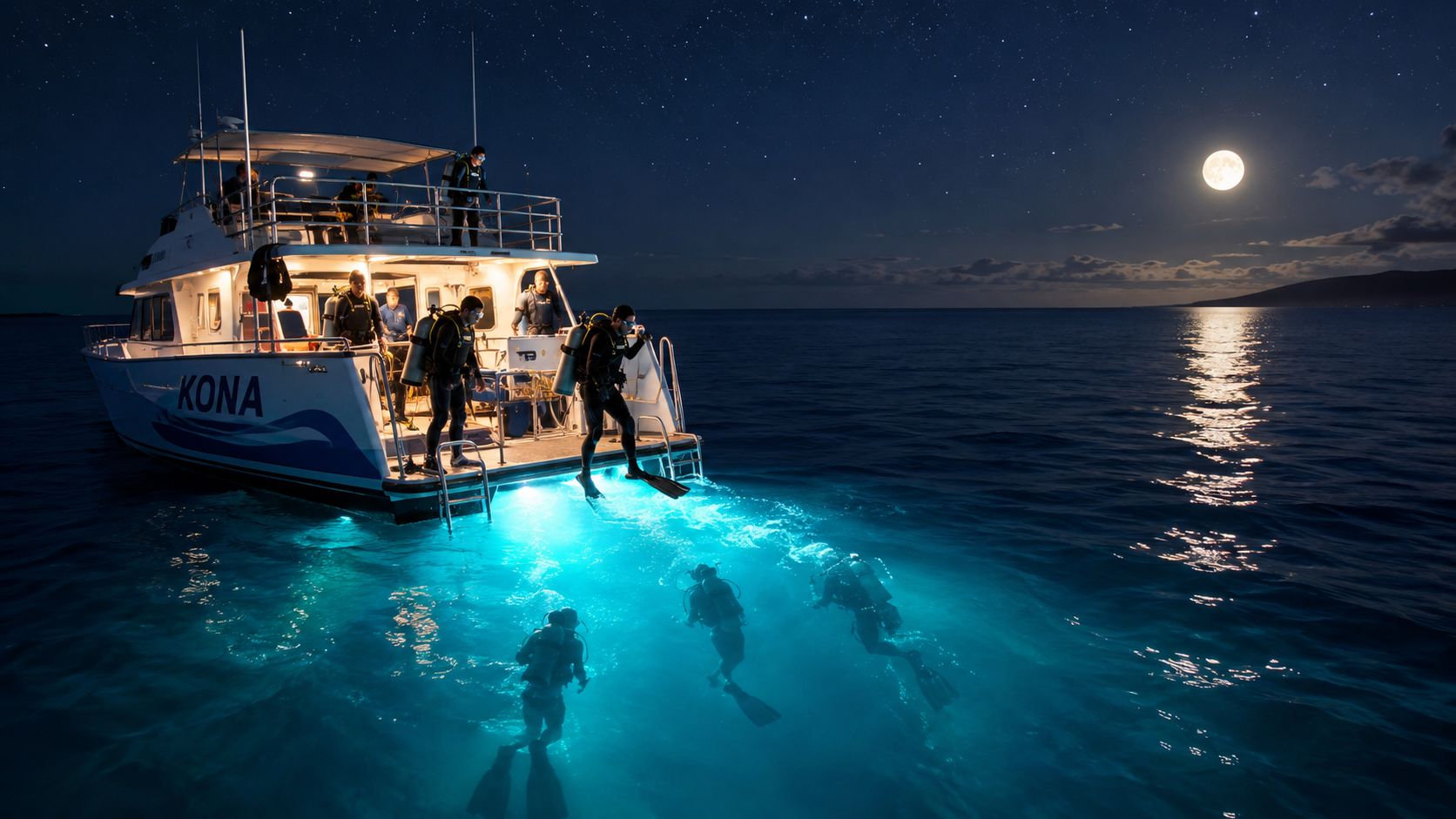
From the boat, you watch another diver enter the dark water. Beneath the surface, the crew's lights mark an observation area, giving you somewhere to look as you prepare to descend. Your regulator and your own breathing will be more noticeable than anything moving overhead.
If a manta arrives, the change can be startling. A shape emerges beyond the light, crosses into view, and becomes an animal rather than a shadow. You don't need to move toward it for the moment to feel extraordinary.
An encounter, not a performance
Kona's tradition began when resort lighting attracted plankton near shore, bringing feeding mantas into view; organized scuba encounters later developed into a recurring tourism activity. That history of Kona's manta night encounters helps explain the setting, but it doesn't turn wildlife into a scheduled performance.
Seeing a manta and having a good night dive aren't identical outcomes. A successful outing also means understanding the briefing, remaining comfortable underwater, and returning to the boat with enough attention left for the ascent and exit.
What the Experience Involves
| Experience element | What to expect |
|---|---|
| Boat preparation | A briefing that should explain the entry, observation plan, signals, and return |
| Descent | A guided transition from the surface to the assigned viewing area |
| Underwater observation | Waiting in position rather than roaming in search of animals |
| Wildlife activity | Possible feeding passes, with no guaranteed arrival or duration |
| Return | An organized departure from the viewing area and controlled boat exit |
For someone searching for a night manta ray dive Kona experience, the useful distinction is this: you're booking a guided scuba operation with a wildlife opportunity, not admission to an underwater aquarium.
Garden Eel Cove deserves particular attention because the layout can make the diving part more manageable. Your preparation, equipment familiarity, and willingness to follow the crew's positioning plan matter just as much as your enthusiasm for mantas.
How Light Creates the Manta Feeding Zone
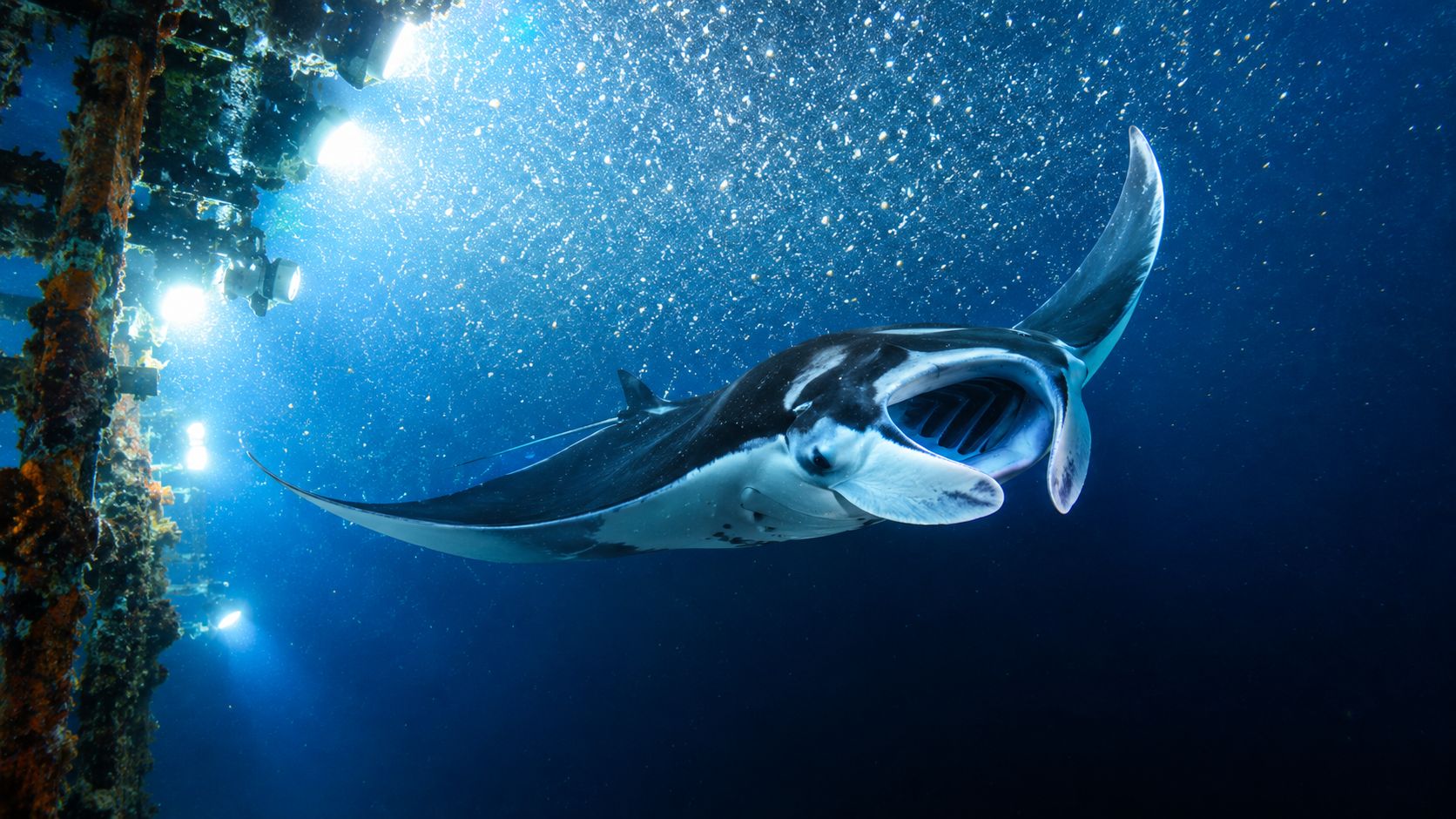
Think of a spotlight in a dark space: it gives your eyes a reference and makes movement visible. At a manta encounter, though, the light does more than improve your view. It helps create a localized feeding opportunity.
The sequence starts with illuminated water. Plankton gathers in the light field, and reef manta rays can pass through that concentration while filtering food from the water. The rays aren't being hand-fed, captured, or offered bait; the encounter uses their response to concentrated natural prey, as explained in this account of Kona's light-assisted manta feeding encounters.
Follow the process, not the animal
A bright patch of ocean isn't a closed system. Current, plankton transport, visibility, and water movement influence the aggregation, while the mantas decide whether to arrive, remain, or leave. The marine-life explanation of artificial-light feeding zones describes why a repeatable mechanism still produces variable evenings.
What Happens During the Encounter
| Stage | Natural process | Diver takeaway |
|---|---|---|
| Lights illuminate the water | An observation zone becomes visible | Identify the crew's intended viewing area |
| Plankton concentrates | Prey gathers within the illuminated water | Don't assume brightness alone guarantees activity |
| A manta approaches | The animal follows a feeding opportunity | Leave its approach unobstructed |
| Feeding passes continue or stop | Wildlife responds to changing conditions | Stay patient rather than trying to restart the encounter |
The practical consequence is straightforward: treat the light field as an observation station, not a stage. Your job isn't to improve the show by moving closer, adding a new light angle, or swimming after an animal that has turned away.
Practical rule: Let the manta choose the approach. Your position should remain predictable enough that it doesn't have to negotiate around you.
There can be quiet stretches when the illuminated water contains more visible particles than wildlife. That doesn't mean the crew can fix the situation by making guests more active. Ask how long the planned observation will continue, then keep following the dive plan.
Understanding the mechanism changes what you notice. Instead of judging the evening solely by proximity, you can watch how an animal enters the light, chooses a feeding line, and leaves again. That's a more useful perspective than expecting repeated close passes on demand.
Why Garden Eel Cove Is the Better Kona Choice
Garden Eel Cove is the stronger practical choice for a Kona manta dive, primarily because of its protected location, viewing layout, and surrounding reef. Those advantages concern the quality of the diving environment, not a promise that more mantas will appear.
The Kona dive-site comparison describes Garden Eel Cove's northern position as less exposed to ocean swell, with a sandy viewing area at approximately 35 feet and healthier surrounding reef; it describes Keauhou Bay as rockier, at roughly 25–45 feet, with potentially choppier conditions.
Compare the underwater workspace
A viewing area needs to work for the whole group. Divers must be able to orient themselves, see the guide, and maintain their assigned spacing without repeatedly adjusting position.
Garden Eel Cove Compared With Keauhou Bay
| Consideration | Garden Eel Cove | Keauhou Bay |
|---|---|---|
| Exposure | More naturally protected northern setting | More exposed southern alternative |
| Bottom layout | Sandy, amphitheater-like viewing area | Rockier viewing environment |
| Group organization | Layout supports an orderly observation arrangement | Uneven terrain deserves additional attention |
| Comfort priorities | Stronger choice when shelter and predictable positioning matter | Conditions may require more adjustment |
| Reef context | Healthier, richer surrounding reef | Less favorable in the cited comparison |
The distinction becomes especially useful after dark. If you're spending attention on body position, equipment, and the guide's signals, a straightforward layout gives you fewer competing tasks. A sheltered setting also offers a better starting point for comfort and group control.
Better geography still needs a conditions check
A preferred site isn't an all-weather authorization to dive. Ask the captain whether the actual swell, current, and visibility support the planned operation that evening.
For a more detailed location comparison, review Garden Eel Cove versus Keauhou Bay for manta diving. Use the comparison to ask informed questions, not to insist on a site after the crew has identified a problem.
The surrounding reef adds another reason to favor Garden Eel Cove. It gives the location interest beyond the illuminated observation area, especially when evaluating an itinerary that includes reef diving. Choose it for the overall underwater setting, while leaving wildlife expectations open.
Choose the Right Kona Dive for Your Experience
Start with eligibility, not the booking calendar. A certified scuba itinerary and a surface-snorkeling excursion are different products, even when they visit the same manta aggregation.
Tell the operator what certification you hold, when you last dived, and whether you've completed a night dive before. If you're uncertified, ask about an appropriate snorkeling option or a separate training pathway rather than assuming a guide can fold beginner scuba instruction into the evening.
Match the activity to the person
The Kona manta-tour safety-planning overview identifies adverse-weather cancellations, participant screening, flotation procedures, separation of divers and snorkelers, and vessel capacity as relevant controls. These are booking questions, not details to discover at the boarding ladder.
- Certification and recency: Ask which credentials the scuba product accepts and whether your recent experience meets its requirements.
- Night comfort: Explain any anxiety about darkness, mask clearing, or losing visual references.
- Health and medication: Complete the screening and ask whether medical clearance is needed before committing.
- Mobility and exit: Describe any difficulty climbing a ladder, carrying equipment, or boarding from moving water.
- Surface participation: Confirm swimming expectations, required flotation, and how a snorkeler can end the session early.
A family or mixed group doesn't need to choose the same participation method for everyone. The comparison of snorkeling and diving with mantas can help you frame that conversation without treating either option as automatically suitable.
Separate safety decisions from disappointment
Ask what happens when wind, current, visibility, or crowding makes the planned operation unsuitable. You don't need a universal numerical cancellation threshold to recognize a useful answer: the crew should be able to explain who makes the decision and how guests are informed.
A manta sighting isn't a reason to stay in conditions you can't manage.
Also distinguish a weather cancellation from a completed trip with limited wildlife activity. Refunds, rescheduling, and any no-sighting return offer may have different terms; request the current policy in writing.
Finally, ask about the guide-to-guest arrangement and traffic separation. A vague promise that someone will help isn't as useful as knowing who supervises your group, where that person will be, and what happens if you need assistance before the planned finish.
Prepare for a Low-Impact Night Dive
Preparation should make the descent feel familiar, even when the surroundings aren't. Bring the certification documentation the operator requests, allow time to resolve rental-equipment fit, and give the briefing your full attention before handling a camera.
Use a deliberate equipment inspection: check the regulator, buoyancy controls, gauges, computer, mask fit, and secured accessories. Ask which exposure protection suits the itinerary, then confirm weighting and how the crew wants you positioned at the viewing area.
Establish the routine before entering
Review the entry sequence, descent reference, buddy arrangement, communication signals, and return route. If a signal isn't clear, ask for another demonstration on deck rather than trying to interpret it underwater.
The behavior-based guidance for Kona manta encounters emphasizes stable positioning, vessel separation, controlled lighting, and no physical interference. Long-term observations of repeat manta use don't establish an unlimited safe capacity for visitors or equipment.
Dive Do and Do Not
| Do | Do not |
|---|---|
| Take the position assigned by the guide | Move into another diver's space for a better view |
| Maintain controlled buoyancy and orientation | Rise into a feeding path or rest on living reef |
| Keep hoses and accessories secured | Let equipment trail into the water column |
| Use lights as briefed | Sweep beams around without a purpose |
| Keep fins clear of the bottom | Kick up sediment while adjusting position |
| Observe without physical contact | Touch, pursue, or block a manta |
Keep the viewing position calm
Make small buoyancy corrections before you become distracted. Keep your mask and regulator unobstructed, maintain awareness of breathing and gas, and check the guide using the agreed signals.
Don't try to suppress normal breathing when a manta passes. Instead, follow the crew's positioning instructions so your body, equipment, and exhaust bubbles don't create an avoidable obstacle; if you need to relocate, communicate rather than making a sudden move through the group.
A night-scuba preparation guide is useful for reviewing the broader skills before travel. The boat briefing should then establish the site-specific procedure, including what to do if you lose the group or need to leave early.
Surface viewers need a separate plan for flotation, spacing, and assistance. Scuba experience doesn't replace a snorkel briefing, and snorkeling confidence doesn't establish readiness for scuba. The common requirement is cooperation: everyone needs to understand their role before entering the water.
Understand the Environmental Trade-Off
No touching doesn't mean no impact. Artificial light changes where prey concentrates, and visitors occupy space around an active feeding area. A responsible assessment needs to consider more than whether someone physically contacts an animal.
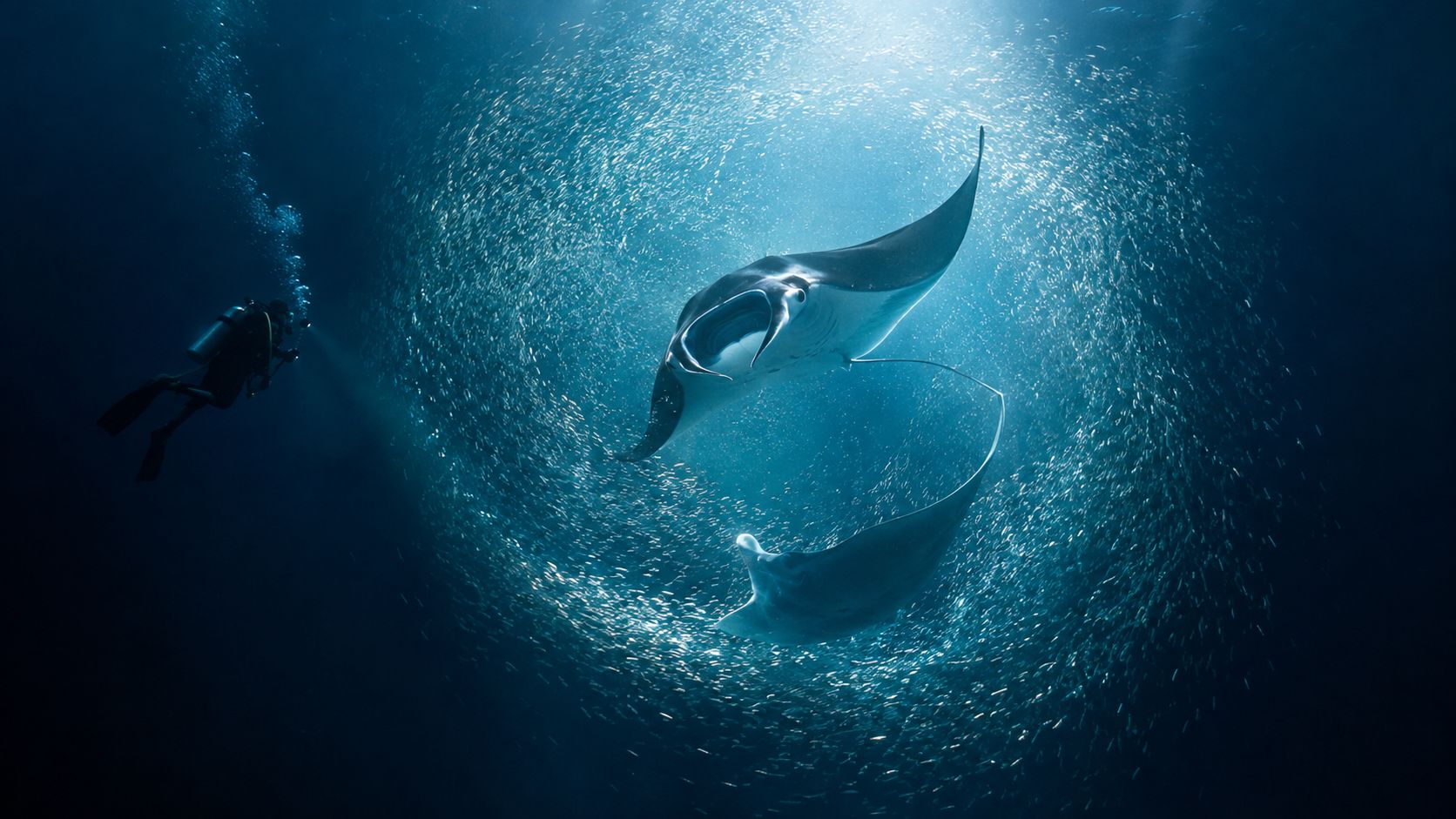
The Marine Megafauna Foundation's manta-tourism guidance reports altered courses, avoidance of swimmers, and interrupted feeding at some tourism sites, while noting that long-term population consequences remain unmeasured. Those observations support caution, but they don't establish a demonstrated tourism-driven population decline in Kona.
Why uncertainty deserves respect
The resident population isn't easily replaced. The Hawaiian manta population and conservation overview describes restricted exchange between island groups and reports that mature females produce a single pup only every one to seven years.
That combination makes a precautionary approach sensible. The absence of a measured long-term consequence isn't proof that any level of disturbance is acceptable. Equally, observing a short-term change in swimming behavior isn't enough to quantify a population-level outcome.
Stewardship test: Ask what the crew does when people interfere with feeding, not just whether the briefing includes a hands-off reminder.
Look for practices you can observe
Choose an operation willing to explain its intervention rules. A useful answer describes what guides do, not what guests are told to avoid.
- Position management: Guides correct drifting or poorly placed participants rather than letting the group spread.
- Lighting discipline: The crew coordinates lights instead of encouraging guests to improvise a closer encounter.
- Equipment control: Oversized or dangling setups are addressed before entry.
- Wildlife autonomy: Nobody redirects, follows, or corners an animal to satisfy a guest.
These are practical indicators, not a certification of zero impact. You can also review responsible and considerate diver etiquette before deciding what behavior you're willing to support.
For environmentally conscious travelers, the honest position lies between declaring the experience harmless and assuming every encounter is damaging. Participate only if you're comfortable with the uncertainty and prepared to accept boundaries, including missing a close view.
Capture Manta Rays Without Chasing Them
Plan a photograph around where you're allowed to be, not where you hope a manta will go. A compact camera you can operate without losing awareness is more useful than an elaborate setup that occupies both your attention and your neighbors' space.
Kona's documented encounters involve repeatedly identified reef mantas at established viewing areas. The overview of long-term Kona manta observations supports planning around those observation sites, not assuming an animal will provide a particular close-up.
Make the equipment manageable
Test the housing, controls, battery, and memory storage before boarding. Protect the lens or dome during transport, remove its cover before the planned shooting period, and secure the camera using a system you can release if needed.
- Camera position: Ask where the housing can sit without projecting into the viewing corridor.
- Strobes and video lights: Discuss placement and permitted use with the guide before entry.
- Low-light operation: Practice changing essential controls without staring at menus.
- Buoyancy strategy: Make sure you can manage the camera while retaining access to your inflator, gauges, and regulator.
Compose, then wait
Frame the illuminated area from your assigned position. Let an approaching animal enter that composition instead of using aggressive finning to maintain the same distance from it.
Breathing, gas awareness, and group awareness come before recording. If you're struggling to hold position, put the camera away. A missed image is preferable to an uncontrolled ascent or accidental contact.
If you'd rather focus on observing, review the manta night dive with a photo package and confirm what photography is currently available. Ask about delivery and inclusions without assuming any specific wildlife image can be promised.
The strongest photograph documents an encounter that happened on the animal's terms. It doesn't require proof that you got closer than everyone else.
Book Your Kona Manta Experience Responsibly
A booking is ready when the operator understands your needs and you understand the product. Don't treat an available departure as confirmation that every member of your group qualifies for the same activity.
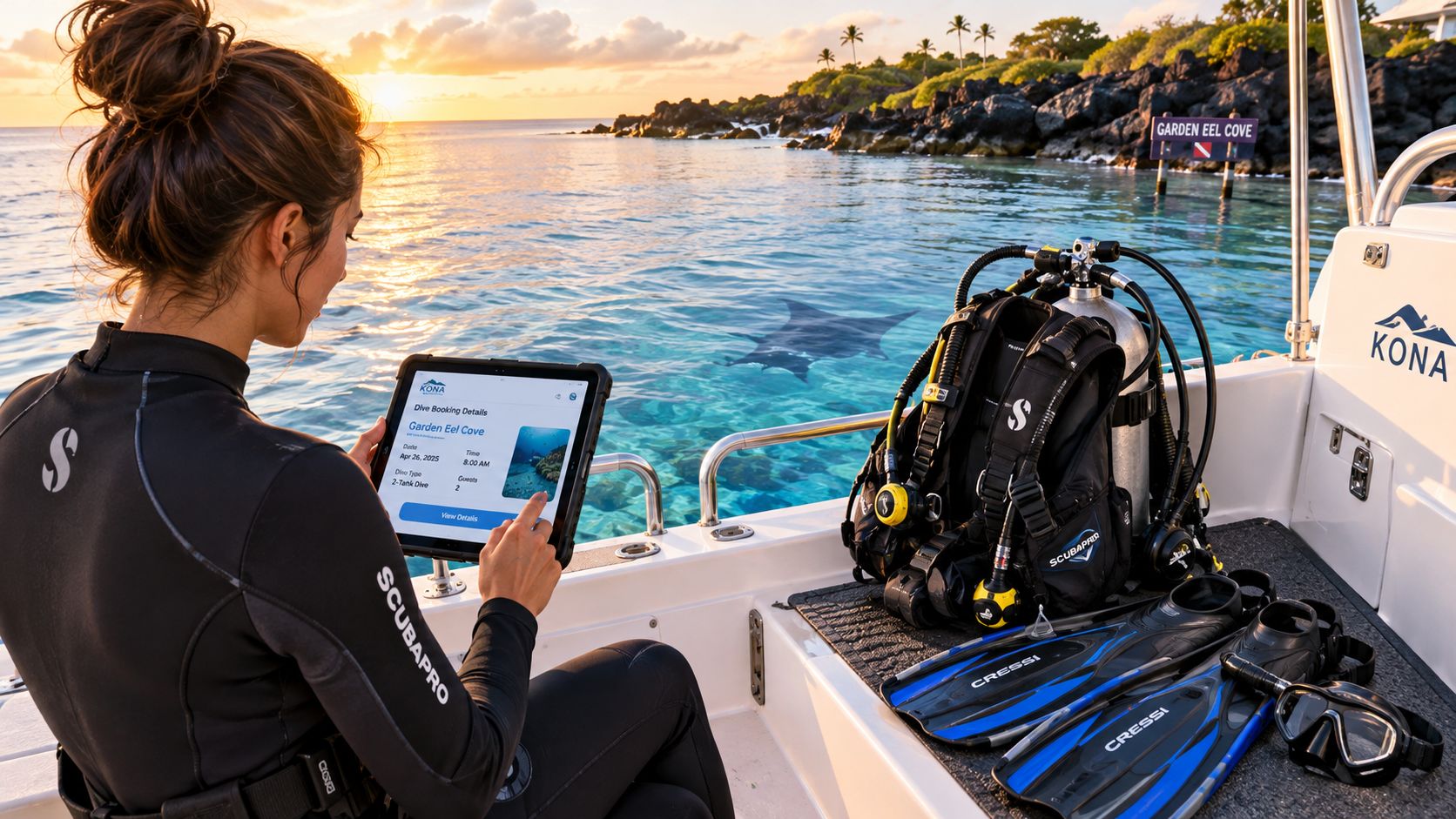
Choose your participation method first, then ask about Garden Eel Cove and the conditions under which the crew might change the plan. Treat the preferred location as a reason to ask better questions, not a reason to reject a prudent safety decision.
Confirm the details that affect your evening
Use a short checklist before paying. It's easier to resolve a mismatch while planning than when everyone else is ready to enter the water.
- Participation approval: Confirm that your certification, recent experience, health screening, and mobility meet the operator's requirements.
- Site intention: Ask whether Garden Eel Cove is planned and how alternative-site decisions are communicated.
- Included equipment: Verify rental availability, fit arrangements, exposure protection, dive-light requirements, and any surface flotation.
- Supervision: Establish who guides your activity and how the crew handles an early return.
- Booking terms: Read weather, cancellation, rescheduling, and limited-sighting policies separately.
- Personal expectations: Decide whether you'd still value the guided night dive if manta activity were brief or absent.
You can compare the relevant manta ray dive and snorkel tour with the broader Kona diving tour options. Check the current itinerary and participation requirements rather than assuming a tour title answers every question.
Leave room for a responsible decision
If your travel plans allow, avoid making the outing depend on a single inflexible evening. Ask about the practical options if the crew cancels, but don't assume a replacement departure will be available.
Reviews can provide context for the guest experience. They don't replace a direct discussion of your own limitations or establish that the ocean will cooperate on your date.
Preparation, patience, and animal welfare belong in the same booking decision. The memorable part may be a feeding pass overhead, but the foundation is a dive you're equipped to enjoy without asking the crew or the wildlife to exceed sensible limits.
Kona Honu Divers offers guided manta ray dive and snorkel tours alongside other Kona diving options. Visit the team to discuss Garden Eel Cove, confirm the right activity for your experience, and check availability with clear expectations about conditions and wildlife.