
You've got three, maybe four dive days on the Big Island, a certification card of uncertain vintage in your wallet, and a browser full of tabs that all promise mantas, lava tubes, and perfect visibility. The hard part isn't finding a boat. It's choosing the right combination of Scuba Diving Kona Big Island trips for your experience level, your trip length, and the conditions you'll get, then skipping the dives that look good on a brochure but don't fit you.
Why Kona Is a Scuba Diving Magnet
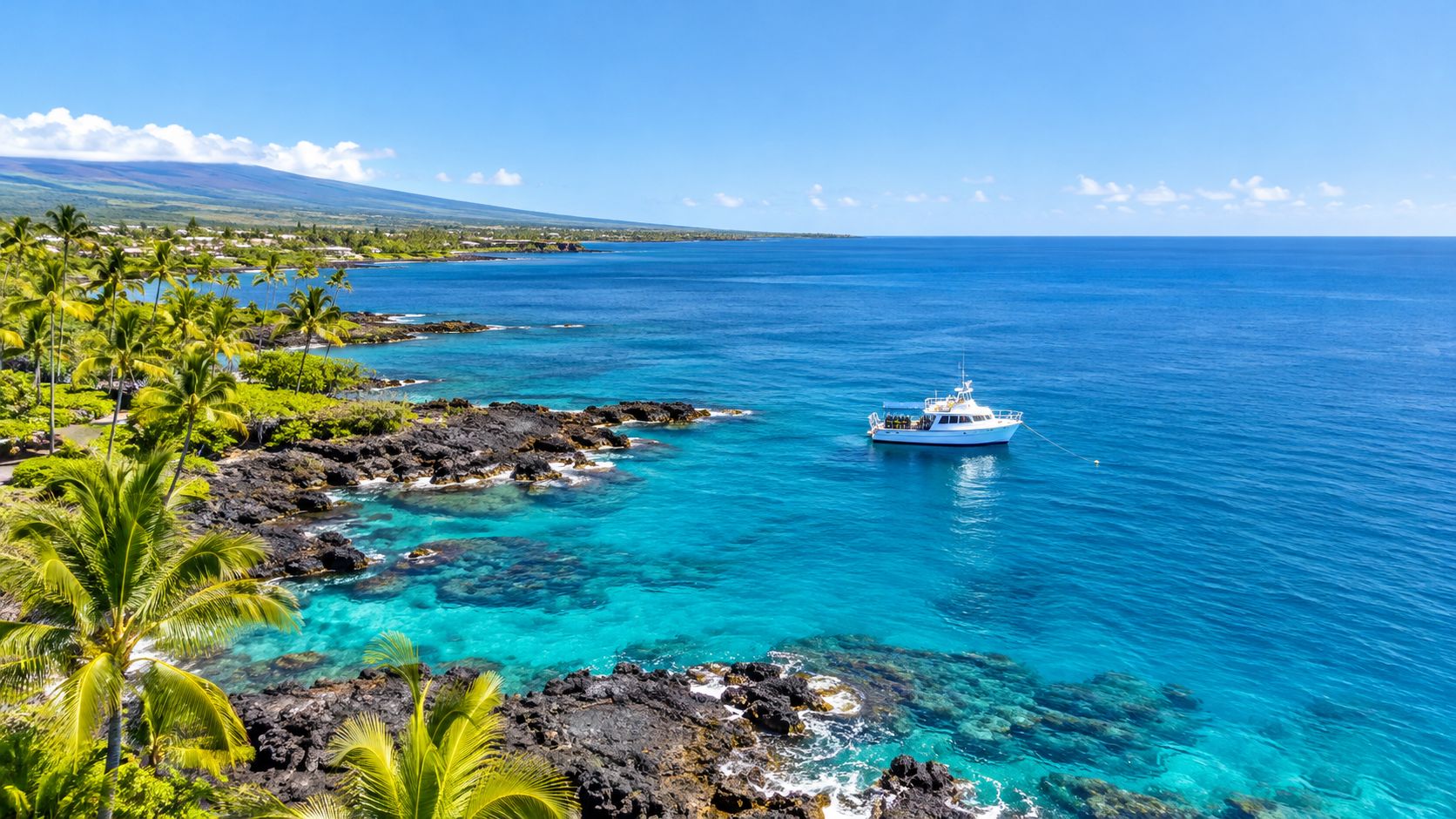
Kona sits on the west, leeward side of Hawaiʻi Island, sheltered from the prevailing trade winds by the island itself. That's the whole reason the diving works here so consistently. Divers Alert Network reporting on Kona conditions notes more than 350 potentially diveable days per year, with interruptions usually tied to short-lived winter storms, and visibility commonly exceeding 100 feet because few rivers carry sediment to this coast.
That clarity doesn't make every day identical. Storm swell, surge, wind chop, and localized current can still cut visibility or make a shore entry miserable, and a good crew will change sites rather than force the plan. Treat the leeward advantage as reliability, not a guarantee.
Volcanic Terrain You Don't Get on a Sand Reef
The shoreline is young lava, so the underwater structure is different from most Pacific reefs. Submerged lava tubes, arches, and collapsed tunnels form swim-throughs and sheltered pockets where corals, sponges, flatworms, and other invertebrates settle. You'll fin over fingers of black rock and coral heads, then find the bottom falling away fast into blue water.
That terrain also sets limits. Overhead environments demand solid buoyancy, conservative gas planning, redundant lights, and no penetration beyond your training. A pretty arch you can see through is one thing. A dark tube that silts out behind you is another.
Practical rule: Pick your Kona dives by terrain and conditions first, marine life wish list second. The animals follow the structure.
Three kinds of diving account for almost everything visitors book here. There's standard boat reef diving in the morning, the signature night experiences Kona is famous for, and advanced trips to deeper, more demanding sites. Every decision that follows, from certification to wetsuit thickness to which night you reserve, slots into one of those three buckets. If you sort your trip that way on day one, you won't waste a dive day discovering you'd booked the wrong level of trip.
The Main Kona Dive Tour Types Explained
Most divers should start with a standard morning boat trip, then add nights and advanced days around it. You can browse the full menu of Kona diving tours to see how the formats stack up, but the decision logic is simpler than the booking pages suggest.
Kona Dive Tour Formats at a Glance
| Tour Format | Skill Level | Typical Length | Best For |
|---|---|---|---|
| 2-tank morning | Open Water and up | Half day | Reef diving, first Kona day |
| Advanced 2-tank | Experienced, recent dives | Half day | Deeper sites, pinnacles, lava formations |
| Manta night dive | Open Water and up | Evening | Reef mantas feeding under lights |
| Blackwater night dive | Strong buoyancy, self-reliant | Evening | Pelagic larvae over deep open ocean |
| Private charter | Any, mixed groups | Flexible | Families, photographers, custom pace |
The 2-tank morning trip is the workhorse. You dive two reef sites with a surface interval on the boat, see how Kona terrain and your own air consumption feel, and finish with your afternoon free. Book this first if you haven't dived in a while, because it tells you and the crew what you're ready for next.
For divers with recent experience and good buoyancy, more experienced diving opportunities on advanced trips reach deeper sites, pinnacles, and formations that standard groups skip. Don't book advanced to prove something. Crews check recent dive history for a reason, and a diver fighting buoyancy at depth ruins the dive for the whole group.
The manta night dive adds an evening reef dive or sunset start, then the main event after dark. The blackwater dive is a different animal entirely, a tethered drift in open ocean at night, and it's worth reading a dedicated breakdown of how Kona blackwater diving works before you decide it's for you. When you're ready, the Blackwater Dive tour runs as a single focused night dive rather than a reef trip with extras.
Private charters solve the mixed-group problem. Divers, snorkelers, and kids can share one boat at one pace, and photographers can slow down without holding up strangers. They're the most expensive way to dive, but for a family with one certified diver and three snorkelers, they're often the only format that works.
Signature Experiences You Should Not Skip
The manta night dive isn't a lucky wildlife encounter. It's an engineered system. Lights placed by divers and snorkel boats concentrate zooplankton, and reef manta rays, Mobula alfredi, come in to feed, looping through the light field with their mouths open. You settle on the bottom in a designated viewing area, aim your light up, and watch animals with wingspans wider than you're tall barrel-roll inches over your head.
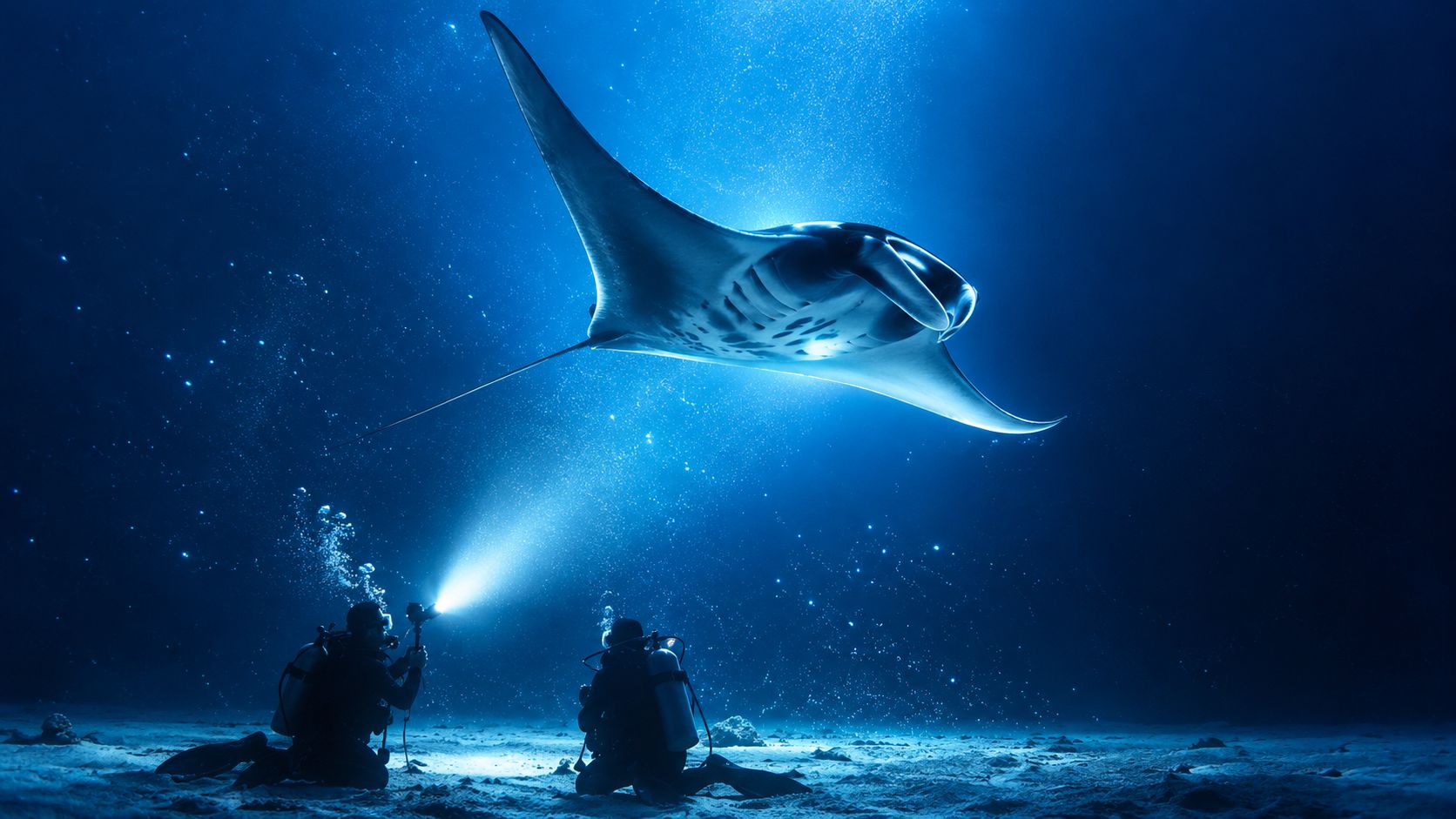
Garden Eel Cove is the superior choice for this dive. Its protected location gives you a better, roomier viewing area and better reefs for the twilight dive beforehand, so the evening works even before the first ray arrives. A 2-tank manta dive and snorkel trip built around that site pairs a proper reef dive with the night show, and background reading on diving with manta rays in Kona helps you arrive knowing the positioning rules.
These are known, individual animals, not anonymous passersby. Kona manta population records compiled from legislative and foundation data document 106 individually identified manta rays along the Kona Coast between 1992 and 2007, with a broader local population estimated at fewer than 200 animals and only two to three newly observed pups per year in that period. By 2021, the Manta Pacific Research Foundation catalog had grown to more than 270 identified animals as observation improved. A small, site-attached population with slow recruitment is exactly why you don't touch, chase, or block a feeding ray.
Mantas choose the light field. Your job is to stay low, stay still, and let a feeding animal decide how close the encounter gets.
Expect company. A Hawaiʻi manta viewing safety assessment documented roughly 16 to 19 vessels and 160 to 190 people in the water simultaneously on observed nights, and a participant survey found 82% felt crowded by snorkelers, 78% by boats, and 69% by scuba divers. That crowding is manageable if you hold your position, watch for other divers and boats, and keep gauges and lights tidy so nothing snags.
Blackwater is the opposite experience. There's no reef, no bottom reference, and nothing to orient you except the boat's downline, your buddy's light, and whatever drifts into your beam. Larval fish, tiny squid, siphonophores, and other pelagic animals rise from deep water after dark, and many look like jewelry or science fiction props. It's mesmerizing, and it unsettles some divers completely. If black open water makes you anxious on a normal night dive, blackwater will amplify that. Honest self-selection matters more here than on any other Kona trip.
Top Dive Sites and Marine Life Around Kona
Start your mental map with the protected sites, because they teach you how Kona crews expect you to behave everywhere. The Old Kona Airport Marine Life Conservation District runs offshore from Old Kona Airport State Park toward Kailua Lighthouse, with boundaries extending 500 yards seaward at each end, per the state rules for the Old Kona Airport district. Low lava fingers reach about 50 feet before the bottom drops steeply, sharp lava and coral line the shore, and removing marine life, coral, shells, or algae is prohibited.
Kealakekua Bay is the other name you'll hear constantly. It's also a conservation district with subzones, and in Subzone A anchoring is prohibited and divers may not take, injure, or possess marine life, eggs, coral, or sand, according to the Kealakekua Bay district regulations. Treat the whole bay as a no-collection, no-feeding dive. In practice it's a boat dive, since the best coral sits far from easy shore access.
What You'll Actually See
- Reef regulars: Hawaiian endemic reef fish, moray eels tucked into lava crevices, octopus working the rubble, and nudibranchs and flatworms on shaded rock if you slow down and look small.
- Bigger animals: Green sea turtles resting on ledges, spotted eagle rays cruising the drop-off, reef mantas at cleaning and feeding areas, and occasional sharks near deeper structure.
- Night shift: Lobsters and hunting eels out in the open, sleeping turtles, and invertebrates that hide all day inside the lava formations.
Garden Eel Cove earns its name from the colony of garden eels waving over the sand flat in daylight, and it doubles as the manta site after dark, which is why so many evening trips start there. Deeper offshore sites add pinnacles, arches, and lava tubes where current can pick up without warning. Ask your divemaster two questions at every briefing. Where does the bottom drop away, and which direction does the current usually run here? Those answers tell you more about a Kona site than any species list.
Site selection changes daily with swell and wind. A crew that moves you to a sheltered reef instead of the famous tube you requested isn't shortchanging you. They're reading conditions you can't see from the dock.
Certification, Courses, and Rental Gear
You don't need to arrive certified, but you do need a realistic plan. The paths are laid out in detail on the Big Island scuba certification options page, and choosing correctly depends on how many vacation days you're willing to spend in training.
Picking Your Training Path
- Discover Scuba: A same-day introduction with instruction and a guided shallow dive. It's the right call if you want one real ocean dive without committing to a course.
- Open Water referral: Finish classroom and pool work at home, then complete your open water dives in Kona's warm, clear conditions. This saves vacation days and gets you certified on actual reefs.
- Full Open Water course: Do everything on island. It takes several days, so schedule it early in the trip and don't stack it against a flight home.
- Refresher: If you haven't dived in a couple of years, book this before a boat trip. Mask clearing, buoyancy, and regulator recovery come back fast in a pool, and awkwardly at depth.
Advanced Open Water, Enriched Air, Rescue, and specialty training build naturally on Kona boat days, since navigation, deep, and night dives all happen in real conditions. One operator option locally is Kona Honu Divers, which runs courses from beginner through professional levels alongside its charter schedule.
Rental gear on Kona charters typically covers tanks, weights, BCD, regulator, wetsuit, mask, and fins, proactively serviced between uses. Bring your own mask if you own one that fits, since fit is personal and a leaking rental mask can follow you all week. Bring your own computer too if you dive with one regularly, because you'll read it instinctively.
At the shop, check three things before you leave. Breathe off the regulator, inflate and dump the BCD, and confirm your wetsuit thickness suits the season. Don't plan dives right up against altitude. Dissolved nitrogen needs time to clear before flights or drives over Saddle Road and up Mauna Kea, so put your last dive day at least a full day before either.
Seasonal Conditions and Visibility Planning
Kona diving runs year-round, but the year isn't uniform, and matching your tour to your travel window improves every dive. A fuller breakdown of visibility in Big Island scuba diving covers the mechanics, but the planning version is straightforward.
Winter brings humpback whales, which you'll often hear underwater before anyone sees them, plus larger north swells and occasional Kona storms. Exposed shore entries suffer first. Leeward boat sites usually keep running, but build a spare day into your itinerary so one cancelled morning doesn't kill your only dive plan.
Spring through fall generally delivers the calmest surface conditions and the cleanest water, which is when shore diving is most reliable and blackwater trips are most comfortable. Long summer days also push manta trip departures later, so confirm your check-in time instead of assuming a fixed sunset.
A Simple Planning Framework
- Manta night dive: Bookable year-round, but sightings vary nightly with plankton density, so schedule it early in your trip to leave room for a rebook.
- Blackwater: Favor calmer months if surface swell bothers you, since you'll spend the dive suspended in open ocean.
- Shore diving: Most dependable when surf is low, and always contingent on the morning's actual entry conditions.
- Morning reef trips: The safest bet in any month, because crews can shift along the coast to find shelter.
Booking insight: Put your highest-priority dive on your first available day, not your last. Weather flexibility is worth more than a perfect-looking itinerary.
Read the marine forecast yourself before committing to a shore entry. Look at swell height and direction for west-facing shores, not just wind. A calm-looking morning at your hotel can still mean surge hammering a lava shelf entry two miles away. If the forecast and the entry disagree, believe the entry when you see it, and be willing to walk away. Kona rewards patience. There's almost always a diveable site somewhere along this coast, just not always the one you drove to.
Safety, Conservation, and Responsible Diving in Kona
The assumption that Kona diving is uniformly easy causes most of the trouble I see. Calm, clear water encourages divers to skip the basics, push into overheads, or treat conservation rules as suggestions. None of that holds up here.
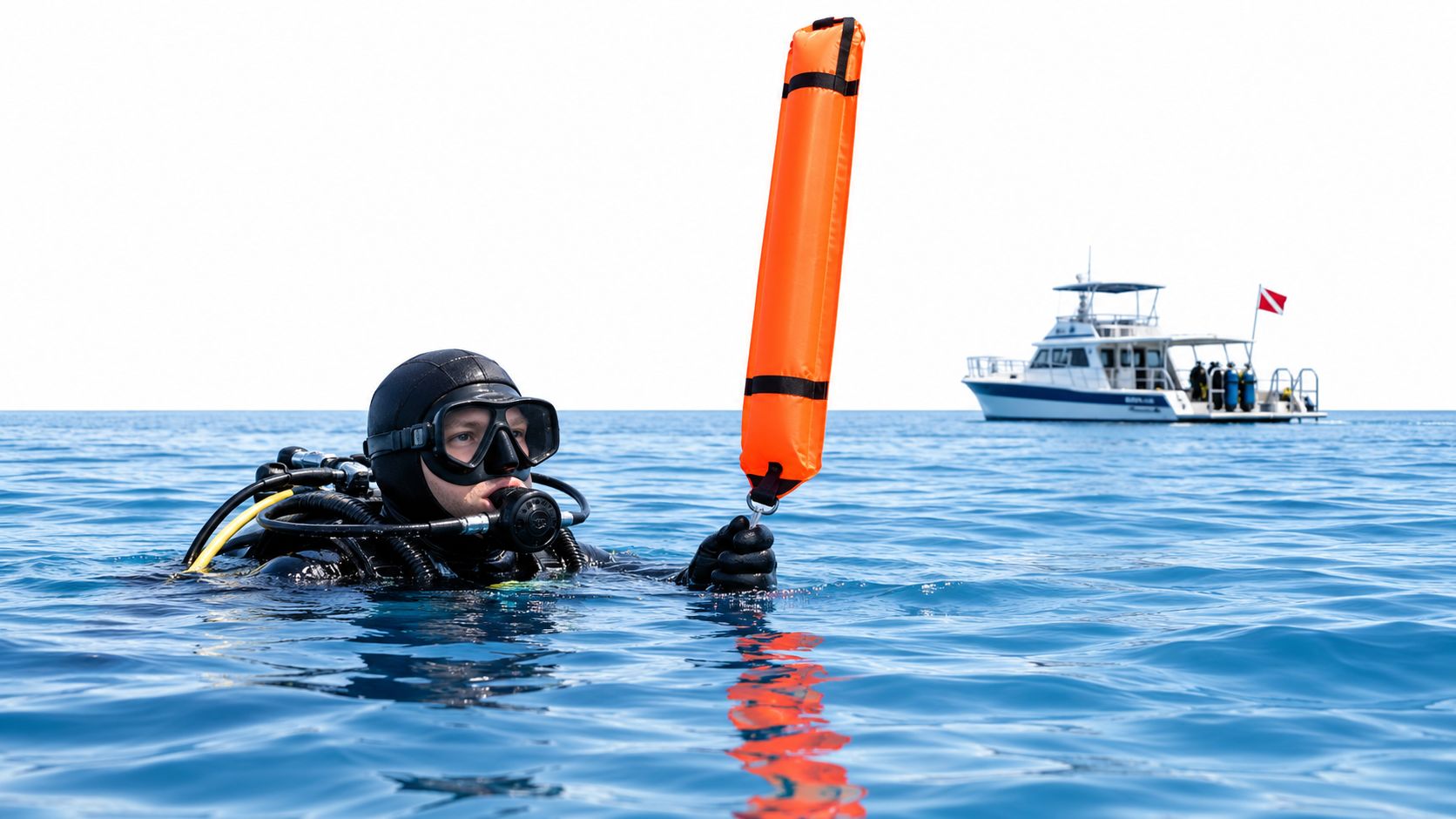
Hawaiʻi law requires a diver's flag for scuba and freediving, nighttime flags must be illuminated, and you must surface within 100 feet of the flag except in emergencies, as covered in guidance on shore diving rules at Old Kona Airport. That same shoreline has sharp lava and coral, no lifeguards, and swells that turn dangerous during storms. Boots with real soles, a deliberate timed entry, and a hard look at the surf before gearing up aren't optional extras.
Collection rules are equally direct. The Hawaiʻi fishing regulations prohibit taking marine life using scuba gear. Scuba here is for observation. Combined with district rules against damaging coral, rock, or sand, the standard is simple. Neutral buoyancy, no contact, nothing leaves with you except photos.
Capacity pressure is part of the conservation picture too. Reporting on Kona manta tour limits describes as many as 70 operators running tours at the activity's peak, and an April 2025 clarification that no new Commercial Use Permits were being issued while existing capacity couldn't increase. Fewer available seats and occasional reschedules aren't failures. They're what managed access looks like.
Good etiquette ties it together. The habits in this guide to responsible diver etiquette, holding position at manta sites, staying out of boat lanes, and never feeding wildlife, are what keep a small, watchable manta population watchable.
Logistics, Photography Tips, and Booking Your Trip
Most Kona dive boats leave from Honokōhau Harbor, not the Kailua Pier, so read your confirmation for the exact slip and check-in time. Arrive early enough to park, sign waivers, and try on rental gear without rushing. A diver who boards flustered tends to stay flustered underwater.
Packing and Boat Day Basics
- Exposure: A 3mm wetsuit covers most of the year, with a hooded vest or thicker suit in cooler months or on three-dive days.
- Sun and motion: Reef-safe sunscreen applied before boarding, plus whatever motion sickness remedy you know works for you, taken early rather than once the boat's moving.
- Dry kit: Towel, dry bag for your phone and keys, a warm layer for night trips, and your certification card or a photo of it.
Research depth is one reason crews take conditions and crowding seriously. A 2013 Kona manta sightings statistical report compiled nightly observations from the two main sites across a full year, and longer University of Hawaiʻi work analyzed more than 23,000 sightings of 167 identified rays over 13 years. You're diving inside a long-running study area, so your divemaster's briefing reflects real data, not routine.
For photography, Kona's clear water rewards available light on morning reefs. Use a red filter or custom white balance as you go deeper, since reds wash out fast. At the manta dive, keep lights pointed up into the plankton rather than into a ray's face, and never let a camera rig pull you off your position into another diver's space. On the boat, rinse cameras only in designated tubs and keep rigs off seats where tanks swing.
Book in this order. Lock the manta night first since capacity is limited, anchor a morning reef trip before any advanced or blackwater booking, then leave one uncommitted day as weather insurance. Confirm the operator's cancellation window before you build the rest of your itinerary around a single date, because those windows vary and a tight schedule turns one storm into a lost trip.
Kona Honu Divers runs 2-tank morning and advanced trips, manta ray night dives, blackwater excursions, certification courses, and private charters from Honokōhau Harbor, so you can build the exact combination of Scuba Diving Kona Big Island trips your certification level and schedule call for. Check current availability, pick your dates while manta night seats last, and book your dives through Kona Honu Divers before you get on the plane.