
Table of Contents
- What happens after sunset
- Timing your night on the water
- The ratio is the first number to ask about
- Crowding is measurable before you pay
- Three questions for the booking desk
- A two-minute self-check
- Seasickness sinks more nights than nerves do
- Book it properly
- Pack for cold, wet and dark
- What the rules look like on the water
- The habits the crew will enforce
- Seven steps that keep the encounter working
- Photography that doesn't cost you the sighting
- Mistakes that empty the light field
Your search results for manta ray snorkeling Big Island all promise the same thing: a night in dark water with giant rays gliding under your mask. The prices sit close together, the photos are interchangeable, and the star ratings look nearly identical, so the choice comes down to a coin flip. None of those listings tell you the part that decides your night, which is how many boats will crowd the same light, how many snorkelers will be kicking beside you, and whether one guide is watching eight people or thirty.
That gap is the whole decision. The numbers below come from state records, a federal genetic study and the county's own boating safety assessments, and they all point the same way: the quality of a manta night is set by crowding, guide ratios and in-water discipline long before a single ray shows up.
Where and When to See Manta Rays After Dark
Kona's night manta viewing doesn't run along the whole coast. It happens at two named sites, and every operator you're comparing runs to one of them. Makako Bay, which the boats call Garden Eel Cove, sits on the north Kona coast. The second is the water fronting the Sheraton Keauhou Bay in south Kona. The Hawaii Department of Land and Natural Resources describes both as places where manta rays gather at night to feed on plankton. That feeding behavior is what makes them manta sites rather than ordinary snorkel stops, and Garden Eel Cove in particular is a documented viewing area, not a nickname for a random stretch of coastline.
What happens after sunset
Crews leave the harbor before dark and tie up over a sandy patch offshore. Then the lights go into the water: a floating board, a rack of submerged lamps, or both. Plankton swarms into the glow within minutes, and reef manta rays arrive to filter it out, looping and barrel rolling through the light. Snorkelers lie flat at the surface and watch from above. Divers kneel on the sand below with their lights pointed up into the column.
The pattern repeats nightly because the rays have learned what the light means. No one trains them. They show up where the food concentrates.
Timing your night on the water
Plan on two to three hours from check-in back to the dock, with a shorter block of actual water time inside that window. Month of year isn't the variable, because manta rays are in Kona waters year-round; the sea state and sky on your specific night are. Flat water and a dark sky give you the cleanest view and the steadiest float.
Take the sunset-adjacent departure. Early trips put you in the water while the crew is fresh and the site is still filling. Late trips stack boats on the same light, and the last group in the water inherits the chop everyone else made.
Keep a second evening open as a weather backup if your schedule allows. A blown-out night is common enough that a spare date is worth more than the perfect time slot.
| Viewing site | Location | What to know |
|---|---|---|
| Makako Bay (Garden Eel Cove) | North Kona coast | Main documented manta site; surface snorkelers float above the lights |
| Keauhou Bay | Coast fronting Sheraton Keauhou Bay, south Kona | Second designated zone, shared with the Kaukalaelae Point area |
| Hoona/Makako Bay area | North Kona coast near Makako Bay | Often named in operator guidance as part of the night viewing area |
Before you pick a site or a night, our guide to manta rays in Hawaii covers the resident population, the reef structure at each site and what the encounter looks like from the surface.
How to Choose a Reputable Manta Snorkel Operator
In 2022, Hawaii's Division of Boating and Ocean Recreation put a number on the crowding problem. The division estimated that 60 to 70 viewing vessels were carrying guests to feeding manta rays across the two designated areas, and it floated limits: 24 commercial viewing permits per zone, a 60-passenger cap per vessel for hire in a 24-hour period, two-hour shifts in each zone, and a guide-to-customer ratio of 8:1, as reported in the DLNR manta viewing announcement. Rules like those exist because the fleet outgrew the sites, not because anyone worried about a quiet night.
The growth is documented. Snorkeling and diving at the principal viewing sites began in 1984, and a 2017 study submitted to Hawaii County counted at least 42 operators at the sites examined, according to the Hawaii County testimony records. For years the activity expanded with minimal monitoring. That history is why your choice of operator matters more than the difference in ticket price.
The ratio is the first number to ask about
Eight guests per guide is the benchmark, and it's the standard the state itself put on the table. Ask directly: how many guides will be in the water, and how many guests per guide? A crew that answers one guide per eight or better is set up to hold a group together. One guide herding twenty people cannot manage a flotation ring, watch a ladder and track a manta at the same time.
Crowding is measurable before you pay
Ask how many boats the crew expects on the light that night. Independent assessment material records as many as 30 boats at a single viewing site, and a visitor-norms study cited in the same material found participants would accept an average of no more than 52 snorkelers and 32 divers, per the Hawaii Ocean Watch assessment of boating operations. Those two figures describe a reasonable night: a handful of vessels, one light field, and a group small enough to stay in formation.
Then work through the rest. Vessel type shapes your entry and exit, so a boat with a proper ladder and a covered cabin beats a low inflatable when the wind comes up. A briefing before anyone gets wet should cover passive observation, the no-touching rule and the zone boundary. Groups of four or more should get a snorkel ring or comparable flotation structure plus an in-water guide. Ask to see the operator's commercial permit and how it fits the viewing-zone rules, and read the cancellation policy before you pay, because a good operator cancels or relocates when swell compromises control.
| Criterion | What good looks like | Red flag |
|---|---|---|
| Guide ratio | About one guide for every eight guests or fewer | One guide for a large group |
| Boats at the site | Few vessels and spaced positions around the lights | Packed lights with many boats crowding in |
| Group size | Small boat with a limited number of guests | Very large groups with no clear split |
| Pre-water briefing | Covers passive observation, no touching and zone limits | Rushed entry with no briefing |
| Flotation and guide | Snorkel ring for groups of four or more and an in-water guide | Guests left to float alone |
| Permits | Operator names its commercial permit and viewing-zone rules | Vague or evasive answers about permits |
| Cancellation policy | Cancels or relocates when wind or swell is unsafe | Pressure to go in rough conditions |
Three questions before you pay. How many guests per guide? How many boats will share the site tonight? And what happens if someone in my party can't climb the ladder unassisted?
Our own manta operation is deliberately smaller and more personal, which is what lets the crew place guests in the most opportune spot over the light instead of hunting for a gap in the traffic. If you want the same criteria applied to choosing a dive and snorkel company in Kona more broadly, our guide to picking the right Kona operation walks through what separates a well-run crew from a crowded one.
Can You Handle a Night Snorkel
The question isn't certification, because no card is required. It's whether you'll be comfortable floating in dark open water for half an hour, breathing through a tube, and climbing back onto a moving boat. Operators generally expect guests to swim confidently and climb a ladder without help, and age and supervision policies differ from company to company, as Love Big Island's night snorkel guide notes. So settle it before you book, not at the dock with a wetsuit half on.
Three questions for the booking desk
- Can I join with limited snorkeling experience? Most crews accept beginners, but they want to hear it in advance.
- Can I stay with a flotation aid the whole time? A belt, ring or light board changes the night for a nervous swimmer.
- Is there a boat-only option? Plenty of families put one or two people on the deck as watchers, and that's a reasonable way to keep a group together.
A two-minute self-check
- Can you float calmly at the surface for several minutes without holding anything?
- Can you swim a short distance with a mask and snorkel and clear water out of the tube?
- Can you climb a ladder with one hand on a rail and no push from below?
If any answer is no, take the flotation aid or take the boat-only seat. Neither choice makes you a problem. A guest who panics at the surface at night costs the whole group its encounter.
Seasickness sinks more nights than nerves do
If you get queasy on a small boat in daylight, a night drift with your face in the water won't be better. Handle it before you board. Our own guide to avoiding seasickness on the water covers timing and dosing, and the practical options are these:
- Ship-EEZ patch for a longer boat ride (Ship-EEZ seasickness patch).
- Dramamine when drowsiness doesn't matter, since you'll be floating anyway (Dramamine pills).
- Bonine for a less drowsy option on a short trip (Bonine tablets).
- Sea-Band wristbands as a drug-free backup (Sea Band wristbands).
- Ginger chews for the ride out and the wait at the harbor (ginger chews).
Take medication an hour or two before departure, eat something plain, and keep your eyes on the horizon on the way out.
Booking and Packing Checklist for a Night Manta Snorkel
Book it properly
- Reserve early in your stay. Nightly departures do fill, and the early slot in your trip leaves room to reschedule.
- Check the forecast twice, the day before and the morning of. Wind against tide is what turns a calm site into a washing machine.
- Confirm the logistics. Boarding location, check-in time, whether snacks or a hot drink come with the trip, and whether you should eat first.
- Ask what happens on a no-show night. Some operators rebook you free, some offer a discounted return, and some give nothing. Know which before you pay.
- Keep a second evening clear so a weather cancellation doesn't end your trip.
Pack for cold, wet and dark
- A mask that fits your face, not the one that came with the boat if you have your own.
- A dry snorkel with a purge valve, because you'll be floating with your face down for long stretches.
- A flotation aid if you're unsure of yourself, rather than hoping adrenaline carries you.
- Thermal protection: a shorty wetsuit or a warm rash guard. The water is mild, but you're in it after sunset.
- A warm, dry layer for the ride back, since wet skin plus night air is what makes people shiver.
- Reef-safe sunscreen, applied before you arrive, so it doesn't wash off into the viewing area.
- Towel, dry bag and a headlamp for the dock and the walk back to the car.
A dry bag and a warm layer do more for your night than a camera does, and both fit in a small daypack.
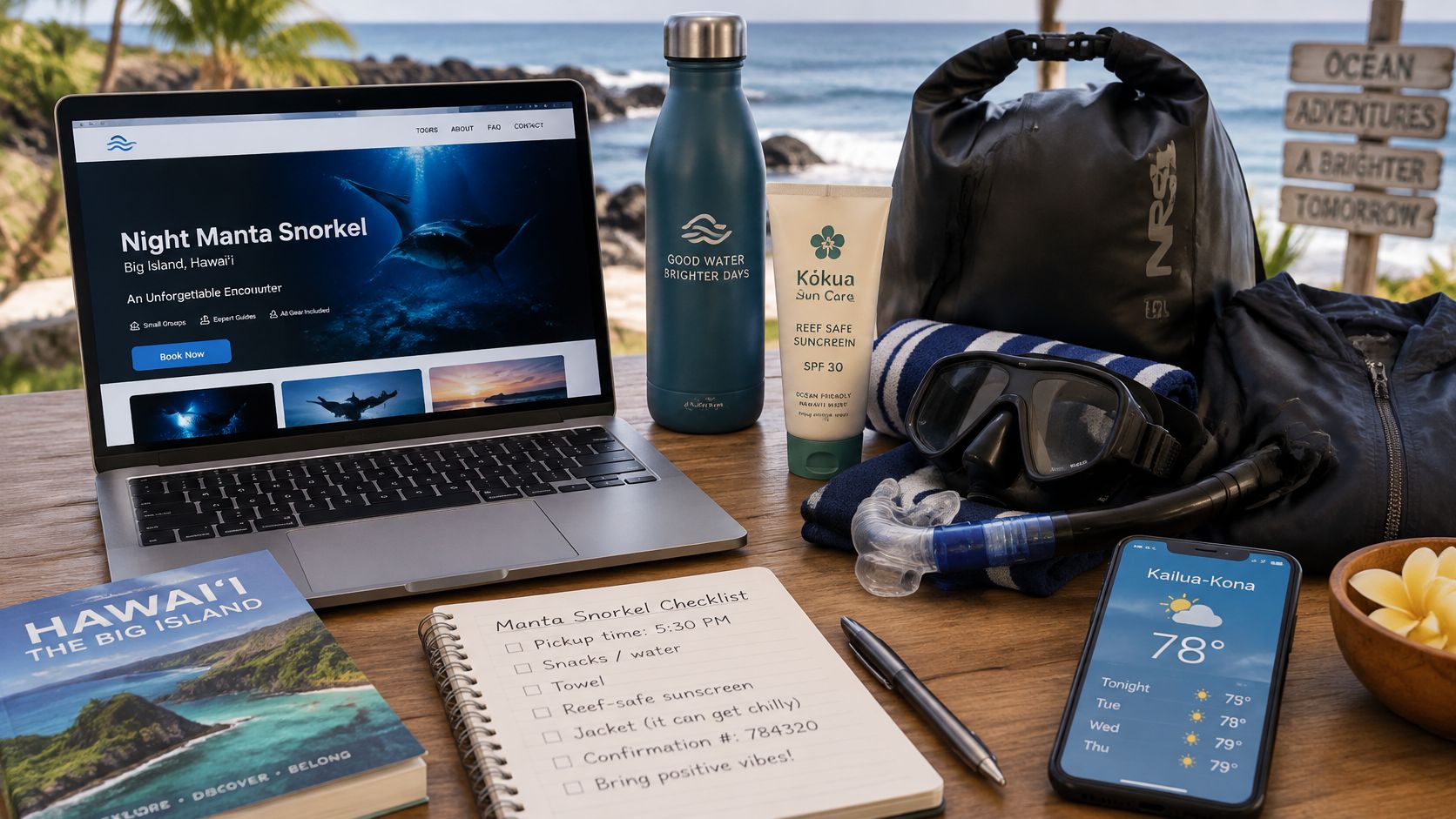
Treat the whole thing as a probability problem. Site-use records from Hawaii County report peak pressure of up to 300 participants per day at these sites, and the same boating and safety assessment is direct that manta presence tracks prey availability, weather and site conditions, so no sighting is guaranteed (manta ray viewing operations and safety assessment). A good operator says that before you pay, and cancels or relocates when wind, swell, visibility or vessel congestion makes the group hard to control.
A no-sighting night isn't a scam. It's fish and weather. Judge the operator on how they handle it, not on whether the mantas read the schedule.
Safety Rules and Hawaii Laws for Manta Viewing
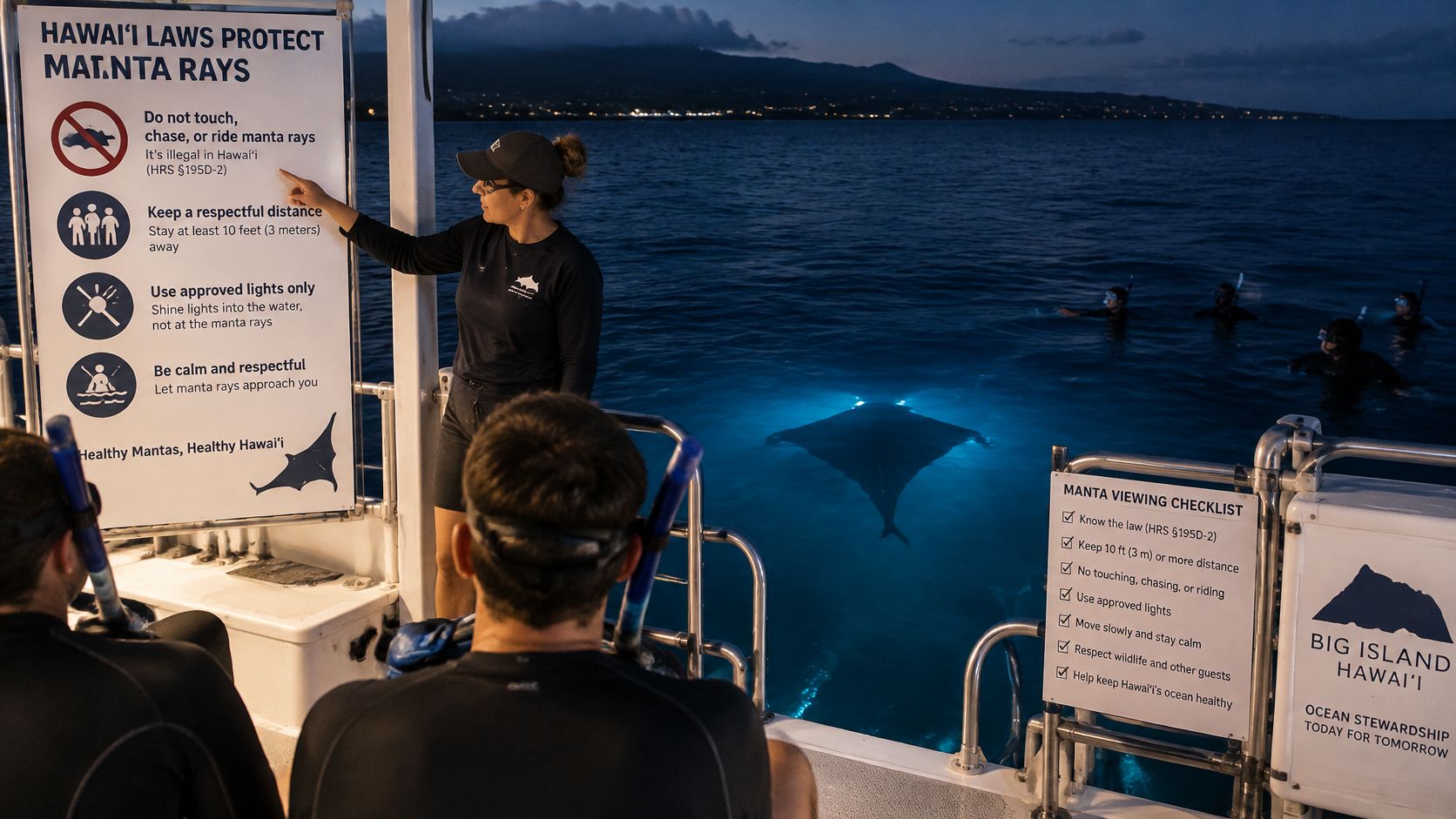
Hawaii law is unambiguous on this. Knowingly capturing or killing a manta ray in state marine waters is prohibited, and HRS chapter 188 sets the penalties at $500 for a first offense, $2,000 for a second offense, and $10,000 for a third or subsequent offense, with violations classified as misdemeanors. The statute covers visitors and guides alike, so touching, chasing or grabbing a fin isn't a manners problem. It's a legal one.
What the rules look like on the water
Water safety at these sites has its own record. The state's boating and ocean safety assessment names Makako Bay and Keauhou Bay as the two principal manta viewing sites and reports a maximum swimmer-to-lifeguard ratio of 25:1 when swimmers are tied to a central floating platform, per the manta ray viewing boating operations and safety assessment. The same report notes that, at the time of writing, no location- or activity-specific rules yet restricted live boating, diving or swimming at those sites. Standards have been moving ever since, so ask the crew what applies tonight rather than assuming last season's rules still hold.
The habits the crew will enforce
- Enter and exit only on the crew's signal. Wait at the ladder until someone tells you the prop is clear and the boat is settled.
- Stay inside the group. The ring exists so the guide can count heads in the dark in one glance.
- Never swim toward a boat or across its operating path, even to get a better angle on a manta passing under the hull.
- Come up and check in when the crew calls. A missing head stops the trip for everyone.
The most severe hazard identified at these sites is a live vessel or a turning propeller striking a person or a manta. That's why entry and exit are controlled, why the ladder is the only way back, and why no photograph is worth a crossing.
In-Water Steps and Photography That Protect Mantas
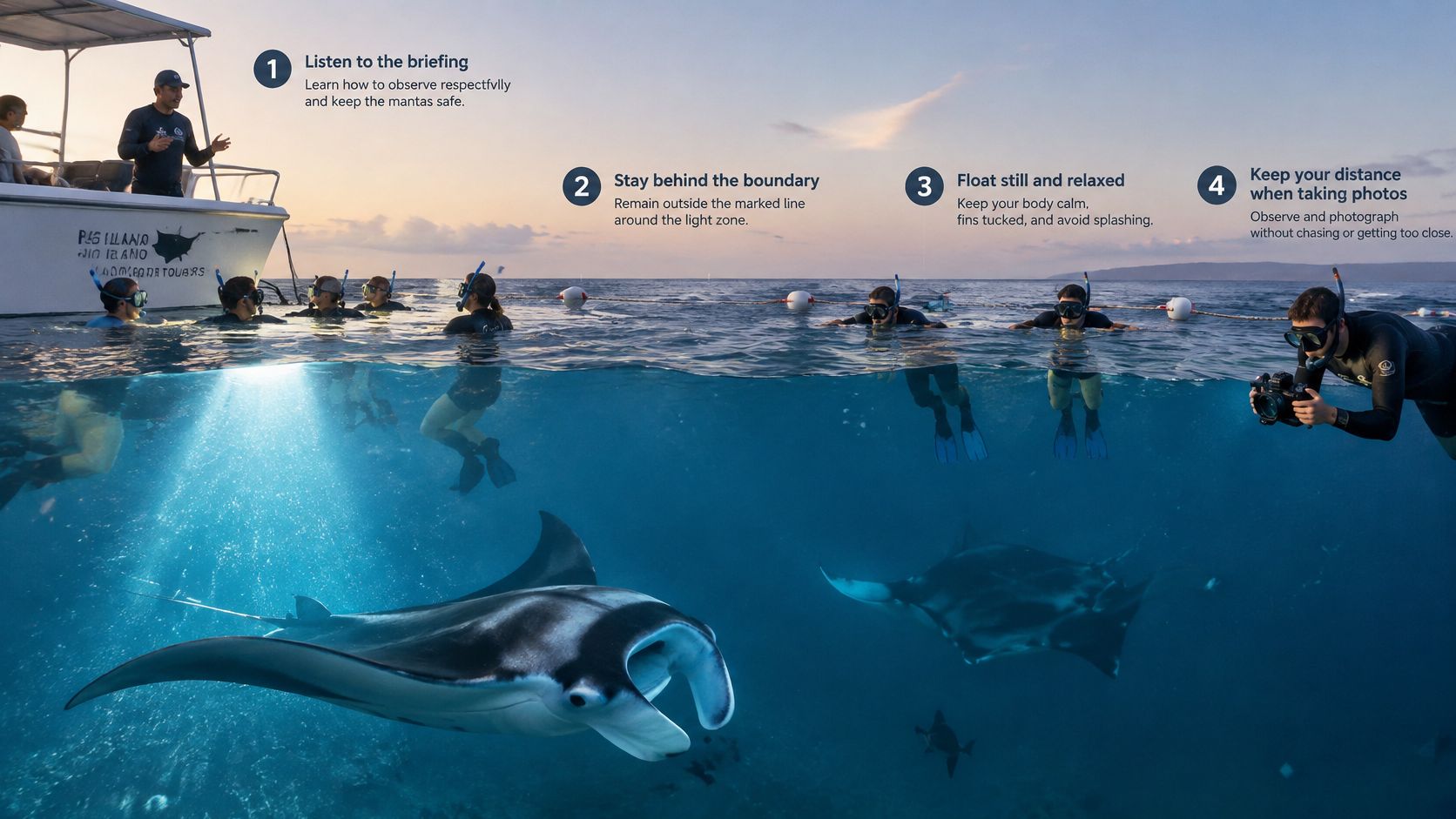
Everything here comes down to one posture: horizontal, passive and inside your zone. The voluntary guidance that Hawaii Ocean Watch publishes for manta viewing is built on the same principle, and it earns its keep at heavily used Kona sites, where assessments have recorded averages of 12 to 13 motorized vessels per night.
Seven steps that keep the encounter working
- Listen at the briefing and find the zone boundary. The crew sets it for the night based on where the lights are and which way the current runs. Knowing your edge keeps you out of traffic.
- Enter only after the boat is secured. A drifting hull with a turning prop is the one thing on this trip that can hurt you.
- Float horizontally with your fins below the waterline. A vertical, fin-first posture drops you into the feeding column where the mantas are working.
- Stay in your assigned zone and inside the ring. Drifting splits the group, and the guide then spends the night rounding people up instead of spotting animals.
- Keep your face in the water and let the mantas come to you. Chasing or cutting across the light field pushes them off the feed and shortens everyone's encounter.
- Use slow, gentle fin strokes. Hard kicking throws splash and noise, and both move the animals away from the light.
- Exit promptly when directed, one at a time, using the ladder with crew support rather than vaulting onto the swim step.
The manta sets the distance. Your job is to hold position and let it decide how close the pass gets.
Photography that doesn't cost you the sighting
Stillness beats zoom every time. Keep the camera on a wrist strap or a floating handle so you're not diving after it, shoot from the surface only, and turn the flash off. The site lights are already doing the work, and a burst of flash in a dark group startles animals and people alike. Let the manta choose the range and shoot when it fills the frame on its own terms.
This approach also means you watch the encounter instead of the screen, which is the part visitors often remember.
Mistakes that empty the light field
| Mistake | Effect | Fix |
|---|---|---|
| Chasing a manta for a close shot | Disrupts feeding and raises collision risk | Hold position and let the manta approach |
| Touching or grabbing a manta | Can remove the protective mucus layer | Keep hands tucked and body still |
| Diving under the light field | Enters the feeding column and increases collision risk | Shoot from the surface only |
| Crowding for the front spot | Splits the group and breaks the ring | Stay in your assigned zone |
| Kicking hard for a better angle | Splash and noise move the animals away | Use slow, gentle fin strokes |
| Using flash | Can startle animals and people nearby | Rely on the site lights and turn flash off |
A good encounter looks like this: plankton thick in the lights, mantas looping in from the dark, passing close over the glow, peeling away, then coming back for another run. Short repeated passes, not one long stare. If you're also a diver, the etiquette that keeps reefs and animals healthy applies double at a site this busy.
Book Your Manta Snorkel and Protect the Mantas
Choose on group size, guide ratio and cancellation terms. Those three decide whether your night is a quiet float over one light or a scrum of fins around a boat engine, and they're worth more attention than the brochure photo or a few dollars of price difference.
Manta snorkeling runs year-round in Kona, so the calendar rarely blocks you; the sunset-adjacent slot is the one to chase. Kona Honu Divers runs its manta snorkel every night, and if you'd rather be on the sand under the lights than on the surface, the same outing pairs as a two-tank manta dive and snorkel trip.
The population you're visiting is small. NOAA and partner researchers identified 318 unique reef manta rays around Hawaii Island from records going back to 1979 and estimated only about 104 adult breeders in the island population, work published by NOAA Fisheries. A limited breeding base is what makes your habits matter: stay at the surface, keep hands and fins off the animals, carry out every scrap of gear, and follow the crew every time. The eco-friendly practices we run on the water are the same ones that keep these sites worth returning to.
Kona Honu Divers runs manta ray snorkel and dive trips out of Honokohau Harbor, with the surface snorkel going out nightly and a crew that keeps groups small enough to stay in formation over the light. If you want the encounter handled with a real briefing, an in-water guide and a boat that doesn't crowd the site, check dates for the nights you're on the island. Visit Kona Honu Divers to see the schedule and book your spot.