
You're looking at photos of clear blue water, lava arches, and mantas looping through lights at night, and now you're trying to decide which trip fits you. That's the right question. Clear water doesn't make every dive easy, and the same coast can feel calm inside a protected bay and rough at an exposed point a short boat ride away.
For Scuba Diving Kona Big Island trips, match the tour to your certification, your recent experience, and the sea state on the day. I would pick the dive you can do comfortably in surge, current, and darkness, not just the one with the best photos.
Kona Dive Tours Compared and Matched to You
Start with the table. It'll save you from booking a night dive that asks more of your buoyancy than a relaxed morning reef dive does.
Kona Dive Tours Compared
| Tour | Best for | Entry requirement | Time of day |
|---|---|---|---|
| 2 Tank Local Morning Dive | Certified divers who want coral gardens, lava tubes and arches | Open Water Diver certification | Morning |
| Manta Ray Night Dive | Divers and snorkelers who want reef manta encounters at night | Open Water for divers, no certification for snorkelers | Night |
| Black Water Night Dive | Divers who want open-water night plankton and pelagic life | Certified diver with excellent buoyancy | Night |
| Premium Advanced 2 Tank Trip | Experienced certified divers seeking remote, pristine sites with deeper drop-offs and drift dives | Certified divers with advanced experience | Morning |
| Morning Introductory Scuba Dive | Beginners with no certification | No certification required | Morning |
The 2 Tank Local Morning Dive is the standard certified-diver trip, built around reef structure and a briefing before each dive. The Manta Ray Night Dive is a nighttime wildlife encounter, not a tour of different reef sites. The Black Water Night Dive leaves the reef entirely for open water. The Premium Advanced 2 Tank Trip goes farther and deeper, with drift exposure. The Morning Introductory Scuba Dive is the supervised route in if you aren't certified.
You can compare the full lineup on the Kona Honu Divers diving tours page before you narrow it down. If you're also weighing shops, the guide to Kona scuba dive shops helps you judge what you're buying beyond the boat ride.
Blackwater Is Not a Reef Dive After Dark
On a Black Water Night Dive, you're drifting over deep open water at night while lights draw animals up from depth. There's no bottom reference to settle your orientation. Steady buoyancy, calm light use, and comfort holding position in black water matter more than finning power.
A NOAA-supported study of nighttime scuba observations near Kona followed blackwater dives over 19 months and found salps, siphonophores, and ctenophores were the most abundant organisms encountered. Its statistical model explained 43 percent of the observed deviation in pelagic biodiversity, with water temperature, bathymetry, and the El Niño-Southern Oscillation index as the three most important predictors.
That means you shouldn't book blackwater expecting a fixed species checklist. One night can be dense with gelatinous life, the next can feel sparse, and that's ecology, not a failed tour. I would book it only if drifting in the dark sounds interesting even when the animals are small and scattered.
Advanced Means Current Skills, Not Just an Old Card
The Premium Advanced 2 Tank Trip asks for more than certification on paper. You need current buoyancy control, tidy air management, and comfort following a drift briefing without a fixed return line. Deeper drop-offs punish sloppy depth control, and a drift site doesn't wait while you sort out your trim.
Kona is warm and clear year-round, but sea state changes the dive more than the season label does. A calm morning reef dive and an advanced exposed site can happen in the same week and feel like different sports.
First-pick rule: Beginners start with the intro dive, certified divers choose the morning two-tank trip, night-dive fans pick manta or blackwater, and divers who have logged deeper and drift dives choose advanced.
If you're honest about that match, you'll enjoy the dive you booked instead of spending it managing stress.
Certification, Courses and Gear You Need
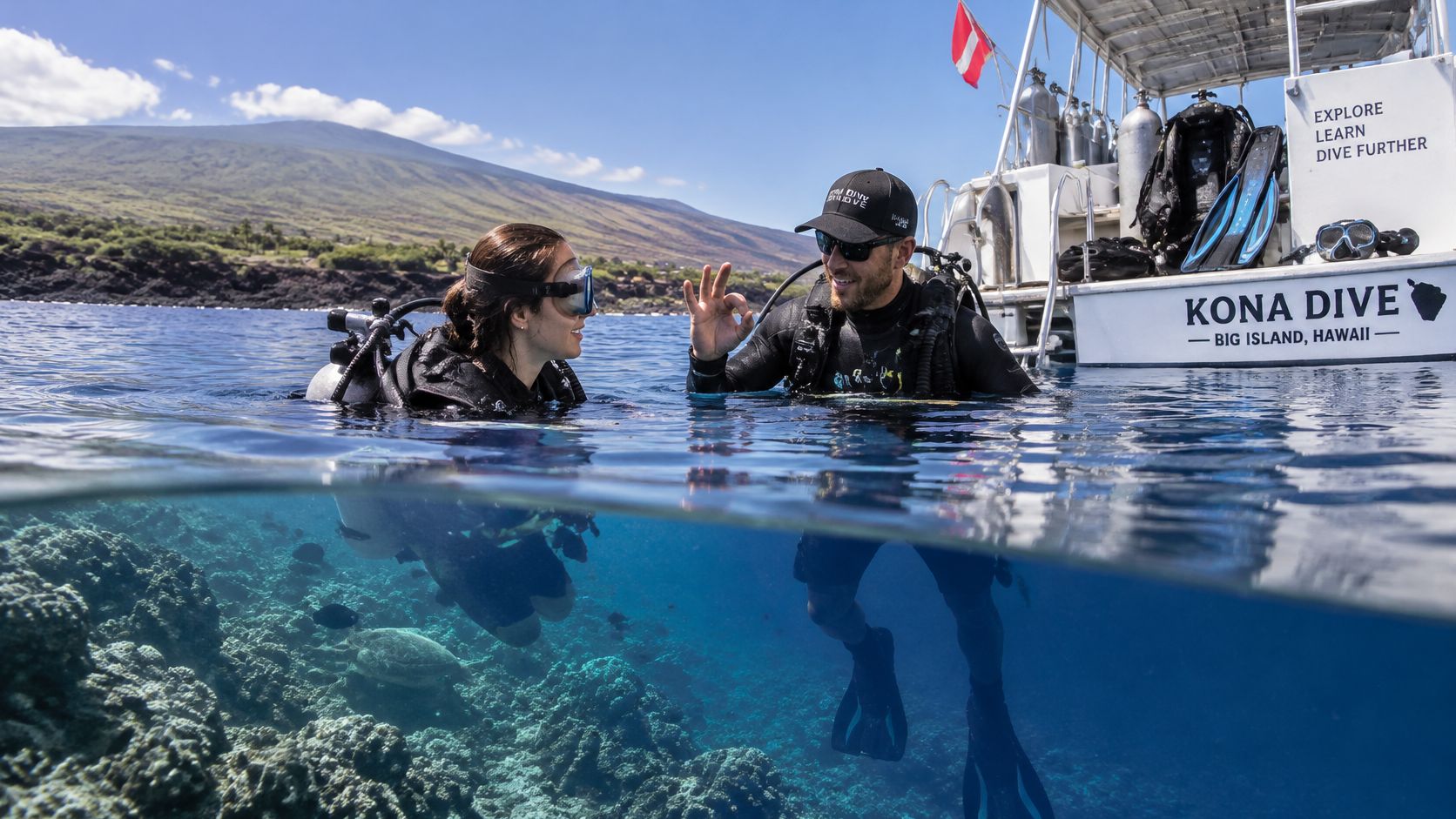
Most regular Kona Honu Divers charters require Open Water Diver certification from a recognized agency such as PADI, SSI or NAUI, which allows diving to 60 feet (18 meters) with a buddy. Bring your C-card. Crews check it, and a photo of a card you left at home isn't the same as planning ahead.
If you have no certification, the Morning Introductory Scuba Dive is your route. Don't try to talk your way onto a certified charter because you've snorkeled a lot. Snorkeling comfort helps, but it doesn't cover regulator recovery, buoyancy, or ascent control.
The Course Path
The Big Island scuba certification options follow a logical ladder. Pick the rung that fixes your actual limitation.
- PADI Scuba Certification Course: The full starting point for beginners.
- PADI Open Water Referral Course: For divers who finished theory elsewhere and need the water work.
- PADI Advanced Open Water: For broader experience and deeper diving under training.
- PADI Enriched Air Diver: For nitrox use, covered below.
- PADI Rescue Diver: For divers ready to manage problems, not just avoid them.
- PADI Peak Performance Buoyancy: For control, which protects both you and the reef.
- PADI Deep Diver and PADI Boat Diver: Specialty training for depth and boat procedures.
- PADI Reactivate: For divers whose skills have lapsed and shouldn't pretend otherwise.
Nitrox needs its own training for a simple reason. Enriched air changes the oxygen mix, so planning and bottom time follow different rules. You don't just breathe a different tank and follow the same limits.
Gear That Fits Kona Water
A 3 mm wetsuit or shorty suits most divers in Kona's warm water. If you chill easily or you're doing a night dive after a morning dive, choose more coverage rather than spending dive two shivering.
Your mask should seal without you cranking the strap down. Pressure points get worse, not better, during a long dive. Your fins should fit the boat ladder entry and exit you'll use, with boots and straps in good condition.
For rental gear, I would check three things before the boat leaves:
- Fit: BCD, wetsuit, mask, and fins work together without pinching or slipping.
- Service history: Ask when the regulator and BCD were serviced, and breathe from the regulator before departure.
- Weights: Confirm how your weight is carried and ditched, and that you're comfortable reaching every release.
Comfortable gear isn't a luxury. It's what lets you hold position, watch your buddy, and notice the reef instead of fighting your equipment.
Dive Conditions and Seasons Worth Planning Around
Don't plan around a visibility promise. Plan around the factors that decide whether a site is diveable and enjoyable on the day you're there.
Kona Dive Conditions to Check Before You Book
| Factor | Planning benchmark | What changes it |
|---|---|---|
| Water temperature | 24-27°C (75-81°F) year-round | Little seasonal change, warm water in every season |
| Visibility | 18-30 m (60-100+ ft) typical | Rain and runoff can reduce clarity for a few days |
| Swell and wind | Site-specific and varies by day | Winter brings stronger swells and more variable winds |
| Entry and exit | Site-specific | Exposed points can have surge and difficult lava-shelf entries |
The Kona Honu Divers guide to scuba diving in Kona uses approximately 18-30 m (60-100+ ft) visibility and 24-27°C (75-81°F) water as a practical planning benchmark, with rainfall and runoff capable of temporarily reducing clarity. Kona's leeward volcanic coast is partially sheltered from prevailing trade-wind swell, but that protection is site-specific. Exposed points can still experience surge, current, or difficult lava-shelf entries even when nearby bays appear calm.
That last point is where visitors get caught. A flat-looking shoreline tells you little about surge pushing across a lava shelf or current moving along a point. Evaluate swell direction, tide, and surface conditions independently rather than using shoreline calm as a proxy for underwater safety.
Why Sites Are Chosen on the Day
Morning trips visit coral gardens, ancient lava tubes and dramatic arches, but the specific site is chosen by swell, current, and exit plan, not by a fixed schedule. A lava tube that's calm and photogenic on a light day can become a surge funnel on the wrong swell. The crew isn't being vague when they won't promise a named site days ahead. They're leaving room to make the safe call.
Winter makes this clearer. Stronger swells, more variable winds, and reduced visibility mean the same site may be easy in July and hard in January. If you're choosing travel dates, the breakdown of the best months to scuba dive in Hawaii is useful, but it still won't replace the morning-of check.
Clear water can coexist with surge, exposure, and a hard ladder climb. Visibility tells you how far you can see, not how hard you'll work.
Before any dive, make three checks:
- Confirm the day's site assignment: Ask what changed and why, so your expectations match the plan.
- Check swell direction and tide: Direction matters as much as size on a volcanic coast with points and bays.
- Plan the exit before the entry: Know the ladder, mooring, or shelf you'll use when you're tired and your tank is light.
I would choose a tour by conditions and your comfort level, not by visibility promises. That rule holds in every season.
Manta Ray Night Dives and Where to Watch Them
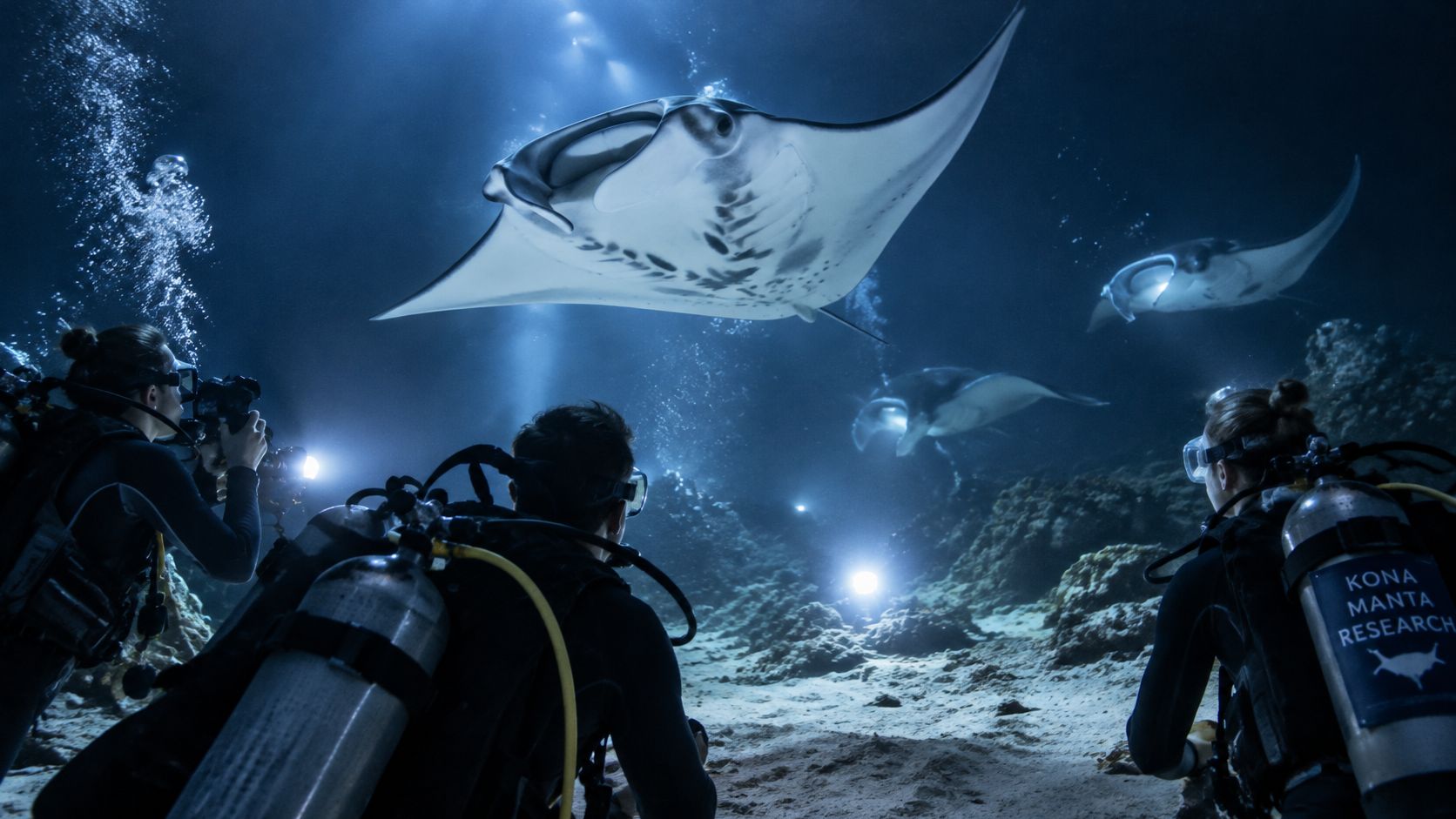
Kona's manta dive works because lights concentrate zooplankton, and reef mantas come to feed on that plankton. You're watching a feeding behavior, not a trained show. When the food is there, the mantas have a reason to stay and loop through the light. When it isn't, no crew can schedule them.
The reliability has a real record behind it. A six-year monitoring project in the Kona Honu Divers account of manta rays on the Big Island, covering January 1, 2009, through December 31, 2014, recorded 25,444 manta observations involving 118 distinct reef manta rays at established Kona viewing sites. One repeatedly observed individual appeared on more than 56% of monitored nights, which shows strong site fidelity by returning animals.
A separate University of Hawaiʻi analysis of community-sourced observations from 2010 through 2022 documented more than 23,000 sightings representing 167 individually identified reef manta rays. Seasonal and annual changes in aggregation size tracked zooplankton density. Their presence follows the food, not the visitor schedule.
Why Garden Eel Cove Is the Better Choice
I would choose Garden Eel Cove for the manta ray dive and snorkel tour because its protected location gives you a better viewing area and better reefs than more exposed options. Protection matters twice. Divers and snorkelers hold position more easily, and the reef around the viewing area gives you more to see before and during the encounter.
An exposed site can turn a wildlife dive into a workout. You're managing surge, watching your light, and trying not to drift into other people. At a protected site, you can settle, stay low and still, and let the mantas do the moving. That's better for your view and calmer for the animals.
What to Expect and How to Behave
Expect a pre-dive briefing first. You'll use dive lights carefully so you don't dazzle the animals, keep distance, and never touch a manta. If one approaches, stay still and let it choose the path. Don't chase, block, or reach for a closer photo.
The guide to diving with manta rays covers the encounter itself, but the core behavior is simple. Divers stay in the viewing area, snorkelers stay at the surface, and everyone gives the animals room to feed. Crowding doesn't improve the encounter. It shortens it.
Accept the trade-off before you book. A manta may not appear on a given night, even at a reliable site. That isn't permission to demand closer access the next night or treat the animals as guaranteed entertainment.
Booking rule: Schedule the manta night early in your trip, so a missed night can be rescheduled while you're still on island.
That one scheduling decision removes most of the pressure. You're no longer asking one specific night to carry the whole trip.
Underwater Photography Tips for Kona Dives
Bring the camera only if you can dive well without it. A housing in your hands makes buoyancy, buddy awareness, and light discipline harder, not easier.
- Go wide for mantas: Use a wide-angle lens or wide dome port so the animal, the reef, and the lights fit the frame without you backing into other divers.
- Cut the strobes near mantas: Turn strobes off or drop them to the lowest setting, because flash can dazzle animals and push them away. Use continuous light sparingly.
- Open up on blackwater: Set a higher ISO or wider aperture and use a slow shutter speed for drifting plankton, siphonophores, and ctenophores. Expect fast animal movement to blur some shots, and delete them later.
- Hold position and wait: Let animals approach rather than chasing them. Frantic kicking stirs sediment, reduces clarity, and makes animals less comfortable.
- Set white balance manually: Low ambient light pushes images toward blue, and manual balance preserves color that's hard to recover in editing.
- Secure everything: Clip and stow your rig so surge can't push it into coral or lava.
I would rather surface with fewer, sharp frames from a stable position than a card full of chased, flashed, and blurred animals. These steps keep the photos usable and the dive safe for the reef.
Dive Day Logistics, Safety and Reef Etiquette
A typical Kona Honu Divers dive day runs in a set order for a reason. You arrive and set up gear, get a briefing on site conditions and entry style, do dive one at the deeper or more condition-sensitive site, rest through a surface interval, then do a more relaxed second dive. We focus on small groups and personal attention from the moment divers step aboard, which makes that briefing easier to use.
Listen for the exit plan during the briefing, not just the marine life list. Know where the ladder is, how you'll hand up fins or a camera, and what you'll do if current picks up during the dive.
Surface Rules and Protected Areas
Hawaii's dive-flag rules in the Department of Land and Natural Resources fishing regulations require a flag at least 12 by 12 inches displayed while diving in ocean waters, and divers may not surface more than 100 feet from that flag except in an emergency. The flag must be removed when diving stops. Plan your route around the flag, current, and boat traffic instead of treating the flag as decoration.
Protected areas add stricter duties. The Old Kona Airport Marine Life Conservation District page describes a district extending offshore from Old Kona Airport State Park to the Kailua Lighthouse, with boundaries reaching 500 yards seaward from each endpoint. Removing marine life, live coral, algae, shells, sand, rocks, or other geological features is generally prohibited, as is feeding or introducing attractants. Anchoring is prohibited within the district.
Those rules shape how you dive there. No collecting, no feeding, no anchoring, and no treating a shell as a souvenir. The responsible diver etiquette guidance points the same way for every Kona reef, protected or not.
Etiquette That Prevents Damage
- Hold neutral buoyancy: Hover instead of kneeling on reef or lava to adjust gear.
- Make no contact: Keep hands, fins, and knees off coral and rock, especially in surge.
- Secure gauges and hoses: Dangling equipment drags across the reef when water movement pushes you.
- Keep conservative distance: Give animals an exit path and don't corner them for a photo.
Good buoyancy isn't a style point. It's the difference between observing the reef and landing on it.
Handle health and travel with care. Disclose medical conditions to us before diving, and leave an adequate surface interval before flying after diving instead of squeezing a last dive against a departure. Confirm the exact window when you book, based on your dive profile.
For transport, plan a rental car from Kona International Airport and arrive early for the morning briefing. Rushing gear setup is how divers skip buddy checks.
Choose Your Kona Dive Operator and Book
Match the tour to your certification first, then compare operators. A good operator on the wrong trip still leaves you overmatched. A modest reef dive with the right operator beats an advanced site you spend entirely on air and depth control.
Kona Honu Divers operates in Kona, Hawaii, on the Big Island, was voted best dive operator in Kona, and is a separate operator from Kona Diving Company. Judge us on the same questions you'd ask anyone else, and check recent reviews before you commit.
Questions to Ask Before You Pay
- Conditions change: If conditions change the site, do we substitute another site or reschedule, and who decides?
- Cancellation: What counts as a safety cancellation, and what happens to your booking?
- Briefing: How is the briefing run, and does it cover entry, exit, current, and lost-buddy steps?
- Group size: How many divers share a guide, and are beginners mixed with advanced divers?
- Certification check: Is certification checked, and what recent experience do we expect for this trip?
- Gear included: What's included, what costs extra, and can you try fit before departure?
I would pay close attention to the conditions answer. An operator who explains substitution and reschedule rules clearly will make better calls on the water than one who promises a named site regardless of swell. We focus on small groups and personal attention from the moment divers step aboard, and you can ask us directly at 808-324-4668.
Confirm your certification, the sea-state policy, and cancellation terms before you book. Then choose the tour that fits both your skills and the conditions window you'll have in Kona.
Kona Honu Divers runs morning reef dives, manta ray night dives, blackwater excursions, and advanced trips matched to certification and conditions, so you can book the dive you're ready for instead of guessing. Visit Kona Honu Divers to choose your tour, confirm the requirements, and lock in your Kona dive dates.