
You have just landed, you're sorting a rental car and a hotel checkout time, and somewhere in between you're trying to decide if you're ready for scuba diving Kona Big Island reefs, a manta night dive, or something stranger after dark. That's normal. Kona looks easy from shore. The water is often clear, the west coast is sheltered, and boats leave close to town. That calm picture is real, but it can also make first-time visitors skip the parts that matter, like your recent dive experience, entry conditions, and what you'll do after the dive.
Think of your dive plan as starting before you get wet. Your certification level sets your depth limit. Swell, wind, and visibility set whether a shore entry makes sense that day. Your flight home, a drive to altitude, and the distance to medical treatment shape how conservative your profiles should be. Work through those pieces in order, and scuba diving Kona Big Island water becomes much easier to enjoy without guessing.
Certification, Nitrox and Gear Rentals
Start with the rule that sets most limits. For most regular dive charters, Kona Honu Divers requires at least an Open Water Diver certification from a recognized agency such as PADI, SSI or NAUI, which allows diving to 60 feet (18 meters) with a buddy. Bring your C-card, because a claim that you're certified isn't the same as proof at check-in. If you can't show it, a regular charter may not be the right booking.
That 60-foot limit isn't a suggestion you stretch because visibility looks good. It matches the training you've completed, the supervision you need, and the sites a guide can choose responsibly. A diver trained for deeper, drift, or more complex conditions has more options, which is why the next course matters only when it opens the diving you want to do.
Kona Certification Levels and Depth Limits
| Course | Depth limit | Prerequisite | What it unlocks in Kona |
|---|---|---|---|
| Open Water Diver | 60 ft (18 m) with a buddy | None, start from scratch | Most regular two-tank and manta charters |
| Advanced Open Water | 100 ft (30 m) | Open Water Diver | Deeper sites and drift dives |
| Enriched Air Diver (nitrox) | Set by certified limits | Open Water Diver | Longer bottom time within limits |
| Rescue Diver | 100 ft (30 m) through prior training | Advanced Open Water | Safety skills for buddy and group diving |
How Nitrox Helps, in Plain Terms
Nitrox, also called enriched air, holds a higher share of oxygen than regular air. Because you're breathing less nitrogen as a share of each breath, it can extend your allowable bottom time within the limits you're certified for. It doesn't let you ignore depth limits, and it doesn't make an untrained diver ready for a deeper site. If you want that option on repetitive Kona reef days, look at the Enriched Air Diver certification course before your trip, so you arrive qualified to use it.
Rentals and Bringing Your Own Kit
We offer scuba diving rentals and freediving rentals, we sell scuba gear, freediving gear and spearfishing gear, and our rental gear is proactively serviced before trips. That still doesn't remove your buddy check. Before you board, confirm your mask seals, your fins fit over your boots, your regulator breathes cleanly, and your inflator works without sticking. A dive computer can be requested when booking, and we'll confirm availability and any small extra cost at that time, so don't leave that question for the dock.
Before you pack: A computer you know how to read is more useful than an unfamiliar one with more features. If you're renting one, ask the crew to walk you through depth, no-decompression time, and ascent alerts before dive one.
Use this arrival checklist so nothing small blocks your day:
- Certification card: Bring the physical or digital C-card that matches the charter you booked.
- Logbook: Bring recent entries that show your last dive, typical depths, and night experience if you have it.
- Recent dive history: Be ready to say when you last dived and whether you need a refresher.
- Gear list confirmed: Note sizes for wetsuit, BCD, and fins, plus any computer or nitrox request, before arrival.
Pick the Right Kona Dive Tour
Match the tour to your certification and your goal, not to the most dramatic photo. A first breath underwater, a relaxed reef morning, and an open-ocean night dive ask for different training, buoyancy control, and comfort after dark. If you're unsure, start with the option that leaves you margin, then build up.
Kona Dive Tours by Experience Level
| Tour | Best for | Experience needed | When it runs |
|---|---|---|---|
| Morning Introductory Scuba Dive | First-time divers and curious snorkelers | No certification required | Morning |
| 2 Tank Local Morning Dive | Certified divers wanting reefs, lava tubes and arches | Open Water certification | Morning |
| Manta Ray Night Dive | Night dive fans and underwater photographers | Certified divers | After dark |
| Black Water Night Dive | Divers interested in open-ocean and plankton life | Certified divers with night experience | After dark |
| Premium Advanced 2 Tank Trip | Experienced divers seeking remote sites and drift dives | Advanced certification | Half day or morning |
| Private Charter | Groups, families and private parties | Set by group and guide | Custom schedule |
Browse the full Kona diving tours schedule and compare departure times with your other plans before you lock in altitude drives or flights. For most of our regular dive charters, we require at least an Open Water Diver certification from PADI, SSI or NAUI, and divers must bring their C-card.
If you're a first-time visitor with certification, book the morning two-tank dive first. You'll see coral gardens, ancient lava tubes, and dramatic arches in daylight, settle your weighting and air consumption, and learn how local briefings and entries work. If you're comparing shops before you choose, this guide to Kona scuba dive shops helps you judge what to ask about group size, gear, and supervision.
Private charters suit groups and families who want a custom pace, mixed snorkelers and divers, or a plan built around kids and non-divers. Tell us the weakest swimmer's comfort level, not just the strongest diver's wish list. We'll build around the person who needs the most support.
Manta Night Dives and the Top Kona Sites
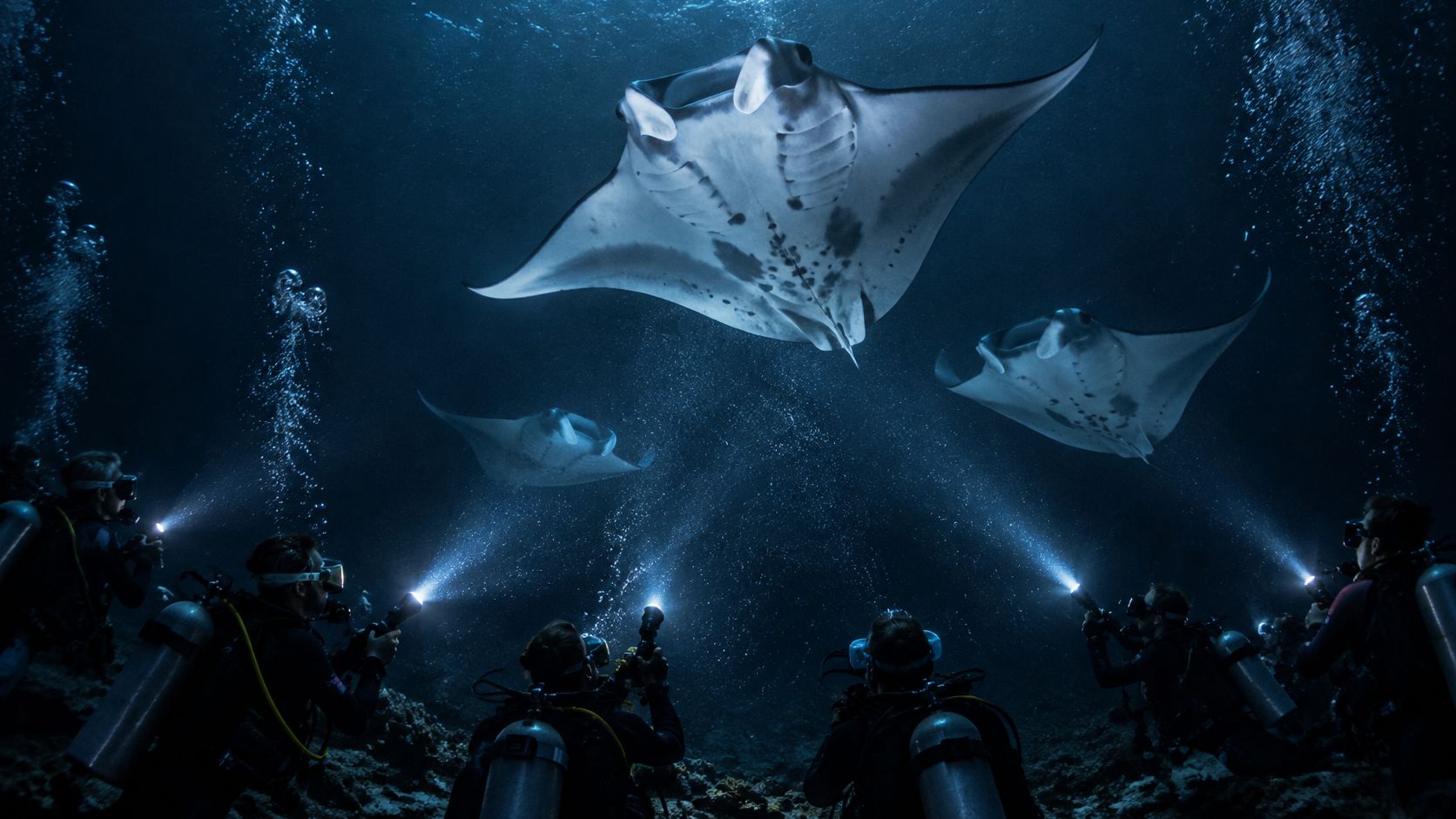
After sunset, you descend with your buddy, follow your guide to a sandy patch, and point your light upward. Plankton gather in the beam. Then a reef manta ray rolls through the lit water column, mouth open, feeding on that plankton while you stay low and still. That is the core of Kona's manta night dive, and your position is part of how it works.
Set expectations with the record, not a promise. State legislative testimony on the Kona manta surveys reports 3,208 manta surveys from 1992 through 2007 that identified 106 individual manta rays at Keauhou and Ho'ona Bay, according to Hawaii legislative testimony on the 1992 to 2007 manta surveys. A separate long-term record helps explain why one night differs from the next. A University of Hawaii study recorded more than 23,000 sightings of 167 individual reef manta rays from 2010 to 2022 and found aggregation size tracked zooplankton density, according to the University of Hawaii ScholarSpace manta aggregation study. More plankton generally gives mantas more reason to stay and feed. Low plankton can mean fewer animals, shorter passes, or a quiet night.
Why Garden Eel Cove Gets Our Vote
Garden Eel Cove is the superior choice for the manta dive because its protected location gives a better viewing area and better reefs. You're positioned where you can look up into the feeding water column without sitting in the mantas' path, and the surrounding reef gives you more to see if mantas arrive late or pass less often. That protected setting also helps guides manage lights, spacing, and the light circle. When you're ready to compare dates, check the two-tank manta dive and snorkel tour, then confirm your certification and recent experience before booking.
Keauhou Bay is the second major manta site, with strong female site fidelity and a female-biased visitation pattern in the long-term record. Ho'ona Bay matters historically as one of the two survey sites used from 1992 to 2007. Pawai Arches is different. It's a boat-accessed arch and reef site for confident divers, so check swell first and don't treat it as a beginner backup just because the water looks flat from the harbor.
Top Kona Dive Sites at a Glance
| Site | Main draw | Best suited to | Notes |
|---|---|---|---|
| Garden Eel Cove | Manta night dives, larger manta groups, protected reefs | Night divers and photographers | Sheltered with a better viewing area |
| Keauhou Bay | Manta observations and long-running survey data | Manta night divers | Female-biased visitation pattern |
| Ho'ona Bay | Historic manta survey site (1992 to 2007) | Manta divers | Used in long-term recreational survey work |
| Pawai Arches | Arches and reef life | Confident divers and boat-tour guests | Boat-accessed; check swell first |
Follow the Viewing Standard Step by Step
The behavior rules aren't etiquette for its own sake. They keep plankton concentrated, mantas feeding, and coral undamaged. NOAA's voluntary Hawaii manta viewing standard tells divers to hold lights above their heads and shine them upward, place lights over sand or rubble, and time breathing so bubbles don't rise into a passing manta, as set out in NOAA's voluntary standard for manta viewing in Hawaii.
- Hold your light above your head: Shine it upward into the water column to attract plankton.
- Move your snorkel: Take it off your mask and put it in a buoyancy-compensator pocket so a manta can't snag it.
- Stay on sand or rubble: Keep the light circle off live coral and settle only where your guide directs you.
- Time your breaths: Pause your exhale as a ray passes overhead so bubbles don't hit its face.
- Follow the divemaster: Let guides and videographers direct light placement, spacing, and movement.
Don't descend into the feeding water column to chase a better angle. You'll scatter plankton, block feeding paths, and ruin the view for snorkelers above and divers beside you. Photographers get better results by staying still, letting the ray complete its loop, and shooting as it turns back through the light. For a deeper walkthrough of conduct and positioning, read our night manta ray dive guide for Kona before your trip.
If the encounter is poor, stay positioned and follow your guide instead of wandering the reef with your light. Mantas can arrive after the group settles. If they don't, accept a daytime backup dive as the better second chance to enjoy Kona reefs. Choose your site by the animal you want and the conditions on the day, not by a guarantee no responsible operator can make.
Blackwater Night Dives and What They Reveal
A blackwater dive is like walking through a city whose residents change after sunset. In daylight, the open ocean over deep water can look empty. After dark, zooplankton and larger mesopelagic animals rise from depth to feed near the surface, and predators and larvae move with them. You're not touring a reef with landmarks. You're hovering in dark water while a temporary community drifts past your light.
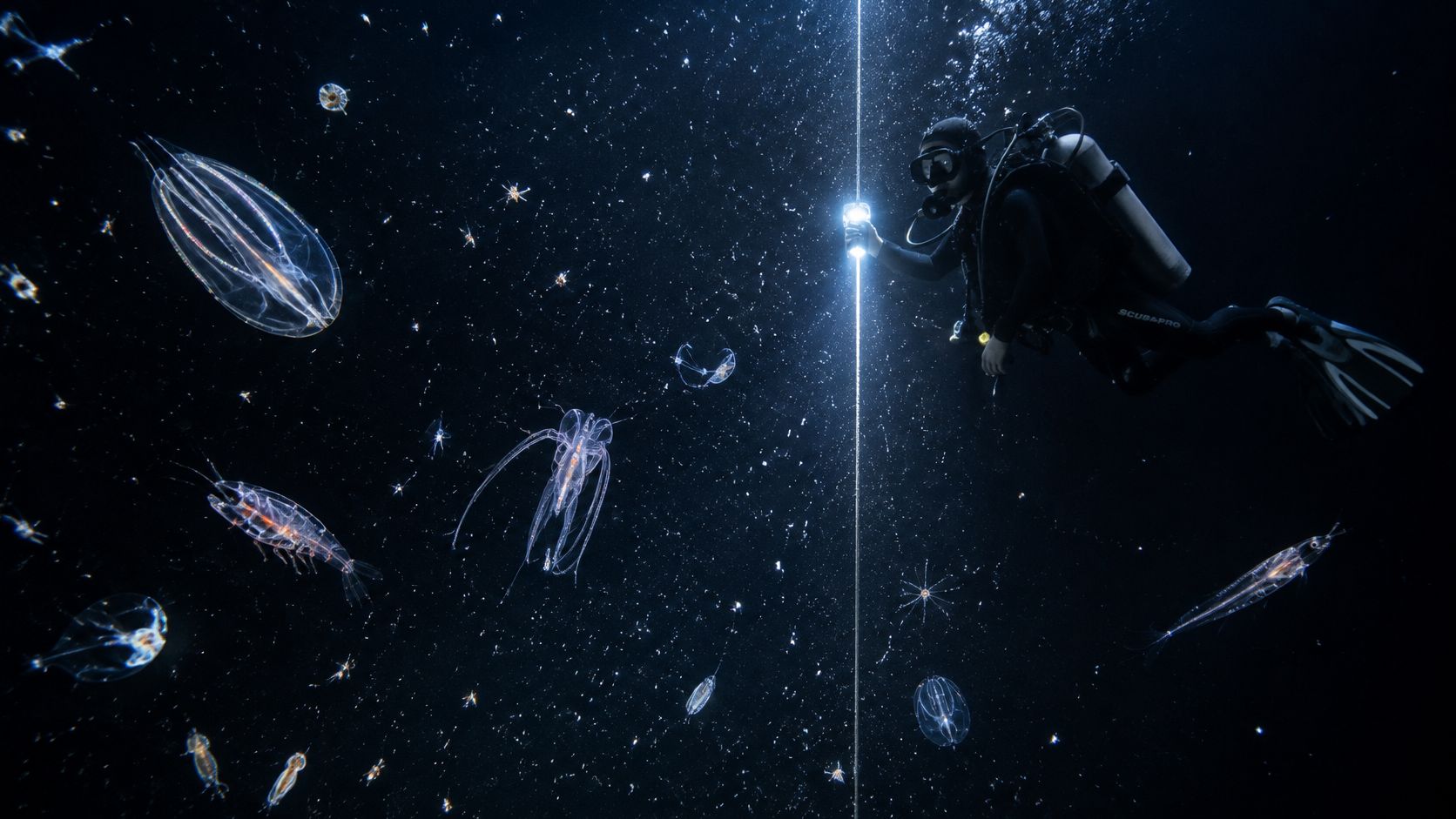
You may see larval billfish, juvenile cephalopods, deep-sea gelatinous animals, and occasionally young pelagic fish. Many subjects are translucent, small, and slow enough to miss if you fin hard or sweep your light too fast. University of Hawaii diving guidance notes Kona blackwater operations run over waters exceeding 500 m deep and identifies a safe ascent range of approximately 0.3 to 1 m/s, according to University of Hawaii diving technology guidance. That depth below you is exactly why there's no bottom reference to rescue sloppy buoyancy.
Night-to-night change is part of the appeal and the frustration. A NOAA Fisheries census near Kona found salps, siphonophores, and ctenophores were the most abundant groups and built a model that explained 43% of the total observed deviation in biodiversity, with water temperature, bathymetry, and the El Nino Southern Oscillation index as the most important predictors, according to the NOAA Fisheries nocturnal visual census near Kona. In plain terms, ocean conditions decide much of what shows up. A quiet night doesn't mean you did it wrong.
Skills That Matter More Than Curiosity
Hold a stable neutral hover. If you sink, rise, or bicycle your fins, you'll push fragile gelatinous animals away and may lose your buddy or your depth target. Check depth, cylinder pressure, elapsed time, and buddy position more often than you would on a reef, because the black background gives your brain fewer cues that you're drifting up or down. Keep light discipline, too. Aim lights with purpose, signal clearly, and don't blind your buddy every time something small appears.
Ascend slowly and stay together. The profile is highly vertical, and there's no reef slope to follow upward. Make your safety stop a controlled hover, watch your computer, and keep the support vessel and your buddy in your awareness during the final ascent.
Don't book blackwater to prove you're advanced. Book it after you've proved to yourself, on easier night dives, that you can hover, check gauges, and stay calm without a bottom.
Photography Without Chasing Everything
Use a steady light setup you can manage with one hand while the other controls buoyancy and camera position. Angle light slightly away from the lens axis to reduce backscatter from particles in front of the port. Expect slow, low-contrast subjects that need patience, short movements, and several frames as they pulse or turn. If you chase every speck, you'll stir the water and lose the subject you already found.
Book blackwater only after confirming you're comfortable at night, in open water, without visual references. Read more about how we run the Kona blackwater dive, then check dates on the Black Water Night Dive tour page when your experience matches the dive.
Best Season, Water Temperature and What to Pack
Diving in Kona is available year-round, with warm water and generally clear visibility in every season. That consistency comes from geography. Kona sits on Hawaii's leeward side, sheltered from prevailing trade-wind swell, with few river outlets and little coastal sediment to cloud the water. DAN reports divers commonly encounter more than 100 feet of visibility and Kona offers roughly 350 diveable days per year, according to DAN's Alert Diver guide to Kona.
Year-round doesn't mean identical. Winter brings cooler water and short storms that account for many missed days. Late summer and early fall bring the warmest water, which helps if you chill easily or plan repetitive dives. Use the season to choose exposure protection, then still check the forecast for your specific day.
Kona Water Temperatures and Conditions by Season
| Period | Water temperature | Conditions | Suggested exposure protection |
|---|---|---|---|
| Winter (December to February) | Low to mid 70s °F | Short winter storms cause most missed dives | 3 mm or 5 mm wetsuit; hood for heavy repetitive diving |
| Peak warm season (August to October) | Low 80s °F | Warmest water of the year | 3 mm or 5 mm wetsuit, depending on comfort |
| Year-round summary | Warm all year | Visibility commonly above 100 ft; about 350 diveable days | Plan for a wetsuit in every season |
Most divers do well in a 3 mm or 5 mm wetsuit. Choose 5 mm if you run cold, plan long bottom times, or dive several days in a row. Add a hood for heavy repetitive diving, because heat loss adds up across a trip even when a single dive feels warm. If you're choosing dates around comfort and conditions, our month-by-month notes on the best months to scuba dive in Hawaii will help you match water temperature to your tolerance.
Pack for the boat and the drive, not just the dive:
- Reef-safe sunscreen: Apply before boarding and reapply during surface intervals.
- Rash guard: Use it for sun protection and an easy layer under a wetsuit.
- Logbook: Keep it dry, but bring it for check-in and post-dive notes.
- Dry bag: Protect your camera, phone, towel, and spare clothes from spray.
- Towel and warm layer: You'll feel cooler after night dives and winter mornings.
Forecast rule: Clear water last week doesn't promise an easy entry today. Check swell, wind, and visibility for your site on the morning you dive.
Safety Rules, Medical Limits and Dive Flags
Kona's clear, sheltered water can make you overconfident. Excellent visibility doesn't remove entry hazards, current, surge, equipment problems, or evacuation time. Treat transport, altitude, and emergency planning as part of the dive, especially if you're combining two-tank boat dives with a rental car, an inter-island flight, or a drive toward Mauna Kea.
Hawaii's dive flag rule is simple. Ocean divers must display a dive flag and remain within 100 feet of it, except in an emergency, and the state advises checking tide and wave conditions and observing the sea for several minutes before entry, as summarized in Kona Honu Divers' Hawaii scuba safety overview. The flag marks your position for surface traffic and defines your operating radius. If your plan takes you beyond that radius, your plan is wrong for that entry.
Protected and regulated areas also matter. Hawaii includes fishery management areas, ocean recreation management areas, and wildlife sanctuaries, so verify local restrictions before collecting marine life, fishing, anchoring, or entering a managed site. A site that's legal for a guided boat dive may have rules you'd miss as an independent shore team.
A Shore Entry Check You Can Actually Use
Stand back and watch the sea for several minutes before you gear up. Look for sets, surge channels, slippery lava, and a clear exit if conditions build while you're underwater. Check official beach-safety and surf forecasts before shore entries, and cancel when the forecast or the entry in front of you shows changing swell, wind, surge, or reduced visibility. If you're caught in a rip current, stay calm and swim parallel to shore instead of fighting straight against it.
Agree on night equipment and a lost-buddy procedure before any after-dark shore plan. Put primary and backup lights, tank markers, and signaling devices in a buddy-checked kit, then confirm signals on land. If either buddy hesitates about entry, exit, or navigation, call the dive. A cancelled shore dive costs an evening. A forced exit through surge can cost much more.
On our boat days, the order is deliberate: arrival and gear setup, a briefing on site conditions and entry style, dive one at the deeper or more condition-sensitive site, a surface interval, then a more relaxed dive two. That sequence puts the hardest dive first while you're fresh and gives the crew the best weather window for the site that needs it.
Medical planning needs the same honesty. There's no recompression chamber in Kona, and treatment for decompression illness is in Honolulu rather than on this island. Confirm how you'd reach care, keep profiles conservative, and plan altitude travel carefully before driving high or flying home. Details on shore conditions, forecasts, and Honolulu treatment are covered in Love Big Island's Big Island scuba diving guide. If symptoms appear after a dive, don't drive yourself around the island hoping they'll fade. Seek emergency help and say clearly that you've been scuba diving.
Book Your Kona Dive Days
A sample plan makes the decision concrete. Put your most demanding dive when you're rested, keep a buffer before altitude or flights, and don't stack every specialty into your first 24 hours on island. The first dive of a boat day goes to the deeper or more condition-sensitive site because that's when you're freshest and conditions give the crew the most options.
Sample Kona Dive Itineraries
| Trip length | Dive plan | Best for |
|---|---|---|
| One day | Morning two-tank dive, then rest | First-time visitors with certification |
| Two days | Morning two-tank day, then manta night dive | Night and manta fans |
| Three days | Morning two-tank, blackwater night dive and advanced two-tank trip | Experienced divers |
| Four days | Introductory dive, two-tank days, manta night dive and a rest day | Non-certified visitors who want to learn |
For more experienced diving opportunities, remote sites and drift dives belong on an advanced itinerary only when your recent experience supports them, so review the Premium Advanced 2 Tank Trip before adding it to a three-day plan. Kona Honu Divers was voted best dive operator in Kona, Hawaii, and we focus on small groups and personal attention from the moment divers step aboard. That matters in checkable ways. Your guide can hear your concerns at the briefing, watch your buoyancy on dive one, and adjust dive two to your air use and comfort. You can also keep advanced, manta, and blackwater options under one roof instead of rebuilding trust with a new crew each day.
Questions about certification, recent experience, or which trip fits your group? Call us at 808-324-4668. Read independent feedback before you decide:
Follow these three steps:
- Choose the tour that fits your certification: Intro, morning reef, manta, blackwater, advanced, or private.
- Confirm your documents and kit: Certification card, logbook, recent dive history, sizes, and any computer or nitrox request.
- Check availability and book: Leave buffer time before flights, altitude drives, and non-refundable plans.
Ready to plan scuba diving Kona Big Island days around your certification, comfort, and the conditions on the water? Visit Kona Honu Divers to compare morning reef dives, manta and blackwater nights, advanced trips, courses, rentals, and private charters, then book the itinerary that gives you margin before flights or altitude.