
More than 23,000 sightings of 167 individually identified reef manta rays were recorded at Kona's two major nighttime feeding sites from 2010 through 2022, according to a 13-year analysis of manta observations at Garden Eel Cove and Keauhou. That record points to the best place to look for manta rays in Hawaii: Kona, on Hawaiʻi Island, where the animals feed after dark beneath underwater lights.
The two sites aren't interchangeable stages for the same show. Garden Eel Cove tends to draw larger gatherings and offers a more sheltered setting, while Keauhou has smaller gatherings and a strong female bias. Choosing a protected viewing area and giving the rays room to feed can make for a better night for visitors and wildlife alike.
Where Kona Mantas Gather at Night
For reliable night encounters with reef manta rays in Hawaii, look to Kona, not a Waikiki beach swim. The two documented Kona feeding sites are Garden Eel Cove at Makako Bay and Keauhou. The long-running observation analysis found larger, more variable aggregations at Garden Eel Cove; at Keauhou, females accounted for 91% of sightings. The Kona site analysis also found that aggregation size at both sites tracked zooplankton density, so a busy evening depends on prey availability, not the date on the calendar.
My recommendation: Garden Eel Cove is the superior night-tour choice. Its protected location offers a better viewing area, generally calmer conditions, and a healthier reef.
The two sites have different patterns, but they're part of a connected Kona feeding area. Mantas move between them, and when both sites are considered together, the sexes are roughly balanced. Garden Eel Cove's larger gatherings suit visitors hoping to see multiple rays pass through the light, while Keauhou's distinctive female-heavy pattern tells a different ecological story. Neither site is a guaranteed nightly performance.
| Kona night sites for manta rays | Aggregations | Who shows up | Conditions | Best for |
|---|---|---|---|---|
| Garden Eel Cove at Makako Bay | Larger and more variable | Mixed sexes, connected to Keauhou | Protected cove, generally calmer, clearer viewing area, healthier reef | Default night dive and snorkel |
| Keauhou | Smaller gatherings | About 91 percent female sightings | More exposed to swell on some nights | Backup when operators shift sites |
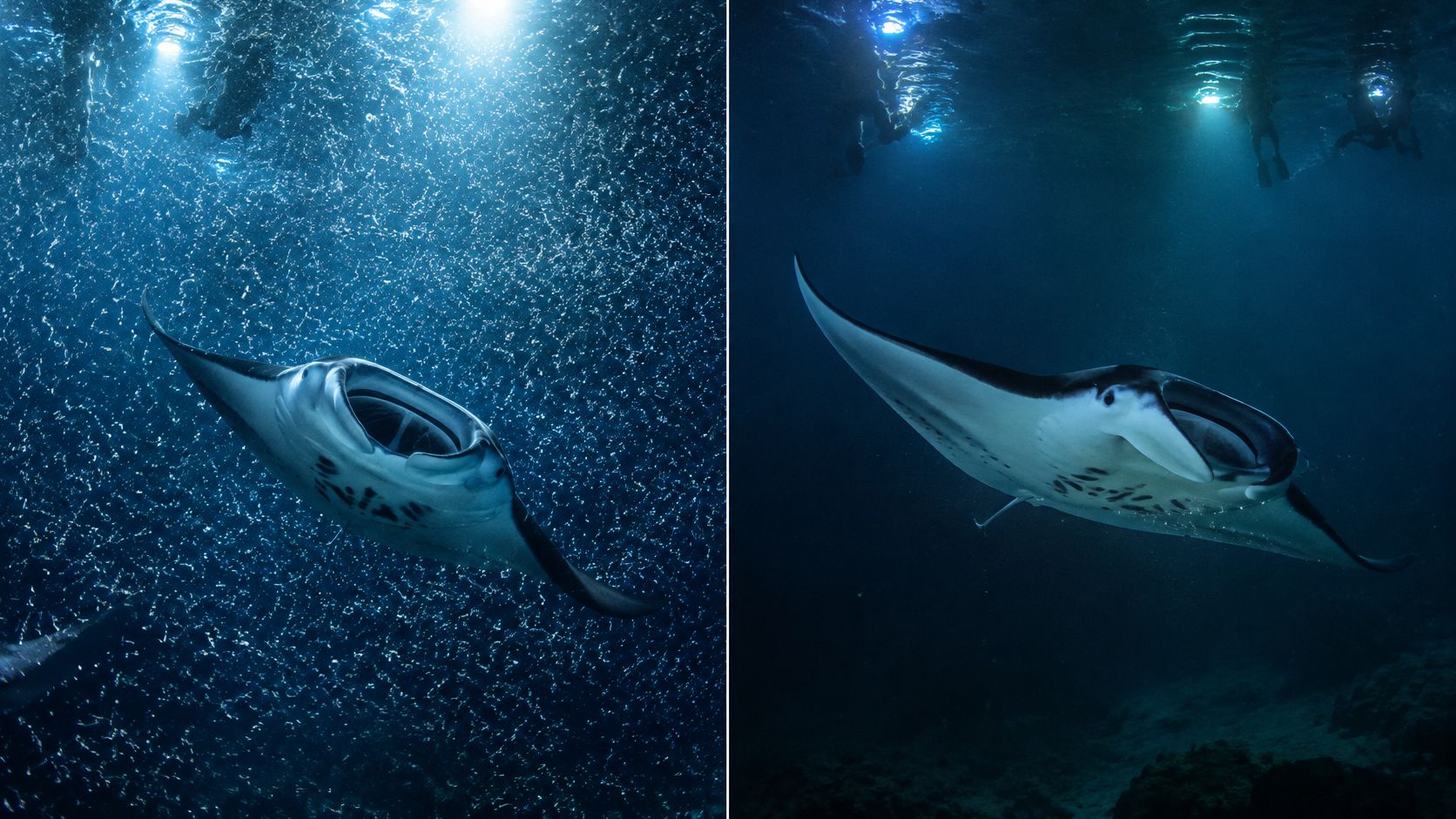
Underwater lights attract plankton, and the manta rays feed on the concentration of prey around them. The rays aren't being fed by tour crews. The light and plankton relationship helps explain why Kona's nighttime viewing sites work, and why the number of animals can change from one outing to another.
How Reef Mantas Feed in the Dark
Reef mantas are filter feeders, not hunters. As a manta swims through the water, its cephalic fins help guide water and food toward its open mouth, where gill plates strain plankton from the flow. The animal needs a dense supply of tiny prey, so a chance daytime swim doesn't offer the same predictable feeding conditions as the familiar night encounter.
After dark, underwater lights attract plankton into a concentrated area. Mantas make repeated passes through that illuminated patch, filtering prey from the water rather than eating food supplied by the boat. The lights make the feeding activity easier to watch, but they work because plankton gathers there. Manta activity can still change with natural prey availability.
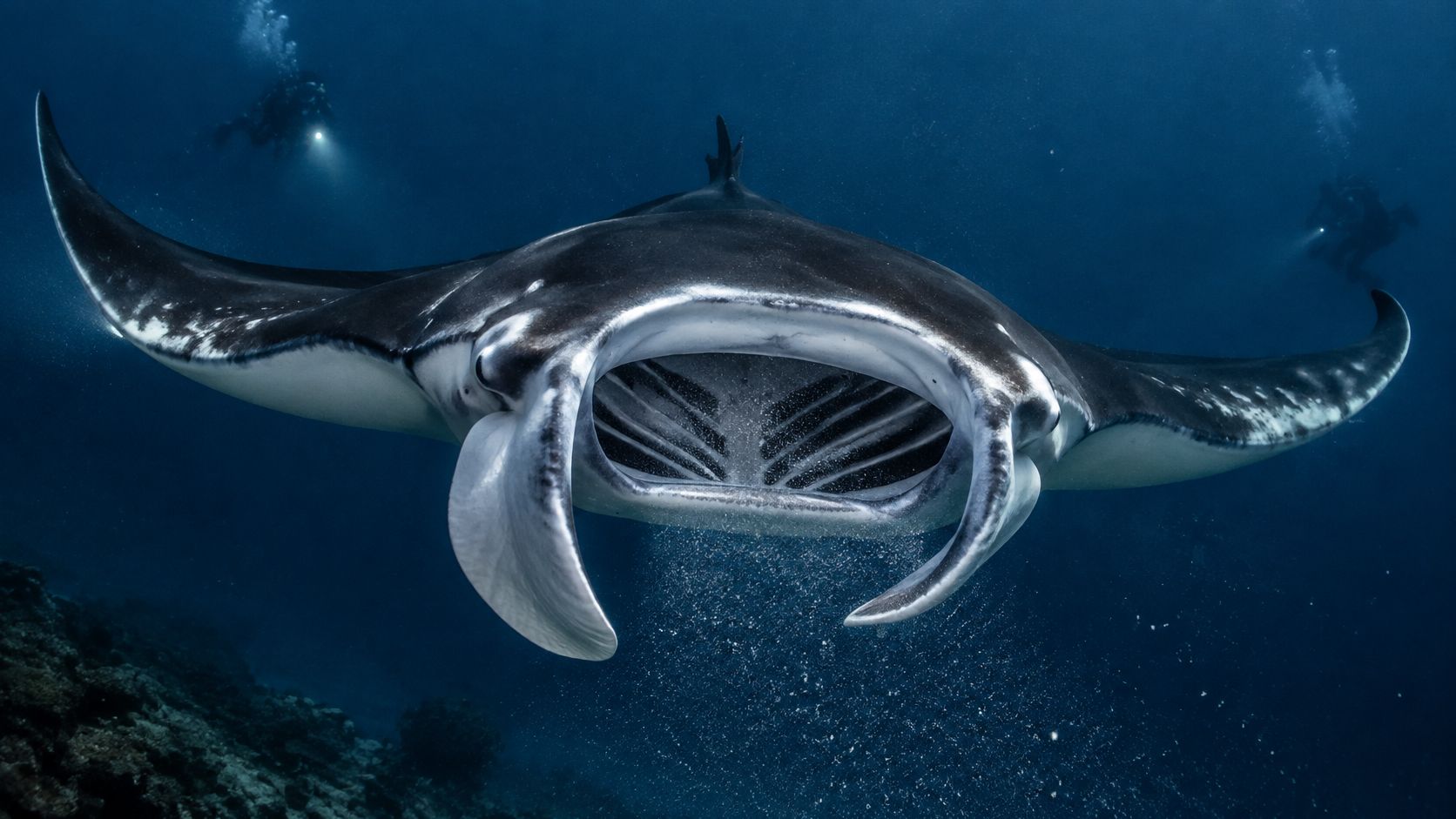
Hawaiʻi's manta encounters are especially well documented. A peer-reviewed global analysis of Hawaiian manta sightings examined 4,001 dive observations across 13 Hawaiian sites and found manta presence at 73 of 538 surveyed sites, the highest site-level sighting frequency in that study. Separate genetic research estimated an effective population size of about 104 reef mantas around Hawaiʻi Island, with a 95% confidence interval of 99–110. Photo-identification catalogs documented at least 318 individuals around Hawaiʻi Island.
Those counts describe different things: an effective population estimate is not the same as a catalog of identified animals. Researchers also concluded that Hawaiʻi Island and Maui Nui likely have relatively small, island-resident manta populations. A quiet night is more likely to reflect conditions such as plankton availability or weather than proof that the population has left. Respectful viewing matters because a local encounter depends on animals that aren't quickly replaced from elsewhere.
Night Dive Versus Surface Snorkel
| Manta night dive compared with surface snorkel | Format | Where you watch | Certification | Effort | Best fit |
|---|---|---|---|---|---|
| Night dive | Scuba | Kneeling on the sand under the light circle | Open Water or equivalent | Stationary and closely guided | Certified divers who want rays overhead |
| Surface snorkel | Snorkel | Floating at the surface looking down | None | Mask, fins, and a float | Non-divers and comfortable open-water swimmers |
| Shared boat | Combined trip | Divers below and snorkelers above the same lights | Only divers need a card | One briefing for both groups | Mixed parties |
The main difference is where you watch from. On a night dive, certified divers settle in a designated viewing area beneath the lights. The stationary format avoids swimming a reef circuit, and guides stay in the water with the group. It suits certified divers who want manta rays passing overhead without needing to cover distance underwater.
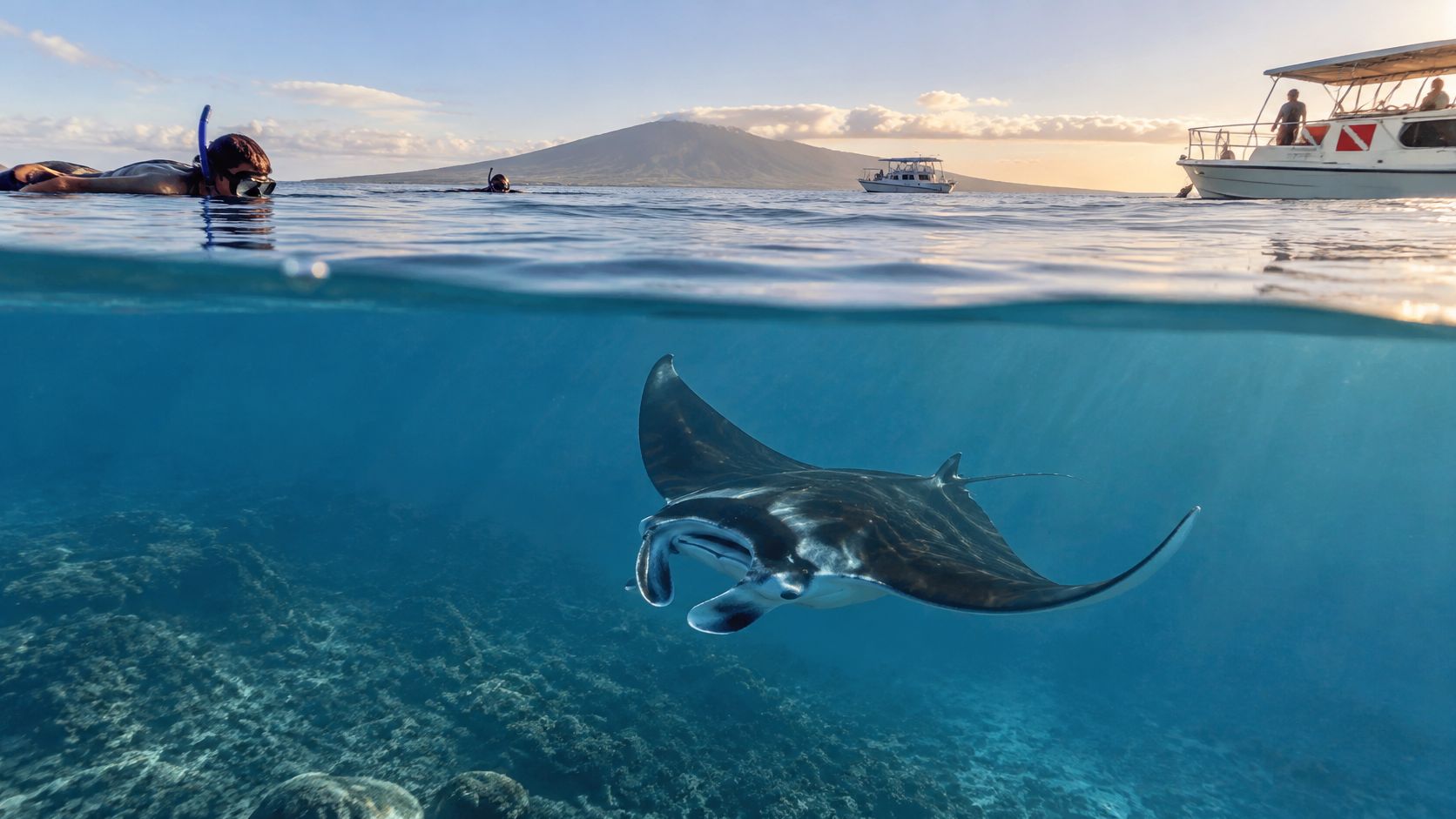
Snorkelers watch from the surface, looking down through the lighted water as rays pass below. There's no scuba certification requirement, but you should be comfortable swimming in open water at night and able to follow the crew's directions. A float gives snorkelers a stable place to hold while they watch.
Mixed groups can share the boat and the same viewing site, with divers below and snorkelers above. That makes the experience practical for families or travel companions with different qualifications. For a more detailed comparison of the two approaches, see this guide to snorkeling versus diving with manta rays.
When Plankton Beats the Calendar
Kona manta encounters are available year-round, but a month on the calendar can't tell you how many rays will appear on a given night. Zooplankton density is a stronger clue to aggregation size than the season alone. Two evenings in the same week can look very different if feeding conditions change.
Season still matters for ocean comfort. Winter, roughly December through March, can bring larger north and west swells; a protected cove may remain more comfortable than an exposed site, but sufficiently rough conditions can still affect a boat trip. Spring and summer, about April through September, are often calmer and warmer, which can make the evening easier for first-timers. Fall can also be a good fit for visitors looking for a quieter-feeling trip.
Daytime water clarity isn't a reliable forecast of how many mantas will feed at night. A plankton-rich evening can produce strong activity even if the water looks murky, while clear water alone doesn't mean prey will be concentrated under the lights. For more on timing, read this guide to the best time to see manta rays in Kona.
No operator can honestly guarantee a manta sighting. A quiet night doesn't mean the population has disappeared.
If your visit is short, book an earlier night in your stay so you have more flexibility if weather affects plans. If you can make room for a second outing, it may show how much the feeding scene can change at the same site. Before reserving, ask which site is planned for the night, what swell conditions are expected, and what the operator's policy is if rays don't appear.
Watching Without Crowding the Rays
Crowding is more than a vague complaint. In a survey of 444 manta viewers, 82% felt crowded by snorkelers, 78% by boats, and 69% by scuba divers, according to a NOAA recovery-status review for giant manta rays. The same review described proposed site rules that would limit commercial boats and passengers, set a guide ratio and viewing period, and include lighting requirements, propeller guards, and a safety lookout. These were proposed limits, not a claim that every listed rule is currently in force.
| Crowding signals and proposed site limits | Measure | Figure |
|---|---|---|
| Viewers who felt crowded by snorkelers | Survey response | 82 percent of 444 |
| Viewers who felt crowded by boats | Survey response | 78 percent of 444 |
| Viewers who felt crowded by scuba divers | Survey response | 69 percent of 444 |
| Proposed commercial boats per site per day | Site limit | 24 |
| Proposed passengers per site per day | Site limit | 60 |
| Proposed guide ratio | Customers per guide | 1 guide per 8 guests |
| Proposed viewing limit | Time and operating window | 2 hours inside 4 p.m. to 4 a.m. |
Guest behavior can keep a close encounter from becoming a collision or disruption. Follow these rules:
- Stay in your assigned spot. Divers should remain in the viewing area; snorkelers should stay at the surface with the float.
- Never touch, ride, or chase a manta. A ray needs to feed and move freely.
- Keep gear out of its path. Don't swing fins or cameras into the animal's route, and don't block its exit.
- Control your position. Divers should avoid stirring up sand or drifting into the viewing circle.
- Follow the briefing. Don't leave your spot for a closer pass.
- Let the crew manage the boat. Predictable routes and cautious speed matter around surface-feeding animals.
Safety and etiquette go together. Before boarding, confirm that the boat has a safety lookout and propeller guards. Enter the water only when the crew calls you in, stay close to your buddy or float, and surface slowly if a ray or light catches you by surprise. For a practical guide to responsible, considerate diver etiquette, focus on the same basic principle: give wildlife a clear path, even when a closer pass looks tempting.
Packing and Photographing the Pass
Pack for a dark, wet boat ride rather than a sunny beach day. A warm layer and towel make the ride back more comfortable, and a rash guard or thin wetsuit helps if you'll be in the water after dark. Bring your own mask if rental fit is a concern. Reef-safe sunscreen belongs in your daytime kit; you don't need to apply a fresh coat for a night trip.
If boat motion is a concern, plan ahead rather than waiting until you feel ill. Options include a Ship-EEZ Seasickness Patch, Dramamine pills, Bonine pills, Sea-Band wristbands, and ginger chews. The Sea-Band link is a lower-cost generic option that often receives good ratings. Take medication before boarding if that's how its label directs, and follow the product instructions.
For camera gear, choose a wide-angle action camera or a compact camera secured in a tray. Continuous video can capture a slow pass without the repeated flash of still photos; keep the camera strap secured to your wrist. Avoid pointing a bright light or strobe at a manta, and don't leave your assigned position to follow a ray for another frame.
The cleanest shot is usually a calm pass through the existing beam, with the manta filling the frame and other guests clear of its path. The goal isn't to control the animal's movement, but to be ready when it crosses the light. For more about a Kona manta night dive with a photo package, consider how you'll secure and use your camera before entering the water.
Pack check: warmth, motion plan, mask, camera secured.
Choose a Crew and Book the Night
A responsible manta operator should meet five practical standards:
- Choose a sheltered site when conditions favor it. Our go-to manta dive site is Garden Eel Cove, a protected location with a good viewing area, healthier reef, and generally calmer conditions.
- Brief guests before entry. Explain passive observation and how to stay in position.
- Keep divers in a defined viewing area. Guides should be in the water with divers.
- Prioritize boat safety. Look for a safety lookout and propeller guards, and ask how the crew handles site capacity.
- Be candid about wildlife. No wild animal can be guaranteed; the operator should explain what happens if rays don't show.
Kona Honu Divers runs its manta dive with lights on the seafloor, divers kneeling in the viewing area, and snorkelers at the surface. The crew briefs guests on passive observation, and experienced divemasters and instructors are in the water with divers. Divers have seen manta rays on 92% of Manta Ray Night Dive trips, though that record doesn't guarantee an encounter on any particular evening. You can book the 2-Tank Manta Dive & Snorkel, explore other Kona scuba diving tours, or use this guide to choosing a Kona diving company.
For a surface-only outing, Kona Snorkel Trips offers a way to watch from above the light circle without scuba certification. The snorkel format suits people who are comfortable in open water at night and want to see the feeding passes from the surface.
Book the earlier night of your trip if your schedule allows, leaving room to adapt if sea conditions change. Before boarding, reread the no-touch rules and be ready to watch without chasing the rays.
Kona Honu Divers offers a 2-Tank Manta Dive & Snorkel tour at Garden Eel Cove, with a guided dive and a surface option for snorkelers. Visit Kona Honu Divers to plan a manta night built around a protected site and respectful wildlife viewing.