
You're on the deck at dusk with wet hair, a heavy wetsuit, and one question that matters: will this night produce photos you want to show, or just dark frames from a crowded boat? A Kona Manta Night Dive with Photo Package can give you both the encounter and the files, but only if the operator is clear about what is shot, how much gets edited, and when you receive it.
Kona's manta dive is documented, not random. A multi-year photo-identification study documented a stable manta aggregation at the two main Kona sites, which is why repeat encounters and repeatable framing are realistic goals, even though weather, visibility, and low manta activity still shape the final gallery.
The seat price buys the whole sequence, from gear fitting to the hour in the lighted zone. That is what you are paying for, plus the chance that someone on board is watching the scene, selecting usable angles, and turning a crowded, low-light dive into a set of deliverables you can share.
What a Kona Manta Night Dive with Photo Package Includes
A diver steps onto the boat at sunset, not midnight. That timing sets the entire package. Check-in comes first, then gear fitting, a short briefing on boat etiquette and light handling, the ride out, and roughly one hour in the water inside the lighted feeding zone, with typical dives beginning around 18:00. If you buy the photo package, you are paying for that full sequence and for a usable gallery at the end, not just a seat on the boat.
What you should expect the package to cover
The useful version of a manta photo package gives you clear deliverables. Ask whether the package includes staff-shot stills, guest-shot images from a rented housing, or both. Ask whether the final files arrive as edited JPEGs, RAW files, or a mixed gallery. Ask how delivery works, email, download link, or cloud gallery, and how long turnaround usually takes.
Practical rule: if an operator won't say who shoots, who edits, and how the files get delivered, the package is too fuzzy to buy.
That detail matters because the value is in execution. Someone on board needs to watch the scene, shoot through changing light, and sort the strongest frames after the trip. In a crowded night dive, a crew member with a camera usually gets cleaner shots than a guest juggling buoyancy, gloves, and a rental housing.
Expect the operator to set limits too. A serious package says what happens if the mantas stay distant, if the group is too dense for a clean angle, or if visibility drops. Weather, crowding, and low manta activity all change the final gallery. The goal is not a fantasy promise, it is a realistic photo set from a difficult environment.
The NOAA study PDF NOAA study PDF helps explain why repeat encounters can happen here, but it does not change the practical reality underwater. Some nights produce tight, dramatic frames. Other nights produce fewer usable images and a smaller edited set. Good operators tell you that upfront.
How the Manta Encounter Works
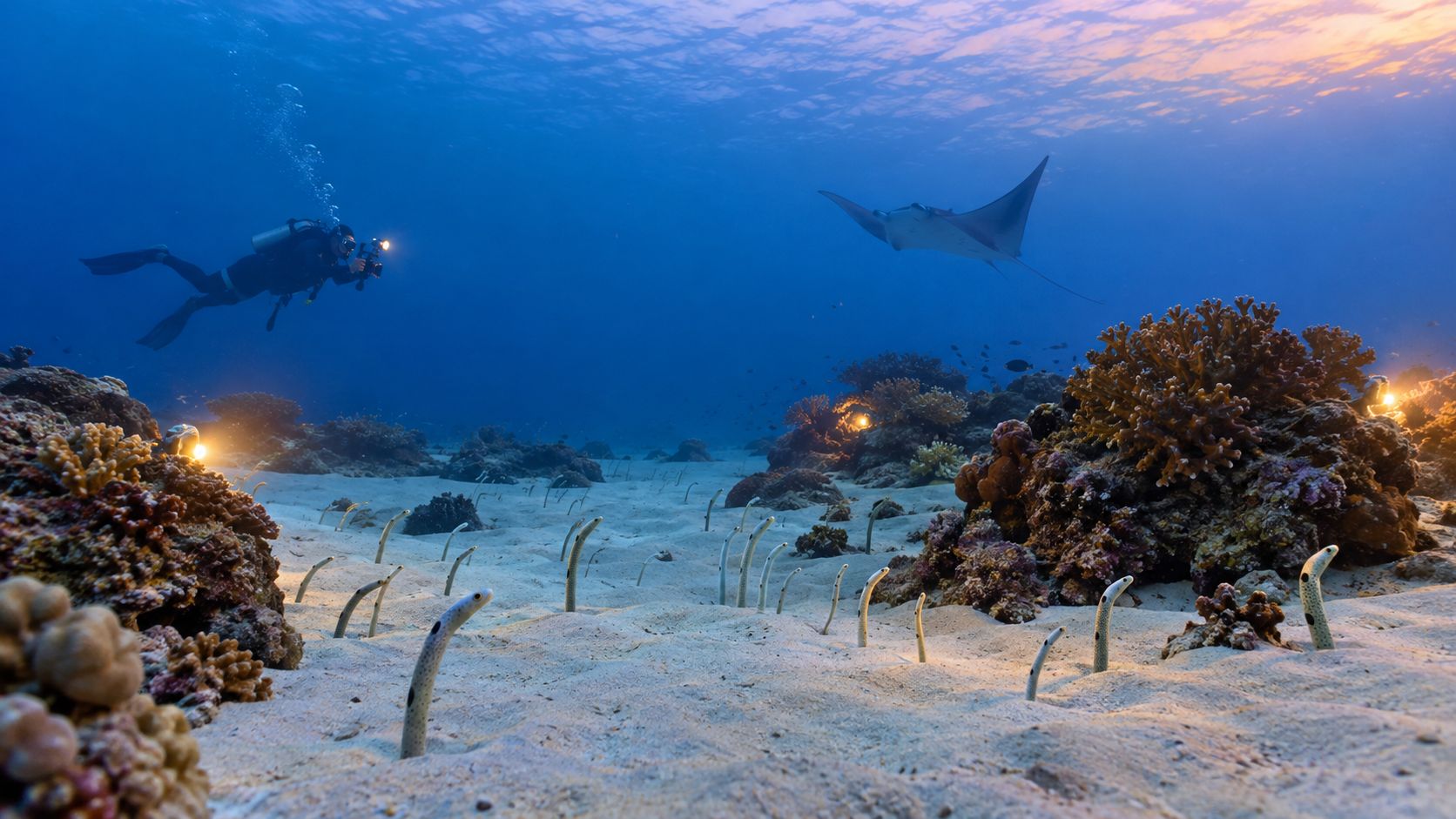
Manta rays feed at night. After dark, zooplankton rise into the water column, and the dive lights concentrate that food in the beam, which draws mantas in to feed (NOAA feeding mechanism brief). The lights work like a dinner table rather than bait: the plankton gather in the illuminated water, and the mantas decide whether to join.
What to watch for underwater
The cue is easy to spot once you know it. A feeding manta opens wide, unfurls its cephalic fins, and makes slow, repeated passes through the lit zone. That is the shot. Chasing the ray ruins your angle and usually ruins the frame.
Hold position, stay neutrally buoyant, and let the animal choose its line. That gives the photographer time to pre-compose, wait for the manta to enter the light, and keep the subject clean instead of filling the image with motion blur and backscatter. In a crowded night dive, a crew member with the right position usually gets stronger coverage than a guest trying to steer a housing at the same time.
The best manta images usually come from patience, not pursuit.
Use a wider frame than you think you need. The strongest image often shows the manta, the light field, and enough surrounding water to explain the feeding pattern. Tight crops can look dramatic, but they flatten the scene.
For a more detailed look at the Kona manta setup, the operator's manta overview at Kona Honu Divers' manta page shows what the crew is trying to create in the water.
Why Garden Eel Cove Is the Superior Site for a Photo Package
Garden Eel Cove, also known as Manta Heaven, is the better site for a photo package because it gives you a cleaner working environment. The cove sits in a more protected setting than the exposed alternative, and the documented dive area is about 36 feet deep with roughly 50% coral cover (Hawaiʻi site survey). That combination matters when you're trying to stay stable, keep strobes off-axis, and frame a manta against something other than black water.
Why the site layout helps photographers
Protected water is easier to hold position in. A steadier platform means less drift, fewer accidental fin kicks, and a better chance of keeping your subject in the light. The reef texture also gives your images structure, so the manta doesn't float in a featureless void.
Garden Eel Cove also has the right reputation for a manta-focused night. A long-term community-sourced record reported more than 23,000 sightings of 167 individual mantas at Kona's two principal nighttime sites, and it noted that Garden Eel Cove generally supports larger aggregations while Keauhou shows strong female site fidelity (community-sourced assessment). That distinction matters for photography because bigger aggregations usually give you more passes, more angles, and more chances to recover from a missed frame.
Keauhou, by contrast, is the calmer, more sheltered site, but calmer doesn't automatically mean better for the photo package you're buying. If your goal is the strongest mix of reef context, stable positioning, and a higher chance of a more active scene, Garden Eel Cove wins.
My take: book for the photo outcome, not just the map pin. Garden Eel Cove usually gives you the cleaner frame.
The site choice also affects how long you can remain composed and ready. A stable viewing patch lets the crew manage the light field while photographers work the same scene through multiple manta passes instead of scrambling after moving animals.
Who the Manta Night Dive with Photo Package Is For
If you are certified and steady in open water after dark, you fit the core audience. Divers work the bottom of the light column, while snorkelers stay at the surface with crew support and a surface view of the mantas. On our trips, that split is clear: divers get the underwater angle, snorkelers get the top-down view.
The photo package makes the most sense for people who want a usable record of the night, not just a memory. It is a good fit if you want staff-shot coverage, cleaner framing than you can manage on your own in low light, and a set of images that reflects what the crew could capture in that water.
Self-check before you book
- Comfort at night: If dark water makes you tense, the photos will not change that.
- Medical readiness: If motion or pressure changes usually bother you, sort that out before boarding.
- Personal dive comfort: If you are rusty, a calm reef dive earlier in the trip is smarter than jumping straight into a photo-driven night charter.
- Surface-only versus underwater: Non-certified snorkelers should expect surface viewing, not the bottom-up shots that come from the diver position.
Match the package to your role on the trip. Certified divers usually get the strongest perspective because the camera can face upward into the lit column. Snorkelers can still leave with strong keepsakes, but the delivery is different, with more surface context and less dramatic upward framing.
Experienced divers should keep one thing in mind. Skill helps, but slow buoyancy, disciplined positioning, and a crew that keeps the group from spreading out in the light field matter more for clean photos. That is what separates a sharp set of images from a cluttered one.
What the Photo Package Delivers and What It Cannot Promise
A serious package should spell out the deliverable in plain language. Ask whether the trip includes staff-shot stills, how many edited files you receive, what resolution the gallery is delivered in, and whether you get a direct download or a hosted link. Ask whether you can bring your own camera housing or whether the operator expects the crew to capture the key images for you.
| Photo Package Expectations vs Nightly Variability | What Can Change It |
|---|---|
| Edited stills or gallery link | Crew workload, group density, and how much action happens in the light field |
| Staff-shot versus guest-shot coverage | Whether you can hold position and whether the operator has a dedicated photographer |
| Consistent color and sharpness | Water clarity, backscatter, and how well strobes are placed |
| Fast turnaround | Editing queue and how many other trips ran that night |
| Wide, dramatic manta frames | Manta path, crowd spacing, and whether the animal stays in the zone |
| A usable set of images | Weather, equipment issues, and low manta activity |
The reason the images vary is technical, not mystical. Water removes red first, then orange and yellow, so night images go blue and flat without artificial light (underwater lighting fundamentals). Strobes bring back color, and off-axis placement limits backscatter from suspended particles. If the operator's lights are poorly placed, the photo package will show it.
How to judge the shooting style
Look for broad-angle framing and enough working distance to capture the manta's full wing span. A good operator won't force a cramped portrait at the expense of subject space. The frame should show the ray, the diver lights, and the feeding geometry, not just a cropped animal in dirty water.
The biggest mistake is treating every night like a studio shoot. You can't control plankton density, crowding, or the animal's path. A good package acknowledges that variability upfront and gives you usable images even when the scene isn't perfect. For examples of how Kona photography is framed in practice, see the operator's manta photo package guide.
Preparation, Packing List, and Managing Seasickness
Pack for comfort first, camera second. A 3mm wetsuit is the normal comfort baseline for this kind of night, and a hood is optional if you run cold. Bring anti-fog, fresh mask defog, dry clothes for the ride back, and a small towel you don't mind getting salty.
What actually belongs in your bag
- Exposure protection: swimsuit, 3mm suit if you're sensitive to cold, and a hood if you want extra warmth.
- Mask care: anti-fog and a backup mask strap if you travel with your own gear.
- Boat comfort: dry layers, especially a light jacket or hoodie for after the dive.
- Camera decisions: only bring a personal camera if you already know your controls by touch.
- Hydration and snacks: enough water for the boat ride, nothing messy.
Seasickness deserves real attention. The boat ride is short, but the entry and exit can still feel lurchy, and a queasy stomach ruins fast. If you know you're prone to it, sort it out before you leave the dock with the Ship-EEZ Seasickness Patch, Dramamine pills, Bonine pills, Sea Band wristbands, or ginger chews.
Take your seasickness plan seriously. If you wait until you feel bad, you're already behind.
A quick packing check makes the night easier:
- Swimsuit on under your clothes.
- Dry layer for the ride home.
- Mask gear, anti-fog, and any prescription items.
- Seasickness prevention if you need it.
- Camera only if you can operate it without thinking.
For more comfort-focused trip prep, this seasickness guide is the right place to start before you board.
Pricing, Booking Tips, and How to Choose an Operator
The right operator is the one that tells you exactly what the night can and cannot do. For a manta photo package, ask about boat capacity, crew-to-guest ratio, whether there's an in-house photographer, and how the gallery is delivered. The boating side also matters because state rules shape the night, commercial operators need the proper permits, day-use moorings can't be occupied for more than 2.5 hours when another vessel is waiting, anchoring is prohibited within 100 yards of a day-use mooring, and vessels must run at slow-no-wake speed within 100 feet of a displayed dive flag when divers or swimmers are entering the water (boating operations and safety assessment).
What to ask before you pay
- Is the photo work staff-shot or guest-shot?
- How many edited files are included?
- How are the files delivered, and when?
- What happens if manta activity is low?
- How does the operator handle crowding around the light field?
- Do they explain their contribution to identification or monitoring records?
Those questions tell you more than a star rating ever will. A transparent operator will answer cleanly because they know the night is shaped by biology and boat rules, not marketing copy. If they dodge the question about low-activity nights, assume the photo package is selling certainty it can't provide.
The business case is simple. Small groups improve positioning, dedicated camera support improves consistency, and good logistics reduce wasted time at the site. If you want to compare trip style and operator discipline before booking, the Kona diving company guide is worth a read.
Kona Honu Divers runs a manta-oriented two-tank option that combines an afternoon reef dive with a manta night dive, and it's one way to bundle the day around the same theme if you want your trip organized around the experience rather than piecing it together yourself.
Frequently Asked Questions About the Manta Photo Package
Do you tip on a manta charter? Yes, if the crew handled your trip well. Tip the people who made the night run smoothly, especially if the photographer, captain, and in-water guide kept the group organized and the images usable.
Can you do the same site twice on one trip? You can, but you shouldn't assume the second night will look the same. The manta aggregation shifts with nightly conditions, so the value of a repeat trip is in giving yourself another chance at a cleaner scene, not replaying the exact same show.
Does visibility change by month? It can, but the important part is that manta activity tracks natural conditions and plankton availability, not a fixed calendar. The better question is whether the operator is honest about tonight's conditions and how that affects photography.
Can you fly the next day? Most divers plan a recovery window before flying. Don't compress your schedule if you can help it, because a relaxed next day is better than trying to pack, check out, and head to the airport right after a night dive.
If you want the strongest chance at a clean manta gallery, stop shopping for vague promises and book a trip that treats photography, animal behavior, and boat handling as one system. Kona Honu Divers runs manta-focused dives and can help you line up the right night for the conditions, the crew, and the kind of images you want.
If you want a manta dive that respects the animals and still gets you the shot, book with Kona Honu Divers. They run manta-oriented trips on the Big Island, and that makes them a practical choice when you want a photo package that fits the dive instead of fighting it.