
You're on the couch with a Kona tab open, and the group chat is already split. One person has never put a mask on after dark. Someone else has an Open Water card and wants to kneel on the sand. Both of you typed manta ray swimming Hawaii into the same search, and every listing sounds like a private show with a different price.
It isn't a show. It's a guided night on the Kona coast, where lights gather plankton and reef mantas come in to feed if the food is there. Some nights the water is busy. Some nights a handful of rays pass, or the plankton thins and the night stays quiet. I would rather book a sheltered site and a crew that holds people in place than chase the listing that sells the closest pass.
Manta Ray Swimming Options Compared in Hawaii
Swimming with manta rays in Hawaii, for nearly every visitor, means that guided Kona night. Crews light the water, plankton collects, and the rays follow the food. You don't hand them anything, and you don't swim after them.
Four common ways to spend the evening, or to skip the night entirely, look like this.
| Experience | Where you are | Skill level | Best for |
|---|---|---|---|
| Manta Ray Night Snorkel | Surface, looking down into the feeding column | Comfortable snorkeler; flotation helpful | Families and first-timers |
| Manta Ray Night Dive | Kneeling on the sandy bottom in the viewing area | Certified diver, beginner to advanced | Divers who want closer views |
| Blackwater Dive | Deep open-water night dive | Experienced certified diver | Divers seeking a more demanding night dive |
| 2-Tank Morning Dive | Daytime reef dives | Certified diver | Reef life when mantas are not the goal |
Snorkeling and diving are the same feeding event from two heights. Snorkelers float and look down. Divers kneel in a set viewing area and look up. The animals and the rules stay the same. Gear, certification, and the angle of the view are what change. If the group is stuck between those two seats, this snorkel or dive comparison lays out comfort, time in the water, and what each person actually watches.
Which seat fits the person
The night dive is the one most certified guests should start with. You stay in one place, guides stay with you, and the dive suits beginners through advanced divers. Snorkelers on a mixed charter stay at the surface, so the group doesn't need two boats.
Blackwater is a different job. You're off the reef, in deep open water, looking for small midwater animals rather than mantas over sand. Save the Blackwater Dive for divers who already like dark, deep water. Divers who want a longer daytime run to remote reef, once local sites feel easy, can look at the premium advanced 2-tank trip. A morning two-tank is for reef fish, lava, and, on the right site, turtles or spinner dolphins. Treat it as daylight diving, not a backup manta plan.
Sightings stay wildlife observations. Choose by certification, how you feel in dark water, and whether you want the surface or the sand. Don't choose by a promise that a ray will brush your mask.
How Night Manta Encounters Work in Kona
Think of a porch lamp on a summer night. Bugs pile into the glow, and something larger shows up to eat. Underwater lights do the same job. As WHOI's Oceanus account of Kona's rays describes it, the lights concentrate plankton, and reef mantas follow that cloud. They're filter feeders. They swim through the lit water with mouths open, keep the plankton, and pass the water out through their gills. At one Kona site, large numbers started showing up after a hotel put decorative lights underwater about 30 years ago.
Those lights are an observation aid. They aren't bait, and they aren't an invitation to touch, chase, or block an animal.
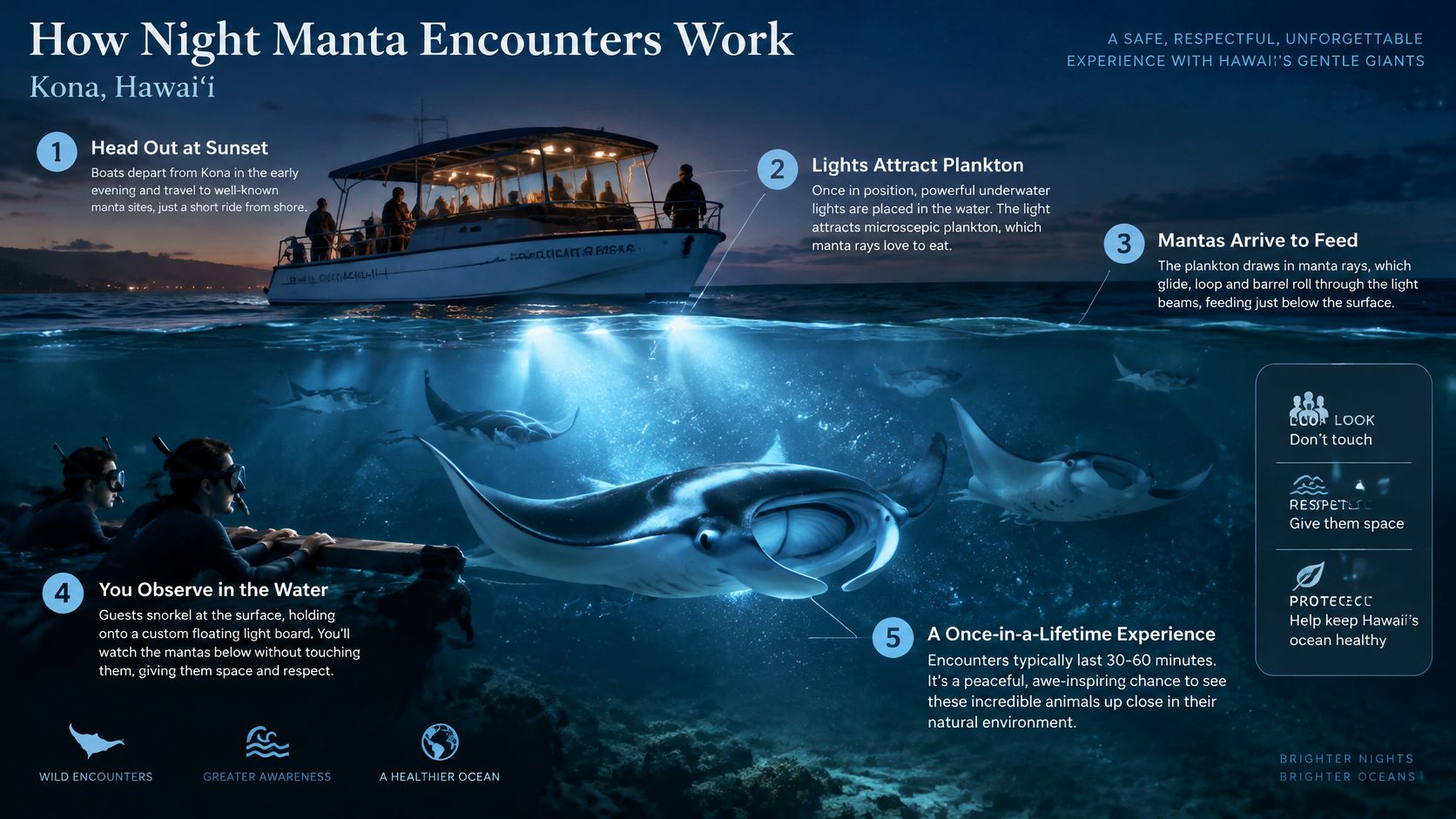
A typical night from the dock to the last pass
- Briefing first. The crew covers the science of what you're about to see and the rules of passive observation before anyone zips a wetsuit.
- Gear, then lights. Masks, fins, and tanks get a check. You enter as the lights come on, not while you're still sorting a strap in the dark.
- Two heights, one area. Divers settle on the sand in the viewing area. Snorkelers stay at the surface on the lit boards.
- A bright circle, not a blackout. Powerful dive lights throw a bright circle on the seafloor, so you aren't kneeling in complete darkness.
- You hold still. Rays arrive on their own schedule, loop, and line up to feed. Your job is a quiet body and a predictable outline.
- Guides run the clock. Experienced divemasters and instructors are in the water on our night dive, and they keep people in position until the encounter ends.
Practical rule: If you drift out of the viewing area to “get a better look,” you become the thing the next ray has to dodge.
A fat plankton cloud and a thin one won't produce the same night, even on the same sand. That's why two evenings with the same crew can feel completely different, and why holding your spot matters more than swimming toward the first white belly you see.
Where to Swim With Manta Rays and When
For the night dive, Garden Eel Cove (also called Manta Heaven) is the site I want. It sits near the airport over a broad sandy bottom, at roughly 30–45 feet, with divers around a light and snorkelers above illuminated boards. Kona Honu Divers' site notes on manta diving lay out why that layout works. Sand gives you a place to settle without hovering over living coral. The light builds the plankton-rich column the mantas use. Reef structure is close, so the night isn't a random open-water drop.
The cove is also naturally sheltered from the open ocean, which means calmer, clearer water than an exposed site on the same evening. That protected feel, the defined viewing area, and the nearby reef are why it's the superior choice for the manta dive. We often take the manta charter there. The 2-tank manta dive and snorkel is built around that kind of night, with a daytime reef tank in the same outing when you want both.
What the long record shows next door
Keauhou is the other site in the long Kona record, and it doesn't behave like a copy of the cove. A University of Hawaiʻi at Mānoa study used community observations from 2010 through 2022: more than 23,000 sightings of 167 individually identified reef mantas at Garden Eel Cove and Keauhou. Garden Eel Cove consistently held the larger nighttime aggregations. Keauhou was visited mostly by females, with strong female site fidelity. Prey density drove how big each gathering got. The local groups stayed relatively stable even with tourism on the water.
| Site | Setting | What the research or operator shows |
|---|---|---|
| Garden Eel Cove | Sandy bottom at about 30 to 45 ft, sheltered from open ocean | Larger nighttime aggregations; recommended site for the manta dive |
| Keauhou | Second Kona night site in the 2010–2022 record | Mostly female visitors with strong site fidelity |
| Kaunaʻoa Bay | Bay outside those two Kona night sites | At least 18 individual manta rays appeared in 2025, per Manta Ray Advocates' 2025 stats |
When to put it on the calendar
Encounters happen after dark. Diving in Kona is possible 365 days a year, so you aren't waiting on a migration season. Aggregation size still shifts with seasonal and year-to-year plankton, which means Tuesday can look nothing like Thursday. Read the best time to see Kona's mantas for moon and season context, then keep a second evening free. Pick the site that matches the trip, and build flexibility into the date.
Safety, Skill Levels and What to Bring
Closer is not better. A ray that has to flare, climb, or abort a feeding pass is a worse night for you and for the animal. A University of Hawaiʻi study of Kona manta sites looked at perceived crowding and support for management, which tells you the visitor experience is part of the problem, not only the biology. Earlier years also carried serious safety problems. Later commentary flagged anchors, reef disturbance, and boat-related injuries. I judge a good night by whether people stay put, not by how near a wingtip comes.
Hawaii marine-life guidance is plain about contact. Don't touch, chase, or harass. Touch can damage the protective mucus layer. Stay inside the designated viewing area so you aren't crossing the feeding lane at a lit site like Garden Eel Cove. Don't swim directly above or in front of a ray. Sudden body movement breaks the path the animal is already using.
Who stays where
- Surface snorkelers: Stay out of the feeding column. Don't duck-dive down into it for a photo.
- Divers: Stay low on the sand. Don't rise underneath a ray that's passing overhead.
- Photographers: Control strobes and buoyancy so you aren't a moving obstacle in the lane.
- Anyone anxious: Ask about flotation, entry, current, group size, and the guide-to-guest setup before you pay.
Permitted operators, caps on boats and guests, guide supervision, and a mandatory briefing are the controls that make a crowded site workable. Our night dive is stationary and closely supervised, with guides watching comfort as well as position. The responsible diver etiquette page is worth reading before you pack, because the habits are the same on a manta night as on a reef.
A slightly wider view, fewer kicks, and a body that stays where it was briefed will beat a lunge that empties the light.
What the trip actually expects
Snorkelers should be able to float calmly for ten minutes or more in dark water. Scuba guests need Open Water or higher. Our 2-tank manta charter also requires a dive within the past two years. Blackwater is for experienced divers only. The night dive itself doesn't ask for a fitness test. It asks whether you're comfortable in the water. If mobility is limited, ask us about entry and boarding help before you book. If you can't float calmly in the dark, don't force the night. If you can float and you don't want a tank, take the snorkel.
| Guest type | What the trip expects | What to bring |
|---|---|---|
| Nervous or non-swimmer | Calm floating on the surface with flotation; ask before booking | Mask that fits, snorkel, fins, flotation if provided |
| Confident snorkeler | Relaxed floating in dark water for the full session | Rash guard or wetsuit, towel, dry bag |
| Certified diver | Open Water or higher; dive within the past two years for the 2-tank manta charter | Own gear or rentals, dive computer, logbook, exposure protection |
| Experienced diver | Advanced certification and comfort in deep, dark water for blackwater | Full dive kit, backup light, dive computer |
Pack a rash guard or wetsuit, reef-safe sunscreen to apply before you enter, a towel, a warm layer, a dry bag, and a mask that fits well. Divers add a computer and a logbook. Bring a prescription mask if you need one. Ask which lights, flotation, and rentals are already on the boat so you aren't buying a second of each at the harbor.
Photographing Manta Rays Without Disturbing Them
A frame and a feeding pass are a trade. The dive lights already build the scene, so point the lens toward that bright circle and use a wide-angle lens. You want the ray against the plankton, not a tight crop that only works if you swim into the lane.
Don't fire a strobe into the mouth or across the belly. Hawaii's Division of Aquatic Resources manta page describes how these rays filter with the mouth open, and a blast of light across that ventral corridor can break the stream of water they're using. Drop to low strobe power, or switch the strobe off when a ray passes close. The site lights are enough for a silhouette and a lit belly.
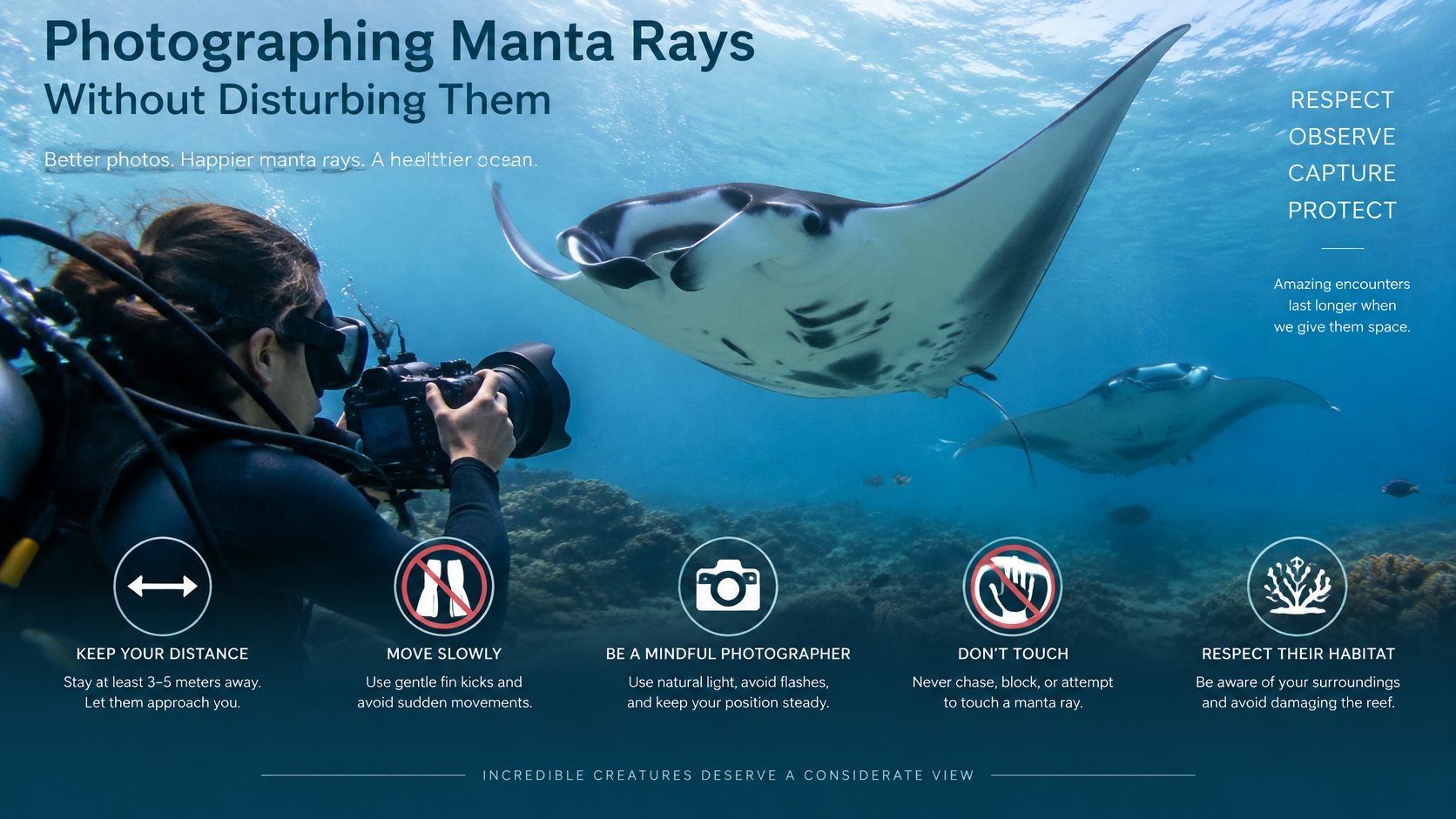
Settings that don't require a chase
Buoyancy beats any menu setting. A kick that lifts sand blurs the frame and can send the next animal wide. Kneel or hover where you were placed and let the ray come to you. Chasing one for a turn is how you ruin the pass for everyone behind you.
Set a manual white balance for mixed blue water and white dive lights. Raise ISO and use a shutter around 1/125 so the wing doesn't smear, then shoot a short burst as the animal banks. Snorkelers do well with a phone in a waterproof housing and the flash off, shot from the surface while they hold the board.
A missed photo is a better result than a ray that leaves the light. If you want a guide who already plans for cameras, the Kona manta night dive with photo package is the trip to book, not a promise that every wing will fill the frame.
Book Your Manta Ray Swim Before It Sells Out
Go back to the options table and match the row to the person, not to the most dramatic photo on the page. Certification or a calm snorkel float decides the trip. Everything else is scheduling.
We run the Manta Ray Night Dive, the Blackwater Dive, and a 2-tank manta charter. The popular nights, including the manta ray night dive, often sell out weeks ahead. Book the date you want, then hold a backup evening for wind or a thin plankton night. Other Kona scuba options sit on our diving tours page, and daytime boats are listed with Big Island boat tours if the rest of the week needs a plan that isn't another night entry.
Check AvailabilityThree steps, then you're done. Confirm the certification or that you can snorkel calmly in the dark. Choose the trip that matches that row. Book on the availability page, and read the briefing notes and flotation policy before the night so the dock isn't the first time you hear them.
Kona Honu Divers runs guided night dives and snorkels on the Kona coast, including the manta night at sheltered Garden Eel Cove, with lights, a briefing, and guides in the water. If manta ray swimming Hawaii is the night you came for, match the trip to your comfort and leave room for a second date. Visit Kona Honu Divers to see the charters and lock the evening in.