
Table of Contents
You're on the harbor dock after dark, wetsuit half zipped, watching other boats motor toward a patch of lights. One person in your group can float for a long time and wants a simple night on the surface. Someone else is certified and wants to kneel on the sand. Nobody wants to chase a wild animal for a closer photo, and nobody wants a night sold as a sure thing.
A manta ray snorkel in Kona works when you treat it as behavior-sensitive wildlife observation. Pick the format that matches how you swim, pick a date with real seasonal evidence behind it, and stay still once the lights are on. Mantas feed when plankton is there. They leave when people block them. I would plan the night around that, not around touching distance.
Choose Between Manta Snorkel and Manta Dive
After dark in Kona you have two ways to watch mantas. The question that usually decides it is practical. Can you float comfortably at the surface, or do you hold a dive certification and want the view from the sandy bottom?
| Factor | Night Manta Snorkel | Night Manta Dive |
|---|---|---|
| Where you watch | Surface, floating above the lights | Sandy bottom, kneeling |
| Certification | Not required | Certified divers only |
| Light role | Shine lights downward | Hold lights above your head to draw plankton up |
| Best fit | Confident floaters who want a simple night on the water | Certified divers who want to watch from the seafloor |
NOAA's voluntary wildlife-interaction standard sets the mechanics. Snorkelers remain on the surface and avoid diving into the feeding column. Divers stay near the sand, rubble, or boulder bottom so open water stays clear for manta maneuvering. Divers hold lights above their heads so plankton rises into the water column. Snorkelers shine lights downward. For a group of four or more snorkelers, the standard recommends a snorkel ring or similar device so everyone stays together above the lights.
Those rules exist so people watch passively instead of chasing or steering the animals. Dropping into the feeding column from the surface, or hovering mid-water as a diver, puts a body where a manta needs to turn.
Decision rule: no certification and a comfortable float points to the snorkel. Certified, and you want the lower viewpoint, points to the dive.
The snorkel needs no scuba certification. It still asks you to be comfortable in open water at night, with a mask on and your face down. If your group is split, read the comparison of whether it is better to snorkel or dive with manta rays before you book one format for everyone.
Best Months and Times to Book
Tour desks often talk as if every night is the same. The seasonal evidence is narrower than that reputation.
| Season | What the 2025 Study Found | Booking Advice |
|---|---|---|
| Summer (June to August) | Higher manta occupancy and eDNA concentrations | Strongest evidence; a good default for seeing mantas |
| Early fall (September to October) | Higher manta occupancy and eDNA concentrations | Strong evidence, similar to summer |
| Late fall (November to December) | No detections at study sites | Highest uncertainty; book a buffer date |
| Early winter (January) | No detections at study sites | Highest uncertainty; confirm reschedule terms |
| Spring (March to May) | Not covered by the 2025 study | Ask the operator for recent sightings |
A 2025 peer-reviewed study found higher manta occupancy and environmental-DNA concentrations in summer and early fall, with no detections from late fall through early winter at the study sites. The same study cautions that environmental-DNA detection does not prove feeding behavior. A strong season is not a guarantee of an active snorkel.
Three claims that are not the same
People mix these up, and they are different statements.
- "Mantas were detected recently" means animals, or their DNA, showed up at a study site. It does not mean they were feeding under lights.
- "Mantas are likely to appear" is a forecast based on season, plankton, weather, and water movement. It can still be wrong on a given night.
- "Mantas are actively feeding at the viewing site" is the only claim that matches the night you came for. Nobody can promise that before you leave the dock.
The date with the busiest tourist reputation is not automatically the strongest biological window. Late summer or early fall has the firmer evidence. Late fall and early winter carry more uncertainty, even when boats still run.
Plankton, weather, and water movement still shape the night inside a good month. A calm evening with plankton stacked in the light is a different trip from a windy one where the animals pass once and leave.
If seeing mantas matters most, book your primary date in summer or early fall, then keep a spare day. In November, December, or January, ask about a buffer date before you pay. For spring, which that study did not cover, ask what crews have seen in the last week. Use this guide to the best time to see the manta rays in Kona when you compare windows, and ask three things: the reschedule policy, what you do if conditions are poor, and recent sightings for any spring date.
Gear, Readiness and Family Questions
Night water feels cooler than the afternoon you swam in, and a leaking mask is harder to fix in the dark. Pack for that, then check yourself candidly.
- Mask: Bring one that seals on your face without you pressing it. Test it in a sink the day before. A new mask with the film still on the lens will fog the whole night.
- Snorkel: A simple dry or semi-dry tube is enough. You will breathe face-down for a long stretch, so a tube you have already used beats a brand-new one you have never cleared.
- Fins: Use your own if you already kick well in them. Rental fins are fine if they do not slip. Loose fins make you kick harder, and hard kicking splashes.
- Exposure: A rash guard or a thin wetsuit. Air on the boat ride back is cooler than the water felt at first.
- Towel and dry bag: A towel for the ride in, and a dry bag for keys and phone. Leave valuables you do not need on shore.
- Reef-safe sunscreen: Put it on before you reach the dock. Sunscreen applied on the boat ends up on masks and on other people's gear.
- Camera case: A waterproof case only if you already know the camera. A new housing on a first night is a distraction.
Confirm which lights and flotation the boat supplies, and whether a flotation vest is available if you are not a confident swimmer. Do not assume every boat hands out the same vest.
A short self-screen
Pass all three before you pay, and have children pass the same three. There is no separate, easier test for a first night.
- Float: You can float comfortably for an extended period with your face in the water.
- Directions: You can follow directions without descending or swimming off on your own.
- Signal: You can raise a hand or call for help without letting go of the group.
No scuba certification does not mean the night is easy. Darkness, open water, cold, a leaking mask, and a crowded light board make surface floating demanding even when you never dive. Hawaiʻi authorities classify giant manta rays as a protected species and ask people to report animals that are injured, entangled, hooked, or distressed. Staying clear of the animal is part of that, not an extra courtesy.
Families, nerves, and the boat ride
Ask about minimum age and flotation before you book a child. A child who cannot float face-down, or who will not stay with the group, should stay on the boat. That is a normal choice, not a failed night.
If you get anxious in the water, signal early. You should be able to exit with a crew member, not by swimming away from the group toward a dark hull. Keep your light visible so the boat can see you, and stay with the group the whole time you are in.
The boat ride is the other filter. If you get seasick, deal with it before you leave the dock, not after the briefing. Read how to avoid sea sickness and pick one option you have already tried on land: a Ship-EEZ Seasickness Patch, Dramamine pills, Bonine pills, Sea Band wristbands (a cheaper generic that often rates well), or ginger chews. Do not stack a new medication with a patch for the first time on this boat.
Practice with a mask and snorkel in shallow, calm water first. If the mantas do not show, a clear explanation of the conditions is not a failed trip, but you should know the reschedule and alternative options before you pay. Staying aboard, or ending early, is an accepted choice. I would rather you do that than white-knuckle a night you are not ready for.
How to Behave When the Mantas Arrive
The night is a success when the manta keeps feeding or traveling without changing course. It is not a success because someone touched it, or because a photo is full-frame.
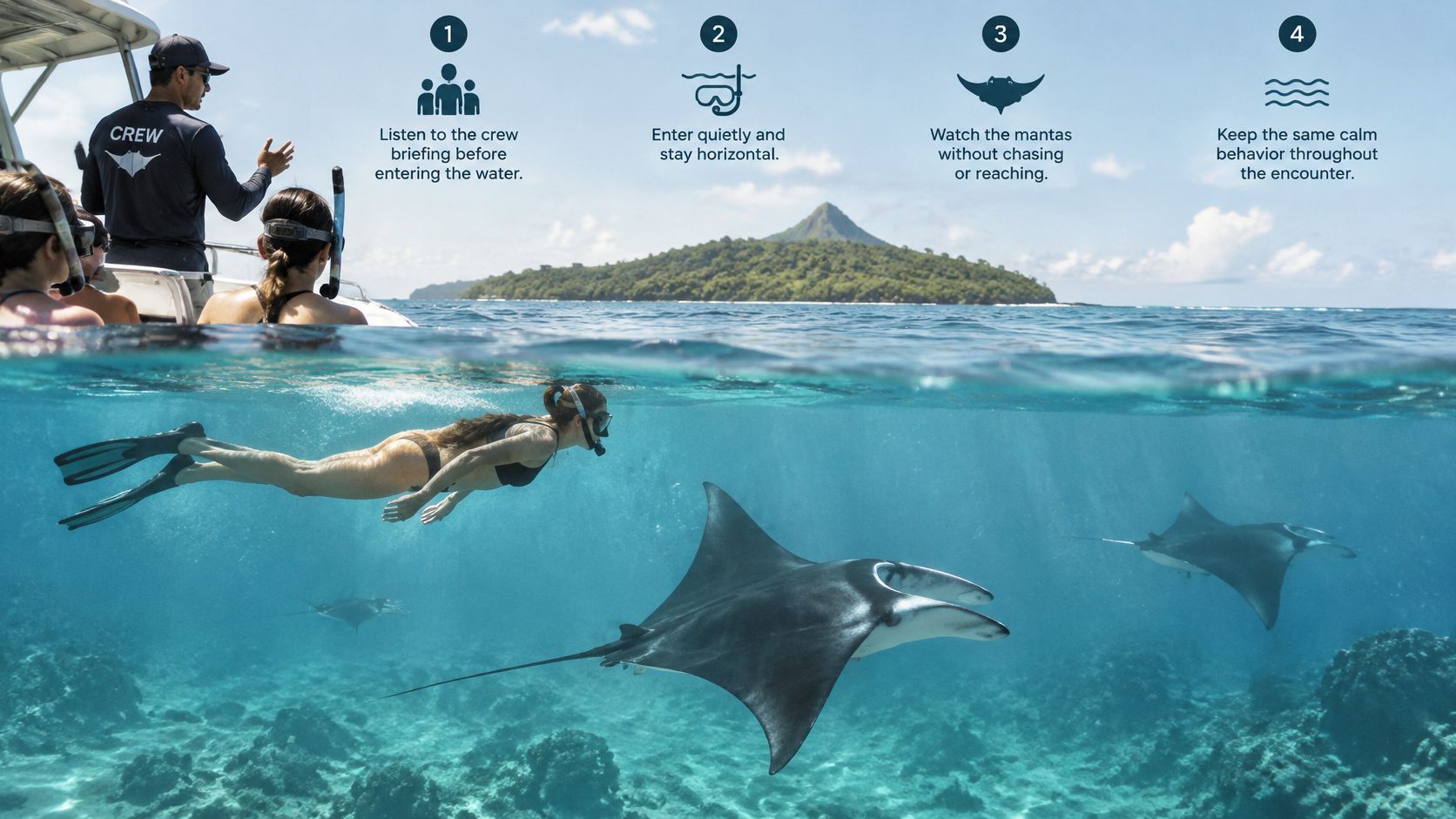
The evening starts with a detailed crew briefing on the science behind the viewing and the golden rules of passive observation. Experienced divemasters and instructors are in the water managing the group, so follow their signals instead of improvising when an animal turns toward you.
- Listen to that briefing before you enter, because the rules are easier to keep when you have heard them on the boat, not while a manta is already in the light.
- Enter without splashing, avoid splashing, and spread sideways rather than stacking into a dense front, so you do not block the lane the animal is using.
- Float still inside your light circle and stay with the group, because drifting out makes the boat's job harder and puts you in the animal's path.
- Let the manta choose its distance and keep at least 3 m (10 ft) back, which is the minimum a Maldives study of human-manta interactions.pdf) supports.
- Approach only from the side. Never swim directly in front, above, behind, or underneath, because those angles cut off the animal's line.
- Keep hands, fins, and cameras controlled, and do not touch the animal. A close pass is the manta's choice, not a cue to reach.
- If it turns toward you, move out of its path and let it come back on its own.
- Stop as soon as it changes course or stops feeding. Create more distance and wait. Do not follow.
That Maldives work looked at 407 human-manta interactions across 138 feeding encounters and 38 interactions across 11 cleaning-station encounters. Cleaning stops more easily than feeding, which is why chasing a close pass is the usual way people ruin the rest of the night. The same habits belong in any responsible diver etiquette you already use on a reef: low impact, no contact, and no blocking the animal's work.
If the manta changes course, stops feeding, or keeps avoiding the group, you are too close. Back off and let it re-approach.
Where to Go and How to Photograph Mantas
Garden Eel Cove is a gently sloping sandy plain broken up by scattered coral heads and lava-rock formations. It is the better choice for the manta dive because the cove is protected, the viewing area is cleaner, and the reef is in better shape than a site sitting in open-ocean swell. A site guide to Garden Eel Cove reports that as many as 10 boats and approximately 80 divers and snorkelers may share that relatively small site at once. Line discipline and buddy contact matter more than they do on a quiet day reef.
A summary of a University of Hawaiʻi analysis of more than 23,000 manta sightings and 167 individual reef mantas from 2010 through 2022 found aggregations stayed relatively stable as tourism grew, and that Garden Eel Cove generally supported larger aggregations than Keauhou. Our go-to for this night is that cove for the same reason: it is consistently calmer and more protected from open-ocean swell, with a good viewing area and healthier reef.
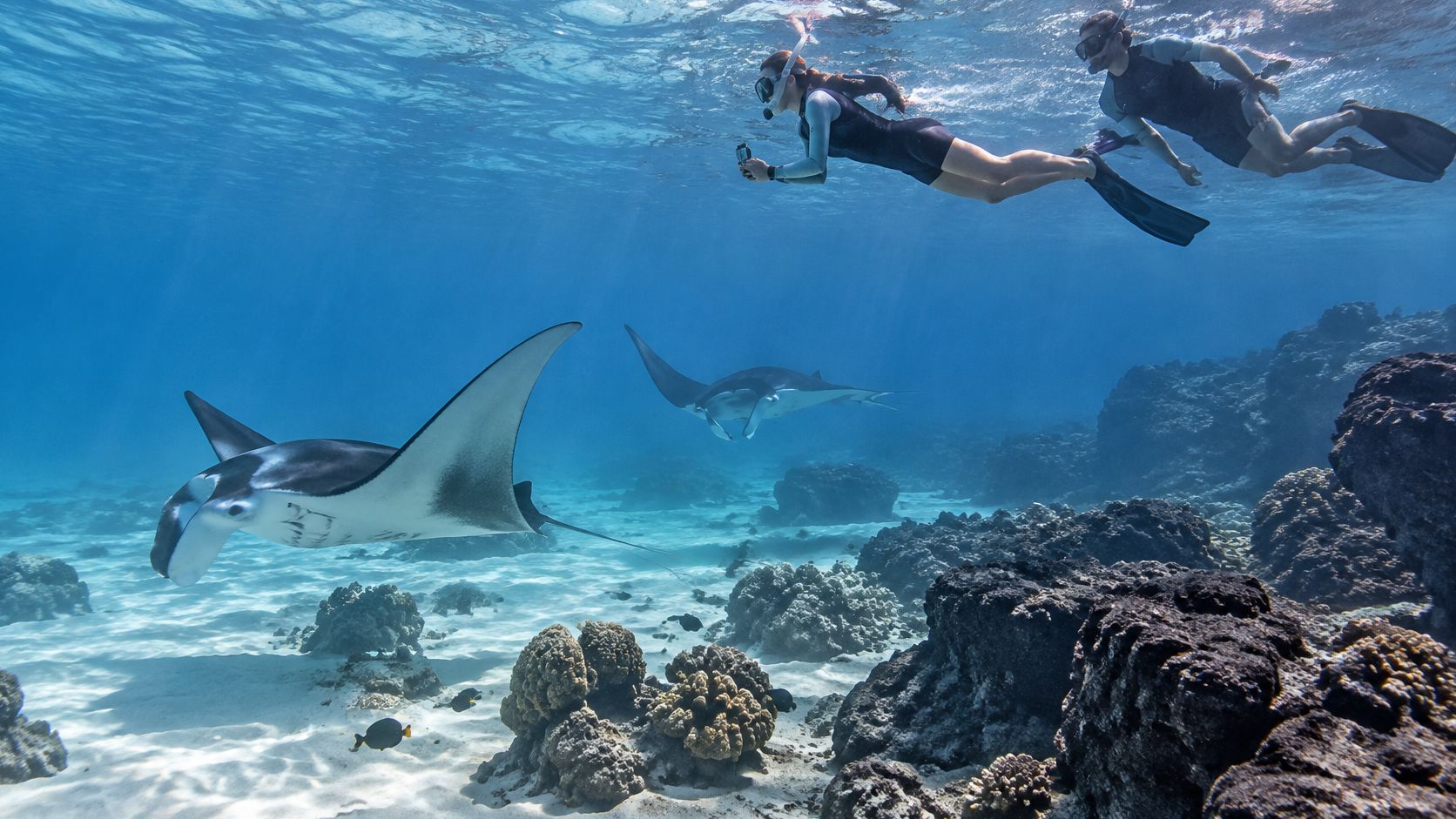
Before you board, ask which site the boat is using and whether that site is protected from swell that night. On the water, keep these rules:
- Primary and backup lights: Carry both. A dead primary light in a crowd of 80 people is how people lose the group.
- Light circle: Stay inside it. The circle is the safe lane and the viewing area.
- Ascent: Come up only on the operator's line.
- Surface: Never surface away from the vessel. Boat traffic and dark water are a bad mix.
For photos, skip flash. It startles animals and ruins the pass for everyone else. Raise ISO and use a fast shutter, because mantas move quickly through the beam. A wide-angle lens covers a close pass without you swimming toward the animal to fill the frame. Tether the camera to your wrist so both hands stay free for fin control. Shoot the animal as it crosses the light. Moving in to "get the shot" is the same mistake as chasing. If you want a guide handling lights and framing, look at a Kona manta night dive with a photo package rather than learning a new housing in the dark.
Book Your Manta Snorkel With Confidence
Three choices set the night. Match the format to your certification and to how well you float. Put the date in summer or early fall, or add a buffer day if you are traveling later. Pack the gear and pass the float, direction, and signal screen before you pay.
We brief every group on passive observation, keep the night stationary, and put experienced guides in the water so people stay safe and comfortable. The night dive is open to beginners through advanced divers, and snorkelers can watch the same feeding from the surface. Certified divers can use our 2-Tank Manta Dive and Snorkel. If you want the wider set of Big Island trips, start from our diving tours. Guests who will float at the surface should book the Kona Snorkel Trips manta snorkel. Confirm reschedule terms and any minimum age before you pay.
Kona Honu Divers runs the manta night from Kona with a crew briefing, a stationary viewing setup, and guides in the water for both divers and surface snorkelers. If you want that kind of night, with the animal left free to keep feeding, visit Kona Honu Divers and check the date that matches your season and your comfort in the water.