
Table of Contents
- Powerful, but Never Guaranteed
- The Porch Light Problem
- What Changes the Odds
- What You're Actually Watching
- Why Garden Eel Cove Gets the Recommendation
- How the Night Unfolds
- The Flag Rules That Govern the Night
- Why Those Numbers Matter at a Manta Site
- Habits That Keep the Group Safe
- Warmth, Fit, and the Gear Check
- Photographing Mantas Without Ruining the Moment
- Tour Selection Criteria
- What One Established Operator Offers Against These Criteria
- What Operators Can Control, and What They Can't
- Your Part as a Guest
- What If No Mantas Appear
- Can Families and Mixed Groups Do This Together
- How Do You Compare Two Tours at Similar Prices
- How Do You Prepare If Night Water Makes You Nervous
You're sitting at the harbor in late light, wetsuit half zipped, trying to decide if you're more excited or nervous. The boat crew is checking lights. Someone next to you asks if the mantas always come, and someone else asks how dark it gets down there. Both are fair questions, and the honest answers shape whether this becomes the night you talk about for years or a cold, crowded hour you wish you'd planned better.
What a Manta Ray Night Dive Is Really Like
The lights come on first. Under the boat and on the bottom, beams cut through black water and catch drifting plankton, tiny specks moving like dust in a flashlight. Then a shadow appears at the edge of visibility, banks inward, and turns white underneath as a manta rolls through the light with its mouth open and wings moving in slow, deliberate strokes.
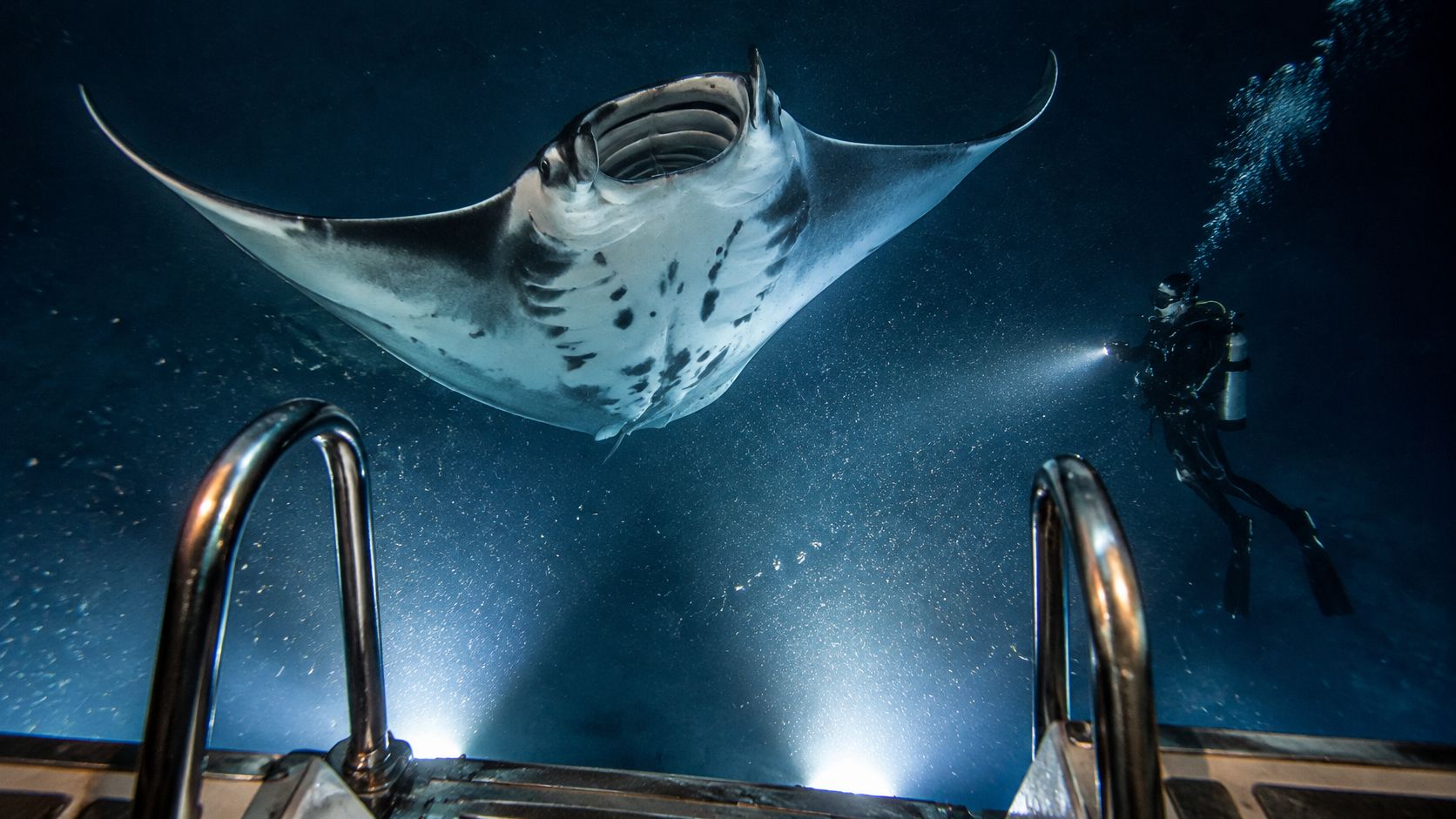
That first pass usually quiets the whole group. Divers settle lower, stop fidgeting, and watch the animal loop back for another turn. You're not chasing anything. You're holding position while a wild animal feeds overhead, close enough that you can see the pattern on its belly and feel your bubbles rising into its path.
Powerful, but Never Guaranteed
Set your expectations there. A manta ray night dive on the Big Island can be sustained and close, with repeated passes through the light, or it can be a quiet reef at night with plankton drifting and no big wings to follow it. Good crews tell you that before you board. Crews that promise a show are selling you certainty they don't control.
What does hold up is the history. Regular manta dives have operated along the Kona Coast since at least the late 1970s, and the attraction grew into a documented local industry rather than a novelty side trip. A Hawaiʻi legislative testimony report states that nine Kona dive shops carried approximately 11,000 snorkelers and divers on manta-ray tours in 2002, generating about $920,000 in direct revenue for those operators, as detailed in the Hawaiʻi legislative testimony report on manta ray ecotourism revenue.
The divers who enjoy this dive most aren't the ones who move the most. They're the ones who settle early, keep the center of the water open, and let the animal choose the distance.
That economic footprint matters for how you judge a trip. This is a mature, busy wildlife operation involving boats, guides, snorkelers, and divers sharing a small lit area after dark. The quality of your night depends as much on positioning, spacing, and crew discipline as on whether a manta appears.
This guide is for first-time recreational divers weighing nerves against curiosity, families mixing divers and non-divers, and experienced divers who want a demanding night done properly. Each group needs a slightly different version of the same honesty.
Why Mantas Come to Kona at Night and When to Go
Mantas aren't coming for the divers. They're coming for zooplankton, the tiny animals they filter from the water in large volumes. Everything about the timing of this dive follows from where that food goes after sunset.
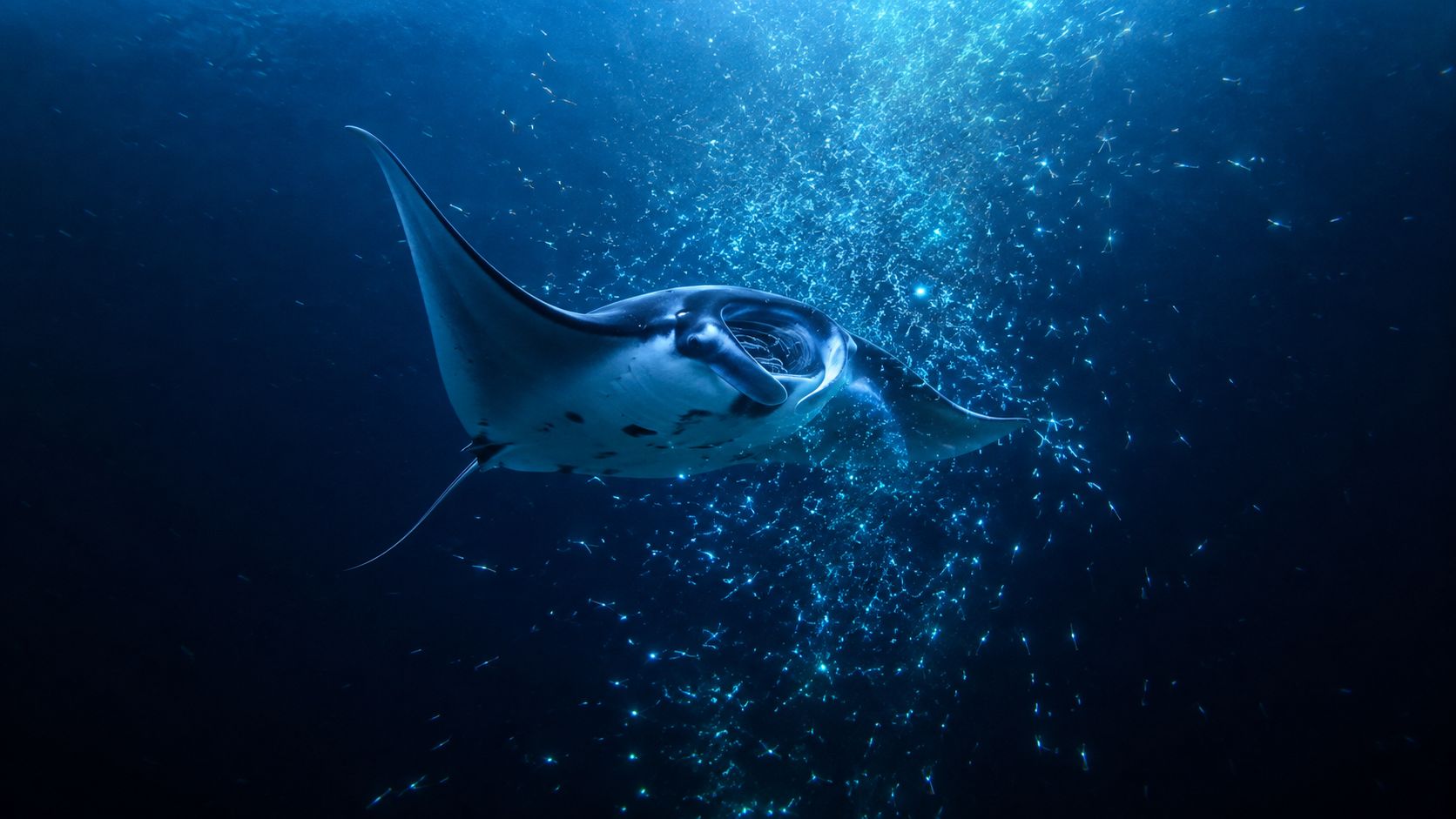
At night, deep-water plankton layers migrate upward, which increases prey accessibility near the surface. NOAA materials associate nocturnal feeding with that upward migration, as described in NOAA research material on Kona manta monitoring and feeding. That vertical movement is the engine of the dive. Without it, you've got lights in empty water.
The Porch Light Problem
Think of your dive light as a porch light on a summer night. The light doesn't create insects. It gathers the ones already nearby into a visible cloud, and anything that eats insects learns to check that spot.
Dive lights work the same way. They concentrate plankton that's already in the water column, and mantas follow the denser food. If currents have swept the plankton elsewhere, or the water column isn't structured in a way that holds it near the site, adding more light doesn't fix the problem. That's why experienced guides talk about conditions first and light setups second.
What Changes the Odds
Several variables shift how well a given night feeds.
- Moonlight: Bright nights can spread plankton behavior differently than dark nights, which changes how tightly food gathers in artificial light.
- Currents: Moving water can deliver fresh plankton into the site or flush it straight through before mantas settle into loops.
- Water-column structure: Layers in the water affect where plankton holds, and mantas feed where the layer is accessible, not where the schedule says they should.
- Weather and surface conditions: Wind and swell affect boat positioning, entry and exit, and how comfortably divers can hold still on the bottom.
None of these can be read accurately a week ahead. That's one reason planning around the best time to see manta rays in Kona works best as a starting point rather than a promise. Conditions get checked on the day, and a responsible operator adjusts the plan or calls the trip accordingly.
What You're Actually Watching
Reef mantas are filter feeders. They swim with mouths open, funneling plankton-rich water across filtering structures, then turn and pass through the densest part of the cloud again. The loops and barrel rolls people remember aren't performance. They're efficient feeding paths through a concentrated patch of food, repeated as long as the patch holds.
That explains the rhythm of a good night. One pass becomes a turn, the turn becomes a loop, and the animal settles into a pattern you can predict well enough to watch. It also explains the gaps. When the food thins, the loops widen and the animal leaves.
Practical rule: Book the calmest, clearest night your schedule allows, and keep a backup night open if you can. Flexibility is worth more than any single forecast.
Divers who build the manta dive into the first part of a Kona stay have room to reschedule if weather closes in. Divers who save it for their last night have no margin. That scheduling choice, boring as it sounds, affects your odds more than most gear decisions combined.
Kona Dive Sites and How the Night Dive Runs
Most guests board before dark, while there's still enough light to sort gear, meet the crew, and hear the briefing without a flashlight in hand. The boat runs out along the Kona Coast as the light fades, and the mood on deck shifts from social to focused. By the time you gear up, you're watching black water for the first sign of movement.
Why Garden Eel Cove Gets the Recommendation
Garden Eel Cove is the superior choice for the manta dive tour because of its protected location, better viewing area, and better reefs. Those aren't abstract advantages. Protection means calmer conditions for holding position, which matters enormously when a dozen divers need to stay low and still in the dark. A better viewing area means the lit feeding space sits where divers can watch animals circling through it without crowding each other for sight lines.
The reef quality matters in two ways. Healthier reef structure gives you something real to observe during an afternoon dive or while waiting for mantas to arrive, so the trip isn't a single-purpose gamble. It also gives the site shape. Divers position around structure rather than spreading across bare sand with no reference points in the dark.
Less protected sites can still produce good nights, and honest guides won't pretend otherwise. The trade-off is comfort and control. More exposure means more surge to fight, more silt kicked up by struggling divers, and a harder time keeping the group organized when an animal makes its first pass and everyone reacts at once.
How the Night Unfolds
The sequence is deliberate, and each step exists for a reason.
- Departure and setup: Crews leave with enough daylight to reach the site, set the boat, and check conditions before anyone enters the water.
- Pre-dive briefing: Guides cover positioning, light discipline, hand signals, and what to do if you feel disoriented or need to surface.
- Descent and entry: Divers go down in an organized order rather than dropping whenever they're ready, so the bottom doesn't turn into a traffic jam.
- Positioning in the viewing area: You settle where the guide places you, keep your fins down and quiet, and leave the center of the light column open for feeding animals.
- Exit with lights managed: Ascents and returns to the boat stay controlled, with lights handled so nobody blinds a buddy or loses the boat in the dark.
The most common misunderstanding happens at step four. New divers expect a roaming tour of the reef. This is a stationary dive. The action comes to the light, and divers who scoot around hunting for a better angle usually silt up their own view and push feeding animals wider.
Operators vary in timing and detail, so confirm the actual plan before you book rather than assuming every boat runs the night the same way. You can compare the structure of the manta ray dive tour against the wider range of Kona diving tours to see how the manta night fits alongside reef and afternoon diving.
Ask one direct question when you call. Where exactly will divers be positioned relative to the lights and the snorkelers above? A crew that answers clearly has thought about the in-water layout. A crew that waves the question off probably hasn't.
Safety, Certification and Diver Flag Rules
A daytime reef dive forgives small mistakes. A night dive with boats overhead, ladders moving in swell, currents pushing through a lit site, and two user groups stacked in the same water column does not forgive them as easily. The mantas themselves aren't dangerous predators. The operational environment is what demands respect.
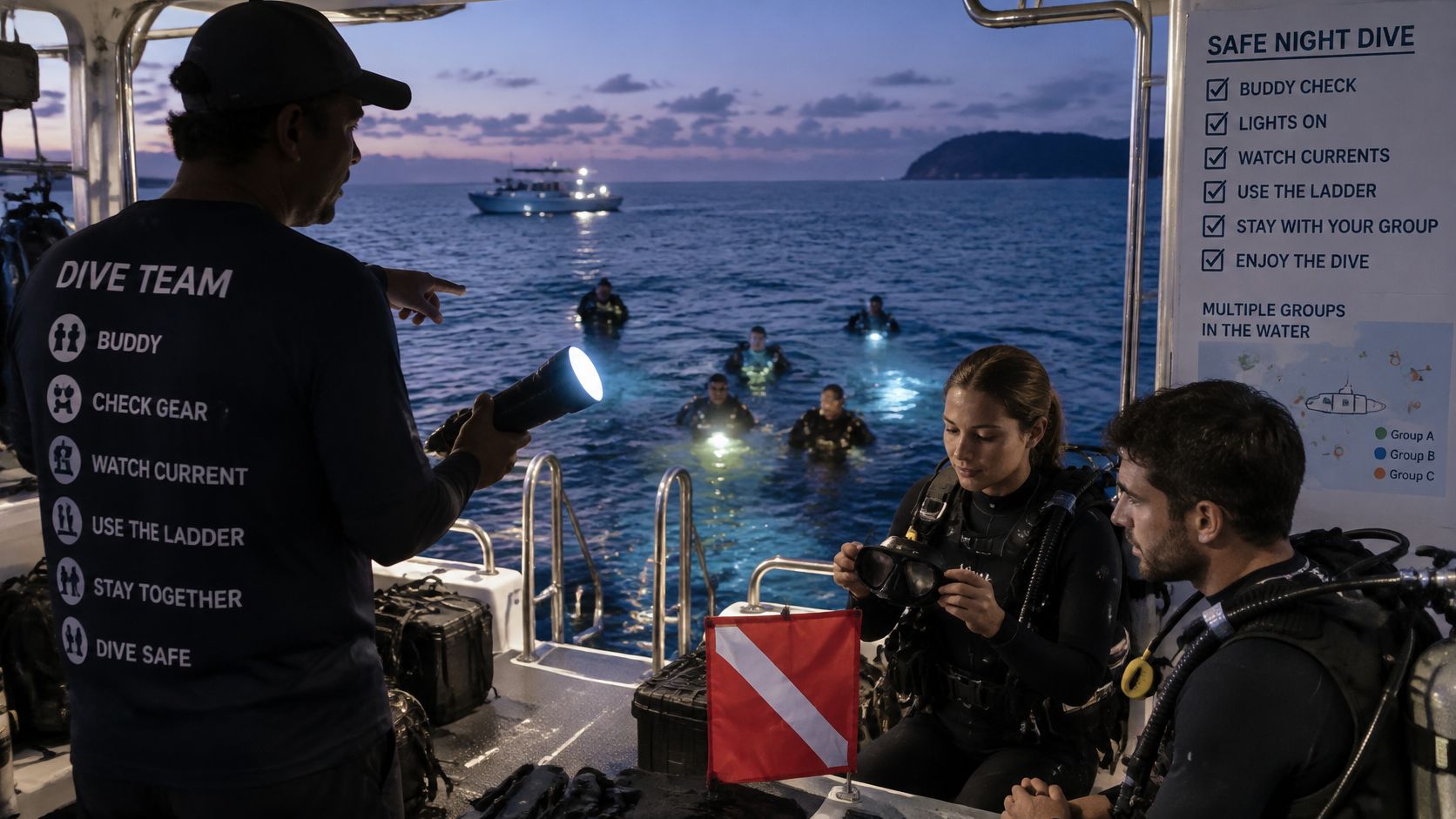
You should be comfortable with buoyancy control before this dive, because hovering poorly in the dark means kicking the bottom, drifting into the feeding lane, or floating up into snorkeler space. Dark-water skills matter too, including reading your gauges by light, signaling your buddy, and staying oriented when your only reference is a beam. Confirm each operator's certification and experience requirements before booking, and if you're unsure where you stand, read up on whether you can scuba dive in Hawaii without certification before you commit money to a trip you may not be qualified to take.
The Flag Rules That Govern the Night
Hawai'i nighttime diving rules include measurable diver-flag requirements, and they form the legal backbone of a safe night in shared water. When scuba diving, freediving, or snorkeling occurs between sunset and sunrise, the diver's flag must be clearly illuminated and visible from at least 100 feet away, and the flag itself must measure at least 12 by 12 inches, as set out in the summary of Hawai'i nighttime diver flag requirements.
Distance rules complete the picture. Divers may travel underwater beyond the flag, but they generally may not surface more than 100 feet from it except in an emergency. Vessels must also generally remain at least 100 feet from a displayed diver's flag.
Why Those Numbers Matter at a Manta Site
For a manta ray night dive on the Big Island, these requirements are practical, not bureaucratic. Multiple boats work dark water near swimmers whose heads sit low at the surface. An illuminated, visible flag tells a captain where people are before the boat is on top of them. The surfacing distance keeps divers from coming up in unmarked water where no one expects them.
A flag nobody can see at night is decoration. Illumination and distance are what turn it into protection for divers below and a clear signal for every vessel working the site.
Habits That Keep the Group Safe
Rules cover the water around you. Habits cover everything else.
- Pre-dive briefing: Listen for abort signals, lost-buddy procedure, and the exact ascent plan, not just the manta talk.
- Buddy check: Confirm air, weights, releases, and lights on deck while you can still see, not bobbing at the stern.
- Light plan with a backup: A dead primary light in black water turns a calm diver anxious fast, so your backup needs to be reachable with one hand.
- Clear emergency plan: Know how you'd signal the guide, where you'd surface, and how the boat crew would find you.
Divers who treat these as formalities tend to be the ones fumbling at the worst moment. Divers who run through them properly get to spend the dive watching mantas instead of managing preventable problems.
Gear and Photo Tips for Night Manta Dives
Prepare in the order you'll use things. Lights first, then warmth and fit, then a camera only if you can handle it without turning the dive into equipment management.
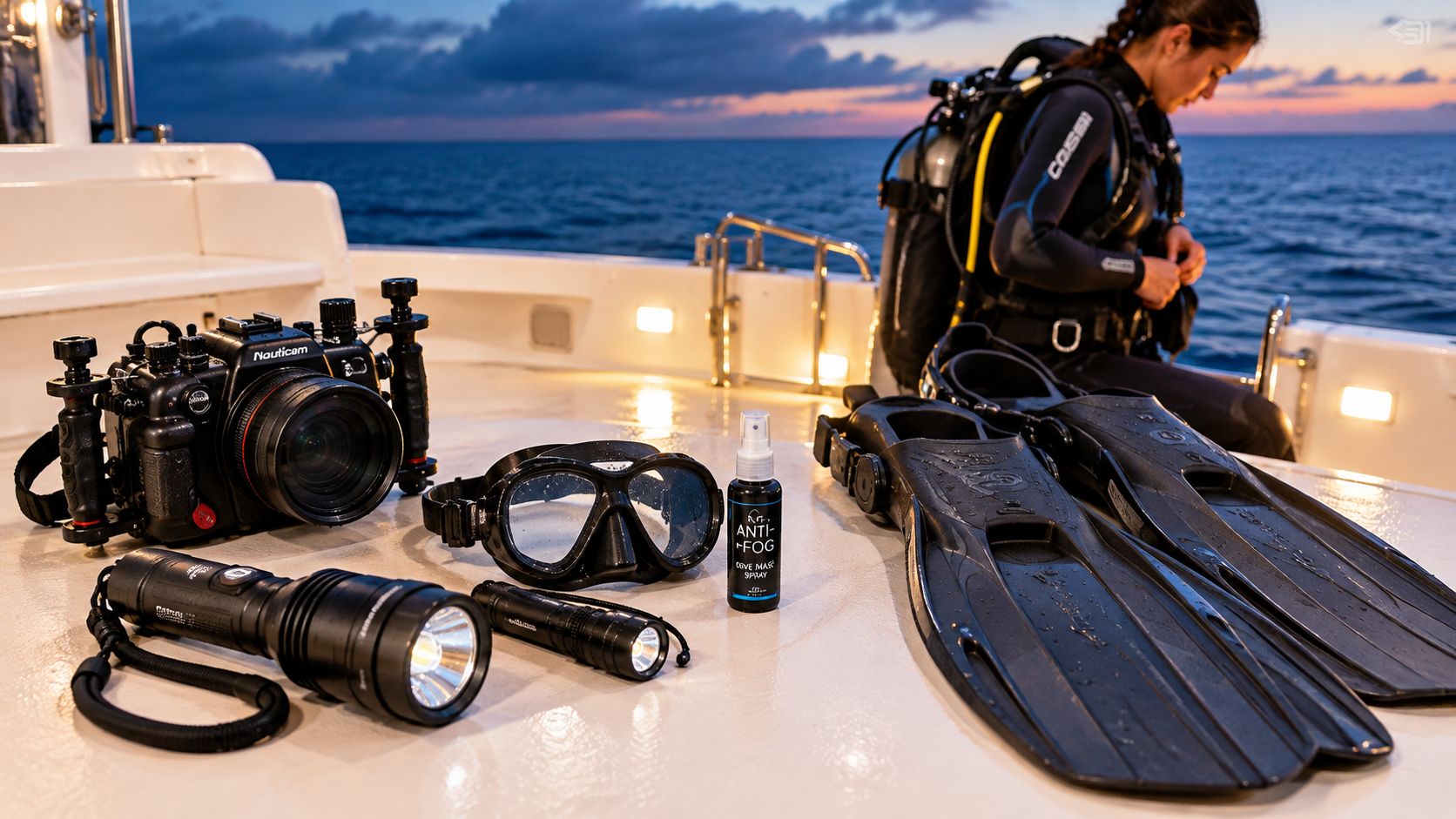
Your primary dive light is your main tool for orientation, signaling, and contributing to the lit area that gathers plankton. Your backup light isn't optional. Primary lights flood, batteries die early, and a diver with no light in a dark site becomes a problem the guide has to solve instead of watching the group.
Light discipline matters as much as brightness. Don't shine your beam into other divers' eyes, don't wave it across a feeding animal's path, and don't treat your light like a pointer every time something moves. Steady, directed light helps everyone. Wild light ruins the view for the whole arc of divers around you.
Warmth, Fit, and the Gear Check
Night water feels cooler than daytime water, and a stationary dive cools you faster than a swimming one because you aren't generating heat by finning. Wear adequate exposure protection for sitting still, not for an active reef tour. A dependable mask that you've tested for leaks and fins you can control without big kicks round out the basics.
Run your gear check before boarding or on deck in daylight. That's when you catch a worn strap, a sticky inflator, or a light that flickers when you twist it. Kona Honu Divers offers gear rentals and repairs with meticulously maintained gear, which gives guests who don't own equipment, or who find a problem the afternoon of the dive, a practical option instead of a canceled night.
Photographing Mantas Without Ruining the Moment
Mantas are large animals in dark water, so wide-angle compositions work best. Shooting upward toward the animal as it passes overhead generally works better than shooting down, because the white underside reads against dark water and the light column gives you contrast. Shooting down usually gives you a gray back against a gray bottom.
Avoid flash. It startles animals, blows out the plankton in the water between you and the subject, and disrupts viewing for everyone around you. Continuous light, handled steadily, does the job without the blast.
A few habits keep the camera from taking over your dive. Set it up before the descent so nothing gets fumbled in the dark. Keep your distance and let the animal approach on its feeding path, which produces closer, calmer passes than any attempt to reposition. Then put the camera down for stretches and watch with both eyes.
If you'd rather have someone else handle the images while you stay present in the water, look into the Kona manta night dive with a photo package. For many divers, that's the better trade. You get the memory and the photographs, without spending the best pass of the night staring at a settings menu.
How to Choose the Right Manta Night Dive Tour
Price and departure time are common points of comparison. Both matter, but neither determines whether your night feels spacious and organized or cramped and frantic. Crowding does. A trip can put mantas in front of you and still feel poor because you're shoulder to shoulder with strangers, staring through someone else's bubbles while boats stack up overhead.
Research involving 444 participants found that 82% felt crowded by snorkelers, 78% by boats, and 69% by scuba divers, as documented in the survey research on crowding among Kona manta tour participants. Read those figures as a booking checklist. You should know how many boats, snorkelers, and divers will share the lit area with you before you pay.
Tour Selection Criteria
| Criterion | What to Ask | Why It Matters |
|---|---|---|
| Group size | How many divers and snorkelers go out on this boat? | Larger groups crowd the viewing arc and slow every entry and exit |
| In-water spacing | How are divers positioned relative to the lights and snorkelers? | Spacing decides sight lines, silt, and whether the feeding lane stays open |
| Guide-to-guest ratio | How many guides are in the water with the group? | More guides means faster help, better positioning, and calmer problem solving |
| Site choice | Which site do you use, and do you change with conditions? | Protected sites hold position better in wind and swell |
| Departure timing | When do you leave and how long is the boat ride? | Timing affects light for setup, guest fatigue, and overlap with other boats |
| Certification fit | What experience do you require for the night dive? | Proper screening keeps struggling divers from disrupting the group |
Use the table in order. Group size and spacing shape your experience minute by minute. Certification fit shapes whether the divers next to you can hold still or spend the dive bicycling their fins through the silt.
What One Established Operator Offers Against These Criteria
Kona Honu Divers runs its manta trips with custom dive boats, meticulously maintained gear, and a knowledgeable crew, with early diver discounts, free nitrox, and more than 200 years of combined industry experience across the team. Judge those details against the table rather than as marketing claims. Maintained gear reduces light and regulator failures in the dark. Crew experience shows up in briefing quality and in-water spacing.
Divers who find the standard manta format comfortable and want more demanding water can look at the premium advanced long-range dive trip for experienced-diver itineraries beyond the manta site. That's a separate decision from the manta night itself. Don't book advanced water to prove something on the same trip where you're still learning to sit still in the dark.
Book for the weakest point in your group, not the strongest. If one person is nervous, inexperienced, or prone to feeling crowded, choose the tour that works for that person.
Nobody can promise you a private encounter at a famous site, and you should distrust anyone who does. What a good operator can deliver is a managed one, where spacing, timing, and guide attention keep a shared wildlife site from feeling like a stadium.
Conservation and Etiquette for Responsible Viewing
It's easy to assume that because mantas are gentle and the dive feels calm, the activity must be harmless by default. That assumption deserves pressure. A calm experience for guests and a low-impact experience for animals are related, but they aren't the same thing.
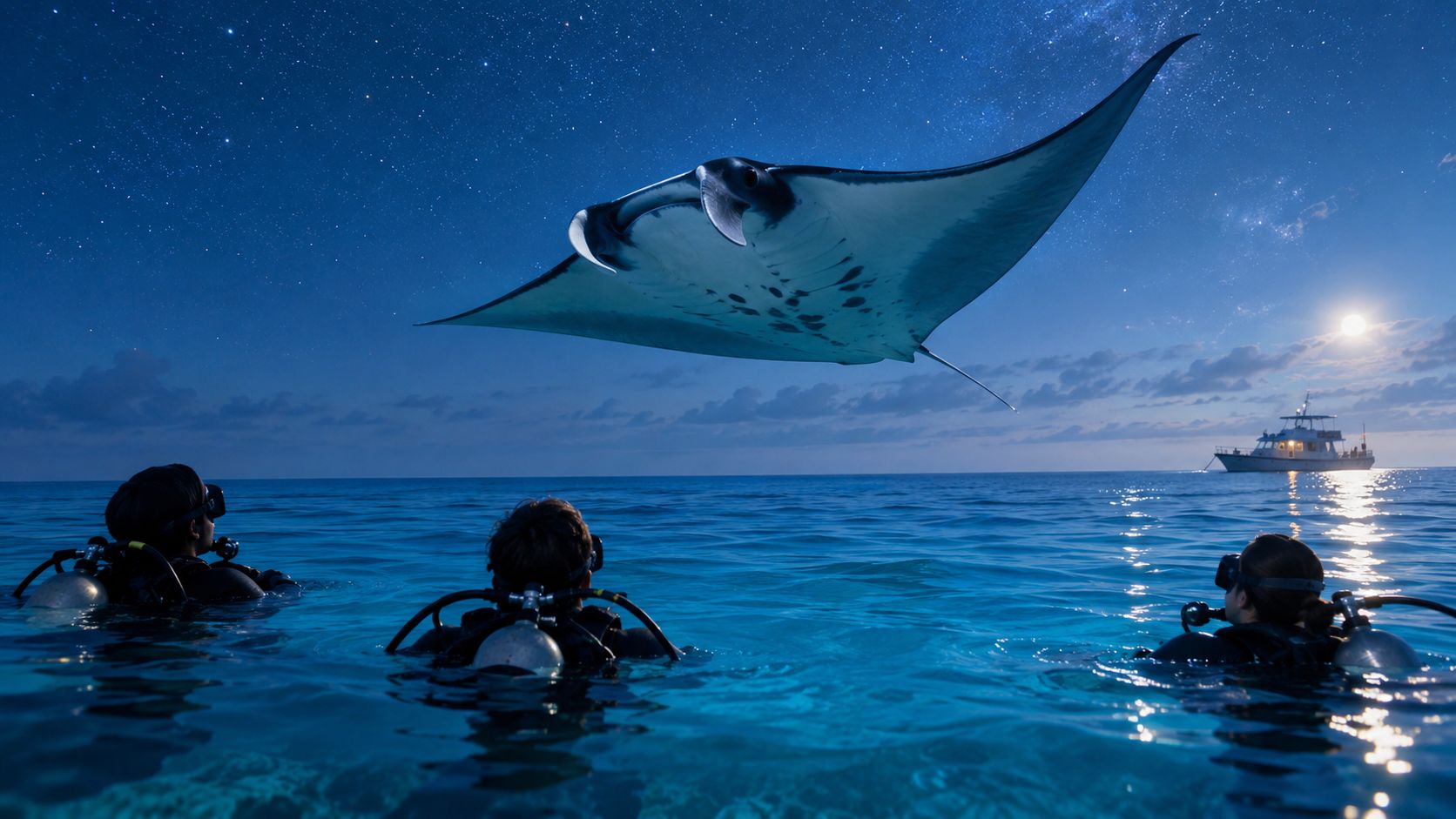
A boating-safety assessment identified at least 42 commercial operators visiting Kona's two principal manta sites as of August 2015, as documented in the Kona manta ray viewing boating operations and safety assessment. With that level of concentrated nighttime tourism, vessel congestion, collisions, diver or snorkeler behavior, and manta disturbance become documented concerns rather than hypotheticals.
Researchers have recorded short-term behavioral responses in mantas exposed to tourism, including altered movement, avoidance, interrupted feeding, and stress. The long-term population effects remain insufficiently measured. Both halves of that sentence matter. Anyone claiming the activity is proven harmless is ahead of the evidence, and anyone claiming it's proven destructive is doing the same.
What Operators Can Control, and What They Can't
Responsible operators control the operational layer. That includes thorough pre-dive briefings, careful vessel positioning, lighting discipline, emergency readiness, guest screening, and strict no-touch rules enforced in the water, not just mentioned on the boat. Those controls reduce the most immediate forms of disturbance and most of the guest safety risk.
What remains uncertain sits at the population level. Hawai'i law prohibits knowingly capturing or killing manta rays in state marine waters, and state guidance identifies them as protected, as set out on Hawai'i's protected species fishing rules page. Legal protection, though, doesn't answer every question about years of concentrated feeding under lights. Honest operators say so.
Your Part as a Guest
Etiquette translates directly from those operator controls to your own behavior, much of it covered in established guidance on responsible and considerate diver etiquette.
- Hands off, always: Contact can injure the animal and turns observation into interference, no matter how gentle it feels to you.
- No sudden fin kicks: Abrupt movement near a feeding animal interrupts its path and silts the water for everyone behind you.
- Stay clear of hazards: Keep distance from entanglement risks and vessel exposure zones, especially near the surface on your way back to the boat.
- Report problems: If you see an injured or entangled animal, tell your guide so it reaches the appropriate wildlife authorities instead of being handled by guests.
Good etiquette isn't a tax on your experience. A still, well-spaced group gets closer passes and cleaner sight lines than a restless one, because the animals keep feeding through the light instead of routing around it.
Individual identification work gives this etiquette a sharper point. Kona's mantas are photographed, named, and cataloged, so the animal looping over your head may be a known individual with years of sighting history. You're not watching generic wildlife. You're a guest at a specific animal's feeding site, and behaving that way costs you nothing.
Common Questions and Your Next Step
What If No Mantas Appear
Judge the trip by what the operator controlled. Was the briefing clear, the positioning organized, the site choice sensible for the conditions, and the crew honest about odds before departure? A no-show night with professional handling and a healthy reef to watch is a wildlife outcome, not a failed product. A chaotic night with mantas present can still be a badly run trip. Keep the two judgments separate, and book early enough in your stay that a quiet night isn't your only chance.
Can Families and Mixed Groups Do This Together
Yes, if the group splits by format instead of forcing one experience on everyone. Certified, confident divers take the bottom view. Non-divers, cautious swimmers, and anyone who prefers holding flotation at the surface take the snorkel view, which you can explore through options to snorkel with manta rays. Both groups watch the same feeding activity from different levels of the same water column, ride the same boat, and compare notes on the way home. What doesn't work is pressuring a nervous person into scuba because the rest of the group is diving.
How Do You Compare Two Tours at Similar Prices
Ignore the headline price for a moment and compare inclusions and crowding details. Ask what's covered for gear, lights, and guides, then work through the spacing questions from the selection criteria. At equal prices, the better trip is almost always the one with fewer people in the lit area, more guides in the water, and a clearer answer about site choice. Price parity hides big differences in encounter quality.
How Do You Prepare If Night Water Makes You Nervous
Start with exposure rather than willpower. A daytime dive with the same crew at a familiar site builds trust before darkness adds its layer. On the night itself, tell your guide early, stay near the light column, and give yourself a simple job, such as watching the plankton gather, so your attention has somewhere specific to go. Most divers find the first manta pass dissolves the nerves, because the animal's movement is slow and predictable. If the anxiety stays high, the snorkel format is a legitimate choice, not a consolation prize.
You now know how the food, lights, sites, rules, and crowds fit together. The remaining step is choosing your night and securing a spot with a crew whose spacing and briefing standards match what you've just read.
If you're ready to sit in the dark at Garden Eel Cove and watch a manta loop through the light overhead, Kona Honu Divers runs guided manta night dives with maintained gear, experienced crews, and the spacing and briefing discipline this kind of night demands. Check dates, pick the calmest night your trip allows, and book your place through Kona Honu Divers before the small-group departures fill.