
You're sitting with three browser tabs open, each one promising a guaranteed manta encounter, and you're trying to work out why the boats don't all go to the same place. That's the normal starting point for manta ray diving Kona, and it's also where most bad decisions happen. A bigger number in a headline doesn't tell you how protected the water is, how much room you'll have to kneel and watch, or how a crew handles boats moving in the dark. Once you separate those questions, the choice gets clearer and a lot calmer.
The Kona Manta Night Dive in One View
Say you're already in the water. The crew has set lights on the sand, the beam is filling with tiny specks, and you can feel your breathing slow down because there's nowhere you need to swim. Those specks are plankton, and they are the whole reason you're here. A reef manta ray, Mobula alfredi, turns into the light column with its mouth open, rolls through the densest patch of food, and comes around again because the food is still there.
You're kneeling in a marked viewing area on the bottom. Above you, snorkelers stay on the surface and look down through the same beam. You aren't sharing one crowded lane. Divers hold the bottom, snorkelers hold the surface, and the mantas get the open water between you. That's the basic shape of the dive, and if you understand that shape, most of the rules that follow will make sense.
Why Night Changes the Animal You Meet
This isn't a daytime reef dive that someone moved after sunset for drama. According to the NOAA manta ray work product, Kona's reef mantas show strong site fidelity, with individuals re-sighted along the coast across 15 years of surveys. By day they commonly stay within the upper 10 m near reefs, cleaning stations, and feeding grounds. At night, documented individuals can descend to approximately 432 m, likely tracking deeper zooplankton layers.
That sounds like a reason they'd be harder to find at night, not easier. The lights change the equation. Artificial light gathers plankton in shallow water, so a manta that might otherwise work much deeper water gets a temporary feeding stop inside comfortable diver depth. You're not chasing the animal into its world. You're sitting still while the food, and then the animal, comes into a small lit patch of yours.
The pace tells you what's happening, too. That same NOAA document puts feeding at about 30 pectoral-fin beats per minute, nearly twice the slower cleaning-station rate. So when a ray makes a slow, controlled barrel roll a few feet over your head, that's not a tired or sick animal. That's a filter feeder working a food patch exactly the way it should.
If a manta looks calm and deliberate in the beam, don't read that as an invitation to move closer. Calm feeding depends on you staying predictable.
The Snapshot Before You Compare Anything
A longer historical record counts 3,208 surveys from 1992 to 2007 and reports manta sightings on roughly 80% of dives at Garden Eel Cove, as summarized on the Kona Honu Divers manta history page. That's a useful reality check. It tells you this is a reliable place by wildlife standards, and it also tells you that roughly one night in five in that record didn't produce a sighting. Anyone who turns that into a promise is selling you something the ocean hasn't agreed to.
Kona manta night dive at a glance
| Question | What to expect |
|---|---|
| Who can join | Certified scuba divers and snorkelers; guides supervise both groups |
| How the encounter works | Seafloor lights gather plankton; divers kneel; snorkelers stay at the surface |
| Sighting context | About 80 percent historically at Garden Eel Cove; Kona sightings often exceed 90 percent |
| Preferred site | Garden Eel Cove, also called Manta Heaven, when conditions allow |
| Scuba requirement | Open Water Diver from a recognized agency for the dive portion |
| Practical base | North Kona via Honokōhau Harbor; handy for the airport, Waikōloa, and Kohala |
If you're building a wider trip around this night, you can see other Kona diving tours alongside the dedicated manta ray dive and snorkel trip. Keep the order straight, though. Pick the site and the safety setup first. The booking button can wait until those two things make sense.
Why Garden Eel Cove Is the Better Site
Start with the verdict, then check the reasoning. For a dive tour, Garden Eel Cove is the superior choice when the boat can get there, and not only because it tends to draw more animals. The cove is protected, the viewing area is broad enough for a stationary semicircle, and the adjacent reef gives the site real structure. An open sand patch can host feeding rays, but it doesn't give you the same settled, well-defined place to kneel, orient yourself, and stay out of the way.
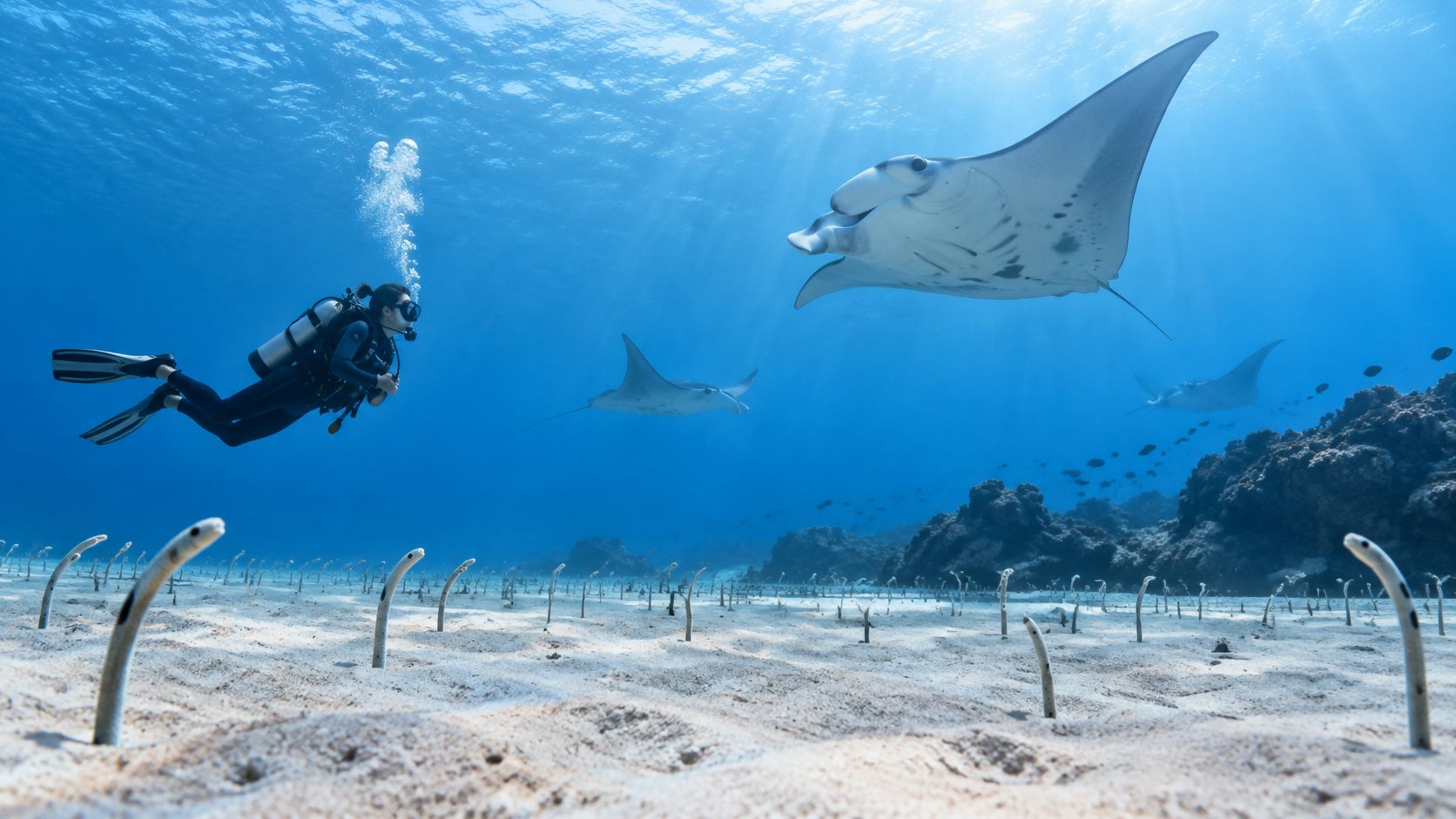
Garden Eel Cove, also called Manta Heaven, sits on the north Kona, airport side of the coast and is commonly reached from Honokōhau Harbor. That matters if you're staying near Kona International Airport, Waikōloa, or the Kohala Coast, because a shorter, simpler run to the harbor is not a small thing on a night when you're already managing gear, nerves, and a late finish. We often take our manta ray charter to Garden Eel Cove, and on the dive our divers are positioned in a specific viewing area at a well-established site rather than left to find their own spot.
What Thirteen Years of Sightings Actually Show
A 2025 University of Hawaiʻi study analyzed 13 years of community-sourced observations from 2010 to 2022 at Garden Eel Cove and Keauhou, covering more than 23,000 sightings involving 167 individual reef manta rays. Garden Eel Cove consistently supported larger manta aggregations than Keauhou. Just as important, seasonal and annual changes in aggregation size closely tracked zooplankton density, which means prey availability is a primary factor shaping whether animals show up and stay.
Read that second finding slowly, because it changes how you should judge any operator's marketing. If group size follows food, then a calm month on the calendar can still produce a quiet feeding night, and a night nobody predicted can turn busy. A separate long-term analysis described Garden Eel Cove groups as larger and more variable, while Keauhou groups were smaller with 91% of sightings female in that study, as reported in the Springer analysis of Kona manta aggregations. That's interesting ecology. It isn't a booking guarantee for either site.
Garden Eel Cove compared with Keauhou
| Site | Where it sits | What the long record shows | Best reason to choose it |
|---|---|---|---|
| Garden Eel Cove (Manta Heaven) | North Kona, airport side, from Honokohau Harbor | Larger, more variable feeding groups tied to zooplankton | Protected water, broad viewing area, and nearby reef |
| Keauhou | South Kona, Keauhou Bay | Smaller groups and a strongly female-biased pattern, 91 percent female in the study | Fallback when north-shore conditions are poor |
More Rays Is Not Always a Better Night
Here's the part most sales pages skip. A large aggregation often draws more boats, more lights, and more people trying to watch the same animals. A slightly smaller night with good spacing can feel better, especially if you're a newer diver who wants room to settle and breathe slowly. Count the rays if you like, but also count how crowded your semicircle feels.
Persistence cuts both ways, too. These feeding aggregations have persisted under years of tourism and artificial-light feeding, which is encouraging. It doesn't prove that every practice around them is harmless. A site can keep working while individual boats still crowd it, rush entries, or brief people badly.
So ask a direct question before you pay. Which site does the boat expect tonight, and why? Conditions can move a trip, and a good crew will say so plainly. Don't assume Manta Heaven is always reachable just because it's the preferred site. The honest answer tells you more about an operator than any sighting percentage on a homepage.
Certification Safety and Night Boat Rules
Calm black water can fool you. The surface looks gentle, the boat lights feel cozy, and it's easy to assume the risky part is the large animal overhead. It isn't. The harder safety problem on a manta night is mixed traffic, with swimmers, snorkelers, divers, ladders, and moving vessels sharing dark water while everyone's attention points down at a ray.
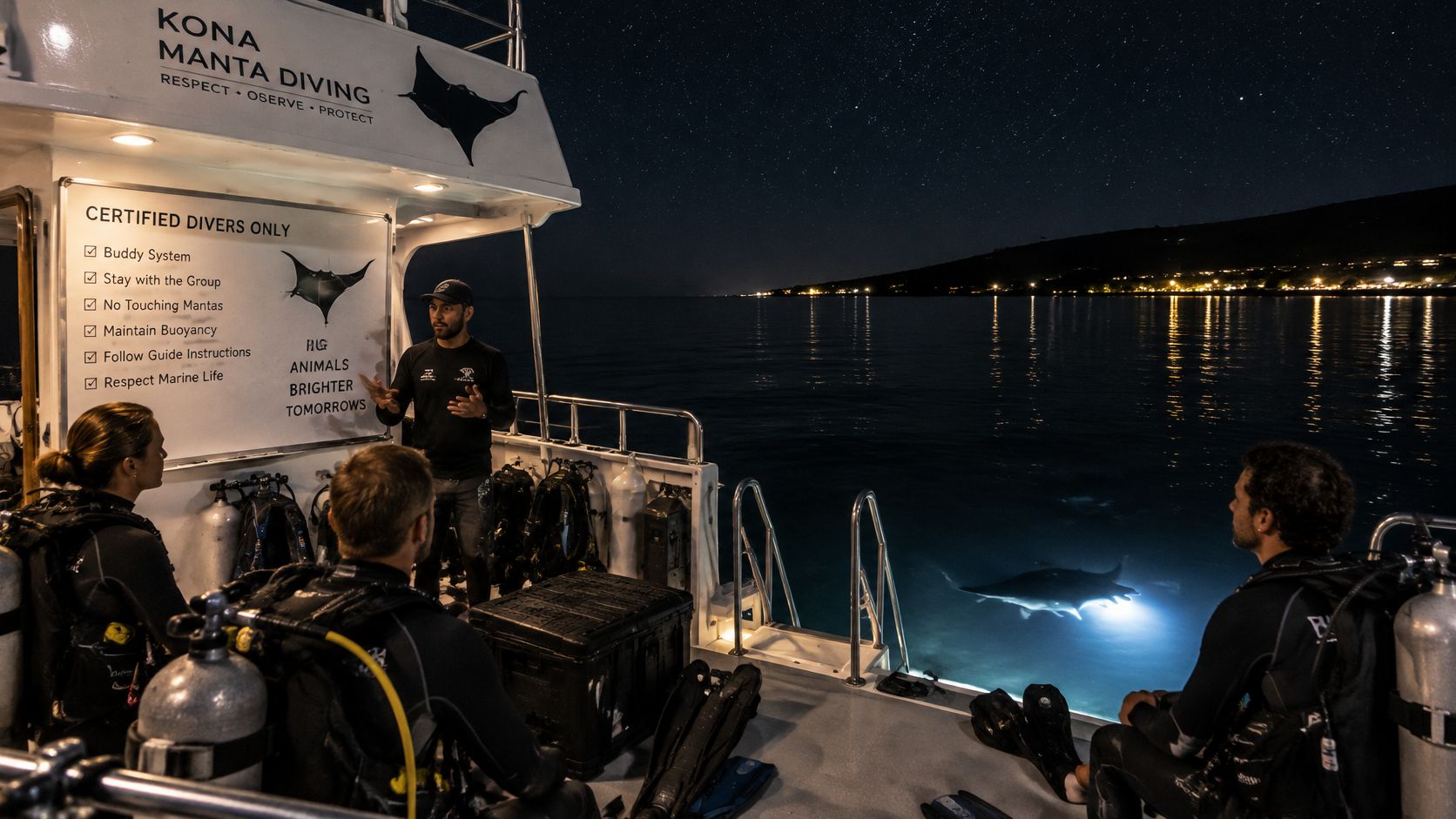
A safety assessment of manta-viewing operations at Makako Bay and Keauhou Bay reported that no regulations governed recreational or commercial swimming and snorkeling at night among actively motoring vessels. The same assessment notes that operators require commercial-use and harbor or launch-ramp permits. A permit says a business may operate. It doesn't brief you, separate you from a prop, or watch the water while you're mesmerized.
Questions That Reveal a Real Safety Plan
Ask these before you book, and listen for specific answers rather than reassurance.
- Entry and exit zones: How are swimmers kept clear of props and the ladder while other guests are boarding?
- Boat traffic watch: Who monitors approaching vessels while guides are in the water with the group?
- Falling visibility: What changes if rain, surge, or plankton haze cuts the light beam down to a few feet?
- A close pass: What should a nervous first-timer do when a ray fills their mask and instinct says to back away fast?
- Separation: How does the crew handle a guest who drifts out of the designated area?
If the answers sound improvised, treat that as information. Responsible marketing shouldn't use conservation language as a substitute for documented procedures, and a high review score doesn't answer a single one of those questions. Families and inexperienced snorkelers benefit most from asking, precisely because they're the guests most likely to be looking down when a hull moves nearby.
The Certification Baseline
Most of our regular dive charters require at least an Open Water Diver certification from a recognized agency. The manta night dive itself is stationary and closely supervised, with experienced divemasters and instructors in the water with divers, and experienced guides making sure everyone is safe and comfortable. Your job as a first-timer is narrow on purpose. Stay kneeling, watch the guide's light signals, and surface only with the group.
If you're weighing how different this feels from other after-dark diving, our background on scuba diving at night covers the general night-diving picture. Wildlife etiquette is handled in the dive sequence below, so treat this section as the boat-traffic half of safety, not the animal half.
Before you pay: Bring your certification card, mention a long layoff honestly, say upfront if you get seasick, and confirm a guide will be in the water with you.
What to Bring and When Nights Vary
Pack for a boat night, not a shore dive. That means a small bag, nothing dangling, and nothing you'll spend the ride out worrying about. Most first-timers overpack accessories and underpack the boring items that decide whether the night feels easy.
Pack list for a boat night
| Item | Why it matters |
|---|---|
| Certification card | Required for scuba; snorkelers do not need one |
| Motion-sickness plan | Take it early enough to take effect before boarding |
| Warm layer | For the ride back after the cooler feeding window |
| Trusted mask | Pack your own only if rental masks have leaked before |
| Light exposure suit | The feeding window can sit several degrees cooler than the afternoon snorkel |
| Compact camera | Optional; a large rig adds risk in the water column |
A few notes make that list work in real life. Take motion-sickness medication before you're standing on a moving deck, because swallowing it as the boat leaves the harbor is mostly wishful thinking. Bring a warm layer even if the afternoon felt hot, since a wet ride home in the dark is the coldest part of the evening for most guests. If rental masks have leaked on you before, your own fitted mask is worth the suitcase space. If they haven't, leave yours at the hotel.
You don't need to buy a last-minute kit for one night. Rental scuba and freediving gear is available, so a traveler who owns nothing can still show up properly equipped. Leave spearguns and extra handheld gear off the boat entirely. A compact camera you can hold close to your chest is fine. A tray with arms sticking into the feeding lane is not, and the posture section below explains why.
Two Changes That Should Reset Your Expectations
First, the site can move. North swell or harbor traffic can push a boat off Garden Eel Cove even when that was the plan at check-in. That's a seamanship call, not a bait and switch, and you want a captain who makes it early rather than one who forces a marginal site.
Second, food sets the guest list. Zooplankton density, not the weekday, drives how many mantas stay in the beam. Our guide to the best time to see manta rays in Kona goes deeper on timing, but the short version is that a night with one ray, or none, can still be a correctly run dive. Judge the crew on whether the briefing, spacing, and exit stayed disciplined, not on a head count they never controlled.
Two leftover questions come up at nearly every check-in. Snorkelers don't need a scuba card, because they watch from the surface. And if it's been years since your last dive, say so at check-in rather than hoping the kneel feels familiar once you're down there. Guides can work with honest information. They can't work with a surprise.
Dive Sequence Posture and Camera Control
The night runs in a set order, and knowing the order removes most of the anxiety. Nothing here is complicated. Each step exists to keep the feeding corridor open and your body out of the animal's path.
- Briefing first: Our manta ray night dives begin with a detailed briefing covering the science of what you'll see and the rules of passive observation.
- Sort the basics on land: Confirm certification, rental fit, and whether you're diving or snorkeling before the boat leaves.
- Ride out: Head from Honokōhau toward Garden Eel Cove when that protected site is the evening's plan.
- Enter and settle: Get in on the crew's signal and, if you're diving, kneel into your assigned spot.
- Aim the lights correctly: Divers point lights up, snorkelers point lights down, and the plankton gathers between you.
- Hold position: Stay still while rays barrel-roll and pass through the beam.
- Exit on signal: Leave the water only when the crew calls it, staying clear of ladder and prop zones.
Posture Is the Whole Technique
The Love Big Island manta night dive guide lays out the mechanics plainly. Divers remain on or near the sand, rubble, or boulder bottom and form a semicircle, leaving the water column open for manta movement. Snorkelers stay at the surface rather than diving down into the feeding zone. Divers direct lights upward to attract plankton into the column, while snorkelers direct lights downward. Nobody touches, chases, grabs, or rides a manta, partly because contact can damage the animal's protective mucus layer.
Set your weight so your knees, or one fingertip, rest lightly on the bottom and your fins stay off the sand. Streamline hoses, pointers, and camera trays against your body. If you're hovering, kicking to hold position, or standing up in the beam to get a better look, you've become an obstacle in the exact space the ray needs to turn. The mantas are doing the moving on this dive. You're furniture, and good furniture doesn't shuffle around.
When a ray brushes close, freeze, exhale slowly, and let it choose the gap. It has done this pass far more often than you have.
Why You Never Follow a Ray That Drops Away
Mantas don't live in the lit patch. The NOAA repository record on manta vertical movement describes archival-tag research showing mantas centering near the upper boundary of the thermocline and shifting to vertically migrating prey at roughly 100 to 150 m. Independent observations show repeated nighttime excursions to approximately 30 to 50 m, where temperatures may be up to 10°C cooler. When a ray slides out of the beam and angles down, it's following food into water you have no business entering on a recreational night dive.
That's also why the camera rules are strict. Pre-focus at a few meters, keep a modest light angled up with the plankton beam rather than into an animal's eyes, and accept partial frames. If you want a sense of what patient positioning produces, browse these manta ray dive Kona pictures before you go. Nearly every strong shot comes from a diver who stayed put.
A thin plankton night with fewer rays is still a completed dive. Your job is to be predictable, not to hunt a closer pass.
Environmental Rules and Permits
These feeding sites matter beyond your one night because the same individual mantas return to the same cleaning stations and feeding grounds year after year. That repeat use is ecologically significant, not incidental. When an animal's routine runs through a small cove, what boats do in that cove stops being a private business decision.
Food decides whether animals gather, and crowding decides how much disturbance sits on top of that. Several boats working one cove add noise, light, and bodies to a place that functions because it stays relatively predictable. Tourism here can be economically valuable and still hazardous to animals and people at the same time. Both things can be true, and pretending otherwise helps nobody.
Operators need commercial-use and harbor or launch-ramp permits, and you should confirm your operator holds them. But be clear about what a permit does. It controls who may operate. It doesn't cap how crowded a site gets on a given night, and it doesn't govern how guests behave in the beam. That's why our own guidance on responsible and considerate diver etiquette focuses on conduct rather than paperwork.
Ask how many boats share the site that night and whether guest numbers are limited. Then hold up your end. Follow crew positioning and keep lights out of the animals' eyes.
- Permit confirmation: Ask directly and expect a plain yes.
- Stated guest limit: A number beats a vague promise of small groups.
- One site per night: Discipline about where the boat settles protects the routine.
Frequently Asked Questions
Will I Definitely See Mantas
No. Sightings aren't guaranteed, and any operator who says otherwise is guessing on the ocean's behalf. Kona sightings often exceed 90 percent, and plankton, not the calendar, decides whether animals stay in the beam on your particular night. Booking early in a trip leaves room to try again if the food isn't there.
Do I Need Scuba Certification
Scuba divers need an Open Water Diver card from a recognized agency. Snorkelers don't need a card and watch the same feeding from the surface. If your group is split between the two, our comparison of whether it's better to snorkel or dive with manta rays walks through the tradeoff without pushing either option.
What If I Have Never Done a Night Dive
Say so at check-in, plainly and early. Ask to kneel at the edge of the group, where you'll have a clear view of the guide and a little extra space while you settle. Watch the guide's light signals before you move for any reason, including adjusting a mask strap. Most first-night nerves fade within the first few minutes on the bottom, because the dive asks you to stay still rather than find your way. You're not following a route in the dark. You're sitting in one supervised spot with a job that's mostly breathing slowly.
Can I Get My Money Back If No Rays Appear
Check the booking terms before you pay, because refund and rescheduling policies are set by each operator's terms rather than by any shared industry rule. Read that page while you're still comparison shopping, not after a quiet night. If a rebooking option matters to you, confirm how it works before your card is charged.
Reserve the Dive and Settle the Last Questions
If the Garden Eel Cove night is the one you want, we're a direct fit for it. Kona Honu Divers offers the Manta Ray Night Dive, our go-to site for that dive is Garden Eel Cove, and we run it as a 2-tank manta ray charter through the 2-tank manta dive and snorkel trip. Our manta ray night dive has encounter rates of up to 92%, which we'd rather present as a strong track record than a promise. The same supervised kneel-and-watch format serves a newer Open Water diver and an experienced guest on the same evening, because the skill being tested is stillness, not range.
Ask at booking which site the boat expects that evening and whether Garden Eel Cove is confirmed. Conditions can change the plan, and you'd rather hear that at the counter than guess about it on the ride out. If the manta night leaves you wanting more experienced diving on later days, our premium advanced 2-tank trip is the natural next step.
Three last answers, since they come up at almost every booking. Snorkelers watch from the surface on the same outing, so a mixed group doesn't need two boats or two evenings. A missed night usually reflects food and sea state rather than a failed crew, so judge the trip by the briefing, spacing, and exit discipline you saw. And anyone unsure about certification should say so before boarding, while there's still time to sort out the right option. That one honest minute at check-in protects your whole night.
Ready to kneel on the sand at Garden Eel Cove and watch reef mantas roll through the lights overhead? Kona Honu Divers runs the supervised 2-tank manta charter with experienced guides in the water, plus a full range of Kona reef and advanced trips for the rest of your stay. Visit Kona Honu Divers to check dates and reserve your spot.