
You've got an evening free in Kona, you're looking at manta tour listings, and the choices sound almost identical. Some put you on the seabed, others keep you at the surface, and nearly every description leads with a spectacular close encounter. The useful questions are less glamorous: Can you hold your position comfortably, which site will the boat use, and how does the crew manage people around feeding wildlife?
A good manta ray dive in Kona isn't a chase through dark water. It's a managed observation dive where plankton availability, underwater lights, and your position determine what you see. Choose the right format, arrive with familiar gear, and leave room for the animals to decide whether they'll feed nearby.
Choosing Between the Manta Night Dive and Night Snorkel
Manta ray night dive and night snorkel compared
| Format | Where You Are | Gear Needed | Entry Requirement |
|---|---|---|---|
| Manta ray night dive | Kneeling on the sandy bottom inside the light circle | Full scuba set, weights and dive computer | Certified diver, typically Open Water or higher |
| Manta ray night snorkel | Floating on the surface above the lights | Mask, snorkel, fins and flotation | No certification needed |
The night dive gives certified divers a stationary view from below. You descend with the group, settle in the designated sandy viewing area, and watch the water above the lights. You're not swimming alongside mantas or choosing your own route around the site. The attraction is holding a stable position while the animals pass through their feeding space.
The night snorkel keeps you at the surface, looking down into the illuminated water. There's no scuba equipment to manage and no certification requirement, but you still need to be comfortable breathing through a snorkel and following instructions in the ocean after dark. Flotation helps support your position; it doesn't replace water confidence.
Choose for comfort rather than bragging rights
Both formats observe the same feeding behavior around lights. Neither gives you ownership of the closest pass, and paying for scuba doesn't mean different animals will arrive. Your viewing angle changes, not the wildlife's obligation to appear.
Most regular Kona scuba charters require at least an Open Water Diver certification from a recognized agency. If you're certified but haven't dived recently, don't use the stationary format as a reason to skip refreshing your skills. You still need to descend, equalize, monitor gas, communicate, and ascend correctly.
- Choose the dive if you're certified, comfortable managing scuba equipment, and want to watch from a settled position beneath the feeding area.
- Choose the snorkel if you're not certified, prefer staying at the surface, or want less equipment and a simpler activity briefing.
- Reconsider either format if darkness, boat motion, or breathing through unfamiliar equipment already feels overwhelming. Discuss those concerns before paying.
For a closer look at the practical differences, use this comparison of snorkeling and diving with manta rays.
Both trips operate in the same ocean. The crew's briefing on the day confirms entry, positioning, supervision, and whether conditions support the planned activity. Choose the format you can manage calmly, not the one that sounds more adventurous.
Why Kona Is the Best Place to See Manta Rays
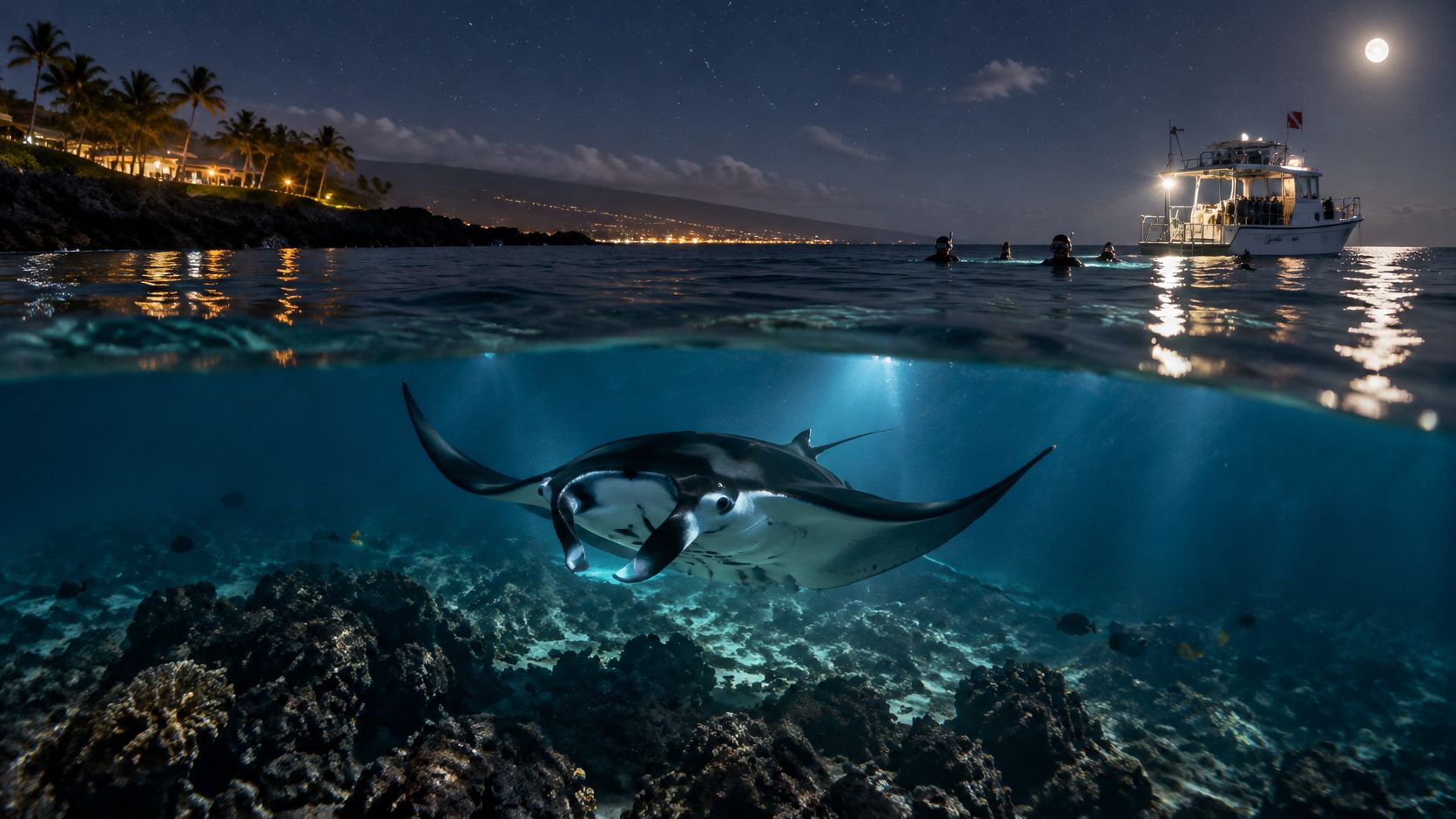
Kona's advantage starts with resident reef mantas, rather than a short migration window. These animals repeatedly use coastal feeding areas, which gives visitors a meaningful opportunity to observe familiar wildlife behavior instead of hoping for an isolated offshore encounter.
A long-term study published in Environmental Biology of Fishes examined 13 years of community-sourced observations, from 2010 through 2022, at Kona's principal nighttime feeding locations, recording more than 23,000 sightings of 167 individually identified reef manta rays. Those are repeated sightings within a monitored population, not a claim that thousands of different animals live in the viewing bays.
A familiar feeding place, not an appointment
Think of a regular diner returning to a restaurant because the food is dependable. The diner knows where to go, but doesn't necessarily eat there every evening or choose the same table. Kona's mantas likewise return to feeding locations without making every night identical.
Garden Eel Cove and Keauhou aren't interchangeable stops for every individual ray. Animals can use the sites differently, so a quiet evening at one location doesn't mean the entire coastal population has disappeared. It means you're observing a particular place under that evening's conditions.
The value for divers is repeated site use. A crew can organize a controlled viewing area around established feeding behavior rather than search widely and encourage people to follow animals. That makes preparation and disciplined positioning useful parts of the encounter.
A resident population makes Kona a strong place to plan a manta encounter. It doesn't turn wildlife into a scheduled performance.
What reliability means for your booking
Reliability should describe the opportunity, not a guaranteed outcome. You can choose a suitable site and a competent crew, yet still have a quiet night, brief appearances, or animals feeding beyond your preferred camera angle.
Keep the distinction between seeing mantas and getting a particular photograph. A distant pass can be a worthwhile wildlife encounter even when it doesn't produce the frame you wanted. Arriving with a fixed expectation of overhead loops makes it harder to appreciate what happens.
This overview of manta rays in Hawaii provides useful background before the trip. For planning, prioritize flexibility and current conditions over claims that a particular calendar date guarantees activity.
What Happens on a Night Manta Ray Dive
The dive follows a deliberate sequence. Each stage helps the group arrive at the viewing area without turning the feeding zone into a moving crowd.
From briefing to viewing position
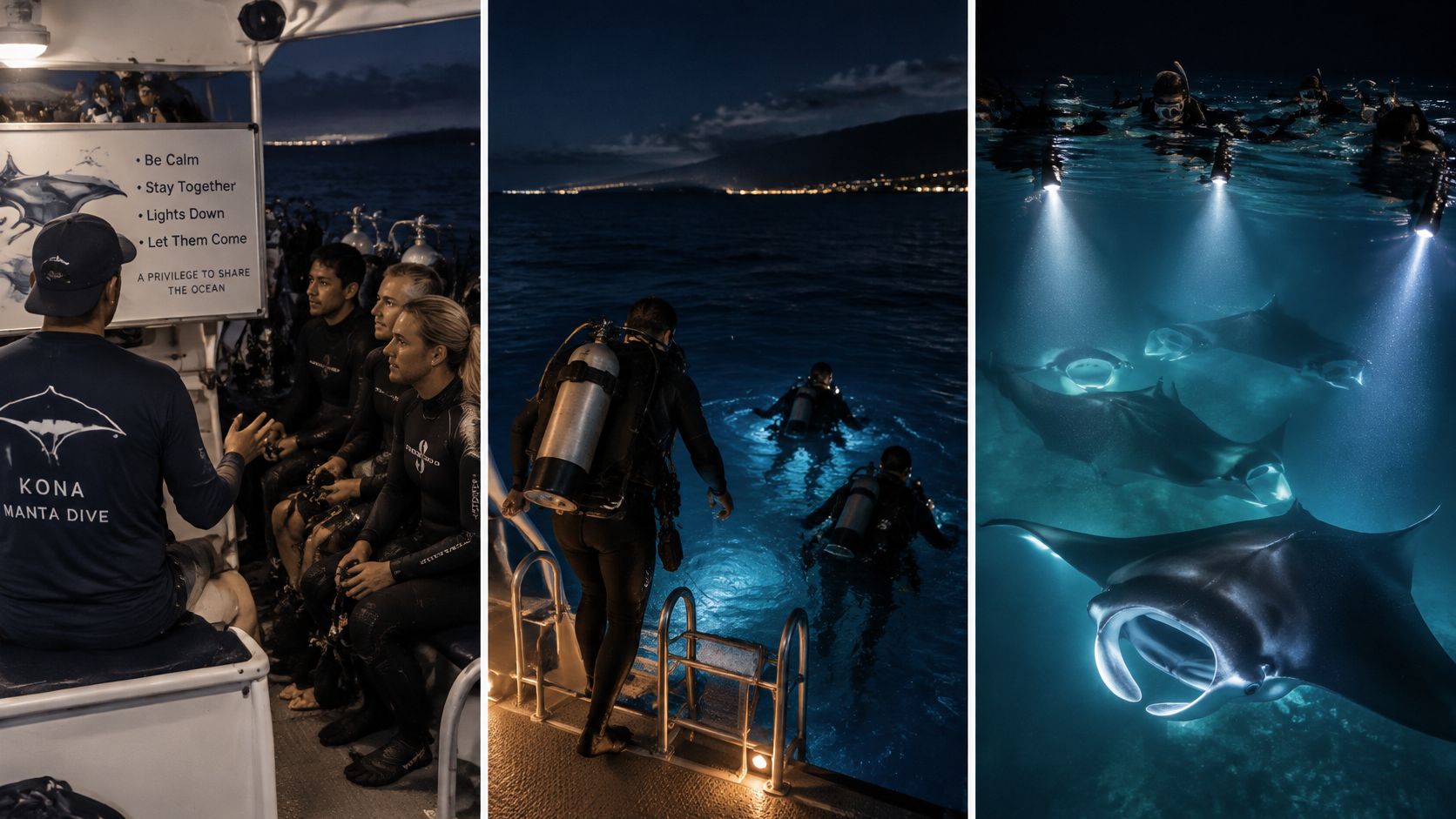
Listen to the briefing before gearing up. The crew explains the science behind the encounter and the rules of passive observation. Pay particular attention to signals, your assigned location, and the return procedure. A group that understands the plan is easier to keep together when attention shifts toward an approaching manta.
Follow the guided descent. Enter using the crew's instructions, establish contact with your buddy, and descend with the group rather than racing toward the lights. Equalize early and signal a problem while the guide can still address it. Experienced divemasters and instructors remain in the water alongside our divers.
Settle only where directed. At the designated sandy viewing area, kneel, balance your weights, and bring your hands and equipment close. Don't choose a convenient patch of reef as a seat. Stirring the bottom sends sediment into the light field and makes viewing harder for everyone behind you.
Let the lighting do its job. Powerful dive lights create a bright circle on the seafloor, so divers aren't sitting in complete darkness. The lights attract plankton into the illuminated water. You don't need to add uncontrolled beams or reposition yourself to improve the setup.
Watch without joining the feeding circuit
Stay stationary if mantas arrive. Animals may loop through the light field or pass close overhead, but your job remains the same: breathe normally, monitor your instruments, and hold your assigned position. Keep fins, hoses, and the camera within your space. If nothing appears immediately, don't leave the group to search.
Leave with the guide, then debrief. Follow the ascent signal even if an animal has just entered the lights. Check your buddy, control the ascent, and complete the exit. Back aboard, the crew can help explain the feeding behavior you observed and discuss anything that felt difficult.
The practical guidance in this Kona manta-diving overview emphasizes controlled buoyancy, secured equipment, and passive observation around plankton-feeding animals. Reef mantas don't hunt divers. The avoidable problems come from people interfering with their movement, colliding with them, or leaving equipment in their path.
This is a stationary, closely supervised dive, not an excuse to switch off your diving skills. A calm diver who can remain settled, check gas without becoming distracted, and respond promptly to signals is better prepared than someone focused entirely on the next pass.
If you become uncomfortable, tell the guide. Staying silent because you don't want to interrupt the encounter makes a manageable issue harder to resolve.
Safety and Etiquette Rules During the Encounter
Crowding is a practical safety issue, not just an aesthetic complaint. A Hawaiʻi County manta-viewing safety assessment identified at least 42 commercial operators as of August 2015 and, during observations from August 10–13, 2015, counted 16–19 vessels per night and approximately 160–190 snorkelers and divers in the water simultaneously. Those historical observations aren't a current nightly headcount, but they explain why vessel coordination and assigned positions matter.
In darkness, a diver who drifts toward another group creates more than a bad viewing angle. Guides must distinguish participants, maintain their group, and manage departures around boat operations. Staying where you're placed helps them do that work.
A checklist for your viewing position
- Stay inside your assigned zone. Don't slide toward another group because its lights look brighter or a manta passed there.
- Control buoyancy and fin movement. Make small corrections rather than broad kicks, especially when an animal approaches.
- Never touch, chase, block, or dive beneath a manta. Remain in the assigned bottom position rather than swimming under an approaching animal to create a close encounter.
- Secure loose equipment. Clip off gauges and accessories, manage camera lanyards, and keep hoses and fins out of the flight path.
- Keep handheld beams off the animals. Use your torch according to the briefing, not to track a manta's face or redirect its movement.
- Let departing animals leave. Following a manta out of the viewing area separates you from your group and changes a passive encounter into pursuit.
Practical rule: If your next movement would make a manta change direction, stop and hold your position.
Your responsibility extends beyond the animal
Keep checking your buddy and instruments. A manta directly overhead can make it surprisingly easy to forget gas monitoring or lose track of a guide's signal. Agree on communication before entering, especially if a camera will occupy your attention.
If your mask floods or you lose your position, address the diving task first. Signal the guide rather than grabbing another diver, reef structure, or equipment in the lighting area. Don't make an uncontrolled move toward the surface because you momentarily lose sight of the group.
Mobula rays also receive protection under relevant fisheries regulations, and fishing guidance calls for moving or retrieving lines when mantas are present. For visitors, the useful principle is straightforward: keep lines and equipment away from animals and don't interfere with feeding.
Good responsible diver etiquette includes respecting other participants' space without competing for the closest view. Before booking, ask how the crew manages crowding, separates groups, and handles a diver who needs to leave early. A clear answer matters more than an enthusiastic description of the wildlife.
Gear, Camera Settings and Preparation
Starting camera settings for night manta photos
| Setting | Starting Point | Why It Matters |
|---|---|---|
| Mode | Manual or shutter priority | Gives you control as mantas move through the light |
| ISO | Try ISO 800 to 1600 | Balances a usable shutter speed against image noise |
| Shutter speed | Try 1/125 to 1/250 second | Helps freeze wing movement |
| Aperture | Try f/2.8 to f/4, if your lens allows | Makes use of the light from the seafloor lamps |
| White balance | Custom setting | Helps control unwanted green or blue color casts |
These are working starting points, not promised exposures. Lamp placement, camera performance, subject distance, and the direction of a pass all change the result. Set the camera before entering, then adjust from a test frame rather than spending the encounter navigating menus.
Manual exposure keeps your selected settings consistent; shutter priority protects the shutter speed but may let brightness change between frames. If the camera reaches its widest aperture and the image is still dark, raise ISO rather than automatically accepting motion blur. Custom white balance helps with color, but it can't remove every cast from mixed underwater lighting.
Pack for holding still
- Dive computer and backup torch. Use a computer you can read easily in low light, and secure the torch where you can reach it without searching.
- Appropriate exposure protection. A wetsuit generally provides more insulation than a rash guard. Choose for the conditions and the fact that you'll be relatively inactive, not just the air temperature onshore.
- A familiar mask. A comfortable seal and an effective defog treatment prevent repeated adjustments while the group is settling.
- Controllable fins. Bring fins you can keep still and use for small corrections. This isn't the place to learn how unfamiliar blades respond.
Most of our regular dive charters require at least an Open Water Diver certification from a recognized agency. Certification establishes the entry level, but comfortable equipment handling determines how much attention you can give the encounter.
Prepare the camera without compromising the dive
- Check buoyancy during daylight. Confirm weighting with the exposure protection and equipment you'll use.
- Test focus behavior. Practice focus lock or continuous autofocus before the trip, and make sure you can operate the relevant control through the housing.
- Carry a spare battery aboard. Install a charged battery before entry, inspect the housing seal, and keep the spare dry.
- Secure the camera close. Use a manageable attachment that doesn't create a long loop or let the housing swing into another diver.
The fundamentals of scuba diving at night still apply when the viewing area is brightly lit. Know your signals, instrument lighting, and equipment layout before you descend.
Leave flash off for this encounter and follow the crew's lighting rules to avoid disturbing feeding behavior. Never extend the housing toward an animal to compensate for a lens that isn't wide enough. If photography makes it hard to stay settled, lower the camera and watch.
Choosing an Operator and the Right Site
Judge the operator by how the encounter is organized, not by how close its promotional photographs look. You need a crew that can explain the plan, position the group, and change course when the ocean doesn't cooperate.
Use these questions when comparing trips:
- In-water supervision. Who accompanies the divers, and how does the guide keep the group together?
- Briefing quality. Does the crew explain passive observation, signals, lighting, and exit procedures before entry?
- Group positioning. Where will divers settle, and how will they avoid crowding adjacent groups or reef structure?
- Site decisions. What conditions would make the crew change the planned location or cancel?
- Participant readiness. How does the operator assess recent experience and comfort after dark?
Why Garden Eel Cove is the superior dive choice
For the scuba format, Garden Eel Cove is the superior choice when conditions allow. The Garden Eel Cove site description identifies a protected nearshore setting, a broad sandy viewing area, and separation between the illuminated encounter zone and nearby reef structure.
That layout matters underwater. Divers can occupy a defined viewing area while animals circle through the lights, rather than crowding reef edges or trying to manufacture a better angle by moving around. Its better viewing area and better surrounding reef environment make the overall dive more appealing, not merely the possibility of an overhead pass.
Protected doesn't mean immune to swell or suitable every evening. A good site choice remains conditional on safe access, manageable water movement, and the crew's ability to organize the encounter. Treat an operator's willingness to change the plan as sound judgment, not a failure to deliver.
Apply the criteria to the crew
At Kona Honu Divers, we often take the manta charter to Garden Eel Cove, and experienced divemasters and instructors are in the water with our divers. The dive is closely supervised, with attention to participant comfort and a stable viewing position.
Reviews can help you assess communication and how guests describe the crew, but they shouldn't replace questions about your own readiness. A relaxed, recently active diver and a newly certified traveler who hasn't entered the ocean after dark may need different preparation.
Use this guide to choosing a Kona diving company to organize your comparison. Look for concrete answers rather than broad claims about safety or guaranteed excitement.
Before departure, confirm the actual site and how the group will be arranged there. If Garden Eel Cove isn't suitable that evening, ask what changes in entry, positioning, or viewing layout at the alternative location. The right operator makes those differences understandable before you're standing at the boat's entry point.
Best Times and Conditions for Night Mantas
Plankton availability matters more than a supposedly perfect date. Mantas come to feed, so an evening with productive feeding conditions can look very different from another visit to the same site.
The long-term Kona aggregation analysis found that aggregation size increased with zooplankton density, and that Garden Eel Cove supported larger and more variable aggregations than Keauhou. Larger and more variable belong together: the stronger case for targeting Garden Eel Cove isn't a promise of a consistently crowded light field.
Read the ocean, not just the calendar
Water movement can concentrate food, including around upwelling areas near steep drop-offs. That ecological advantage doesn't mean stronger current or rougher water automatically makes a better recreational dive. The crew still needs conditions in which participants can enter, settle, communicate, and return safely.
Calm surface conditions help with the boat ride and entry. Manageable movement at the viewing area helps divers stay positioned without repeated corrections. These are separate considerations from how many mantas happen to feed nearby.
Book for a well-managed opportunity to observe feeding wildlife, not for a predicted number of animals.
A bright light field also doesn't guarantee clear photography. Suspended particles can show strongly in the lamps, and feeding activity may happen beyond the cleanest angle. Let the guide choose a workable viewing position rather than moving independently toward clearer-looking water.
Build useful flexibility into a short visit
- Book early in your stay. Leave room to respond if weather disrupts the planned departure.
- Keep another evening available. Consider a second booking if seeing mantas is a major priority, but check the terms before committing.
- Ask about recent activity. Recent observations help set expectations, though they don't predict your evening.
- Confirm the current plan. Check whether sea conditions still support the intended site and whether the entry briefing has changed.
There isn't a calendar shortcut that removes wildlife variability. A sighting is a reasonable hope in Kona, never a guarantee, and an additional evening creates another opportunity rather than a certainty.
Book Your Manta Ray Dive and Confirm the Details
Match the booking to your certification before comparing prices. Certified divers can consider the scuba format; guests without certification should select the surface snorkel option and confirm the required water comfort. Beginner-friendly doesn't mean that everyone should enter without preparation.
Our flagship encounter accommodates divers and snorkelers across experience levels, with the appropriate format and entry requirements. The optional PADI Manta Ray Diver specialty, taken before the night dive, covers manta biology, behavior, and conservation. It can deepen your understanding, but it doesn't replace basic scuba certification.
Choose a date and review the inclusions
Use the manta ray dive and snorkel booking page to review the trip format and available departures. If you're arranging daytime diving too, compare the general Kona diving tours without assuming every charter has the same equipment or experience requirements.
Don't budget from a fixed rate in a general guide. Compare current quotes for the same activity, then check gear rental, tanks and weights, certification verification, taxes, and any optional extras. If nitrox appears in the description, confirm both eligibility and inclusion rather than assuming it changes the encounter itself.
For trip questions, call 808-324-4668. Describe your certification, recent diving, comfort in darkness, and any equipment concerns so the conversation produces a useful recommendation rather than just an available seat.
Make conservation part of the booking decision
A well-managed location matters beyond your evening's photographs. The manta etiquette guide from Sunlight on Water discusses genomic evidence consistent with small, island-resident reef manta populations associated with Kona's nighttime viewing areas. That localized population context supports protecting feeding sites rather than treating the animals as an unlimited tourism resource.
Choose an encounter that leaves room for normal feeding and accepts that wildlife can move away. A company's explanation of what guests must not do can be more informative than its best encounter video.
Check these details before payment
- Certification and experience. Confirm that you've selected scuba or snorkeling correctly, and disclose inactivity or concerns that could affect participation.
- Site choice. Establish whether Garden Eel Cove is intended and how the crew handles a necessary site change.
- Briefing and supervision. Confirm that entry, position, signals, lighting rules, and the return procedure are explained before you enter.
- Equipment and total price. Identify what's included, what needs reserving, and which charges remain outside the quoted fare.
- Cancellation and wildlife policies. Read the weather cancellation, customer cancellation, rescheduling, and no-sighting terms before paying.
Choose the format you can handle comfortably, select a date with some flexibility, and complete those checks before you book. Arrive ready to follow the crew's positioning plan and let the animals decide how the encounter unfolds.
Kona Honu Divers offers guided manta ray night diving and surface snorkeling, with Garden Eel Cove as our go-to dive site and experienced professionals in the water with divers. Visit Kona Honu Divers to choose your format, review available dates, and plan a passive wildlife encounter that matches your experience.