
You're comparing manta trips in Kailua-Kona, and every booking page seems to promise the same thing: bright lights, enormous wings, and a night you won't forget. The useful questions are more practical. Which site gives you a better place to settle, should you dive or snorkel, and how can you tell whether a crowded encounter still leaves the animals room to feed?
For manta ray dives of Hawaii, Kailua-Kona, HI, I'd prioritize Garden Eel Cove when conditions allow. But choosing the site is only part of getting the night right. Your position in the water matters just as much as whether a manta arrives.
A Kailua-Kona Manta Night in Plain Terms
Say you're on the boat as the last light fades along the Kona coast. The crew finishes the briefing, checks equipment, and lowers lights over a sandy patch. Once you enter, the job isn't to swim around looking for animals. Divers settle into an assigned viewing area, while snorkelers watch from the surface.
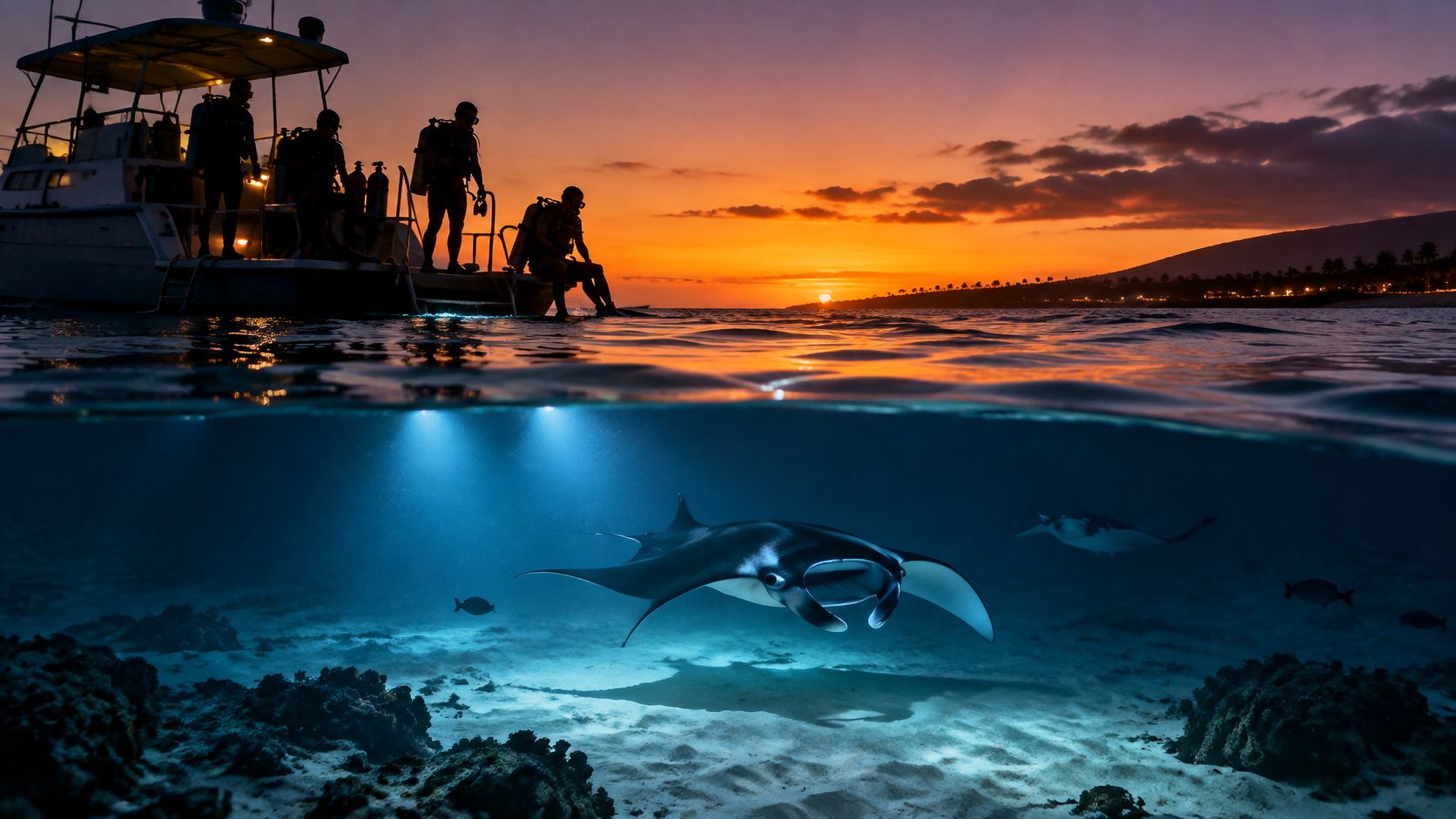
This isn't a brief seasonal migration that you have to catch during a narrow travel window. According to NOAA's voluntary wildlife-interaction standards, Kona's reef mantas, Mobula alfredi, have been studied closely since 1991, with named individuals and nightly identification records; the document also describes gestation lasting about 13 months. Their late maturity and low birth rate make respectful observation especially important.
What the outing feels like
Expect a crew briefing, a coastal boat ride, an equipment check, and a controlled entry. The main encounter is a stationary watch rather than a roaming reef dive. If plankton gathers and mantas arrive to feed, you may see repeated passes through the illuminated water.
Diving in Kona is possible 365 days a year, but that doesn't mean every site operates in every sea state or that animals appear on command. A booking reserves your place on an outing, not a guaranteed wildlife interaction.
Set the right expectation: You're visiting a feeding area, not entering a touch encounter. Let the animals choose their route and distance.
For daytime context, browse the broader Kona diving tours, then compare the format of the manta dive and snorkel outing. If you're leaning toward the surface option, this guide to snorkeling with manta rays in Hawaii helps frame the experience without scuba equipment.
The best starting point is a site where people can remain settled without occupying the animals' feeding route.
Why Garden Eel Cove Beats Keauhou
Choose Garden Eel Cove when the captain can run it responsibly. Its feeding record, protected position, sandy viewing area, and nearby reefs make it the stronger overall dive setting.
Garden Eel Cove and Keauhou at a glance
The study-related comparisons below come from the University of Hawaiʻi analysis of community observations from 2010–2022, covering more than 23,000 sightings of 167 identified reef mantas over 13 years.
| Feature | Garden Eel Cove | Keauhou |
|---|---|---|
| Aggregation size across the study record | Larger feeding groups | Smaller aggregations than the cove |
| Visitor sex ratio | More similar male and female visitation | Predominantly female, with high female site fidelity |
| Study base | Part of the combined community-sourced sightings dataset | Same community dataset |
| Setting | Protected nearshore water with calmer operating conditions | Separate coastal feeding location, assessed on its own conditions |
| Best use | Default manta dive and snorkel site when conditions allow | Alternate when the cove isn't the plan |
The important distinction is larger aggregations, not a promise that every departure produces a bigger show. Researchers also identified movement between the sites, so these aren't isolated groups living in separate viewing areas. Keauhou remains an important feeding location, particularly for females that return there consistently.
Across the combined study sites, researchers found a broadly balanced sex ratio. That shouldn't be turned into an exact ratio for Garden Eel Cove alone. The useful site-level finding is that male and female visitation there was more similar than at Keauhou.
Why the layout matters underwater
The Garden Eel Cove site description identifies the practical advantages: protected nearshore water, a broad sandy viewing area, and separation between the illuminated encounter zone and nearby reef structure. Those features make the cove a better viewing area and a better reef setting for a dive tour.
A sandy camp gives divers a defined place to settle without treating coral as a seat or handhold. The adjacent reef adds interest to the setting, but it isn't somewhere to wander while mantas are feeding. Better reefs are a reason to protect your position, not an invitation to spread out.
We often take our manta charter to Garden Eel Cove and position divers in a specific viewing area at this well-established site. That organization matters because scattered divers create a less predictable route for an approaching animal.
- Choose the viewing layout: Look for a defined camp rather than a group drifting after individual rays.
- Respect the captain's call: A preferred site isn't the right site when swell, current, or entry conditions make it unsuitable.
- Separate comfort from feeding: Sheltered water can make an outing easier without making plankton more abundant.
For a closer geographic comparison, use the Manta Heaven versus Manta Village guide. A calm booking can still be quiet when prey is thin. The cove is the stronger default, not a calendar-night guarantee.
How Lights Bring Mantas In and Keep the Pass Clean
At dusk, the lights illuminate the sand and the water above it. Small particles become visible in the beams, and a manta approaching from outside the lit area can seem to materialize from dark water. The useful thing to watch isn't just the animal's size. Watch how its mouth and cephalic fins direct water as it enters the feeding zone.
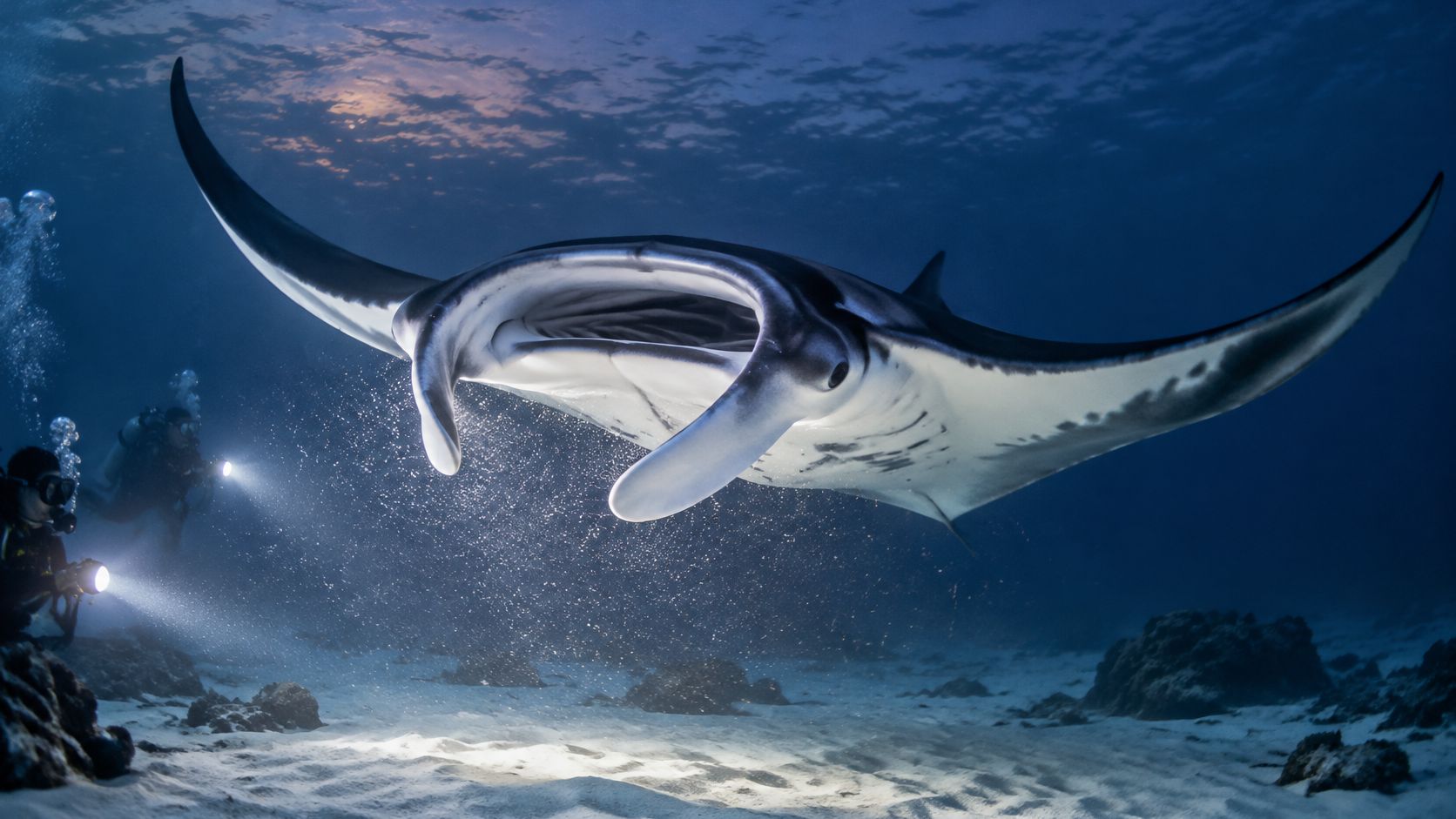
The lights gather prey, not tame animals
Reef mantas are filter feeders. Their cephalic fins help funnel plankton-rich water into an open mouth and across filtering structures associated with the gills. They aren't coming for food handed out by a diver.
NOAA's manta ecology material describes feeding aggregations in water shallower than 10 meters, alongside tagged individuals diving to approximately 432 meters at night. A shallow encounter therefore shows only part of the animal's wider nighttime habitat use.
Zooplankton rise toward surface waters after dark. Artificial lights concentrate plankton in the illuminated water, and mantas can exploit that localized feeding opportunity. More light doesn't give visitors permission to reposition the encounter wherever they want.
Think of the illuminated column as a hallway. A diver who rises into it or swims after a passing manta closes part of the route. Staying in your assigned position leaves the animal a predictable way through.
What a clean feeding pass looks like
Our crew begins with a detailed briefing covering the science of the encounter and the rules of passive observation. In the water, the dive is stationary and closely supervised by experienced guides. Powerful lights create a bright circle on the seafloor, so divers aren't sitting in complete darkness.
In a well-arranged camp, divers remain low on the designated sand, snorkelers float above, and guides monitor the group. A manta can enter, feed, turn, and return without guests trying to follow it. Nobody needs to reach upward to improve the encounter.
A close pass is something the manta chooses. It isn't something you create by moving into its path.
Say a ray approaches along the edge of the light. The diver nearest its route keeps their shoulders low, holds the camera close, and leaves their hands tucked in. The animal has space to continue, and everyone else can keep watching.
Now change that scene. A swimmer kicks toward the ray, a diver rises for a photograph, or a fin stirs sand beside the camp. The ray may turn away, while suspended sediment makes the next view worse for the whole group.
A single turn doesn't establish why an animal changed direction. Repeated avoidance or aborted feeding approaches, however, are reasons to stop adding movement and let the guide restore space.
Judge the behavior, not just the head count
The Kona manta-monitoring overview describes 25,444 observations of 118 identified reef mantas from 2009–2014, alongside the later University of Hawaiʻi record of more than 23,000 sightings of 167 individuals from 2010–2022. These are repeated observations of identified animals, not counts of that many different rays living offshore.
That distinction matters when someone uses a busy evening as proof that tourism has no cost. A small, site-faithful population can remain visible while individual animals still face interruptions. Stable sightings and undisturbed feeding are different measures.
The University study found no evidence that activity levels during its study period had reduced local population viability. That finding supports a measured view, not a claim that any crowd size or visitor behavior is harmless.
Use this checklist while you're watching:
- Position: Stay where the guide places you rather than edging toward a productive beam.
- Lights: Keep handheld beams directed upward as instructed, without sweeping them after animals.
- Hands and fins: Keep them out of the feeding route and away from coral.
- Animal response: Notice repeated avoidance instead of measuring success only by proximity.
- Guide response: Follow repositioning instructions promptly when the group needs more separation.
The same principles apply beyond this encounter. Good responsible diver etiquette means controlling your body before adding equipment, movement, or photographic ambition.
Make the photograph from your position
A wide-angle lens usually suits a close, large subject better than trying to back away mid-pass. Set exposure for the illuminated water before an animal arrives, check a test frame, and then leave the controls alone long enough to hold position.
As a diver, frame across the feeding route rather than lifting yourself into it. As a snorkeler, point down through the light column while keeping your body supported at the surface. Let the ray enter the composition instead of steering your body after it.
Secure loose straps and keep the camera within your own space. If working the housing makes you lose buoyancy or kick continuously, put it away. A sharp photograph isn't worth an interrupted feeding pass.
Choosing the Night and the Format
Calm water isn't the same as a plankton-rich night. Choose the format around your water skills and comfort, then let the crew assess whether the conditions suit the outing.
Manta dive or manta snorkel
| Reader situation | Better fit | Why |
|---|---|---|
| Certified or intro scuba diver | Manta night dive, subject to operator eligibility | Kneel on sand and remain below surface chop |
| Confident swimmer who doesn't dive | Manta night snorkel | Watch the same feeding loops from above with a simpler setup |
| Gets seasick in chop | Dive if certified, otherwise wait for a calmer call | Divers leave the surface; snorkelers remain in it |
| Wants eye-level barrel rolls | Dive | The stationary camp can put passing rays at camera height |
| Wants a simpler family-style look from above | Snorkel | Float over the light column without a tank |
| Chills easily | Dive with suitable exposure protection, or a shorter snorkel if offered | Immersion time and wetsuit fit affect comfort |
| Photography portfolio goal | Dive in clear, darker water | A stable position can be easier to work from than a windy surface |
The Kona manta format guide highlights the central trade-off: aggregation size follows plankton availability, while visitor comfort also reflects currents, sea state, visibility, and the viewing format. A busy holiday date doesn't make prey appear close to shore.
Match the water skills before the camera goals
Certified divers who are comfortable equalizing, breathing underwater, and maintaining position often prefer the lower viewpoint. Being below surface chop can feel more settled, but the boat ride and ladder still happen at the surface. Scuba isn't a cure for seasickness.
An introductory daytime dive also doesn't automatically qualify a guest for a night scuba outing. Confirm eligibility before booking, especially if you've never dived or haven't used scuba recently.
Snorkeling removes the tank and much of the equipment management. It doesn't remove the need for swimming confidence, controlled breathing, and comfort with dark open water. Families should choose around the least comfortable participant, not the strongest swimmer.
Choose for comfort first: A relaxed snorkeler usually gets more from the night than an anxious diver managing unfamiliar equipment.
Moonlight may help a snorkeler distinguish silhouettes outside the main beam. Darker surroundings can make the illuminated column look more dramatic to a photographer below, but neither effect guarantees animals.
Winter north swell or a windy afternoon can change the operational plan. Treat forecasts as planning information, not a reason to overrule the captain. For travel scheduling, use the guide to the best time to see Kona's manta rays, and leave room for weather adjustments where your itinerary permits.
Before committing, settle your eligibility, exposure protection, and motion-sickness plan.
How to Prepare for the Night Dive
Preparation should reduce tasks once you're in the water. The goal is to arrive with familiar equipment, realistic expectations, and enough warmth to remain comfortable while stationary.
Before leaving for the harbor
Match the format to your skills. For scuba, confirm the required certification and recent experience rather than assuming an introductory dive is sufficient. For snorkeling, be honest about swimming ability and open-water comfort, because surface flotation doesn't replace those skills.
Pack for both sun and the ride home. Bring sunscreen suitable for the outing, apply it early, and pack a towel plus a dry warm layer. Wind over wet skin can make the return trip feel cooler than the departure.
Choose exposure protection for a stationary dive. I'd favor a well-fitting full wetsuit over a shorty if you chill easily. You won't be generating the same warmth as on an active reef swim, and water moving through a loose suit undermines insulation.
Eat lightly and avoid alcohol before entering the water. An early, modest meal is easier to manage than a heavy dinner immediately before boarding. If you use motion-sickness medication, follow its label and get medical advice when appropriate.
On the boat before entry
Add a camera only after body control is reliable. Secure the housing, shorten loose straps, and make sure you can operate it without using the bottom as a brace. If the camera makes you reach for sand or reef, leave it aboard.
Tell the crew about concerns at check-in. Mention ear trouble, anxiety, mobility limitations, and motion sickness before gear-up. That gives the crew a chance to discuss entry, seating, assistance, or whether you should sit out.
Check rental equipment before the splash. Test the mask seal, adjust fins, and have the crew confirm scuba fit and function. A loose strap is much easier to correct on deck than while managing an entry in darkness.
For unfamiliar procedures, review the basics of scuba diving at night before travel, then follow the actual boat briefing.
If you're planning additional dives, the premium advanced trip belongs in a different part of the itinerary. The Kona blackwater dive is a separate offshore night experience, not another version of the stationary manta camp.
What Manta Night Pricing Depends On
Use the live booking price, not an old blog figure, to compare fares. A scuba outing with tanks, a surface snorkel, and a package containing additional diving aren't equivalent purchases.
Equipment rental, wetsuit hire, package structure, and shared versus private arrangements can change the total where those options are offered. Compare the complete experience rather than the first number displayed.
Compare the complete fare
- Inclusions: Confirm whether the fare covers the briefing, boat, in-water guides, equipment, wetsuit, and tank fills.
- Group arrangement: Review shared-boat capacity and any stated limit on divers in the viewing camp.
- Weather terms: Read cancellation and rescheduling conditions before choosing a tightly scheduled evening.
- Package value: Check whether combining daytime diving with the manta outing changes the total.
- Rental total: Compare the per-person checkout amount after adding whatever equipment you need.
A lower fare isn't automatically better value if you can't determine how the group will be supervised. Clear passive-viewing procedures and adequate in-water support matter more than an attractive headline price.
Compare what you'll receive and how you'll be managed in the water, not just what gets you onto the boat.
Open the booking calendar below for current rates and availability before making your final choice.
Book the Garden Eel Cove Manta Night
I recommend Kona Honu Divers for this outing because Garden Eel Cove is our go-to manta site, and our stationary camp accommodates beginner through advanced participants within the appropriate format and eligibility requirements. Experienced divemasters and instructors are in the water with divers, helping guests remain comfortable and correctly positioned.
Our manta night dive has encounter rates of up to 92%. That's an encounter figure, not a guarantee for your departure, a promised number of animals, or a measure of how little disturbance occurs. The responsible booking decision still includes site conditions, supervision, and your willingness to remain passive.
Choose the outing that fits your trip
Our menu includes the Manta Ray Night Dive, 2 Tank Local Morning Dive, Black Water Night Dive, Premium Advanced 2 Tank Trip, and Morning Introductory Scuba Dive. The surface Manta Ray Night Snorkel gives non-divers a way to watch the feeding activity without scuba equipment.
For this particular night, keep the decision simple: choose the manta format that matches your skills, identify Garden Eel Cove as your preferred setting, and accept that the captain makes the final operational call. A protected location is an advantage, not permission to ignore changing water conditions.
- Before reserving: Confirm whether you're booking scuba or snorkeling and review participation requirements.
- Before arrival: Resolve equipment needs and disclose anything that may affect entry or comfort.
- During the encounter: Let the guides manage the camp and let the animals control their approach.
If you need help choosing the right format, call 808-324-4668. A conversation about your experience and comfort is more useful than selecting scuba solely because the photographs look closer.
Review recent guest feedback, then check the live calendar for a night that fits your itinerary.
Reserve the Garden Eel Cove manta night when conditions allow, then arrive ready to follow the passive camp rules. The best contribution you can make underwater is a calm, predictable position.
Kona Honu Divers offers guided manta ray diving and surface snorkeling in Kailua-Kona, with Garden Eel Cove as our go-to manta dive site. Visit Kona Honu Divers to choose your format, check current availability, and plan a night that leaves the mantas room to feed.