
Why Kona Manta Nights Are So Reliable
Kona's manta rays are resident reef animals, so manta encounters are possible throughout the year. That does not mean a sighting is guaranteed on any particular night. The more useful question is whether plankton gathers at the site, whether the group leaves room for feeding passes, and whether the crew keeps everyone safely positioned.
Garden Eel Cove is the site I would prioritize when conditions allow. Its sheltered setting and defined viewing area support a more orderly encounter, but the night still depends on the animals and the feeding conditions.
From 2009 through 2014, monitoring documented 25,444 observations of 118 individually identified reef mantas, with one animal appearing on more than 56% of study nights, according to this account of Kona's manta history and monitoring. That pattern shows site fidelity, not a migrating group that appears only during one lucky vacation month.
Arriving outside the season a friend recommended does not necessarily mean you have missed the mantas. Resident animals return to established feeding areas, though their presence on your particular evening remains uncertain.
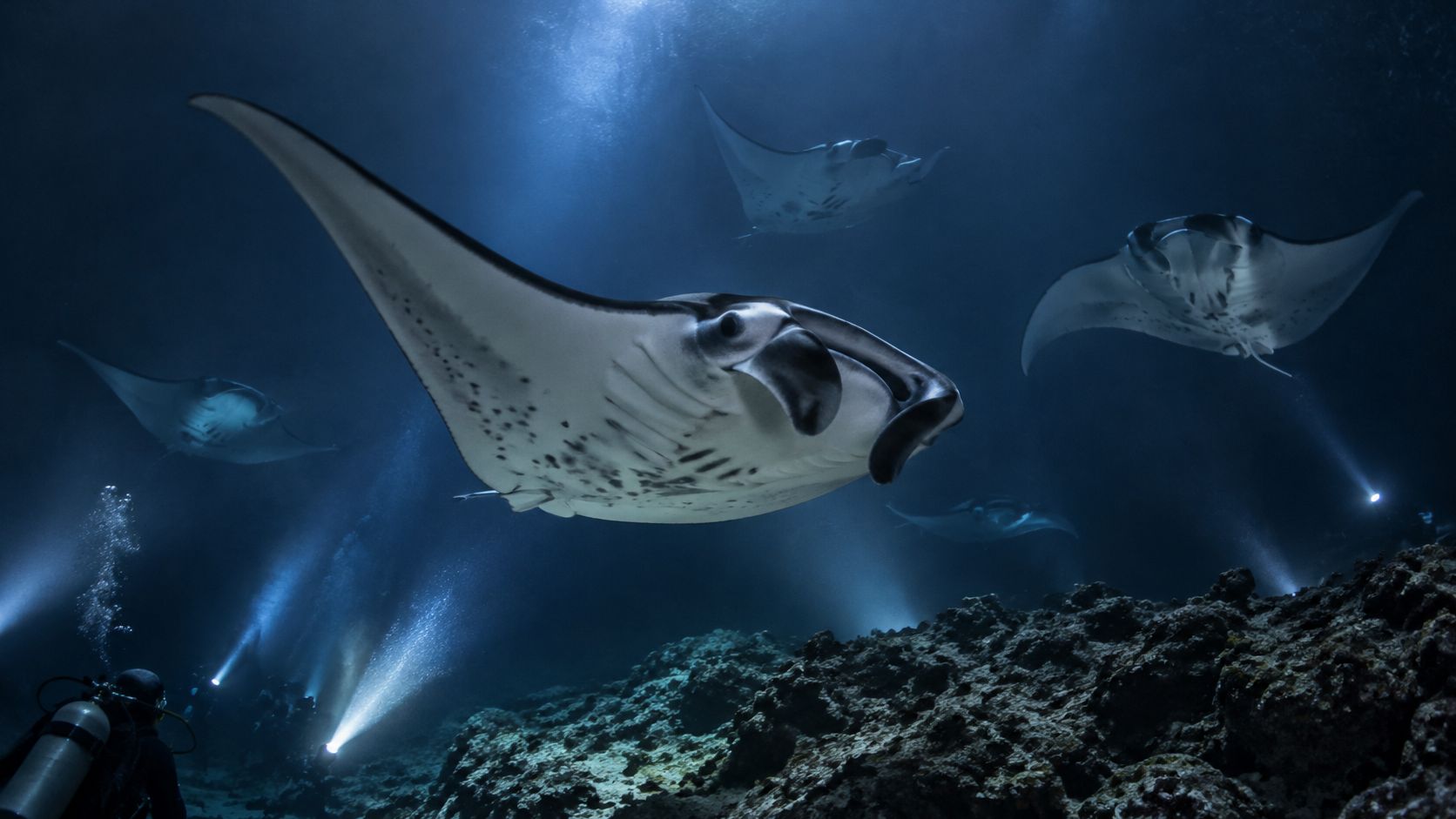
A Night Built Around Returning Animals
The same historical account dates the activity's beginning to 1991, when underwater lights near the former Kona Surf Hotel concentrated plankton and brought feeding mantas into view. It describes about five boats and 50 people by 1993, then a period of inactivity at the original site from 2000 to 2004, before floodlights returned and encounters resumed.
People established a place to observe feeding, not an appointment the animals must keep. Reef mantas, Mobula alfredi, remain free to move elsewhere.
Practical rule: Book for the opportunity to watch natural feeding behavior, not for a promised number of passes.
For visitors comparing manta rays in Hawaii, Kona's strength is its established observation pattern. A stationary night encounter can be extraordinary without turning into a chase.
If you also want daytime reef exploration, compare the wider range of Kona diving tours. Keep the goals distinct: a reef dive rewards looking around, while a manta night rewards staying still.
Scuba or Snorkel and the Better Site
Request Garden Eel Cove when sea conditions allow the boat to use it. Its sheltered setting and defined viewing area make it the stronger choice for a manta dive, especially if you want a steady position rather than an improvised spot beside the reef.
A 2025 University of Hawaii study analyzed community observations from 2010 through 2022, covering more than 23,000 sightings of 167 individually identified reef mantas. It found that Garden Eel Cove consistently supported larger aggregations than Keauhou. The study also linked changes in aggregation closely to zooplankton density, so a busy charter schedule does not automatically mean a busy feeding show.
Why the Cove Wins for Divers
The Garden Eel Cove site guide describes a protected location with a broad sandy viewing area. That layout helps divers stay centralized rather than spreading onto nearby reef structure, supporting better viewing conditions and better reef protection than an exposed or poorly defined observation position.
A sandy area is not permission to kneel on coral. It gives divers room to enjoy the surrounding habitat without using living reef as a handhold, camera support, or place to settle their fins.
Kona Honu Divers often takes its manta charter to Garden Eel Cove. The crew still makes the final site decision after assessing that evening's conditions, so a preferred site on your itinerary is not a guarantee.
Who Should Scuba, Snorkel, or Wait
| Role | Requirement | Where you stay | Choose this if |
|---|---|---|---|
| Certified diver | Open Water or equivalent | Kneeling on sand in the light circle | You can hold buoyancy and want a stable close view |
| Surface snorkeler | Calm night swimmer, no scuba card | At the surface with a guide | You want the feeding show without a descent |
| New or uneasy in the ocean | Honest comfort check first | Surface only, or skip the night | Pool confidence is not the same as dark open water |
| Photographer | Advanced stillness and buoyancy | Low in the sandy lane, lights aimed up | You will shoot passes without chasing |
Scuba is not automatically the better experience. It offers a bottom-up perspective, while adding equipment management, descent control, gas monitoring, and the discipline to remain low when an animal passes overhead.
Surface viewing removes those scuba tasks. You can watch the same feeding activity without descending if you are comfortable breathing through a snorkel and holding position in nighttime ocean conditions.
Snorkeling is not a fix for panic. If darkness or open water already feels unmanageable, sitting out is a better decision than assuming flotation will solve everything.
Use the manta dive and snorkel tour details to choose your format before reserving. Choose the role you can perform calmly, not the one that sounds more adventurous.
Certification Safety Gear and Nitrox
Start with the scuba card, then assess actual comfort. Most regular Kona Honu Divers charters require at least an Open Water Diver certification from a recognized agency. Certification establishes training, but it does not tell the crew whether you have recently practiced buoyancy or feel comfortable descending at night.
Snorkelers do not need a scuba card. They do need to follow directions, remain calm at the surface, and manage darkness, current, and nearby boat activity without leaving the group.
Make the Comfort Decision Before the Dock
Strong seasickness, panic in darkness, a recent injury, or discomfort in open water deserve an honest conversation before boarding. An injury or medical concern may require advice from a qualified clinician, not reassurance from a travel article.
- Choose the surface for the right reason. It removes scuba-specific demands, but it does not remove the ocean.
- Skip the night if needed. Swimming laps in a pool is not the same as maintaining position beside a boat after dark.
- Tell the crew early. Explain concerns while there is time to discuss the plan, rather than during entry.
The crew gives a detailed briefing before anyone enters, covering the feeding mechanism and passive-observation rules. Powerful lights create a bright circle on the seafloor, so divers are not in complete darkness. Experienced divemasters and instructors are in the water with divers, helping keep the stationary, closely supervised dive safe and comfortable.
Sort Fit and Gas Before Boarding
Check that your mask seals with a gentle inhale, without needing an overtightened strap. Choose exposure protection that suits your cold tolerance, bring a dry layer for the ride home, and make sure you can operate your dive light without fumbling.
Rental equipment can save luggage space, but fit still needs checking. Do not discover a slipping fin strap or unfamiliar buoyancy-control inflator during the descent.
Nitrox is optional, not a manta-dive requirement. On a repetitive diving day, trained divers may use enriched air while retaining conservative air-based limits to reduce nitrogen exposure relative to breathing air. It does not erase earlier dives or replace proper planning. Review enriched-air certification if you are not trained, and always analyze the cylinder, set your computer correctly, and respect the gas's depth limit.
A 2024 Hawaii Ocean Watch page reported that 25% of regularly observed manta rays showed some form of human-caused injury. That figure does not establish that tourism caused every injury, but it gives a concrete reason to take low-impact behavior seriously.
Gloves are not permission to touch. Keep your hands, fins, gauges, and camera inside your own space.
How a Manta Ray Night Dive Unfolds
The light attracts food, not a trained animal responding to a cue. NOAA's manta-viewing guidance explains how illuminated water concentrates zooplankton and how stationary observers can leave an unobstructed feeding lane.
Illuminated water can concentrate plankton much like a campfire draws insects, but the ocean has moving water and large animals that need room to turn.
The Sequence From Boat to Viewing Area
Check in and travel to the site. Confirm equipment, meet your guide, and listen for the entry and return plan. Departure timing depends on the itinerary, so a trip that includes a reef dive may leave before sunset rather than after dark.
Take the science and behavior briefing seriously. Understand where your group belongs, how to signal a problem, and why swimming toward a feeding manta disrupts the observation setup.
Enter in your assigned role. Divers descend with their group to the sandy viewing area, while snorkelers stay at the surface with an in-water guide. The surface-viewing guidance recommends a flotation ring for snorkel groups of four or more.
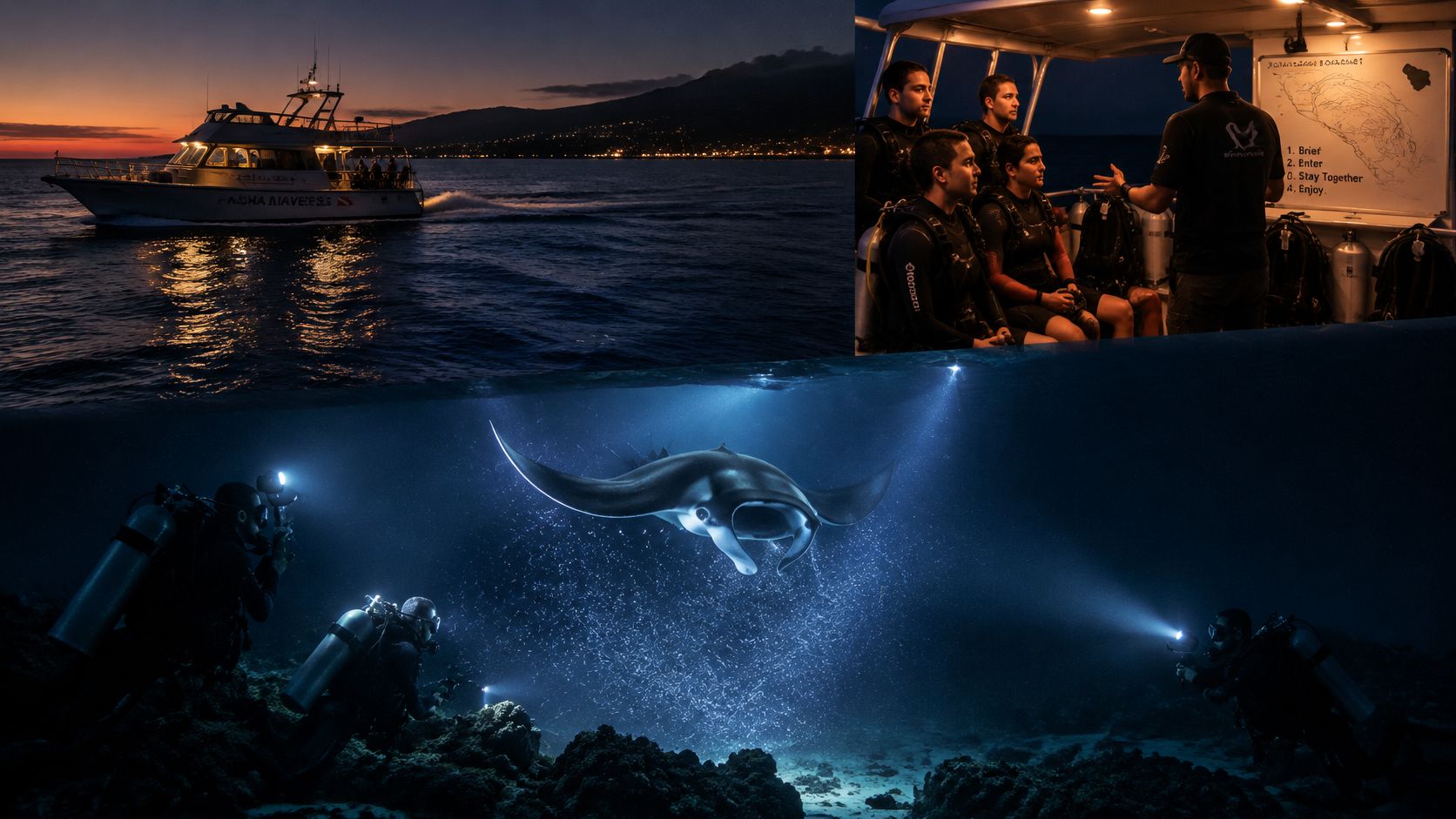
Keep the Feeding Lane Open
The crew places lights on the seafloor to create the viewing area. Leave the equipment where it is; moving it for a personal camera angle can change where people and feeding animals converge.
Settle on designated sand or rubble and hold your light above your head. This keeps the illuminated plankton in the water column and leaves maneuvering space above stationary divers. Avoid live coral and keep your fins from sweeping the reef behind you.
Watch the passes without reaching, pursuing, or rising into the lane. Where practical, time exhalations to reduce bubbles directly into an approaching animal's path, but never hold your breath on scuba or interrupt normal breathing to improve a view.
Leave with the crew's signal. A likely final pass is not a reason to separate from the group or stretch your gas reserve. Follow the controlled ascent and boat approach rather than following a manta out of the viewing area.
If you are unfamiliar with the broader procedures, review the practical differences involved in scuba diving at night before traveling.
A thin plankton night can mean fewer passes or no mantas. Roaming the reef will not improve the food conditions, and it adds separation, navigation, and habitat-contact problems to a disappointing evening.
Crowding Seasons and Choosing an Operator
No calendar month guarantees a feeding show. Kona's mantas are residents, while the size of an evening aggregation responds to food availability and moving water. Plan around your travel dates, then let wind, swell, and the crew's assessment determine whether the site is workable.
Shelter matters, but it does not make a site immune to weather. Garden Eel Cove is the preferred option when conditions support it, not a reason to ignore a cancellation or pressure the captain into using a site.
Crowding Is Part of the Safety Assessment
A county boating assessment described in Big Island Now's reporting on West Hawaii manta tourism recorded 16–19 vessels and approximately 160–190 people in the water simultaneously during nighttime observations. Those counts describe observation periods, not a prediction for your booking, but they show why vessel positioning and group separation deserve attention.
The same reporting describes debate over mooring boats rather than allowing them to drift with engines running. Propellers and people sharing dark water are a serious concern, and mantas also need clear space around vessels.
Tourism supports local work, but concentrating visitors at a feeding site creates real trade-offs. A small group on your boat can still enter a busy shared site, so passenger count alone does not tell you how the night will feel.
Questions That Reveal the Operating Plan
- How does the boat hold position? Get a clear explanation of mooring, engine use, and how guests move between the vessel and the viewing area.
- How many people will share the water? Distinguish your boat's group size from the number of other groups expected at the site.
- How are viewing layers separated? Snorkelers should remain above, divers below, and guides should make the boundaries clear before entry.
Kona Honu Divers' manta night uses a designated viewing area and in-water supervision. These process details matter more than a dramatic photograph taken on an unusually active evening.
A small passenger list does not guarantee a quiet site. Good spacing and clear supervision still matter when other boats arrive.
Check that the briefing establishes passive observation before entry and that the booking description acknowledges wildlife uncertainty. A return-trip policy, if offered, is a commercial arrangement, not a guarantee that animals will appear.
Review responsible diver etiquette before joining a shared viewing area. For photographers, anxious swimmers, and families, a predictable position and a guide who communicates clearly are more valuable than claims about being closest to the action.
Photo Setup and Two Sample Days
Build the day around arriving rested. The manta portion may be stationary, but entries, exits, equipment handling, and sustained attention still take energy. A packed itinerary can turn an otherwise manageable evening into the dive where your concentration slips.
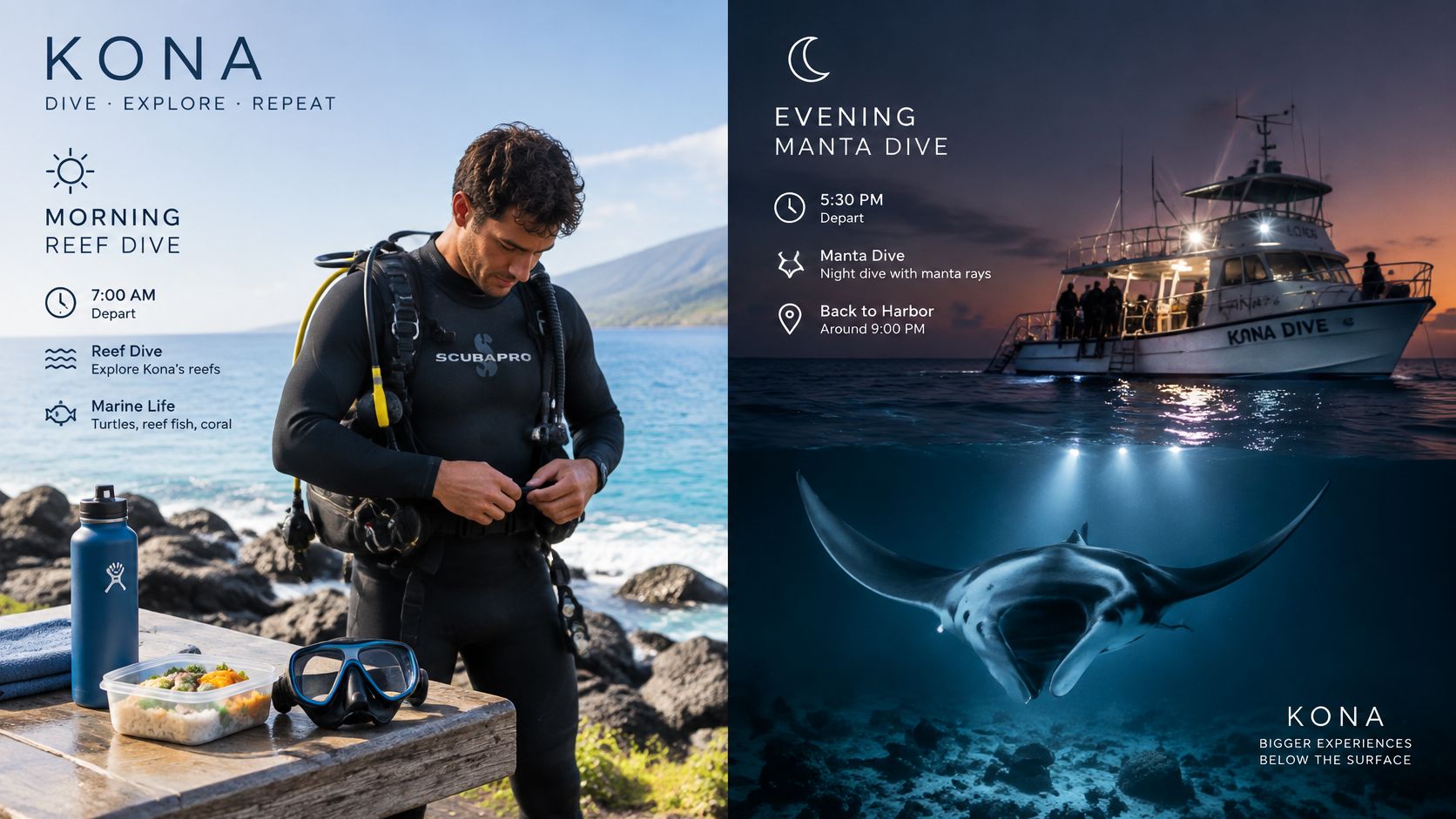
Day A for Certified Divers
Start with a local morning reef outing along the Kona Coast, then leave a substantial surface interval for a proper meal, fluids, and rest. Skip alcohol between dives, record your profiles, and make sure the evening crew knows about your earlier diving.
Be careful with the word “night” when booking. A two-tank manta charter adds its own diving to the day, so do not assume you are reserving only one evening descent when calculating the workload and repetitive-dive plan.
Choose this schedule only if you are comfortable with the total diving involved. Nitrox can fit a conservative plan for qualified users, but it is not a remedy for fatigue, poor gas management, or pushing a computer limit.
For another day, experienced divers can consider a premium advanced reef trip. Keep the Kona blackwater dive on a separate night rather than stacking it onto the manta outing.
Day B With the Manta Outing as the Only Commitment
Leave the morning open: sleep, eat normally, check the evening sea conditions, and avoid tiring yourself out with another demanding ocean activity. This is the cleaner choice for families, first ocean nights, and anyone who wants to give the experience their full attention.
“Manta-only day” means no separate morning charter. Confirm the actual evening itinerary and choose scuba or surface viewing based on your qualification and comfort.
Photograph the Pass That Comes to You
Use the Kona manta photography guide to plan the shot before you enter, then keep the setup simple enough to operate without losing position.
- Choose a wide angle. Frame the animal's approach rather than trying to back away through other divers.
- Prepare focus early. Set a useful close-working focus distance and test controls before the action starts.
- Expect backscatter. Plankton is part of the encounter, so do not solve a speckled frame by moving into the feeding lane.
- Keep lights controlled. Follow the guide's lighting instructions and avoid firing a strobe into an animal's face at contact range.
A missed frame costs less than a collision. Lower the camera whenever managing it interferes with your buoyancy or the manta's route.
Manta Ray Dive Kona FAQs
Will I See Mantas Every Night?
No. Resident animals make Kona a dependable place to try, but plankton distribution, current, and water movement can still leave a particular outing with few or no feeding passes.
Do I Need a Scuba Card to See Them?
Not for surface snorkeling. You still need enough nighttime ocean comfort to follow an in-water guide and use the group's flotation arrangement without repeatedly leaving position.
Is It Crowded?
It can be, and a modest passenger count on your boat does not guarantee an uncrowded shared site. Get a clear explanation of vessel positioning, group spacing, and the route between the boat and viewing area before paying.
Is Nitrox Required?
No. Nitrox requires appropriate training, rather than just choosing a different cylinder. Its usefulness belongs in your overall repetitive-dive plan, not in a claim that you need enriched air to watch mantas from a shallow viewing position.
Do Tourists Harm the Rays?
Human-caused injuries have been documented, although that does not establish that every injury came from a tour guest. Keep the encounter passive: do not reach toward a close pass, pursue an animal, or block its turn with your body or camera.
Which Site Should I Request?
Garden Eel Cove is the stronger dive-site choice because it combines a protected location, a defined sandy viewing area, and favorable aggregation findings. Accept a different plan or cancellation when the crew judges that conditions do not support using it.
Before you reserve: Decide whether you belong underwater, at the surface, or out of the water that evening. A sensible choice made ashore is easier than managing a comfort mismatch after entry.
A successful manta night is not measured only by how many animals appear. You should also leave knowing the group maintained its position, the crew managed the return safely, and nobody needed to chase wildlife to make the outing feel worthwhile.
Book the Garden Eel Cove Manta Night
Kona Honu Divers offers a two-tank manta ray charter, with Garden Eel Cove as its go-to manta site. It is a practical fit if you want the protected setting, defined viewing area, and reef-conscious positioning described above.
Settle your role before payment. Have your recognized Open Water certification ready if you will scuba, and be candid about recent diving, nighttime comfort, and any concerns that could affect your participation.
Confirm the Departure Details
Choose the snorkel option if surface viewing fits your abilities better than a descent. Do not select it merely because you hope flotation will overcome panic in dark open water.
- Confirm the itinerary. Understand what the two-tank charter includes and how it fits with any other diving that day.
- Confirm the intended site. Request Garden Eel Cove while accepting that conditions determine the final plan.
- Confirm your readiness. Arrive rested, with equipment and comfort questions addressed before boarding.
Call 808-324-4668 if you need to discuss your certification or which viewing role fits you. A clear conversation beforehand is more useful than changing plans at the water's edge.
Confirm Garden Eel Cove as the intended site for your departure and check availability for your preferred date. Reserve with realistic expectations: the crew can organize the encounter, but no night with wild mantas is guaranteed.
Kona Honu Divers offers guided manta night diving with in-water supervision and Garden Eel Cove as its go-to site. Visit Kona Honu Divers to choose your viewing option, discuss your readiness, and plan a night built around calm positioning rather than a sighting promise.