
You're choosing a manta tour in Kona, and the listings look almost identical until you notice different departure points, dive sites, and certification requirements. For a manta ray dive in Kona, I'd start with the site: Garden Eel Cove's protected setting and sandy amphitheater make it the stronger choice for a well-positioned underwater view.
Night Dive, Night Snorkel and Day Dive Compared
Manta experiences in Kona compared
| Option | Where You Are | Who It Suits | Certification Needed | What You Typically See |
|---|---|---|---|---|
| Night manta dive | Kneeling on the sandy bottom, lights aimed upward | Certified divers who want close overhead passes | Open Water Diver or higher, confirm with the operator | Mantas gliding through the lit water column, often close to the bottom |
| Night manta snorkel | Floating at the surface, lights aimed downward | Beginners, non-divers, families | None; comfort swimming on the surface | Mantas passing beneath the surface light, seen from above |
| Morning reef dive | Open reef, natural daylight, no manta lights | Divers who want reef fish and daytime marine life | Open Water Diver or higher, confirm with the operator | Reef fish and reef structure; manta encounters aren't the purpose of the dive |
Choose the night dive for the bottom-up perspective. You settle into an assigned position, look upward, and watch the animals approach through illuminated water. The appeal isn't swimming alongside a manta. It's staying still while a feeding pass brings the animal overhead.
The night dive and night snorkel draw the same animals to the same illuminated feeding area. Your depth and viewing angle change, not the species you're watching. Neither option owns the closest encounter, because mantas can feed near the bottom or rise toward the surface.
Match the experience to your comfort
For a certified diver, the night dive is the stronger choice if you're comfortable managing buoyancy, breathing equipment, and a nighttime entry. A stationary viewing session removes the need to move through a dark reef, but it doesn't remove your responsibility to monitor air and follow your guide.
For non-divers and mixed families, snorkeling avoids the scuba certification requirement. Surface conditions still matter, though. A floating light setup isn't a substitute for comfort with your face in the water, a snorkel in your mouth, and movement beneath you.
For reef exploration, choose a morning dive. Daylight lets you appreciate reef structure and fish behavior without spending the dive in a fixed viewing area. Don't book a morning reef trip expecting it to substitute for a dedicated manta session.
The practical distinction in snorkeling versus diving with manta rays is whether you want to look down from the surface or up from the seafloor.
- First night in Kona: Choose the option that matches your existing water skills, rather than adding unfamiliar scuba equipment to a night encounter.
- Certified diver on a limited budget: Compare the complete scuba price against the snorkel price, then decide how much the underwater viewpoint matters.
- Non-swimmer: Don't assume flotation makes the tour suitable. Discuss your ability with the crew before paying.
Operators set their own certification and participation rules, so treat the table as a starting point, not permission to join every charter.
How the Lights Bring Mantas In
Kona's night viewing began with an accidental connection between shoreline lighting and wildlife. Hotel lights attracted plankton, and reef mantas returned to feed; organized nighttime viewing began near the Kona Surf Hotel in 1991, according to Kona Honu Divers' account of the dive's origins.
The simple analogy is a porch light attracting moths. Here, the moths are zooplankton, and the light concentrates a food source already present in the ocean. Crews aren't handing food to the mantas or using physical interaction to keep them nearby.
Reef mantas feed by swimming through plankton-rich water with their mouths open, using their cephalic fins to direct that water inward. Zooplankton becoming more accessible after dark helps explain the timing of the encounter, as described in this NOAA-hosted manta biology document.
Your position creates the viewing space
Divers generally gather in a semicircle near the bottom with lights directed upward, while snorkelers remain at the surface with lights directed down, as explained in the Love Big Island manta viewing guide. That arrangement leaves the middle of the water column open for feeding passes and reduces unnecessary contact with coral, urchins, and other bottom life.
On sand, the guide may position you kneeling or settled close to the bottom. That isn't permission to kneel anywhere you find space. Identify the assigned patch, keep your fins clear of neighboring divers, and don't use a coral head as a handhold.
Aim your light where the briefing directs it, rather than sweeping the beam around to follow every animal. Constantly changing its direction doesn't improve your seat. It makes the group less predictable and can distract other divers.
Practical rule: Keep your body out of the feeding lane and let the manta choose how close to pass.
Our experienced divemasters and instructors stay in the water with the group. The dive is stationary and closely supervised, with guides helping divers remain comfortable and correctly positioned. Powerful lights illuminate the viewing area, so you aren't sitting in total darkness.
What a good pass looks like
A manta approaches through the beam, sweeps toward the group, turns near the sand, and leaves through open water. Your job is to preserve that open route. Don't rise into the turn, stretch a camera toward its mouth, or lift an arm to meet a wing.
Keep breathing normally throughout the encounter. Never hold your breath to avoid bubbles, and don't sacrifice buoyancy control for a photograph. Secure loose gauges and accessories before entering so they can't drag or swing into an animal.
The crew explains passive observation before the dive, including where to settle and what to do if you need assistance. Reviewing responsible and considerate diver etiquette beforehand makes those instructions easier to apply when your attention is on the mantas.
Never touch, chase, grab, ride, or obstruct a manta. Touching can remove its protective mucus coating. A successful close encounter ends with the animal continuing its feeding path undisturbed, not with a diver making contact.
Best Times to See Mantas in Kona
Conditions that change your manta sighting odds
| Factor | What It Changes | How to Plan |
|---|---|---|
| Season | Mantas are present year-round in Kona; plankton supply changes through the year | Book in the month you're visiting, but keep a flexible backup night |
| Moon brightness | Moonlight can change how plankton responds to artificial lights | Ask how the crew handles bright-moon nights |
| Sea state | Low swell makes entry, positioning, and holding still easier | Check the marine forecast on the day |
| Plankton density | Denser zooplankton supports larger aggregations | Expect night-to-night changes rather than a fixed manta count |
| Past sighting record | Kona sightings often exceed a 90% success rate | Treat the record as context, not a promise for your departure |
| Time of night | The viewing window follows darkness and light deployment | Confirm departure time and the complete session length |
Conditions matter more than a supposedly perfect month. Kona's resident mantas don't require you to target a brief migration window. What matters on your evening is whether the sea permits a controlled session and whether enough food is available to concentrate feeding activity.
A University of Hawaiʻi community-science study covering 2010–2022 found that Garden Eel Cove consistently supported larger aggregations and that aggregation size tracked zooplankton density across seasons and years. That gives you a better planning principle than choosing a date solely by the moon calendar.
Plan around food and sea conditions
A calm ocean helps the crew manage entries and makes it easier for you to stay comfortable. It doesn't create plankton. You can have a smooth boat ride and a modest manta gathering on the same evening.
Likewise, a bright moon isn't an automatic reason to cancel your plans. Ask how the crew runs those nights rather than assuming a universal moon-phase rule. The guide to the best time to see Kona's mantas can help you weigh timing against the rest of your itinerary.
Book early in your stay, not on the final evening before departure.
For a multi-night visit, target your first suitable night and leave another evening open. That gives you room to respond to rough conditions or an unsuccessful wildlife encounter, subject to the operator's actual availability and rebooking terms.
Before leaving your accommodation, check the marine forecast for swell, not just the sunshine icon on a weather app. Then confirm the departure status and cancellation procedure with the crew. A sighting record can help you choose a destination, but no operator can promise a fixed number of wild animals.
Garden Eel Cove Versus Keauhou Bay
Garden Eel Cove, also called Makako Bay, is the stronger choice for a manta dive when conditions allow. Its protected location, better-defined viewing area, and surrounding reefs provide a more useful combination for divers than choosing a departure solely by convenience.
Garden Eel Cove versus Keauhou Bay for the manta dive
| Factor | Garden Eel Cove (Makako Bay) | Keauhou Bay (Manta Village) |
|---|---|---|
| Setting | Protected cove | Open bay setting; assess conditions for the actual departure |
| Bottom | Broad sandy clearing shaped like a gently sloping amphitheater | Rockier bottom |
| Primary viewing depth | Approximately 35 feet, according to the published site comparison | Roughly 25 to 45 feet, in that same comparison |
| Typical aggregation size | Larger aggregations in the long-term site comparison | Smaller aggregations relative to Garden Eel Cove |
| Female visitation | Lower relative female use | Stronger female visitation and high female site fidelity |
| Diver positioning | Centralized sandy viewing area that helps keep divers off reef | Rockier bottom makes the assigned position especially important |
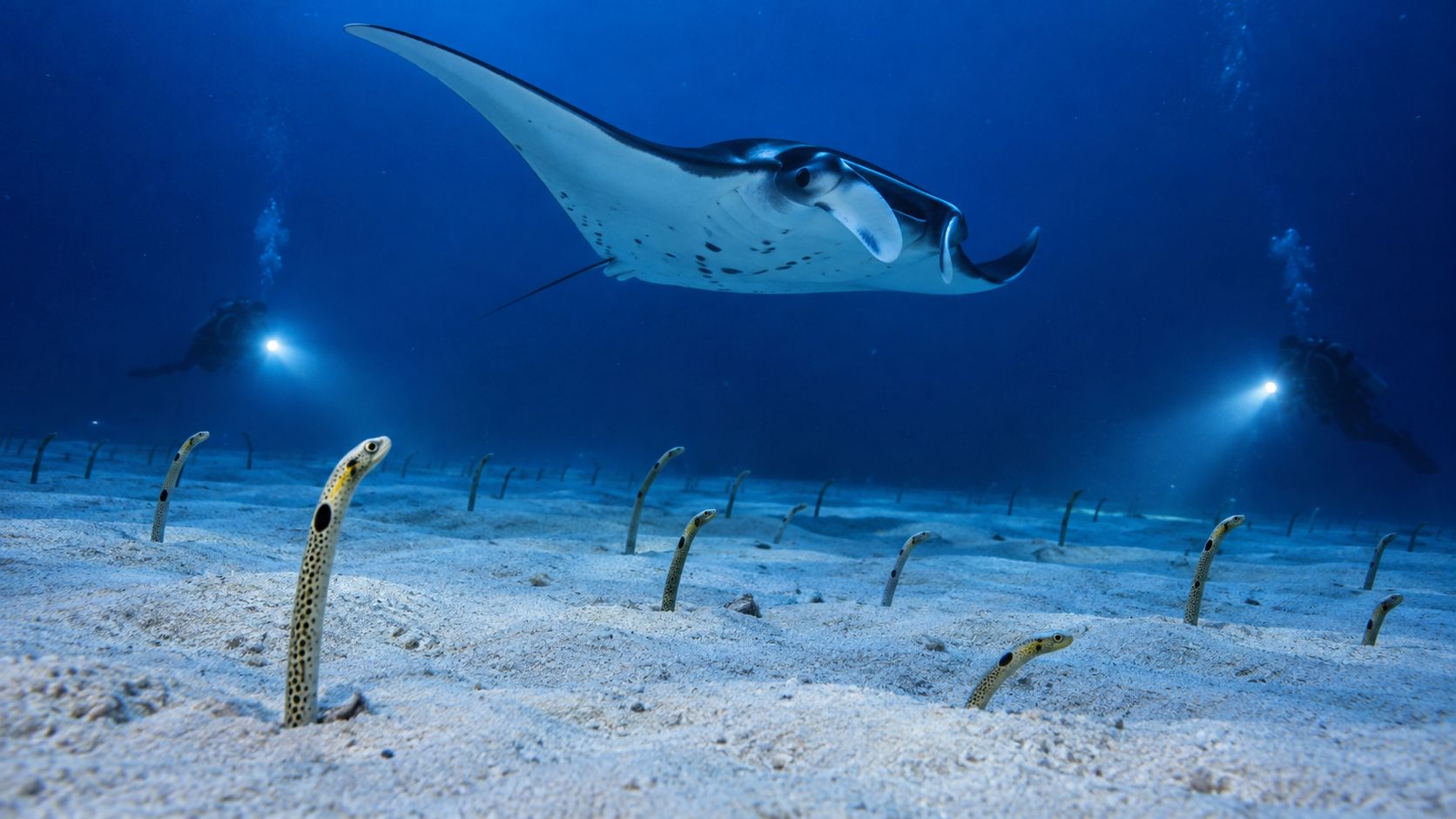
Why the amphitheater matters underwater
A sandy amphitheater gives the guide a defined place to arrange the group around the viewing area. You're less likely to spend the session trying to find a workable perch between rocks or adjusting your body around nearby reef. That makes looking upward and anticipating an approaching manta more straightforward.
The surrounding reef also gives Garden Eel Cove a better overall dive setting. Better reefs don't mean you should leave the group to explore during the manta session. They matter when assessing the site as a whole, while the nighttime viewing itself remains centered on the assigned area.
Protection helps reduce exposure to open-ocean conditions, but the cove isn't immune to swell or an unsuitable forecast. A crew that changes plans for conditions is making an operational decision, not failing to deliver the preferred location.
Where Keauhou still makes sense
Keauhou remains an established manta viewing option with its own ecological profile. Stronger female use doesn't make it inferior as habitat, and it doesn't mean a particular female will appear during your session. For the visiting scuba diver, the distinction is the combination of bottom layout, protection, and viewing configuration.
We often take our manta charters to Garden Eel Cove and position divers in a specific viewing area at a well-established site. Confirm the intended site when booking, then understand that the crew must retain the ability to respond to conditions.
I'd favor Garden Eel Cove for its protected amphitheater and better reef setting. That's a site-choice recommendation, not a guarantee of a particular manta count.
Certification, Gear and Photo Tips Before You Dive
Most regular Kona scuba charters require at least an Open Water Diver certification from a recognized agency, including most of our regular dive departures. Night snorkeling doesn't require scuba certification, but it does require comfort swimming at the surface. Confirm the exact participation requirements before booking.
Requirements by manta option
| Option | Certification | Experience and Fitness | Equipment |
|---|---|---|---|
| Night manta snorkel | None required | Comfortable swimming at the surface at night | Mask, snorkel, fins, and a wetsuit or rash guard; rentals may be available |
| Night manta dive | Open Water Diver or higher from a recognized agency; confirm the departure requirements | Recent diving, buoyancy control, and comfort with night entries | Full scuba rig and wetsuit; rentals may be available |
| Manta Ray Diver specialty | PADI Manta Ray Diver specialty course | Certified diver interested in manta biology and conservation | Course materials and standard dive gear |
The PADI Manta Ray Diver specialty covers manta biology, behavior, and conservation and is taken before the night dive. It's a useful learning option if you want more context or plan repeat encounters, not a replacement for basic scuba certification.
Bring your certification details and recent dive log. If you haven't dived recently, address that before making a nighttime wildlife encounter your return to scuba. Being stationary doesn't compensate for rusty regulator recovery, unfamiliar weighting, or difficulty controlling buoyancy.
Prepare for staying still
Choose exposure protection for a relatively inactive session, not just for warm water. A wetsuit generally provides more thermal protection than a rash guard; pack a dry thermal layer for the boat ride home. Masks, fins, wetsuits, and complete scuba rigs may be available to rent, so confirm sizing and inclusions in advance.
Our crew gives a detailed briefing on the science of the encounter and the rules of passive observation. Listen before assembling your camera. Understanding your assigned position matters more than choosing a camera mode.
Photograph the pass without disrupting it
- Use a wide-angle lens. Fit the manta into the frame without extending the camera into its path.
- Raise ISO. Increase sensitivity enough to capture movement under available light, then check noise on a test image.
- Set manual or custom white balance. Test it under the viewing lights instead of relying on a changing automatic setting.
- Avoid direct strobe flashes at animals. Follow the crew's lighting rules and use available light where practical.
- Anticipate the lit route. Frame the water the manta is approaching rather than swinging the camera after it.
- Keep your fins still. Suspended sand creates backscatter and spoils neighboring divers' visibility.
Use these Kona manta photography examples to think about composition before entering. Flash photography directed at animals can disturb them, and chasing creates avoidable risk. Neither is worth a photograph.
A Sample Night From Check-In to Shore
Typical timeline for one manta night
| Time (approximate) | Stage | What Happens |
|---|---|---|
| Afternoon | Check-in at the harbor | Sign-in, gear fitting, and checks of certification or swimming ability |
| Late afternoon | Departure | Boat leaves the harbor; crew explains the science and passive observation rules |
| Dusk | Arrival at the viewing site | Crew secures the boat as appropriate; guests gear up and enter with their group |
| After dark | Lights on, possible manta arrivals | Lights illuminate the feeding area; the group settles into fixed positions and waits |
| Viewing period | Stationary observation | Divers remain in the assigned bottom area, snorkelers stay at the surface, and guides supervise |
| Return | Boat back to the harbor | Warm-up and debrief; equipment handling and rinsing follow the crew's procedure |
These are approximate stages, not a promised departure schedule. Operators and seasons change the timing, and a trip with an earlier reef dive needs a different check-in than a dedicated nighttime session. Confirm the actual meeting time and harbor location before arranging dinner or transportation.
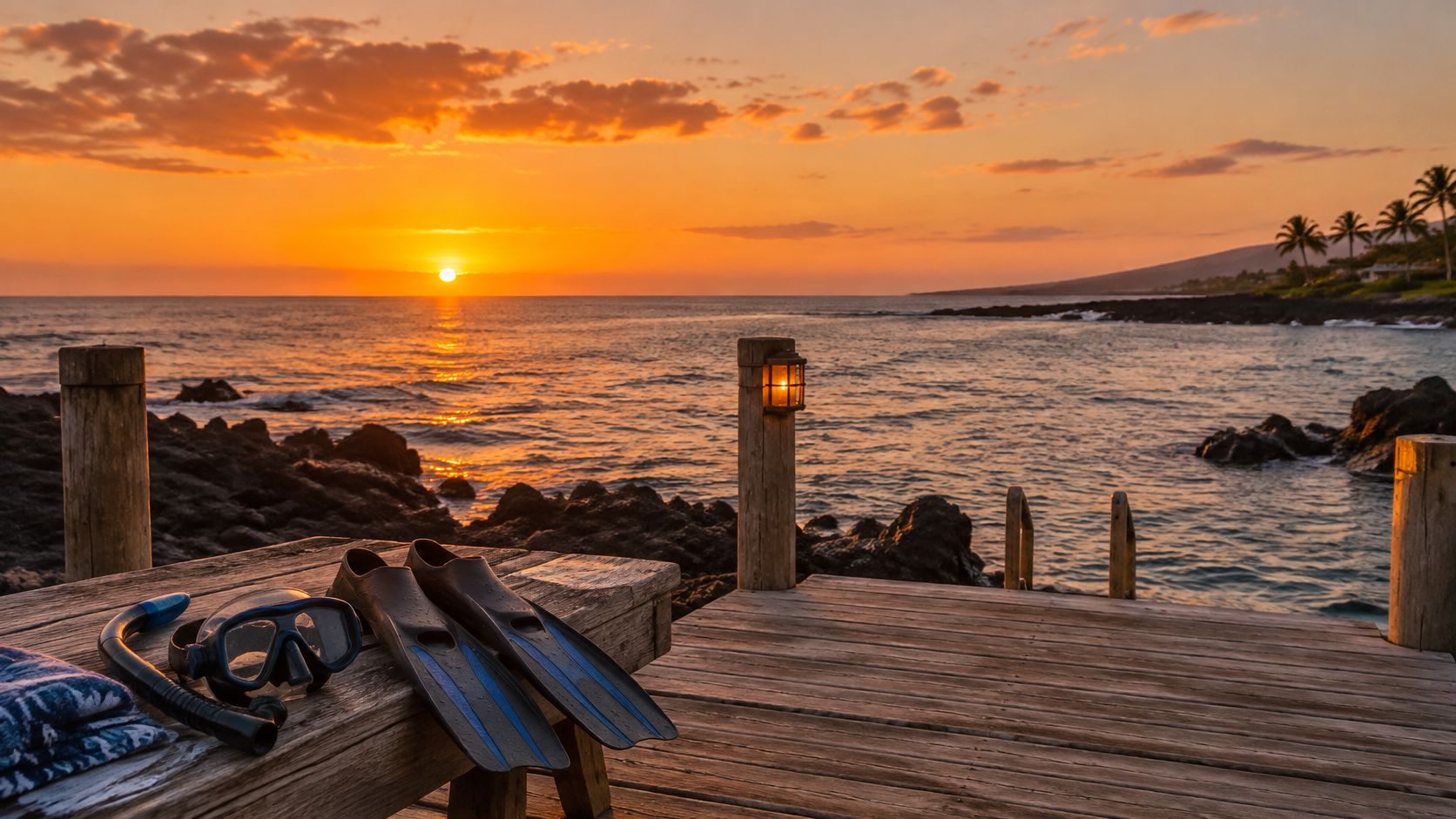
From gear fitting to the assigned position
At check-in, deal with fit problems while you're still on land. A leaking mask strap, uncomfortable fin pocket, or unfamiliar buoyancy compensator becomes harder to troubleshoot once the group is entering at dusk. Tell the crew about any concern rather than hoping it won't matter.
During the briefing, listen for entry and exit instructions, guide signals, and the procedure if you become uncomfortable. Once the boat reaches the site, prepare in the order the crew requests. Don't enter early because another group is already in the water.
Crowding is a realistic consideration. A Hawaii County boating operations and safety assessment recorded 16–19 vessels and approximately 160–190 people in the water across the two sites concurrently during observations on August 10–13, 2015. That historical snapshot isn't a forecast for your booking, but it explains why vessel spacing and assigned viewing positions matter.
Your guide's chosen position matters more than moving toward whichever group currently has a manta overhead.
During viewing and the return
Follow your guide to the viewing area and settle without drifting into the next group. Powerful dive lights create a bright circle on the seafloor, so the session doesn't feel like floating in unbroken darkness. The surrounding ocean remains dark, which makes staying oriented to your guide important.
Keep checking your instruments even when the mantas are active. If you need help, signal rather than leaving your position without notice. When the guide ends the session, leave with the group instead of waiting for another pass.
Back aboard, secure your gear before reaching for a camera or dry clothing. Bring a small light for finding belongings on the return, but don't shine it into the captain's eyes or toward the helm. A wind-resistant outer layer makes the ride back more comfortable after immersion.
Booking Your Garden Eel Cove Manta Dive
- Compare the full scuba and snorkel totals. Scuba generally costs more because it involves dive equipment, certification checks, and underwater supervision. Certification is a prerequisite, not necessarily something included in the ticket.
- Check package structure. Multi-tank trips and dive packages can change the effective per-dive cost, so compare the complete itinerary rather than the headline rate.
- Verify inclusions. Establish whether rental equipment, nitrox, and transport are included, optional, or unnecessary for your chosen experience.
- Protect flexibility. Your party size and available evenings affect how easily you can accept another departure if plans change.
Compare current per-person totals on the booking page rather than relying on an old price in a blog post. A cheaper departure isn't automatically better value if it excludes equipment you need or takes you to a site that doesn't match your priorities.
Match the booking to the person entering the water
Kona Honu Divers offers guided diving tours along the Kona Coast, including the two-tank manta dive and snorkel excursion. Certified divers can choose the underwater session, while beginners and non-divers can consider the surface option if they meet the swimming requirements; guests seeking more experienced diving opportunities can also review the Premium Advanced Two-Tank Trip.
Our manta encounter accommodates participants from beginner to advanced levels through the appropriate dive or snorkel option. That doesn't mean an uncertified beginner can join the regular scuba portion. Choose by qualification and water comfort first, then by preferred perspective.
Our manta night dive has encounter rates of up to 92%. That's an encounter record, not a guarantee for a particular evening, animal count, or pass distance. Keep wildlife uncertainty separate from the operational details the crew can confirm.
Confirm these details before paying
- Intended site: We often run our manta charters to Garden Eel Cove. Confirm the plan for your date and understand that conditions can require changes.
- Certification rule: Provide your agency, certification level, and recent diving history so the crew can confirm suitability.
- Weather and cancellation terms: Ask what happens if the crew cancels, if you cancel, or if the trip runs without a sighting. Those are different situations.
- Group arrangement: Ask how many guests join your guided group and how divers and snorkelers are supervised.
- Equipment and timing: Confirm rental needs, check-in location, departure time, and the expected return before organizing the rest of your evening.
Call 808-324-4668 with questions about suitability, equipment, or the intended site. Then choose a date early enough in your stay to preserve alternatives, rather than treating your final evening as the only opportunity.
Frequently Asked Questions About the Manta Dive
What if no mantas appear on my night?
A completed boat trip doesn't guarantee wildlife, and a no-sighting policy isn't necessarily the same as a weather cancellation policy. Use the early-stay approach in Best Times to See Mantas in Kona, leave another evening open, and confirm the actual rescheduling terms before purchasing.
Can children or non-swimmers join?
Night snorkeling doesn't require scuba certification, but participants need to be comfortable swimming at the surface; confirm age limits and any swimming assessment with the crew. For scuba, the distinction explained in diving in Hawaii without certification matters: an introductory scuba experience isn't interchangeable with a certified night charter, and flotation doesn't automatically make nighttime snorkeling appropriate for a non-swimmer.
Do I need my own gear?
Not necessarily, because rental equipment may be available, but reserve the correct sizes and confirm what your booking includes. Follow the preparation guidance in Certification, Gear and Photo Tips Before You Dive, particularly exposure protection for an inactive session and dry, warm clothing for the return.
Is it safe with many people in the water?
A busy site requires disciplined spacing and supervision, not a promise that crowds create no risk. The practical response in A Sample Night From Check-In to Shore is to stay with your guide, hold your assigned position, and signal promptly if you're uncomfortable rather than moving between groups.
Can I touch a manta that comes close?
No, even if the animal approaches you. Apply the passive-observation rule in How the Lights Bring Mantas In: keep your hands to yourself, leave its route open, and let it pass without contact that could remove protective mucus.
Kona Honu Divers offers guided manta diving and surface snorkeling, with Garden Eel Cove as our go-to manta dive site. Visit Kona Honu Divers to choose the experience that fits your certification and swimming comfort, then confirm your intended site and date with the crew.