
You're comparing Kona manta tours on your phone, wondering whether you should be on the bottom with a tank or floating at the surface beside people who've never dived. You're also wondering if a manta will show up at all. Those are the right questions. A manta ray dive in Kona isn't a daytime reef swim moved to after dark. It's a stationary, light-driven encounter with wild animals that choose when to feed. Choose the format that fits your skills, pick Garden Eel Cove for its protected location, better viewing area, and better reefs, and understand why holding still gets you closer passes than chasing ever will.
Manta Ray Dive Formats at a Glance
The lights come on, the seafloor glows, and a reef manta glides through the beam above you, sometimes within arm's reach. Certified divers who want that bottom-up view should choose scuba. Everyone else should choose the snorkel.
A night manta scuba dive puts you on the bottom, holding still while mantas feed overhead. A night snorkel puts you at the surface, looking down as they rise into the light. For a side-by-side decision help, read this comparison of snorkeling versus diving with manta rays.
The Kona blackwater night dive belongs in this table only as a contrast. It drifts in deep open water and doesn't focus on mantas, so don't book the Kona blackwater dive tour expecting a manta show.
Manta ray night formats compared
| Format | Where You Watch From | Certification and Gear | Typical Length |
|---|---|---|---|
| Night manta scuba dive | On the seafloor, holding still | Scuba certification, rental gear, complimentary nitrox | 3-5 hours |
| Night manta snorkel | At the surface, lights aimed downward | Snorkel gear, no certification needed | 3-5 hours |
| Kona blackwater night dive (comparison only) | Deep open water, not a manta site | Scuba certification and experience | Night boat tour, check schedule |
If you want the scuba version, the Kona Honu Divers 2-tank manta dive and snorkel tour is built around rental gear and complimentary nitrox.
Simple rule: If you're certified and comfortable at night, dive. If you're not certified, snorkel. Don't force the wrong format.
Why Manta Rays Come Close After Dark
Mantas aren't coming to see you. They're coming to eat.
The Light and Plankton Sequence
First, dive lights illuminate the water column. That light concentrates zooplankton, tiny drifting organisms. Reef mantas then enter the lit zone and filter-feed, which is the light, plankton, and manta sequence behind the Kona night encounter.
That's why the dive produces repeat passes without bait or contact. The food stays in the beam, so a feeding manta turns and passes through it again instead of swimming away after one look.
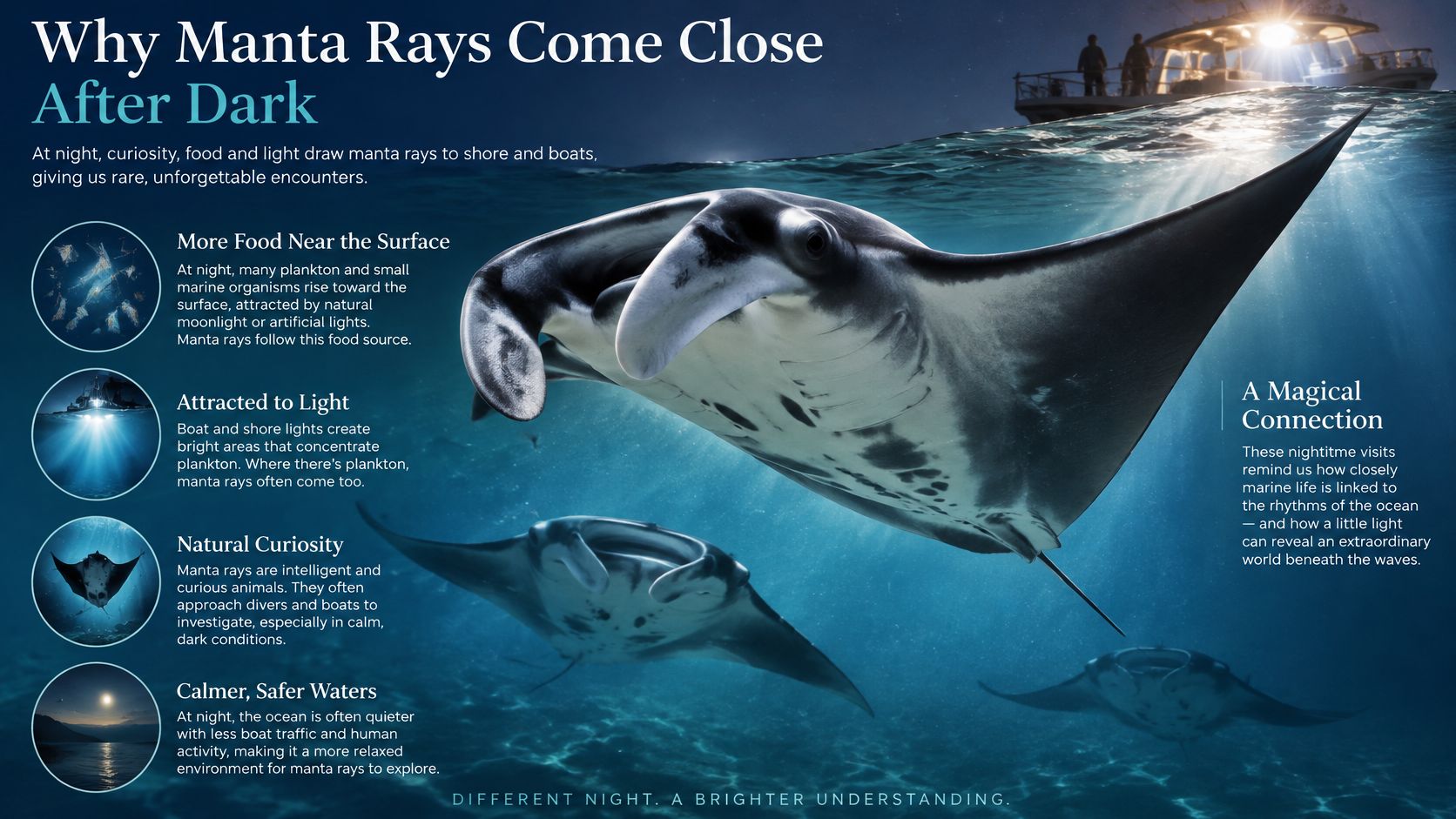
Your light angle depends on your position. Divers on the bottom aim lights upward. Snorkelers at the surface aim lights downward. Both groups are building the same illuminated feeding zone from opposite sides.
Feeding Versus Cleaning
Mantas also visit cleaning stations, where smaller fish remove parasites. Think of a commuter choosing between a busy food court and a quick car wash. When plankton is concentrated and feeding is efficient, the food court wins. When feeding is less rewarding but cleaner fish are active, the car wash is worth the stop.
That's not random behavior. In a 2019 study of manta attendance at cleaning stations, mantas used cleaning stations when conditions were less favorable for foraging, then left when currents concentrated plankton for feeding.
What Controls a Given Night
- Current strength: It can gather plankton or disperse it.
- Sea state: It affects how comfortably mantas and people can hold position.
- Moon illumination: It changes the night water column and plankton distribution.
- Plankton density: Sparse food gives a manta little reason to stay.
The clock matters less than those conditions. A boat can leave on time, set the lights correctly, and still have a quiet night. A good operator tells you that before you pay. Don't book with anyone who promises a manta as if it's scheduled entertainment.
Garden Eel Cove and Kona Honu Divers Compared
Garden Eel Cove is the superior manta site. Book there first. Also called Manta Heaven, it offers a protected location near Keahole Point, a better viewing area, and better reefs than the busier southern option.
The site has a sandy slope with garden eels and reef habitat along the margins. At night, divers settle around a designated lighted viewing area while resident reef mantas maneuver through open water above them, as described in this Garden Eel Cove site overview. You reach it by boat. Touching and chasing mantas are prohibited.
That layout matters, especially your first time. You get a defined place to stay, reef structure at the edges instead of an empty sand patch, and open water overhead for the animals. You're not swimming around trying to find the action. You hold still and let the feeding lane form above you.
Before choosing a harbor, compare Manta Heaven versus Manta Village in this Kona manta guide. One assessment reported that a Kona viewing site could hold 100 to more than 300 people at one time, according to Hawaii Ocean Watch guidance on Kona manta viewing sites. That scale is exactly why site management and group positioning matter.
Kona manta viewing sites compared
| Site | Setting | Viewing Area | Reef Habitat | Crowding |
|---|---|---|---|---|
| Garden Eel Cove (Manta Heaven) | Protected location near Keahole Point | Designated, lighted viewing area | Better reefs along the margins | Managed, low-impact viewing rules |
| Keauhou Bay (Manta Village) | Long-running commercial site | Established nightly viewing area | Developed shoreline site | Research cites 100 to more than 300 people at one viewing site at a time |
| Hoona Bay-Makako Bay | Principal Kona manta area | Northern Kona viewing area | Reef and sand habitat | Busy principal site |
Kona Honu Divers builds its manta night dive around this northern site, with rental gear, complimentary nitrox, and spacious custom dive boats. Check those inclusions when you book, and check recent guest reviews rather than taking any operator's word for its reputation.
For first-timers, a calmer, clearly managed viewing area beats a crowded free-for-all. You'll hear your guide better, settle faster, and spend less energy figuring out where your body belongs.
Who Can Join and What to Bring
Start with honesty, not optimism. If you're a certified diver with reliable buoyancy and you're comfortable in dark water, take the scuba format. If you're not certified, take the snorkel and stay at the surface.
Inexperienced snorkelers shouldn't dive underneath or near mantas. Your job is passive observation from above. If you can't control where your body drifts, you can't control your distance from the animal.
Skip It or Talk to the Operator First
- Limited swimming ability: You still need to enter, exit, and stay calm in open water at night.
- Motion sensitivity: The boat ride and waiting at the site can undo an otherwise ready guest.
- Strong darkness or open-water anxiety: Night water feels different, even for decent daytime swimmers.
- First-time participation: Tell the crew before departure so guides can watch you more closely.
If certification is your blocker, read whether you can scuba dive in Hawaii without certification before picking a format. Experienced divers who want more than a single-focus manta night should also look at the premium advanced 2-tank trip for more experienced diving opportunities.
Gear by manta format
| Item | Scuba Diver | Snorkeler | Notes |
|---|---|---|---|
| Certification | Recognized scuba certification required | Not required | Confirm your card at booking |
| Regulator, BCD and wetsuit | Rental available | Not needed | Ask about sizing |
| Mask, snorkel and fins | Included in the dive kit | Rental or own gear | Check fit before departure |
| Dive light | Used during the dive | Not required | Confirm what is provided |
| Nitrox | Complimentary | Not applicable | Ask at booking |
Nitrox is an enriched air mix divers breathe from their tank. Kona Honu Divers includes it at no extra charge, but you should confirm your nitrox qualification when booking. Snorkelers use no tank and no nitrox.
Rental regulators, BCDs, and wetsuits are sized at booking so your kit fits from the first dive. Bring a warm layer for the boat after dark, a towel, a dry bag for valuables, and reef-safe sunscreen applied well before the trip. Confirm sizing and certification details when you reserve, not at the dock.
Diver Positioning Rules That Keep Mantas Close
A close pass doesn't prove you behaved well. It may only prove the manta tolerated you.
The stakes aren't trivial. More than 1 million people worldwide snorkel or dive with mantas each year, producing about US$140 million in direct economic impact, according to Hawaii County testimony citing published manta tourism research. Regional subpopulations are usually fewer than 1,000 individuals, and both recognized manta species are classified globally as Vulnerable in that same cited material.
Compliance is the weak point. Only 44% of human and manta interactions complied with existing guidelines in research on manta tourism interactions. Obstruction, front approaches, chasing, and getting too close were tied to avoidance or feeding stopping.
What the Manta Experiences
From the manta's perspective, a diver dropping into its path is an obstacle in its feeding lane. A diver rising from the bottom changes the open water it planned to use. A head-on swimmer forces a decision: turn, stop feeding, or leave.
Distance changes that outcome. Reef mantas at cleaning stations showed minimal response when divers stayed more than 3 meters away and off the station, and analysis of 431 tourism videos found people within 0 to 3 meters increased avoidance, according to Convention on Migratory Species research on diver effects on reef mantas. Approaching from the front strongly increased behavior changes in that same summary.
Use the same mindset you'd use for responsible and considerate diver etiquette. Stay low, stay at the perimeter, and keep the animal's entry and exit routes open.
Diver positioning rules and why they matter
| Situation | Correct Action | Why It Matters |
|---|---|---|
| Within 0-3 meters of a ray | Back off and hold a stable position | Avoidance rises sharply at close range |
| Approaching from the front | Approach from the side and let the ray choose its path | Head-on approach increases behavior change |
| Standing in the cleaning-station corridor | Keep the cleaning area clear | Blocking the route interrupts cleaning |
| Chasing or intercepting a ray | Never pursue; remain still | Chasing causes avoidance and stops feeding |
| Touching a manta | Never touch | Contact disturbs the animal and is prohibited at the site |
A close pass is not the same as a successful encounter. If you blocked the route or interrupted feeding, the animal paid for your photo.
Long-term population effects from individual encounters aren't fully measured. That uncertainty doesn't justify sloppy behavior. It supports a precautionary approach: give space now, even when a manta seems unbothered.
What Happens on a Night Manta Dive
A good manta night is methodical. Nothing about it should feel improvised once you're in dark water.
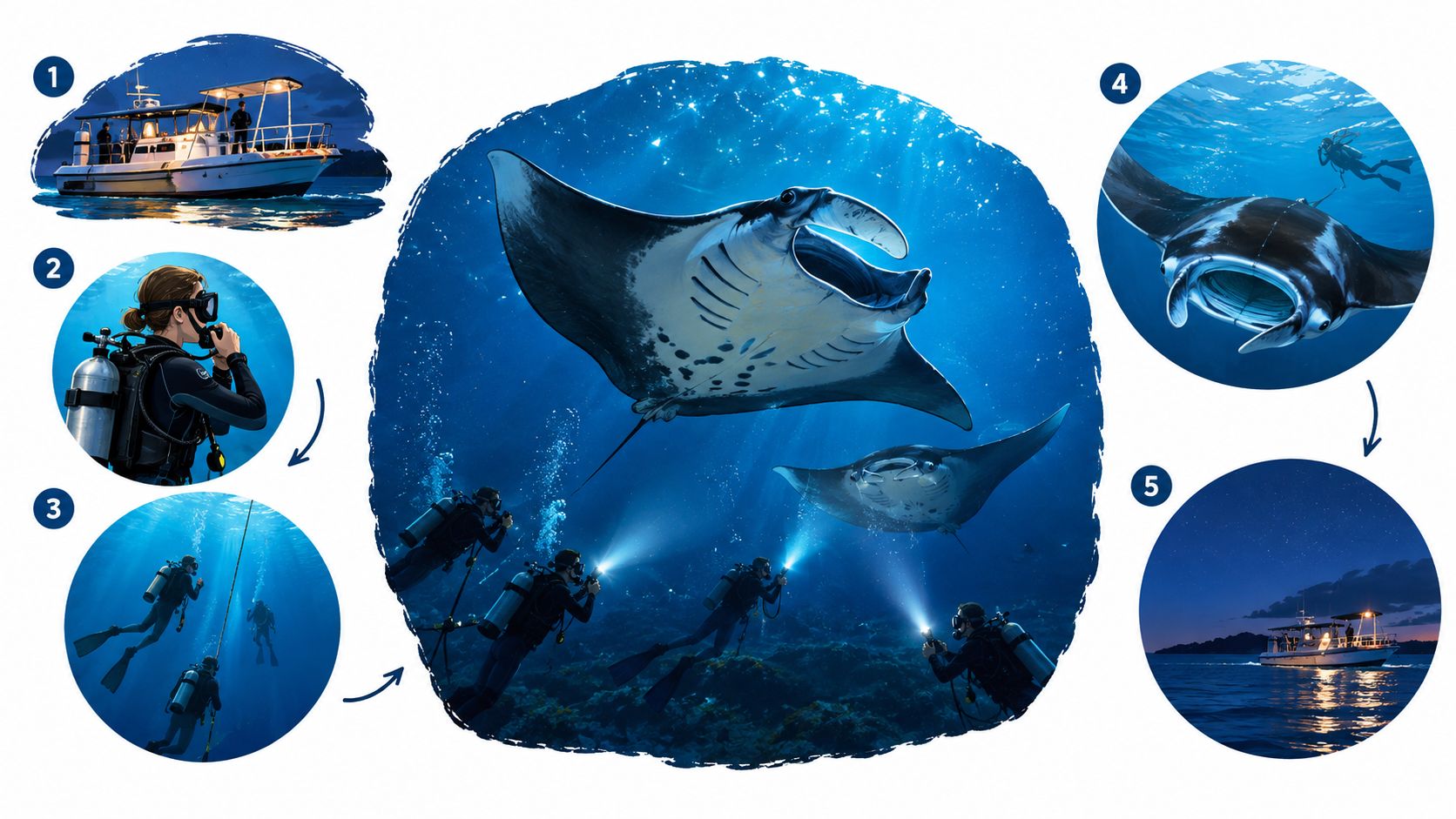
The Night Step by Step
- Check in and fit your gear. A mask that seals and a BCD that fits keep small annoyances from becoming distractions underwater.
- Attend the briefing. The crew covers light direction, positioning, buddy contact, and what not to do when a manta turns toward you.
- Ride to the site after dark. Use the run from Kona to settle your stomach, check your light, and ask anything you didn't understand.
- Enter and descend to the designated area. Stay with your buddy and guide. Don't wander toward reef structure or into open water looking for a better seat.
- Switch on your light and hold still. Your stillness lets plankton concentrate and gives mantas a predictable space.
- Watch the passes. If a manta changes course, don't follow it. Let it circle back through the food on its own line.
- Surface or exit as directed. Check your buddy, secure your light and camera, and listen for the crew's exit order.
- Debrief on the boat. Guides can explain what you saw and why the animals behaved as they did that night.
Timing and Quiet Nights
The full tour typically runs into the evening from check-in to return, with the underwater portion only one part of the operation. Gear fitting, briefing, transit, setup, and the ride back all take real time. Plan dinner and transport around the full booking, not just bottom time.
If mantas are slow to arrive, the crew waits or repositions as conditions allow. They shouldn't chase animals or urge guests to swim after shadows. That patience can feel anticlimactic, but it's the correct response.
Guide's expectation: Book early in your trip if you can. If your first night is quiet, you'll still have options instead of a flight home the next morning.
A quiet night isn't a crew failure by default. It's part of wildlife tourism, and your booking decision should assume that possibility from the start.
Photography Tips for Manta Night Dives
The best manta photo usually belongs to the calmest person in the water. If you swim at the animal, you'll get a tail, a burst of bubbles, or nothing.
Stay still and let the manta cross your frame. On the bottom, that gives you a clean upward angle through the light column. At the surface, it gives snorkelers a stable downward view without kicking into the feeding lane.
Camera Setup
- Go wide: Use a wide-angle lens or your widest setting so the wings and light column fit in one frame.
- Angle strobes outward: Point strobes slightly away from the ray to reduce bright plankton backscatter.
- Set white balance manually: Night beams are uneven, and auto settings can shift color between passes.
- Focus early: Lock your technique before the manta enters the brightest zone, so the camera isn't hunting during the pass.
In-Water Discipline
- Use both hands: Keep the housing steady and rest low only where the site and guide allow.
- Shoot short bursts: Take several frames during a clean pass, then lower the camera and watch.
- Secure snorkel cameras: Use a housing and wrist strap, and stay at the surface.
- Review later: Check images on the boat, not while mantas are feeding around you.
For framing ideas before you go, browse these Kona manta ray dive pictures. Notice how many strong shots come from a fixed position below or above the animal.
No photo justifies moving into a manta's path, rising into its turn, or chasing it for a cleaner angle. If the shot requires bad positioning, skip the shot.
Questions Still Open Before You Book
Is a manta sighting guaranteed? No. Currents, moonlight, sea state, and plankton can produce a quiet night. Your booking buys a properly run trip to a suitable site, not a promised wildlife pass.
What's the cancellation and weather policy? Check the operator's current terms on the booking page before you pay. Don't rely on a blog summary, another guest's experience, or what a different company offered last season.
Do you need camera gear? No. Bring a personal camera in a housing if photography matters to you, and ask at booking whether any camera equipment is provided. Don't buy new gear solely for one night dive.
Can a non-diving companion join? A companion can consider the snorkel format if they're comfortable in open water at night and can stay at the surface. Limited swimming ability, motion sensitivity, or strong anxiety should be discussed with the operator before booking.
Is blackwater a manta trip? No. It's a deep-water night dive with a different focus. Book it because you want that experience, not as a substitute manta encounter.
Book Your Manta Ray Dive With Confidence
Use price as a starting check, not the decision. A separate assessment reported manta tours cost approximately US$110 per participant on average, according to Hawaii Ocean Watch information on Kona's manta viewing sites. Check that benchmark against current live rates.
Format moves price. So do rental gear, nitrox, season, and group size. A cheaper headline rate can stop looking cheap once required equipment is added.
Manta night dive cost factors
| Cost Item | Typical Figure | What to Check |
|---|---|---|
| Average manta night tour, per participant | About US$110 (research average) | Current operator rates before booking |
| Kona Honu Divers manta night dive | Live rate on booking page | Live rate and dates on the booking page |
| Rental gear | Depends on package | Whether your package includes it |
| Complimentary nitrox | Included | Confirm it is on your booking |
Compare inclusions, not slogans. Well-maintained rental gear and complimentary nitrox change the value of a scuba booking, especially if you're traveling without your own kit.
Before you pay, confirm your certification, nitrox qualification, and gear sizes. Select Garden Eel Cove, choose a night early in your stay, and accept that manta visits vary. Then book the format you can perform calmly in the dark.
Kona Honu Divers runs guided manta night dives to Garden Eel Cove with rental gear, complimentary nitrox, and a briefing built around staying still while the mantas feed above you. Choose the scuba or snorkel format that fits your experience, check live availability for early in your Kona stay, and book through Kona Honu Divers.