
The most popular advice about the manta dive is to book the night with the most rays. That misses the decision that can make or break your experience: how many boats and people will share the viewing site. Before you pay, ask where the trip goes, what the viewing setup is like, and how the operator manages crowding.
Garden Eel Cove is my first choice for a scuba manta tour. Its protected setting and adjacent reef make it a strong place to settle in and watch, but no site can promise a wildlife encounter or a quiet night. Here's what to expect, how to choose between diving and snorkeling, and what to ask before booking.
What a Manta Dive Is and Why Mantas Come to the Lights
The lights come on in the dark water, plankton gathers in their beams, and a reef manta glides in from the night. That's the basic manta encounter: a night scuba dive from below the light, or a snorkel at the surface, where underwater lights concentrate drifting zooplankton and mantas come to feed.
The mechanism is simple. Light gathers prey, the bright water becomes a feeding lane, and mantas make repeated passes through it. Think of the lights as a spotlight, the plankton as the audience the performers came for, and the mantas as the animals returning to the same stage.
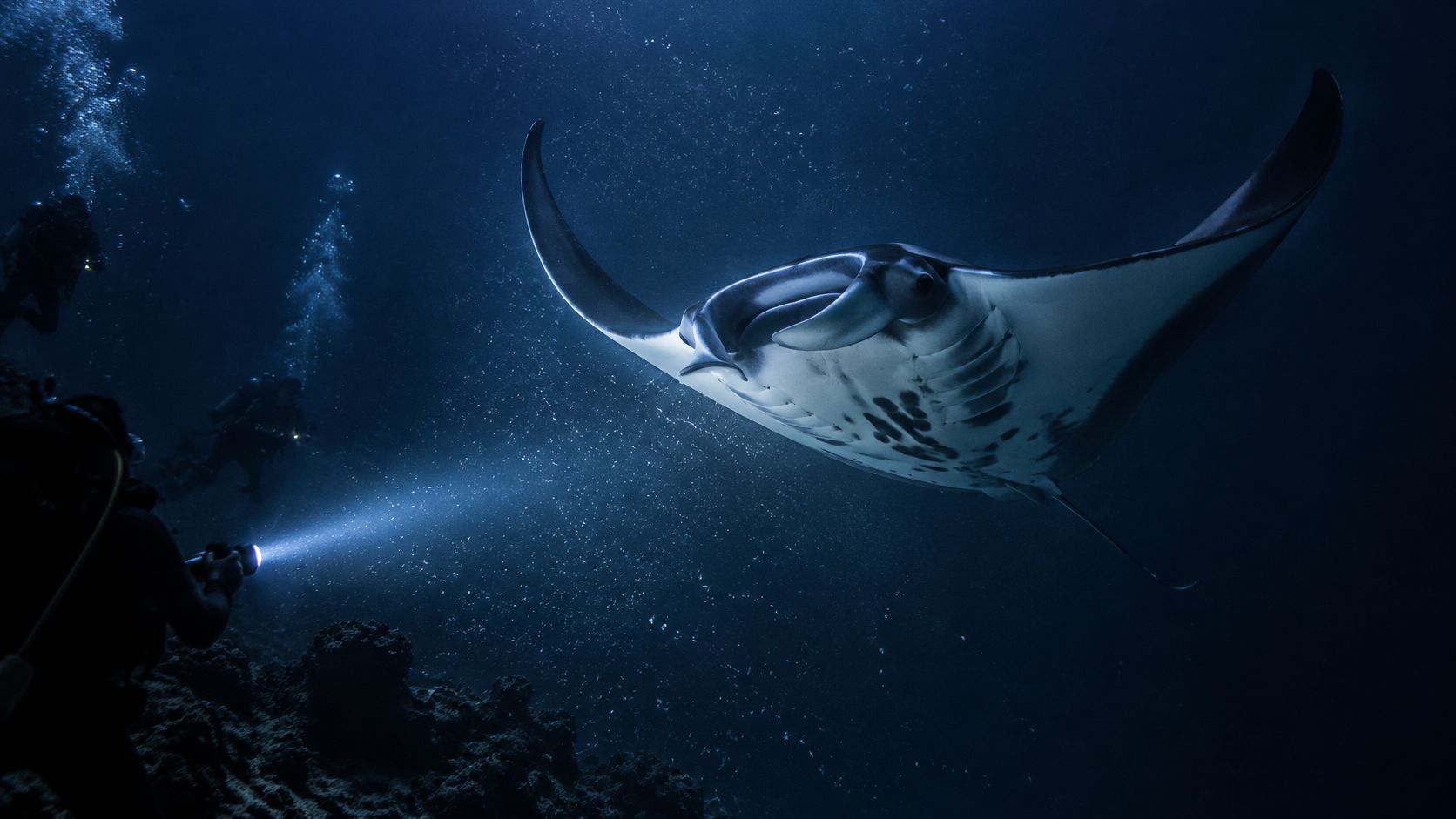
This is a natural feeding behavior, not baiting. Tour operators don't hand-feed or train the mantas. A six-year monitoring program at two Kailua-Kona sites recorded 25,444 observations involving 118 individually identified reef mantas, evidence of recurring use of the sites; the Kona manta dive monitoring account also explains why divers should stay low, still, and out of the rays' approach path.
The primary manta species documented around Kona is the reef manta ray, Mobula alfredi. The giant manta, Mobula birostris, is rare in the area, according to a 2025 study in Frontiers in Marine Science. The animals visitors are most likely to encounter are therefore reef mantas, whose broad wings make close passes feel enormous even when you're staying still.
Kona's manta tourism has roots on the coast going back to the late 1970s. A Hawaii legislative testimony document describes the activity's early history and records substantial visitor participation and spending by 2002. It's a long-established wildlife-viewing experience, not a new attraction.
A 2023 genetic study estimated the effective population of reef mantas around Hawaiʻi Island at 104 individuals, with a 95% confidence interval of 99 to 110, as summarized by Manta Trust. That small estimated population helps explain why identifiable rays can recur at the same feeding sites, and why respectful viewing matters.
The practical choice is between watching from below the light as a certified diver and floating at the surface as a snorkeler. Neither format involves chasing a manta. Your job is to hold position and let the animal decide whether to pass through the light.
Why Garden Eel Cove Beats Keauhou for Viewing
Choose Garden Eel Cove unless an operator gives you a clear reason to prefer Keauhou. The protected nearshore setting supports a more stationary viewing setup, and the adjacent reef adds scenery beyond the illuminated feeding area.
Garden Eel Cove is also called Makako Bay. It lies immediately west of Kona International Airport and the Natural Energy Laboratory campus. Hawaiʻi's Department of Land and Natural Resources lists it alongside Keauhou Bay, also known as Manta Village, as one of Kona's two primary manta-viewing sites. The DLNR document describing the viewing sites identifies Garden Eel Cove as a nearshore site rather than an open-ocean encounter.
The historical reliability figure is encouraging, but it isn't a guarantee. Hawaii legislative testimony reports manta rays observed on 80% of dives at Garden Eel Cove each year. That's useful context for choosing a tour, not a promise that a manta will appear on your particular night, as the legislative testimony on Garden Eel Cove sightings makes clear.
Crowding deserves equal attention. A 2023 independent account says Kona's two principal sites can each draw up to 30 tour boats and more than 400 to 500 people on busy nights. Before booking, ask how many boats are expected to share the water and what the operator does to keep divers and snorkelers from crowding one another.
| Site | Location and setting | Viewing setup | Historical manta reliability | Crowding |
|---|---|---|---|---|
| Garden Eel Cove (Makako Bay) | Protected nearshore cove immediately west of Kona International Airport | Stationary viewing area with adjacent reef scenery | Mantas seen on 80% of dives each year, according to legislative testimony | Up to 30 tour boats on busy nights |
| Keauhou Bay (Manta Village) | Bay site and second primary viewing site listed by DLNR | Nearshore bay viewing site | No comparable figure stated here | Up to 30 tour boats on busy nights |
The crowding figure comes from Manta Ray Advocates' account of busy-site conditions. It describes possible busy-night conditions, not a nightly head count or a forecast for your departure.
Keauhou remains a recognized primary site, but the available comparison doesn't establish a matching reliability figure or a particular viewing setup there. If Garden Eel Cove is available and you want a protected, stationary viewing area with reef scenery, it's the more straightforward choice. If an operator proposes Keauhou instead, ask what's driving that choice and what to expect from the setup that night.
When Manta Sightings Are Most Likely
There's no fixed calendar season that guarantees Kona manta sightings. Plan around conditions and the operator's site decision rather than choosing a month on the assumption that a particular season will deliver more rays.
Mantas feed on drifting prey. Current flow, sea state, and moon illumination can all affect where plankton collects and whether it passes through the illuminated area. Food availability also matters: long-term monitoring at Kona aggregation sites found that changes in aggregation size tracked zooplankton density. The Kona night-snorkel conditions overview describes why sighting conditions can shift even when the tour runs at a familiar site.
| Condition | What it changes | What to do |
|---|---|---|
| Moon illumination | Can shift plankton location and manta attendance | Ask how the operator adjusts on bright-moon nights |
| Current flow | Changes how plankton drifts into the light and how difficult it is to hold position | Trust the guide's site call on strong-current days |
| Sea state | Affects boarding, entry safety, and visibility | Check the forecast on the morning of the dive |
| Prey distribution | Determines whether feeding passes come through the light, with no fixed season | Book a flexible date rather than planning around a particular month |
At Garden Eel Cove, legislative testimony reports mantas on 80% of dives each year, a strong historical record that still leaves room for a quiet night. Fewer passes can reflect prey moving elsewhere, not poor guiding or a failed setup.
If your schedule allows, leave room to move the tour to another evening. Choose a calm night when possible, check the forecast on the day, and ask whether the operator would change sites if conditions deteriorate. The best plan treats wildlife as wildlife: make the conditions comfortable and the viewing respectful, but don't expect a guaranteed performance.
Eligibility, Safety and Packing Checklist
Certified divers need Open Water Diver certification or higher from a recognized agency for the manta night dive. Non-certified participants can join a night snorkel without a scuba certificate, but they should be comfortable floating in open water after dark. If you've only just earned your certification, practise buoyancy and light handling on a shallow night dive before taking on a manta dive.
| Participant | Best format | Certification needed | Practical note |
|---|---|---|---|
| Certified scuba diver | Manta ray night dive | Open Water Diver or higher from a recognized agency | Watch from below the light on sand or rubble |
| Non-certified swimmer or snorkeler | Manta ray night snorkel | None | Hold the floating light board at the surface |
| Newly certified diver | Practise a shallow night dive first | Open Water Diver | Build comfort with buoyancy and lights before booking |
| Experienced diver wanting more depth | Premium advanced two-tank trip or blackwater night dive | Check the operator's requirements | Confirm logged dives and experience with the operator |
If you're deciding between the two manta formats, compare the underwater perspective, not just the certification requirement. The guide to snorkeling versus diving with manta rays can help you choose the experience that suits your comfort in the water.
Safety comes before photos
Stay with your assigned buddy, remain inside the group's light zone, and follow the guide's instructions about where to settle. Don't touch mantas or reef, chase an animal, or swim into its feeding lane. Respect the dive plan's depth and time limits, and tell the guide early if you're having ear trouble, feeling seasick, or getting tired.
For a night dive, make sure you know how your primary and backup lights work before entering the water. A red light can help you move around the boat deck without shining a bright beam into other people's eyes. Secure your mask and regulator before joining the group.
Pack for the dock, the water, and the ride back
- Paperwork: Bring your certification card, logbook, and photo ID if you're diving.
- Exposure: A 3 mm wetsuit or rash guard can suit water around 24 to 27°C; bring a warm layer and towel for the ride back.
- Lights: Pack a primary dive light, a backup light, and a red light for the boat deck.
- Dry gear: Use a dry bag for your phone, keys, and wallet, and bring closed-toe water shoes for the dock.
- Comfort: Take motion-sickness medication before boarding if you use it; bring water and a snack.
- Dive extras: Carry a dive computer, spare battery, and mask defogger.
- Sun protection: Bring reef-safe sunscreen and check local product restrictions before applying it.
Before departure, ask which equipment the operator rents and which items you need to bring yourself. Don't assume a dive light or personal accessories are included just because tanks and weights are.
What Happens on a Kona Manta Night Dive, Step by Step
A manta night dive follows a clear routine. The exact timing and sequence can vary by operator and conditions, so listen closely to the crew's briefing rather than treating a sample itinerary as a fixed schedule.
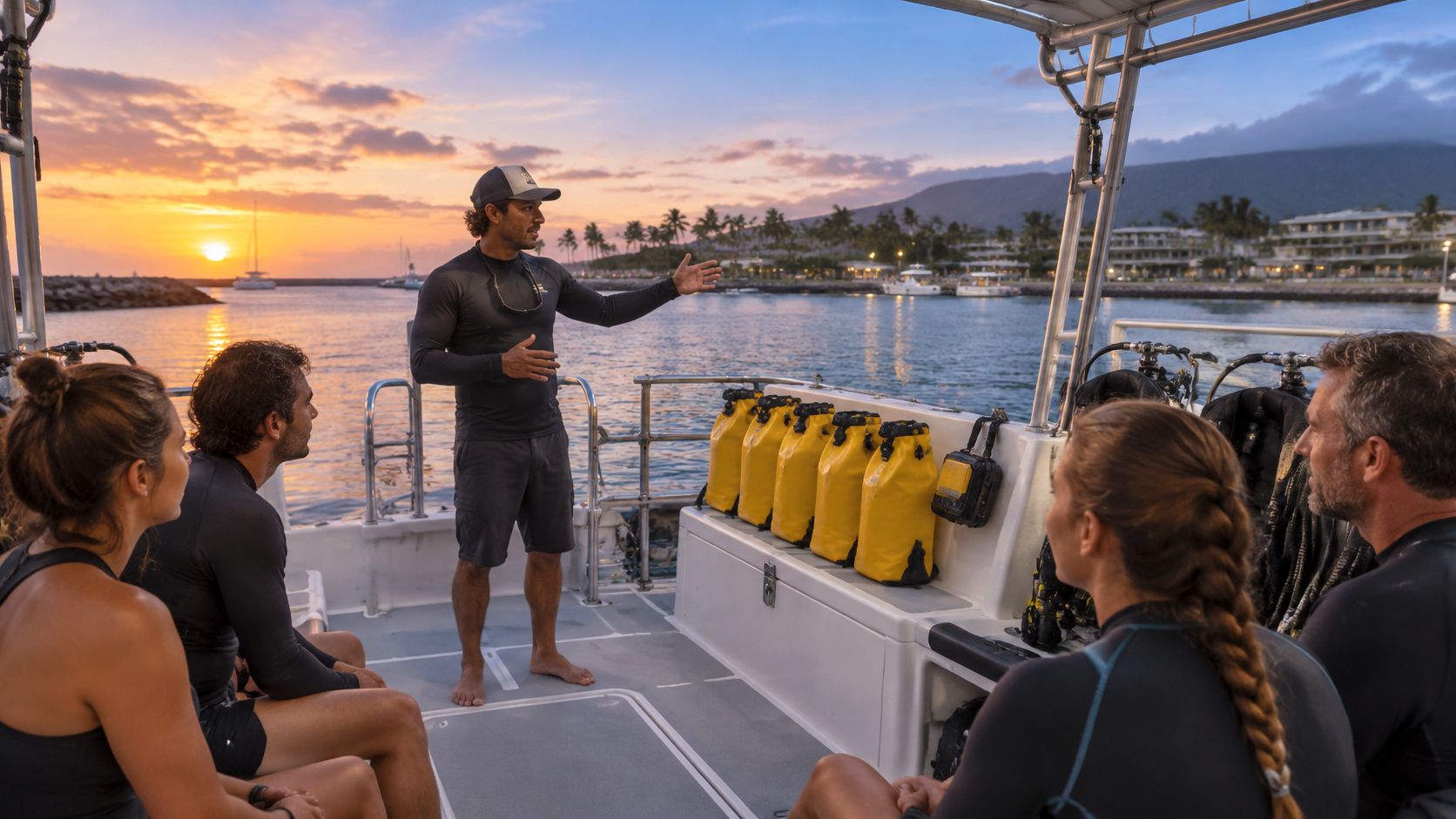
- Check in before dusk. Keep your phone, keys, and wallet in a dry bag so they're secure while you gear up and board.
- Listen to the boat briefing. The crew explains the light rules, hand signals, where each person sits, and how the group will enter and leave the water.
- Check your equipment. Confirm your mask, regulator, weights, dive computer, and primary and backup lights are ready before the boat reaches the site.
- Enter and descend with the group. Divers settle on sand, rubble, or another nonliving surface near the illuminated area rather than hovering over coral.
- Find a stable position. Switch on your light as directed, settle into neutral buoyancy, and avoid finning up sand or pushing into the viewing area.
- Wait for the feeding activity. Plankton gathers in the beams; snorkelers hold the floating light board at the surface while divers watch upward from below.
- Let the mantas choose their route. Stay still, don't reach or rise toward an animal, and leave its feeding lane unobstructed.
- Ascend and return to the boat. Follow the guide's ascent and safety-stop instructions, then debrief with the crew after boarding.
A manta may pass close, circle through the light, or make fewer appearances than you hoped. You can't control how much prey gathers or where the rays feed, so judge the experience by whether the group and guides give the animals room, not by how many close passes you can record.
Trip duration is set by the operator and can change with conditions. Confirm the expected dock-to-dock timing before booking, especially if you have an early start the next morning. If you want to prepare for the dark-water procedures, read this practical guide to scuba diving at night.
The group's light setup is there to support natural feeding, not to pull rays into a specific path. A 2023 genetic study summarized by Manta Trust adds context on the small, locally important manta population; the practical takeaway in the water is simple: follow the guide, hold your position, and don't turn a close pass into a chase.
Photographing Mantas Without Blocking Their Path
Your position matters more than your camera settings. A large camera housing or strobe adds to your horizontal profile, and that can obstruct a manta's low approach if you drift into its feeding lane. Settle on a nonliving bottom, stay neutrally buoyant, and hold your light above your head aimed upward. The Kona manta dive guide outlines the positioning that keeps the feeding corridor open.
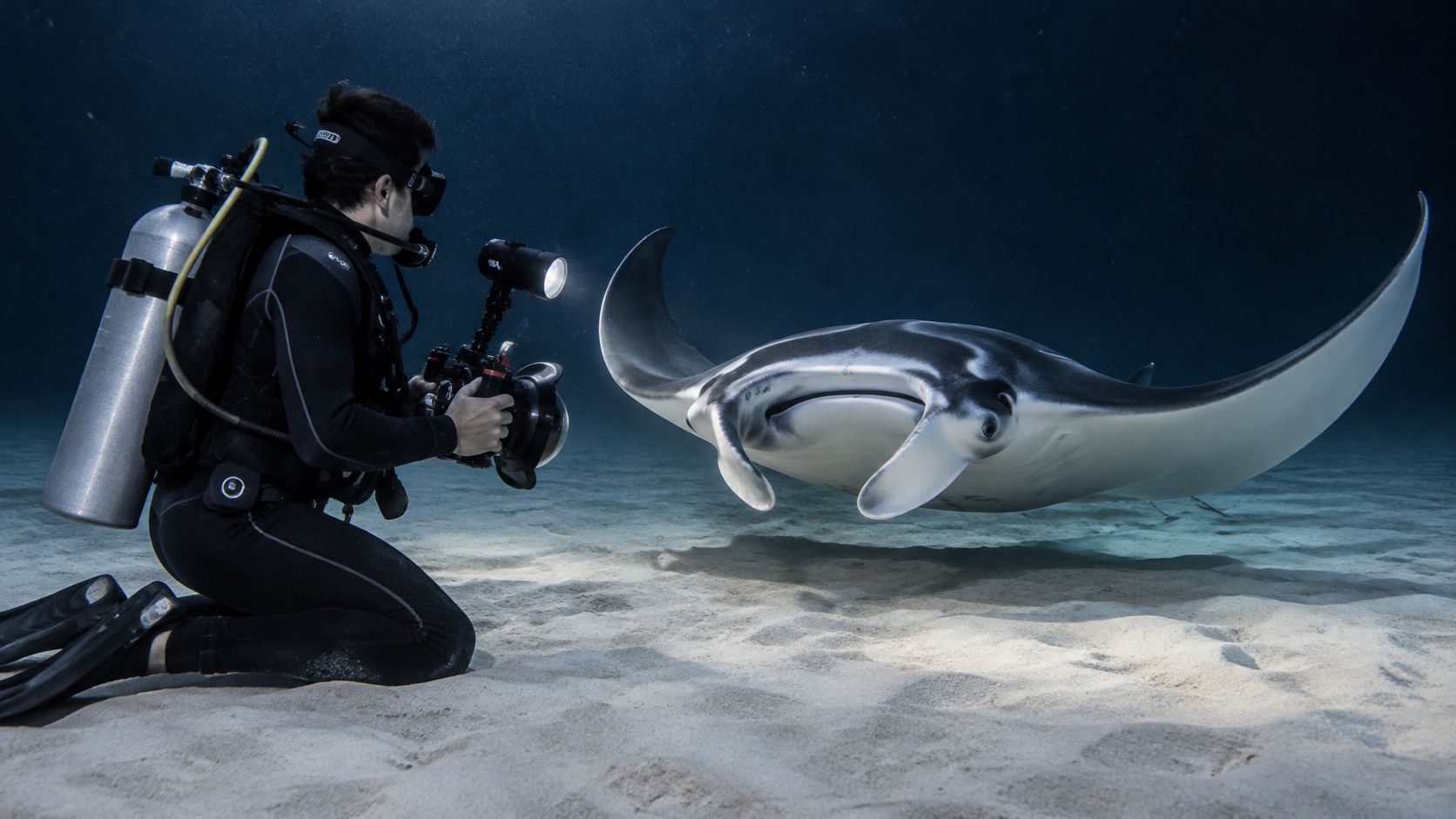
For the full encounter, keep the key rule in mind: don't chase, rise beneath, or kick into a manta's path. Stillness gives the animal room to turn and gives you a better chance of framing a pass without disturbing it.
Start with simple camera choices
- Go wide. A wide-angle lens can frame both the manta and the illuminated water instead of cutting off the animal as it passes close.
- Preserve shutter speed. Raise ISO as needed to avoid motion blur in the dark, and check the result between passes rather than moving around to improve the angle.
- Use strobes sparingly. Start at low power and aim them away from the manta's face; don't fire continuously into other divers' eyes.
- Control video lights. Keep continuous lights from pointing into other guests' faces, and follow the guide's direction about where to aim them.
- Protect your space. Keep your rig tucked in close when a manta approaches instead of swinging the housing into the shared viewing area.
Crowding can affect the guest experience even when a wildlife encounter is successful. In a survey of 444 manta-tour participants, 79% of snorkelers and 53% of scuba divers reported conflict with other participants, including bumping, lack of awareness, and guests blinding others with lights, according to the Hawaiʻi County testimony document discussing visitor interactions.
That finding matters when you choose a tour, not only when you're already underwater. Ask how the guide spaces people and manages lights, then follow those instructions. You can also review considerate diver etiquette before the trip.
A busy site doesn't automatically mean fewer mantas, but it can make the view less comfortable and photography harder. Stillness produces better photos than movement because it preserves the animal's route and keeps your camera from becoming another obstacle.
Pricing, Logistics and Common Questions
Prices depend on the format and what the operator includes. Check the current rate on the booking page rather than relying on an old quote. Before paying, confirm whether the listed price covers boat transport, guide, rental gear, and any additional fees.
Plan to fly into Kona International Airport and continue to Kailua-Kona by rental car or shuttle. Staying in Kailua-Kona keeps you close to harbor access, and a rest day after a night dive is a sensible way to avoid stacking a late return with an early activity.
Before you book, ask about group size, the number of boats expected at the site, the lighting policy, and what happens if weather makes the trip unsafe. If you're prone to motion sickness, prepare before boarding and review these practical small-boat seasickness tips.
Can I go without scuba certification? Yes. Book a night snorkel instead, and be comfortable floating in open water after dark while holding the floating light board.
Are mantas guaranteed? No. Legislative testimony records mantas at Garden Eel Cove on 80% of dives each year, but that historical figure isn't a promise for an individual departure.
What if the forecast turns rough? Ask whether the operator would switch sites and get the weather-cancellation and refund terms before paying.
Is the trip suitable for children? Ask the operator about its minimum age and swimming requirements. A child's comfort in open water after dark matters more than merely being able to swim in a pool.
The best booking decision isn't based on a promise of guaranteed sightings. It's based on a clear understanding of the trip format, the site, the crowding plan, and the conditions under which the operator will cancel or adjust the outing.
Choose Your Operator and Book Your Manta Dive
Start with the site. Garden Eel Cove is the first choice for a manta dive if you want a protected nearshore viewing area and reef scenery. Then ask how many boats will share the water, what the group size is, whether experienced divemasters or instructors will be in the water, how certification is checked, and how the crew manages lights and guest positioning.
Confirm the details that affect your comfort before you pay: rental equipment, the lighting policy, and the operator's weather-cancellation terms. If an operator can't explain how it will handle a crowded or rough night, keep comparing options. This guide to choosing a Kona diving company offers further questions to consider.
Kona Honu Divers' experienced divemasters and instructors are in the water with divers on its Manta Ray Night Dive. The company requires at least Open Water Diver certification from a recognized agency for most regular dive charters, and it also offers a two-tank manta charter.
| Option | Best for |
|---|---|
| Manta ray night dive | Certified divers who want to watch from below the light |
| Manta ray night snorkel | Non-certified swimmers and beginners |
| Premium advanced two-tank trip | Experienced divers wanting more depth and challenge |
| Blackwater night dive | Experienced divers wanting deep-water night diving |
Check the current price and availability for the manta ray dive tour, the premium advanced two-tank trip, and the blackwater night dive. For other trip formats, see the Kona diving tours page. Current prices are confirmed on the booking page.
Kona Honu Divers is based in Kona on the Big Island. Fly into Kona International Airport, stay in Kailua-Kona for harbor access, and leave room for a rest day after a night dive. For questions about the trip, call 808-324-4668.
Book a Kona Honu Divers manta charter to experience the night dive with guides in the water and Garden Eel Cove as the go-to site. Review the available trip formats, choose the dive or snorkel that fits your experience, and visit Kona Honu Divers to plan your manta encounter.