
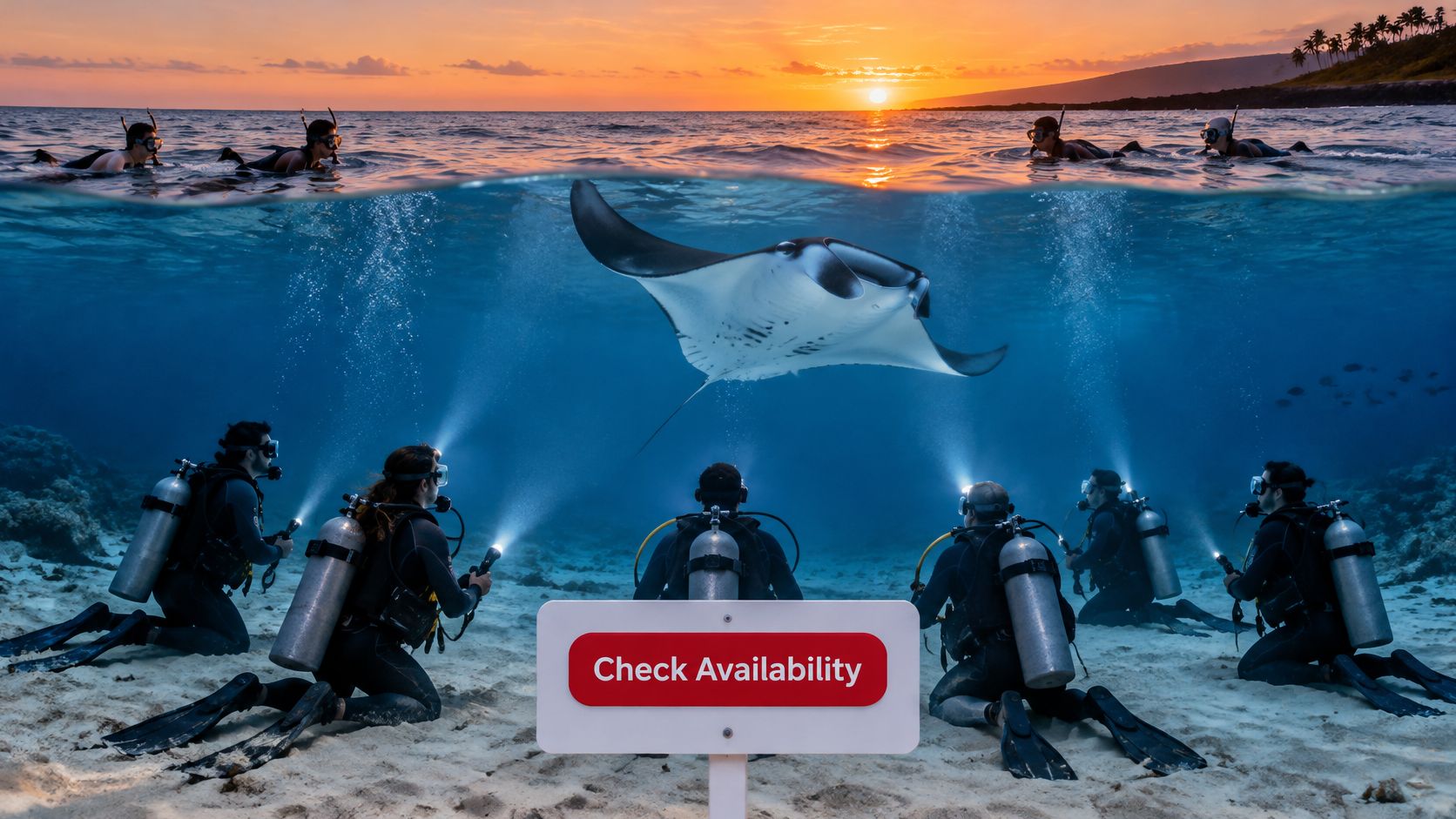
The Kona manta night dive starts just after sunset and lasts about an hour. Divers settle on the sand in a semicircle while snorkelers float at the surface, and Garden Eel Cove is my recommended site for its protected location, viewing area, and reefs.
If you're deciding whether to book while planning a Big Island trip, the key thing to understand is that this isn't a show on a schedule. It's a carefully arranged wildlife encounter: lights gather plankton, mantas may arrive to feed, and everyone needs to leave them room to move. The right site and calm, respectful positioning can make the experience better, but no operator can promise what wild animals will do on a particular night.
What a Manta Dive in Hawaii Really Involves
The water is dark when you settle onto the sandy bottom. You hold your place in the group's semicircle as beams of light reach upward; then a manta may glide into view, turn through the illuminated water, and pass overhead. The scene feels close and quiet, but the setup is deliberate. Divers stay put so the rays have an open feeding corridor.
The lights work like a dinner bell for plankton. Tiny organisms gather in the illuminated water, and reef manta rays (Mobula alfredi) come to feed. A typical Kona dive begins just after sunset and lasts about an hour, giving the animals time to make repeated passes if they come to the light.
The modern Kona manta night dive began as a small local activity. Historical accounts describe a single boat bringing six to eight divers to the site a few nights each week in 1991; by 1993, as many as five boats carried about 50 people into the water, according to Scuba Diving magazine's history of Kona's manta encounters. The same account records 106 individual mantas identified along the Kona Coast from 1992 through 2007, with some individuals recorded as many as 724 times.
That resident population is part of what makes the dive distinctive, but it doesn't turn a wild encounter into a guarantee. You're watching animals feed, not waiting for performers to hit their marks. Mantas are large rays with wingspans that can reach several meters, and the safest view comes when you stay still and let them choose their path.
Garden Eel Cove Versus Other Kona Viewing Sites
Kona's manta viewing sites sit within a few miles of each other on the same coast, yet their long-term feeding records diverge. Mantas show site fidelity, returning to familiar feeding areas rather than spreading evenly along the shoreline, so a site's history of use tells you more than its position on a map.
| Site | Manta presence | Aggregation size | Protection and viewing area | Best for |
|---|---|---|---|---|
| Garden Eel Cove (Manta Heaven) | About 92% of monitored nights | Larger, more consistent groups | Protected cove with an established viewing area and reef | First-time divers, families, photographers |
| Manta Village | About 78% of monitored nights | A consistent aggregation, generally smaller than Manta Heaven | Established viewing site | Divers comparing sites |
| Keauhou | Site-specific presence rate not stated | Generally smaller groups; females made up 91% of sightings | A known manta viewing area | Repeat visitors and residency studies |
A six-year study comparing Manta Heaven and Manta Village recorded 25,444 observations involving 118 identified reef manta rays. Manta Heaven accounted for 19,841 observations, and mantas appeared there on about 92% of monitored nights, compared with about 78% at Manta Village, according to the Kona manta-site study. Those figures describe feeding records, not a forecast for a single evening.
Garden Eel Cove recorded the highest manta presence in the six-year comparison, and Kona Honu Divers often takes its manta charter there. That track record makes it a practical pick for a first or one-off trip, though a strong site can still go quiet when the animals feed elsewhere for the night.
Keauhou has a different ecological profile. A 13-year analysis of more than 23,000 sightings involving 167 identified mantas found that groups there were generally smaller and that females made up 91% of sightings at Keauhou, as reported in the University of Hawaiʻi study of Kona's manta aggregation sites. That skew toward resident females makes Keauhou interesting for repeat visitors and for manta residency research. For a first dive, Garden Eel Cove offers the larger recorded aggregations and the higher presence rate.
When to Go and What Changes Your Odds
A slow night can happen even at Kona's best manta sites. Sightings run high at well-established feeding areas, yet no operator can promise rays on a specific evening. Dives begin just after sunset and last about an hour, so arrive in time for check-in and the crew briefing instead of rushing aboard at the last moment.
The calendar alone cannot predict which night draws the largest group. Manta gatherings tend to grow when zooplankton, the mantas' food source, concentrates in the water, so plankton levels on a given night matter more than the month you pick. This is also why the lights placed on the seafloor work: they pull plankton into one spot, and resident mantas have learned to feed where the beams shine. For seasonal expectations, read this guide to the best time to see manta rays in Kona.
Individual mantas behave differently too. Long-term monitoring logged mantas at Manta Village on 1,702 of 2,178 monitored nights, according to the NOAA-linked manta tracking report. Those figures come from past monitoring and cannot predict your booking. Some rays stay close to one site while others move between locations, so even a strong site can have a quiet night.
Kona Honu Divers reports that manta sightings often exceed a 90% success rate. Treat that as a track record rather than a guarantee for an individual trip. If the mantas stay away, you still get the bright circle the dive lights throw on the seafloor, the reef life drawn to it, and a clear view of how the feeding station is set up. On a one-off trip, booking a second possible night spreads the risk instead of letting one evening carry the whole experience.
Before booking, ask the crew about recent plankton and sea conditions, and keep a backup evening free if your schedule allows.
Who Should Dive and How to Prepare
The manta night experience has options for certified scuba divers and surface snorkelers, but their preparations aren't interchangeable. Use this table to identify what you need, then confirm eligibility with the operator before you pay.
| Diver type | Requirement | Preparation focus |
|---|---|---|
| Certified recreational diver | Open Water certification and a dive within the past 2 years for the 2-tank manta charter | Buoyancy control and dive-light handling in the dark |
| New or uncertified diver | Most regular charters need at least Open Water Diver certification from a recognized agency | Confirm eligibility before booking |
| Snorkeler | No scuba certification needed | Float calmly at the surface with lights pointed down |
| Family with children | Confirm age and swimming minimums with the operator | Plan a calm briefing and keep children close to the group |
| Photographer | Buoyancy and low-light experience recommended | Practise in shallow water before the night dive |
| Experienced diver | Advanced options available | Consider the Premium Advanced 2 Tank Trip |
For the 2-tank manta charter, Kona Honu Divers requires Open Water certification or higher and a dive within the past two years. Most of its regular dive charters also require at least Open Water Diver certification from a recognized agency. If you're not certified, check whether you can scuba dive in Hawaii without certification and confirm which experience is appropriate before booking.
Snorkelers don't need scuba certification, but they do need to be comfortable floating at the surface and following directions with a light. Families should confirm age and swimming requirements in advance. A calm explanation before boarding can help children understand why they need to stay with the group and keep their bodies still.
Photographers should practise buoyancy and camera handling in shallow, familiar conditions before the night dive. Everyone should check medical fitness, become comfortable using a dive light, and consider dive insurance; Kona Honu Divers strongly recommends it. Eligibility is confirmed with the operator, not assumed from a certification card alone.
How the Manta Night Dive Unfolds and How to Keep It Safe
A smooth dive starts before anyone enters the water. The crew's briefing sets out the feeding setup and passive-observation rules; listen carefully, because the positioning instructions protect both the group and the mantas.
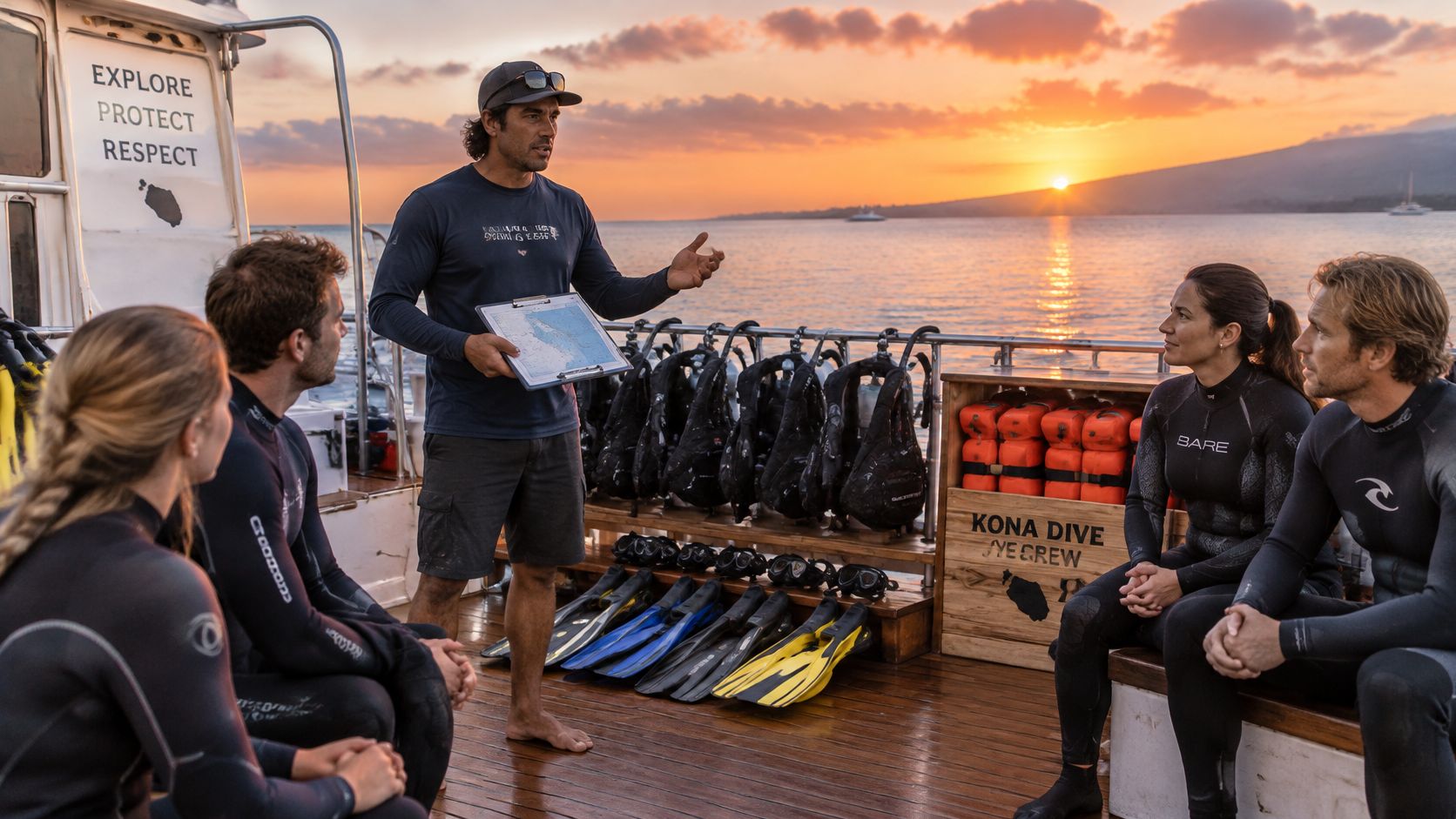
Arrive before sunset and check in. Late arrivals can miss the briefing and leave the crew less time to check your gear. Get settled early rather than trying to catch up while everyone prepares to enter the water.
Listen to the crew briefing. Kona Honu Divers starts the manta night dive with a detailed explanation of what divers may see and how to observe passively. The common slip is treating the briefing as routine and missing the rules about light direction, position, and animal space.
Settle on the seafloor. Divers stay on sand, rubble, or boulders, never coral, and form a semicircle that leaves the central water column open. Don't drift forward or kick toward an approaching manta to improve your view.
Aim lights correctly. Scuba divers direct their beams upward into the water; snorkelers keep their lights pointed downward from the surface. Plankton gathers in the illuminated water, so pointing a beam directly at a manta or across another person's light spoils the setup. The Manta Pacific participant guidelines also ask snorkelers to remain at the surface with their legs horizontal rather than diving into the feeding area.
Stay still as the rays feed. Let mantas enter and leave the illuminated zone without pursuit. Experienced divemasters and instructors are in the water with Kona Honu Divers divers, and guides can help the group maintain its position.
Keep a bright circle on the bottom. Powerful dive lights create an illuminated area on the seafloor so divers aren't in complete darkness. Avoid swinging your light around as you reposition.
Secure gear and give the animals space. Clip or tuck away hoses, gauges, and lights before entry. Don't touch, chase, grab, or ride a manta, and minimize fin movement and bubbles toward the rays. A 2025 Hawaii Ocean Watch page on manta tourism reported that 25% of regularly observed manta rays showed some form of human-caused injury.
Surface and exit when the crew signals. Follow the crew's direction at the end of the encounter, which lasts about an hour after sunset. On the boat, ask whether the crew posts a lookout and slows near harbors; propeller strikes can be fatal to mantas.
Choose an operator by how it runs the encounter. Look for a clear briefing, controlled groups, habitat protection, and support for long-term monitoring, not just an advertised sighting rate. These responsible diver etiquette practices help keep the feeding area usable for the animals.
Photography and Gear Tips for Night Encounters
For photographers, the best starting point is stillness. Kneel on the sand, keep your fins quiet, and let mantas come into the feeding area rather than following them. That calm positioning helps preserve the plankton-attraction pattern and leaves the animals a clear route through the light.
A wide lens is useful when a manta passes close and its full wingspan won't fit in a tighter frame. Pre-focus on the feeding area, raise ISO as needed, and choose a shutter speed fast enough to reduce motion blur. Use flash or strobes sparingly; multiple beams crossing the same space can interfere with viewing and distract the animals. The NOAA-linked guide to Kona manta encounters describes how stable positioning, minimal fin movement, and giving mantas room can support repeated passes without disrupting their feeding behavior.
| Gear or technique | Why it matters | Practical tip |
|---|---|---|
| Dive light | Projects light into the water column and reduces glare | Hold above your head when diving; point down when snorkelling |
| Wide-angle lens | Captures the full wingspan at close range | Use the widest lens you own |
| Strobe or flash | Adds light but can startle animals | Avoid cross-beam lighting; use sparingly |
| Buoyancy control | Fin movement stirs silt and disturbs approaches | Kneel on the sand and keep fins still |
| Secured equipment | Loose hoses and lights can contact mantas | Clip or tuck gear before entry |
Test your camera settings on a day dive before the night trip, when you can see the controls without rushing. Bring a spare battery and a dry bag for the boat. For examples of the kinds of images the encounter can produce, browse these Kona manta ray dive pictures.
Common Questions From Beginners, Families and Photographers
What should I wear and bring? Wear a wetsuit or rash guard for comfort after dark, and pack a towel and dry bag. Rinse sunscreen off before entering the water to reduce what washes into the marine environment.
Can I come if I'm not a strong swimmer? Snorkelers stay at the surface, but they need to feel comfortable in the water and follow the crew's directions. Confirm swimming requirements with the operator before booking.
Should I eat before the dive? Have a light meal well before departure. A full stomach can make a boat ride and time in dark water less comfortable.
Is the night dive suitable for children? It can work for families when children meet the operator's age and swimming requirements. Prepare them for the briefing, and keep them close to the group throughout the activity.
Can I use my own camera? Yes, as long as you can secure it and have tested its settings beforehand. If you're choosing between scuba and snorkeling, this guide to whether it's better to snorkel or dive with manta rays can help match the format to your comfort in the water.
What if the weather is rough? Ask the operator about its weather policy and rebooking options before paying. Don't assume a trip will go out in unsafe conditions or that every booking has the same change terms.
Book Your Manta Night Dive at Garden Eel Cove
For a first or one-off manta dive, choose Garden Eel Cove. Its protected location, preferred viewing area, and reefs make it the better choice for this tour, while its history as a consistent feeding aggregation strengthens the case for going there. Kona Honu Divers often takes its manta charter to the cove.
Kona Honu Divers offers a 2-tank manta dive and snorkel charter, along with a 2 Tank Local Morning Dive, Black Water Night Dive, Premium Advanced 2 Tank Trip, and Morning Introductory Scuba Dive. The Black Water Night Dive is a different kind of night experience for divers interested in open-ocean encounters, while the full list of Kona diving tours covers other options.
Kona Honu Divers reports manta encounter rates of up to 92%, but wild sightings are never guaranteed. Check current rates and availability on the booking page, and book early for your preferred night if your schedule is tight. Before paying, ask about group size and how the crew handles the briefing. You can also call Kona Honu Divers at 808-324-4668 with questions.
Book a Kona Honu Divers manta night dive to watch feeding mantas from a guided viewing area at Garden Eel Cove. Visit Kona Honu Divers to check the trip details and choose a night that fits your Big Island plans.