
You've got an evening open in Kona, a booking calendar on your phone, and a decision to make: dive beneath the mantas or watch from a snorkel float. The photos make every night look spectacular. What they don't show is the waiting, the briefing, or the difference between a quick sighting and a sustained feeding encounter.
A Kona manta ray dive works best when you arrive prepared to stay still, follow the lighting plan, and let the animals choose their approach. Picking a comfortable format and a suitable site matters more than chasing a supposedly perfect month.
Night Dive and Night Snorkel Compared at a Glance
Choose the dive for the view from below, or the snorkel for the view from the surface. Both formats put you beside an illuminated feeding area after dark, where Kona's reef mantas, Mobula alfredi, may circle through concentrated plankton.
Kona manta night experiences compared
| Option | Who It Suits | Where You Are in the Water | Main Requirement |
|---|---|---|---|
| Manta Ray Night Dive | Certified divers, and newer divers with close guide support | Kneeling on the sandy bottom inside the light circle | Scuba certification and buoyancy control |
| Manta Ray Night Snorkel | Snorkelers, non-divers and families | Floating at the surface with lights pointed down | Comfort in open water and a flotation device |
The distinction isn't just how close you might get. A diver watches a manta's silhouette cross the lights overhead, while a snorkeler looks down as the animal turns beneath the surface. Neither perspective requires pursuing the ray, and neither guarantees that an animal will approach your particular position.
Choose the viewpoint you'll enjoy
For a certified diver who's comfortable managing equipment in darkness, the underwater setting is compelling. You hear your regulator, see suspended particles in the beams, and wait for a shape to emerge beyond the illuminated area.
Snorkeling removes the scuba tasks, but it isn't a dry sightseeing ride. You still need to tolerate open water, breathe comfortably through a snorkel, and follow the guide's directions. Compare those practical differences in this guide to snorkeling versus diving with manta rays.
There's a substantial observational basis for planning an encounter at these sites. A University of Hawaiʻi study analyzed more than 23,000 sightings involving 167 individually identified reef mantas, collected at Garden Eel Cove and Keauhou from 2010 through 2022. These are repeatedly used feeding grounds, not places where crews hope a passing manta appears.
When comparing itineraries, review the two-tank manta dive and snorkel trip details. Don't confuse this encounter with a blackwater night dive, a different experience conducted over deeper water rather than at a stationary manta-viewing area.
The practical rule is straightforward: certified divers can choose the close, kneeling perspective; non-divers, families, and first-time participants can choose the surface format without missing the feeding action.
How the Night Manta Dive Works and How to Behave
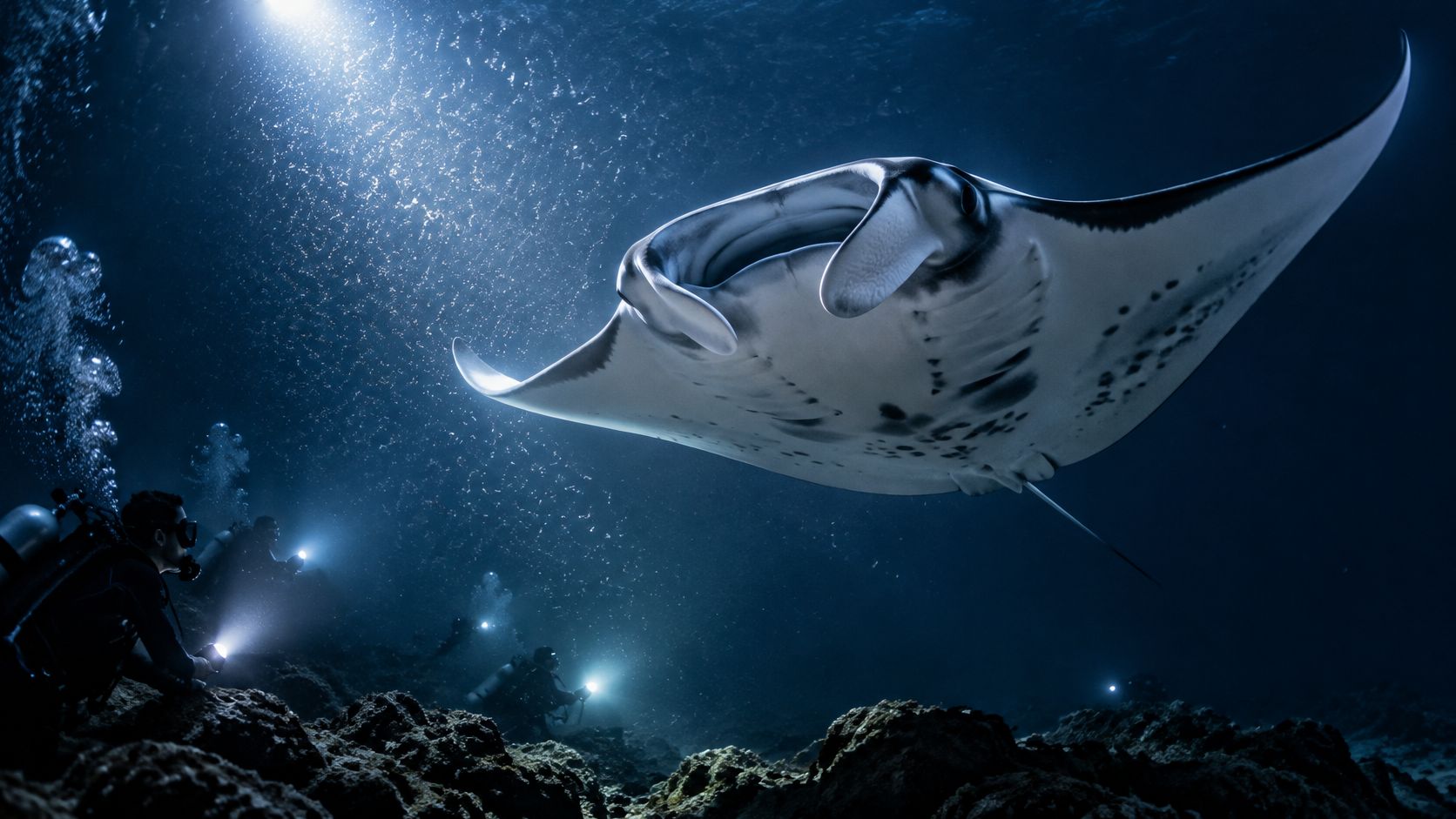
The lights concentrate food; the crew doesn't hand-feed the mantas. Artificial light attracts zooplankton into the water column, and reef mantas filter that prey as they move through the illuminated area.
Hawaiʻi's Division of Aquatic Resources manta guide describes their diet as primarily planktonic crustaceans and small schooling fish, and records their use of waters from the surface to at least 120 feet. That depth describes the animals' habitat, not the planned depth of your dive.
Follow the sequence, not the animal
Our crew begins with a detailed briefing covering manta biology, the lighting setup, and passive observation. Powerful lights create an illuminated viewing area, so you're not descending into complete darkness and improvising your position.
- Listen before gearing up. Learn the entry procedure, underwater signals, assigned viewing arrangement, and exit plan. Ask how to signal discomfort before your mask goes on.
- Check equipment and enter with the group. Confirm that your regulator, buoyancy compensator, gauges, and light are accessible. Stay with the guide rather than descending independently toward an interesting shadow.
- Settle into the assigned sandy area. Keep clear of living reef and leave space for neighboring divers. Secure dangling equipment so it can't scrape the bottom or catch another diver.
- Aim your light upward from above your head. Follow the guide's lighting arrangement rather than sweeping the beam across animals, masks, or sand. A consistent lighting pattern helps maintain a coherent feeding area.
- Hold position during a pass. Don't rise toward the manta or kick after it. Fin turbulence can disturb suspended prey and lift sediment into everyone's view.
- Leave when the guide signals. A final approach isn't a reason to ignore an ascent instruction. Keep your group together and remain alert around the boat.
The strongest moments often feel quieter than expected. You're stationary, your breathing becomes noticeable, and a manta may turn through the light without any need for you to move.
Keep the feeding lane open
A NOAA-hosted voluntary wildlife-interaction standard recommends viewing guidance and prohibits touching, chasing, grabbing, or riding during the encounter. It also recommends that snorkelers remain at the surface, divers direct lights upward from above their heads, and snorkel operations consider a ring or similar device for groups of four or more.
A close pass isn't permission to touch. Contact can damage the manta's protective mucus coating, and an extended hand or camera can obstruct its path. Keep your arms contained and let the animal decide its distance.
Practical rule: If you have to chase a manta to keep it in view, stop moving and return your attention to the guide.
For photography, keep the camera close to your body and establish your position before composing. Reduce or stop strobes if the guide asks, and don't trade buoyancy control for a better angle. Review responsible diver etiquette before boarding so these choices feel automatic.
A strong encounter might include repeated passes and tight feeding turns. Your contribution is less dramatic: remain predictable, keep the space open, and avoid turning a good view into a collision.
Why Garden Eel Cove Is the Better Viewing Site
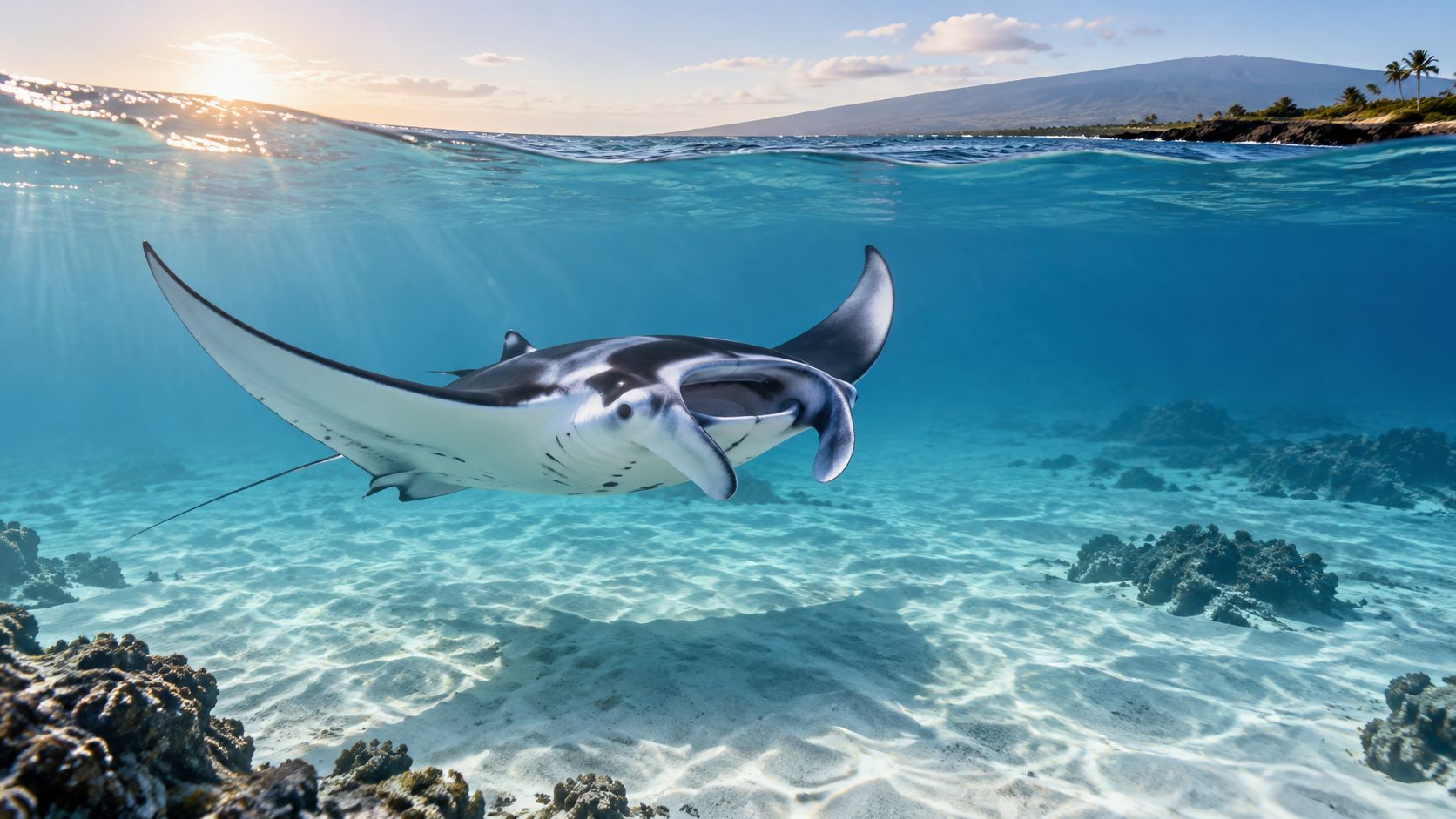
I would prioritize Garden Eel Cove for a manta dive, while leaving the final decision to the crew's assessment of that evening's conditions. Also called Manta Heaven, this northern site offers a useful combination of protection, an established viewing area, and surrounding reef.
The Garden Eel Cove site comparison identifies its position as more protected than southern Keauhou and highlights its dedicated viewing area and reef surroundings. Those are practical advantages, particularly when unsettled conditions make a well-organized dive harder to deliver.
Why the layout matters underwater
A defined viewing area helps the guide place divers where they can see without drifting into a feeding lane. It also makes the lighting arrangement easier to understand: you know where to settle, where the open water is, and where to look for instructions.
That organization matters more than a photograph suggests. In darkness, unnecessary repositioning creates work. A guest adjusting their place can lift sediment, distract a buddy, or force another diver to move.
Garden Eel Cove's advantages are specific:
- More protected positioning. Shelter can improve comfort when conditions outside the cove are less settled.
- A dedicated viewing area. The group has an established place to observe instead of assembling without a clear arrangement.
- Better reef surroundings. Nearby reef structure adds habitat and visual interest beyond the central light circle.
- A more organized encounter. Guides can manage positioning and observation within a recognizable layout.
The reef is an advantage, not an invitation to wander away while the group waits. Enjoy the broader underwater setting within the dive plan, and don't investigate coral with your knees, hands, or fins.
Prefer the site without insisting on it
Protected doesn't mean immune to swell, surge, or an unsuitable forecast. A site's general advantages can't replace the captain's judgment on the day, and a responsible site change isn't evidence that the original recommendation was wrong.
Before committing, understand the planned location and what might cause it to change. The Manta Heaven versus Manta Village comparison can help you distinguish the locations without treating either name as a promise.
For the guest, a strong site choice means a steadier platform for observation and more surrounding habitat to appreciate if the animals are slow to arrive. Garden Eel Cove is the superior starting preference for this dive, not a reason to override conditions.
Best Time and Conditions for a Good Encounter
Kona's mantas are a recurring resident attraction, not a strictly seasonal migration event. You don't need to identify a single arrival month before planning a trip.
A summary of standardized manta monitoring describes 25,444 sightings involving 118 individually identified reef mantas at Manta Heaven and Manta Village during 2009 through 2014. That record supports year-round opportunity, but it doesn't promise equal feeding activity on every outing.
Conditions matter more than a calendar label
Food availability is central to the difference between animals being nearby and animals feeding repeatedly in front of you. The University of Hawaiʻi aggregation study published in Environmental Biology of Fishes found a positive association between aggregation size and zooplankton density.
Local food concentration also shifts. The Kona manta feeding explanation describes how tidal currents, internal waves, island topography, and surface convergence can change localized plankton biomass.
Factors that change manta encounter quality
| Factor | Effect on the Encounter | What to Do |
|---|---|---|
| Zooplankton density | Influences how many mantas appear and how actively they feed | Book flexible dates and ask about recent plankton conditions |
| Ocean state and swell | Rough seas can change the site or shorten the dive | Choose a protected site and keep a backup date |
| Tidal currents and internal waves | Shift localized plankton biomass from one night to the next | Accept night-to-night variation when planning |
| Site choice | Protected coves can offer calmer water and a defined viewing area | Prefer sites with a dedicated viewing area |
| Group size and placement | Crowding and poorly aimed lights can disturb feeding | Stay in your assigned spot and follow crew direction |
Build flexibility into the booking
Schedule the encounter while you still have room to respond to a cancellation. Leaving it until your final evening removes that option, regardless of how favorable the season sounds.
Before paying, distinguish a weather cancellation, a no-manta outing, and a brief or weak encounter. Those aren't automatically covered by the same rescheduling terms. Ask what qualifies for another trip, whether space must be available, and whether additional charges apply.
A sighting and a sustained feeding display are different outcomes. Neither should be sold as the other.
A high historical sighting probability can't tell you how comfortable you'll feel, how clear the water will be, or how long a ray will remain. Use this guide to timing a Kona manta encounter to plan around workable conditions rather than a promise about a particular month.
Gear, Skills and Who Can Join
The scuba version requires certification, controlled buoyancy, and enough comfort in darkness to follow instructions without rushing. The snorkel version removes regulator and buoyancy-compensator tasks, but still requires water comfort and an appropriate flotation setup.
Stationary doesn't mean skill-free. A diver who repeatedly floats upward, tips onto the reef, or loses track of the guide can struggle even when there's little swimming.
| Participant | Better Starting Option | Preparation and Gear |
|---|---|---|
| Certified diver with reliable buoyancy | Guided manta night dive | Familiar scuba equipment, exposure protection, underwater light |
| Newly certified or rusty diver | Discuss readiness before choosing the dive | Skills review and close guide support |
| Non-diver comfortable in open water | Guided night snorkel | Well-fitting mask, snorkel, flotation device |
| Nervous first-time snorkeler | Discuss support needs before booking | Practice breathing through a snorkel and using flotation |
| Photographer | The format that matches existing skills | Compact camera setup and secure accessories |
Prepare for stillness and darkness
Exposure protection matters because you won't be generating much warmth through movement. Choose a suit that fits properly and suits your tolerance, rather than assuming tropical water means you'll stay comfortable throughout a stationary encounter.
Test your mask seal before entry. Check light operation, secure the wrist lanyard, and make sure you can locate your gauges without rearranging your camera. Bring a dry layer for the boat ride afterward.
Useful preparation includes:
- A buoyancy check. You should be able to adjust position without pushing off the bottom.
- Familiar signals. Review light signals, buddy communication, and how to report a problem.
- Honest experience information. Tell the crew about recent diving, nervousness, or equipment difficulties before boarding.
- A manageable camera. Leave an unfamiliar housing or complicated accessory arrangement for another dive.
The PADI Manta Ray Diver specialty, taken before the night encounter, covers manta biology, behavior, and conservation. It's useful preparation, but it doesn't replace basic scuba competence or the site briefing.
Match the challenge to your current skills
Review night-diving preparation if your previous dives have all been in daylight. Ask for a guide position where you can see signals easily rather than placing yourself at the edge of the group for a camera angle.
Divers seeking a different challenge can compare the premium advanced two-tank itinerary, rather than expecting a stationary wildlife encounter to function as an exploratory dive.
If buoyancy or darkness already makes you uneasy, choose a shorter, closely guided session over a longer unfamiliar one. Don't use the manta encounter as the place to discover whether neglected skills still work.
Pricing, Day Versus Night and What to Compare
Compare the complete trip, not just the advertised fare. A lower headline rate may represent a different format, fewer inclusions, or a different amount of time on the boat.
Start by matching like with like. A snorkel booking and a scuba booking aren't interchangeable purchases, and a daytime reef excursion has different goals from a stationary nighttime wildlife encounter.
Check what you're actually buying
Use the same checklist for each option:
- Equipment inclusions. Confirm whether scuba rental, exposure protection, a dive light, and snorkeler flotation are included where applicable.
- Guide arrangement. Ask how the group is supervised underwater and how participants with different experience levels are placed.
- Surface setup. Clarify whether snorkelers use a ring, board, or another flotation arrangement, and how the group stays together.
- Trip format. Check the itinerary, entry procedures, and whether divers and snorkelers share the departure.
- Cancellation terms. Separate guest cancellations from sea-state cancellations and wildlife-related rebooking provisions.
- Backup availability. Find out whether a replacement date is available during your stay.
A clear answer is more valuable than an attractive photograph. Save the written terms and your confirmation so you don't have to reconstruct a conversation if plans change.
Daylight exploration or nighttime observation
A daytime reef dive generally suits someone who wants to move through habitat, inspect reef structure, and observe a wider assortment of marine life. A manta night dive suits someone willing to spend the underwater session in a designated viewing area.
Compare the day and night diving tour formats by purpose, not by assuming that darkness automatically makes a trip more advanced. Experienced divers may prefer an advanced itinerary for exploration and the manta encounter for observation; they serve different interests.
Booking check: Confirm the total payable amount, included equipment, meeting location, and cancellation terms before entering payment details.
There's no fixed price quoted here because current rates and inclusions belong on the booking page. Make your final comparison using the live listing, and don't assume a rental item or repeat outing is included unless the terms say so.
Book Your Night Manta Dive and Confirm the Details
Kona Honu Divers offers the Manta Ray Night Dive, with Garden Eel Cove as its go-to site. The flagship experience accommodates divers and snorkelers from beginner to advanced levels, with scuba participants still needing the appropriate certification and readiness.
Our encounter is stationary and closely supervised, with experienced guides helping participants remain safe and comfortable. Confirm how the site plan and your chosen format apply to your departure date before completing the booking.
Finish the practical checks
- Choose dive or snorkel. Select the format that matches your certification and comfort, not just the perspective that looks most dramatic online.
- Keep dates flexible. Pick a date that leaves room in your itinerary for a backup night.
- Confirm the site and contingency plan. Understand possible site changes, sea-state cancellations, and the exact rescheduling rules.
- Give accurate participant information. Confirm certification, group size, age requirements, and any support needs. Don't leave a nervous swimmer's concerns until the boat is departing.
- Save your confirmation. Keep the meeting time, location, packing instructions, and contact details accessible.
Recent guest feedback can help you assess communication, organization, and how participants describe the briefing. Look for details relevant to your situation, particularly if you're newly certified or bringing a first-time snorkeler.
Arrive ready to observe
Before leaving for check-in, review your confirmation rather than relying on a saved map pin alone. Bring certification information if you're diving, your personal essentials, and any equipment specified in the booking instructions.
Book the guided experience, the preparation, and the opportunity to observe feeding mantas. The animals remain wild, so the encounter is bookable, not guaranteed.
Kona Honu Divers offers guided manta night diving and snorkeling with Garden Eel Cove as its go-to viewing site. Visit Kona Honu Divers to choose your format, check available dates, and confirm the details for your Kona manta ray encounter.