
Manta ray swimming in Hawaii means a guided night trip on the Kona coast, preferably at sheltered Garden Eel Cove, not a daytime beach swim. You're probably looking at photos of a huge ray rolling inches from a snorkeler and wondering whether you need scuba certification, whether you'll see one, and whether the whole thing happens off any beach in the islands. It doesn't. You book a boat, you go after dark, you stay still in a ring of light, and plankton decides how busy the night gets. Get those basics right and you'll know which trip to choose, where to ask the boat to go, and how to behave once a manta chooses your light.
Where Kona Night Swims Actually Happen
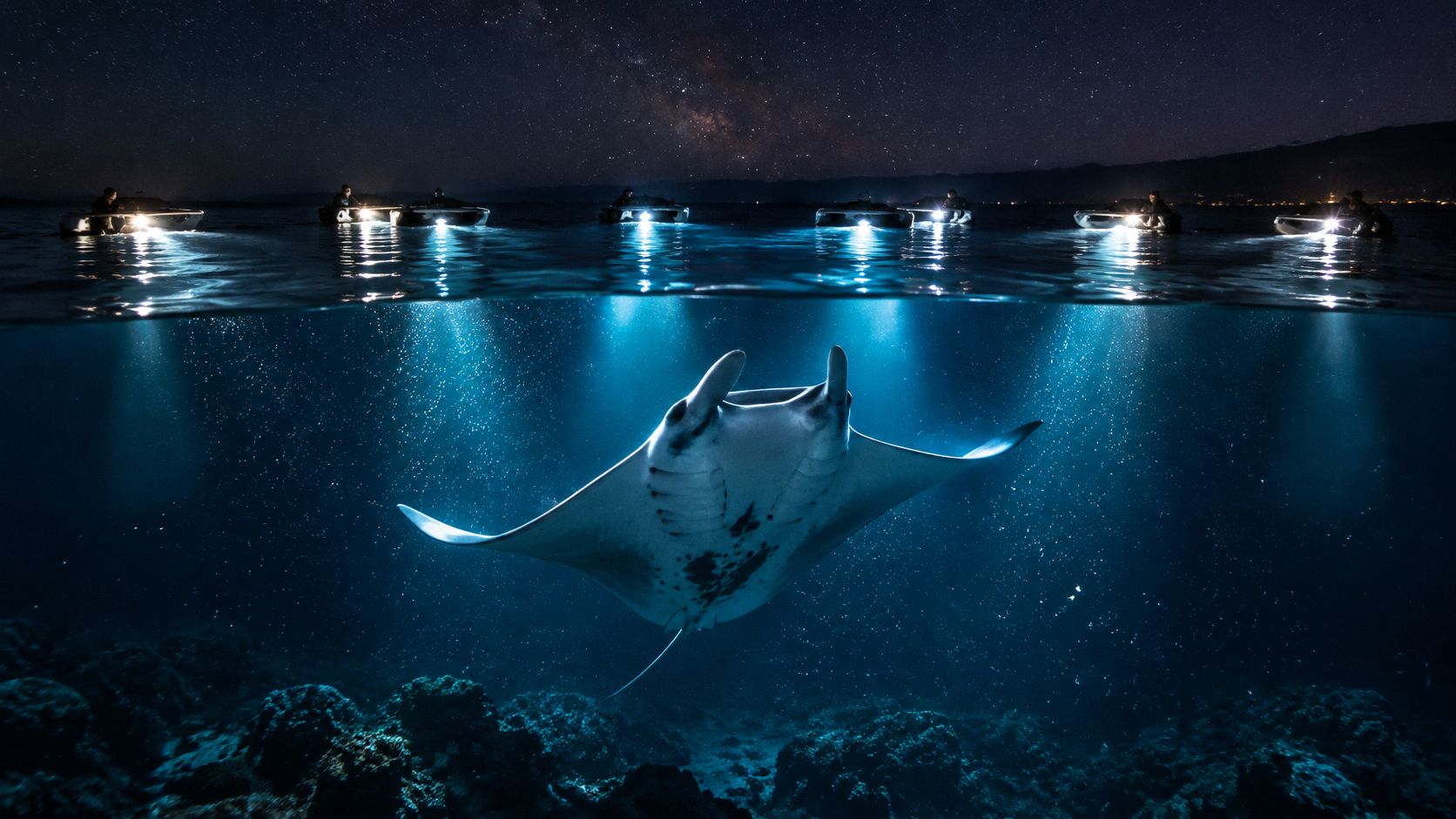
You're floating face down in warm black water, holding a light board, watching specks of zooplankton drift through the beam below you. Nothing's chasing anything. Then a shadow bigger than your body slides in from the dark edge, mouth open, and starts slow barrel rolls through the brightest part of the light because that's where the food is thickest. That's the encounter. Not a swim alongside a wild animal in open water, and not a daytime snorkel where you hope to get lucky.
Manta ray swimming in Hawaii means the west coast of Hawaiʻi Island after sunset. It doesn't mean Maui, it doesn't mean Oʻahu, and it doesn't mean walking off a Kona beach at noon with a mask. Reef mantas feed here at night at established stations where lights concentrate plankton over reef and sand. During the day they're solitary and scattered. At night they converge on food, and that's the only window that makes a reliable trip possible.
The Two Established Sites
There are two established night feeding sites on this coast, and naming them matters when you book.
- Garden Eel Cove, also called Manta Heaven: The northern site, in a protected pocket with a better viewing area and better reefs, and the site that holds larger groups.
- Keauhou, also called Manta Village: The southern site, about 20 km from Garden Eel Cove, with its own loyal regulars and typically smaller gatherings.
I would make Garden Eel Cove your default. The shelter matters more than most first-timers expect. You're either floating at the surface for an extended session or kneeling on sand in the dark, and calmer, clearer water makes both jobs easier. You're not fighting surge while you try to hold a light steady. You're not watching the beam fill with stirred-up sand. The reef around the viewing area also gives divers something real to look at on the way in and out, eels in the sand, reef fish settling in for the night, structure that holds life even between manta passes.
What Reliability Actually Means Here
Diving in Kona is possible 365 days a year, and manta trips run as night charters through that whole calendar. That year-round access fools people into thinking every night delivers the same show. It doesn't. Zooplankton density changes how many animals appear, and plankton doesn't follow your vacation schedule. A night with thick plankton in the lights can draw repeated feeding passes. A thin night can mean long quiet stretches between visitors.
One manta present is not the same as a large aggregation, and a good operator will tell you that before you pay.
Manta sightings in Kona often exceed a 90% success rate, which is strong for a wild animal encounter. Read that number correctly, though. It means mantas show up on most nights. It doesn't promise a dozen animals, a full hour of barrel rolls, or a pass close enough to fill your camera frame. If you book expecting a scheduled performance, you'll misread a perfectly good night with two animals feeding steadily as a disappointment.
Book the date early for a practical reason, not a sales reason. The most popular trips, including the manta ray night dive, often sell out weeks in advance. If this swim is the reason you're coming to the Big Island, lock the night before you finalize flights and hotels around it. Booking early in your stay also leaves room to reschedule if wind or swell shuts down your first choice of evening. Once you've settled on a night at Garden Eel Cove, your next decision is simpler than it looks. You need to pick your position in the water, surface or bottom.
Snorkel or Dive and Which Cove to Choose
For most visitors, the night snorkel is enough. You float at the surface, aim lights downward, and watch mantas feed in the lit water below and beside you, often passing very close as they work the plankton. The night dive is for certified divers who want to kneel on the sand and look up as rays pass at eye level and overhead. Both groups watch the same feeding behavior at the same site on the same night. Neither one is the budget version of the other, and you can compare the trade-offs in detail in this guide to whether it's better to snorkel or dive with manta rays.
| Choice | Position and lights | Who it fits | What to expect |
|---|---|---|---|
| Night snorkel at Garden Eel Cove | Surface float with lights aimed down | Comfortable swimmers and families, no certification | Close passes from above in sheltered water with the larger aggregations |
| Night dive at Garden Eel Cove | Kneel on sand in a set viewing area with lights aimed up | Open Water or higher and a dive within the past 2 years | Eye-level feeding passes on a stationary, guided dive |
| Keauhou, also called Manta Village | Same snorkel or dive setup at the second site | Guests already based near Keauhou | Smaller gatherings; females accounted for 91 percent of sightings |
| Daytime shore swim | No fixed night light station | Anyone hoping for a chance sighting | Unreliable; the dependable encounter is the night aggregation |
The Certification Rule With No Wiggle Room
The charter rule is plain. The 2 Tank Manta Charter requires Open Water Certification or higher and diving within the past 2 years. If your card is old and your last dive was on a honeymoon a decade ago, don't book the dive and hope the crew waves you through. Either refresh your skills first or take the snorkel spot, where you'll still see the animals well. If you're planning more scuba diving on the Big Island around the manta night, a daytime reef dive earlier in the trip is a sensible way to get your buoyancy and gear sorted before you kneel in the dark.
Don't let the word night scare you off the dive if you're current. The manta ray night dive is stationary and closely supervised, with experienced guides making sure everyone is safe and comfortable. Divers are positioned in a specific viewing area at a well-established dive site. You're not navigating a reef in the dark or following a guide on a long swim. You descend, settle, aim your light, and stay put.
Why the Two Coves Don't Perform the Same
The sites sit about 20 km apart, close enough that visitors assume they're interchangeable. The 2026 study in Environmental Biology of Fishes analyzed 13 years of community-sourced records, more than 23,000 sightings of 167 individually identified reef manta rays, at Garden Eel Cove and Keauhou. Garden Eel Cove supported larger and more variable aggregations, while Keauhou consistently had smaller gatherings and a strongly female-biased pattern, with females accounting for 91% of sightings there.
That same long record shows aggregation size rose and fell with zooplankton density. Conditions drive the head count more than season, operator quality, or luck. Nobody can schedule a full squadron for your anniversary night, and any operator who promises one is selling you something the ocean hasn't agreed to. The lights concentrate the mantas' food. The animals aren't trained, they aren't fed by hand, and they leave when the plankton thins out.
Practical rule: Choose the site with the better odds and the calmer water, then accept whatever number of mantas the plankton supports that night.
That's why I call Garden Eel Cove the superior tour site when sea conditions and operations allow. Sheltered water, a better viewing area, better reefs, and the larger aggregations in the long-term record all point the same way. Keauhou is a legitimate site with its own resident animals, and it's convenient if you're staying nearby. But if you're traveling to Kona for one manta night, spend it where the record is stronger. Book the manta ray dive at Garden Eel Cove, or the snorkel on the same trip if you're not a current certified diver, and let the site do the work it does best.
How the In-Water Encounter Should Go
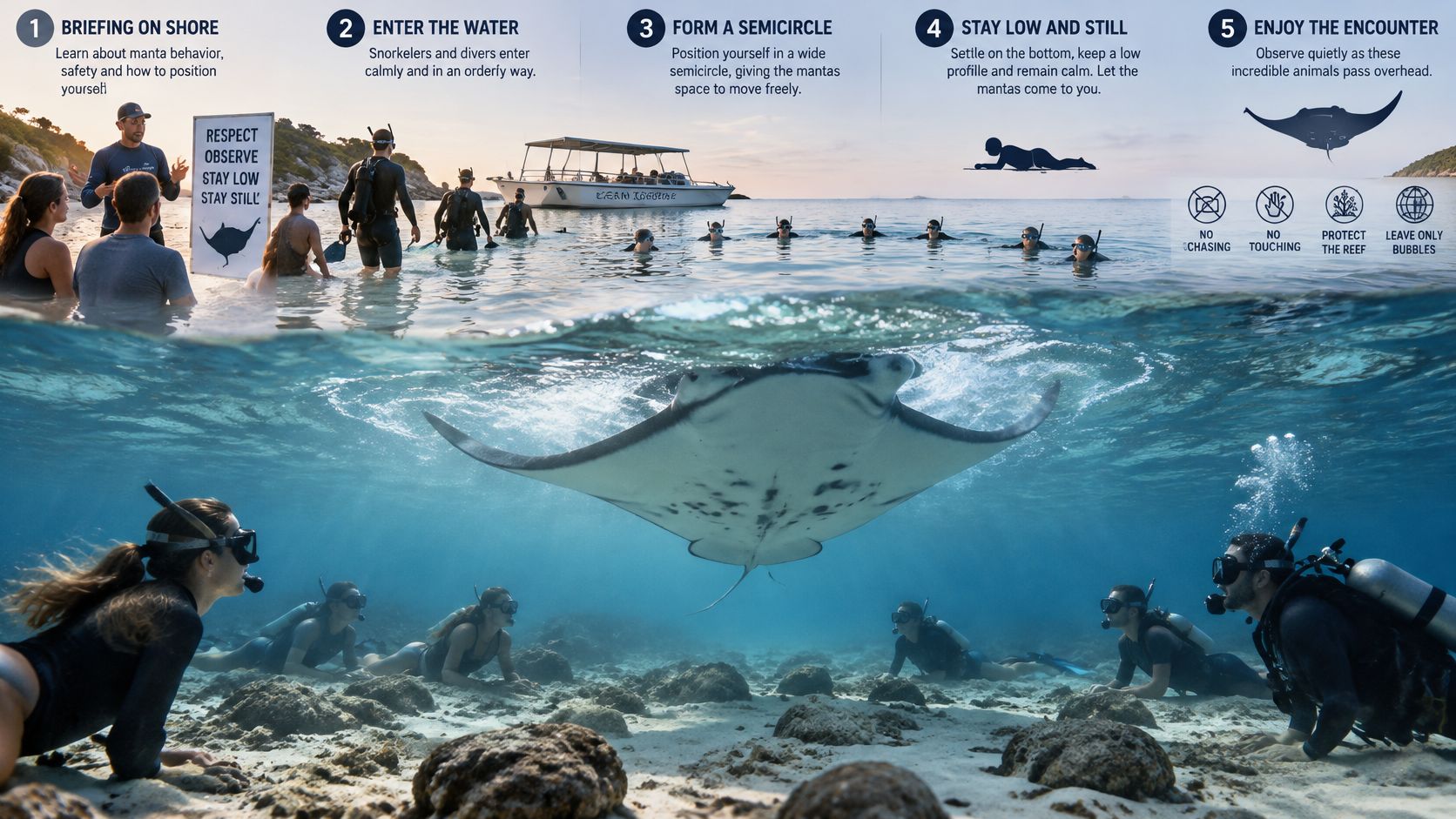
A good manta night runs on a simple sequence, and every step exists for a reason you'll understand once you're in the water. The Love Big Island guide to the manta ray night dive describes encounters in Hawaiʻi as observation-only, with swimmers and divers who must not touch, chase, grab, ride, or otherwise harass the animals. That isn't legal boilerplate. It's the mechanic that makes close passes possible, because mantas keep feeding near people who behave predictably.
The Six Steps From Briefing to Exit
- Enter only after the briefing and stay with the guide. You'll hear where to position yourself, where the lights go, and what the exit signal looks like. If you're new to scuba diving at night, this briefing is where the dark stops being the hard part.
- Take your assigned level in the water column. Divers remain on or near the sandy, rubble, or boulder bottom and form a semicircle, leaving the open water column available for manta movements. Snorkelers remain at the surface rather than diving into the feeding area. Nobody occupies the middle, because the middle is the manta's road.
- Aim your light the right way for your role. Divers direct lights upward to attract plankton into the water column, while snorkelers direct lights downward from the surface. On our Manta Ray Night Dive, powerful dive lights create a bright circle on the seafloor so divers are never in complete darkness, and experienced divemasters and instructors are in the water with you the whole time.
- Hold still and let the manta choose the distance. Move slowly when you must move at all. Touching a manta damages its mucus coating, a surface layer that helps protect its skin from harmful organisms and abrasion. If an animal's path brings it close, that's its choice. Tuck your hands in and enjoy it.
- Keep your light, bubbles, and gear out of the animal's line. Avoid shining lights into a manta's face, exhaling bubbles directly at it, or extending cameras and other equipment into its path. A camera on a long pole shoved into a feeding loop doesn't get you a better shot. It gets you a manta that veers off and feeds somewhere else.
- Exit when the guide ends the session. Even if another pass looks likely, even if your neighbor sucks less air than you do. The guide is managing the group's air, the boat's schedule, and the conditions on the surface that you can't see from the bottom.
Why Stillness Gets You Closer Than Swimming
New guests often assume the snorkelers floating above get a worse view than the divers below. In practice, mantas working the surface lights pass right under the float line, sometimes close enough that snorkelers have to remind themselves not to reach out. Divers get the upward view, the white underside and open mouth crossing the light beams overhead. Both views depend on the same thing, a group that stays put and lets the feeding pattern develop.
The closest passes of the night almost always go to the stillest person in the group.
Follow those positioning and lighting rules and a well-run Garden Eel Cove night can feel startlingly close without anyone making contact. That's the design. The lights bring the plankton, the plankton brings the mantas, and your stillness keeps them comfortable enough to feed in front of you instead of drifting off into the dark.
Photograph the Pass Without Chasing It
Stop trying to swim with the ray. That's the single most useful thing a photographer can hear before this dive. A manta moves by oscillating and traveling-wave motion of its large flexible pectoral fins, and the Springer hydrodynamic study of manta swimming describes how spanwise and chordwise flexion of those fins generates thrust while supporting maneuverability. In plain terms, the animal changes fin beat and heading smoothly and efficiently, and it will out-swim your best fin kicks without noticing you tried. Rapid kicks don't keep you alongside a manta. They put you in its path, stir the bottom, and ruin your own shot.
Set Up the Shot and Let the Animal Deliver It
Work from a fixed, predictable position instead. These habits produce the frames people keep, as you'll see in these manta ray dive Kona pictures taken from stationary positions.
- Hold neutral buoyancy or a settled kneeling spot: A stable camera beats a close camera, and a diver who isn't yo-yoing in the column doesn't block the feeding loop.
- Stay to the side and leave an escape corridor: Keep a predictable lateral position and an unobstructed path ahead of the animal so it can choose its distance and keep feeding past you.
- Shoot wide with a pre-focused beam: A wide angle forgives the manta's exact line, and a steady light lets you frame the pass before it happens instead of panning after it.
- Photograph the underside and the markings beside the mouth: The white ventral pattern and cephalic-fin markings are how individuals get identified, and they read beautifully against black water.
- Keep flash out of the face: Light the scene, don't blast the animal. A startled manta that banks away gives you a tail shot and gives the next diver nothing.
Ignore any urge to match a specific swimming tempo. Laboratory fin models describe mechanics under controlled conditions. They aren't field speeds for you to copy, because real mantas alter their fin movement with depth, current, feeding behavior, body size, and maneuvering demand. Your job is buoyancy control and patience, not imitation.
When the Night Doesn't Cooperate
A quiet night can still be a success. One ray that feeds steadily in your light for several passes and then leaves has given you the encounter you came for, even if the group count never climbs. Plankton, sea state, and which recognizable individuals return all change the tally, and none of them answer to the boat crew. Judge the night by behavior watched, not by a head count you invented on the dock.
If wind or swell makes Garden Eel Cove uncomfortable, accept a move, a delay, or a cancellation rather than pushing for a rocky entry in the dark. Seasick guests should take medication before the ride, stay where the breeze hits them on the boat, and leave the camera alone until they're stable, because staring at a small screen in a swell makes nausea worse fast. If you spot a tangled or injured animal, report it to the crew and stay clear. Approaching a distressed manta with a camera helps nobody, and the crew knows who to call.
Why This Small Population Needs Quiet Guests
Start with the numbers, because they change how the whole night feels once you know them. The NOAA peer-reviewed summary of the 2023 genetic study analyzed whole mitochondrial genomes and 2,048 nuclear genetic markers from reef mantas around Hawaiʻi Island and Maui Nui, and the results supported treating the two areas as genetically distinct management units. Long-term identification records found only 318 unique manta rays around Hawaiʻi Island since 1979, and genetic estimates put that population at about 104 adult breeders, against approximately 600 identified animals and about 129 adult breeders in Maui Nui.
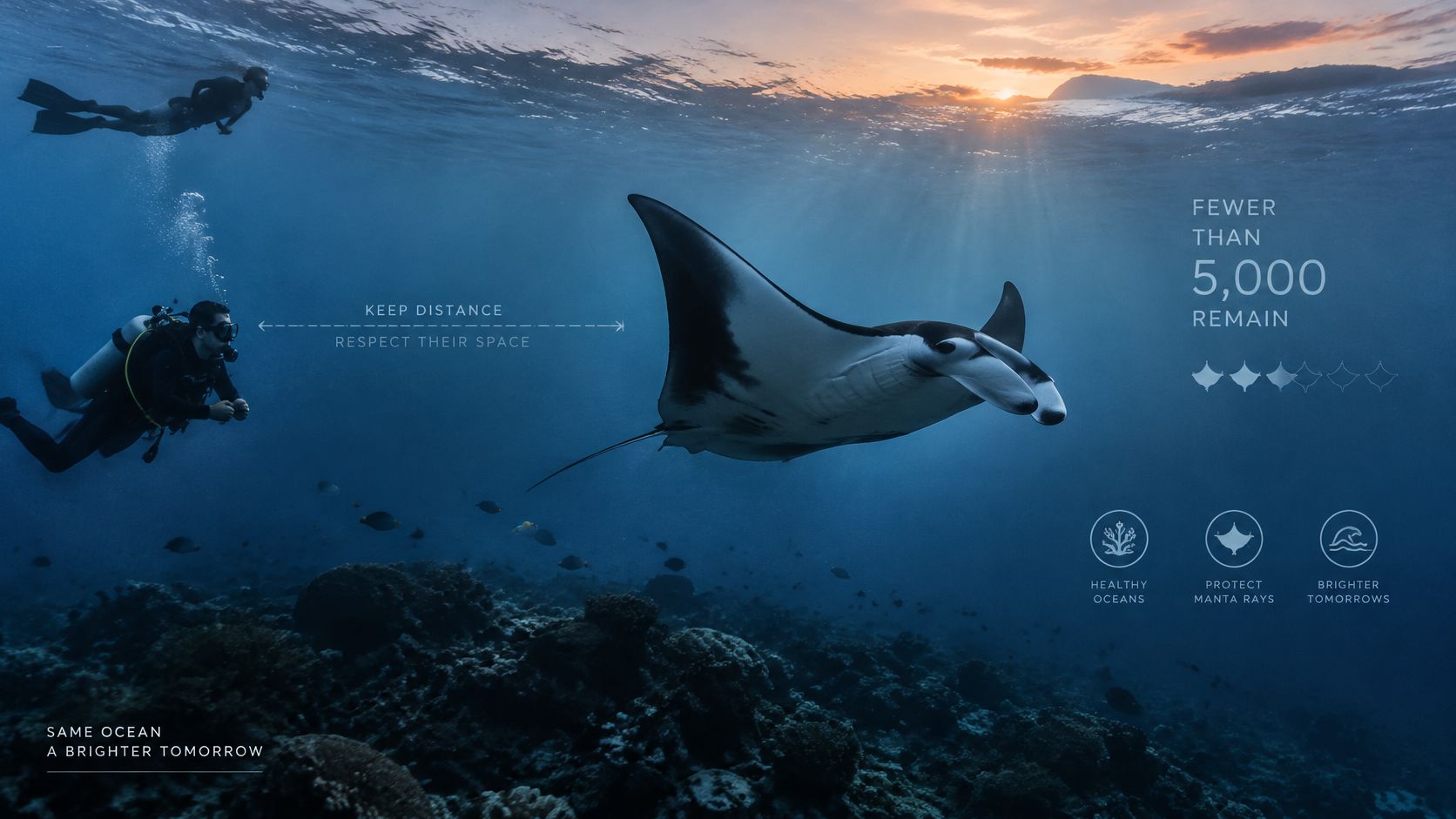
Read that again before you get in the water. The animals rolling through the lights at Garden Eel Cove belong to a community with roughly a hundred breeding adults. Reef mantas generally remain near their home island, so damage, disturbance, or loss of feeding and cleaning habitat here may not be quickly offset by immigration from another island group. There is no large regional population waiting to refill Kona if this one thins out.
The Same Faces, Night After Night
That's why crews recognize individuals. The ventral spot patterns are unique, the animals return to the same feeding sites, and trip after trip can involve the same recognizable residents. When a guide tells you an animal's name, that isn't a gimmick. It's a sign you're watching a small, known community, and your behavior lands on the same animals that next week's guests will meet. The visitor standard fits in one line. Keep distance, make no contact, and follow the guide. The fuller picture of responsible, considerate diver etiquette is worth reading before any Kona dive, manta night or not.
The Risks That Have Nothing to Do With Your Hands
Etiquette doesn't end with not touching. Mooring and anchor lines can entangle a manta badly enough to wound it or drown it, and propellers are a boat-handling hazard around animals feeding near the surface at night. These are infrastructure problems, managed by crews who place moorings carefully, tend their lines, brief passive observation, and keep the operation at established sites instead of improvising new light stations wherever a ray appears.
Night aggregations persisting under years of tourism doesn't prove the animals have unlimited tolerance. It proves the current rules are worth keeping.
Choose crews who run the encounter that way, with a real briefing, managed lines, and a fixed viewing area at an established site such as sheltered Garden Eel Cove. In a population this small, the difference between a careful operator and a careless one isn't style. It's cumulative pressure on about a hundred breeding animals that can't be replaced from somewhere else.
Book Garden Eel Cove and Pack Your Gear
Booking this trip well is mostly a matter of asking the right questions in the right order. Work through these steps and you'll avoid the two common mistakes, booking the dive without current certification and assuming every boat goes to the same cove.
Five Booking Steps in Order
- Pick snorkel or dive first. Use the comparison of position, lights, and fit to decide, and confirm Open Water or higher plus a dive within the past two years before you reserve a dive seat.
- Request Garden Eel Cove by name. Don't assume it's automatic. We run our 2-tank manta ray trip to Garden Eel Cove as our go-to site because the cove is naturally sheltered, with calmer and clearer water, and the same night works for snorkelers at the surface and certified divers on the bottom, from beginners through advanced guests.
- Reserve weeks ahead. The busiest manta nights sell out early, so book before your travel dates harden around them. Ask about age limits, swimming ability requirements, and total trip length while you're on the phone, and skim these dive travel tips and tricks before you fly.
- Read the sea-condition and cancellation policy before paying. Night trips live and die by wind and swell, and you want to know your reschedule options before the forecast forces the question.
- Expect the full arc of the night. A night departure, a boat ride, a detailed crew briefing covering the science of what you'll see and the rules of passive observation, one in-water session, and a late return to the harbor. Don't schedule an early flight the next morning if you can help it.
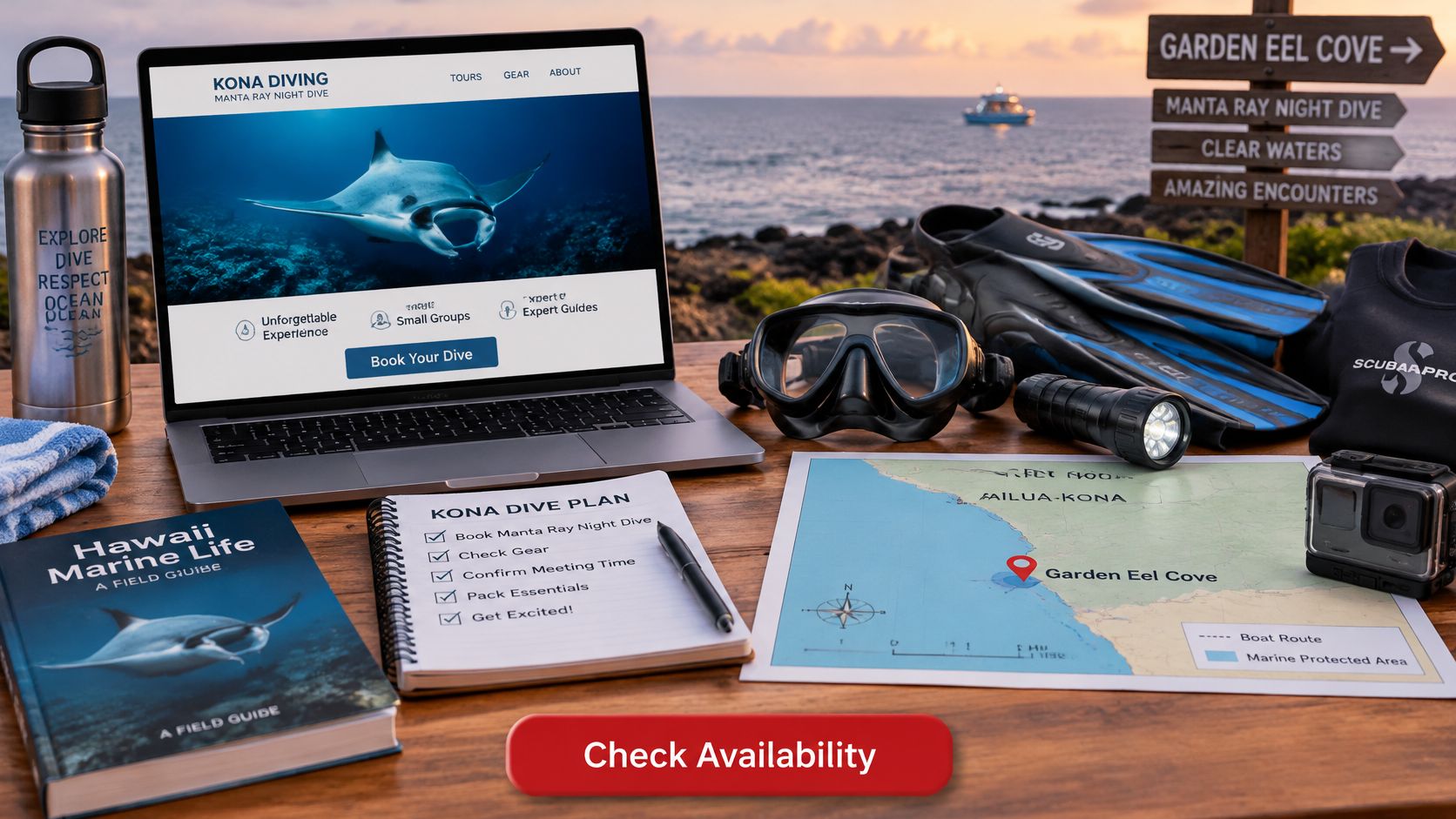
Pack light but pack deliberately. Bring reef-safe sunscreen applied well before boarding, a towel, a warm layer for the ride back, motion bands or medication if you're prone to seasickness, a prescription mask if you need one, and a personal light only if the crew allows it. Rental gear and wetsuits come from the operator, so your bag stays small.
Kona Honu Divers runs this charter as a 2-tank manta ray trip pairing reef time with the night session at Garden Eel Cove. If you're building a fuller dive week, the wider range of diving tours covers morning reef trips, and more experienced divers can step up to the premium advanced 2-tank trip for long-range sites beyond the manta cove.
Book the sheltered cove, pack for a cool ride home, and settle into your spot in the light. Plankton, not your booking confirmation, decides whether the group that night is one ray or many.
Kona Honu Divers runs guided manta ray night dives and snorkels at Garden Eel Cove, pairing a thorough passive-observation briefing with in-water divemasters and instructors so certified divers and surface snorkelers can watch feeding mantas from the right position. If you're planning a manta night or a fuller Kona dive trip, visit Kona Honu Divers to choose your date and confirm your spot before the popular nights fill.