
You've probably reached the point in your Big Island planning where the manta ray night encounter is circled on the calendar, but one question remains: what does “year-round” really mean in Kona? The rays may be present throughout the year, yet the quality of a particular outing still depends on the sea, the plankton, the lighting, the viewing site, and how many people are sharing the water.
A good manta experience is not just a matter of finding a boat and hoping for a close pass. The strongest outings match the right format to your comfort level, use a protected and productive location, and give the animals room to feed naturally. This guide explains how to make that decision with realistic expectations, whether you're planning a dive, a snorkel, or a first nighttime wildlife encounter.
What to Expect During a Manta Ray Encounter
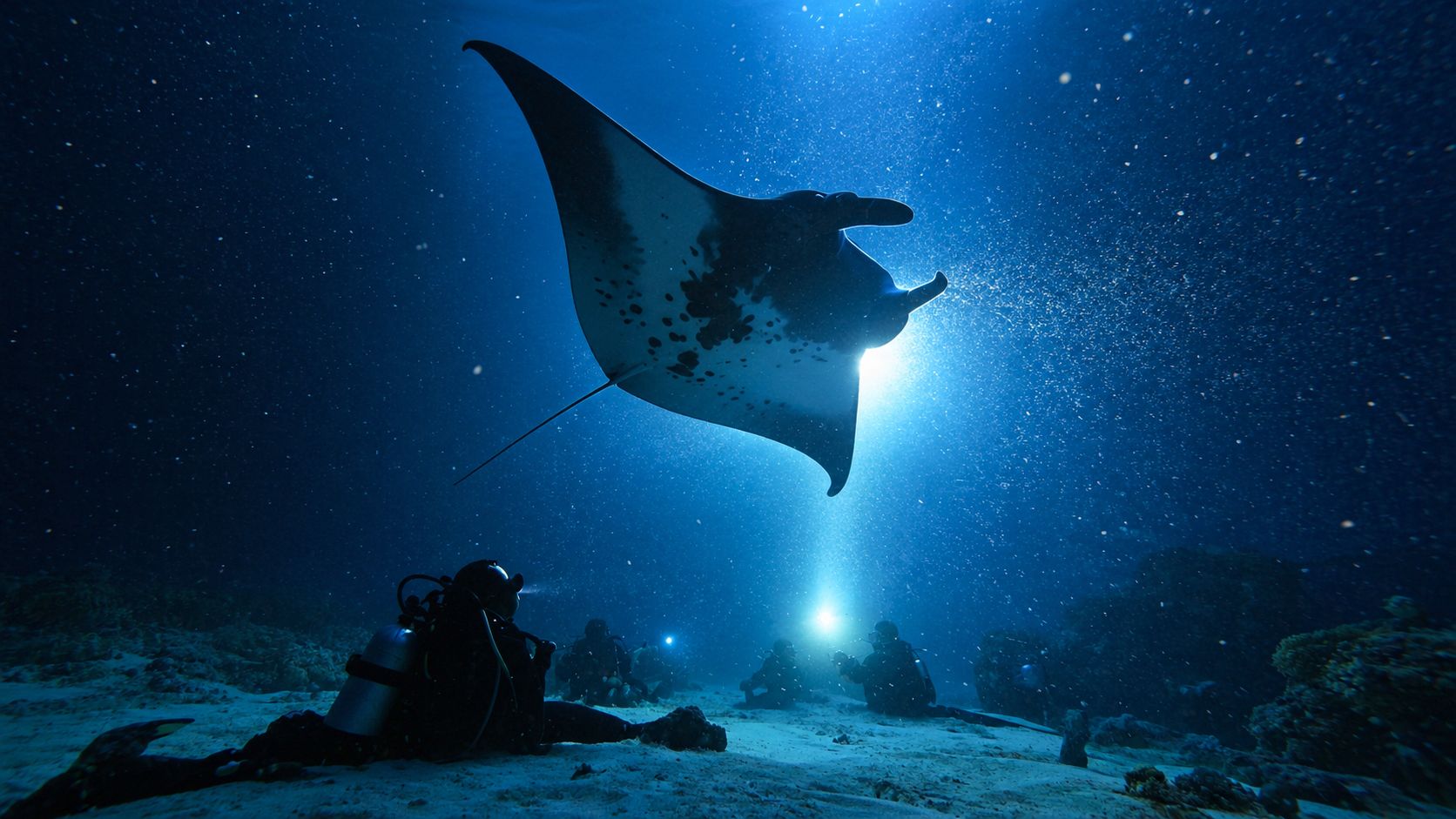
At the water's edge, Kona feels different after sunset. The shoreline becomes a dark outline, the boat's deck lights reflect off the water, and the usual daytime reef scenery disappears as soon as you enter the sea. Then the viewing lights come on, illuminating the water column and drawing plankton toward the surface.
You may be floating when a broad shadow appears below. A manta ray sweeps upward, turns on its side, and glides through the light with its mouth open, filtering plankton from the water. The animal may circle close, disappear into the darkness, and return from another direction without making a sound.
The environment is part of the experience
Night snorkeling and diving can feel surprisingly calm, but you're still in open ocean conditions. A light current may move you away from the group, and surface chop can make it harder to keep your face in the water. Darkness also changes your sense of distance, so a manta that looks far away can suddenly pass directly beneath you.
The standard setup uses artificial light to gather plankton near the viewing area. Snorkelers remain near the surface and direct their lights downward, while divers generally stay on the seafloor and shine lights upward. That arrangement leaves a central corridor open so mantas can turn, climb, and feed without encountering a wall of swimmers.
Practical rule: Don't try to create the close encounter. Hold your position, keep your movements controlled, and let the manta choose the distance.
The most memorable moments often happen when guests stop trying to take the perfect photograph. Keep your body still, listen to the crew, and watch the animal's flight path rather than reaching toward it. A manta encounter is a wildlife observation, not an interactive performance.
Understanding Kona’s Resident Manta Rays
Kona's reef mantas, Mobula alfredi, are unusual because many individuals can be tracked over long periods. Their ventral spot patterns are distinctive, and researchers can supplement those markings with scars, fin injuries, and other identifying features. This turns a brief nighttime sighting into a possible contribution to a long-running record.
Researchers first identified a resident Kona reef manta named “Lefty” in 1979, beginning a photo-identification tradition that has continued for decades. By 2026, the Manta Pacific Research Foundation had identified 318 unique manta rays around Hawaiʻi Island (Big Island Now reports on the Kona manta catalogue and research).
Residents rather than passing visitors
Genetic research involving NOAA's Pacific Islands Fisheries Science Center, the Hawaiʻi Association for Marine Education and Research, and the University of Miami found that Hawaiian reef mantas generally remain near their natal island rather than regularly crossing deep channels. The estimated migration rate was approximately one female moving between island groups every 1,300 years, compared with one male approximately every 64 years, and researchers reported that females reproduce at the island where they were born, according to the same research coverage of Hawaiʻi Island's manta population.
That doesn't mean every manta you see belongs to one fixed viewing site. Individual movement varies, and NOAA-supported research found meaningful differences in movement and site use between sexes. A manta that appears regularly at one location shouldn't be treated as representative of the entire population.
You also shouldn't assume that “resident” means guaranteed. Food availability, local conditions, and individual behavior still determine whether a ray visits a particular light station on a particular night. The better interpretation is that Kona has a localized population with recurring associations, not a parade of animals passing through on a predictable migration route.
Why identification matters to visitors
A clear underside photograph can help researchers match an individual to previous observations. The useful photograph is taken without pursuing, touching, or obstructing the ray. Repeated identification can reveal residency, injuries, reproduction, sex-specific habitat use, and changes in local occurrence.
For travelers, that science adds significance to the encounter. You may be looking at an animal whose history is known across years of observations, rather than an anonymous visitor that happened to appear under a boat light. The Kona manta ray guide provides additional background for visitors who want to understand the animals before entering the water.
Night Dives vs Snorkeling with Manta Rays
The right format depends less on which activity sounds more adventurous and more on how you're comfortable moving in the water at night. A scuba diver can settle on the bottom and observe the feeding corridor from below, while a snorkeler stays at the surface and looks down into the illuminated water.
Neither option guarantees a better encounter. They offer different angles, different physical demands, and different ways of responding when the sea becomes unsettled.
| Feature | Night Dive | Snorkel Tour |
|---|---|---|
| Viewing position | Generally seated or kneeling on the seafloor | Floating at the surface |
| Perspective | Looks upward as mantas move through the light | Looks downward into the feeding corridor |
| Main demand | Comfort with scuba equipment, depth, and nighttime buoyancy | Comfort floating in open water after dark |
| Best fit | Certified divers who want a reef dive followed by the manta experience | Swimmers, families, and non-divers |
| Common challenge | Maintaining position without entering the manta's path | Managing mask fit, surface movement, and personal space |
What the dive adds
A night dive gives you the structure of the seafloor beneath you. You can observe the reef before or around the manta portion of the outing, then watch the rays sweep overhead from a lower viewpoint. Divers also have to manage buoyancy, regulators, lights, and equipment while resisting the temptation to rise into the animals' corridor.
Scuba isn't automatically the more intimate choice. If you're distracted by unfamiliar gear or uncomfortable in darkness, the dive can reduce your ability to observe calmly. Choose it because you enjoy scuba and can maintain controlled buoyancy, not because you expect the rays to reward deeper access.
The scuba versus snorkeling manta guide offers a useful way to compare the two formats before booking.
Why snorkeling works for many travelers
Snorkeling keeps the setup simple. You remain at the surface, usually supported by flotation equipment or a light board, and watch the mantas rise into the illuminated water. For families and first-time nighttime participants, that can feel less demanding than managing a full scuba system.
The trade-off is that surface conditions matter more. Small waves, mask leaks, cold, or anxiety can make it difficult to stay relaxed. A crew that explains positioning clearly and watches the group closely matters just as much as the boat or the viewing light.
A relaxed snorkeler who holds position will often get more from the encounter than a technically capable diver who keeps chasing the action.
If you're already a comfortable diver, the night dive offers a distinctive reef perspective. If you want the least complicated route to observing feeding mantas, snorkeling is usually the more accessible choice. In both cases, the animal should control the interaction.
Choosing the Best Locations and Operators
Location affects more than the view from the boat. A productive feeding area can attract larger aggregations, while a less suitable site may offer a more limited encounter even when mantas are active elsewhere along the coast.
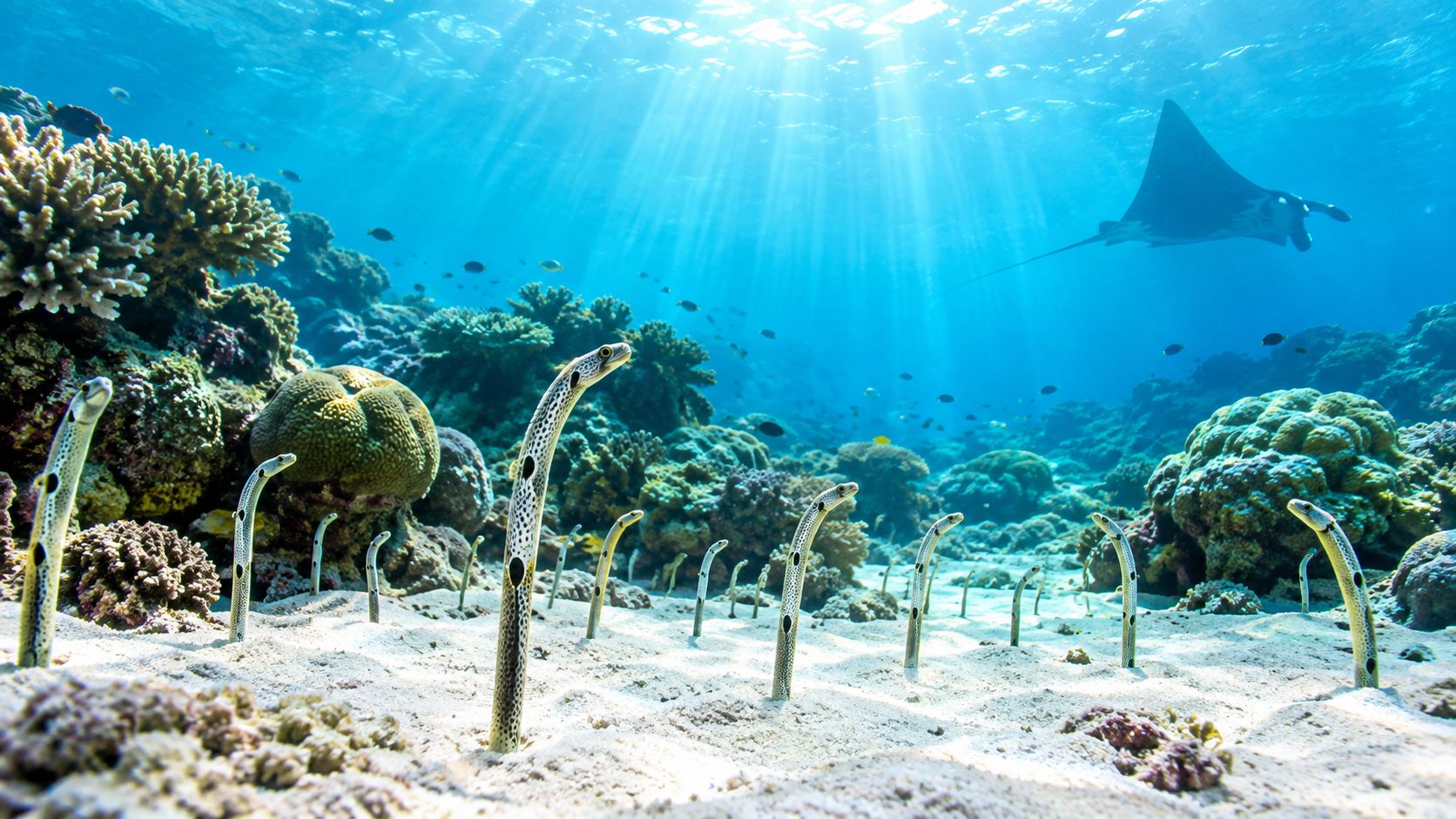
Garden Eel Cove deserves particular attention for that reason. A 2025 University of Hawaiʻi study analyzing 13 years of data found that Garden Eel Cove consistently supported larger manta aggregations than Keauhou, indicating that it functions as a particularly reliable feeding area (University of Hawaiʻi study of Kona reef-manta observations).
Why Garden Eel Cove stands out
The site's protected setting and established viewing area help operators position lights, divers, and snorkelers in a controlled arrangement. That matters because mantas need an open path through the water, and guests need a stable place to observe without spreading across the feeding zone.
The same University of Hawaiʻi research used community-sourced observations from 2010 through 2022, covering more than 23,000 sightings of 167 individually identified reef manta rays at Garden Eel Cove and Keauhou (the long-term Kona manta observation study). It found that prey availability, particularly zooplankton density, closely tracked seasonal and annual changes in aggregation size.
That finding changes how you interpret a quiet night. The rays aren't failing to follow a tourist schedule. They're responding to the distribution of their food, while weather and sea conditions affect whether guests can reach and comfortably use the site.
How to assess an operator
Ask specific questions before booking rather than relying on broad promises about guaranteed sightings.
- Ask about the location: Find out whether the trip uses Garden Eel Cove or another established viewing area, and ask how the crew handles a site change.
- Check the positioning plan: Divers should stay on the bottom, snorkelers should remain at the surface, and the central water column should remain open.
- Look for trained in-water guides: Hawaiʻi Ocean Watch standards call for adequately trained and certified guides for each in-water activity.
- Review the lighting approach: Operators should place lights to attract plankton without drawing mantas toward dangerous boat equipment or into another group's space.
- Consider the boat experience: A smaller boat isn't automatically better, and a larger boat isn't automatically worse. The useful question is whether the crew can control entry, exit, equipment, and guest spacing.
A Kona diving company guide to choosing an operator can help you compare practical details beyond marketing language. Kona Honu Divers offers a two-tank manta dive and a manta night snorkel, including trips using Garden Eel Cove, so it's one local option to evaluate alongside other safety-focused operators.
Safety, Etiquette, and Conservation Impact
The basic rules are simple because the consequences of ignoring them aren't. Don't touch, chase, grab, ride, or block a manta ray. Don't dive down toward an approaching animal, and don't position your body or equipment where the ray has to alter its feeding path.
Manta rays have a protective mucus coating. The NOAA-hosted manta interaction guidance explains why physical contact is harmful and also advises divers not to blow bubbles directly into an approaching manta. Snorkelers should remove the snorkel from the mask and secure it in a buoyancy-compensator pocket or another safe location because a passing ray can snag it and pull the mask loose.
Passive observation protects the encounter
The most effective behavior is also the least dramatic. Stay stationary, keep your hands to yourself, secure dangling equipment, and let the manta determine how close it comes. If the ray turns away, don't follow it.
Hawaiʻi Ocean Watch's manta-tour operator standards describe a “campsite” arrangement. Divers stay at the bottom, snorkelers remain at the surface, and the center of the water column stays open for manta movement. The standards also emphasize passive observation, trained in-water guides, and careful light placement.
That structure protects more than individual animals. It gives the rays a predictable corridor and gives crews a way to intervene before a guest drifts into the animals' path. A disciplined group can be close to wildlife without turning proximity into pressure.
Leave the water column open: The manta needs that space more than you need a closer photograph.
Why local vulnerability matters
NOAA status-review material describes the Kona population as likely closed, with low immigration, and reports an estimated average of 4.27 new pups entering the population annually in a long-term analysis (wildlife-interaction information discussing manta population vulnerability). When a population has limited replenishment from other island groups, repeated disturbance, boat strikes, entanglement, habitat loss, or changes in feeding behavior deserve serious attention.
Tourism creates a strong reason to protect these encounters, but economic value shouldn't be the only reason for responsible conduct. Global estimates indicate that more than 1 million people snorkel or scuba dive with manta rays each year, generating approximately US$140 million in economic impact. At crowded viewing sites, participants have encountered an average of 62 snorkelers and 33 scuba divers, according to the peer-reviewed manta tourism analysis.
Those figures explain the trade-off. Manta tourism supports local livelihoods and marine education, but crowding makes each guest's behavior more important. Your responsibility doesn't end with choosing a conscientious operator. It continues in the water, where staying still and keeping the corridor clear directly reduces pressure on the animals.
Hawaiʻi's Department of Land and Natural Resources advises viewers to enjoy protected marine species from a distance and avoid disturbing them. The agency also identifies pelagic manta rays, Mobula birostris, as endangered under the federal Endangered Species Act and provides 1-888-256-9840, option 5, for certain wildlife reports (DLNR guidance on protecting marine species). Kona's reef mantas are a different species, but the broader principle remains useful: close wildlife viewing requires restraint, not contact.
The responsible diver etiquette guide puts that principle into practical terms. Secure your gear, follow the crew's position, and treat every close pass as a privilege that the animal can end at any moment.
Booking Advice and Practical Planning
A traveler booking a single evening often asks whether there's a “best month” for manta rays. The honest answer is more nuanced than “there's no season.” Kona's resident reef mantas are available throughout the year, but availability doesn't guarantee that your boat will run, that the water will be comfortable, or that the encounter will be long and calm.
Weather, sea state, water clarity, plankton distribution, lighting, site choice, and operational cancellations can all change the result. Think in terms of three separate questions: Are mantas present? Is the outing suitable tonight? Will the encounter quality match what you want?
Build flexibility into the plan
If the manta encounter is a priority, avoid treating it as a last-minute filler activity. Reserve early enough to give yourself options, especially if your itinerary includes only one suitable evening. Travelers with flexible schedules can place the outing earlier in the visit, leaving room to reschedule if weather or operations make the first attempt unsuitable.
Holiday periods can also bring more visitor pressure. Avoiding the busiest demand windows won't make the mantas appear, but it may produce a less crowded experience when boats and viewing stations have more space to manage guests.
Pack for the entire outing, not just the time in the water:
- Wear a swimsuit underneath: It makes changing and gearing up easier.
- Bring a light jacket: The ride back can feel cool after sunset, even when the water felt comfortable.
- Secure long hair: Hair ties prevent distractions while you're fitting a mask or watching the rays.
- Use familiar gear if appropriate: A preferred mask can help, but it should fit securely and be acceptable to the operator.
- Plan for motion sensitivity: If you're prone to seasickness, ask a medical professional or pharmacist what's appropriate for you. Common products travelers consider include Ship-EEZ Seasickness Patch, Dramamine pills, Bonine pills, Sea Band wristbands, and ginger chews. Follow the product directions and check whether a medication could affect alertness or diving fitness.
A good operator will explain what happens if conditions change, how guests enter and exit the water, what equipment is supplied, and what behavior is expected around the mantas. For divers, confirm certification and equipment requirements before departure. For snorkelers, be candid about your swimming comfort and ask about flotation support.
The Kona boat tour information can help you understand the type of vessel and trip structure involved before you commit. More important, choose a company that treats the encounter as a wildlife activity, not a guaranteed animal performance.
By the time the lights switch on, preparation should leave you with little to do except breathe, float, and watch. The ray may arrive immediately, circle at a distance, or make only a brief appearance. A successful night isn't measured only by how close the manta came. It's measured by whether you observed a wild animal without forcing the encounter.
Kona Honu Divers offers manta ray night dives and snorkeling outings from custom boats, with Garden Eel Cove among the locations used for the experience. Visit Kona Honu Divers to review the available trips, compare the dive and snorkel formats, and plan a respectful Kona manta encounter.