
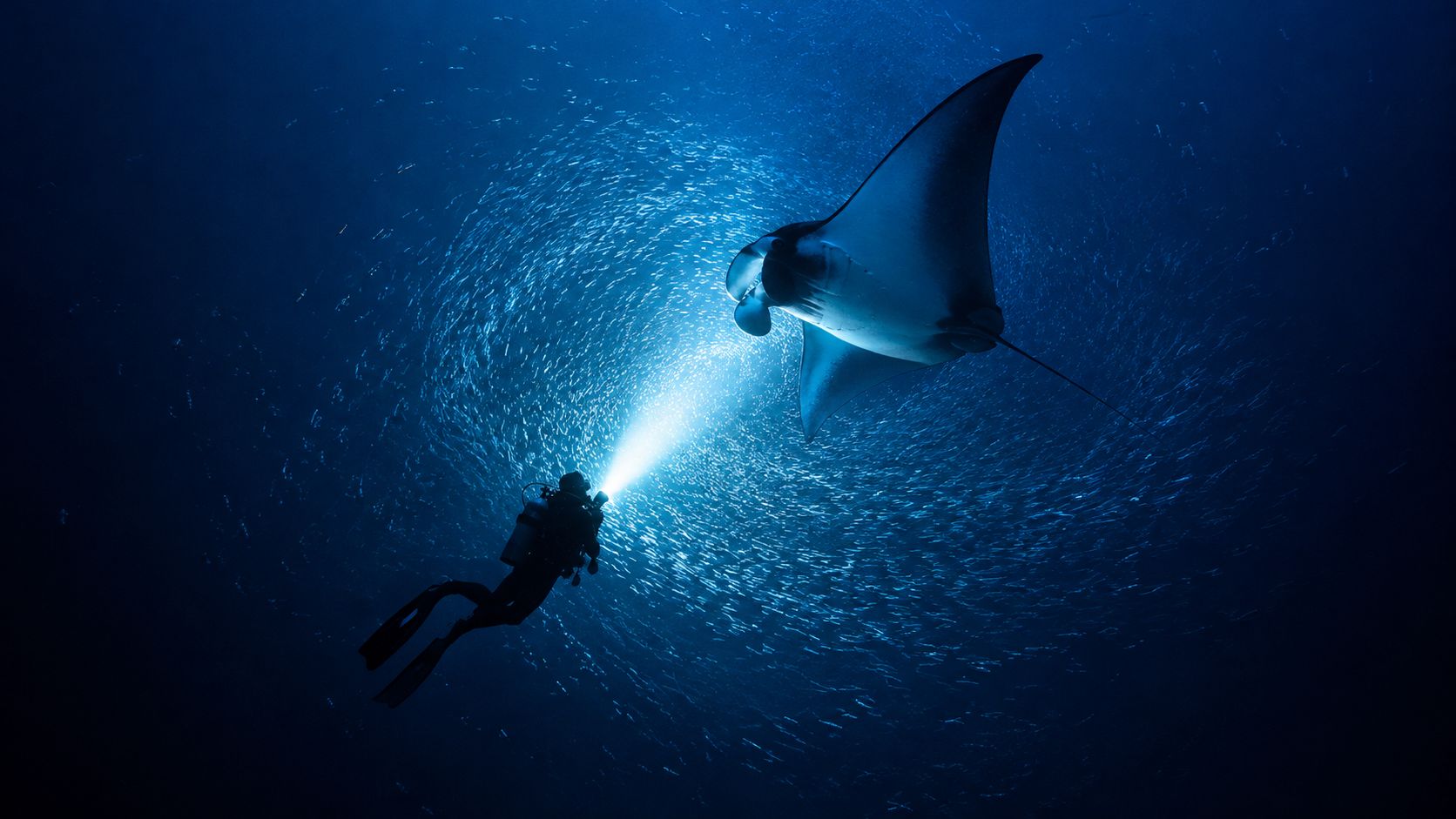
You're standing on a Kona boat after sunset, mask ready, watching the last blue light disappear from the horizon. Below you, darkness replaces the reef, and a cone of underwater light begins to glow. Then a broad shadow rises from the blackness, turns on its side, and glides through the beam close enough for you to see the distinctive pattern beneath its body.
That moment is what draws divers to the Kona manta dive. The experience feels spontaneous, but the encounter depends on a precise relationship between artificial light, plankton, manta behavior, diver positioning, and site management. Choose the right location, listen to the briefing, and stay calm in the water, and the dive becomes far more than a wildlife sighting.
Experience the Magic of the Night Dive
The first few minutes underwater can feel strangely quiet. Your eyes adjust to the darkness while your dive light illuminates only a small patch of water. Around you, other divers settle onto the bottom, equipment close to their bodies, leaving the open water above clear.
The lights create a visible stage in the darkness. Tiny particles drift through the beams, and the surrounding ocean seems to disappear. Then a manta ray enters from outside the light, wings moving with slow, controlled strokes. It rolls through the illuminated water, mouth open as it filters food, then banks away and returns for another pass.
What the encounter feels like
A good manta encounter doesn't require you to chase anything. The diver's job is mostly to become predictable. Once you're neutrally buoyant and settled, the mantas control the distance, direction, and timing of every pass.
Some rays sweep low over the divers. Others loop through the light column, turning their pale undersides toward the surface. Their movements look effortless, but the animals are working continuously to collect plankton from the water.
The experience has a strong contrast built into it. The bottom is still and structured, while the water above is full of motion. Your bubbles rise, lights flicker across the reef, and a large animal emerges gently out of the darkness. That combination makes the dive feel more intimate than a daytime reef tour, even though you remain a passive observer.
The best view isn't created by getting closer. It's created by staying still enough for the manta to choose its own path.
Kona's resident reef mantas are individually recognizable by the dark spot patterns on their undersides. That detail turns each encounter into more than a fleeting glimpse. Researchers and experienced guides can follow familiar animals over time, while divers get a front-row view of a living population that repeatedly uses these feeding locations.
For photographers, the darkness adds both drama and difficulty. Keep your camera settings simple, avoid blocking the light field, and prioritize the animal's path over the shot. You can find practical examples in these Kona manta dive pictures, but no image captures the full sensation of hovering beneath a moving manta in open water.
How the Manta Night Dive Works Ecologically
What you see at a Kona manta site is a feeding setup, not a performance. Kona's manta ray night dive is an artificial-light-mediated feeding interaction. The lights draw zooplankton into a tighter patch of water, and that concentrated food source is what keeps mantas working the same part of the water column, a pattern described in this overview of Hawaii marine life after whale season.
The mechanism is simple once you watch it a few times in the water. Lights go on. Plankton gathers in the beam. Mantas find that denser pocket of prey and start making repeated passes through it.
That does not mean the lights command the animals or pull them in on cue. The rays still choose whether the feeding opportunity is worth their effort on that dive. Some nights the pattern builds quickly. Other nights it stays scattered, because the key driver is still food density.
Why the feeding passes repeat
A manta feeds by moving water through its open mouth and filtering out tiny prey. If one patch of water holds more plankton than the surrounding reef, the animal gets a better return by circling back through that patch instead of ranging widely. That is why you see repeated straight passes, tight turns, and barrel rolls under the lights. These are feeding maneuvers, not trained behaviors.
The biology matters because it explains what divers can ruin without meaning to. Swim into the lane and the manta has to break its line. Raise a camera rig too high and you turn open water into an obstacle. Exhale directly into the approach and you put a stream of bubbles where the animal is trying to feed. Reef mantas keep returning to these prey-rich lanes while filter-feeding, which is one reason a little background on manta rays in Hawaii helps people understand why positioning matters so much.
A good encounter depends on keeping that feeding lane clean.
Artificial light helps organize the show for people, but it only works when plankton is available in the first place. Researchers at the University of Hawaiʻi found that changes in manta numbers at Kona sites tracked with changes in zooplankton density. That is the practical takeaway crews live with every week. A strong night does not make the next one predictable, and no honest operator can promise a fixed number of rays.
The same research looked at 13 years of community-sourced observations from 2010 through 2022, spanning Garden Eel Cove and Keauhou. It documented more than 23,000 sightings representing 167 individually identified manta rays (University of Hawaiʻi research on Kona manta sites). That long record supports what experienced guides already know from the boat and from the bottom. Kona's manta dive works because the sites repeatedly produce a usable feeding situation, not because visitors happen to get lucky.
Once you understand that, the measure of a good operation changes. Close passes are not the whole story. The operator's real job is to build a stable light field, place divers out of the traffic lane, and protect the conditions that let mantas keep feeding naturally.
Essential Diver Behavior and Safety Guidelines
The dive starts going wrong before anyone touches bottom. One diver drops in heavy, another kicks up into the light field, a third chases the first close pass with a camera. The mantas still may show, but the feeding lane gets messy fast. Good crews prevent that by treating diver behavior as part of the encounter, not as an afterthought.
Before you enter the water, listen for exactly where the group will settle, how the lights will be aimed, and what to do if you drift off position. Once underwater, steadiness matters more than athletic ability. Divers should stay on or near the sand, rubble, or boulder bottom so the open water column remains clear for manta movement, as outlined in the West Hawaiʻi wildlife interaction guidelines.
Settle into the correct position
Pick a stable spot on the bottom and get your buoyancy under control before you start watching the animals. Keep your knees, fins, camera, and light tucked in. A diver who hovers high or slides into the middle of the viewing area breaks up the clean approach that makes repeated passes possible.
Light placement matters for the biology of the dive, not just for visibility. Aim your dive light upward into the water column as instructed by the crew. That beam helps concentrate plankton above the group. Snorkelers use a different setup, so divers should not copy it. The job underwater is simple: build the light field, stay low, and leave the center open.
If you lose position, do not fin across the viewing area to get back into the group. Slow down, exhale, regain control, and return to the bottom without crossing in front of a feeding manta.
Let the manta decide the distance
Never touch, chase, grab, ride, or deliberately block a manta's path. Contact can disturb feeding and may remove protective skin mucus, which leaves the animal more exposed to irritation or disease. Chasing does damage too. The manta spends energy avoiding the diver instead of feeding through the plankton concentration created by the lights.
Keep your bubbles out of the animal's path when you can. If a manta is coming straight overhead, time your exhalation and keep your hands, camera, and light down as it passes.
Practical rule: If you need to move toward the manta for a better view, you're already too active.
That rule protects divers as well. A large animal moving through darkness has limited room to adjust around someone who suddenly rises, turns, or reaches up. Staying low and predictable lowers collision risk, protects gear, and gives the whole group a better sightline.
Treat the rules as conservation measures
Viewing rules follow the same principles as responsible, considerate diver etiquette. They protect the conditions that make the encounter work in the first place. Artificial light gathers prey into a small area, which brings people and mantas closer together than they would be during normal reef travel. That is why control matters so much.
Research summarized in a Hawaiʻi County public document describes potential tourism impacts including stress, injury, disease, altered feeding behavior, habituation, and conflicts among human users (Hawaiʻi County manta tourism testimony). A crowded, chaotic dive can feel exciting to guests and still create poor conditions for the animals.
A good manta dive is measured by normal feeding behavior, controlled divers, and a clear viewing zone that keeps working pass after pass.
Choosing the Best Dive Site in Kona
Kona's manta locations aren't interchangeable. The setting affects boat operations, diver positioning, crowd management, and how much open space remains around the feeding animals.
Garden Eel Cove, also called Manta Heaven, is the superior choice for a dive tour when the operator can use it safely. The site lies in Makako Bay offshore from Kona International Airport, giving crews an established viewing area in a more protected setting than an improvised or exposed encounter. During the day, the site is known as Garden Eel Cove. At night, its manta-viewing identity is Manta Heaven.
Keauhou Bay, also called Manta Village, is another recognized viewing area. Manta Point, accessible from a private sandy beach, is the third named area along the Kona coast. Each location can produce a worthwhile encounter, but a protected bay and a defined viewing zone make it easier to keep divers, boats, and feeding mantas organized.
The evidence favors Manta Heaven for consistency
A six-year study recorded 25,444 observations involving 118 individual mantas across two Kona-area sites. Researchers documented 19,841 observations at Manta Heaven in Makako Bay and 5,603 at Manta Village near Kaukalaelae Point (Kona manta ray night dive study summary).
| Site Name | Alternative Name | Observations Recorded | Key Characteristics |
|---|---|---|---|
| Garden Eel Cove | Manta Heaven | 19,841 | Protected Makako Bay setting, established viewing area, stronger recorded site use |
| Keauhou Bay | Manta Village | 5,603 | Important nighttime feeding location, female site fidelity, boat-accessible viewing area |
| Manta Point | No alternative name listed | Not included in the cited comparison | Accessible from a private sandy beach |
The observation difference doesn't mean Manta Village is poor or that every Manta Heaven trip produces the same display. It does show that site use varies substantially, and it supports choosing Garden Eel Cove when the goal is a more controlled dive setting.
Why management affects the experience
Hawaiʻi's Department of Land and Natural Resources reported that approximately 60 to 70 commercial viewing vessels were bringing guests near feeding mantas in the two main West Hawaiʻi viewing zones, Makako Bay and Kaukalaelae Point (DLNR manta viewing management information). Proposed rules included permit limits, passenger caps, assigned shifts, operating hours, vessel lighting, propeller protection or a dedicated lookout, and visible identification markings.
Those details point to a practical truth. The protected location matters, but how the operator manages the location matters just as much. When you compare tours, ask where they expect to go, how they handle crowding, and what happens if conditions make the preferred site unsuitable. More information about the species and Kona viewing areas is available in this guide to manta rays on the Big Island.
What to Expect on Your Dive Tour
A well-run trip starts with a clear briefing rather than a rushed race to the water. The crew should explain the entry, descent, bottom position, light use, separation procedures, and response to changing sea conditions. You should know what to do before the boat reaches the viewing site.
After the boat reaches the location, divers enter with their equipment already checked and descend as a group. The manta portion is quiet and stationary compared with a daytime reef dive. You settle on the bottom, direct your light as instructed, and watch the water above for movement.
The practical sequence
Expect the evening to include:
- Briefing and equipment check: Confirm your regulator, buoyancy system, mask, fins, light, and signals before entering.
- Boat entry: Follow the crew's timing, especially if the sea surface or current changes.
- Controlled descent: Stay with the group and avoid swimming across the viewing zone.
- Bottom viewing: Keep your body and gear low while the mantas feed above.
- Slow exit: Ascend and board only when directed, keeping the entry area clear.
A camera can add value, but it also creates workload. Secure the housing, keep the rig compact, and don't sacrifice buoyancy control for a shot. A photo package such as this Kona manta night dive with photo package can be useful for divers who want to stay focused on the encounter rather than manage every image themselves.
What a sighting guarantee really means
A guarantee generally addresses the presence of manta rays, not the exact number of animals, water clarity, sea state, or personal comfort. The mantas remain wild, and their feeding response changes with plankton density and local conditions.
A tour can have manta activity while still feeling challenging to a nervous diver. Wind, rain, currents, visibility, moonlight, and sea conditions can change the quality of the outing. Winter may bring cooler water and larger swells, while summer often provides calmer conditions. Rain can temporarily reduce visibility, and trade winds can contribute to cancellations.
Ask about relocation and cancellation policies before booking. A responsible operator won't force an exposed entry just to preserve a schedule. In this activity, operational judgment often matters more than an attractive promise.
Why Choose Kona Honu Divers
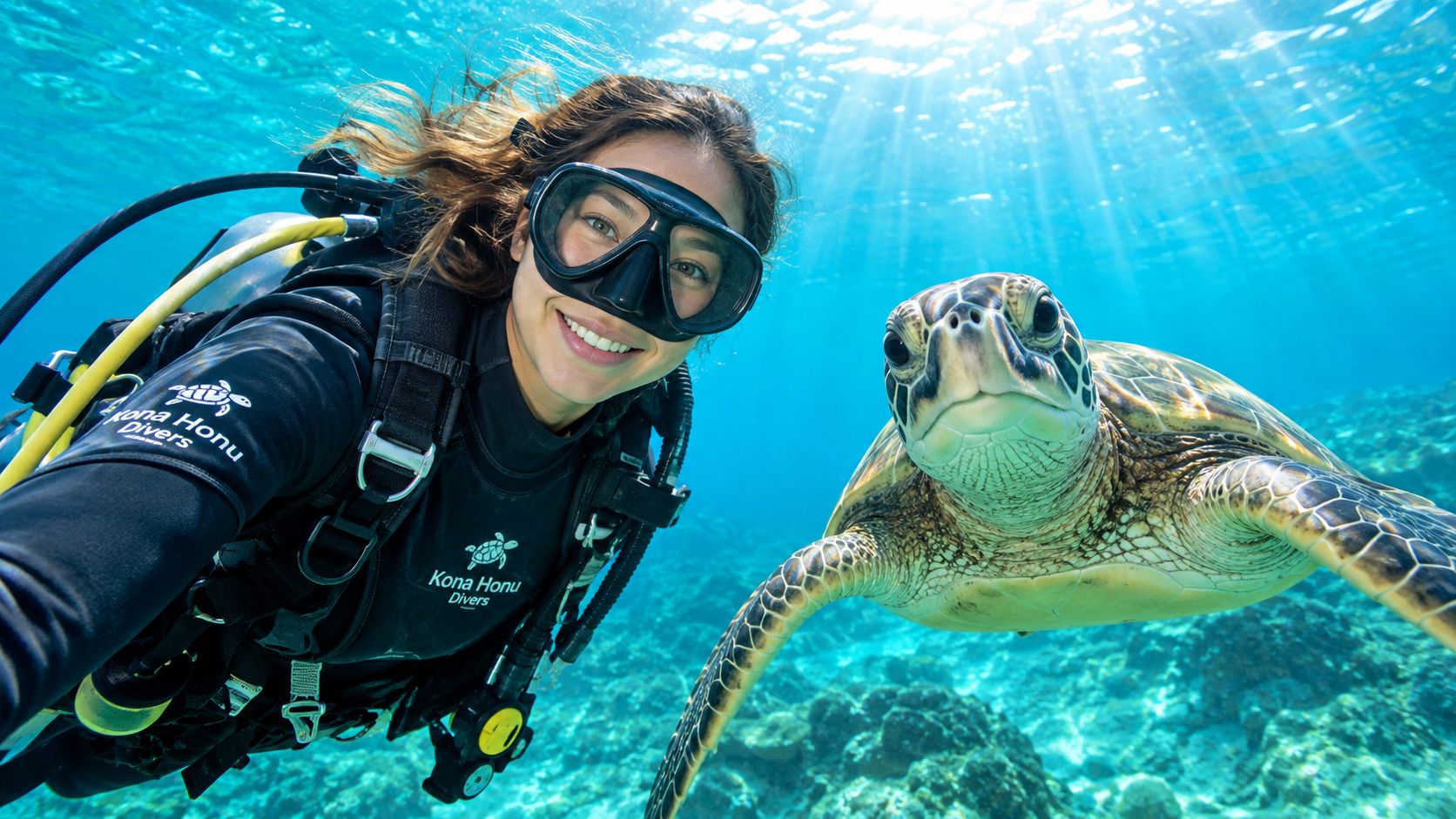
You notice the difference before you roll in. The boat briefing is tighter, lights are assigned with a purpose, and the crew is already thinking about how to keep the feeding lane open once the plankton starts stacking in the beam. That is what matters on a manta dive. The operator does not create the encounter. The operator sets the conditions that let the mantas use the light without interference.
Kona Honu Divers runs a two-tank option that pairs an afternoon reef dive with the night manta dive at Garden Eel Cove, along with certified-diver manta trips and manta snorkel trips. The trip includes a guide, tanks, weights, and a dive light, and the manta portion runs about 45 minutes. For divers, that combination is practical. You get a daylight check on conditions and a better feel for the crew before the night portion begins.
Garden Eel Cove is a strong choice for a simple reason. It gives crews a defined viewing area in a site that is generally more protected and easier to organize well. On a dive built around artificial light and concentrated plankton, small choices in diver placement have outsized effects. A disciplined setup keeps the light column consistent, leaves the center clear, and gives the mantas room to pass and feed instead of veering off a wall of bubbles and scattered beams.
What to evaluate in an operator
Ask about the things that change the dive in the water, not just the booking details:
- Site preference: Does the operator explain when and why it favors Garden Eel Cove?
- Briefing quality: Are diver position, light placement, animal approach, and emergency procedures explained plainly?
- Group control: Do guides keep divers low, still, and out of the feeding path?
- Condition judgment: Will the crew cancel, relocate, or change the plan when the site is not setting up well?
- Educational value: Do guides explain that the lights attract plankton, the plankton draws mantas in to feed, and poor diver behavior can break that chain?
The University of Hawaiʻi study cited earlier also found clear site patterns between Garden Eel Cove and Keauhou, including stronger female site fidelity at Keauhou. That kind of local knowledge matters, but it should not be oversold. No site wins every night, and no guarantee overrides current conditions.
For current trip options, compare the Kona Honu Divers manta ray dive tours. Choose the operator whose crew shows restraint, gives the mantas space to feed, and treats responsible viewing as part of the encounter, not a rule recited on the boat.
Preparation and Certification Requirements
A certified scuba diver should be comfortable managing buoyancy, mask position, regulator breathing, and basic navigation in darkness. The manta dive is often described as accessible, but beginner-friendly doesn't mean risk-free. Night diving removes familiar visual references and adds boat entries, group discipline, and a need to remain stationary near the bottom.
Confirm the certification and experience requirements with the operator before reserving a seat. If you're recently certified, refresh the skills that matter most, especially controlled ascents, low-light communication, and recovering from a minor equipment issue without leaving the group.
Pack for the actual conditions
Bring a swimsuit, towel, dry clothing, and a light jacket for the boat ride back. The crew typically supplies the required dive equipment for the booked trip, but confirm what is included before departure. A compact camera is useful if you can operate it without disturbing your buoyancy or position.
Check your health candidly. If you have a condition that could affect exertion, breathing, cold-water comfort, or night vision, consult a medical professional and disclose relevant information to the dive operator.
Plan for seasickness before boarding
Motion-sensitive guests should plan ahead rather than wait for nausea to start. Options include a Ship-EEZ Seasickness Patch, Dramamine pills, Bonine pills, Sea Band wristbands, and ginger chews. Check product directions, possible drowsiness, medication interactions, and whether a remedy is appropriate for you before using it.
Don't assume calm Kona conditions eliminate motion sickness. Watch the horizon during the ride if that helps, keep your preparation simple, and tell the crew early if you feel unwell. If you need a broader look at available scuba trips, review the Kona diving tours before choosing the format that fits your group.
Final Tips for an Unforgettable Dive
Choose Garden Eel Cove when conditions and operations allow, settle low on the bottom, and let the manta control the encounter. The lights create the feeding opportunity, but your stillness determines whether the interaction remains clear and respectful.
Expect variation. Plankton, weather, currents, visibility, and sea state can change the night, even when the resident mantas remain in the area. A thoughtful crew will protect the animals, communicate openly, and adjust the plan when conditions demand it.
Bring patience into the water. The most memorable pass often happens after the divers stop trying to make it happen.
Kona Honu Divers offers certified-diver manta trips, a two-tank option combining an afternoon reef dive with a nighttime Garden Eel Cove dive, and manta snorkeling choices for mixed groups. Visit Kona Honu Divers to review the available trips and choose a responsible way to experience Kona's night-feeding mantas.