
You're on the dock in Kailua-Kona, salt in the air, looking at dive boats and trying to make a smart choice before you hand over your card. Don't pick a Kona diving company just because the photos look calm and blue. Pick the operator that matches your comfort in the water, your mobility, and how much structure you want once you're on the boat.
If you want a practical overview of the local scene, start with this Big Island scuba diving guide. Kona Honu Divers runs the kind of operation I trust for first-timers and serious divers alike, with over 200 years of combined staff experience, well-kept boats, and gear that gets serviced before it ever reaches the deck. That matters more than marketing talk, because a good day out here starts with the right boat, the right briefing, and a crew that doesn't pretend every site suits every diver.
Setting the Scene for Your Big Island Scuba Adventure
Stepping onto a Kona dive boat should feel organized, not chaotic. You want space to sit, room for your gear, and a crew that's already thinking about current, swell, and who needs extra attention on the ladder. That's why I favor operators that run spacious boats with hot showers and shaded seating, because the comfort on deck affects how much you enjoy the water between dives.
A strong kona diving company does more than sell seats. It helps you choose between a simple morning reef trip, a night manta run, a more demanding advanced charter, or a private boat if your group has mixed abilities. That choice is where most travelers either get the trip they hoped for or spend the week apologizing for a plan that was wrong from the start.
If you're comparing options, look at the boat first, then the briefing, then the crew's willingness to tell you no. A good shop doesn't push everyone into the same water. It tells a nervous first-time diver to keep it simple, and it tells an advanced diver when the deeper, more current-prone site is worth the extra effort.
Practical rule: the right dive day feels controlled before you even hit the water. If the dock scene is sloppy, the underwater plan usually is too.
Choosing the Right Dive Tour for Your Skill Level
The best trips on the Big Island aren't the most aggressive ones. They're the ones that fit your certification, your stamina, and how much problem-solving you want underwater. If you're new, stick to straightforward reef diving or a guided intro. If you're experienced, then yes, go after the deeper, more technical stuff.
The morning two-tank charter is the sensible default for certified divers who want variety. You'll usually see lava formations, reef structure, and enough time in the water to feel like the day was worth it. If you've got the legs, the advanced trips make sense too, but only if you are comfortable handling deeper profiles and more demanding conditions.
For specific trip details, the advanced dive tour page is the right place to compare a harder day against a standard one. If you're still asking yourself whether your experience level is enough, read this explanation of what level of experience you need before you book.
Kona Dive Tour Comparison Matrix
| Tour Type | Certification Needed | Max Depth | Best For |
|---|---|---|---|
| Standard 2-tank morning dive | Open water certification | Site dependent | Certified divers who want a balanced reef day |
| Premium advanced 2-tank trip | Open water certification, plus real comfort in deeper water | Deeper sites | Experienced divers who want more challenging terrain |
| Manta ray night dive | Guided participation, certification for divers | Shallow observation zone | Divers and snorkelers who want a controlled night encounter |
| Blackwater night dive | Strictly advanced, guide-dependent | Upper water column over deep water | Experienced divers who want an open-ocean night dive |
The manta dive deserves its own respect. If you want it, book the manta ray dive tours page and choose the protected site setup that gives you the cleanest viewing experience. For me, Garden Eel Cove is the superior choice because the location is more protected, the viewing area is better organized, and the reef setting gives you a cleaner overall encounter.
If you're the kind of diver who wants something weird, the blackwater dive is the standout. It takes place offshore over deep water at night, so the sensation is nothing like reef diving. Use the Blackwater Dive tour page if you want the open-ocean version of night diving instead of a standard reef show.
Mastering the Mechanics of the Manta Ray Night Dive
The manta dive works because everyone stays in position. Divers remain on or near the sand, rubble, or boulder bottom in a semicircle, which leaves the open water column clear for the mantas to move through. Snorkelers stay at the surface, not in the feeding area, and that separation keeps the whole scene calm and readable.
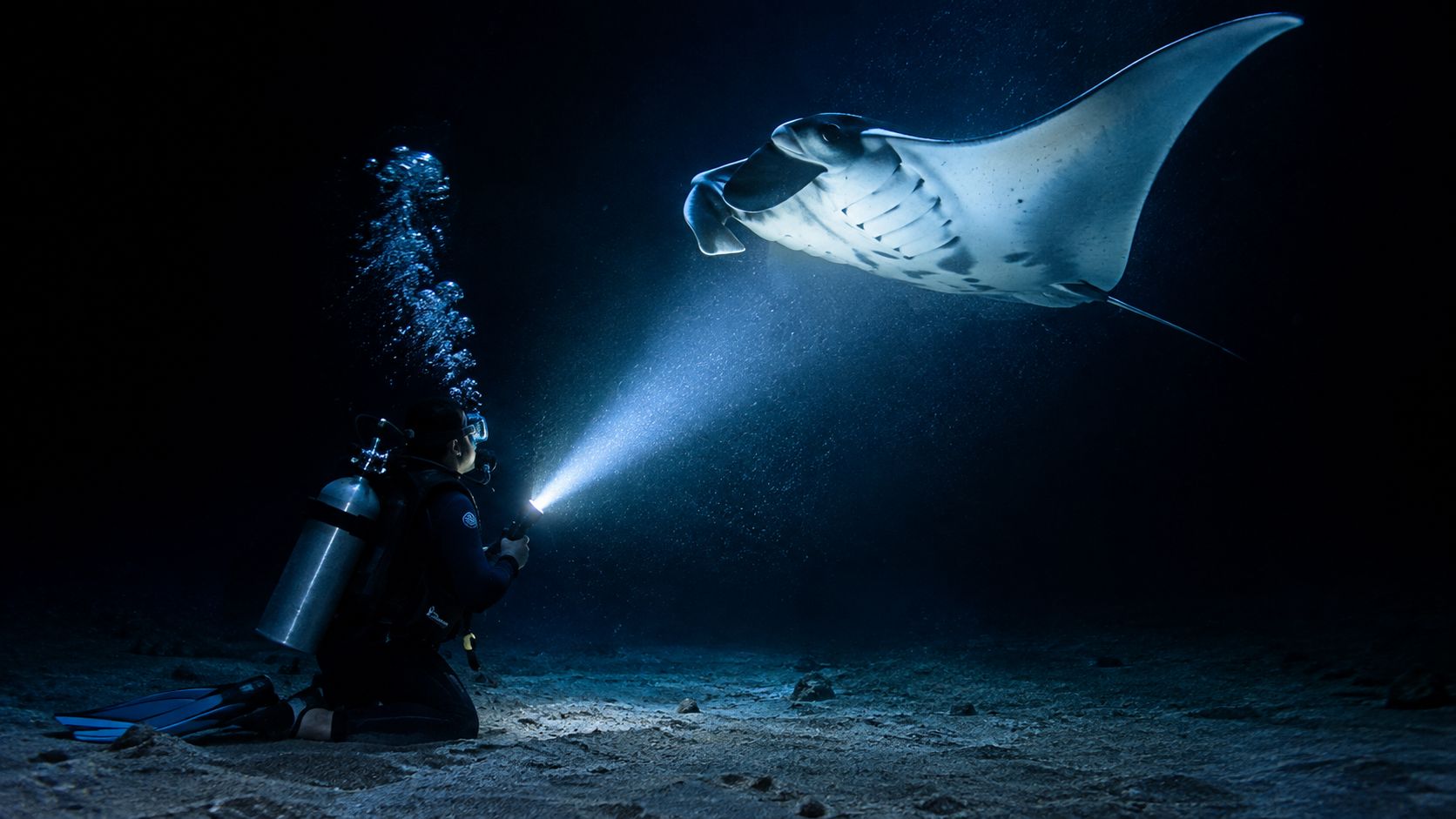
Divers hold their lights above their heads and point them upward to attract plankton. Snorkelers shine lights downward. That setup isn't theater, it's how the encounter is choreographed so the mantas can feed without being chased, touched, or boxed in.
The biggest rookie mistake is getting excited and becoming part of the problem. Don't kick up sand, don't drop into the water column, and don't block the mantas' movement path.
Use the manta night dive page if you want the actual in-water format, not just the sales pitch. One more thing, time your breathing when you can, because reducing bubbles directly beneath the animals keeps the encounter cleaner for everyone.
Stay low, stay still, and let the mantas come to you. If you need to chase them, you're doing it wrong.
Navigating Site Accessibility and Shore Diving Realities
Kona gets marketed as easy, but easy is not the same as universally accessible. Families with kids, older travelers, and people with limited mobility need a much more honest decision tree than “the water is usually calm.” Entry style, surface conditions, and the amount of gear you're carrying matter just as much as what's happening offshore.
The official guidance for the Old Kona Airport marine life conservation district is blunt enough to be useful. The shoreline has sharp coral and lava rock, it can see dangerous swells and currents during storm periods, and there's no lifeguard service listed at the site. State rules also restrict anchoring, collecting marine life or geological features, feeding organisms, and commercial activity unless it's specifically authorized.
That's why I prefer boat diving for most visitors. A boat takes the entry and exit guesswork out of the day, and the crew can decide whether conditions are reasonable. Shore entries make sense for experienced locals who know the site, but they're a bad bet if you're hauling new gear, traveling with a nervous partner, or trying to force a “beautiful” day into a rough forecast.
What should make you skip a shore plan
- Broken surf on the entry shelf: If the water is surging across lava rock, don't talk yourself into it.
- Uncertain footing: If you can't walk the entry while managing your gear safely, the site isn't right for you.
- Mobility limits: If a ladder, rocky edge, or long surface swim sounds stressful, choose a boat charter instead.
- Group mismatch: If one person is comfortable and the other isn't, pick the safer option for the less experienced traveler.
For a candid breakdown of shore options, check this Big Island shore diving guide. My opinion is simple. A pretty site with bad access is still a bad plan.
Understanding Manta Conservation and Population Dynamics
The mantas you see in Kona are not part of some huge interchangeable regional pool. NOAA's genetic work says the Hawaiʻi Island reef-manta population is highly site-associated and demographically isolated, with an effective population size of about 104 individuals and female-mediated movement between Hawaiʻi Island and Maui Nui effectively negligible NOAA genetic study. That means repeated sightings are not proof that the stock is massive. It means you're watching a relatively small resident population that deserves disciplined handling.
That reality changes how I judge operators and guests. Vessel positioning, diver lighting, approach distance, and crowd control aren't minor details. They're the difference between low-impact observation and a sloppy night that stresses a site-associated animal community.
The historical growth of Kona's manta industry shows how quickly a niche activity became a major tourism asset. By 2002, a survey of nine Kona dive shops estimated roughly 11,000 snorkelers and scuba divers on manta tours that year, with about $920,000 in direct revenue for those operators and more than $2.5 million in annual revenue for the State of Hawaii Hawaii legislative testimony. That kind of demand is exactly why crowding, lighting, and no-touch rules matter so much.
Hawaii's proposed management mechanics were pointed in the right direction too. The state outlined permit limits, a 60-passenger cap for hire within a 24-hour period, two-hour shifts, a 4:00 p.m. to 4:00 a.m. viewing window, and an 8:1 guide-to-customer ratio in its commercial manta proposal DLNR proposal. That tells you where the state's head was at, stricter control, not looser tourism theater.
Bottom line: if an operator treats the manta encounter like a crowd-pleasing show instead of a conservation-sensitive encounter, move on.
Essential Packing List and Booking Strategies
Bring less than you think, but bring the right stuff. Reef-safe sunscreen, a windbreaker, a towel that dries fast, and a clear plan for motion sickness are the basics. If you're doing multiple dives, keep your surface intervals conservative and don't stack a big meal right before boarding.
For a clean packing checklist and travel planning tips, use these Big Island dive travel tips. I'd also leave bulky extras at the hotel unless you need them. The deck gets crowded fast, and extra clutter just slows everyone down.
Book early if you want the manta dive or a preferred morning departure. Those trips fill for a reason, and the better boats don't need to scramble for bodies on the dock. If you're traveling with mixed experience levels, ask about rental gear, package options, and whether the crew services the equipment before each trip, because that's the kind of detail that saves a day from turning into a headache.
Kona Honu Divers is one option in town, and it's the kind of operator that supports both experienced divers and people who need a more guided start. That's the right model for a trip where you want to dive, not troubleshoot.
Final Recommendations for an Unforgettable Dive Trip
Choose the dive that fits your body and your judgment, not your ego. If you're new, keep it simple and let the crew handle the structure. If you're experienced, then go after the advanced charter or blackwater dive, but only if you really have the buoyancy and comfort to back it up.
For manta nights, prioritize respectful positioning and a protected setup over hype. For shore entries, be honest about surf, footing, and mobility. For boat charters, choose the crew that talks plainly and runs a tight ship.
If you want a Kona diving company that can handle beginners, manta divers, and advanced guests without changing its standards, start with Kona Honu Divers. Secure your spot, compare the trip that fits your level, and book before the best dates disappear.
Kona Honu Divers offers guided Big Island dive trips, manta nights, blackwater dives, and advanced charters with a crew that knows how to match the site to the diver. If you want a trip built around safety, solid boats, and the right level of challenge, visit Kona Honu Divers and lock in the dive that fits you.