
The boat has cleared the harbor after sunset, and the water beyond the deck lights is nearly black. A crew member lowers bright lights into the ocean; plankton gathers in their beams, and everyone waits for the animals to find the food. If you're planning a Hawaii night manta ray dive, that quiet pause is part of the experience. The mantas aren't summoned on a schedule, and the best encounters happen when people hold their positions and let the animals choose their path.
Table of Contents
What the Hawaii Night Manta Ray Dive Feels Like
How the Night Feeding Dive Actually Works
Why Garden Eel Cove Is the Stronger Site
Safety Checks Before You Book a Manta Dive
What to Expect on a Kona Honu Divers Trip
Photos, Ethics, and Nights Without a Guarantee
Your Next Step and Questions People Still Ask
What the Hawaii Night Manta Ray Dive Feels Like
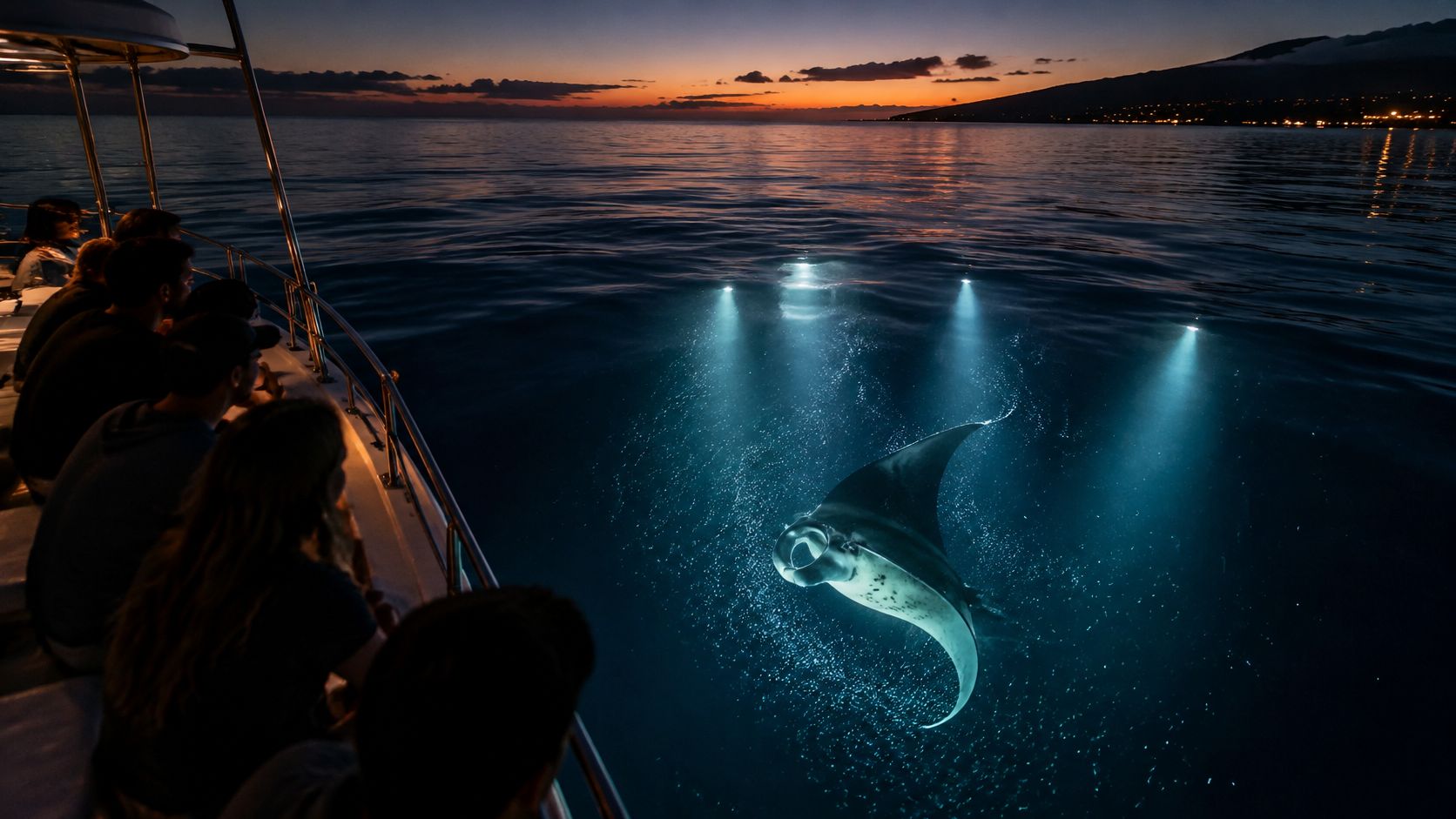
What the Hawaii Night Manta Ray Dive Feels Like
At the viewing site, divers and snorkelers have different vantage points on the same feeding area. Certified divers settle on the seafloor with a guide; snorkelers watch from the surface. Between them, illuminated water gives reef manta rays (Mobula alfredi) room to feed.
A manta may emerge from the dark, turn through the light, and pass overhead. Sometimes the pass is close; sometimes it stays farther away. The best view comes from holding the position the crew assigns, not following the animal. Chasing a manta disrupts its path and makes the encounter less safe.
Who the night suits
The scuba option suits certified recreational divers who can control their buoyancy in low light and stay settled at the viewing area. If you are certified but out of practice, tell the crew about your recent experience and comfort level before boarding. Steady positioning matters more than depth.
The snorkel option lets families and groups with different certification levels watch from the surface. Photographers can join either format, though both require patience from a fixed position. A memorable close pass is possible, but a distant view or no manta sighting can happen too.
Kona's established sites are feeding areas, which helps explain why the island is known for night encounters. Sightings are frequent, not guaranteed. Compare the Kona scuba diving lineup and review photos from Kona manta ray dives to understand the lighting and viewing positions before choosing a trip.
Set expectations around the conditions, not a promised show. Ask how many boats may share the site, what the crew does if the water is crowded, and how the operator handles a night with no manta sighting. Those answers help you judge whether the setup suits your group and what to expect if the animals do not arrive.
How the Night Feeding Dive Actually Works
The manta dive is a managed feeding site. The crew places strong lights near a known feeding area. Zooplankton gathers in the illuminated water, and manta rays move into the beam to filter-feed. The lights make plankton easier to see and concentrate, but they don't guarantee that mantas will arrive.
Kona's steep volcanic coastline helps make this kind of operation possible close to shore. Deep water and plankton-rich habitat sit near the areas where boats can set up established viewing stations. That proximity gives crews a practical way to position lights where feeding encounters have been observed.
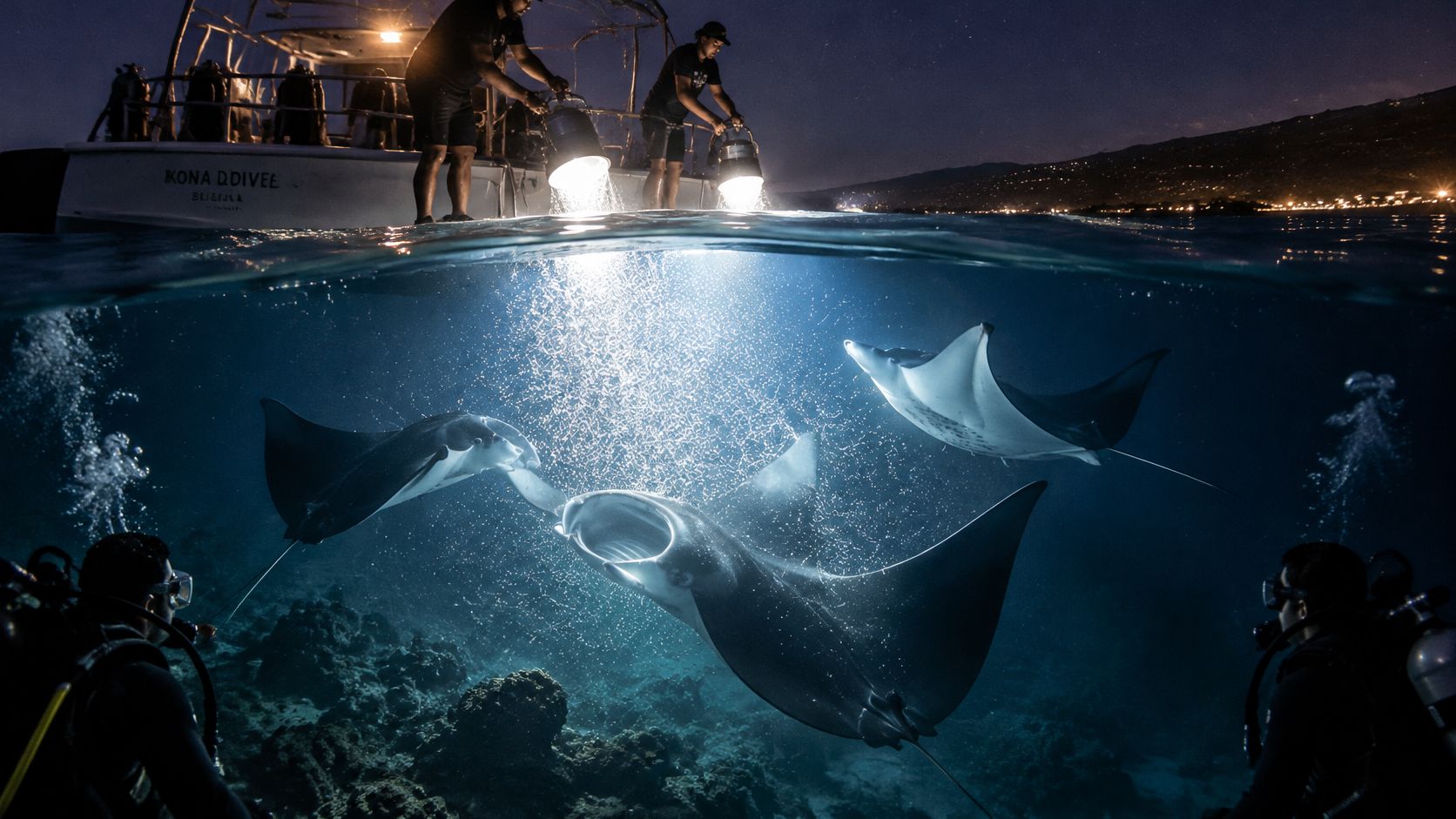
Your position is part of the setup
Divers generally sit on the seafloor, often on sand or rubble, while snorkelers remain at the surface. This keeps a viewing corridor open between the groups. If a diver rises into the water column or a snorkeler dives down through it, that corridor gets harder for the mantas to use and raises the chance of a collision.
Settle into the position your guide assigns. Keep your buoyancy controlled, your body low and stable, and your fins quiet. Avoid sudden vertical movement, and don't touch coral or other marine life while getting comfortable.
Practical rule: Stay still and let the manta choose the line.
That approach protects the animal and helps preserve the feeding pattern. Don't touch, chase, block, or deliberately intercept a manta. The skill that matters most isn't depth. It's staying aware of your position, other guests, and the feeding area in low light.
If you haven't dived at night before, review the basics of scuba diving at night and pay attention to the operator's briefing. A fixed viewing spot can sound easy, but divers still need to manage equipment, buoyancy, light, and awareness around other people.
Why Garden Eel Cove Is the Stronger Site
Why Garden Eel Cove Is the Stronger Site
Garden Eel Cove and Keauhou are Kona's two scientifically studied nighttime manta feeding sites. Garden Eel Cove, also called Manta Heaven or Makako Bay, lies off North Kona near Kona International Airport. Keauhou is a separate site near Keauhou Bay.
For divers who want a defined place to settle, Garden Eel Cove has practical advantages. Its more protected setting and nearby reef structure provide a sheltered viewing area where divers can remain stationary as lights attract plankton and mantas. That setup suits a fixed-position dive, though it does not guarantee a sighting or an uncrowded site.
A University of Hawaiʻi research analysis compiled community-sourced observations from 2010 through 2022, including more than 23,000 sightings involving 167 identified reef manta rays across the two locations. Garden Eel Cove consistently had larger observed aggregations. Across both sites, researchers found an approximately balanced 1:1 male-to-female ratio. Keauhou, by contrast, had predominantly female visitation, with females showing strong site fidelity there and males appearing to move more widely between locations.
Garden Eel Cove and Keauhou at a Glance
| Site | Setting | What the record shows | Best fit |
|---|---|---|---|
| Garden Eel Cove | More protected viewing area off North Kona, with nearby reef structure | Consistently larger observed aggregations | Divers prioritizing a defined, stable viewing position |
| Keauhou | Separate feeding site near Keauhou Bay | Predominantly female visitation and strong female site fidelity | Travelers choosing the southern site for other practical reasons |
Manta numbers at both sites tracked zooplankton density, so food availability helps determine how many animals show up. Researchers also found generally stable aggregations despite increased tourism. That finding describes patterns across the record, not the conditions on any particular night. Mantas follow prey, not a schedule.
Before booking Garden Eel Cove, ask how the operator handles crowding and what happens if mantas do not appear. Confirm whether the boat limits group size, how guests are positioned, and whether the trip has a rescheduling or refund policy for no-sighting nights. A well-managed site can improve the viewing conditions, but it cannot control wildlife or guarantee an encounter.
Safety Checks Before You Book a Manta Dive
Start by choosing the right position for your experience. Scuba divers need to be certified and able to hold buoyancy while remaining settled at the viewing area. If you're certified but uncomfortable at night, uncertain about your control, or not ready to manage low-light conditions around a group, ask whether the snorkel option makes more sense. Non-certified guests belong at the surface, not on the seafloor.
The bigger booking question is how the operator manages the group. A strong manta encounter can still be a poor trip if guests can't hold position, boats crowd the area, or the crew lets people disrupt the feeding corridor.
Ask before paying
- Group size and supervision: What's the maximum group size, and what is the guide-to-guest ratio?
- Separation: How will divers remain on the bottom and snorkelers at the surface, without crossing through the feeding zone?
- Light placement: Does the crew place lights only on sand or rubble rather than live coral? NOAA-hosted viewing guidance recommends keeping lights off live coral (NOAA viewing guidance).
- Photographers: How does the crew prevent videographers from redirecting mantas away from the viewing circle?
- Congestion: What happens if boats stack up or guests can't maintain their positions?
- Emergencies: What's the response plan if a diver or snorkeler needs help during the encounter?
Crowding isn't only uncomfortable. Congestion can create collision, entanglement, and loss-of-control hazards, while hull lighting may draw mantas toward boat hardware. These are practical reasons to ask how the crew responds when the site becomes overloaded, rather than assuming that a trip will remain orderly because it has a briefing.
Passive viewing is the rule
Hawaiʻi law prohibits intentionally or knowingly capturing or entangling a shark or ray and prohibits killing a ray in state waters. The cited provisions are Hawaiʻi Revised Statutes §§188-39.5 and 188-40.8; the cited source also reports that rays have no open season (Hawaiʻi manta protection and rules). Lights are for viewing. Don't pursue, restrain, touch, collect, or intercept a manta.
A concise answer from an operator is more useful than a polished promise. If the crew can explain how they manage guest spacing, light placement, and congestion, you'll have a clearer basis for deciding whether the trip fits your comfort level.
What to Expect on a Kona Honu Divers Trip
What to Expect on a Kona Honu Divers Trip
The trip follows a set routine, from shore check-in to the ride back. At Garden Eel Cove, Kona Honu Divers uses a format with divers seated underwater and snorkelers floating at the surface. Before anyone enters the water, the crew briefs guests on buoyancy, light placement, and the viewing setup. Follow the crew's directions so guests stay in position and leave the feeding area clear.
From check-in to the ride back
At shore check-in, leave time to get organized and confirm your equipment and trip details. The crew prepares the boat and dive gear for the evening. During the ride out, listen to the site briefing and the plan for entering and viewing the water.
At the site, the crew explains where divers and snorkelers should position themselves and how the lights will be arranged. Divers descend with their guide and settle in the assigned area, while snorkelers remain at the surface. Once everyone is in place, the crew allows the feeding site to develop. Mantas may arrive quickly, show up later, pass briefly, or not appear during the viewing period. The trip provides an opportunity to observe them, not a guaranteed encounter.
Afterward, the group returns to the boat for the ride back. Bring a towel and a warm layer, since time in the water at night can leave you chilled. If you're concerned about feeling unwell on the boat, review the operator's advice for avoiding seasickness and ask what preparation may suit you.
Before booking, check the tour details and ask about group management and the operator's terms if no mantas appear. Kona Honu Divers also runs a blackwater night dive and a premium advanced long-range trip. Both are separate outings with different formats, not alternatives that include the manta encounter.
Photos, Ethics, and Nights Without a Guarantee
A camera can make the encounter memorable, but it shouldn't change how you move through the site. Take photos from the position the crew assigns, whether that's the bottom or the surface. Use the crew's lights to support the viewing setup instead of pursuing a manta with a video light, and keep strobes modest so you don't disrupt the feeding pattern.
A sharp silhouette of a manta passing overhead is a better result than a blurry image made while trying to follow it. Keep your equipment close and avoid reaching into the water column. The same passive approach applies whether you're taking pictures or watching.
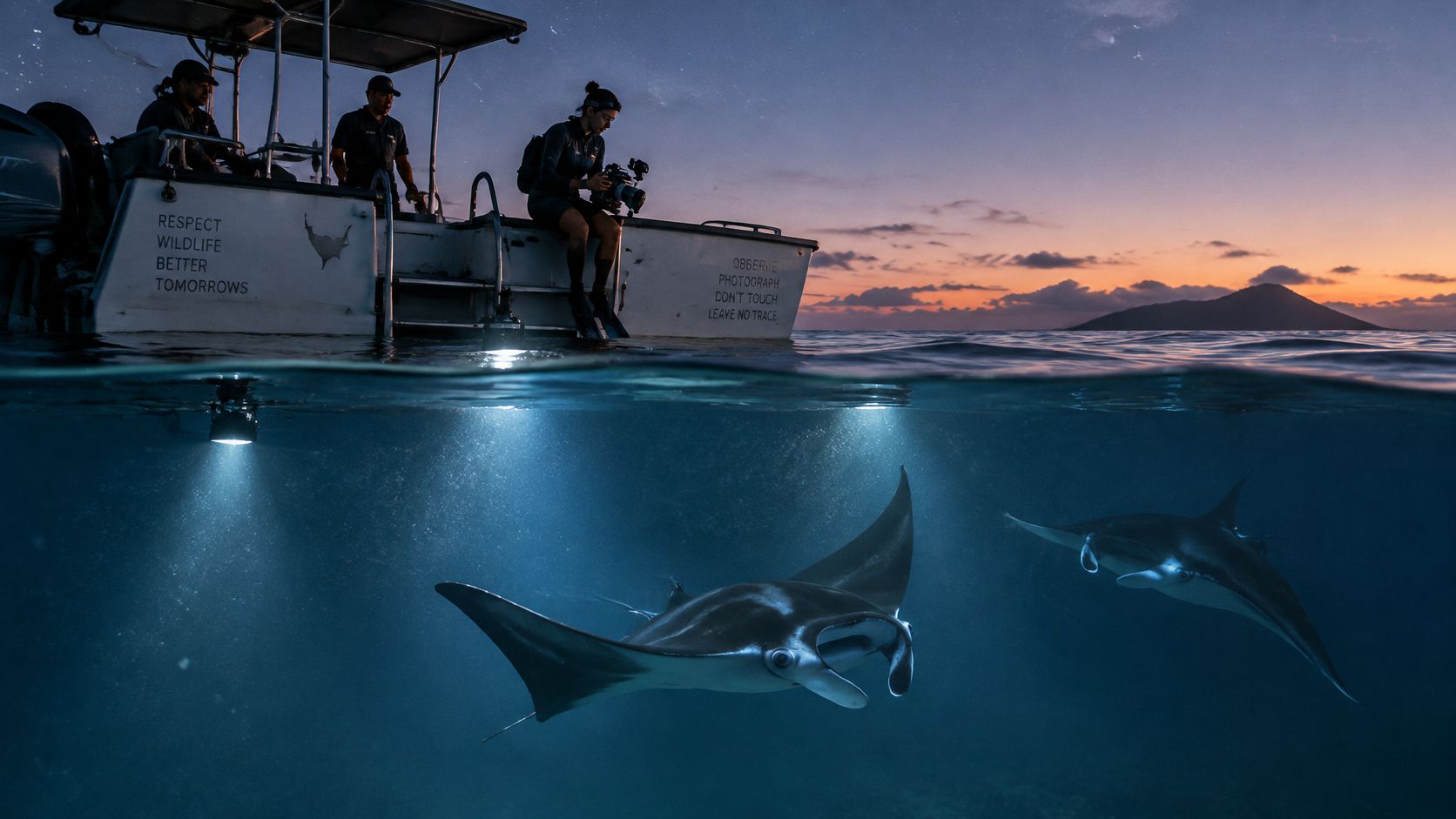
A wildlife encounter, not a staged show
The tradition has a conservation history. Nighttime manta observations began being documented off Hawaiʻi Island in 1985. Historical identification work associated with the Kona manta project cataloged more than 300 individual rays and recorded over 10,000 sightings; a tracking expedition expanded the research in 2002, and laser-based measurement methods were adopted in 2008 to support growth studies (background on Kona manta research and history). Manta rays were listed as vulnerable by the International Union for Conservation of Nature in 2005, and Hawaiʻi enacted legal protection in 2009.
That history makes the central ethic clear: observe, don't manipulate. A responsible crew shouldn't herd animals, redirect them for a better photo, or extend operations to manufacture a count.
Nor should a booking page promise a sighting. Independent guidance says manta sightings aren't guaranteed and recommends checking weather policies, cancellation terms, participant requirements, and no-sighting policies before paying (guidance on ethical wildlife encounters). Plankton concentration, light direction, available sand or rubble, diver positioning, and guest behavior can all affect the encounter.
Ask how the operator handles deteriorating conditions after departure, whether you can reschedule, how refunds or credits work, and whether a substitute dive is offered. Also ask how they distinguish a night with no manta from one with a brief or distant pass. Those outcomes aren't the same, and a clear policy should say what happens in each case.
For a practical reminder of how to keep your behavior considerate underwater, review this guide to responsible diver etiquette.
Your Next Step and Questions People Still Ask
Choose the site and trip setup that fit your group, then confirm the practical details before booking. At Garden Eel Cove, ask about group size, guide ratio, light placement, and what happens if mantas do not appear. If someone in your party prefers to stay at the surface, compare the manta ray snorkeling option.
Questions to settle before the trip
I'm certified but rusty. Should I dive or snorkel? Scuba requires you to manage your equipment in low light and stay controlled in the assigned viewing area. If you doubt you can do that comfortably, ask the operator about alternatives. Snorkeling keeps you off the seafloor, but you still need to follow the crew's directions in the water.
Can I pair the manta night with a separate advanced or blackwater trip? Possibly. These are distinct dives, not substitutes for the manta encounter, and the schedule, conditions, and your experience all matter. Ask the operator whether the timing and workload are a good fit. As noted earlier, a reservation cannot guarantee a manta sighting.
What can help with seasickness on the boat? Some guests consider Ship-EEZ patches, Dramamine pills, Bonine pills, Sea-Band wristbands, or ginger chews. Follow product directions and ask a medical professional or pharmacist what is appropriate, especially if you take other medication.
How early should I reserve during a holiday week? Check availability and cancellation terms once your dates are set. Booking can hold your place, but it cannot control conditions or animal activity.
Ask how the operator handles weather changes, cancellations, and a night with no manta sightings. Clarify what happens if a manta makes only a brief or distant pass, too. Those outcomes can differ, so get the policy before paying.
Kona Honu Divers offers a guided manta night dive at Garden Eel Cove, along with other Kona scuba experiences. Review the trip details and policies before you plan your night on the water.