
Table of Contents
- Key facts about the Kona manta ray night snorkel
- Kona manta viewing sites compared
- Choose conditions before calendar theories
- From check-in to the viewing position
- Let the encounter stay unpredictable
- Decide honestly before paying
- Pack for entry and the ride back
- Legal protection isn't proof of zero impact
- Judge management, not just manners
- Prioritize supervision and usable space
- Read the less glamorous details
- Compare the complete booking
- Quick answers before you commit
You've found an evening in your Kona itinerary, and the manta photos look extraordinary. The harder question is whether everyone in your group will feel comfortable floating in dark ocean water, sharing a viewing area, and climbing back onto a boat afterward. A Big Island manta ray night snorkel can be a remarkable wildlife encounter, but the best booking decision starts with those practical details, not the closest-looking photograph.
Manta Ray Night Snorkel at a Glance
A Big Island manta ray night snorkel is a guided, after-dark float at the surface, where reef manta rays (Mobula alfredi) feed on zooplankton in an illuminated patch of water. You're watching a feeding opportunity, not an animal performance. The mantas decide whether to arrive, how to approach, and when to leave.
The mechanism is straightforward: underwater lights concentrate plankton, and that concentrated food attracts mantas. Snorkelers look down into the illuminated water as rays make feeding passes beneath them. Divers occupy a separate viewing position near the bottom.
Kona's established viewing areas support repeated encounters with individually recognizable animals. That predictability makes a guided outing practical, but it doesn't turn wildlife into a scheduled attraction.
Key facts about the Kona manta ray night snorkel
| Detail | What to Know |
|---|---|
| What you see | Reef manta rays (Mobula alfredi) feeding on plankton in a lit patch of water |
| Wingspan | Giant mantas on the night dive can have wingspans well over 12 feet |
| Certification | Not required to snorkel; certified divers can choose the dive version |
| Where you float | At the surface, with your light pointed downward |
| Group setting | Guided, with crew in the water to manage the group; confirm the operator's guest cap |
| Timing | After dark on scheduled nights; confirm the start time with the operator |
| Main sites | Garden Eel Cove and the Keauhou area, both established viewing sites |
| Animals | Individually recognizable reef mantas, many returning to the same sites |
The important distinction is snorkeling versus swimming around. Your job isn't to search the reef or follow a departing ray. It's to remain in the assigned viewing position and let the animals use the feeding space.
This suits families whose members meet the swimming requirements, curious non-divers, and travelers who prefer watching from the surface. Certified divers can choose the underwater version instead, but certification alone doesn't establish comfort with nighttime conditions. Choose the perspective that matches your actual water skills, not the photograph you hope to bring home.
Where and When to Go on the Kona Coast
Garden Eel Cove is my first choice for a structured manta tour, particularly for the dive version. Its protected setting, defined viewing area, and surrounding reef give the group a sensible place to settle. Protection is an advantage, not a promise of flat water.
The Underwater Atlas Garden Eel Cove guide describes a gently sloping sandy plain with scattered coral heads and lava-rock formations, and notes that as many as 10 boats and approximately 80 divers and snorkelers may share the small site. A well-organized group matters here more than a spacious boat alone.
A University of Hawaiʻi study covering 2010 through 2022 found larger manta aggregations at Garden Eel Cove, while Keauhou was visited predominantly by females. It also linked annual and seasonal changes in aggregation size to zooplankton density. Neither result guarantees a better encounter on your particular evening.
Kona manta viewing sites compared
| Site | Character | What the Research Shows | Best For |
|---|---|---|---|
| Garden Eel Cove | Protected sandy plain with coral heads and lava rock; defined viewing area | Supported larger aggregations in the study described above | Structured tours and first-timers who meet the swimming requirements |
| Keauhou, including Manta Village | Established viewing area near Keauhou Bay | Visited predominantly by females in the same study | Visitors staying toward the south side, subject to departure location |
| Makako Bay | Bay associated with the Garden Eel Cove viewing area, not a separate third destination to assume you can book | Named alongside Keauhou as a nighttime feeding location | Visitors comparing site names across tour descriptions |
The naming deserves attention. Published manta-feeding research identifies Keauhou and Makako Bays as nighttime locations where mantas feed on zooplankton attracted by underwater lights. When comparing departures, get the actual viewing location rather than treating every advertised name as a different reef.
Choose conditions before calendar theories
A departure near dusk can offer daylight for orientation before nighttime viewing begins. It isn't evidence that more mantas will appear than on a later trip. Use this guide to the best time to see mantas in Kona to help plan your evening, then confirm the actual schedule.
Check wind and swell with the operator the day before. A smaller guest group may give you more personal space at its float, but it can't guarantee an uncrowded shared site.
Site-selection rule: A protected location helps. A crew willing to change plans when conditions deteriorate matters more.
What Happens During the Night Snorkel
The sequence below is a practical outline, not a promise that every departure follows an identical timetable. Gear fitting, briefing location, entry method, and the order of operations can change with the boat and conditions.
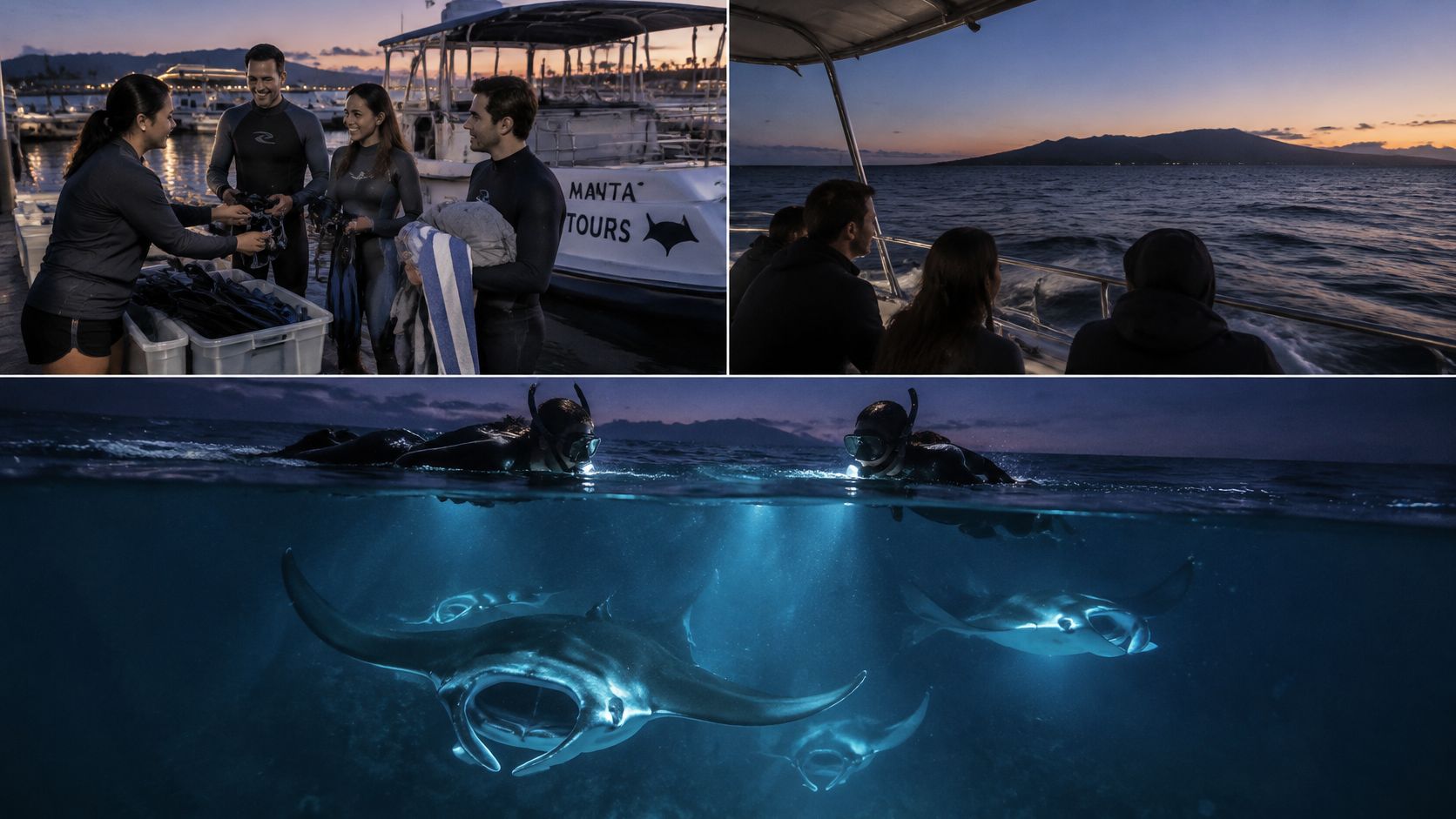
From check-in to the viewing position
Check in and fit your gear. For a dusk departure, arrive at the stated meeting time with your swimsuit on and a towel and warm layer packed. Check that your mask seals without overtightening it; discovering a poor fit after entry makes an unfamiliar setting harder to manage.
Listen to the full briefing. Our manta night-dive process starts with a detailed crew briefing covering the science behind the encounter and the golden rules of passive observation. Don't spend this time adjusting a camera, because entry signals, exit procedures, and group positioning deserve your attention.
Travel to the site and learn the boat procedures. The ride may begin in daylight and finish after dark, depending on the departure. Identify the entry point, ladder, flotation arrangement, and way to request help before the crew starts putting guests in the water.
Wait while the crew establishes the viewing setup. Lights illuminate the feeding area, but the biological response isn't instantaneous or on command. Enter only when directed rather than rushing toward a light because someone thinks they've seen a manta.
Settle into your assigned place. Once positioned, use slow, deliberate movements and keep your equipment close. A common mistake is kicking toward a ray for a better view, which can disrupt both neighboring swimmers and the animal's approach.
Leave the water on the crew's call. Approach the ladder as instructed, keep clear of the person climbing ahead, and use the handholds rather than trying to pull yourself up with loose equipment. Accept offered assistance, but don't book on the assumption that the crew can lift you aboard.
Dry off and check your belongings. Put on your warm layer once you're securely back aboard, then account for your mask, phone, and other equipment. Don't let reviewing footage distract you while other guests are still exiting.
Let the encounter stay unpredictable
A quiet evening can still give you a complete guided night-ocean outing, but it may not deliver the wildlife encounter you hoped for. That's a real disappointment worth acknowledging, not something an operator should explain away.
If photographs matter, compare the manta night-dive photo-package information before deciding to manage your own camera. Your first priority should be maintaining position and following instructions, especially if nighttime snorkeling is new to you.
Who Should Book and What to Bring
Can you tread water without panicking, swim continuously in open water, and recover when a splash interrupts your breathing? Can you clear your mask and snorkel, hold a surface position in darkness, and climb a boat ladder when you're tired? Those questions matter more than enthusiasm or age alone.
A published Kona tour listing on Tripadvisor excludes non-swimmers, requires experienced snorkeling skills, and allows guests to be removed from the water when swimming ability or conditions create a safety risk. Its flotation restrictions also illustrate why you shouldn't assume every operator permits life jackets or uses the same support system.
Decide honestly before paying
Pool snorkeling doesn't test your response to swell, current, darkness, or another guest bumping your mask. A flotation device can support a swimmer, but it doesn't replace the ability to remain calm and respond to instructions.
If several self-assessment answers are no, postpone the water portion or investigate a viewing-only boat option where one is explicitly offered. Deck visibility isn't equivalent to snorkeling, so confirm what that alternative includes. Older travelers, children, and anxious swimmers deserve an individual assessment rather than a blanket yes or no.
Practical check: If you need a raft to prevent panic rather than to maintain a comfortable viewing position, this isn't the right setting to learn snorkeling.
For certified divers deciding between perspectives, consider whether snorkeling or diving with mantas fits your comfort level. Choose the format in which you can manage your equipment without becoming distracted.
Pack for entry and the ride back
- Swimsuit: Wear it under your clothes to simplify changing.
- Rash guard or wetsuit: Confirm what thermal protection is supplied and what fits.
- Mask and snorkel: Bring your own only if needed or preferred, and check their condition beforehand.
- Sunscreen: If boarding before sunset, apply a reef-conscious product beforehand and follow its label.
- Towel: Keep it dry until you're back aboard.
- Warm layer: Pack something easy to put on over damp skin.
- Dry bag: Protect your phone, wallet, and spare clothing.
- Dock footwear: Use secure water shoes or other footwear permitted aboard.
- Afterward snack: Bring something simple if food isn't included.
Don't pack as though every advertised amenity is standard. Written inclusion lists are more useful than photographs of another departure.
Safety and Respecting the Manta Rays
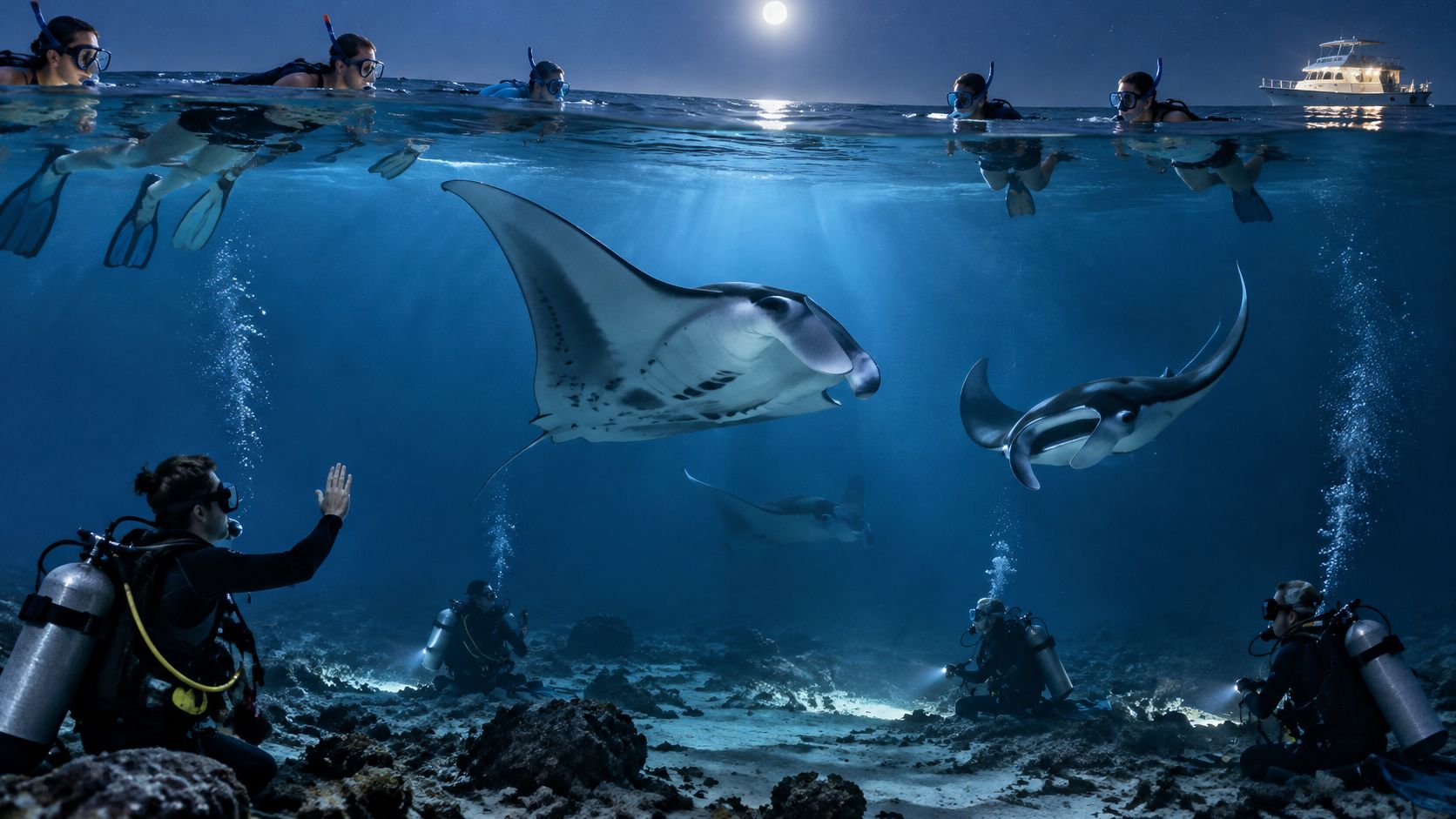
Snorkelers stay at the surface; divers stay near the bottom. The central water column belongs to the feeding mantas, not to guests trying to improve their camera angle. That separation is the foundation of an orderly encounter.
The Kona manta-viewing guidelines archived by NOAA specify passive observation, opposite light directions for snorkelers and divers, and no touching, chasing, grabbing, or riding. They also explain that contact can remove a manta's protective mucus coating.
| Participant | Viewing position | Light direction | Behavior to avoid |
|---|---|---|---|
| Snorkeler | Remain at the surface | Downward | Duck-diving into the feeding column |
| Diver | Remain near the bottom in the assigned area | Upward | Rising into a manta's feeding path |
| Everyone | Stay within the crew's arrangement | Keep illumination controlled | Touching, chasing, blocking, or redirecting animals |
Legal protection isn't proof of zero impact
Hawaiʻi protects rays from capture, killing, abuse, and entanglement. But legal compliance and low-impact practice aren't interchangeable: a lawful viewing operation can still influence how an animal feeds or moves.
The Marine Megafauna Foundation's manta-tourism guidance describes studies at tourism sites in four countries that observed mantas changing course, avoiding swimmers, or stopping feeding; long-term population consequences haven't yet been measured. Those observations don't establish that every Kona encounter causes lasting harm, but they do justify restraint.
Stable attendance at a feeding site also shouldn't be interpreted as proof that every interaction is harmless. Ask whether the crew responds when guests crowd an animal, not just whether the company tells guests not to touch.
Judge management, not just manners
In Beat of Hawaii's 2025 reporting, roughly 70 operators had historically run Kona manta tours, while proposed regulation aimed to reduce participation at Keauhou and Makako Bays to 24 operators. Those were reported proposals, not a current limit to assume when booking.
Useful stewardship includes correcting poor light placement, stopping pursuit immediately, and reducing participation when the group can't maintain its assigned space. Our responsible diver etiquette guidance supports that same principle of controlled, considerate behavior.
For manta sightings or related information, Hawaiʻi's boating and ocean-recreation guidance lists 1-888-256-9840, option 5. Describe noteworthy behavior or concerns without pursuing or handling an animal to document them.
How to Choose a Night Snorkel Operator
| Criterion | What Good Looks Like | Red Flag |
|---|---|---|
| Viewing site | Named site with a defined viewing area | Vague best-spot claims |
| Crew in the water | Guides managing the group and keeping swimmers in sight | Crew only on the boat |
| Group size | Stated guest cap and honest explanation of shared-site crowding | No limit given |
| Briefing | Science and noncontact rules explained before entry | No briefing or a rushed one |
| Flotation policy | Written policy explained before boarding | Policy unclear until entry |
| Stewardship | Light-placement rules and a way to report concerns | Marketing based only on sighting rates |
| Weather policy | Clear rebooking or refund terms | No stated terms |
The best operator is the one whose practices you can verify before paying. Review scores can help you identify recurring issues, but they don't replace a clear explanation of how guests enter, float, communicate, and exit.
Prioritize supervision and usable space
Crew in the water should actively manage the viewing group, not merely appear in promotional photographs. For families, clarify who responds if one participant wants to leave while everyone else continues watching.
Kona Honu Divers is one operator to assess against these criteria. Our night-dive process is stationary and closely supervised, with experienced divemasters and instructors in the water with divers to manage the group. For a surface booking, confirm the specific snorkel supervision arrangement rather than assuming the dive arrangement answers every question.
Group size is another practical issue. Ask for the guest cap and guest-to-guide arrangement, but recognize that an individual operator generally can't promise a cap on unrelated boats at a shared viewing site. A candid explanation is preferable to an unenforceable exclusivity claim.
Read the less glamorous details
A good briefing explains what to do when your mask floods, you lose your assigned position, or you want to exit early. A written flotation policy lets you decide whether the setup fits your abilities before you reach the dock.
Treat guaranteed sightings with caution. A return-trip offer may be a legitimate booking benefit, but it isn't a biological guarantee, and its conditions should be readable before purchase. Likewise, a high sighting rate says little about crowd management or guest eligibility.
Use this guide to choosing a Kona dive company to organize your comparison, then obtain answers to these questions:
- Which site: Where is the planned viewing area, and what would trigger a change?
- Which supervision: How many guests will each in-water guide manage?
- Which flotation: What's provided, permitted, and required?
- Which weather terms: What happens financially if wind or swell prevents departure?
Clear answers about limitations are a better sign than a sales pitch that makes the ocean sound predictable.
Pricing, Booking and Quick Answers
If you're a confident open-water swimmer who wants a guided nighttime wildlife encounter, choose a departure with a named viewing site and explicit in-water supervision. There's no single fixed price across Kona operators, so compare what you receive rather than treating the lowest headline figure as the best value.
A smaller group can justify a higher per-person price when it provides more usable space and closer supervision. It doesn't automatically mean fewer boats nearby, better conditions, or more mantas. Pay for a format that improves your comfort, not an implied promise of wildlife.
Compare the complete booking
- Dates: Reserve early for holidays or inflexible travel dates.
- Group size: Compare the guest cap and supervision arrangement.
- Equipment: Check whether mask, snorkel, flotation, and thermal protection are included.
- Bundled activities: Establish whether photos or diving are separate purchases.
- Weather changes: Read the cancellation, refund, and rescheduling terms.
- Eligibility: Confirm age restrictions alongside swimming and ladder requirements.
- No-manta outcome: Check whether any return offer has availability limits or exclusions.
Our go-to night-dive site is Garden Eel Cove, chosen for its protected location, good viewing area, healthier reef, and generally calmer conditions. Our manta night dive has encounter rates as high as 92%, but that dive-specific figure isn't a guarantee for your snorkel departure.
For certified guests comparing formats, the 2-Tank Manta Dive & Snorkel booking page provides the secondary dive option. Don't assume the charter includes a morning dive; compare the listed itinerary with other Kona diving tours if you're planning daytime diving separately.
Confirm the dock time after booking, since dusk shifts across the year.
For a broader comparison of Big Island snorkeling departures:
Certified divers can check dive-charter availability separately:
Quick answers before you commit
Can I go if I cannot swim well?
Don't treat this as an assisted first swimming lesson. Choose a suitable viewing-only option or postpone until you're comfortable managing yourself in open water.
What is the minimum age?
There isn't a universal minimum stated here. Obtain the departure's written age policy, and assess the child's skills independently of meeting that threshold.
What happens if no mantas appear?
The purchased boat and guided-water experience may still be considered delivered. Any complimentary return or rebooking benefit must be confirmed in the booking terms.
What are the weather rebooking terms?
Read the operator-cancellation and guest-cancellation conditions separately. Ask what happens if an alternative date falls after you leave the island.
Kona Honu Divers offers surface manta viewing and a closely supervised night-dive experience for guests who prefer the underwater perspective. Visit Kona Honu Divers to compare the formats, review the trip details, and choose an evening that fits your group's swimming ability and comfort in the ocean.