
Table of Contents
- A reef you can brief before you splash
- A small local population, not an open-ocean stock
- What the water column is doing
- Leaving the harbor sites
- The flag is part of the brief
- If the ride usually gets you
- A first-timer couple
- A family with one certified diver
- An experienced pair
- Do I need certification for manta night?
- Can I touch the mantas?
- Will I definitely see mantas?
- Why are Kona manta sites regulated?
- How far can a diver drift from the flag?
- Can uncertified kids come?
You're at the harbor railing with a card in your pocket and a group that can't agree. One person wants rays. One wants a calm morning reef. One has never been certified and still wants to come. Comparing Big Island divers in Kailua-Kona, HI, is a boat decision, not a shore-entry map. Plankton and sea state decide the show, and a pretty photo from last week doesn't book the ocean you'll get tonight.
Kona Honu Divers is in Kona, on the Big Island. Dive days start at Honokohau Harbor, and diving here runs year-round in warm, clear water. I would pick the night by the ecology you want and the site that can hold a plan, not by a promise of one animal.
Big Island Dive Choices from Kailua-Kona
Many searching this are looking for a boat from Kailua-Kona. Shore entries present a different challenge, with swell on bare lava and no crew selecting the site after reviewing your log. Begin with the option suitable for the least experienced person who still wants a genuine experience, then add a night dive only if that person is comfortable after dark.
Kailua-Kona dive types at a glance
| Trip | Best guest | Setting | Minimum skill | Realistic sighting |
|---|---|---|---|---|
| Manta night at Garden Eel Cove | Wildlife-focused night divers | Protected reef to about 70 ft, then sand | Open Water | Reef mantas when plankton is present; not guaranteed |
| Morning two-tank reef | Any certified diver | Day boat, coral gardens, lava tubes, swim-throughs | Open Water | Reef fish and lava formations |
| Blackwater night dive | Curious night divers | Tethered night dive over deep water | Comfort in open ocean beyond a brand-new cert | Salps, siphonophores, and ctenophores; large animals uncommon |
| Premium advanced long-range | Experienced divers | Remote day sites on the Kona coast | Strong recent logbook | Offshore reefs; pelagics only if conditions allow |
| Snorkel or ride-along | Uncertified guests in the party | Surface time on the dive boat | No scuba card | Reef from the surface; mention them when booking |
The full set of Kona diving tours is where you line up those seats before the group chat picks a highlight reel. No row promises a named animal. The manta site, the other trip types, the harbor-day timeline, and the certification gate all sit in the pages below, and each one still bends to the water that morning or that night.
Why Garden Eel Cove Wins the Manta Night
If the goal is a manta night, book Garden Eel Cove, also called Makako Bay. It sits in a protected pocket immediately west of Kona International Airport, so the boat can hold a planned viewing area instead of chasing exposed shore water. That shelter is the reason I treat it as the superior manta site, not a rumor that every outing is a ray parade.
Divers settle on a defined reef while rays, when they come, feed overhead.
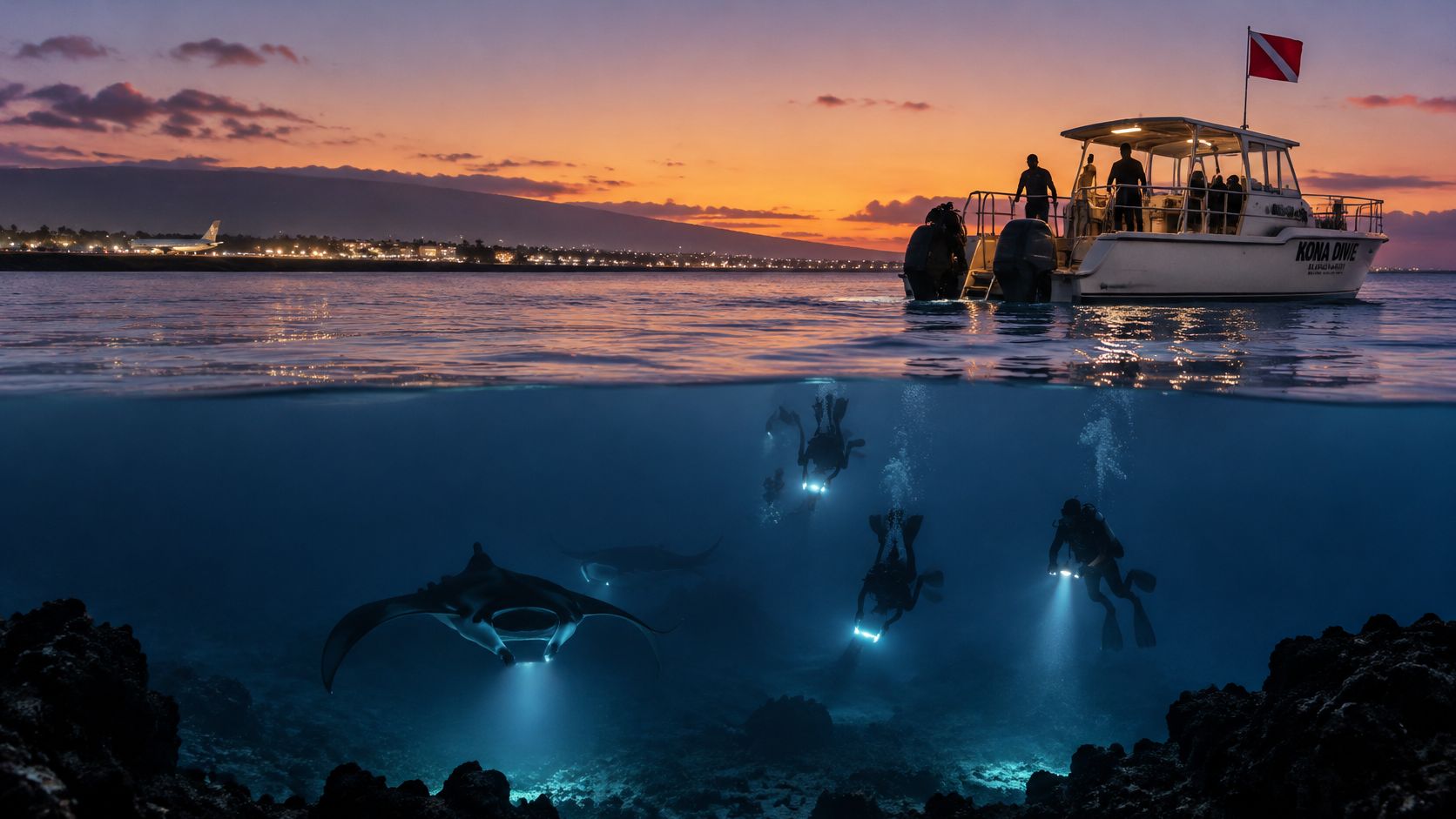
A reef you can brief before you splash
A state environmental document on Makako Bay moorings describes the layout Hawaii's Department of Land and Natural Resources uses for this cove: basalt boulders to roughly 20 feet, active coral reef down to about 70 feet, then sand. The same document lists day-use mooring depths from 15 to 75 feet. Moorings let the crew park the boat with control. Anchoring on that coral is the move that scrapes the viewing area you're paying to see.
You get a real reef to study if the rays are late, quiet, or somewhere else feeding. Lights can bunch plankton and improve the chance of a pass. They can't place an animal on a timetable.
A small local population, not an open-ocean stock
A University of Hawaiʻi community-science record compiled observations from 2010 through 2022 at Garden Eel Cove and Keauhou: more than 23,000 sightings of 167 individually identified reef manta rays. Garden Eel Cove consistently held larger aggregations than Keauhou. Keauhou was visited predominantly by females, while Garden Eel Cove showed more comparable visitation between sexes. Aggregation size tracked zooplankton density. Prey, not the tour clock, drives the nightly count.
Earlier photo-identification along the Kona Coast, summarized in 2009 Hawaii legislative testimony, recorded 106 individual manta rays from 1992 through 2007 and 30 new pups from 1994 through 2007. The local population probably numbered fewer than 200 animals. You are visiting residents with high site fidelity, not a huge mixing stock. That is why contact is off the table.
On the night: no touching, no chasing, and no steering a diver into a ray's path. Belly patterns are how photo-identification works. Your job is to stay on the plan so the animal can keep feeding.
The two-tank manta dive and snorkel uses that sheltered reef on purpose. If you want the fuller picture of how the night is run, read the Hawaii Big Island manta ray night dive notes before you lock the date. A quiet plankton night is still a dive on a mapped reef. It is not a failed booking.
Reef Days Blackwater and Advanced Charters
Morning and night reef charters along the Kona coast are the default certified dive. You get coral gardens, ancient lava tubes, and swim-throughs, and the guide picks the actual spot after the logbook, the wind, and the swell. That is a different job from sitting under feeding rays.
Lava tubes and coral heads are the reliable scenery on a standard Kona day.
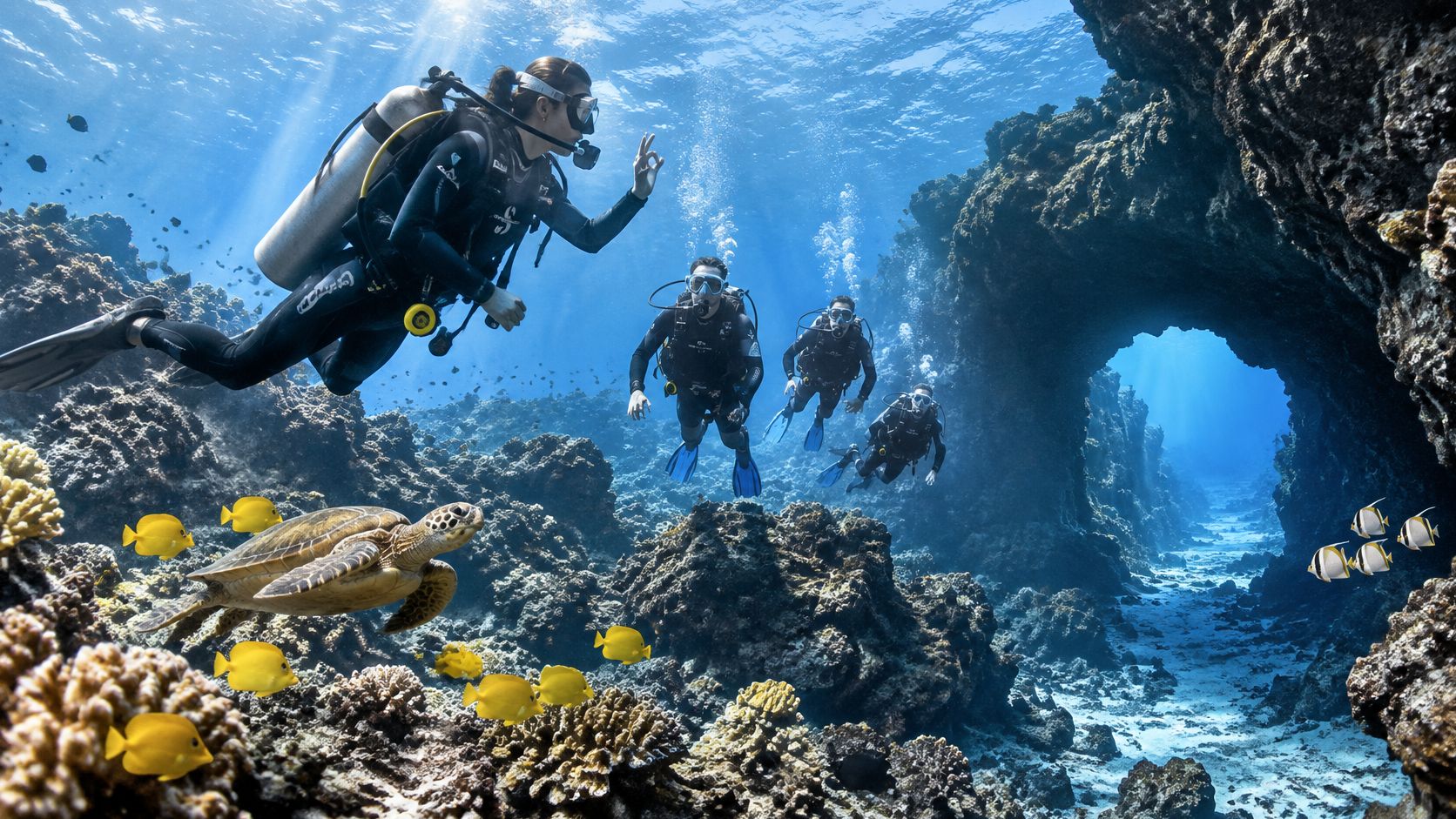
What the water column is doing
Blackwater is another ocean. You hang at night, tethered, over deep water, and you watch whatever drifted up. A Kona night-diving writeup of NOAA-associated surveys covers 59 night-diving surveys around Hawaiʻi Island. Salps, siphonophores, and ctenophores were among the most abundant organisms. Water temperature, local bathymetry, and the El Niño–Southern Oscillation index explained 43% of the variation in pelagic biodiversity.
A good blackwater dive can be a field of small drifters. No shark, no squid, and no manta is a normal outcome, not a dud trip. If you need a landmark animal to feel the night was worth it, don't book this one. The blackwater night dive is for people who are curious about that midwater parade and calm enough to hang in the dark. More on how the tether night is framed sits in this blackwater dive in Kona guide.
Leaving the harbor sites
The premium advanced two-tank is the distance option when seas let the boat reach remoter coast sites. It is not a beginner upgrade with a longer ride. You want a strong recent log, comfort in current, and a willingness to accept offshore reef as the plan. Pelagics show up only if the day allows them. Details are on the premium advanced long-range charter.
Use this split when you choose:
- First night, and you want a known animal: Garden Eel Cove mantas, with plankton as the decider.
- Curiosity about open-ocean night life: blackwater, and treat small drifters as the success.
- A strong log and a wish to leave the usual harbor sites: the advanced boat, on a sea day that can get there.
Stacking all three on consecutive hard days is how people show up tired, seasick, and sloppy on buoyancy. Spread them.
Certification Gear and Who Can Join
Most regular charters, including the morning reef boats and the Garden Eel Cove manta boats, need at least an Open Water Diver certification from PADI, SSI, or NAUI. The card gets you on the boat. The logbook still decides the site. A brand-new card does not earn a remote wall or a stiff current.
| Who | What we can do | What we won't do |
|---|---|---|
| Open Water, any recent agency card | Morning reef and the manta night, site matched to the log | Treat a fresh card like an advanced log |
| Strong recent dives, comfortable in current | Premium long-range when seas allow | Fill those seats with a rusty vacation diver |
| Certified and calm over deep water at night | Blackwater | Put a nervous new diver on a tether “to try it” |
| Uncertified adults or children | Snorkel or ride along, named in the booking | Hand them a tank without a junior or adult certification |
A shared family plan that works is one certified parent underwater while snorkelers stay on the surface. Children can't scuba without a junior certification.
Rental regulators, BCDs, wetsuits, and tanks are on the boat, and the crew sets that gear up. Bring your own mask if you already trust the fit. It is the one item worth the luggage space, because a leaking rental mask ruins an otherwise easy dive. Kona water is warm enough that a shorty or a 3 mm suit covers most guests. Take a thicker layer if you chill on a long night hang.
Say so in the same booking if snorkelers or ride-alongs are in the party. Mixed groups should reserve the scuba seats and the snorkel seats together so the crew plans one boat, one harbor return, and enough surface support. If you still need the card before the trip, start with scuba classes rather than hoping a resort afternoon turns into a remote charter.
We check the certification and the log before the site is chosen. That is the gate, and it is there so the guide isn't improvising a wall dive for someone who last bubbled in a pool.
What to Expect on a Kona Dive Day
Personal attention starts the moment you step aboard, in a small group, not after someone is already struggling at the ladder. The shape of the day is simple.
- Arrive at Honokohau Harbor with your certification card and logbook. The crew matches the site before the boat leaves. A card left at the condo delays everyone, and a verbal “I'm advanced” doesn't replace the book.
- Join the small group and let the crew build the kits. You shouldn't be assembling a rental regulator on a moving deck. If something feels wrong in the harbor, say it there.
- Listen to the brief. It names depth, current, the buddy plan, and who watches the flag. That brief is the dive plan, not background noise while you fiddle with a camera.
- Dive the planned profiles. That's usually two daytime tanks or one night objective, with a real surface interval. Don't negotiate a third tank because the first site was pretty.
- If you separate, stop, signal, and reunite. A long surface swim away from the flag is how people become hard to see in glare, chop, or night light.
The flag is part of the brief
Hawaii's Division of Boating and Ocean Recreation requires a red-and-white diver-down flag for scuba, snorkeling, and freediving, and ocean divers must surface within 100 feet of that flag except in an emergency. The same guidance says to check weather and tide, watch shoreline wave action for about 15 minutes, keep watching conditions, and dive with a partner. A Hawaii shore-and-boat diving brief adds the night and traffic pieces: at night the flag must be illuminated and visible from at least 100 feet, and vessels keep a 200-foot slow-no-wake zone around a displayed flag.
Before you enter, confirm who carries the flag, how it will move with current, and the reunion spot if viz drops. The ascent point, the boat traffic, and the flag are one system.
If the ride usually gets you
Eat a light meal and keep a horizon view on the way out. Options people pack include the Ship-EEZ seasickness patch, Dramamine pills, Bonine pills, Sea-Band style wristbands (a cheaper generic that often rates better), and ginger chews. Ask a clinician before you mix pills. Don't wait until you're green at the mooring to invent a plan.
The crew handles gear setup so your attention stays on the brief, your buddy, and the flag, not on a strap you forgot in the parking lot.
Sample Itineraries for Every Kind of Group
These are days you can copy. Times stay as a shape only: a morning harbor call for day boats, an evening check-in for manta or blackwater. Confirm the clock when you reserve, because sunset moves.
A first-timer couple
Take the morning two-tank reef first. You learn the ladder, the brief, and how the boat feels before you add darkness. Keep the afternoon quiet. That night, go to Garden Eel Cove.
Hawaii legislative testimony reported that manta rays were observed on 80% of dives at Garden Eel Cove and described Kona as one of the world's leading locations for seeing manta rays in the wild. That is past frequency at this cove, not a promise for your Tuesday. Plankton can make the next night quiet. A well-run dive on that sheltered reef is still the win. Don't spend the surface interval demanding a rebooking the ocean can't sign.
A family with one certified diver
Book one reef morning. Put the two snorkelers on snorkel seats in the same party, share the harbor return, and don't try to put uncertified people on scuba. The certified diver gets a guided profile. Everyone else gets the reef from the surface and the boat ride home together. Where you sleep matters more than people think when the harbor call is early. Use these places for divers to stay on the Big Island so the morning isn't a cross-island sprint.
Three ways a Kona week can fit a real group.
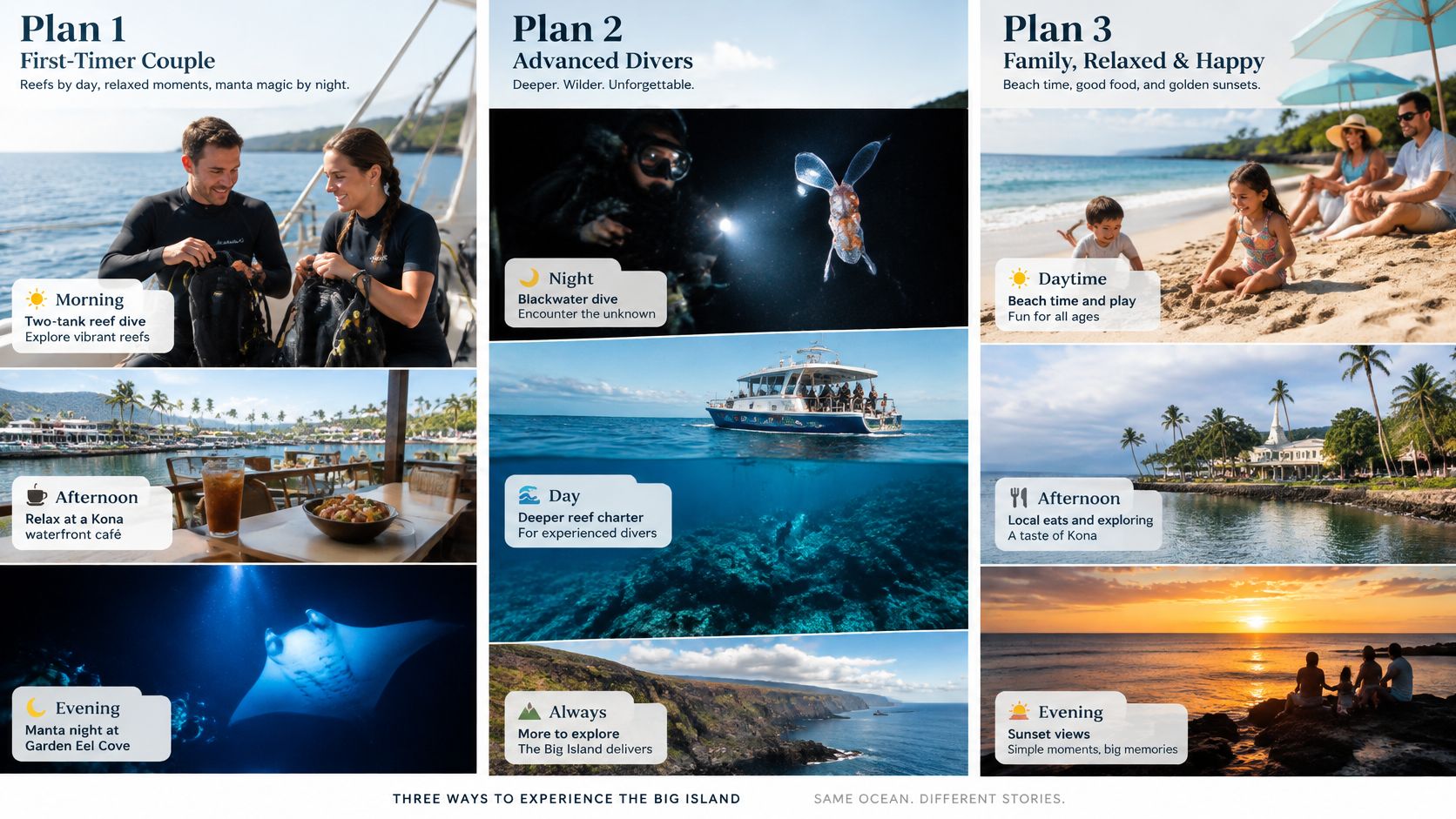
An experienced pair
Put the premium long-range day on a calm morning if the log supports it. Put blackwater on a different night. Take a rest day. Don't stack a remote two-tank with a late open-ocean hang. Tired buoyancy is how small drifters, and lava tubes, both get worse.
If the night is windy or the plankton is poor, change the story you tell yourselves. Look at reef structure, the lights, and whatever small life is in the beam. That is the dive you have. It isn't a coupon for a different ocean.
Frequently Asked Questions About Kona Dives
Do I need certification for manta night?
Yes for the scuba seats. Open Water from PADI, SSI, or NAUI is the usual minimum, and the guide still picks the site from your log. A card with no recent dives may mean a simpler profile, not the night you saw in a video.
Can I touch the mantas?
No. Touching, chasing, and steering divers into a ray are off limits. Stay on the planned spot and let the animal feed.
Will I definitely see mantas?
No. Garden Eel Cove has a strong history, and plankton plus sea state still decide each night. Book the site because the reef and the moorings can hold a plan, not because a crew can summon a ray.
Why are Kona manta sites regulated?
In 2016, the Hawaii Department of Land and Natural Resources said manta viewing at Makako Bay/Garden Eel Cove and Keauhou Bay had become unsustainable and unsafe because of crowded boats and large numbers of swimmers and divers. Proposed steps included prohibiting anchoring, limiting commercial operators, prohibiting rafting between vessels, and restricting live boating. Choose a boat that uses the moorings and the crowd rules.
How far can a diver drift from the flag?
Stay inside the surface envelope the crew briefs, and don't start a long swim if you pop up away from the group. At night that flag has to be lit, and boats are expected to slow in the zone around it. Signal and reunite.
Can uncertified kids come?
Yes, as snorkelers or ride-alongs named in the booking note. They don't get a tank without a junior certification. Put them on the same reservation as the divers.
Booking Your Kona Dive and Discount Options
We offer Big Island scuba diving discount packages, including early-diver deals and free nitrox where the package says so, plus multi-day discounts. Confirm the exact terms when you book, because the deal lives on the package, not in a rumor from the last guest.
- Confirm the certification and bring the logbook to the harbor.
- Pick day or night from the diving tours list, then open the manta ray dive, the blackwater dive, or the advanced long-range trip so the seat matches the log and the group.
- Name every snorkeler and the party size.
- Book scuba and snorkel seats together.
- Call 808-324-4668 for changes or group questions. Current coupons are the place to check a code before you pay, not after you're at the fuel dock.
Wildlife is a bonus of a well-chosen site. It isn't a booked outcome. Pay for the boat, the brief, the mooring, and a crew that will still run a good dive if the rays are elsewhere.
Kona Honu Divers runs guided reef days, Garden Eel Cove manta nights, blackwater hangs, and advanced long-range charters from Honokohau Harbor, with the site chosen from your card and your log. If your group is sorting a Kona week around real sea conditions instead of a guaranteed animal, start with the tour list and the harbor plan. Visit Kona Honu Divers to match the boat to the divers you have.