
The most popular advice about scuba diving in Kona on the Big Island is also the easiest to misuse: the west coast is calm, so pick a famous site and go. Calm water is a probability, not a promise. A protected boat dive, a lava-rock shore entry, a manta feeding area, and an open-ocean blackwater drift demand different decisions, even on the same evening.
The better approach is to choose the dive format that fits your training, then let the day's swell determine the location. You'll spend less time defending a rigid itinerary and more time enjoying the reef.
Which Kona Dive Fits Your Trip
Kona dive formats compared
| Dive format | When it shines | Depth and certification | What you see | Main caution |
|---|---|---|---|---|
| Morning reef boat dive | Year-round; crews pick sheltered lava reefs in winter swell | Open Water to about 60 ft / 18 m | Coral gardens, lava tubes, arches, reef fish | Site moves with same-day swell |
| Advanced remote or drift day | When exposed pinnacles are calm enough | Training beyond Open Water for deeper or current sites | Deeper pinnacles, drift, remote reefs | Current, longer intervals, higher task load |
| Manta night dive at Garden Eel Cove | Night, year-round aggregation | Open Water; feeding often in the upper water | Reef mantas feeding on zooplankton concentrated by lights | No touching, stay low; encounters aren't guaranteed |
| Blackwater night dive | Calm nights with comfortable boat motion | Confident certified divers in open ocean | Pelagic larvae and deep-water migrants | Tethered open ocean and darkness |
| Shore dive, Old Kona Airport area | Small swell and a confirmed exit | Open Water; stay within your training as the bottom drops away | Lava and reef inside a no-take district | Sharp rock, surge, and take prohibitions |
| Supervised introductory dive | Calm mornings | No certification; instructor controls a shallow dive | First breaths on a reef | Not a certification and not suitable for rough entries |
Choose a morning reef boat dive if you're certified and want the most adaptable starting point. Kona isn't one dive site. It's a leeward coastline where crews can move among lava reefs rather than force a visit to an exposed landmark.
For most regular charters, Open Water certification from a recognized agency provides the basic entry point, with a buddy depth limit of 60 feet or 18 meters. That isn't a target depth. A shallower reef with comfortable breathing, good buoyancy, and enough gas for an unhurried return is a better dive than a deep profile you're barely managing.
Match the challenge to your current skills
An advanced day makes sense when you already manage descents, gas, navigation awareness, and ascents without constant prompting. Deeper pinnacles and drift diving add decisions that a basic certification alone doesn't prepare every visitor to handle. Recent experience matters as much as the card in your wallet.
For a signature night experience, I'd choose Garden Eel Cove as the better manta camp because of its more protected location, better viewing area, and healthier reef setting. Blackwater serves a different interest: observing small oceanic animals while suspended away from the bottom. Don't choose it only because the manta trip is full.
- Newly certified visitors: Start with a reef morning before adding darkness, cameras, or more demanding terrain.
- Rusty divers: Refresh your skills before committing to a specialist trip.
- Non-divers: Choose supervised introductory scuba for a taste, or pursue Big Island scuba certification if you want a lasting qualification.
- Mixed groups: Confirm the actual activity available to each person rather than assuming every boat trip accommodates divers and snorkelers equally.
Choose flexibility over a fixed site
Winter north and west swell can favor sheltered corners, while summer surface conditions are usually easier to assess. Neither season makes every lava entry suitable. A flat harbor tells you little about water washing across a distant shoreline shelf.
Use the Kona diving tour menu to choose a format, not to lock yourself into a particular patch of ocean. Conditions, equipment readiness, animal behavior, and entry rules should decide the rest.
Cards, Rentals, Nitrox and Cameras
Bring your C-card. Kona Honu Divers requires at least an Open Water Diver certification from a recognized agency such as PADI, SSI, or NAUI for most regular dive charters. We also need an honest account of your recent diving, because certification doesn't tell the crew whether you're comfortable clearing a mask or recovering neutral buoyancy today.
Choose training that fixes the actual gap
Beginners who want an independent diving qualification should take a full Open Water course. A referral finish suits someone who has completed the required academic and confined-water work elsewhere, provided the receiving instructor accepts the referral documentation. Don't arrive assuming unfinished paperwork can be resolved at the dock.
A refresher or Reactivate session is the sensible choice when your skills feel uncertain. Practice equipment assembly, alternate-air procedures, controlled descents, and a calm ascent before adding a camera or night environment. The objective is usable confidence, not just getting wet again.
For divers aiming at deeper pinnacles or current, continuing education should address the weak point:
- Advanced and deep training: Build depth awareness, gas planning, and more disciplined computer use.
- Buoyancy practice: Learn to hold position without grabbing rock or sculling with your hands.
- Boat training: Make entries, ladder approaches, and surface procedures less distracting.
- Rescue training: Improve recognition of stress before it becomes an emergency.
The Premium Advanced 2 Tank Trip is the relevant format for experienced divers interested in remote sites. It shouldn't be treated as a substitute for the training those conditions require.
Set up the breathing system before the camera
Nitrox is air with extra oxygen and less nitrogen. Think of it as changing the proportions in the tank, not increasing the tank's size. It can extend available no-decompression time on repetitive reef profiles, but it doesn't give you more breathing gas or permission to descend farther.
Use it only with enriched-air training. Analyze the cylinder, confirm its label, set your computer to the measured mixture, and respect that mix's maximum operating depth. Free nitrox is available to appropriately certified divers; that benefit never overrides oxygen-exposure limits.
For rentals, prioritize fit and familiarity over brand preference. Professionally serviced regulators and BCDs still need a user check, and wetsuits should be fitted on site rather than chosen solely from a clothing size. Review scuba rental options before packing, and consider buying personal fit-sensitive equipment if you're staying and diving regularly.
We can arrange a dive computer when requested at booking, with availability and any small extra cost confirmed then. Don't assume a rental package automatically includes one.
Equipment priority: A camera is optional. A breathing system you understand, readable instrumentation, and stable buoyancy aren't.
Use a wrist lanyard that keeps the camera secure without creating a snagging loop. Start with a single strobe or focus light, direct it considerately, and shoot from a stable position. At the manta camp, pursuing a better angle usually produces a worse encounter for everyone.
How the Leeward Coast Sets the Day
The Big Island blocks much of the trade-wind exposure, putting Kona in the lee, rather like standing behind a wall in a breeze. That shelter helps explain why diving is available year-round, with warm water and generally clear visibility. It doesn't stop swell from reaching the coast.
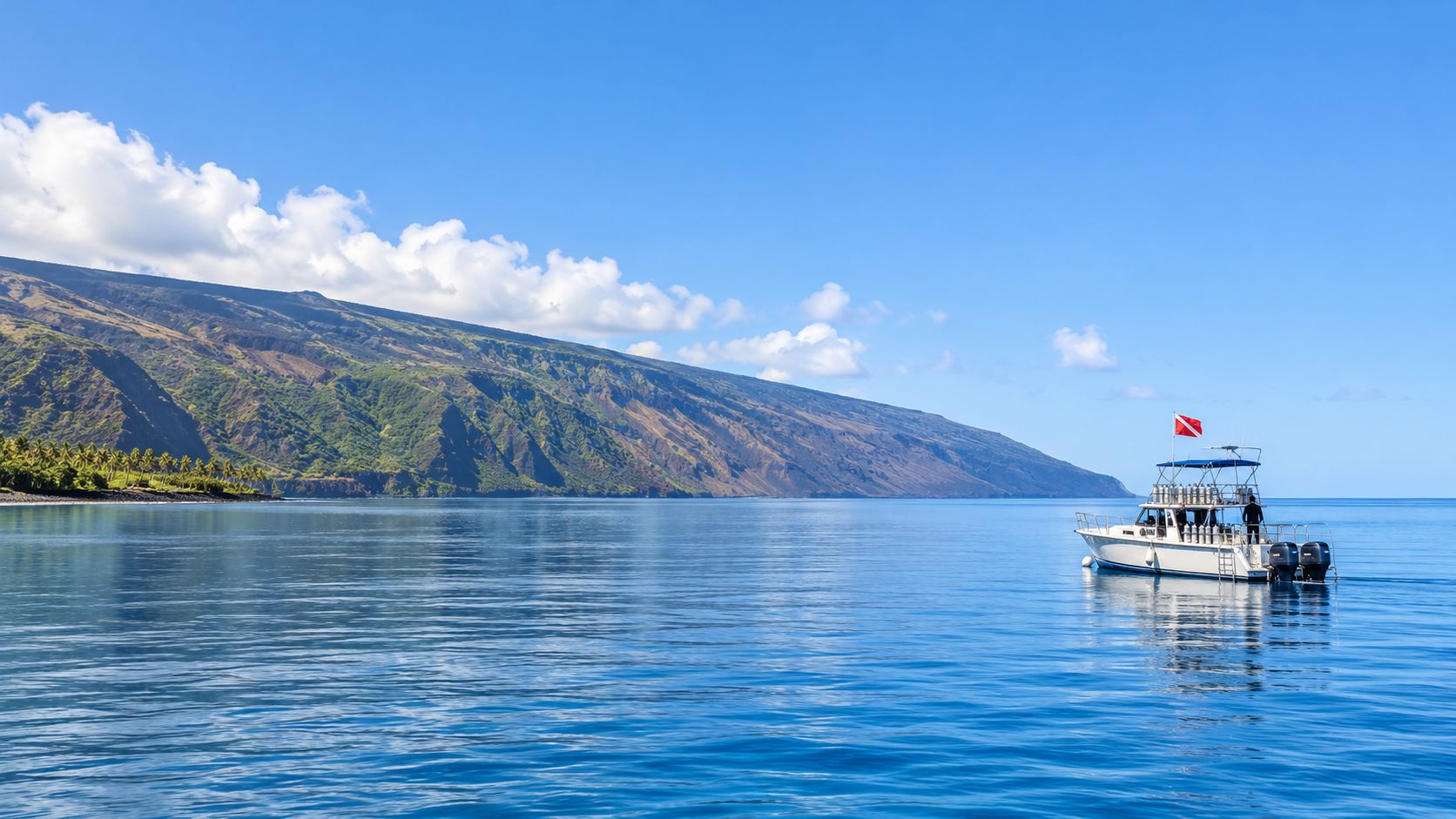
NOAA's marine-economics assessment identifies the Kona-Kohala coast as generally sheltered, notes the concentration of Big Island dive sites there, and describes operators using preferred locations when northwest winter swell creates high surf. The practical advantage is choice among sites, not immunity from weather.
Read exposure rather than the calendar
A boat can pass an unsuitable shoreline and continue to a better-protected reef. A shore diver doesn't have that flexibility once committed to an entry, especially when the return route is a narrow opening in lava. This is why the same forecast can support a sensible boat day and an abandoned shore plan.
Seasonal conditions on the Kona coast
| Season | Swell and surface | Site choice | Night and shore notes |
|---|---|---|---|
| Winter | North and west swell surges exposed corners | Boat crews shift to preferred sheltered sites | Shore entries need strict go or no-go checks |
| Summer | Surface usually more predictable | Sites are generally easier to assess on the day | Shore entries still need an exit check |
| Year-round | Warm water and generally clear visibility | Boat dives shift by local conditions, not season alone | Manta trips remain subject to weather and animal behavior |
Surface chop and underwater surge aren't interchangeable. Wind can roughen the ride while a protected reef remains manageable below, whereas swell can create powerful back-and-forth movement in shallow water despite a smooth-looking surface offshore. Tell the crew whether your concern is boat motion, entry footing, current, or staying stable underwater.
Kona Honu Divers operates along a sheltered stretch with good conditions almost all year. We still make the operational decision from the actual sea state and the divers aboard, not from a general description of Kona.
What a sensible boat sequence accomplishes
A typical day starts with arrival and gear setup, followed by a briefing covering site conditions and entry style. The deeper or more condition-sensitive dive comes first, followed by a surface interval and a more relaxed second dive. That sequence leaves room to respond if conditions or diver comfort change.
- During setup: Explain unfamiliar equipment, mobility limits, equalization problems, or recent inactivity before the boat reaches the site.
- During the briefing: Identify the descent reference, intended route, depth ceiling, turn criteria, and exit procedure.
- During the interval: Report cold, fatigue, difficulty equalizing, or an equipment issue instead of hoping it disappears.
Our small-group approach emphasizes personal attention from the moment people step aboard. Use that opportunity to communicate early. A guide can adjust a plan much more effectively before entry than while managing a stressed diver underwater.
Judge the specific site that morning, not a postcard of Kona.
Sites Worth Planning and When to Skip Shore
West Hawaii boat diving centers on lava reefs, arches, and coral gardens, with crews selecting the stretch that suits the swell. For night planning, the principal names are Manta Village near Keauhou and Garden Eel Cove near the airport, commonly associated with the Manta Heaven name. Confirm the actual location on your booking rather than treating similar names as separate destinations.
For a manta dive, Garden Eel Cove is the superior choice for protection, viewing space, and reef quality. That preference doesn't make it suitable in every sea state.
Named Kona sites at a glance
| Site | Dive type | Why it works | Main caution |
|---|---|---|---|
| Garden Eel Cove | Night manta camp | More protected, better viewing area and reef | Open Water; no touching |
| Manta Village near Keauhou | Night manta camp | Principal viewing area in the NOAA-hosted observation record | Conditions and wildlife attendance aren't guaranteed |
| Manta Heaven near the airport | Night manta camp | Another principal viewing area in the NOAA-hosted record | Confirm the booking's use of the Garden Eel Cove name |
| Old Kona Airport shore | Shore dive in a no-take district | Lava and reef inside the Marine Life Conservation District | Sharp rock, surge, and a rapidly deepening bottom |
| Sheltered lava reefs, arches, coral gardens | Morning boat dive | Crew picks the corner that matches swell | Site changes with same-day swell |
Old Kona Airport requires a shoreline assessment
The Department of Land and Natural Resources' Old Kona Airport district description warns of sharp coral and lava rock, dangerous storm swells and currents, and a rapid drop beyond approximately 50 feet. Comfortable swimming skills don't remove the risk of falling while carrying scuba equipment.
The usual access is a partly protected cove at the northwestern end. Partly protected isn't the same as sheltered from every swell direction. Watch the water long enough to understand how sets affect both the approach and the place where you'll remove fins.
The Kona diving conditions guide explains why lava shelves, pockets, and exposed corners require site-specific evaluation even when the broader coast looks calm. Apply that principle before putting on the tank.
| Check | Proceed only when | Cancel or change the plan when |
|---|---|---|
| Same-day swell | Direction and surf observations support the actual entry | Breaking water washes across the standing area |
| Entry walk | Everyone can negotiate the footing without relying on a lucky lull | Surge could knock a geared diver onto lava |
| Exit inspection | You can identify and approach the exit from the water | Foam, wash, or visibility obscures the return route |
| Buddy capability | The less experienced or less mobile diver can make the exit comfortably | One diver needs assistance the conditions won't allow |
| Return conditions | The exit remains credible if the sea becomes less favorable | Your entire plan relies on conditions staying perfect |
Protect the exit before choosing the route
Agree on navigation references, a conservative turn pressure, and what you'll do if separated. Keep enough gas to solve a problem rather than scheduling the return around an almost-empty cylinder. Don't use a long underwater route to compensate for an entry you already distrust.
No-take protection applies here. Leave marine life, coral, shells, algae, and eggs in place; narrow legal exceptions aren't a visitor's general permission to collect. Anchoring is prohibited, and the designated No Boating Zone restricts motorized vessels.
Use the Big Island shore-diving guide to narrow your options, then make the final decision at the shoreline. When the shore is wrong, a guided boat dive may offer a suitable alternative, provided the crew can find an appropriate site. Snorkeling isn't automatically a safer fallback at the same hazardous entry.
Manta Night and Blackwater Expectations
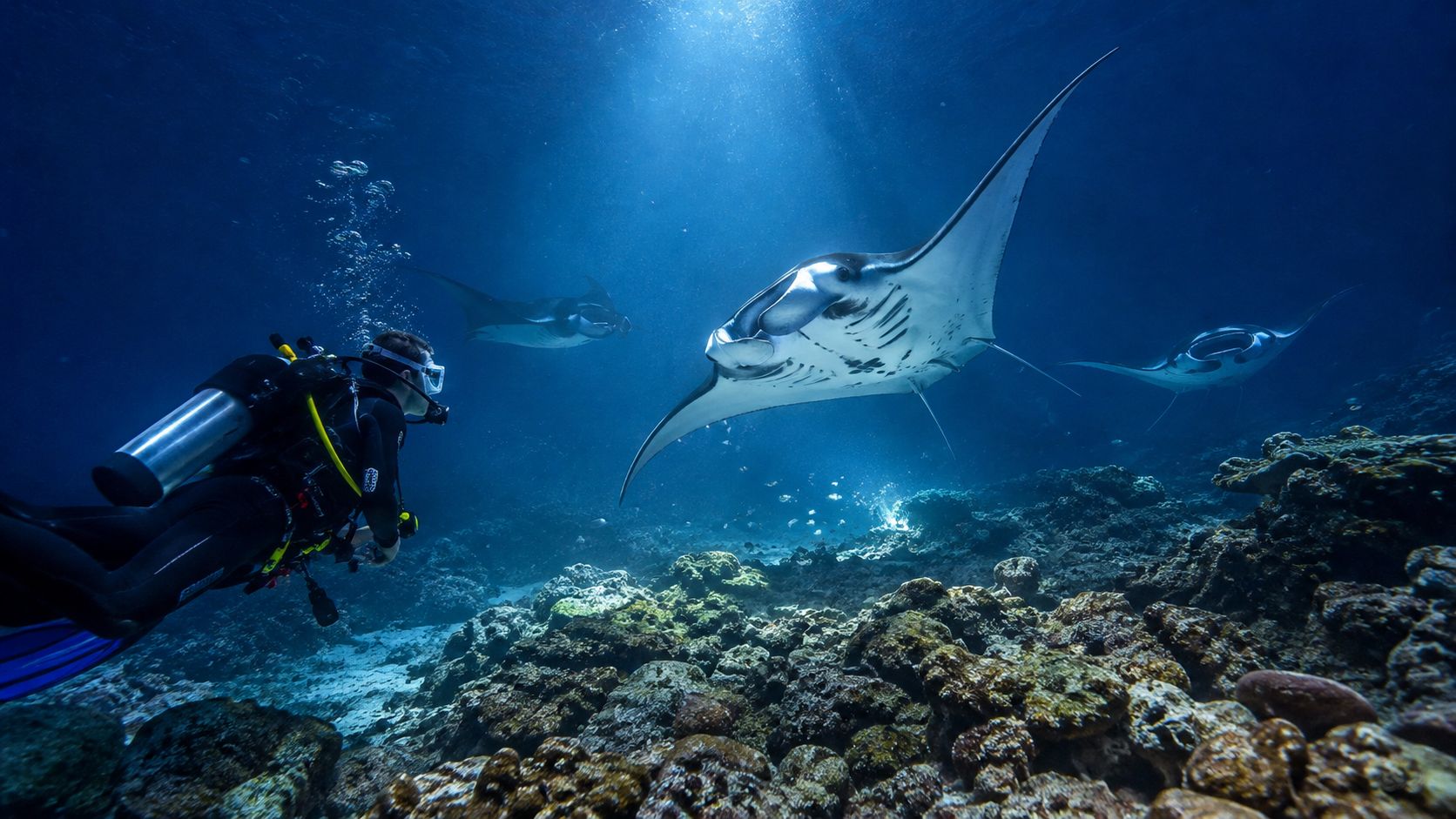
After dark, zooplankton moves upward through the water, and lights concentrate prey near the viewing area. A manta may sweep through the illuminated water, turn, and return along the same feeding path. You're watching a feeding process, not an animal performing for the group.
Let the animal keep its feeding route
Say a manta approaches while you're framing a photograph. The useful response is to hold position and let it pass, not rise into the water column to fill the frame. Moving into its route creates collision risk and forces other divers to react in darkness.
- Stay low and stable: Hold the position assigned in the briefing without resting on living coral.
- Keep your hands to yourself: Never touch, grab, ride, or attempt to redirect a manta.
- Control your lighting: Follow the guide's beam direction and avoid shining into another diver's face.
- Let the encounter end: Don't follow an animal that leaves the illuminated area.
Kona's predictability comes from returning animals, not guaranteed attendance. A NOAA-hosted study summarized in the Kona manta-ray record logged 25,444 observations of 118 individually identified reef mantas from January 1, 2009, through December 31, 2014, at Manta Village and Manta Heaven; one individual appeared on more than 56% of study nights, while earlier Hawaii legislative testimony reported sightings on approximately 80% of dives at Garden Eel Cove and estimated a local population below 200, with two to three new pups observed annually.
Those are historical observations, not your trip's probability forecast. They support strong site fidelity, meaning animals repeatedly return to particular locations. They also describe a relatively small local population, which makes restrained viewing behavior more important, not less.
Why a quiet night can still be normal
Mantas aren't restricted to the illuminated surface layer. NOAA's manta status review reports that mantas commonly occupy the upper 10 meters during daytime feeding and cleaning activity but can descend to approximately 432 meters at night.
That broader movement helps explain why surface conditions alone can't tell you whether animals will appear. Prey distribution and animal movement don't follow a reservation schedule. Operators should explain that uncertainty rather than promise a manta.
For the dive itself, I favor the protected setting and viewing arrangement of the Garden Eel Cove manta night tour. Better reef surroundings also make the location worthwhile as habitat, not merely as a backdrop for lights.
Wildlife standard: A successful encounter leaves the animal free to continue feeding without being chased, touched, or blocked.
Blackwater asks for a different kind of comfort
A blackwater night dive takes you away from the reef into open ocean, tethered beneath the boat. Instead of waiting for large animals at a feeding camp, you look for larval and pelagic life moving through the lights. Many subjects are tiny, delicate, and difficult to recognize at first glance.
The challenge is maintaining orientation without a bottom or wall. Darkness, tether awareness, camera settings, and buoyancy can compete for your attention. The line is part of the system, not a substitute for independent control.
Choose this only when you're a confident certified diver who can manage equipment and stay composed at night. Review the Kona blackwater dive overview before deciding, and confirm current participation requirements during booking. Enjoying a manta dive doesn't automatically mean you'll enjoy open-ocean darkness.
Safety Rules, Health and Getting There
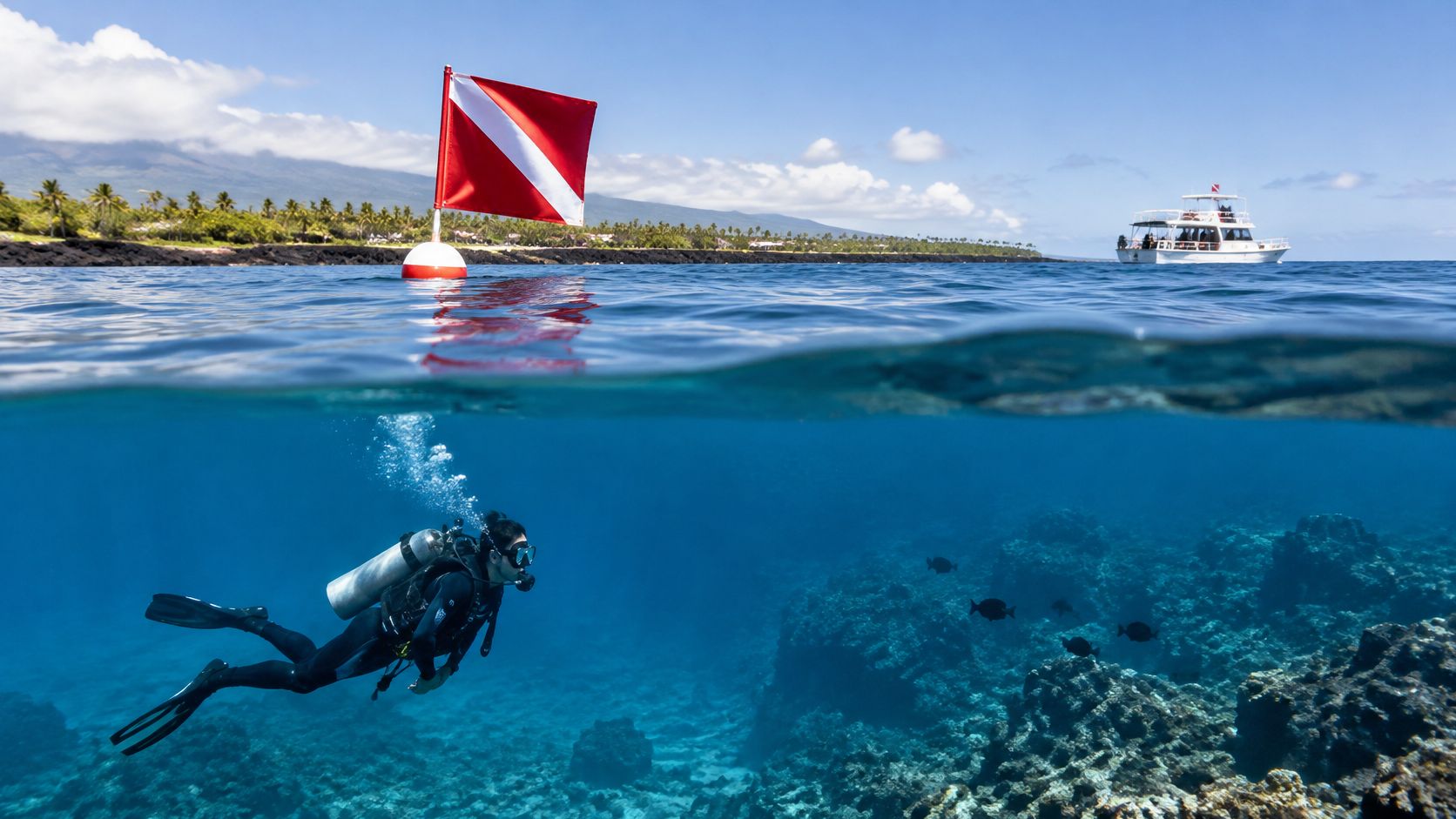
Hawaii's diving regulations require a red-and-white diver flag during scuba, snorkeling, and freediving; ocean divers must surface within 100 feet of it, the flag must be illuminated and visible from at least 100 feet at night, and vessels must observe a 200-foot slow-no-wake area around a displayed flag. Remove the flag when diving ends, and don't dive or swim in navigation channels except during an emergency.
The NOAA-hosted marine-wildlife guidance specifies separation of at least 100 yards from whales and other marine mammals for people on or in the water and 1,000 feet for aircraft. Never chase, surround, closely approach, or attempt to touch them. A stationary manta viewing arrangement doesn't grant permission to approach marine mammals.
Resolve health questions before boarding
Discuss heart or lung conditions, recent congestion, and pregnancy questions with a physician familiar with diving medicine before the trip. Don't force equalization through pain or take a decongestant to conceal a problem that would otherwise keep you out of the water. Complete the medical screening.
Carry appropriate dive accident coverage, such as DAN, and understand how to contact assistance. After repetitive recreational diving, plan a preflight surface interval of at least 18 hours, longer when taking a conservative approach, and follow your computer and training guidance. Treat drives to altitude as a separate planning issue rather than assuming only flights matter.
- Before entry: Agree on gas reserves, buddy separation procedures, and the ascent plan.
- At night: Carry a primary light and a backup, and know the guide's light signals.
- If something feels wrong: End the dive early rather than trying to finish the planned route.
Plan for boat motion without impairing your diving
Motion-sickness options include the Ship-EEZ Seasickness Patch, Dramamine pills, Bonine pills, Sea Band wristbands, and ginger chews. The linked wristbands are a cheaper generic alternative marketed with better ratings, but ratings don't establish medical effectiveness or diving suitability.
Check ingredients and ask a pharmacist or physician about contraindications, interactions, and sedation. If you use a preventative, follow its directions before boarding rather than waiting until nausea starts. Don't test a potentially sedating medication for the first time immediately before scuba.
Fly into Ellison Onizuka Kona International Airport and confirm your boat meeting point when reserving. Kailua-Kona and Keauhou are practical bases, while a rental car makes independent shore logistics easier. A guided shore visit also needs an operator authorized for the area, not merely someone familiar with the entry.
Where to Stay, Get Around and Permits
Choose accommodation around your actual check-in point, not just a map pin labeled Kona. Kailua-Kona suits travelers who want town services and straightforward access to boat-day logistics. Keauhou can be convenient if your itinerary centers on that part of the coast, including the Manta Village area.
Ellison Onizuka Kona International Airport puts you on the appropriate side of the island for these dives. Before committing to lodging, compare the drive to your confirmed meeting point and allow time for parking, unloading, and finding the crew. Don't assume a waterfront hotel is beside the departure location.
Make transport part of the dive plan
A rental car is useful for shore diving because you'll be carrying equipment and need the freedom to inspect an entry before gearing up. Old Kona Airport shore access is a separate outing, not a stop on a boat route. Keep wet equipment secured and leave valuables somewhere safer than an unattended beach vehicle.
- Before arrival: Save the meeting instructions and carry your certification card.
- Before a shore day: Check access, walk the entry, and leave room to change plans.
- Before departure: Protect your no-fly time instead of squeezing in a final dive.
The guide to places for divers to stay on the Big Island can help narrow the accommodation search. Build a spare day into the itinerary when possible, so changing conditions don't force a choice between an unsafe entry and missing your only opportunity.
Protected access isn't unrestricted use
The DLNR's Old Kona Airport regulations define a district extending 500 yards offshore, from the park's western end toward a line extending seaward from the Kailua Lighthouse, and require permits for commercial dive and tour operations. Authorized commercial activity must follow the applicable shore or state-mooring conditions.
Confirm current DLNR requirements before arranging a guided shore session. Permission to enter a park doesn't automatically authorize commercial instruction or touring in the adjoining protected water.
Planning margin: A spare day is useful only if you're willing to move the dive, change the site, or stay out when conditions warrant it.
Book the Kona Honu Divers Day
Book according to what you can comfortably do now, not the most dramatic photograph on the reservation page. Kona Honu Divers offers the Manta Ray Night Dive, 2 Tank Local Morning Dive, Premium Advanced 2 Tank Trip, Black Water Night Dive, and Morning Introductory Scuba Dive, alongside private tours and dive packages.
For a certified visitor's first Kona outing, the local morning format is the straightforward starting point. It gives the crew room to match reef terrain to the group and gives you time to settle into rental equipment before a specialist night experience.
Choose the reservation that matches the diver
- Open Water visitors: Choose the morning reef trip for coral gardens, lava formations, and an adaptable coastal plan.
- Experienced divers: Choose the premium advanced format when your training and recent experience support deeper, remote, or current-influenced sites.
- Manta-focused travelers: Choose the Garden Eel Cove night option for the protected camp and viewing arrangement.
- Confident night divers: Choose blackwater for pelagic subjects and open-ocean suspension rather than a reef-based encounter.
- First-time divers: Choose the introductory experience, or discuss certification if you want more than a supervised taste.
- Private groups: Consider a private tour when different abilities or priorities require a customized arrangement.
We offer early-diver discounts, multi-dive packages, and free nitrox for appropriately qualified divers. Confirm current availability, rental needs, and the practical fit of each reservation before committing. For help matching the schedule to your experience, call 808-324-4668.
Confirm the details that affect your day
Tell us about recent dives, certifications, camera plans, and any mobility or equipment concerns. Specify whether you need a computer, and confirm the meeting point and arrival instructions. Those details are more useful than just describing yourself as beginner or advanced.
Kona Honu Divers is a separate operator from Kona Diving Company. We've been voted best dive operator in Kona and received Scuba Diving Magazine's Readers Choice Award for best dive company in the Pacific; our credentials also include Hawaii's highest-rated and most-reviewed dive-shop standing. Those distinctions don't replace the practical question of whether the chosen trip fits you.
Choose the format that matches your training and interests, then leave the location decision responsive to conditions. If you're also planning shore dives, recheck swell the day before and assess the actual entry again on arrival.
Kona Honu Divers offers guided reef mornings, Garden Eel Cove manta nights, advanced trips, blackwater dives, and beginner instruction on the Big Island. Visit Kona Honu Divers to choose the experience that fits your certification, reserve your equipment, and build a Kona dive plan with room for the ocean to change.