
You're comparing dive trips from your Kailua-Kona hotel, trying to decide whether to start with a reef, save the famous manta dive for night, or try something more unusual in open water. The right choice depends less on the season than on your certification, recent experience, and comfort when visibility and light change.
For Big Island divers in Kailua-Kona, HI, the practical rule is simple: start with a daytime reef dive if you're newly certified or rusty, then choose a night trip that fits your confidence. Manta encounters are frequent at established sites, but wild animals and ocean conditions don't follow a schedule.
Table of Contents
- Kona Dive Options at a Glance
- Why Garden Eel Cove Is the Best Manta Night Dive
- How Many Manta Rays You Can Realistically Expect
- Blackwater Night Dive Over Deep Water
- Safety Limits and Protected-Area Rules
- How to Prepare for Your Kona Dive Day
- Sample Kona Itineraries by Trip Length
- Visitor Tips and Quick Answers
- Book Your Kona Dive and Lock In Your Date
Kona Dive Options at a Glance
Kailua-Kona operators run four core scuba experiences: a daytime reef charter, the manta night dive, the blackwater night dive, and a premium advanced trip to remote sites. Kona diving runs year-round in warm, clear water, so the decision rests on the kind of dive you want and the certification and logged experience behind it.
| Dive | Time of day | Best for | Certification | Standout feature |
|---|---|---|---|---|
| Manta night dive at Garden Eel Cove | Night | Certified divers comfortable in low light | Open Water for most charters | Feeding reef mantas in a lit viewing zone |
| Blackwater night dive | Night | Divers comfortable drifting in open water | Certification verified; logged night dives recommended | Drifting over deep water with plankton and pelagic visitors |
| 2-tank morning dive | Morning | Any certified diver | Open Water for most charters | Coral gardens, lava tubes and swim-throughs |
| Premium advanced long-range trip | Day | Experienced divers | Certification and logbook reviewed; requirements on the trip page | Remote dive sites away from the main coast |
The 2-tank morning dive covers the widest range of divers. Kona Honu Divers' trip is open to any certified diver and visits coral gardens, ancient lava tubes, and swim-throughs. Most regular charters require at least Open Water certification from a recognized agency such as PADI, SSI, or NAUI, and the crew checks each diver's certification and logbook before matching sites to their skill set. Dive days start at Honokohau Harbor.
The manta trip is the stationary option: you hold position in a lit viewing zone and let the rays come to the plankton. Treat the sighting as an outcome rather than a promise, and judge the night by the quality of the dive itself. Blackwater asks something different of you: no bottom reference, just a slow drift over deep water after dark. The long-range trip trades easy logistics for remote sites and draws on the most experience.
I'd slot the blackwater dive last, after a reef day and a night dive have shown you how you handle dark water. For the remote option, review the premium advanced 2-tank trip for its requirements. The best shore-diving sites on the Big Island are worth a look if you want to mix guided boat days with shore entries, and the full Kona dive-tour lineup lists every trip in one place.
Why Garden Eel Cove Is the Best Manta Night Dive
Garden Eel Cove is one of two established manta viewing zones on the Kona Coast, a reef setting where the night dive plays out as a stationary encounter. Divers settle into the lit viewing area and hold position on the bottom while rays feed overhead, and the surrounding coral gives the dive substance even when the animals stay scarce.
The encounter runs on light. Concentrated beams gather zooplankton, the rays' main food, into a dense column in the water. It works like a porch light on a summer night: moths collect near the lamp, and bats arrive behind them. When the plankton cooperates, rays glide through the lit zone and loop close to the group below.
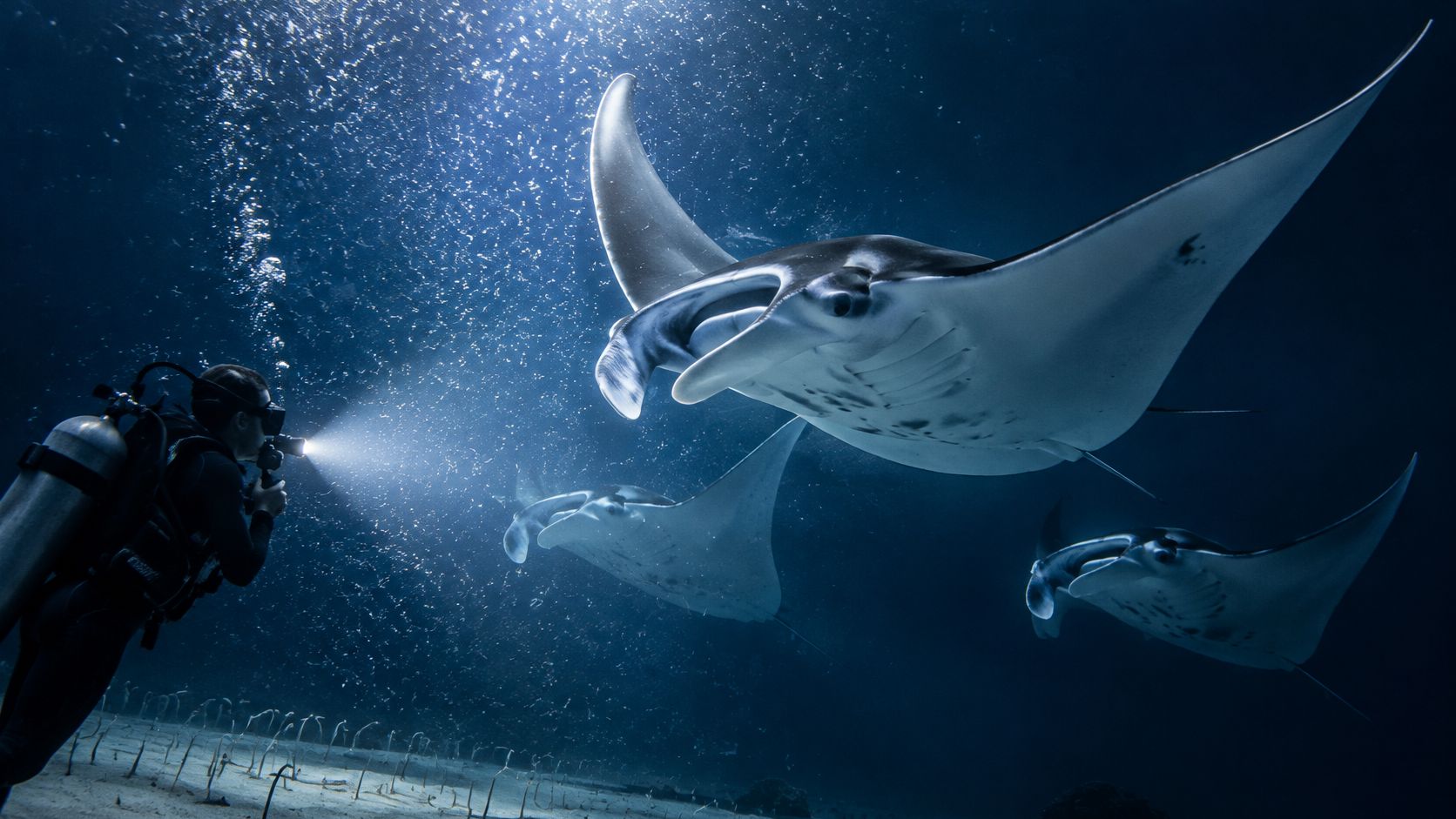
Access to that scene is managed. Hawai'i's proposed manta-viewing framework named Makako Bay, also known as Garden Eel Cove, and Kaukalaelae Point, also known as Keauhou Bay, as the two designated viewing zones. The state boating agency estimated that 60–70 viewing vessels were bringing guests close to feeding rays in those areas. The proposal included a cap of 24 commercial viewing permits in each zone, two-hour vessel shifts, and a limit of 60 passengers for hire in each zone during a 24-hour period, according to the Hawai'i boating agency's proposed manta-viewing framework.
A sighting is an ecological outcome. Operators stage the conditions; the rays decide whether to show. On a quiet night the lights go up, the plankton gathers, and a single ray may pass once and move on, or the water above the group stays empty while the reef carries on around it. I tell divers to score the evening on what was controllable: clean buoyancy, still fins, a group that held position, and a reef worth watching on its own.
Your part is positioning. Stay with your group, keep movement to a minimum, and let the rays choose their distance. If a ray changes direction, hold your place.
For the underwater manta experience, check the two-tank manta dive and snorkel tour. Go for the managed feeding scene and the reef setting, knowing the animals decide how the evening unfolds.
How Many Manta Rays You Can Realistically Expect
Kona's manta dives are built around a resident, locally concentrated population. Historical identification records documented 154 individual reef manta rays along the Kona Coast from 1992 onward. A later community-science analysis recorded more than 23,000 sightings involving 167 individuals from 2010 to 2022, according to the Kona manta identification and sighting records.
| Study or record | Period | Scope | Key figure |
|---|---|---|---|
| Individual identification records | 1992 onward | Reef manta rays on the Kona Coast | 154 individuals |
| Community-science analysis | 2010–2022 | Sightings of 167 individuals | More than 23,000 sightings |
Those records describe a stable local population, and that stability is the honest part of any forecast. Rays return to established feeding areas along the coast, so encounters are common enough to build a nightly trip around. Different sites concentrate different numbers of animals, which is why location still matters within a resident population. What the records cannot tell you is how many rays will appear on your particular evening.
Aggregation size follows the food. Seasonal and annual shifts in zooplankton density, the rays' food source, change how many gather at a feeding site on a given night, and the same site can deliver a busy evening of circling mantas one week and a quiet plankton field the next. I tell guests to treat any head count quoted for a future trip as a rough expectation, never a reservation.
A good manta dive isn't measured by a head count alone. Look at whether the group held position, whether the rays were able to feed without being chased or crowded, and whether the conditions allowed a calm observation.
A quiet night has its own texture: fewer rays making shorter passes, or a longer wait over the lit water while the reef carries on around you. The coral, the fish drawn to the lights, and the chance to watch natural feeding behavior when a ray does arrive still make the dive worth doing. Judge the evening by the conditions and how people behaved around the animals, not only by how many passed overhead.
Blackwater Night Dive Over Deep Water
On a blackwater dive, the reef drops out of view and you drift in open water after dark. There's no seabed beneath you to use as a visual reference. It can feel like floating over a city at night with lights below, but no visible ground to judge distance or direction. You rely on your instruments, the dive leader's signals, and your position relative to the group.
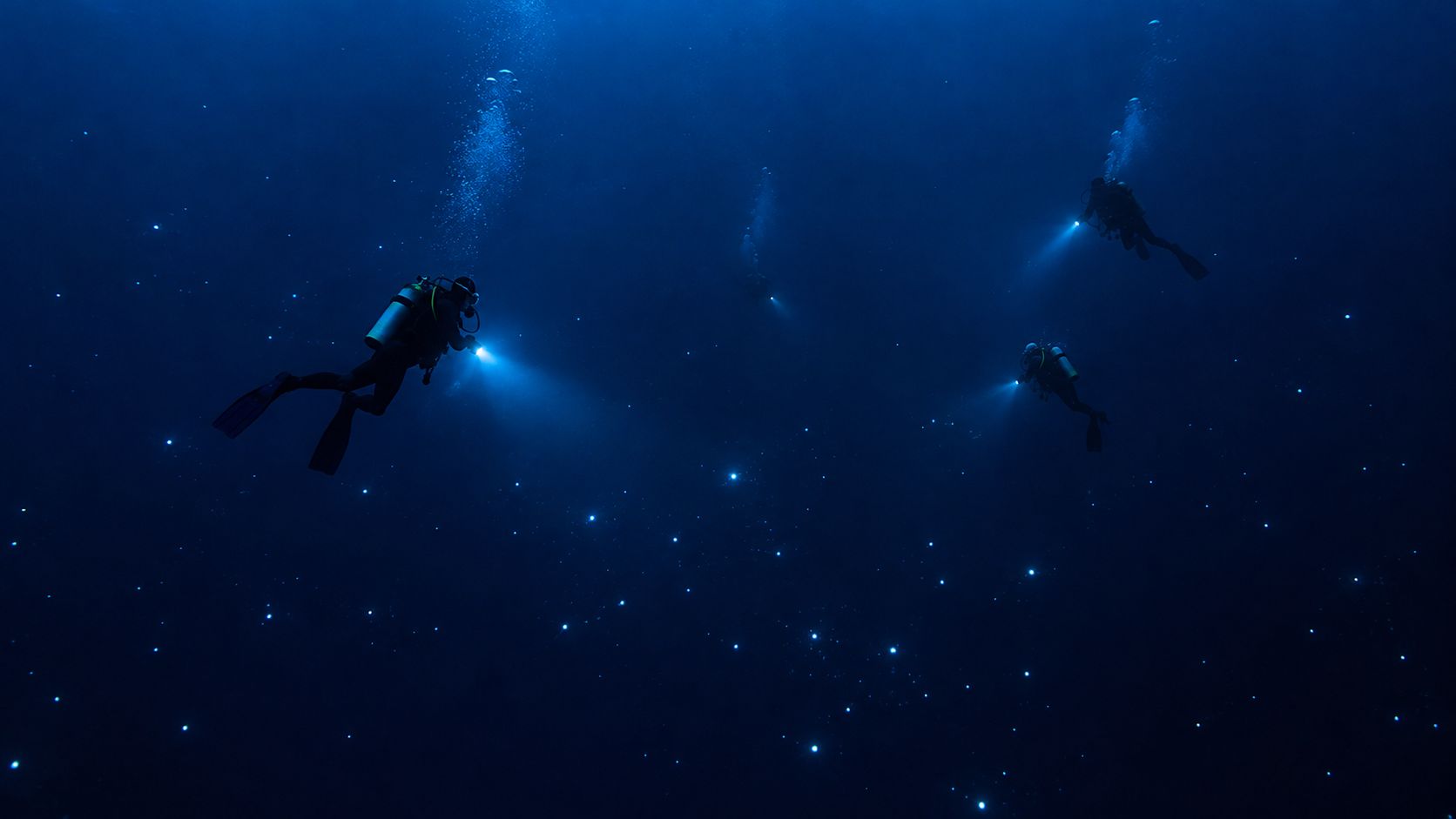
The lights reveal a moving world: plankton, small fish, squid, and sometimes larger pelagic visitors. There's no guaranteed animal encounter, and the appeal isn't a set list of sightings. It's being present in a dark water column where small organisms and passing animals appear in the light.
This dive suits people who already manage buoyancy calmly and can stay oriented in low light. You'll need to read the leader's light signals, keep close to the group, and avoid turning a moment of curiosity into separation. Photographers who enjoy plankton-rich water may find it compelling, but camera work shouldn't distract from position and buoyancy.
Skip it if you feel anxious without a bottom reference, have limited night-diving experience, or haven't practised buoyancy recently. A manta night dive is also after dark, but the fixed viewing position and reef context are different from drifting over open water. If the blackwater format is right for you, see the Kona blackwater night dive tour and read the practical Kona blackwater dive guide before choosing a departure.
Safety Limits and Protected-Area Rules
Calm-looking water still has current, surge, and entanglement risk. Kona's shore sites and night dives call for different checks, and a reassuring surface can hide a difficult entry or a current that only shows itself once you are committed.
At Old Kona Airport, shallow lava fingers run offshore before the bottom drops rapidly into deeper water. Sharp lava and coral at entry points can injure divers, while storms can create dangerous shoreline swells and currents, as described in the Hawaiʻi marine-conservation diving guidance. Before entering, read the swell, confirm current direction, agree on a conservative gas reserve, and set a turnaround point or maximum depth that fits the group's certification and surface-support plan. Adjust gear on sand or another low-impact spot, and keep fins, gauges, and accessories clear of the reef.
Night diving asks more than comfort with darkness. Skip it if low light makes you anxious, your buoyancy is unreliable, your night experience is thin, or you cannot manage a surface swim if needed. Refresh buoyancy control, light handling, buddy signals, and a controlled ascent before entering.
A separate risk is crowding among people, boats, lights, and rays. I judge a night trip by spacing and procedure: where each group is placed, which way lights point, how entries and exits are timed, and whether anyone is chasing animals for a better view. A quiet night with few rays can still be a good dive when those boundaries hold; a packed night with loose positioning is the one to leave.
Manta and protected-area rules
Hawai'i Revised Statutes section 188-39.5 prohibits knowingly capturing or killing a manta ray. The state lists escalating fines for violations in its Hawai'i manta-protection rules:
| Offense | Fine |
|---|---|
| First offense | $500 |
| Second offense | $2,000 |
| Third or subsequent offense | $10,000 |
The Old Kona Airport Marine Life Conservation District also prohibits taking marine life, removing live coral, and feeding or attracting marine life. Within the district, boats must follow its anchoring and operating restrictions, and commercial tours can operate only from designated moorings or shore with a permit, according to the state's Old Kona Airport district rules. Pelagic manta rays are listed under the Endangered Species Act; if one is accidentally hooked, release it in a way that minimizes injury. For practical reef conduct, follow this responsible diver etiquette guide.
How to Prepare for Your Kona Dive Day
Use this sequence to arrive ready, make the site selection more useful, and avoid rushing the parts of a dive day that affect safety.
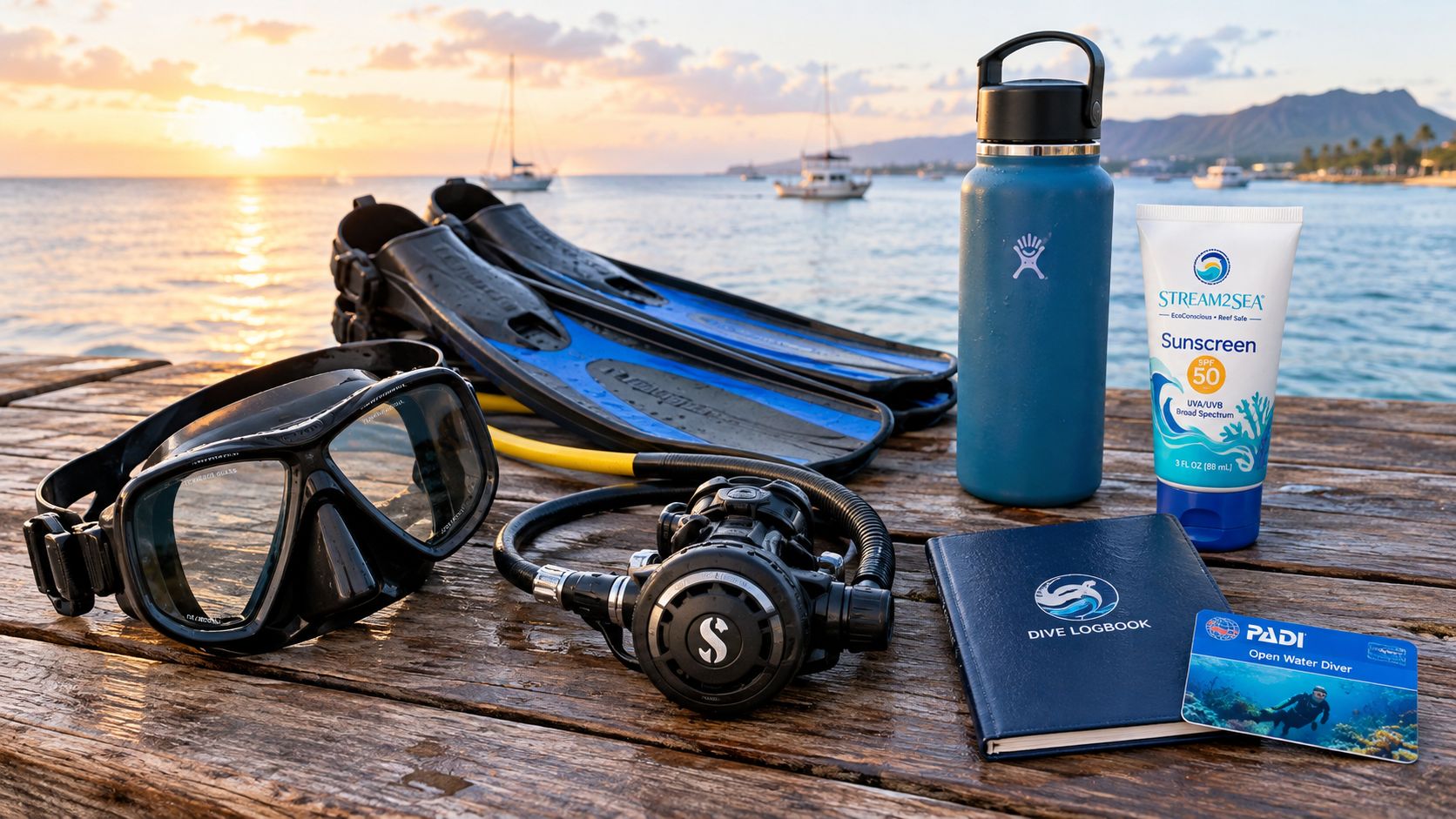
Confirm your certification. Most regular charters require at least Open Water Diver certification from a recognized agency such as PADI, SSI, or NAUI. Bring your certification card so the crew can confirm your qualification.
Bring your logbook. Recent dives help the crew understand your current comfort and experience, not just your highest certification. Kona Honu Divers checks each diver's certification and logbook before choosing sites that match their skill set.
Confirm the departure details. Kona Honu Divers' dive days start at Honokohau Harbor. Confirm the check-in time and parking instructions, then arrive early enough to organize your gear without rushing.
Mention snorkelers and ride-alongs. Non-diving companions can join the boat, so tell us when booking if anyone in your party plans to snorkel or ride along. That gives the crew a clear picture of the group before departure.
Share your gear-sizing details. The crew handles gear setup, so give the team your mask, fin, and wetsuit information in advance rather than arriving with an unplanned equipment list. Mention any fit issue that could distract you underwater.
Listen closely to the briefing. Confirm entry and exit points, current direction, buddy signals, and light signals. Ask about anything you don't understand while you're still on the boat.
Plan your recovery afterward. Hydrate, rest, and leave the recommended interval between diving and flying. For a night trip, pack a warm layer and be ready for the boat ride back in the dark.
For broader trip planning, use these Big Island dive travel tips. The most useful preparation is honest preparation: tell the crew what you've done recently and which parts of the dive you want help with.
Sample Kona Itineraries by Trip Length
| Trip length | Day 1 | Day 2 | Day 3 or later |
|---|---|---|---|
| 2 days, newly certified | 2-tank morning dive | Manta night dive at Garden Eel Cove | Not needed |
| 4 days, mixed experience | 2-tank morning dive | Rest day | Manta night dive on day 3, blackwater night dive on day 4 |
| 7 days, experienced divers | 2-tank morning dive | Premium advanced long-range trip | Manta and blackwater night dives on separate nights |
For a short trip, the morning reef dive provides a daytime check-in with your equipment before a night outing. A newly certified diver can use the next day's manta trip as a distinct experience rather than stacking unfamiliar challenges together.
For the four-day plan, put a rest day before the manta night, then leave room for recovery before blackwater diving. On a longer visit, schedule the more demanding remote-site trip after you've settled into the water, and place the manta and blackwater dives on separate nights. Weather and sea state can change; don't make a night trip the only acceptable outcome of your holiday.
Leave at least a full day between your last dive and a flight, and follow current recreational guidance and the operator's briefing. Experienced divers looking for more challenging sites can consider the premium advanced two-tank trip. When choosing accommodation, proximity to the harbor and your planned departure time can make the morning easier; compare options in this guide to places for divers to stay on the Big Island.
Visitor Tips and Quick Answers
What if the rays don't appear? Don't judge the entire dive by ray count. Use the conditions, animal behavior, and how well the group was managed as your measure of a worthwhile wildlife encounter.
How do I choose between a morning and night dive on a short trip? Start with a 2-tank morning dive, then add a manta night dive after you've had time to settle into the water. The two-day itinerary above follows that progression.
What if I feel uneasy in the dark? Skip blackwater diving if drifting without a visible seabed feels uncomfortable. Consider the manta night dive only if your buoyancy and low-light confidence feel solid.
Is Old Kona Airport a good first shore dive? Only if you've checked swell and current, planned a conservative gas reserve, and set a turnaround limit appropriate to your certification. The safety details above are essential at this site.
Who can answer questions about certification or night availability? Call 808-324-4668 before booking. A quick conversation can help you choose a trip that fits your experience and comfort level.
Book Your Kona Dive and Lock In Your Date
Choose by experience first, then by time of day. A diver who wants lava formations, swim-throughs, and reef life should start with a morning charter. A diver drawn to manta rays can book a night trip with realistic expectations about wildlife. Blackwater diving suits people who are comfortable in open water after dark, while the advanced long-range option suits experienced divers seeking remote sites.
Night departures are the first dates I'd secure if they're the main reason for your trip. A weather change or a quiet wildlife night can't be fixed by booking a more dramatic-sounding outing. Pick a trip you'll value for the dive itself, and leave flexibility in your schedule when possible. On a night when the rays stay scarce, the conditions, the briefing, and how the crew managed the group are what separate a well-run dive from a wasted evening.
Kona Honu Divers offers Big Island scuba diving discount packages, including an early diver discount, free nitrox, and multi-day options for guests diving across several days. If you want variety and a full-service day, the premium experience is a practical way to build range into your trip.
Before you commit dates, confirm the paperwork. Most regular dive charters require at least an Open Water Diver certification from a recognized agency such as PADI, SSI, or NAUI. If snorkelers or ride-alongs are in your party, say so when booking. Small groups and personal attention from the moment you step aboard make it easier to ask questions, and the crew handles gear setup, checks each diver's certification and logbook, and chooses sites to match skill. Dive days start at Honokohau Harbor.
If you have questions about certification, group plans, or night availability, call 808-324-4668. Choose the dive that suits your actual comfort in the water, then confirm the details before you travel.
Kona Honu Divers offers guided reef, manta, blackwater, and advanced trips from Kailua-Kona, with small groups and support adapted to your experience. Choose the dive that fits your comfort in the water, then visit Kona Honu Divers to plan your Big Island dive.